
Hidden Markov Models Chapter 11 CG islands The


- Slides: 30
Hidden Markov Models Chapter 11
CG “islands” • The dinucleotide “CG” is rare – C in a “CG” often gets “methylated” and the resulting C then mutates to T • Methylation is suppressed in some areas of genome, called “CG islands” • Such CG islands often found around genes • Problem: find CG islands in whole genome
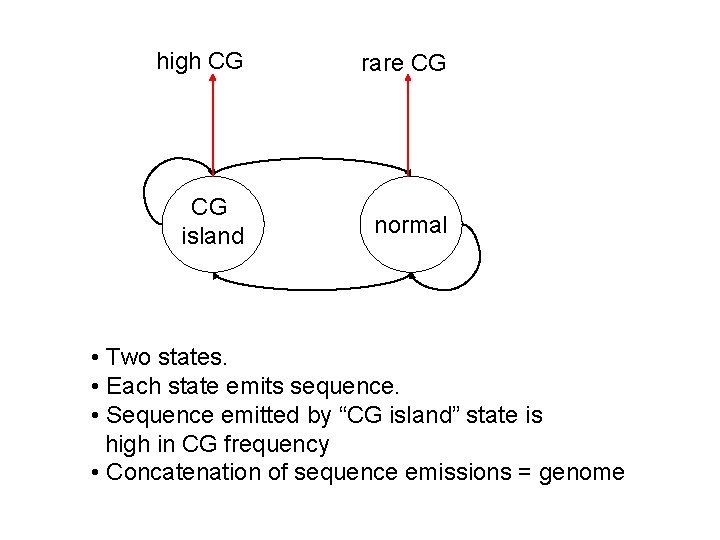
high CG rare CG CG island normal • Two states. • Each state emits sequence. • Sequence emitted by “CG island” state is high in CG frequency • Concatenation of sequence emissions = genome
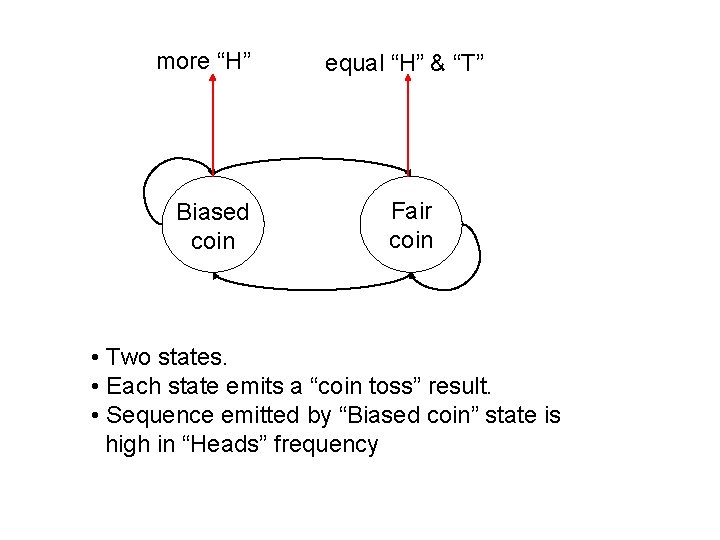
more “H” Biased coin equal “H” & “T” Fair coin • Two states. • Each state emits a “coin toss” result. • Sequence emitted by “Biased coin” state is high in “Heads” frequency
CG Islands and the “Fair Bet Casino” • The CG islands problem can be modeled after a problem named “The Fair Bet Casino” • The game is to flip coins, which results in only two possible outcomes: Head or Tail. • The Fair coin will give Heads and Tails with same probability ½. • The Biased coin will give Heads with prob. ¾.
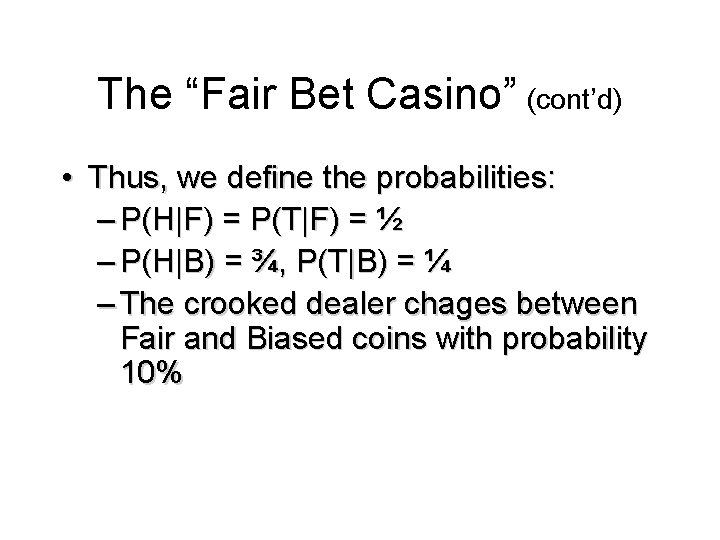
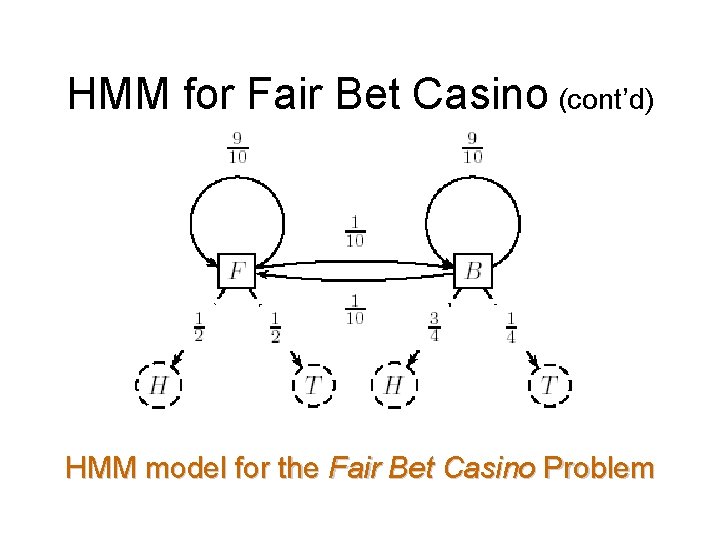
The “Fair Bet Casino” (cont’d) • Thus, we define the probabilities: – P(H|F) = P(T|F) = ½ – P(H|B) = ¾, P(T|B) = ¼ – The crooked dealer chages between Fair and Biased coins with probability 10%
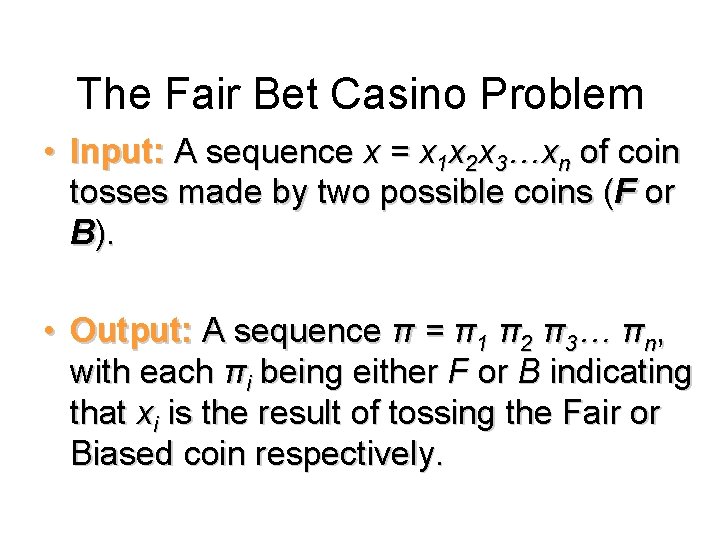
The Fair Bet Casino Problem • Input: A sequence x = x 1 x 2 x 3…xn of coin tosses made by two possible coins (F or B). • Output: A sequence π = π1 π2 π3… πn, with each πi being either F or B indicating that xi is the result of tossing the Fair or Biased coin respectively.
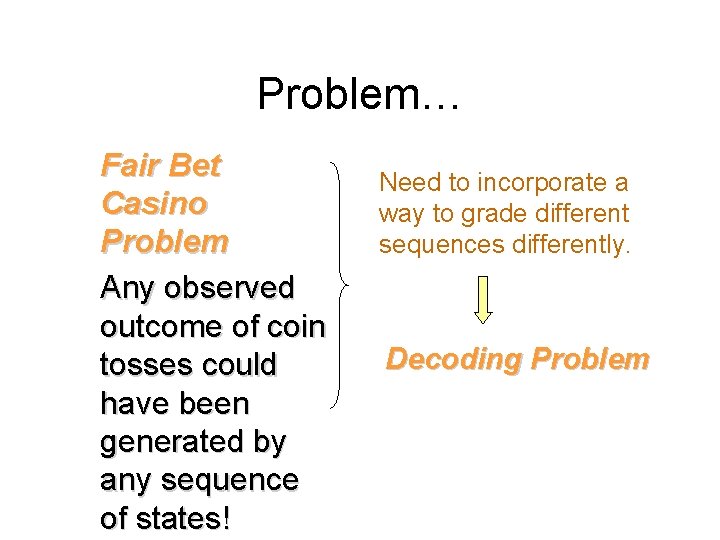
Problem… Fair Bet Casino Problem Any observed outcome of coin tosses could have been generated by any sequence of states! Need to incorporate a way to grade different sequences differently. Decoding Problem
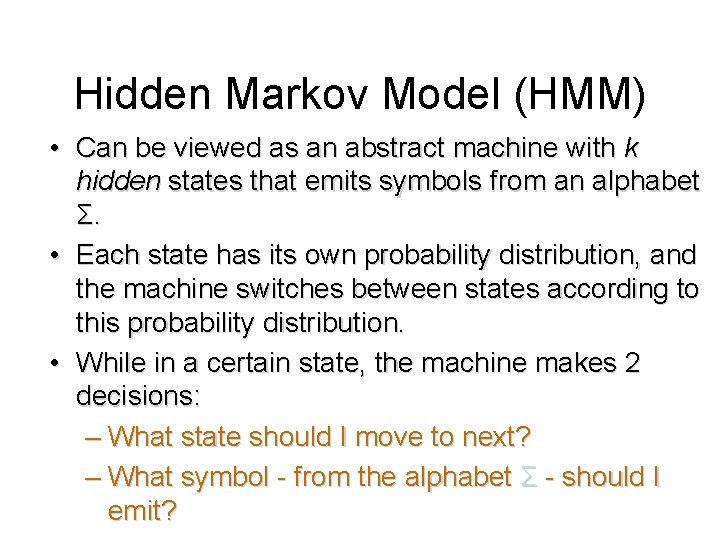
Hidden Markov Model (HMM) • Can be viewed as an abstract machine with k hidden states that emits symbols from an alphabet Σ. • Each state has its own probability distribution, and the machine switches between states according to this probability distribution. • While in a certain state, the machine makes 2 decisions: – What state should I move to next? – What symbol - from the alphabet Σ - should I emit?
Why “Hidden”? • Observers can see the emitted symbols of an HMM but have no ability to know which state the HMM is currently in. • Thus, the goal is to infer the most likely hidden states of an HMM based on the given sequence of emitted symbols.
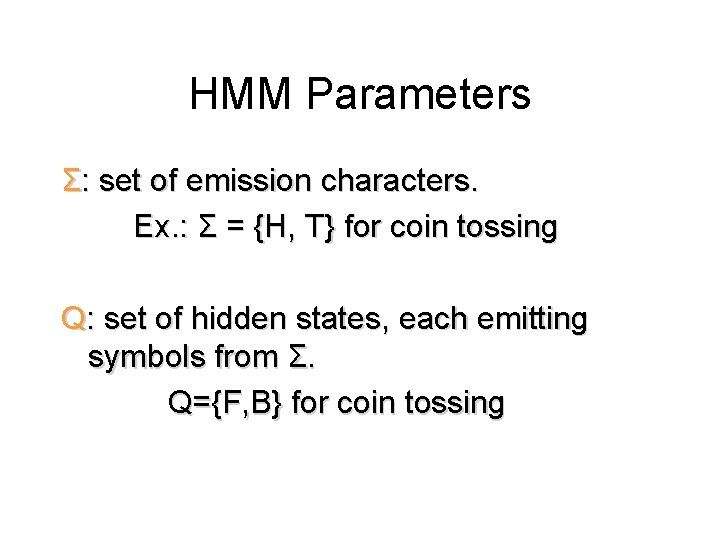
HMM Parameters Σ: set of emission characters. Ex. : Σ = {H, T} for coin tossing Q: set of hidden states, each emitting symbols from Σ. Q={F, B} for coin tossing
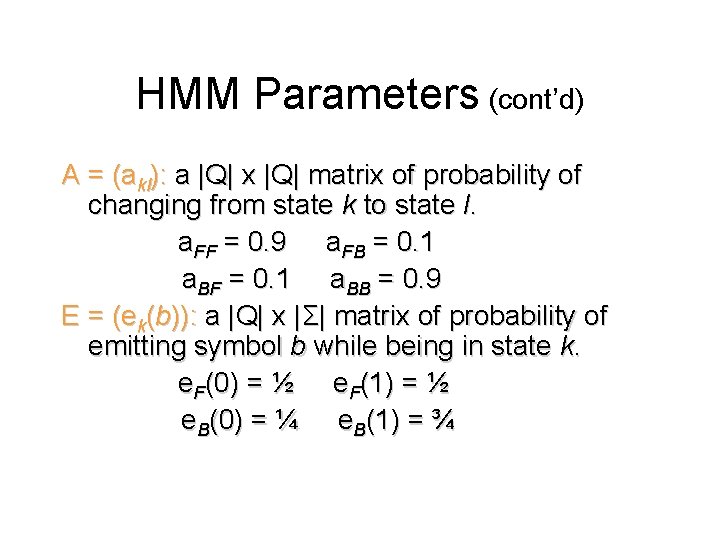
HMM Parameters (cont’d) A = (akl): a |Q| x |Q| matrix of probability of changing from state k to state l. a. FF = 0. 9 a. FB = 0. 1 a. BF = 0. 1 a. BB = 0. 9 E = (ek(b)): a |Q| x |Σ| matrix of probability of emitting symbol b while being in state k. e. F(0) = ½ e. F(1) = ½ e. B(0) = ¼ e. B(1) = ¾
HMM for Fair Bet Casino (cont’d) HMM model for the Fair Bet Casino Problem
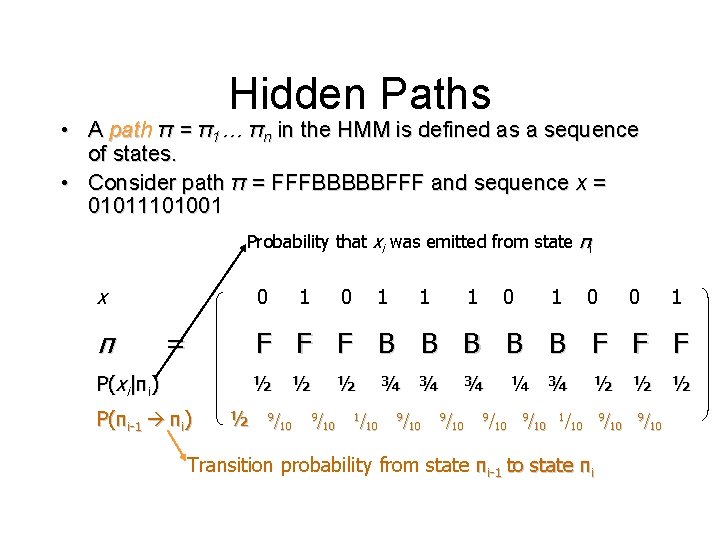
Hidden Paths • A path π = π1… πn in the HMM is defined as a sequence of states. • Consider path π = FFFBBBBBFFF and sequence x = 01011101001 Probability that xi was emitted from state πi x π 0 = 1 0 1 1 1 0 0 1 F F F B B B F F F P(xi|πi) ½ ½ P(πi-1 πi) ½ 9/ 10 ½ 1/ 10 ¾ ¾ 9/ 10 ¼ ¾ 9/ 10 ½ ½ ½ 1/ 10 Transition probability from state πi-1 to state πi 9/ 10
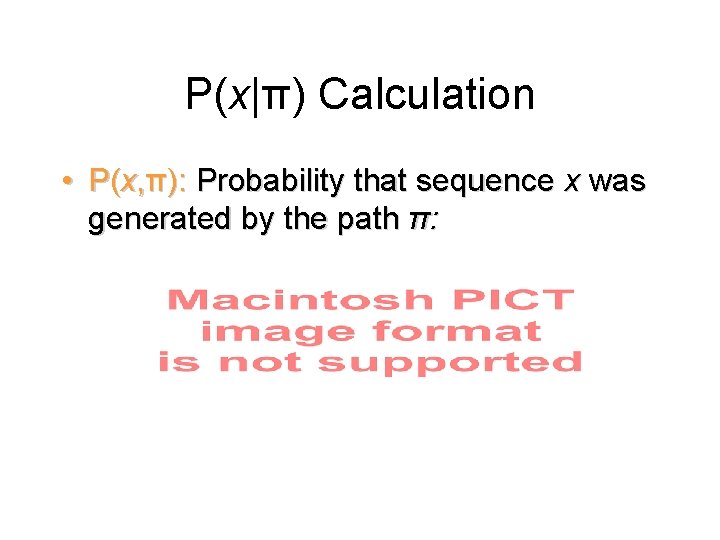
P(x|π) Calculation • P(x, π): Probability that sequence x was generated by the path π:
Decoding Problem • Goal: Find an optimal hidden path of states given observations. • Input: Sequence of observations x = x 1…xn generated by an HMM M(Σ, Q, A, E) • Output: A path that maximizes P(x, π) over all possible paths π.
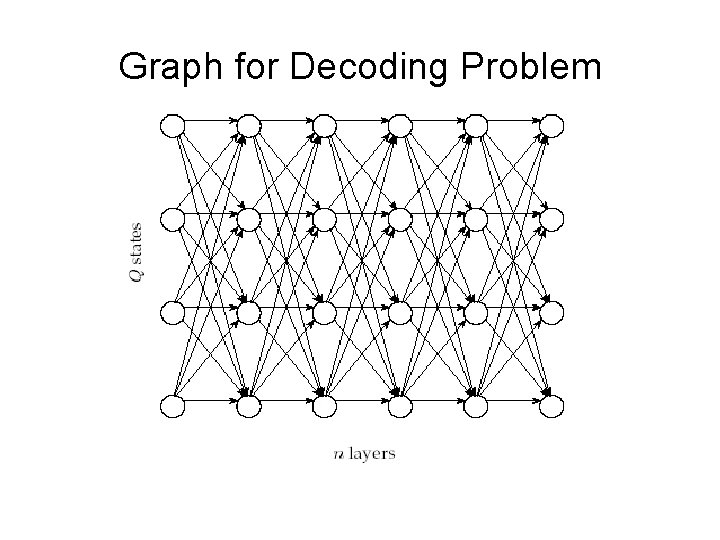
Dynamic programming for the Decoding Problem • Andrew Viterbi used Dynamic programming to solve the Decoding Problem. • Build a graph with one node for every (i, j), representing the possibility that the ith position of π was emitted from state j. • Every choice of π = π1… πn corresponds to a path in the graph. • Edges are weighted. Sum of edge weights on a path π corresponds to P(x, π)
Graph for Decoding Problem
Decoding Problem • Every path in the graph has the probability P(x, π). • The Viterbi algorithm finds the path that maximizes P(x, π) among all possible paths. • The Viterbi algorithm runs in O(n|Q|2) time.
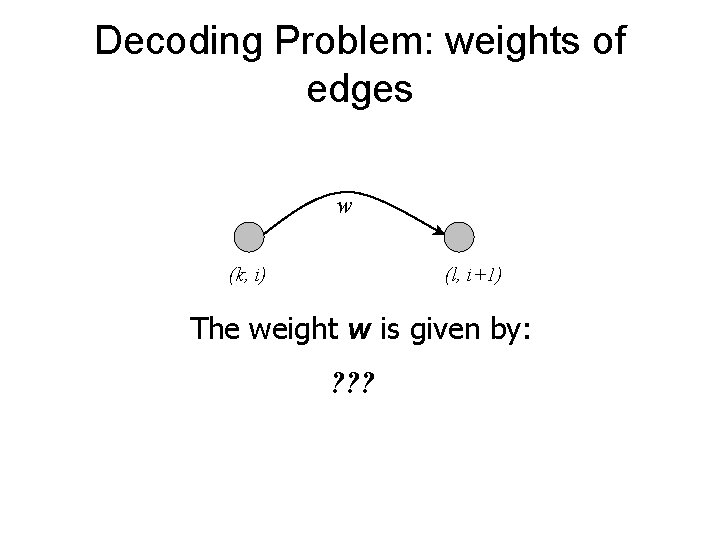
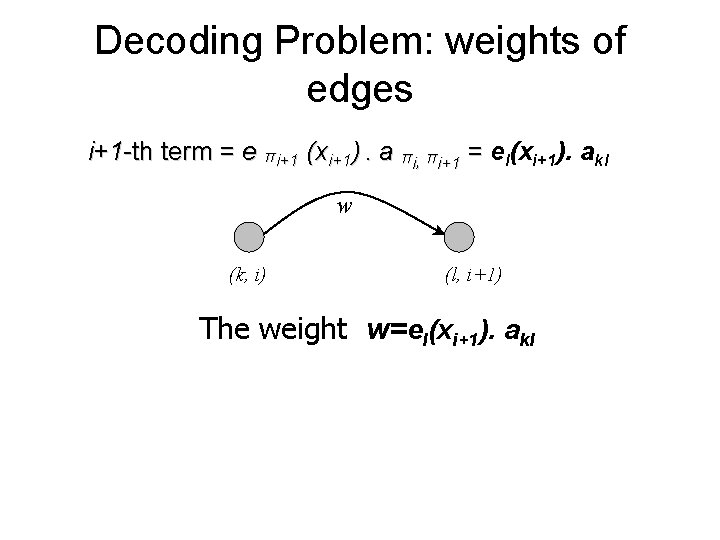
Decoding Problem: weights of edges w (k, i) (l, i+1) The weight w is given by: ? ? ?
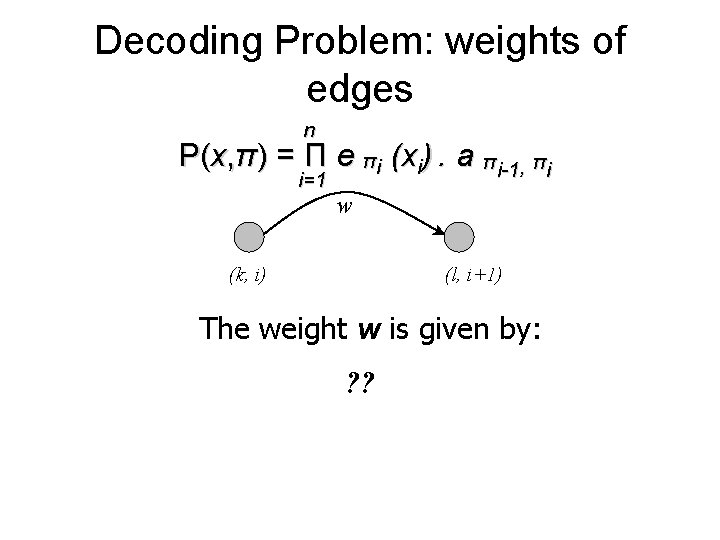
Decoding Problem: weights of edges n P(x, π) = Π e πi (xi). a πi-1, πi i=1 w (k, i) (l, i+1) The weight w is given by: ? ?
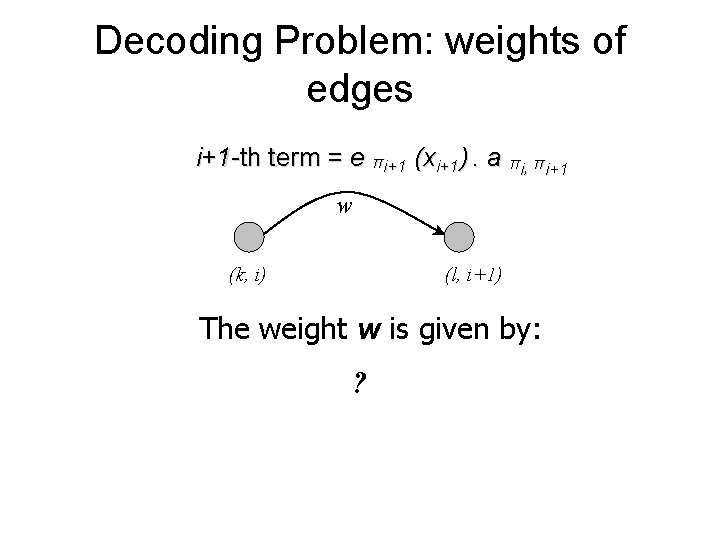
Decoding Problem: weights of edges i+1 -th term = e πi+1 (xi+1). a πi, πi+1 w (k, i) (l, i+1) The weight w is given by: ?
Decoding Problem: weights of edges i+1 -th term = e πi+1 (xi+1). a πi, πi+1 = el(xi+1). akl w (k, i) (l, i+1) The weight w=el(xi+1). akl
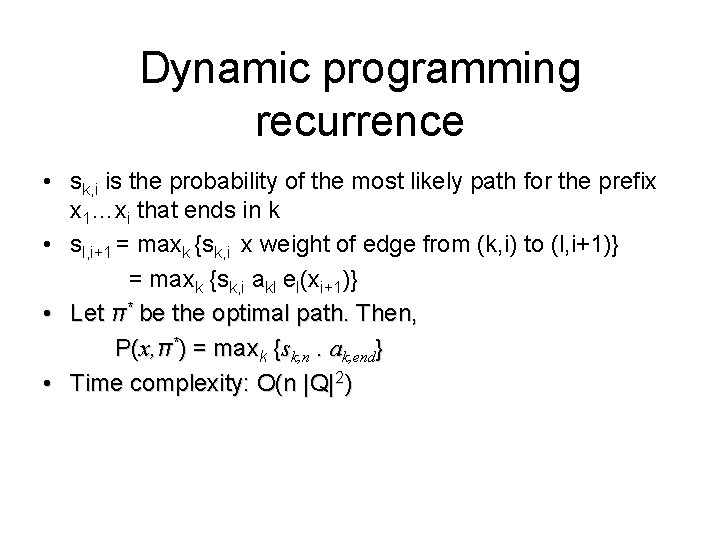
Dynamic programming recurrence • sk, i is the probability of the most likely path for the prefix x 1…xi that ends in k • sl, i+1 = maxk {sk, i x weight of edge from (k, i) to (l, i+1)} = maxk {sk, i akl el(xi+1)} • Let π* be the optimal path. Then, P(x, π*) = maxk {sk, n. ak, end} • Time complexity: O(n |Q|2)
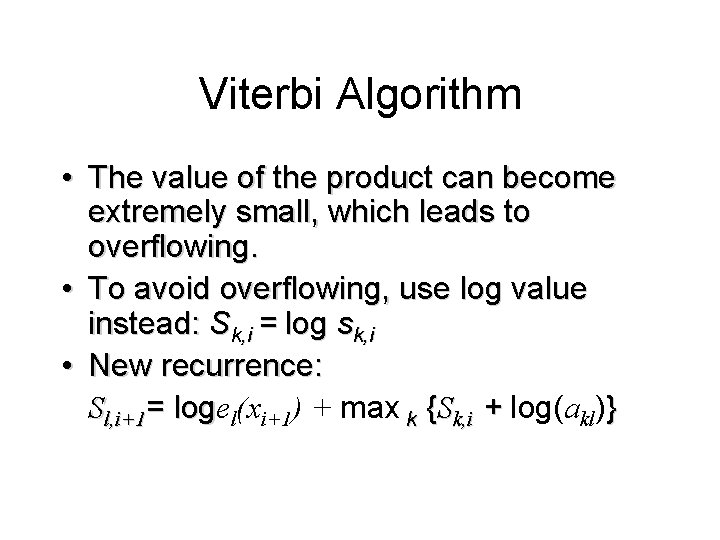
Viterbi Algorithm • The value of the product can become extremely small, which leads to overflowing. • To avoid overflowing, use log value instead: Sk, i = log sk, i • New recurrence: Sl, i+1= loge log l(xi+1) + max k {Sk, i + log(akl)}
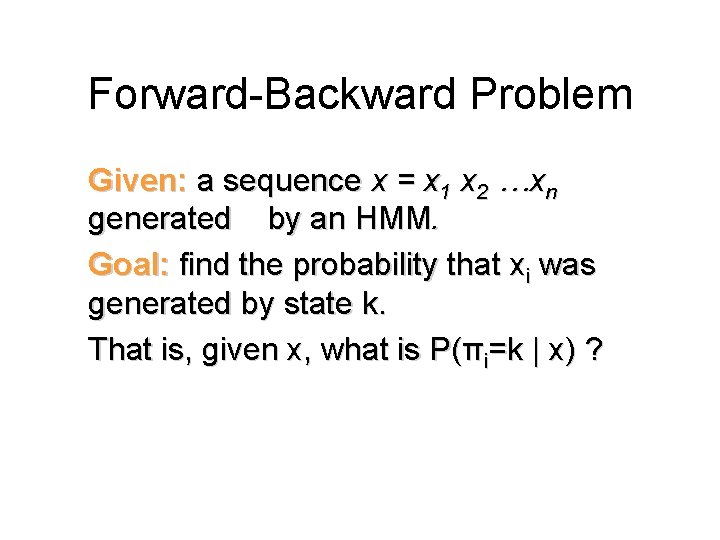
Forward-Backward Problem Given: a sequence x = x 1 x 2 …xn generated by an HMM. Goal: find the probability that xi was generated by state k. That is, given x, what is P(πi=k | x) ?
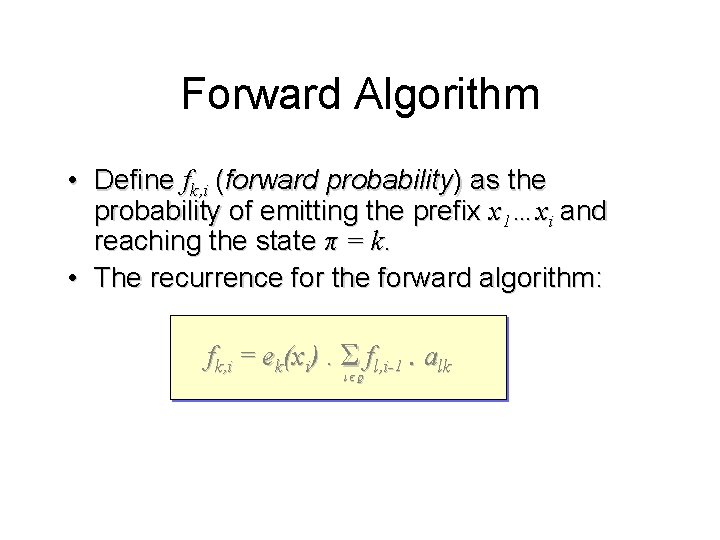
Forward Algorithm • Define fk, i (forward probability) as the probability of emitting the prefix x 1…xi and reaching the state π = k. • The recurrence for the forward algorithm: fk, i = ek(xi). Σ fl, i-1. alk lЄQ
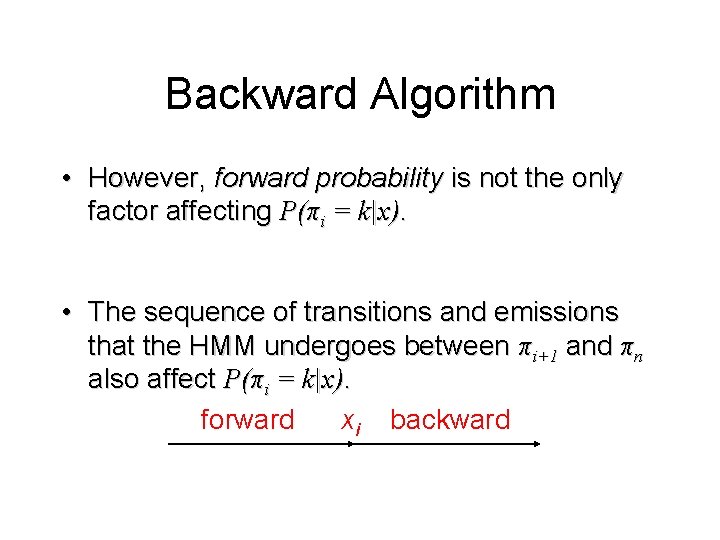
Backward Algorithm • However, forward probability is not the only factor affecting P(πi = k|x). • The sequence of transitions and emissions that the HMM undergoes between πi+1 and πn also affect P(πi = k|x). forward xi backward
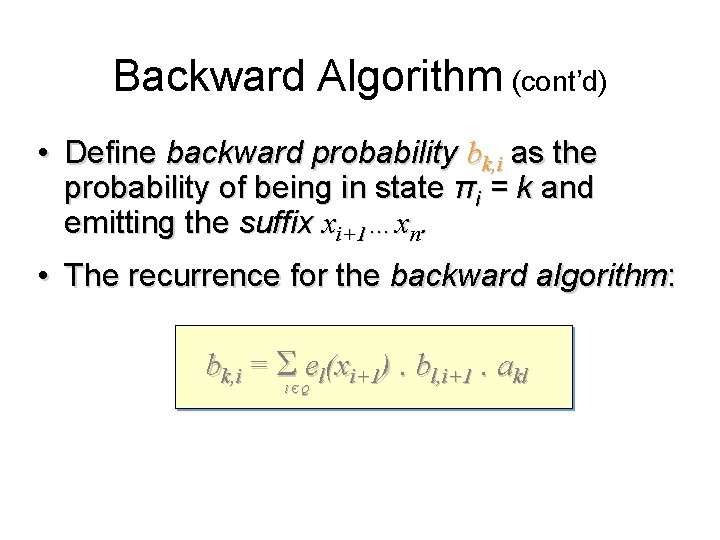
Backward Algorithm (cont’d) • Define backward probability bk, i as the probability of being in state πi = k and emitting the suffix xi+1…xn. • The recurrence for the backward algorithm: bk, i = Σ el(xi+1). bl, i+1. akl lЄQ
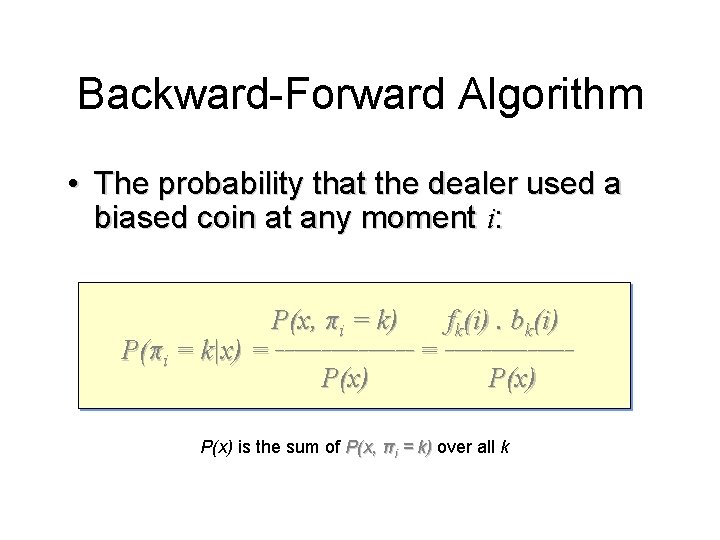
Backward-Forward Algorithm • The probability that the dealer used a biased coin at any moment i: P(x, πi = k) fk(i). bk(i) P(πi = k|x) = ________ = _______ P(x) is the sum of P(x, πi = k) over all k