
Hidden Markov Model Most pages of the slides

- Slides: 17
Hidden Markov Model • Most pages of the slides are from lecture notes from Prof. Serafim Batzoglou’s course in Stanford: – CS 262: Computational Genomics (Winter 2004) – http: //ai. stanford. edu/~serafim/cs 262/
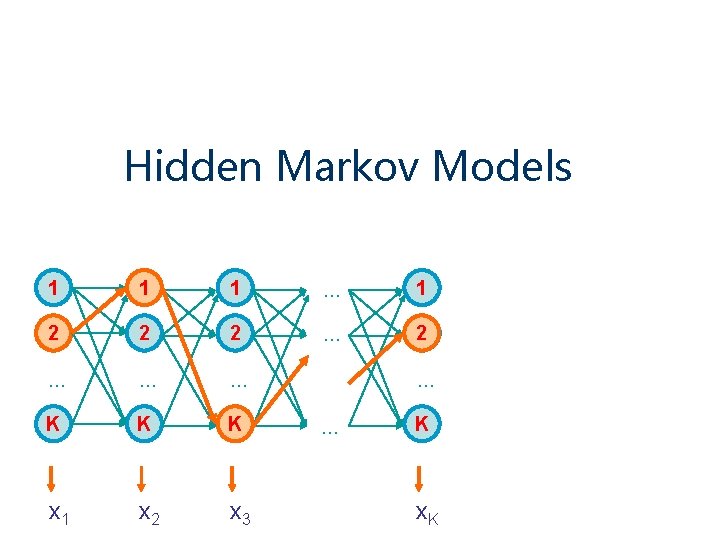
Hidden Markov Models 1 1 1 … 1 2 2 2 … … … K K K x 1 x 2 x 3 … … K x. K
Applications of hidden Markov models • HMMs can be applied in many fields where the goal is to recover a data sequence that is not immediately observable (but other data that depends on the sequence is). – – – Cryptanalysis Speech recognition Machine translation Partial discharge Gene prediction Alignment of bio-sequences * reference: wikipiedia. com
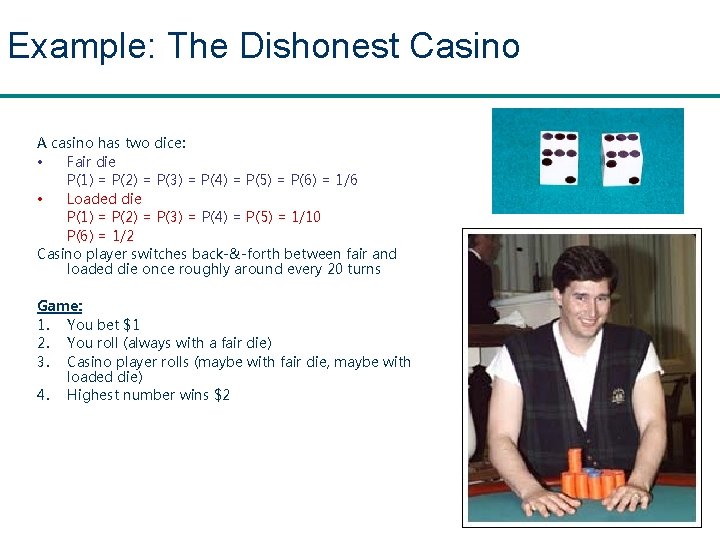
Example: The Dishonest Casino A casino has two dice: • Fair die P(1) = P(2) = P(3) = P(4) = P(5) = P(6) = 1/6 • Loaded die P(1) = P(2) = P(3) = P(4) = P(5) = 1/10 P(6) = 1/2 Casino player switches back-&-forth between fair and loaded die once roughly around every 20 turns Game: 1. You bet $1 2. You roll (always with a fair die) 3. Casino player rolls (maybe with fair die, maybe with loaded die) 4. Highest number wins $2
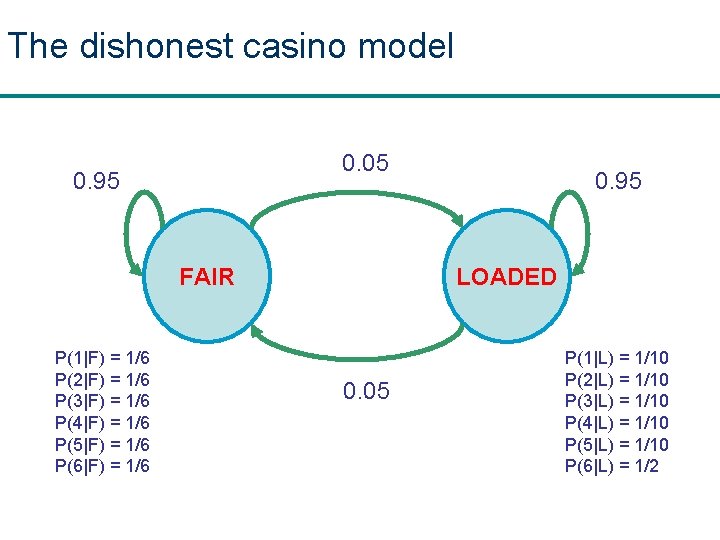
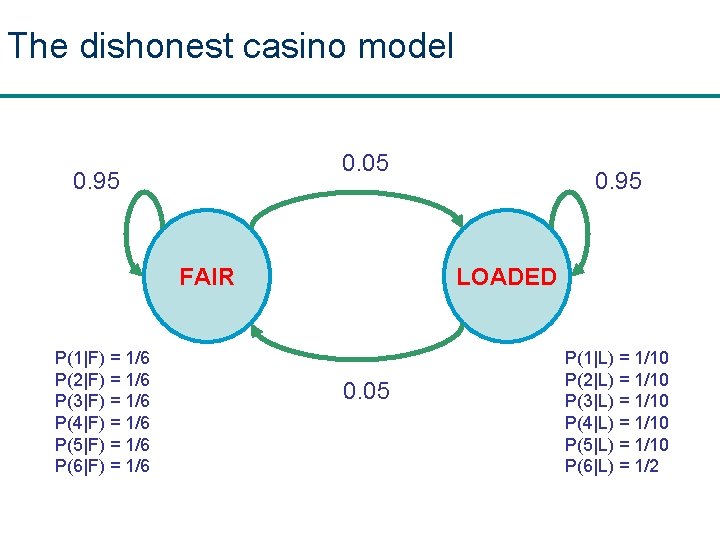
The dishonest casino model 0. 05 0. 95 FAIR P(1|F) = 1/6 P(2|F) = 1/6 P(3|F) = 1/6 P(4|F) = 1/6 P(5|F) = 1/6 P(6|F) = 1/6 0. 95 LOADED 0. 05 P(1|L) = 1/10 P(2|L) = 1/10 P(3|L) = 1/10 P(4|L) = 1/10 P(5|L) = 1/10 P(6|L) = 1/2
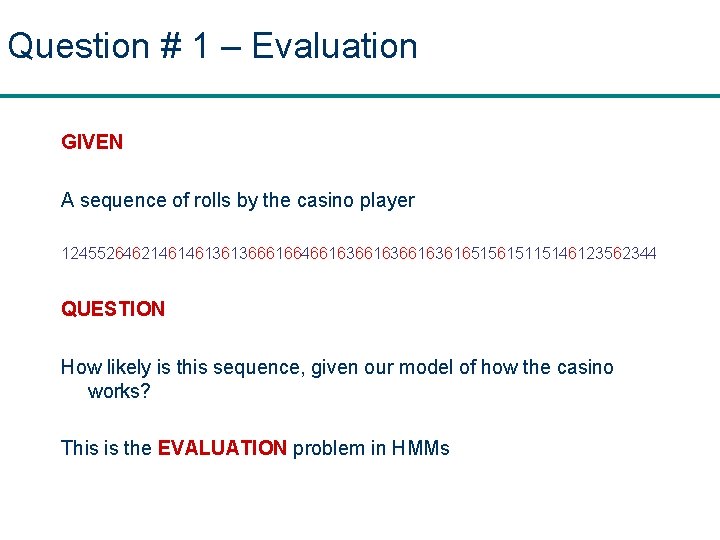
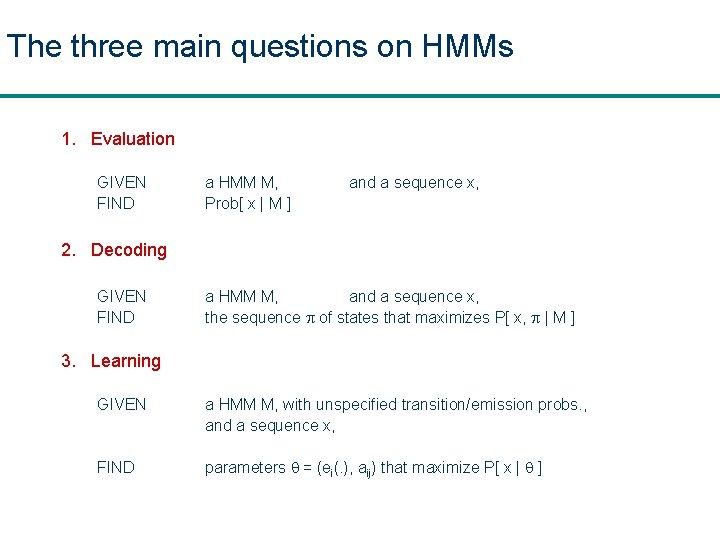
Question # 1 – Evaluation GIVEN A sequence of rolls by the casino player 12455264621461461361366616646616366163616515615115146123562344 QUESTION How likely is this sequence, given our model of how the casino works? This is the EVALUATION problem in HMMs
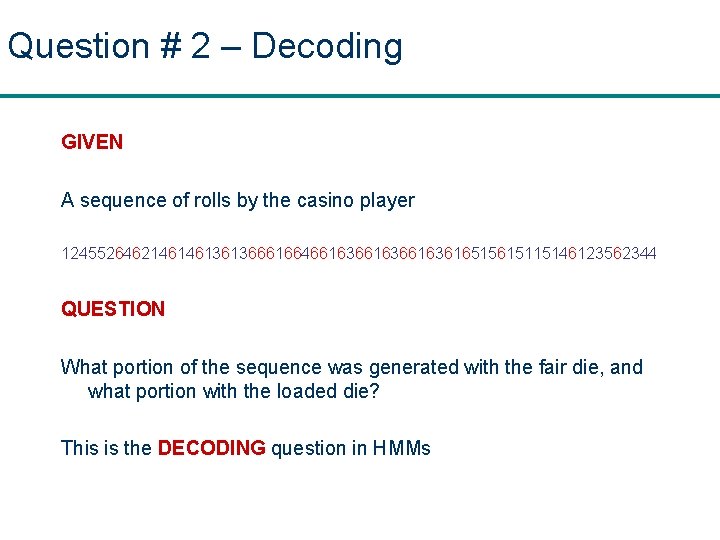
Question # 2 – Decoding GIVEN A sequence of rolls by the casino player 12455264621461461361366616646616366163616515615115146123562344 QUESTION What portion of the sequence was generated with the fair die, and what portion with the loaded die? This is the DECODING question in HMMs
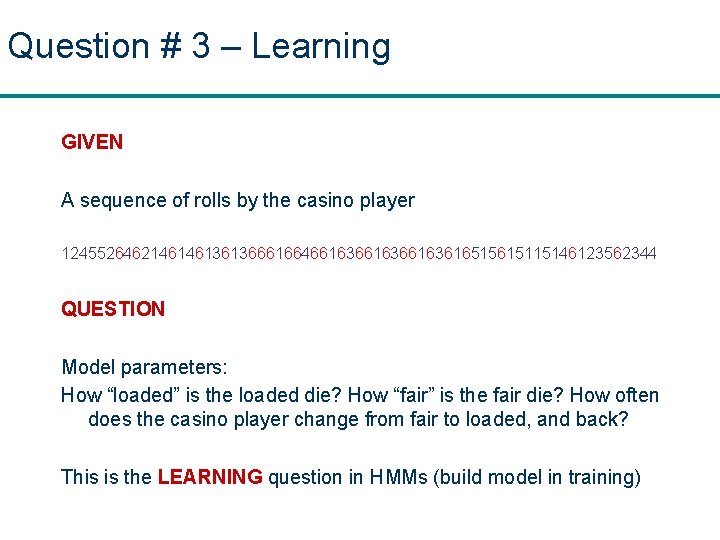
Question # 3 – Learning GIVEN A sequence of rolls by the casino player 12455264621461461361366616646616366163616515615115146123562344 QUESTION Model parameters: How “loaded” is the loaded die? How “fair” is the fair die? How often does the casino player change from fair to loaded, and back? This is the LEARNING question in HMMs (build model in training)
The dishonest casino model 0. 05 0. 95 FAIR P(1|F) = 1/6 P(2|F) = 1/6 P(3|F) = 1/6 P(4|F) = 1/6 P(5|F) = 1/6 P(6|F) = 1/6 0. 95 LOADED 0. 05 P(1|L) = 1/10 P(2|L) = 1/10 P(3|L) = 1/10 P(4|L) = 1/10 P(5|L) = 1/10 P(6|L) = 1/2
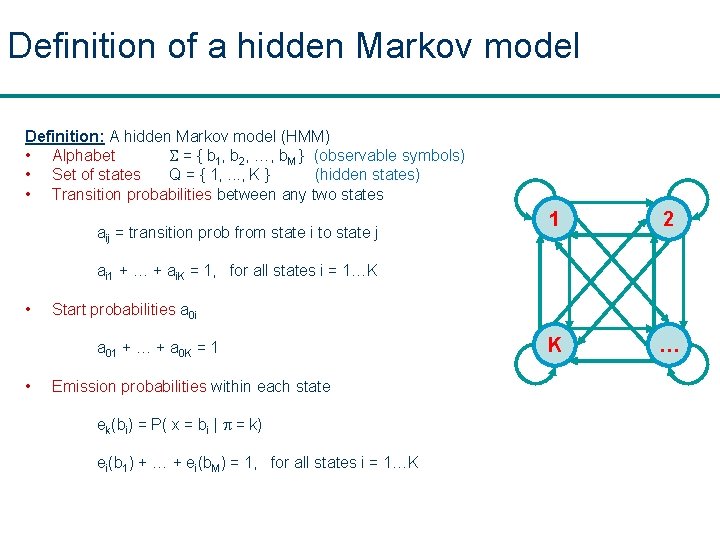
Definition of a hidden Markov model Definition: A hidden Markov model (HMM) • Alphabet = { b 1, b 2, …, b. M } (observable symbols) • Set of states Q = { 1, . . . , K } (hidden states) • Transition probabilities between any two states aij = transition prob from state i to state j 1 2 K … ai 1 + … + ai. K = 1, for all states i = 1…K • Start probabilities a 0 i a 01 + … + a 0 K = 1 • Emission probabilities within each state ek(bi) = P( x = bi | = k) ei(b 1) + … + ei(b. M) = 1, for all states i = 1…K
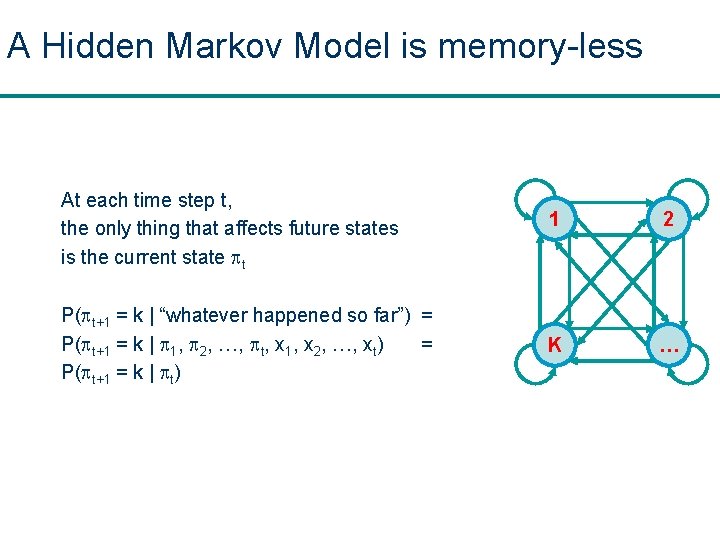
A Hidden Markov Model is memory-less At each time step t, the only thing that affects future states is the current state t P( t+1 = k | “whatever happened so far”) = P( t+1 = k | 1, 2, …, t, x 1, x 2, …, xt) = P( t+1 = k | t) 1 2 K …
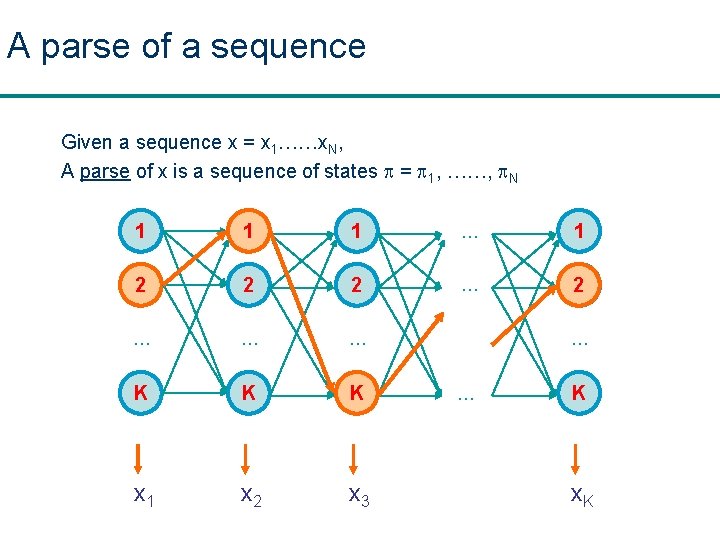
A parse of a sequence Given a sequence x = x 1……x. N, A parse of x is a sequence of states = 1, ……, N 1 1 1 … 1 2 2 2 … … … K K K x 1 x 2 x 3 … … K x. K
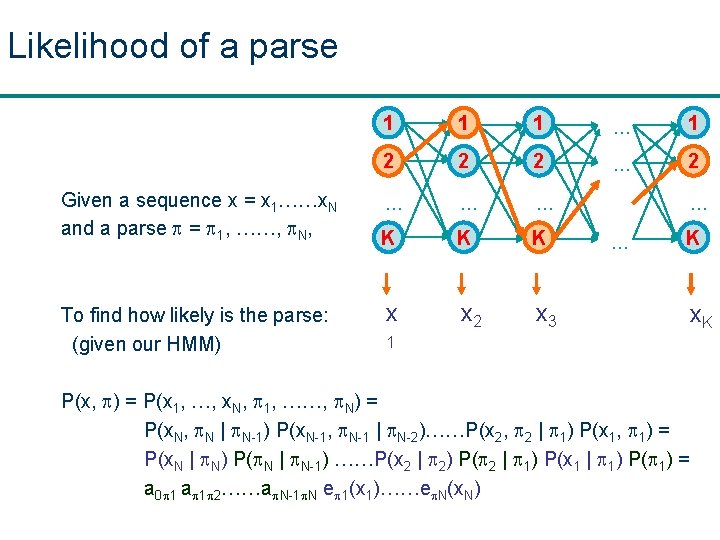
Likelihood of a parse Given a sequence x = x 1……x. N and a parse = 1, ……, N, To find how likely is the parse: (given our HMM) 1 1 1 … 1 2 2 2 … … … K K K x x 2 x 3 … … K 1 P(x, ) = P(x 1, …, x. N, 1, ……, N) = P(x. N, N | N-1) P(x. N-1, N-1 | N-2)……P(x 2, 2 | 1) P(x 1, 1) = P(x. N | N) P( N | N-1) ……P(x 2 | 2) P( 2 | 1) P(x 1 | 1) P( 1) = a 0 1 a 1 2……a N-1 N e 1(x 1)……e N(x. N) x. K
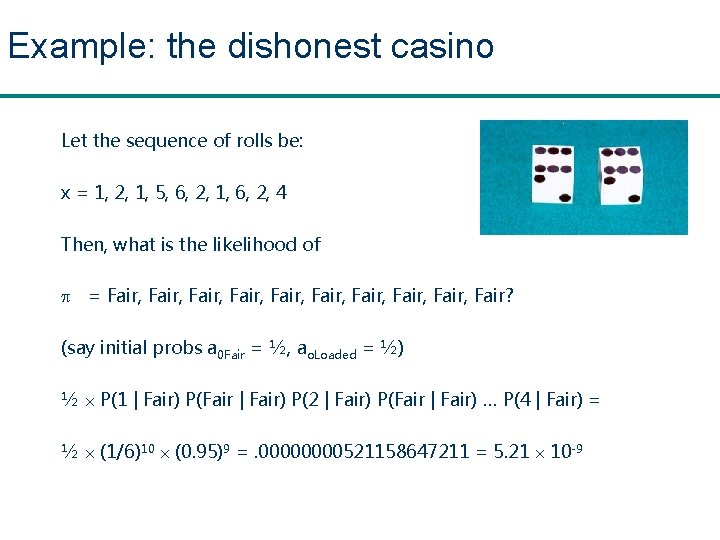
Example: the dishonest casino Let the sequence of rolls be: x = 1, 2, 1, 5, 6, 2, 1, 6, 2, 4 Then, what is the likelihood of = Fair, Fair, Fair, Fair? (say initial probs a 0 Fair = ½, ao. Loaded = ½) ½ P(1 | Fair) P(Fair | Fair) P(2 | Fair) P(Fair | Fair) … P(4 | Fair) = ½ (1/6)10 (0. 95)9 =. 0000521158647211 = 5. 21 10 -9
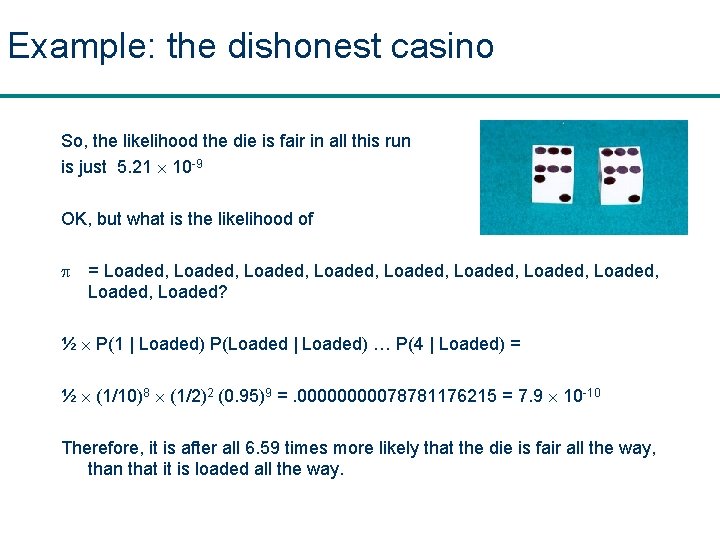
Example: the dishonest casino So, the likelihood the die is fair in all this run is just 5. 21 10 -9 OK, but what is the likelihood of = Loaded, Loaded, Loaded, Loaded? ½ P(1 | Loaded) P(Loaded | Loaded) … P(4 | Loaded) = ½ (1/10)8 (1/2)2 (0. 95)9 =. 0000078781176215 = 7. 9 10 -10 Therefore, it is after all 6. 59 times more likely that the die is fair all the way, than that it is loaded all the way.
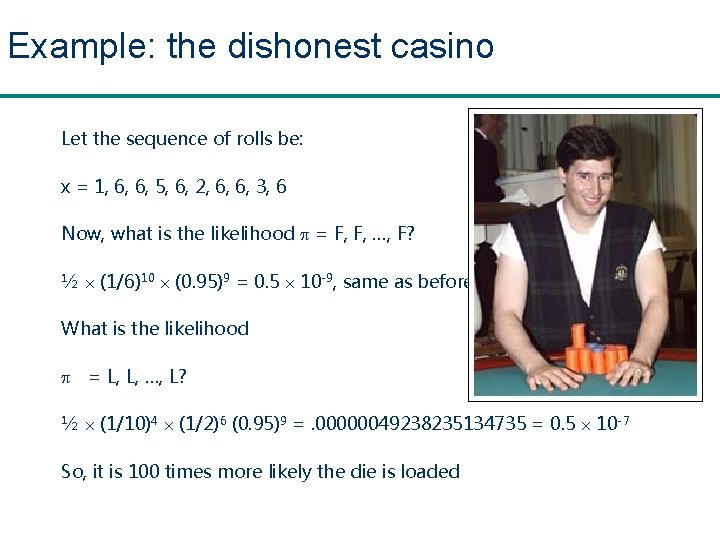
Example: the dishonest casino Let the sequence of rolls be: x = 1, 6, 6, 5, 6, 2, 6, 6, 3, 6 Now, what is the likelihood = F, F, …, F? ½ (1/6)10 (0. 95)9 = 0. 5 10 -9, same as before What is the likelihood = L, L, …, L? ½ (1/10)4 (1/2)6 (0. 95)9 =. 00000049238235134735 = 0. 5 10 -7 So, it is 100 times more likely the die is loaded
The three main questions on HMMs 1. Evaluation GIVEN FIND a HMM M, Prob[ x | M ] and a sequence x, 2. Decoding GIVEN FIND a HMM M, and a sequence x, the sequence of states that maximizes P[ x, | M ] 3. Learning GIVEN a HMM M, with unspecified transition/emission probs. , and a sequence x, FIND parameters = (ei(. ), aij) that maximize P[ x | ]