
Hicum Model in Spectre Diana Moncoqut RD manager
- Slides: 8
Hicum Model in Spectre Diana Moncoqut, R&D manager June 4, 2004 CADENCE CONFIDENTIAL
CMI (Compiled Model Interface) • A flexible and efficient low-level C-language interface • A common model interface to Spectre, Spectre. RF, AMS, Ultra. Sim. • Used to implement all kind of devices in the simulators: Transistors: Bsim 3 v 3, Bsim 4, Hicum, Mextram, Vbic, . . Passive Devices: Resistor, Capacitor, Inductor, Core, Port. . • Used by customers to introduce their proprietary models to Spectre.
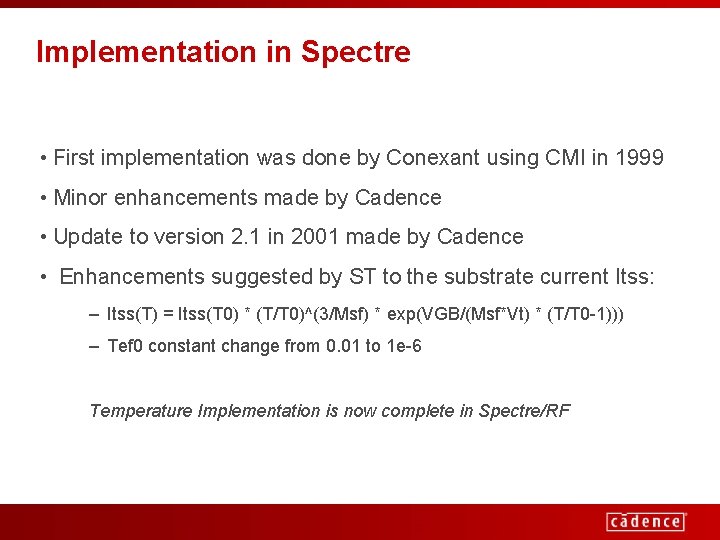
Implementation in Spectre • First implementation was done by Conexant using CMI in 1999 • Minor enhancements made by Cadence • Update to version 2. 1 in 2001 made by Cadence • Enhancements suggested by ST to the substrate current Itss: – Itss(T) = Itss(T 0) * (T/T 0)^(3/Msf) * exp(VGB/(Msf*Vt) * (T/T 0 -1))) – Tef 0 constant change from 0. 01 to 1 e-6 Temperature Implementation is now complete in Spectre/RF
Hicum model advantages A physically based-model • Hicum model is the only model that accurately describes the minority charge and transit time • Hicum model also gives a very accurate and robust large signal simulation
Hicum model status in Spectre Diffusion capacitances are a simplified representation of the distributed minority charge in the transistor Ø C_de/C_dc are not exact derivatives of Q_de/Q_dc This causes convergence problems in transient analysis Provided a work-around for this problem, and working on a complete solution in Q 3. Any remaining problems in derivatives will be examined and fixed in Q 3.
Hidden state problem in RF simulation • Hidden-state problem A hidden state is a variable whose value is used before it is set, which means that its value is retained from a previous time point. In shooting-Newton, one must be able to access and manipulate the state of the circuit, one must be able to compute the sensitivity of v(t) with respect to v(0) Hidden states are a problem for any RF simulator based on PSS algorithms.
Hicum model status in Spectre • In Hicum, Excess phase (a. Qf, ai. T) is implemented using a second-order Bessel polynomial which introduces hidden states. For PSS to converge, we must « expose » the states by explicitely adding new signals in the system. Excess Phase Problems are solved in Spectre/RF by exposing the hidden states • Exponential limiting. Dexp is used but EXP_MAX and EXP_MIN are not defined. Exponential limiting and Pn. J limiting are added to Spectre/RF
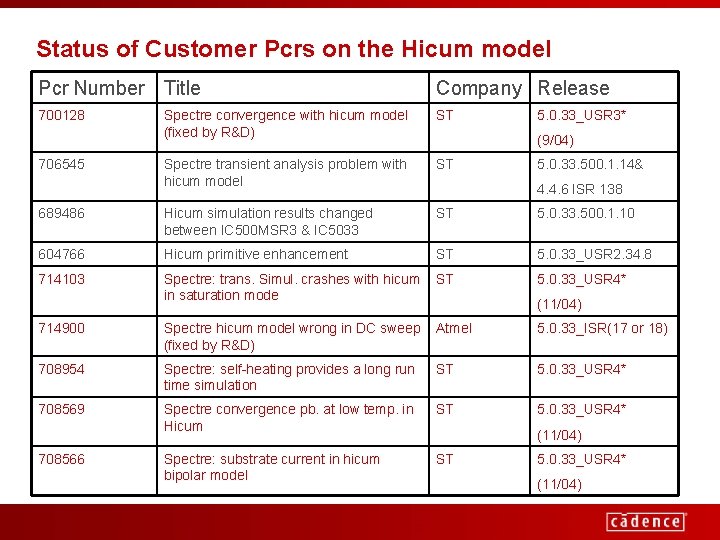
Status of Customer Pcrs on the Hicum model Pcr Number Title Company Release 700128 Spectre convergence with hicum model (fixed by R&D) ST Spectre transient analysis problem with hicum model ST 689486 Hicum simulation results changed between IC 500 MSR 3 & IC 5033 ST 5. 0. 33. 500. 1. 10 604766 Hicum primitive enhancement ST 5. 0. 33_USR 2. 34. 8 714103 Spectre: trans. Simul. crashes with hicum ST in saturation mode 5. 0. 33_USR 4* 714900 Spectre hicum model wrong in DC sweep Atmel (fixed by R&D) 5. 0. 33_ISR(17 or 18) 708954 Spectre: self-heating provides a long run time simulation ST 5. 0. 33_USR 4* 708569 Spectre convergence pb. at low temp. in Hicum ST 5. 0. 33_USR 4* Spectre: substrate current in hicum bipolar model ST 706545 708566 5. 0. 33_USR 3* (9/04) 5. 0. 33. 500. 1. 14& 4. 4. 6 ISR 138 (11/04) 5. 0. 33_USR 4* (11/04)