
HIAS Blended Learning Resource Year 9 Proportion Indirect
HIAS Blended Learning Resource Year 9 Proportion: Indirect (unit 9. 8) Solve problems involving direct and inverse proportion, including graphical and algebraic representations HIAS maths Team Spring 2021 Final version © Hampshire County Council
HIAS Blended Learning Resource These slides are intended to support teachers and students with a blended approach to learning, either in-class or online. The tasks are intended to form part of a learning journey and could be the basis of either one lesson or a short sequence of connected lessons. Teachers should delete, change and add slides to suit the needs of their students. Extra slides with personalised prompts and appropriate examples based on previous teaching may be suitable. When changing the slide-deck, teachers should consider: – Their expectations for the use of representations such as bar models, number lines, arrays and geometric diagrams. – Which strategies and methods students should use and record when solving problems or identifying solutions. This could include a range of informal jottings and diagrams, the use of tables to record solutions systematically and formal or informal calculation methods. Teachers may also wish to record a ‘voice over’ to talk students through the slides.
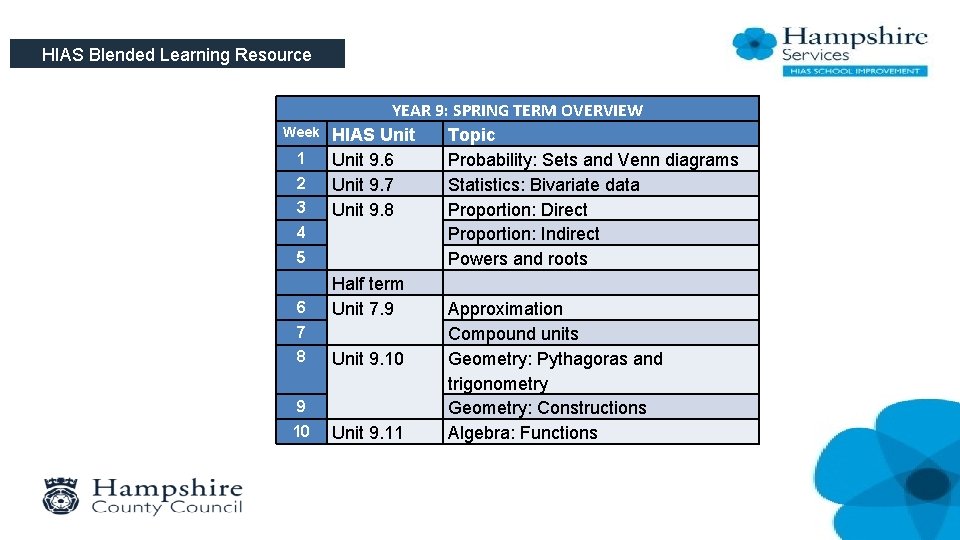
HIAS Blended Learning Resource Week 1 2 3 4 5 6 7 8 9 10 YEAR 9: SPRING TERM OVERVIEW HIAS Unit Topic Unit 9. 6 Probability: Sets and Venn diagrams Unit 9. 7 Statistics: Bivariate data Unit 9. 8 Proportion: Direct Proportion: Indirect Powers and roots Half term Unit 7. 9 Approximation Compound units Unit 9. 10 Geometry: Pythagoras and trigonometry Geometry: Constructions Unit 9. 11 Algebra: Functions
HIAS Blended Learning Resource Adapted from Testbase
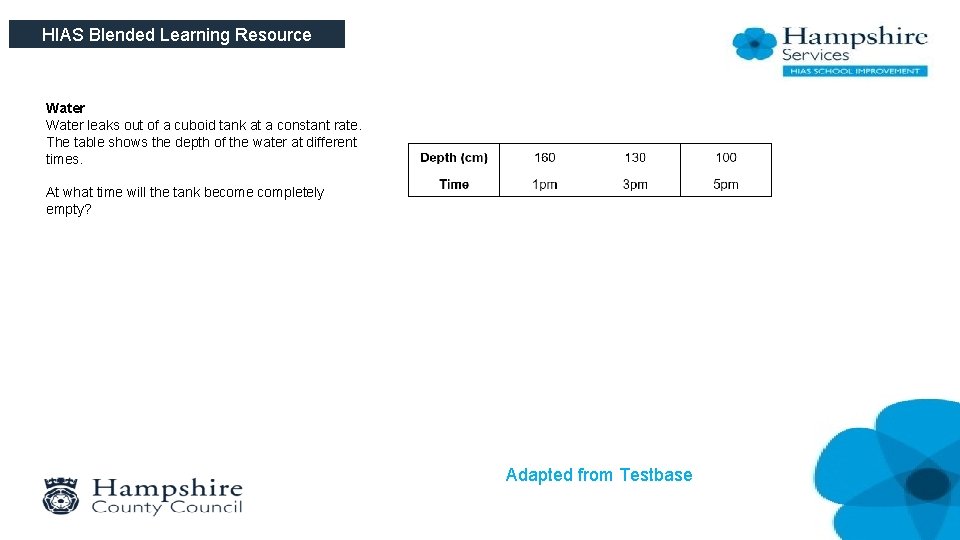
HIAS Blended Learning Resource Water leaks out of a cuboid tank at a constant rate. The table shows the depth of the water at different times. At what time will the tank become completely empty? Adapted from Testbase
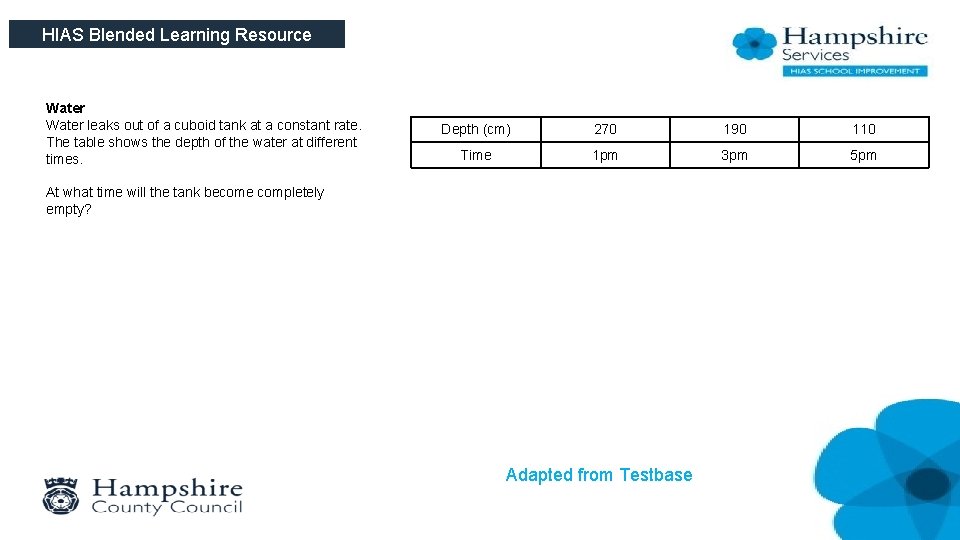
HIAS Blended Learning Resource Water leaks out of a cuboid tank at a constant rate. The table shows the depth of the water at different times. Depth (cm) 270 190 110 Time 1 pm 3 pm 5 pm At what time will the tank become completely empty? Adapted from Testbase
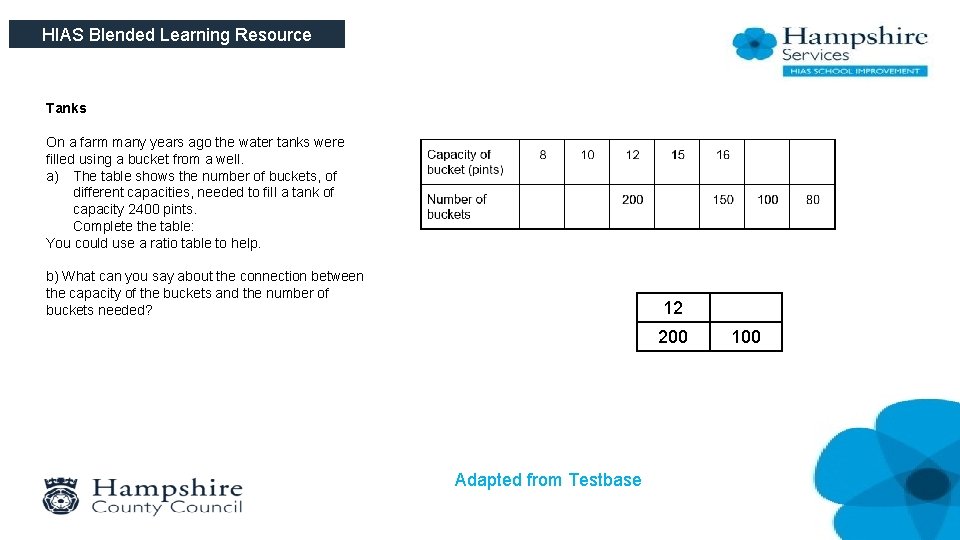
HIAS Blended Learning Resource Tanks On a farm many years ago the water tanks were filled using a bucket from a well. a) The table shows the number of buckets, of different capacities, needed to fill a tank of capacity 2400 pints. Complete the table: You could use a ratio table to help. b) What can you say about the connection between the capacity of the buckets and the number of buckets needed? 12 200 Adapted from Testbase 100
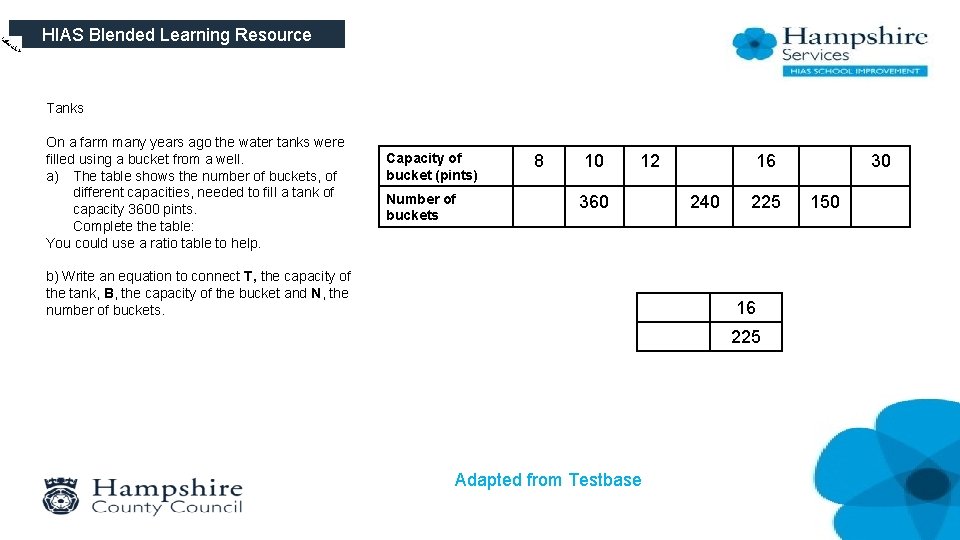
HIAS Blended Learning Resource Tanks On a farm many years ago the water tanks were filled using a bucket from a well. a) The table shows the number of buckets, of different capacities, needed to fill a tank of capacity 3600 pints. Complete the table: You could use a ratio table to help. Capacity of bucket (pints) Number of buckets 8 10 12 360 b) Write an equation to connect T, the capacity of the tank, B, the capacity of the bucket and N, the number of buckets. 16 240 225 16 225 Adapted from Testbase 30 150
HIAS Blended Learning Resource HIAS Maths team The HIAS maths team offer a wide range of high-quality services to support schools in improving outcomes for learners, including courses, bespoke consultancy and in-house training. For further details, please contact any member of the secondary maths team: Jo Lees: Jo. Lees@hants. gov. uk Jenny Burn: Jenny. Burn@hants. gov. uk Tessa Ingrey: Tessa. Ingrey@hants. gov. uk For further details on the full range of services available please contact us using the following details: Tel: 01962 874820 or email: hias. enquiries@hants. gov. uk
- Slides: 9