
HHSC Electronic Visit Verification Overview April 2019 What
- Slides: 13
HHSC Electronic Visit Verification Overview April 2019
What is EVV? EVV is a computer-based system that electronically: • Verifies that service visits occur; and • Documents the date and time service delivery begins and ends. 2
How does EVV Work? When an attendant provides services to a member in the home or the community, the attendant will use one of three approved EVV time recording methods to clock in when service delivery begins and clock out when service delivery ends. 1. Mobile Application 2. Alternative Device 3. Member’s Home Phone Landline 3
What data is collected? EVV electronically documents the following visit data: • Member receiving services • Attendant providing services • Location of service delivery • Date of service delivery • Time the attendant begins and ends service delivery 4
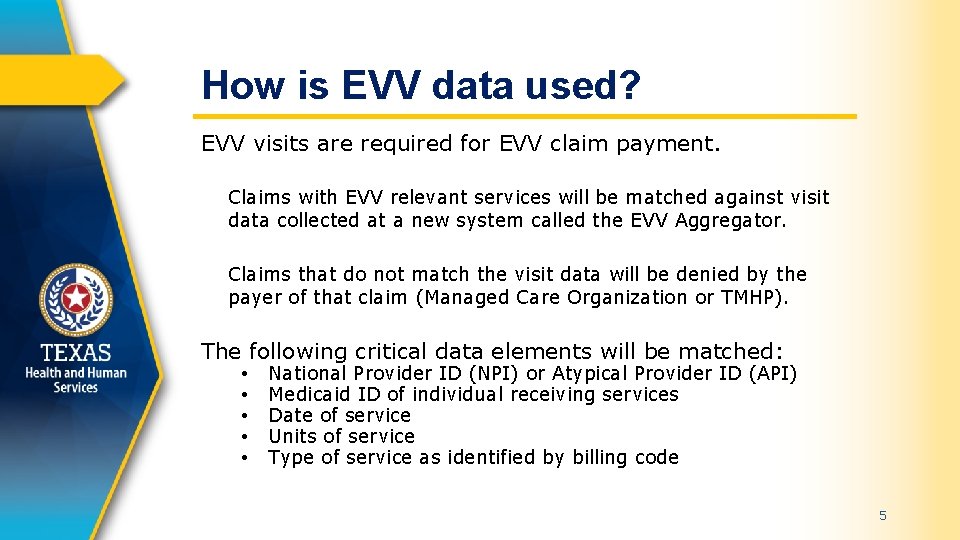
How is EVV data used? EVV visits are required for EVV claim payment. Claims with EVV relevant services will be matched against visit data collected at a new system called the EVV Aggregator. Claims that do not match the visit data will be denied by the payer of that claim (Managed Care Organization or TMHP). The following critical data elements will be matched: • • • National Provider ID (NPI) or Atypical Provider ID (API) Medicaid ID of individual receiving services Date of service Units of service Type of service as identified by billing code 5
EVV Process Flow (Sept. 1, 2019) * EVV Portal can be accessed by Providers to view their EVV Visit Data for billing and Claims Matching results. 6
EVV Process Flow (January 1, 2020) * EVV Portal can be accessed by Providers to view their EVV Visit Data for billing and Claims Matching results. 7
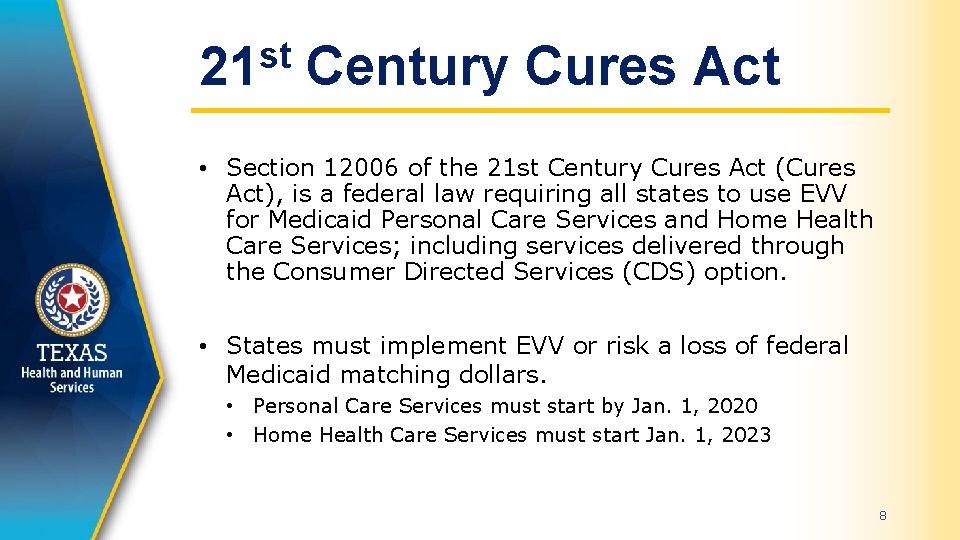
st 21 Century Cures Act • Section 12006 of the 21 st Century Cures Act (Cures Act), is a federal law requiring all states to use EVV for Medicaid Personal Care Services and Home Health Care Services; including services delivered through the Consumer Directed Services (CDS) option. • States must implement EVV or risk a loss of federal Medicaid matching dollars. • Personal Care Services must start by Jan. 1, 2020 • Home Health Care Services must start Jan. 1, 2023 8
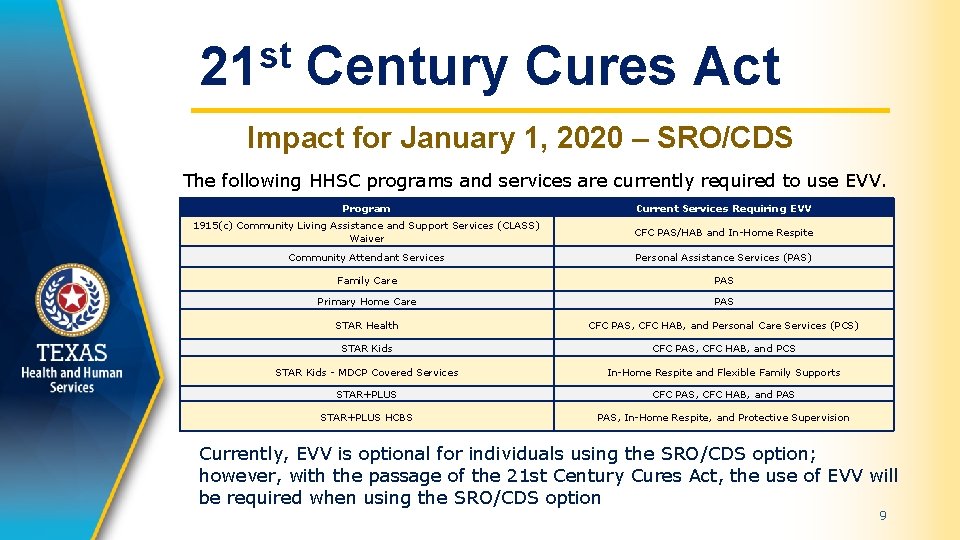
st 21 Century Cures Act Impact for January 1, 2020 – SRO/CDS The following HHSC programs and services are currently required to use EVV. Program Current Services Requiring EVV 1915(c) Community Living Assistance and Support Services (CLASS) Waiver CFC PAS/HAB and In-Home Respite Community Attendant Services Personal Assistance Services (PAS) Family Care PAS Primary Home Care PAS STAR Health CFC PAS, CFC HAB, and Personal Care Services (PCS) STAR Kids CFC PAS, CFC HAB, and PCS STAR Kids - MDCP Covered Services In-Home Respite and Flexible Family Supports STAR+PLUS CFC PAS, CFC HAB, and PAS STAR+PLUS HCBS PAS, In-Home Respite, and Protective Supervision Currently, EVV is optional for individuals using the SRO/CDS option; however, with the passage of the 21 st Century Cures Act, the use of EVV will be required when using the SRO/CDS option 9
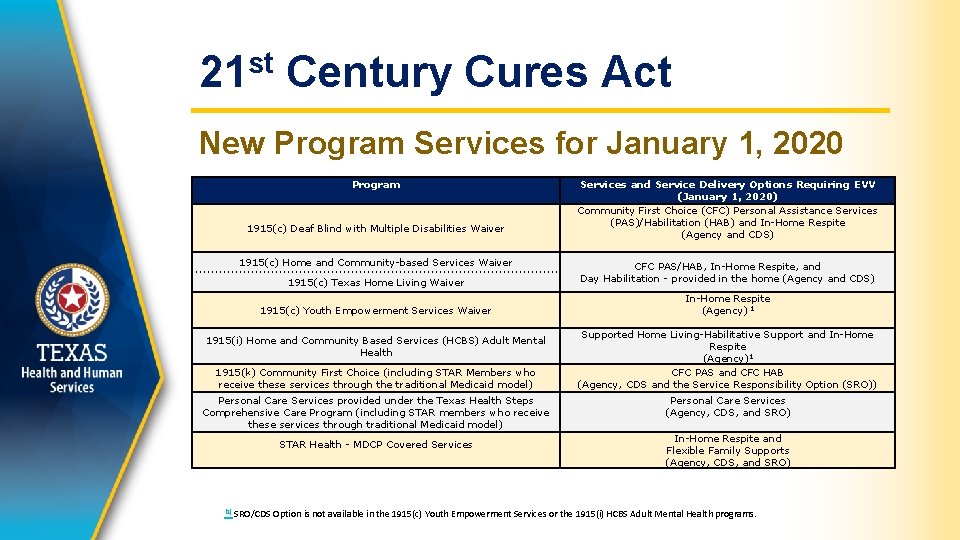
21 st Century Cures Act New Program Services for January 1, 2020 Program 1915(c) Deaf Blind with Multiple Disabilities Waiver 1915(c) Home and Community-based Services Waiver 1915(c) Texas Home Living Waiver CFC PAS/HAB, In-Home Respite, and Day Habilitation - provided in the home (Agency and CDS) 1915(c) Youth Empowerment Services Waiver In-Home Respite (Agency) 1 1915(i) Home and Community Based Services (HCBS) Adult Mental Health 1915(k) Community First Choice (including STAR Members who receive these services through the traditional Medicaid model) Personal Care Services provided under the Texas Health Steps Comprehensive Care Program (including STAR members who receive these services through traditional Medicaid model) STAR Health - MDCP Covered Services [1] Services and Service Delivery Options Requiring EVV (January 1, 2020) Community First Choice (CFC) Personal Assistance Services (PAS)/Habilitation (HAB) and In-Home Respite (Agency and CDS) Supported Home Living-Habilitative Support and In-Home Respite (Agency)1 CFC PAS and CFC HAB (Agency, CDS and the Service Responsibility Option (SRO)) Personal Care Services (Agency, CDS, and SRO) In-Home Respite and Flexible Family Supports (Agency, CDS, and SRO) SRO/CDS Option is not available in the 1915(c) Youth Empowerment Services or the 1915(i) HCBS Adult Mental Health programs.
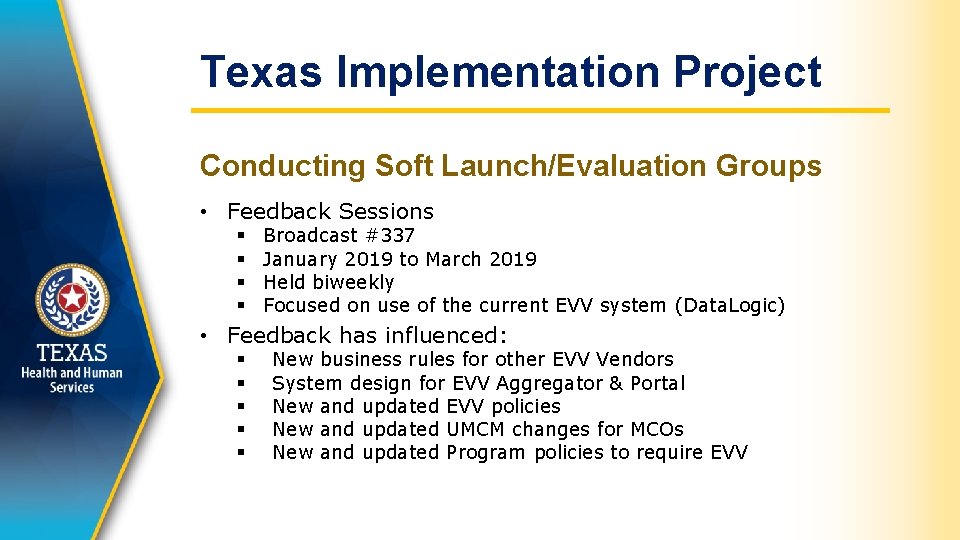
Texas Implementation Project Conducting Soft Launch/Evaluation Groups • Feedback Sessions § § Broadcast #337 January 2019 to March 2019 Held biweekly Focused on use of the current EVV system (Data. Logic) • Feedback has influenced: § § § New business rules for other EVV Vendors System design for EVV Aggregator & Portal New and updated EVV policies New and updated UMCM changes for MCOs New and updated Program policies to require EVV
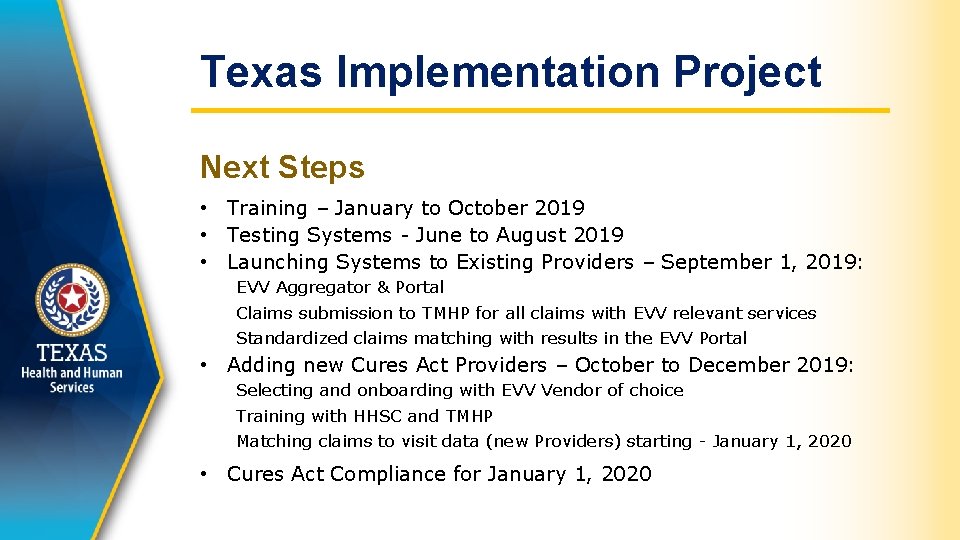
Texas Implementation Project Next Steps • Training – January to October 2019 • Testing Systems - June to August 2019 • Launching Systems to Existing Providers – September 1, 2019: EVV Aggregator & Portal Claims submission to TMHP for all claims with EVV relevant services Standardized claims matching with results in the EVV Portal • Adding new Cures Act Providers – October to December 2019: Selecting and onboarding with EVV Vendor of choice Training with HHSC and TMHP Matching claims to visit data (new Providers) starting - January 1, 2020 • Cures Act Compliance for January 1, 2020
EVV Communications • 21 st Century Cures Act Website https: //hhs. texas. gov/doing-business-hhs/provider-portals/longterm-care-providers/resources/electronic-visit-verification/21 stcentury-cures-act • EVV Alerts via Gov. Delivery https: //service. govdelivery. com/accounts/TXHHSC/subscriber/new • EVV Toolkit Monthly alerts (1 st and 15 th) and Q&A webinars (22 nd), FAQs Electronic_Visit_Verification@hhsc. state. tx. us.