
HHS HEALTH IHS INFORMATIONTECHNOLOGY MODERNIZATION PROJECT Goals Objectives
HHS // HEALTH IHS INFORMATIONTECHNOLOGY MODERNIZATION PROJECT
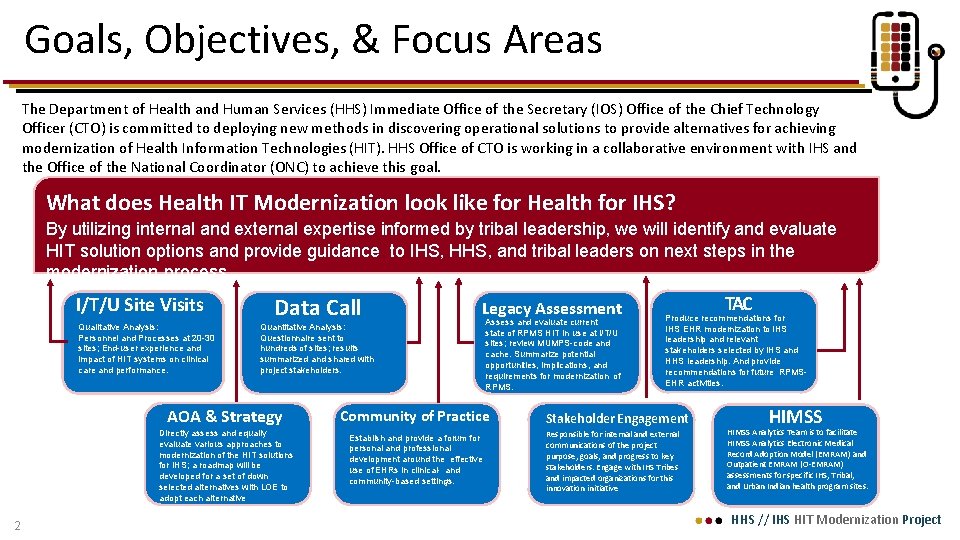
Goals, Objectives, & Focus Areas The Department of Health and Human Services (HHS) Immediate Office of the Secretary (IOS) Office of the Chief Technology Officer (CTO) is committed to deploying new methods in discovering operational solutions to provide alternatives for achieving modernization of Health Information Technologies (HIT). HHS Office of CTO is working in a collaborative environment with IHS and the Office of the National Coordinator (ONC) to achieve this goal. What does Health IT Modernization look like for Health for IHS? By utilizing internal and external expertise informed by tribal leadership, we will identify and evaluate HIT solution options and provide guidance to IHS, HHS, and tribal leaders on next steps in the modernization process. I/T/U Site Visits Qualitative Analysis: Personnel and Processes at 20 -30 sites; End-user experience and impact of HIT systems on clinical care and performance. Data Call Quantitative Analysis: Questionnaire sent to hundreds of sites; results summarized and shared with project stakeholders. AOA & Strategy Directly assess and equally evaluate various approaches to modernization of the HIT solutions for IHS; a roadmap will be developed for a set of down selected alternatives with LOE to adopt each alternative 2 Legacy Assessment Assess and evaluate current state of RPMS HIT in use at I/T/U sites; review MUMPS-code and cache. Summarize potential opportunities, implications, and requirements for modernization of RPMS. Community of Practice Establish and provide a forum for personal and professional development around the effective use of EHRs in clinical- and community-based settings. TAC Produce recommendations for IHS EHR modernization to IHS leadership and relevant stakeholders selected by IHS and HHS leadership. And provide recommendations for future RPMSEHR activities. Stakeholder Engagement Responsible for internal and external communications of the project purpose, goals, and progress to key stakeholders. Engage with IHS Tribes and impacted organizations for this innovation initiative HIMSS Analytics Team is to facilitate HIMSS Analytics Electronic Medical Record Adoption Model (EMRAM) and Outpatient EMRAM (O-EMRAM) assessments for specific IHS, Tribal, and Urban Indian health program sites. HHS // IHS HIT Modernization Project
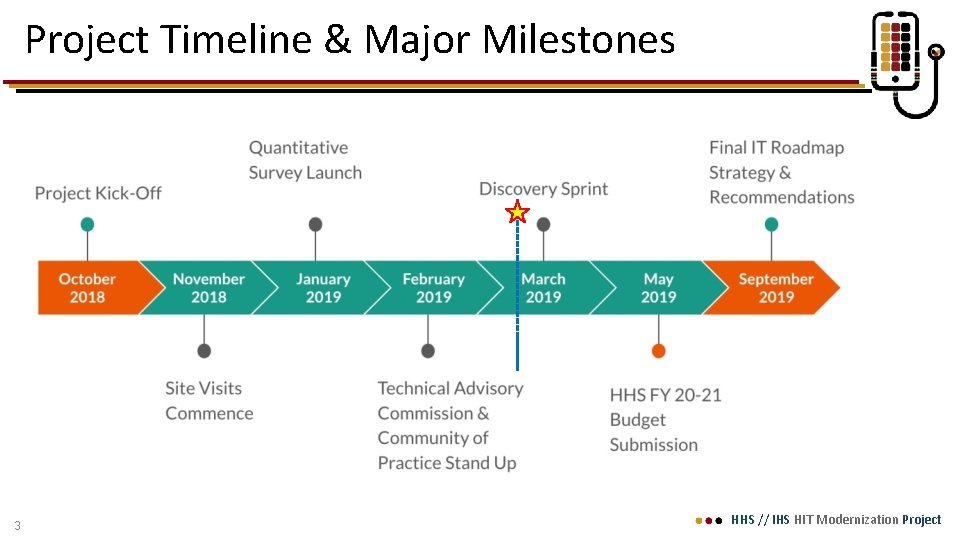
Project Timeline & Major Milestones 3 HHS // IHS HIT Modernization Project
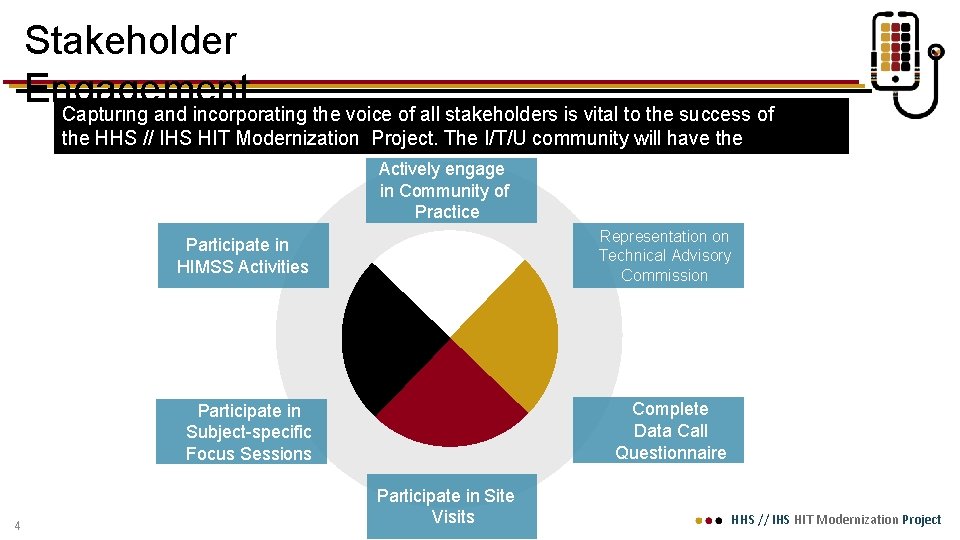
Stakeholder Engagement Capturing and incorporating the voice of all stakeholders is vital to the success of the HHS // IHS HIT Modernization Project. The I/T/U community will have the opportunity to engage in the following ways: engage Actively in Community of Practice Representation on Technical Advisory Commission Participate in HIMSS Activities Complete Data Call Questionnaire Participate in Subject-specific Focus Sessions 4 Participate in Site Visits HHS // IHS HIT Modernization Project
Project Highlights & Site Findings Project Highlights 36 Sites Targeted for Visits across all 12 IHS areas Legacy Assessment team fully engaged, actively understanding RPMS architecture, including a platform walk-through Technical Advisory Commission (TAC) secured several key participants from academia, government, and healthcare industry (CMO, CIO, VP) Community of Practice (Co. P) well received by stakeholder organizations to share best practices, HIT information, and uses of technology 6 Site Visits to date with Human Center Design methodology being utilized 5 Site Visit Findings “It’s important to focus on the interoperability and the interface because that is where the rubber meets the road. Because RPMS does not always talk to the others. ” “I feel like it works if you know how to use it. It’s not an intuitive program. The training isn’t helpful—it’s either so basic I don’t need it or it’s not helpful. It’s not intuitive. ” “I have a dream that maybe one day we won’t have all these million of databases and EHRs, everything will be in the same place. ” Information appears to be lost, and users cannot track it enough to understand what happened and prevent it from happening in the future. HHS // IHS HIT Modernization Project
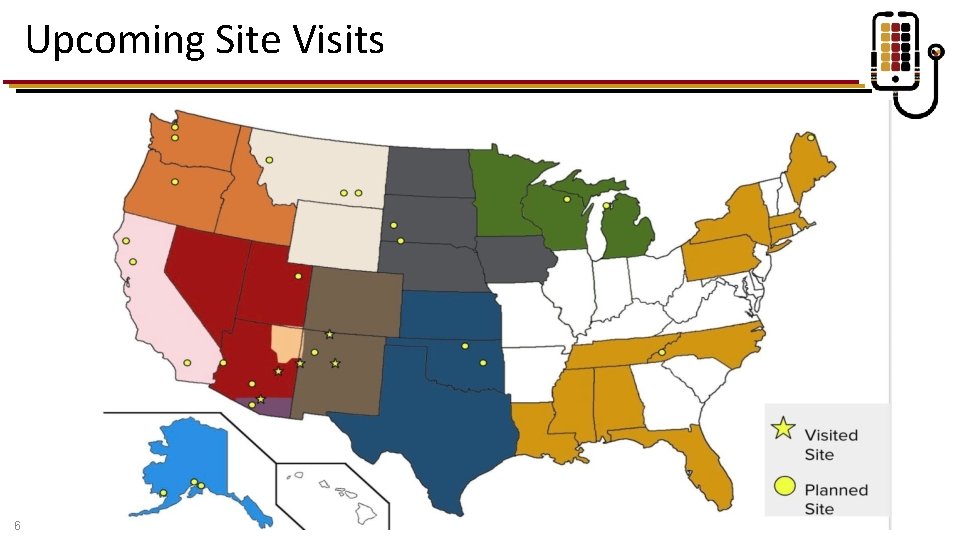
Upcoming Site Visits 6 HHS // IHS HIT Modernization Project

Summary & Expectations of Results 1. Recommendation will be going directly to HHS Office of CTO and shared with IHS Executive Management and Stakeholder groups 2. Teams are actively working with Tribes and want to engage as many of these stakeholder groups possible for initiative-centric feedback 3. NIHB, DSTAC, TSGAC, UIHB, and others have played a very helpful role in identifying and connecting the right tribal partners, which we value and hope for continued support 4. 7 Team is focused on Qualitive and Quantitative analysis with a priority of aligning the communities’ needs with Innovative solutions HHS // IHS HIT Modernization Project
Contact Information Mitchell Thornbrugh Acting Chief Information Officer Acting Director, Office of Information Technology Department of Health and Human Services - Indian Health Services (IHS) e: mitchell. thornbrugh@ihs. gov m: 240. 620. 3117 Maia Z. Laing Office of the Chief Technology Officer | Immediate Office of the Secretary U. S. Department of Health and Human Services e: maia. laing@hhs. gov | w: 202. 774. 2304 | m: 202. 684. 5424 Travis Mells HHS IHS HIT MOD Project | Program Delivery Manager Emerging Sun, LLC e: travis. mells@emergingsun. com | m: 301. 541. 7730 8 Project Group Email: HITModernization@emergingsun. c om Carolyn Crowder HHS IHS HIT MOD Project | RN, Business Analyst Regenstrief Institute (Contractor) e: crowder@j 2 sg. org| m: 907. 952. 4184 HHS // IHS HIT Modernization Project
- Slides: 8