
HGTD High Granularity Timing Detector project Status Plans
- Slides: 14
HGTD (High Granularity Timing Detector) project: Status, Plans A. Henriques , Francesco Lanni 28 August LAr phase II upgrade meeting
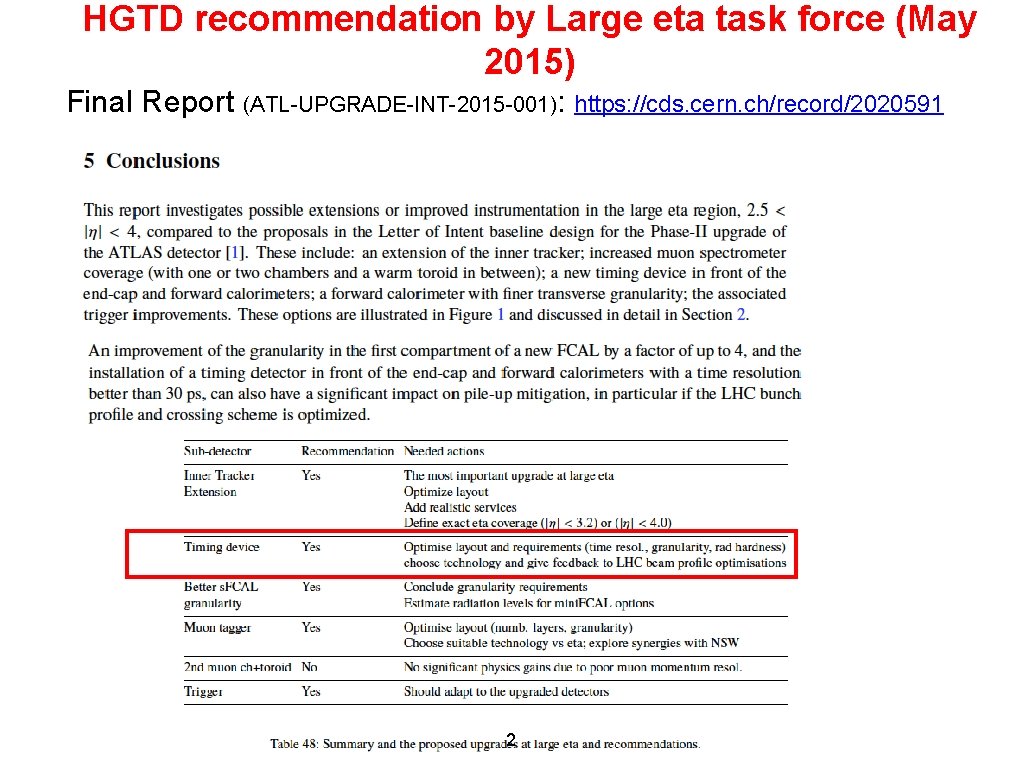
HGTD recommendation by Large eta task force (May 2015) Final Report (ATL-UPGRADE-INT-2015 -001): https: //cds. cern. ch/record/2020591 2
HGTD in the upgrade scoping document • In circulation in ATLAS now (https: //cds. cern. ch/record/2046182 • Part of the calorimeter upgrade plans in the “Reference Detector” scoping scenario chapter V. 5. Motivation in chapter XI. 2. 7. 5 • Release of final draft for review to the LHCC and UCG early September after ATLAS approval. 3
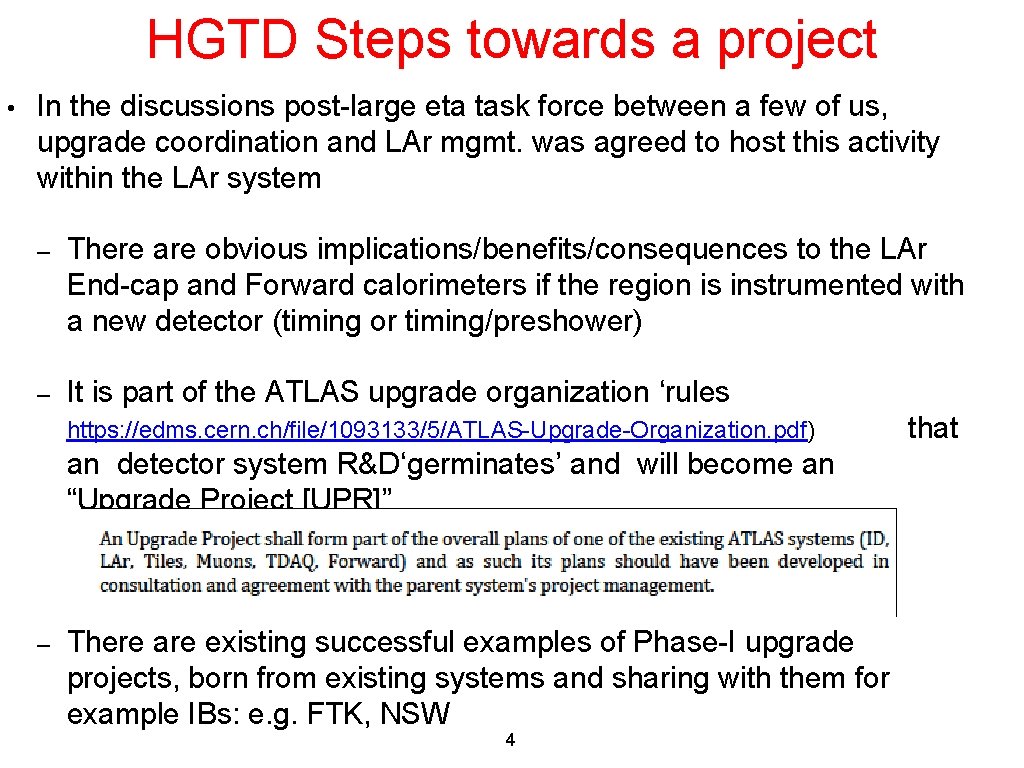
HGTD Steps towards a project • In the discussions post-large eta task force between a few of us, upgrade coordination and LAr mgmt. was agreed to host this activity within the LAr system – There are obvious implications/benefits/consequences to the LAr End-cap and Forward calorimeters if the region is instrumented with a new detector (timing or timing/preshower) – It is part of the ATLAS upgrade organization ‘rules https: //edms. cern. ch/file/1093133/5/ATLAS-Upgrade-Organization. pdf) an detector system R&D‘germinates’ and will become an “Upgrade Project [UPR]” – There are existing successful examples of Phase-I upgrade projects, born from existing systems and sharing with them for example IBs: e. g. FTK, NSW 4 that
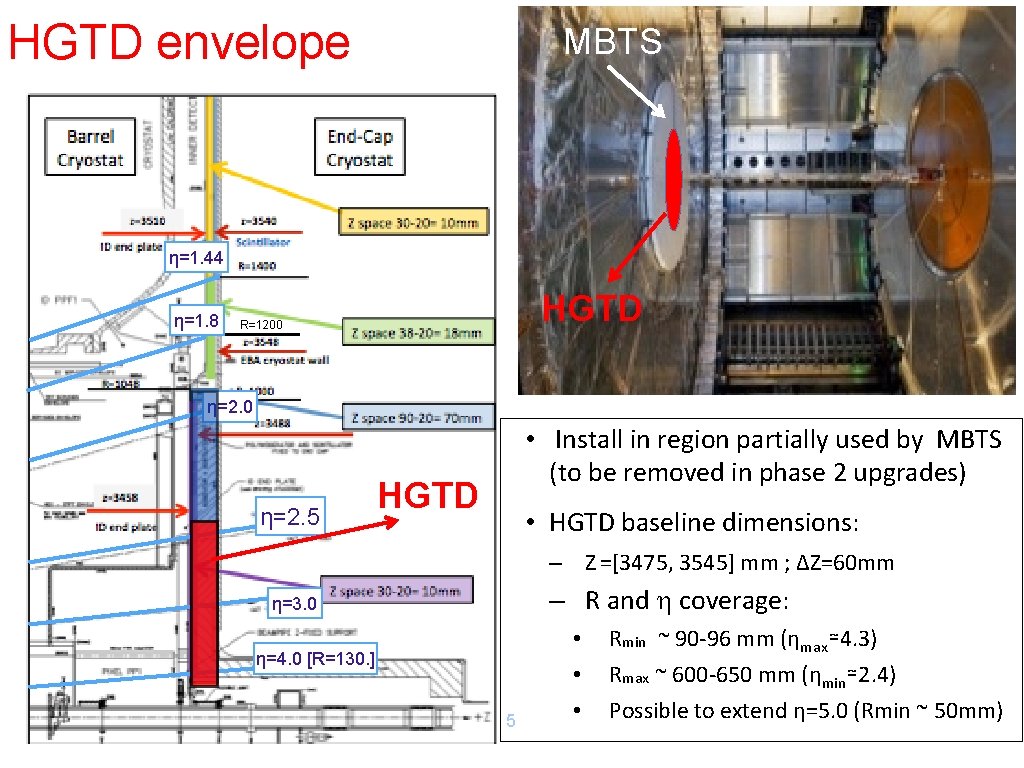
HGTD envelope MBTS η=1. 44 η=1. 8 HGTD R=1200 η=2. 5 • Install in region partially used by MBTS (to be removed in phase 2 upgrades) HGTD • HGTD baseline dimensions: – Z =[3475, 3545] mm ; ΔZ=60 mm – R and h coverage: η=3. 0 η=4. 0 [R=130. ] 5 • • • Rmin ~ 90 -96 mm (ηmax≃4. 3) Rmax ~ 600 -650 mm (ηmin≃2. 4) Possible to extend η=5. 0 (Rmin ~ 50 mm)
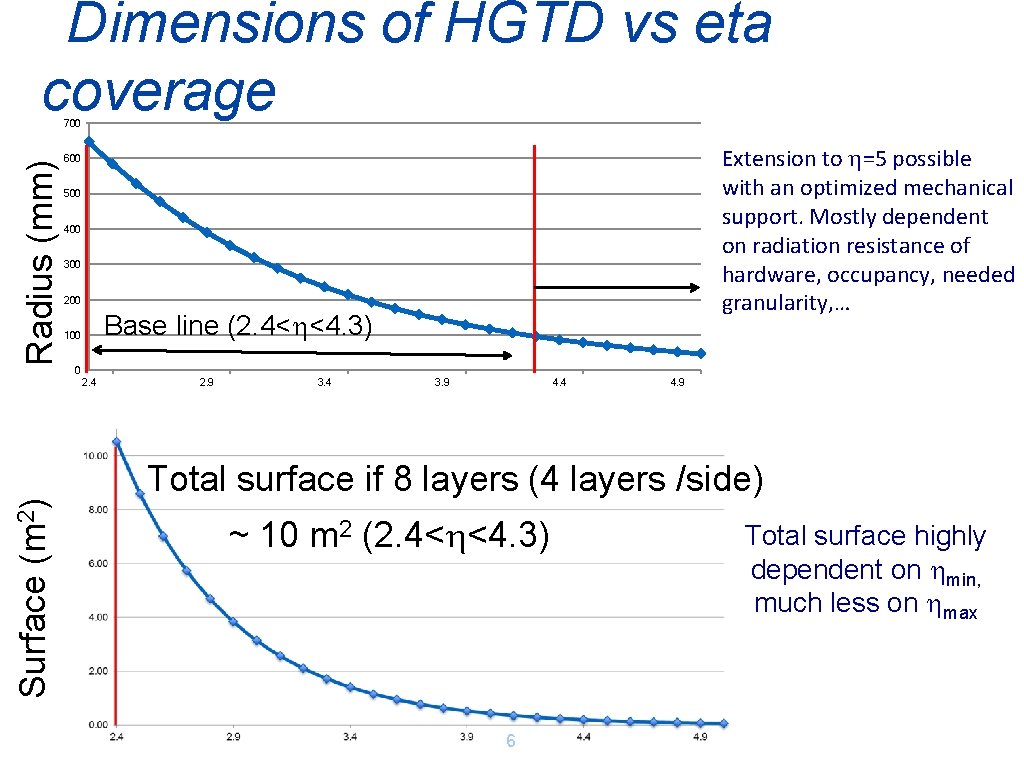
Dimensions of HGTD vs eta coverage Radius (mm) 700 500 400 300 200 Base line (2. 4<h<4. 3) 100 0 2. 4 Surface (m 2) Extension to h=5 possible with an optimized mechanical support. Mostly dependent on radiation resistance of hardware, occupancy, needed granularity, … 600 2. 9 3. 4 3. 9 4. 4 4. 9 Total surface if 8 layers (4 layers /side) ~ 10 m 2 (2. 4<h<4. 3) 6 Total surface highly dependent on hmin, much less on hmax
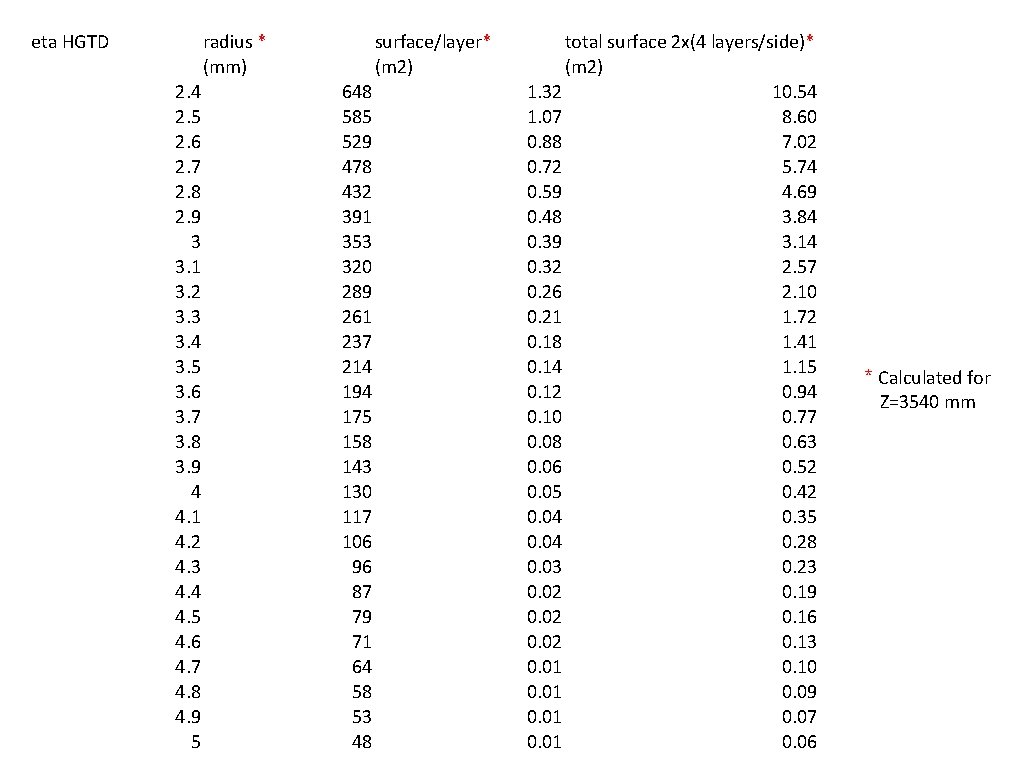
eta HGTD radius * (mm) 2. 4 2. 5 2. 6 2. 7 2. 8 2. 9 3 3. 1 3. 2 3. 3 3. 4 3. 5 3. 6 3. 7 3. 8 3. 9 4 4. 1 4. 2 4. 3 4. 4 4. 5 4. 6 4. 7 4. 8 4. 9 5 surface/layer* (m 2) 648 585 529 478 432 391 353 320 289 261 237 214 194 175 158 143 130 117 106 96 87 79 71 64 58 53 48 total surface 2 x(4 layers/side)* (m 2) 1. 32 10. 54 1. 07 8. 60 0. 88 7. 02 0. 72 5. 74 0. 59 4. 69 0. 48 3. 84 0. 39 3. 14 0. 32 2. 57 0. 26 2. 10 0. 21 1. 72 0. 18 1. 41 0. 14 1. 15 0. 12 0. 94 0. 10 0. 77 0. 08 0. 63 0. 06 0. 52 0. 05 0. 42 0. 04 0. 35 0. 04 0. 28 0. 03 0. 23 0. 02 0. 19 0. 02 0. 16 0. 02 0. 13 0. 01 0. 10 0. 01 0. 09 0. 01 0. 07 0. 01 0. 06 * Calculated for Z=3540 mm
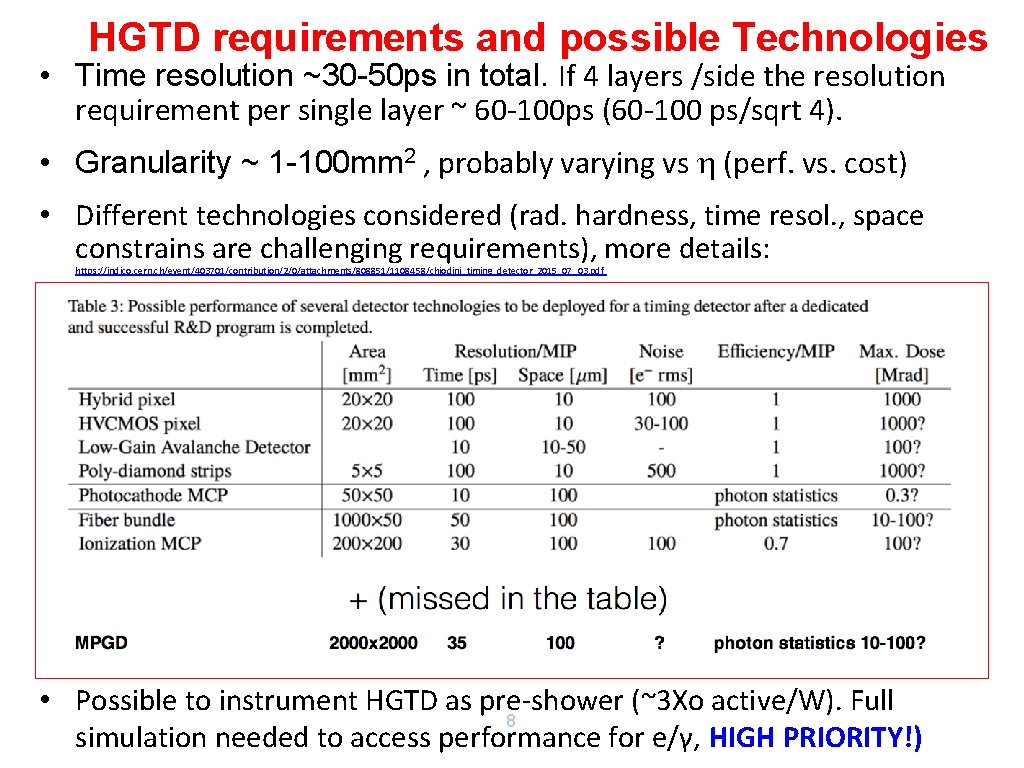
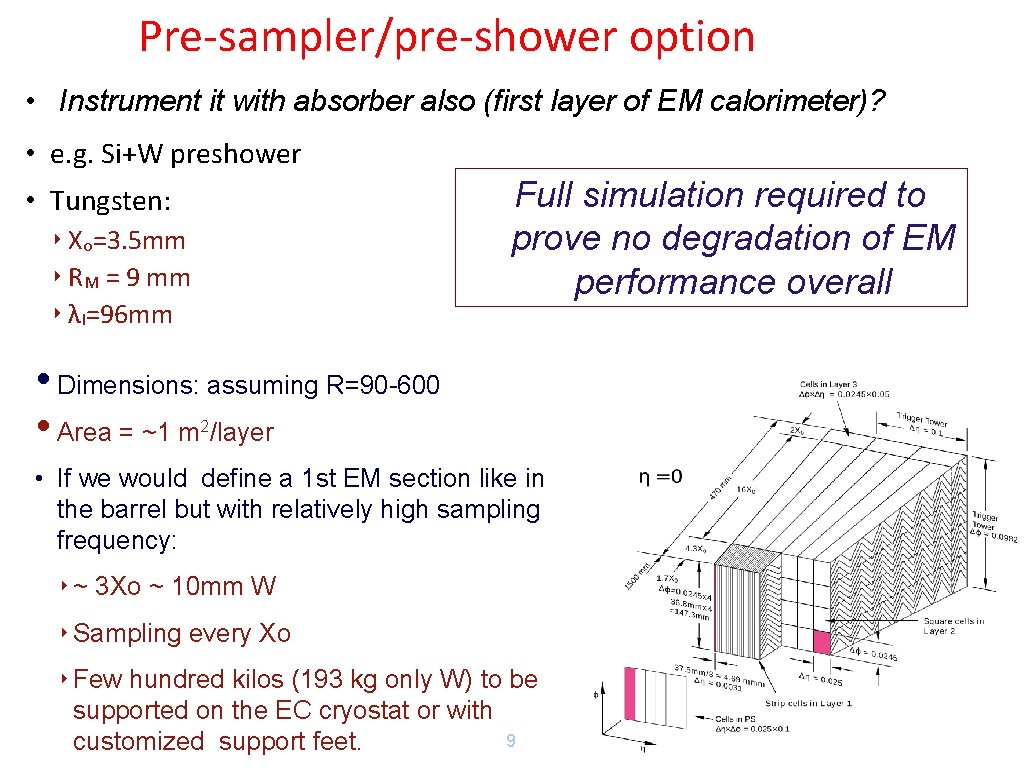
HGTD requirements and possible Technologies • Time resolution ~30 -50 ps in total. If 4 layers /side the resolution requirement per single layer ~ 60 -100 ps (60 -100 ps/sqrt 4). • Granularity ~ 1 -100 mm 2 , probably varying vs h (perf. vs. cost) • Different technologies considered (rad. hardness, time resol. , space constrains are challenging requirements), more details: https: //indico. cern. ch/event/403701/contribution/2/0/attachments/808851/1108458/chiodini_timing_detector_2015_07_03. pdf • Possible to instrument HGTD as pre-shower (~3 Xo active/W). Full 8 simulation needed to access performance for e/γ, HIGH PRIORITY!)
Pre-sampler/pre-shower option • Instrument it with absorber also (first layer of EM calorimeter)? • e. g. Si+W preshower Full simulation required to prove no degradation of EM performance overall • Tungsten: ‣ Xo=3. 5 mm ‣ RM = 9 mm ‣ λI=96 mm • Dimensions: assuming R=90 -600 • Area = ~1 m /layer 2 • If we would define a 1 st EM section like in the barrel but with relatively high sampling frequency: ‣ ~ 3 Xo ~ 10 mm W ‣ Sampling every Xo ‣ Few hundred kilos (193 kg only W) to be supported on the EC cryostat or with 9 customized support feet.
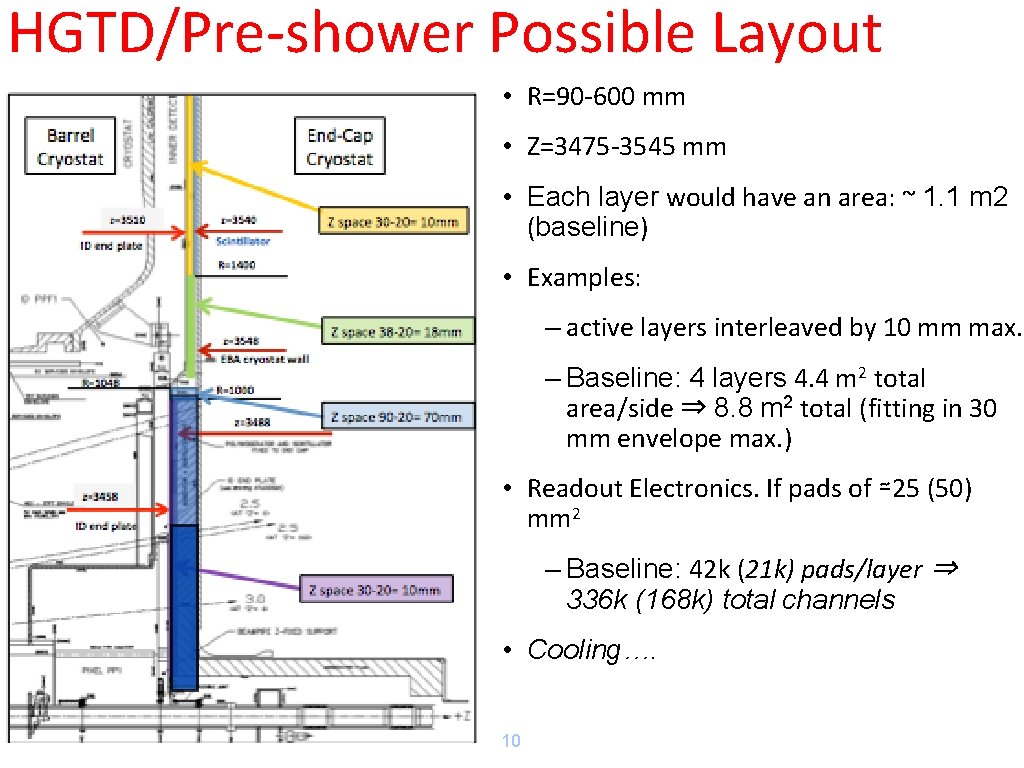
HGTD/Pre-shower Possible Layout • R=90 -600 mm • Z=3475 -3545 mm • Each layer would have an area: ~ 1. 1 m 2 (baseline) • Examples: – active layers interleaved by 10 mm max. – Baseline: 4 layers 4. 4 m 2 total area/side ⇒ 8. 8 m 2 total (fitting in 30 mm envelope max. ) • Readout Electronics. If pads of ≃25 (50) mm 2 – Baseline: 42 k (21 k) pads/layer ⇒ 336 k (168 k) total channels • Cooling…. 10
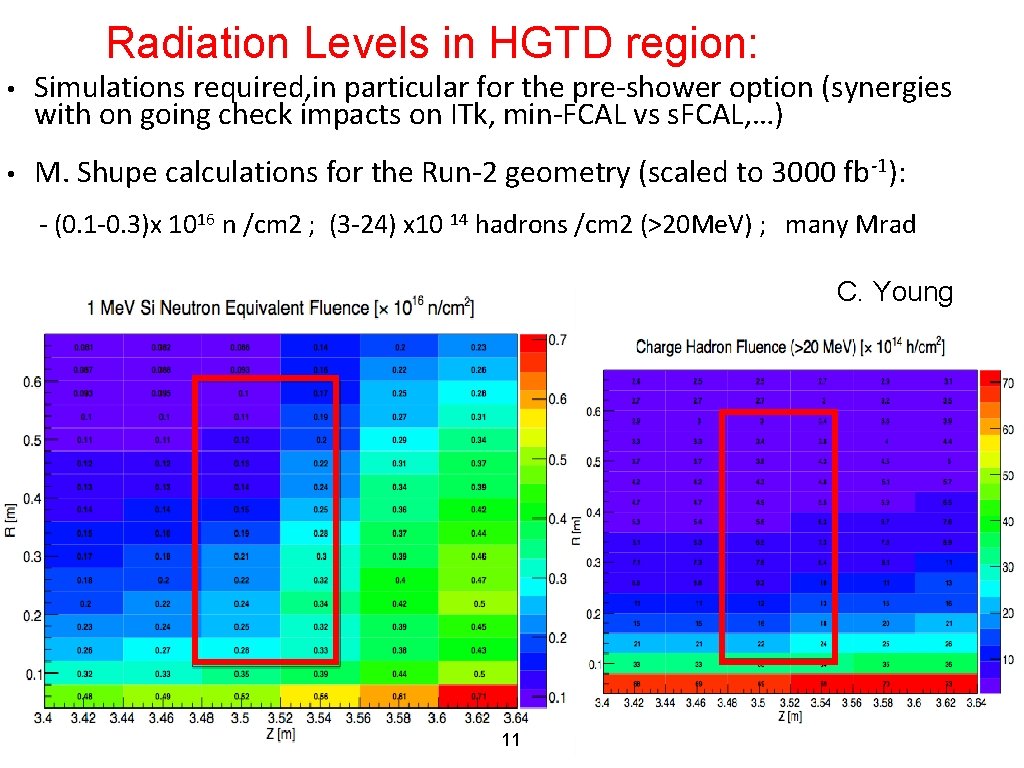
Radiation Levels in HGTD region: • Simulations required, in particular for the pre-shower option (synergies with on going check impacts on ITk, min-FCAL vs s. FCAL, …) • M. Shupe calculations for the Run-2 geometry (scaled to 3000 fb-1): - (0. 1 -0. 3)x 1016 n /cm 2 ; (3 -24) x 10 14 hadrons /cm 2 (>20 Me. V) ; many Mrad C. Young 11
HGTD general information • Please subscribe to email list ! : atlas-larg-upgrade-hgtiming@cern. ch • Twiki: https: //twiki. cern. ch/twiki/bin/view/LAr/High. Granularity. Timing. Detector • Meetings (~ monthly, Friday 3 pm) Indico: https: //indico. cern. ch/category/6660/ • Meetings in 2015 : 3 July; 4 Sept. ; 2 Oct. ; 6 Nov. ; 4 Dec 12
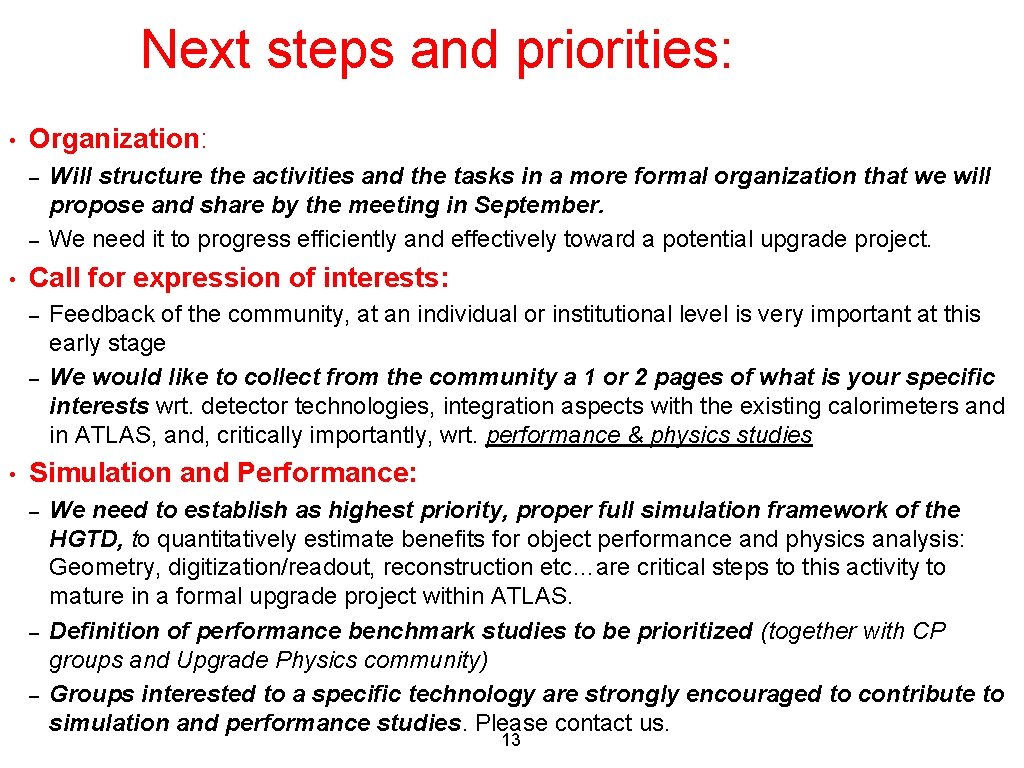
Next steps and priorities: • Organization: – – • Call for expression of interests: – – • Will structure the activities and the tasks in a more formal organization that we will propose and share by the meeting in September. We need it to progress efficiently and effectively toward a potential upgrade project. Feedback of the community, at an individual or institutional level is very important at this early stage We would like to collect from the community a 1 or 2 pages of what is your specific interests wrt. detector technologies, integration aspects with the existing calorimeters and in ATLAS, and, critically importantly, wrt. performance & physics studies Simulation and Performance: – – – We need to establish as highest priority, proper full simulation framework of the HGTD, to quantitatively estimate benefits for object performance and physics analysis: Geometry, digitization/readout, reconstruction etc…are critical steps to this activity to mature in a formal upgrade project within ATLAS. Definition of performance benchmark studies to be prioritized (together with CP groups and Upgrade Physics community) Groups interested to a specific technology are strongly encouraged to contribute to simulation and performance studies. Please contact us. 13
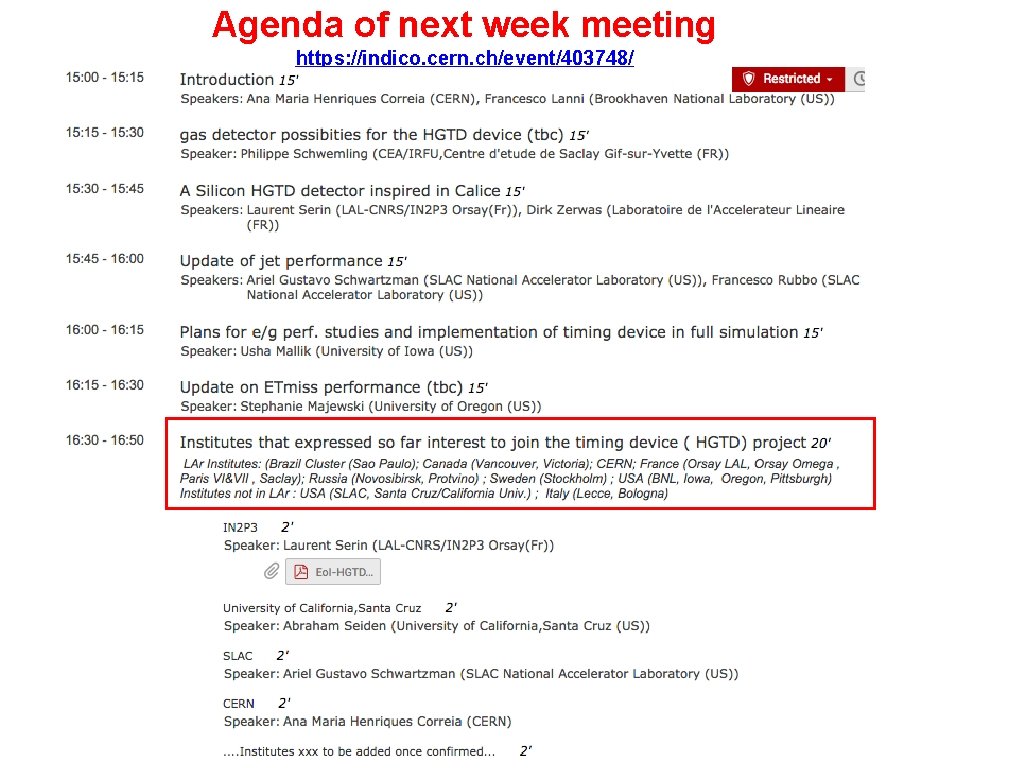
Agenda of next week meeting https: //indico. cern. ch/event/403748/