
HGL and EGL It is often convenient to
- Slides: 14
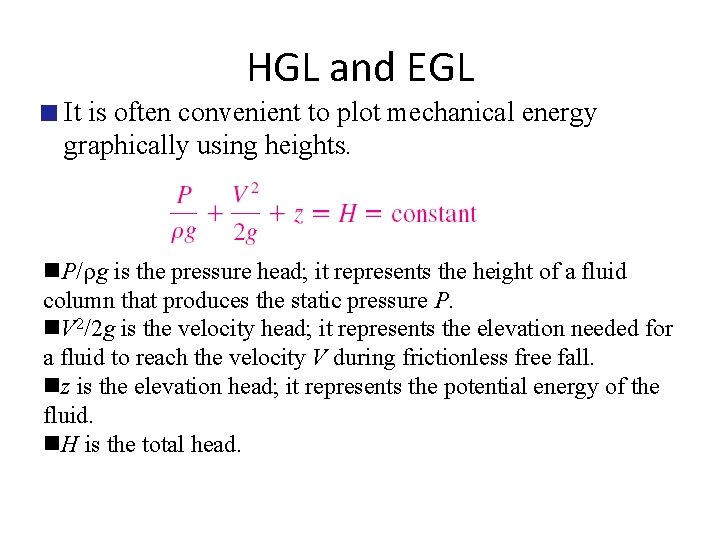
HGL and EGL It is often convenient to plot mechanical energy graphically using heights. n. P/rg is the pressure head; it represents the height of a fluid column that produces the static pressure P. n. V 2/2 g is the velocity head; it represents the elevation needed for a fluid to reach the velocity V during frictionless free fall. nz is the elevation head; it represents the potential energy of the fluid. n. H is the total head.
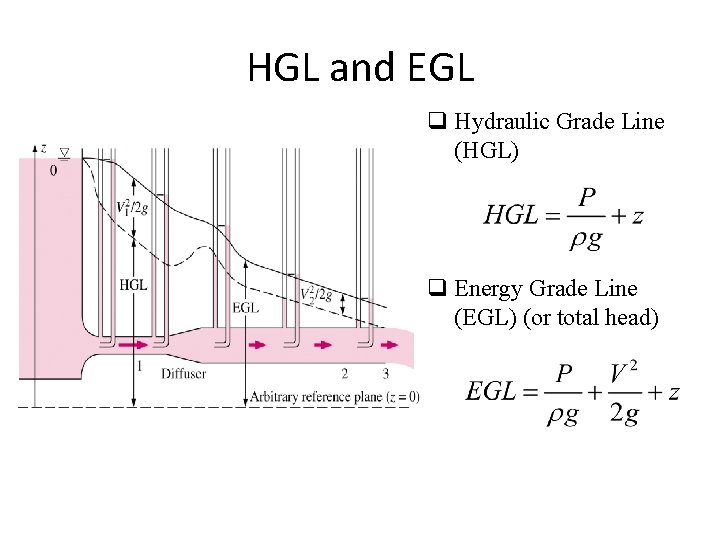
HGL and EGL q Hydraulic Grade Line (HGL) q Energy Grade Line (EGL) (or total head)
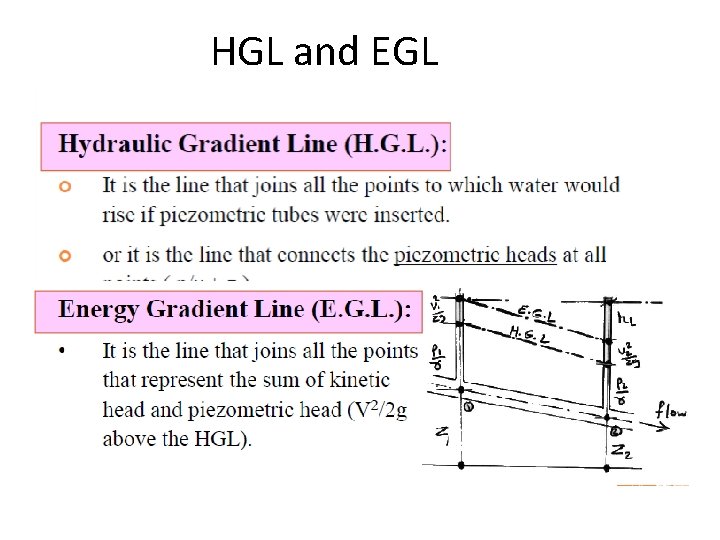
HGL and EGL
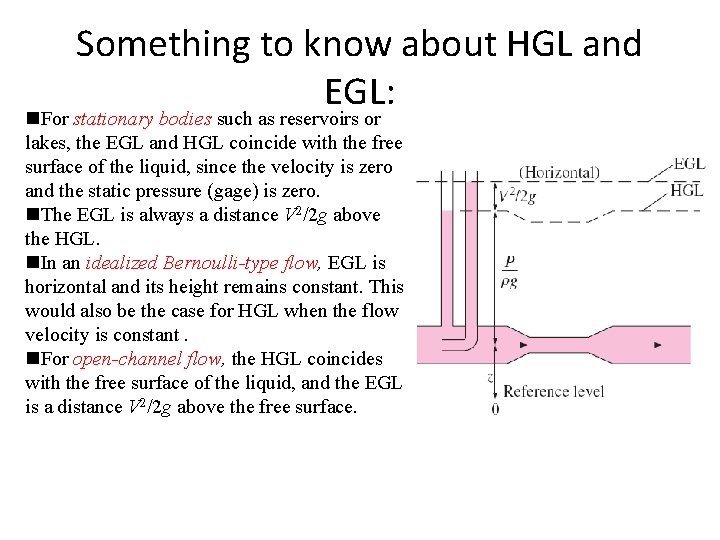
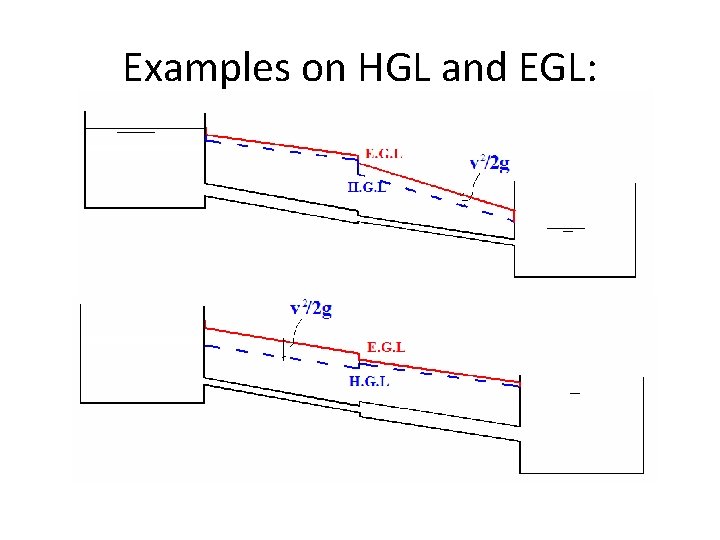
Something to know about HGL and EGL: n. For stationary bodies such as reservoirs or lakes, the EGL and HGL coincide with the free surface of the liquid, since the velocity is zero and the static pressure (gage) is zero. n. The EGL is always a distance V 2/2 g above the HGL. n. In an idealized Bernoulli-type flow, EGL is horizontal and its height remains constant. This would also be the case for HGL when the flow velocity is constant. n. For open-channel flow, the HGL coincides with the free surface of the liquid, and the EGL is a distance V 2/2 g above the free surface.
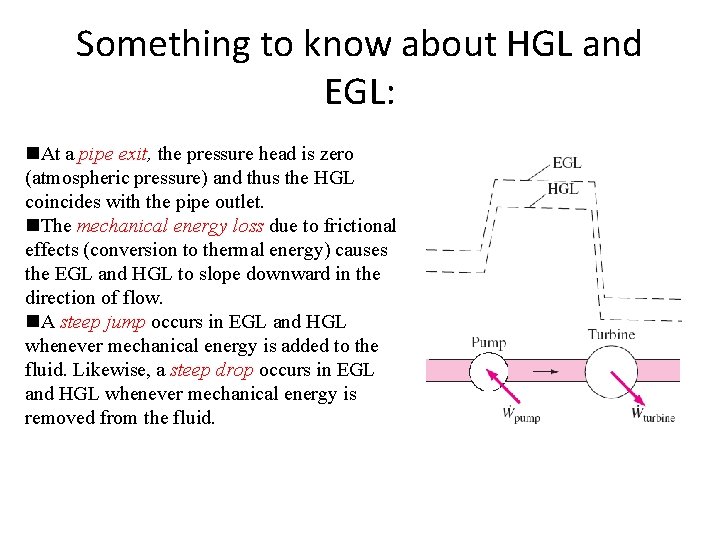
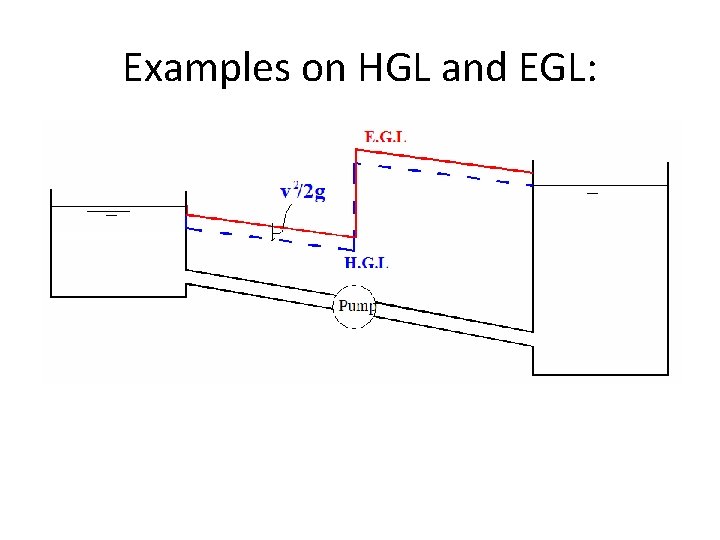
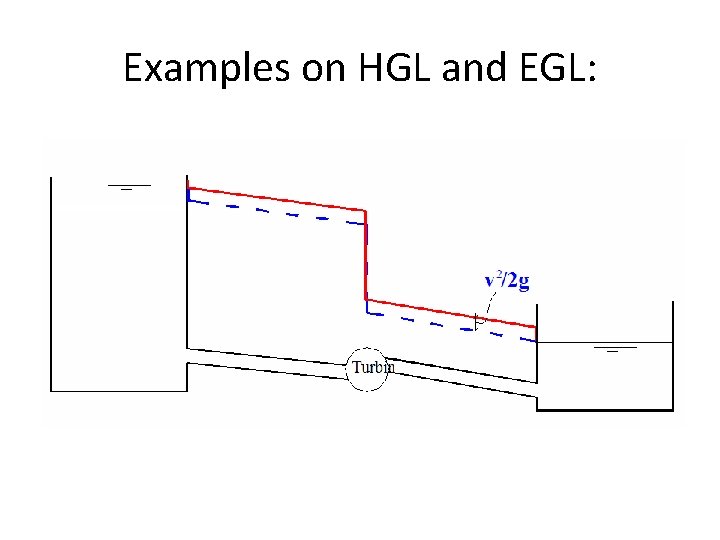
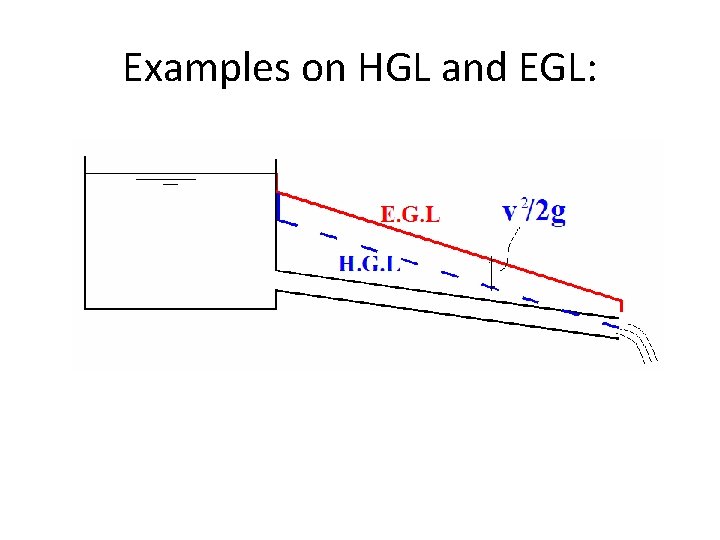
Something to know about HGL and EGL: n. At a pipe exit, the pressure head is zero (atmospheric pressure) and thus the HGL coincides with the pipe outlet. n. The mechanical energy loss due to frictional effects (conversion to thermal energy) causes the EGL and HGL to slope downward in the direction of flow. n. A steep jump occurs in EGL and HGL whenever mechanical energy is added to the fluid. Likewise, a steep drop occurs in EGL and HGL whenever mechanical energy is removed from the fluid.
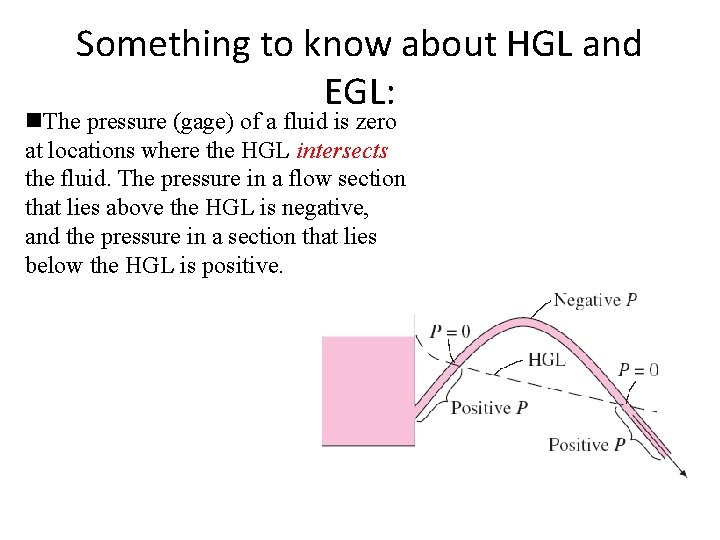
Something to know about HGL and EGL: n. The pressure (gage) of a fluid is zero at locations where the HGL intersects the fluid. The pressure in a flow section that lies above the HGL is negative, and the pressure in a section that lies below the HGL is positive.
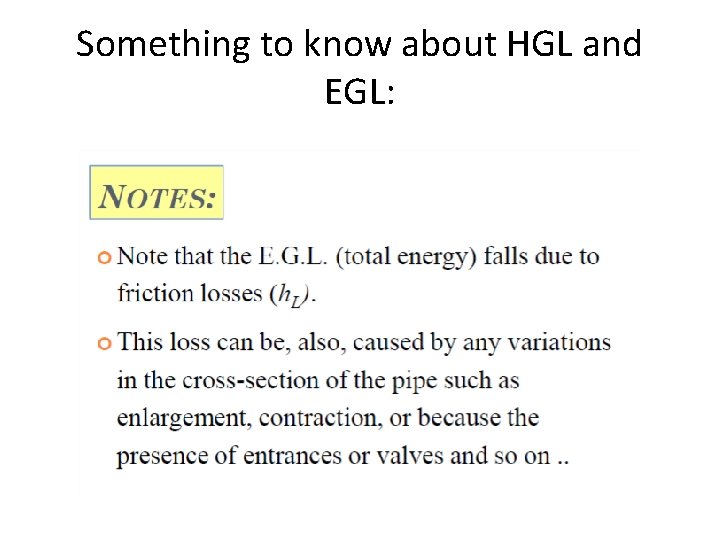
Something to know about HGL and EGL:
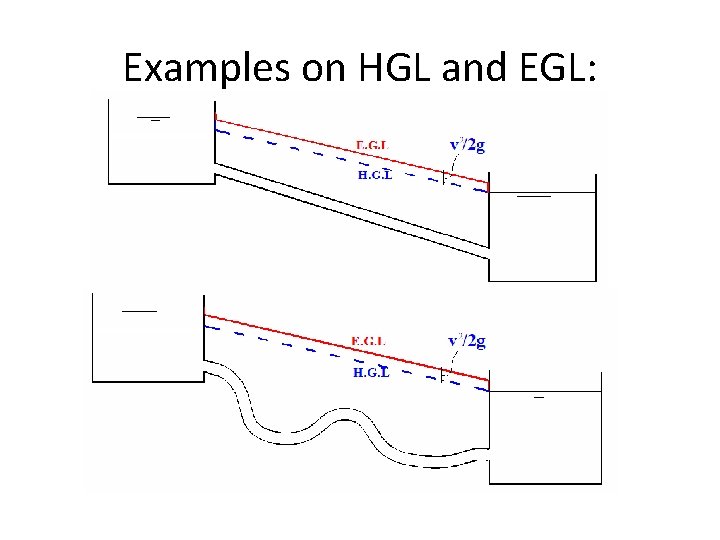
Examples on HGL and EGL:
Examples on HGL and EGL:
Examples on HGL and EGL:
Examples on HGL and EGL:
Examples on HGL and EGL:
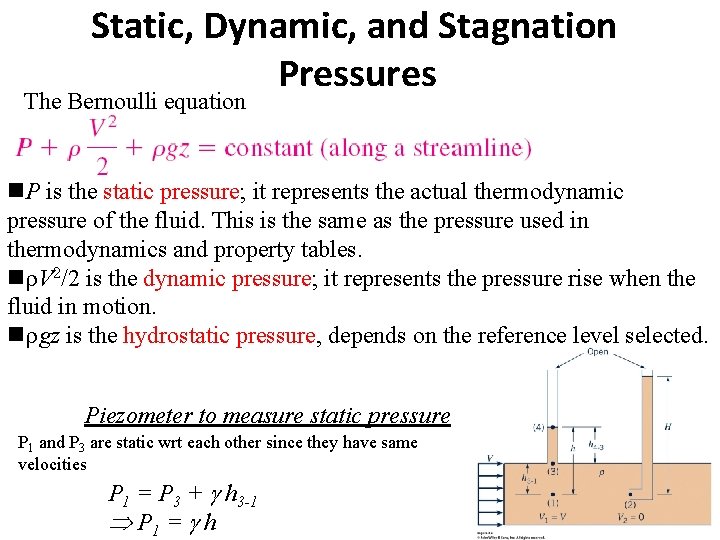
Static, Dynamic, and Stagnation Pressures The Bernoulli equation n. P is the static pressure; it represents the actual thermodynamic pressure of the fluid. This is the same as the pressure used in thermodynamics and property tables. nr. V 2/2 is the dynamic pressure; it represents the pressure rise when the fluid in motion. nrgz is the hydrostatic pressure, depends on the reference level selected. Piezometer to measure static pressure P 1 and P 3 are static wrt each other since they have same velocities P 1 = P 3 + g h 3 -1 P 1 = g h
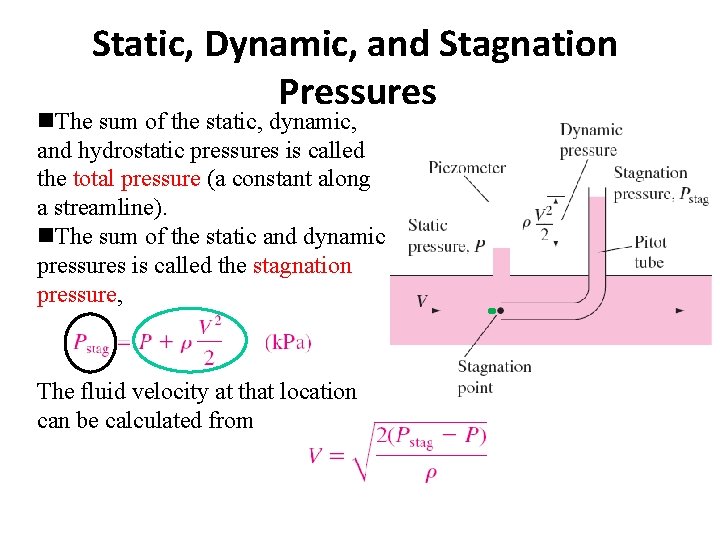
Static, Dynamic, and Stagnation Pressures n. The sum of the static, dynamic, and hydrostatic pressures is called the total pressure (a constant along a streamline). n. The sum of the static and dynamic pressures is called the stagnation pressure, The fluid velocity at that location can be calculated from