
Hg Cd Te Avalanche Photodiode Arrays for Wavefront
- Slides: 29
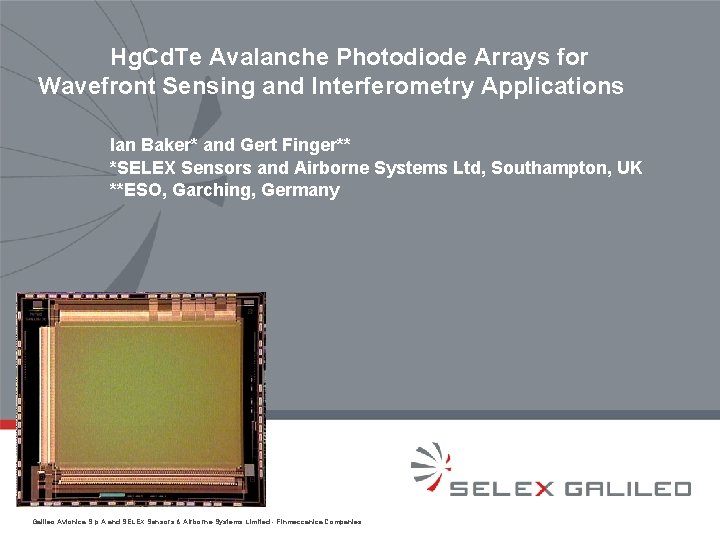
Hg. Cd. Te Avalanche Photodiode Arrays for Wavefront Sensing and Interferometry Applications Ian Baker* and Gert Finger** *SELEX Sensors and Airborne Systems Ltd, Southampton, UK **ESO, Garching, Germany Galileo Avionica S. p. A and SELEX Sensors & Airborne Systems Limited - Finmeccanica Companies
Avalanche gain in Hg. Cd. Te – a unique material • Electron/hole mass ratio very large – electron gets all the energy – single carrier cascade process gives low added noise • The conduction band of Hg. Cd. Te devoid of any low-lying secondary minima, which allows for large electron energy excursions deep into the band, and hence the high probability of impact ionization, with the generation of electron-hole pairs. Avalanche photodiodes • Voltage controlled gain at the point of absorption • Almost no additional noise • Near-zero power consumption • Up to GHz bandwidth • Requires no silicon real estate Quite a useful component! Galileo Avionica S. p. A and SELEX Sensors & Airborne Systems Limited - Finmeccanica Companies 2
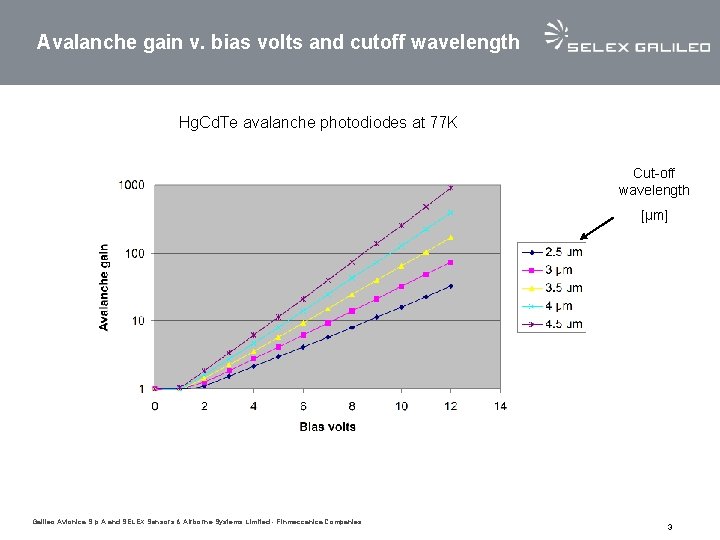
Avalanche gain v. bias volts and cutoff wavelength Hg. Cd. Te avalanche photodiodes at 77 K Cut-off wavelength [μm] Galileo Avionica S. p. A and SELEX Sensors & Airborne Systems Limited - Finmeccanica Companies 3
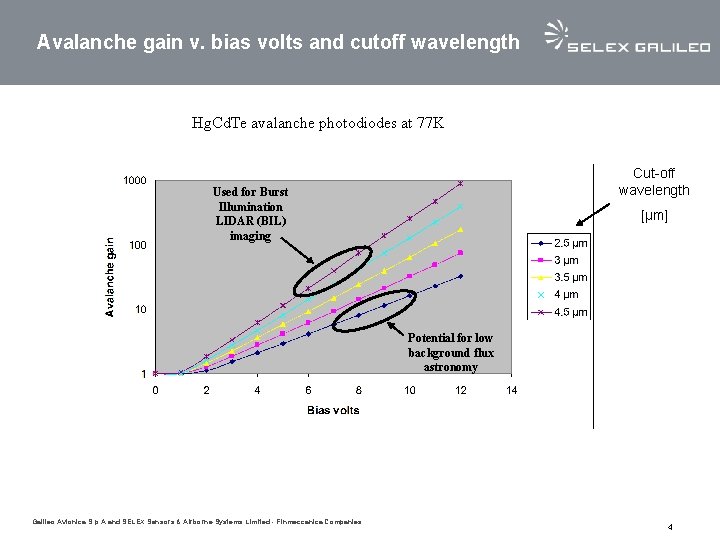
Avalanche gain v. bias volts and cutoff wavelength Hg. Cd. Te avalanche photodiodes at 77 K Cut-off wavelength Used for Burst Illumination LIDAR (BIL) imaging [μm] Potential for low background flux astronomy Galileo Avionica S. p. A and SELEX Sensors & Airborne Systems Limited - Finmeccanica Companies 4
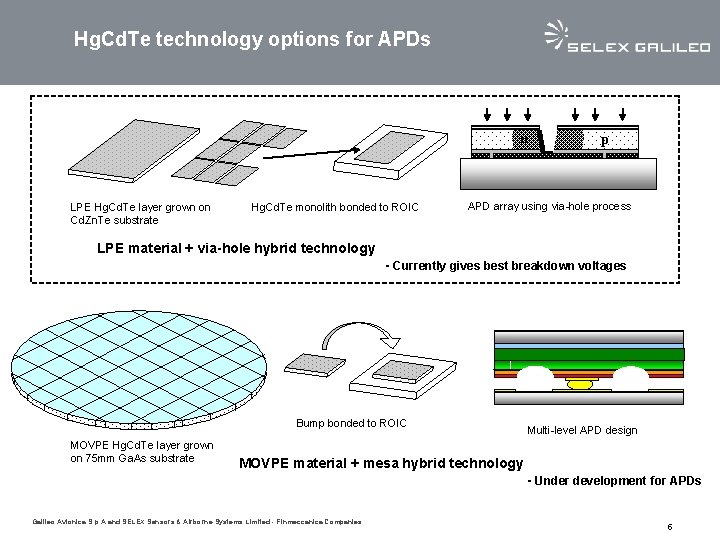
Hg. Cd. Te technology options for APDs n LPE Hg. Cd. Te layer grown on Cd. Zn. Te substrate Hg. Cd. Te monolith bonded to ROIC p APD array using via-hole process LPE material + via-hole hybrid technology - Currently gives best breakdown voltages Bump bonded to ROIC MOVPE Hg. Cd. Te layer grown on 75 mm Ga. As substrate Multi-level APD design MOVPE material + mesa hybrid technology - Under development for APDs Galileo Avionica S. p. A and SELEX Sensors & Airborne Systems Limited - Finmeccanica Companies 5
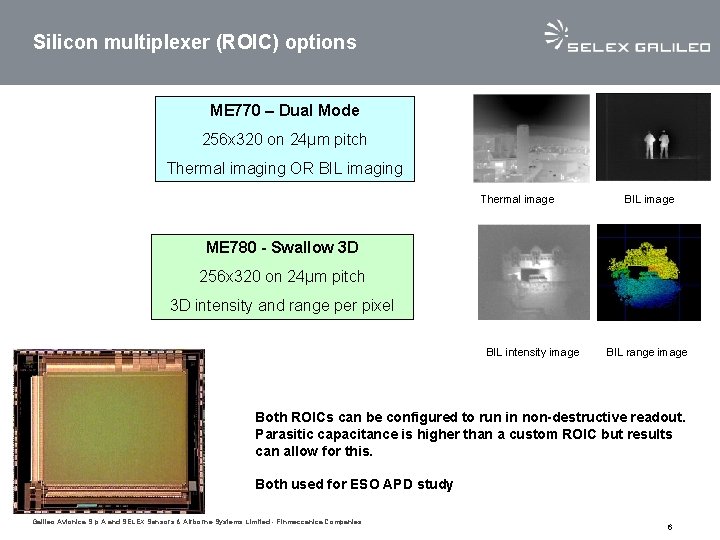
Silicon multiplexer (ROIC) options ME 770 – Dual Mode 256 x 320 on 24µm pitch Thermal imaging OR BIL imaging Thermal image BIL image ME 780 - Swallow 3 D 256 x 320 on 24µm pitch 3 D intensity and range per pixel BIL intensity image BIL range image Both ROICs can be configured to run in non-destructive readout. Parasitic capacitance is higher than a custom ROIC but results can allow for this. Both used for ESO APD study Galileo Avionica S. p. A and SELEX Sensors & Airborne Systems Limited - Finmeccanica Companies 6
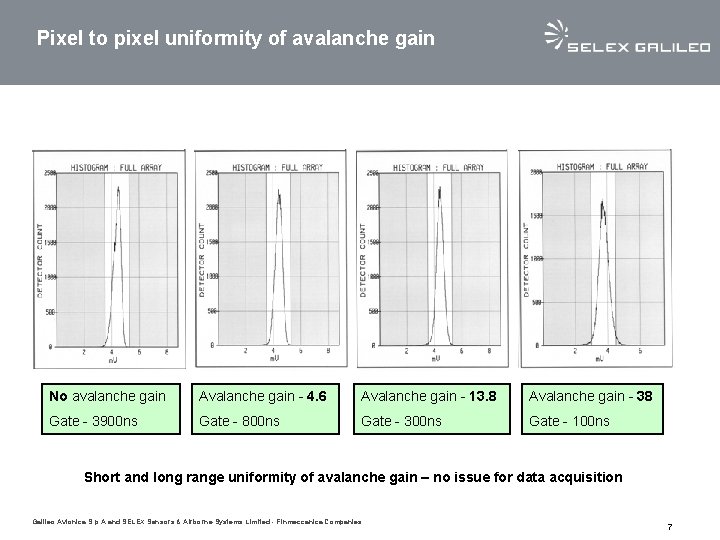
Pixel to pixel uniformity of avalanche gain No avalanche gain Avalanche gain - 4. 6 Avalanche gain - 13. 8 Avalanche gain - 38 Gate - 3900 ns Gate - 800 ns Gate - 300 ns Gate - 100 ns Short and long range uniformity of avalanche gain – no issue for data acquisition Galileo Avionica S. p. A and SELEX Sensors & Airborne Systems Limited - Finmeccanica Companies 7
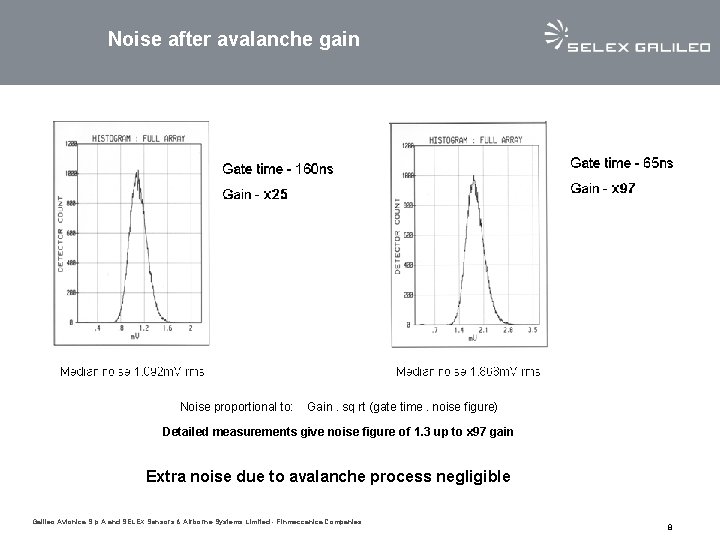
Noise after avalanche gain Noise proportional to: Gain. sq rt (gate time. noise figure) Detailed measurements give noise figure of 1. 3 up to x 97 gain Extra noise due to avalanche process negligible Galileo Avionica S. p. A and SELEX Sensors & Airborne Systems Limited - Finmeccanica Companies 8
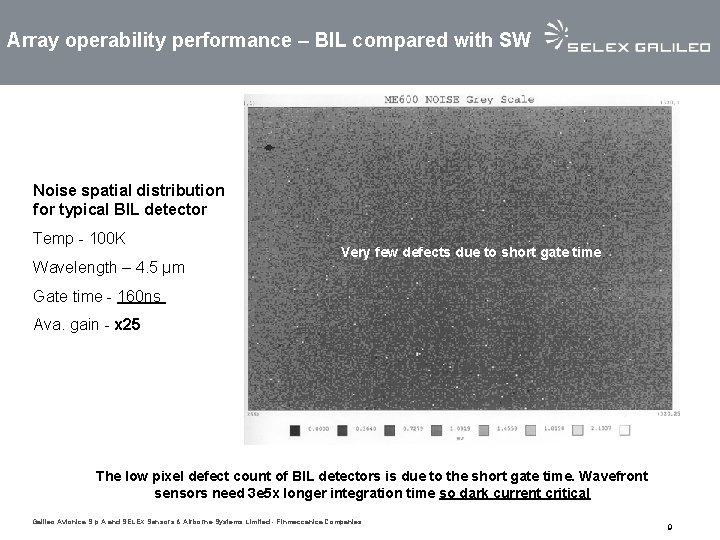
Array operability performance – BIL compared with SW Noise spatial distribution for typical BIL detector Temp - 100 K Wavelength – 4. 5 μm Very few defects due to short gate time Gate time - 160 ns Ava. gain - x 25 The low pixel defect count of BIL detectors is due to the short gate time. Wavefront sensors need 3 e 5 x longer integration time so dark current critical Galileo Avionica S. p. A and SELEX Sensors & Airborne Systems Limited - Finmeccanica Companies 9
Avalanche gain for wavefront sensors How does avalanche gain benefit wavefront sensors? Typical requirement: Integration time – 1. 0 to 5. 0 ms Waveband – 1. 0 to 2. 5 µm Multiple non-destructive readouts Sensitivity in noise-equivalent-photons (NEPh) – 3 photons rms [Note NEPh a better Figure of Merit for APDs] Galileo Avionica S. p. A and SELEX Sensors & Airborne Systems Limited - Finmeccanica Companies 10
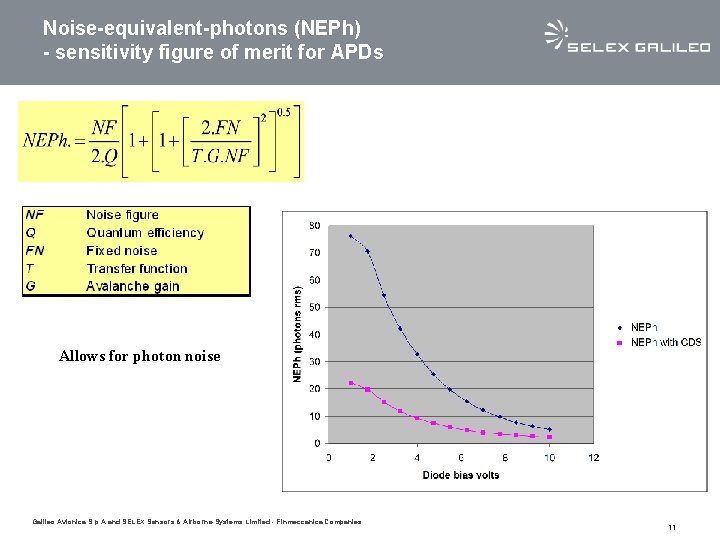
Noise-equivalent-photons (NEPh) - sensitivity figure of merit for APDs Allows for photon noise Galileo Avionica S. p. A and SELEX Sensors & Airborne Systems Limited - Finmeccanica Companies 11
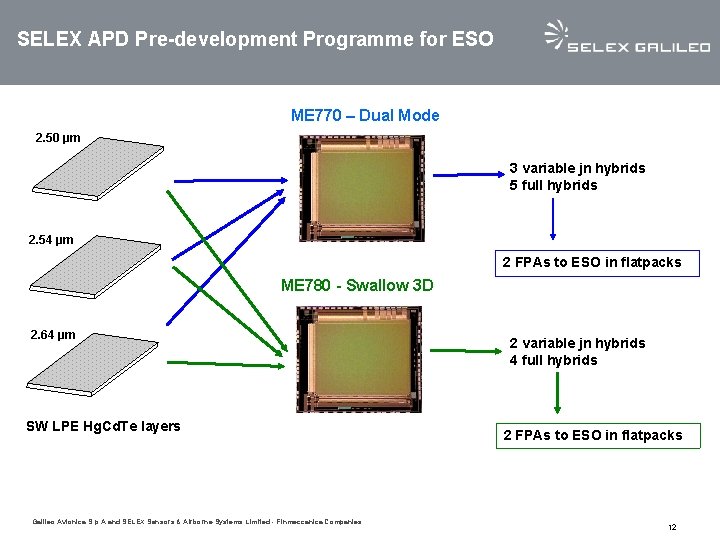
SELEX APD Pre-development Programme for ESO ME 770 – Dual Mode 2. 50 μm 3 variable jn hybrids 5 full hybrids 2. 54 μm 2 FPAs to ESO in flatpacks ME 780 - Swallow 3 D 2. 64 μm SW LPE Hg. Cd. Te layers Galileo Avionica S. p. A and SELEX Sensors & Airborne Systems Limited - Finmeccanica Companies 2 variable jn hybrids 4 full hybrids 2 FPAs to ESO in flatpacks 12
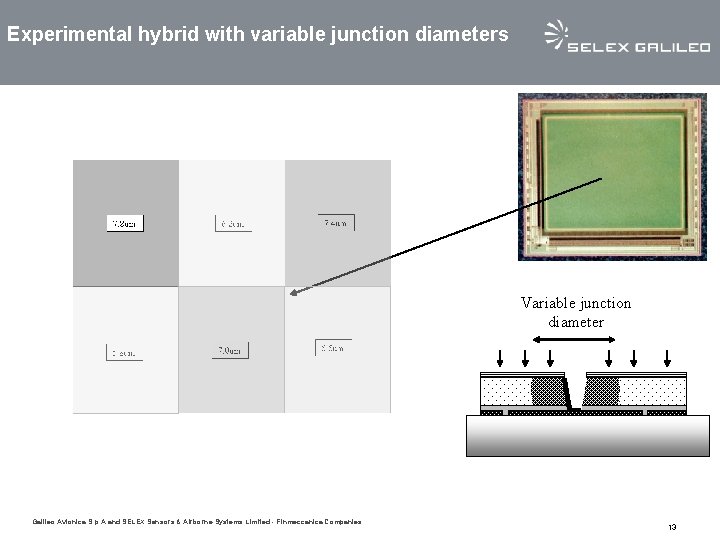
Experimental hybrid with variable junction diameters Variable junction diameter Galileo Avionica S. p. A and SELEX Sensors & Airborne Systems Limited - Finmeccanica Companies 13
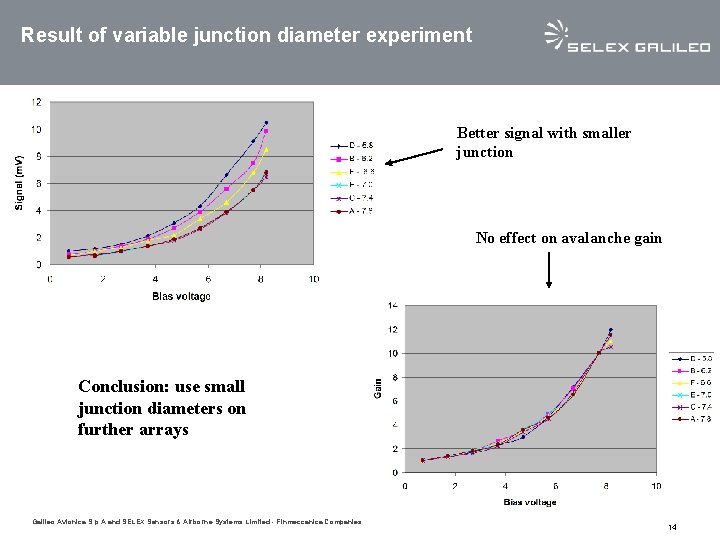
Result of variable junction diameter experiment Better signal with smaller junction No effect on avalanche gain Conclusion: use small junction diameters on further arrays Galileo Avionica S. p. A and SELEX Sensors & Airborne Systems Limited - Finmeccanica Companies 14
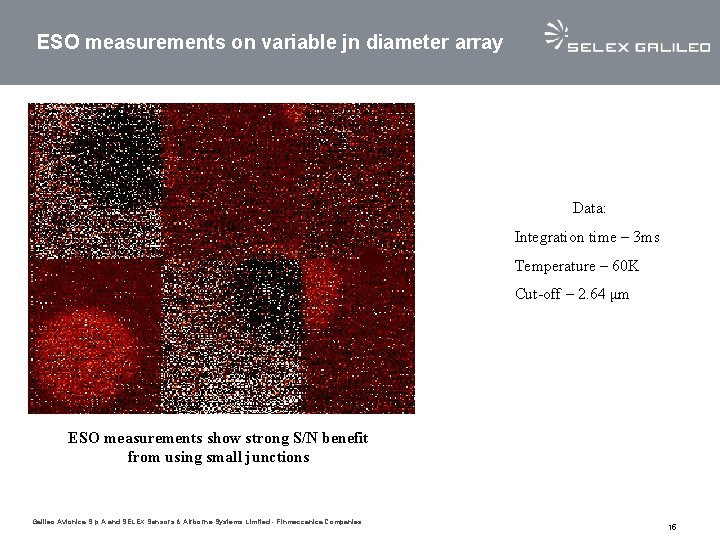
ESO measurements on variable jn diameter array Data: Integration time – 3 ms Temperature – 60 K Cut-off – 2. 64 μm ESO measurements show strong S/N benefit from using small junctions Galileo Avionica S. p. A and SELEX Sensors & Airborne Systems Limited - Finmeccanica Companies 15
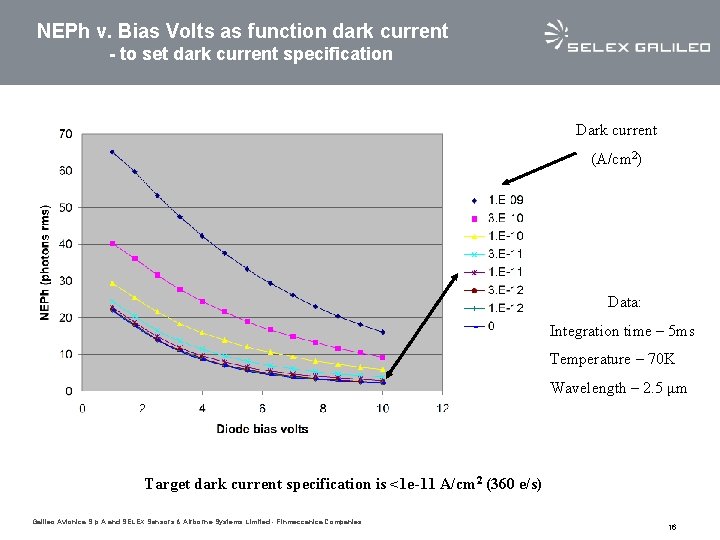
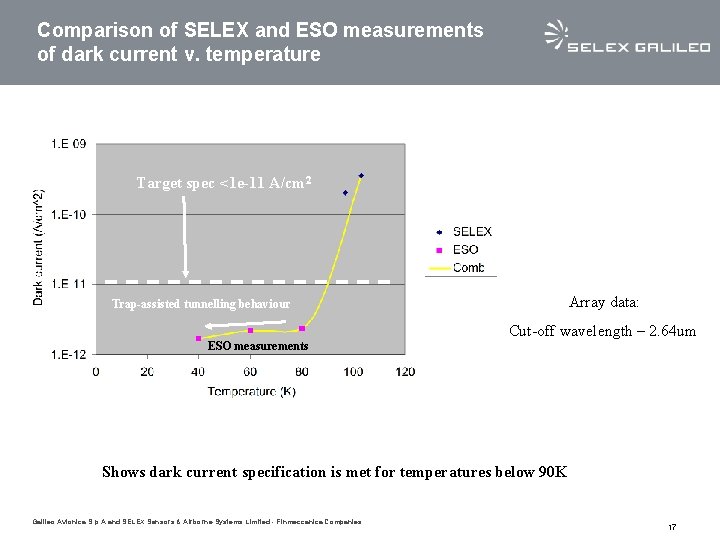
NEPh v. Bias Volts as function dark current - to set dark current specification Dark current (A/cm 2) Data: Integration time – 5 ms Temperature – 70 K Wavelength – 2. 5 μm Target dark current specification is <1 e-11 A/cm 2 (360 e/s) Galileo Avionica S. p. A and SELEX Sensors & Airborne Systems Limited - Finmeccanica Companies 16
Comparison of SELEX and ESO measurements of dark current v. temperature Target spec <1 e-11 A/cm 2 Array data: Trap-assisted tunnelling behaviour Cut-off wavelength – 2. 64 um ESO measurements Shows dark current specification is met for temperatures below 90 K Galileo Avionica S. p. A and SELEX Sensors & Airborne Systems Limited - Finmeccanica Companies 17
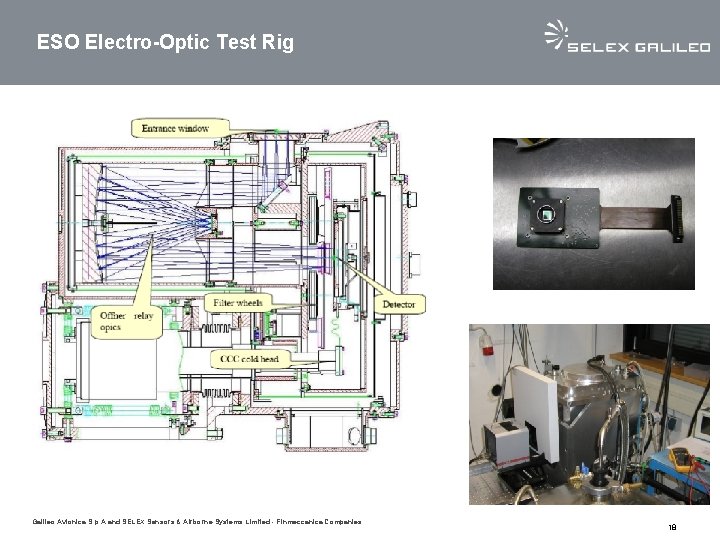
ESO Electro-Optic Test Rig Galileo Avionica S. p. A and SELEX Sensors & Airborne Systems Limited - Finmeccanica Companies 18
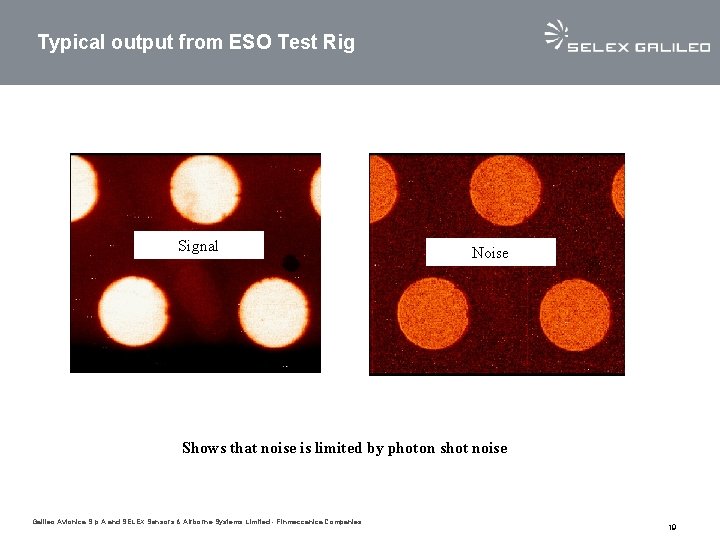
Typical output from ESO Test Rig Signal Noise Shows that noise is limited by photon shot noise Galileo Avionica S. p. A and SELEX Sensors & Airborne Systems Limited - Finmeccanica Companies 19
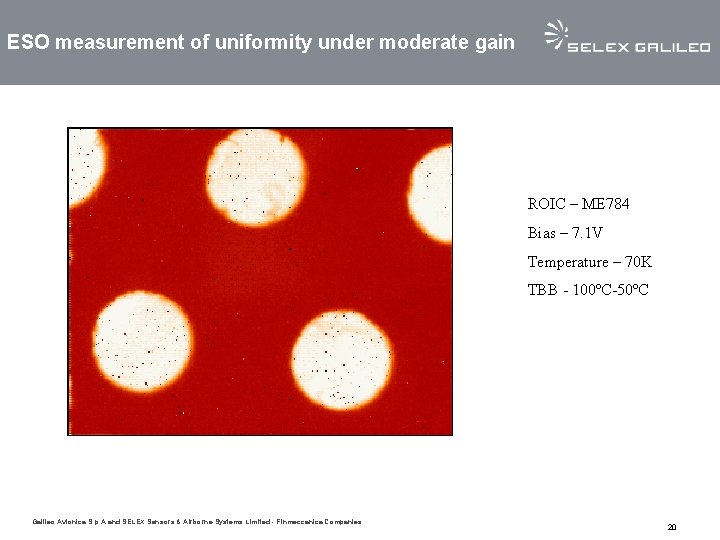
ESO measurement of uniformity under moderate gain ROIC – ME 784 Bias – 7. 1 V Temperature – 70 K TBB - 100ºC-50ºC Galileo Avionica S. p. A and SELEX Sensors & Airborne Systems Limited - Finmeccanica Companies 20
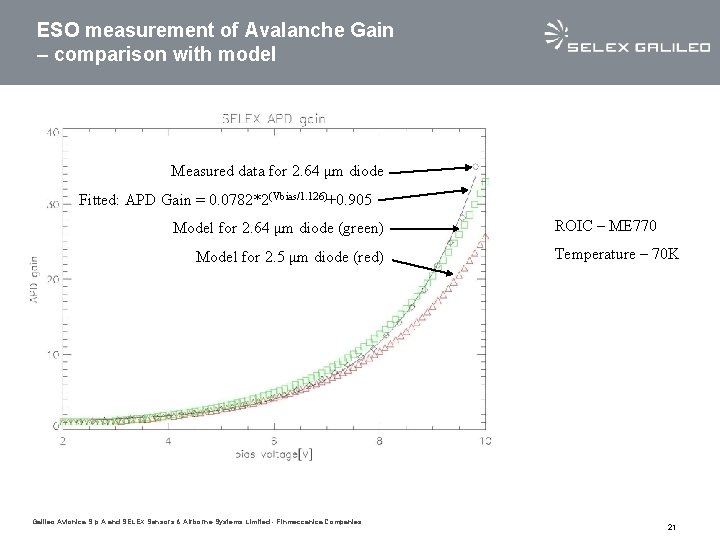
ESO measurement of Avalanche Gain – comparison with model Measured data for 2. 64 μm diode Fitted: APD Gain = 0. 0782*2(Vbias/1. 126)+0. 905 Model for 2. 64 μm diode (green) Model for 2. 5 μm diode (red) Galileo Avionica S. p. A and SELEX Sensors & Airborne Systems Limited - Finmeccanica Companies ROIC – ME 770 Temperature – 70 K 21
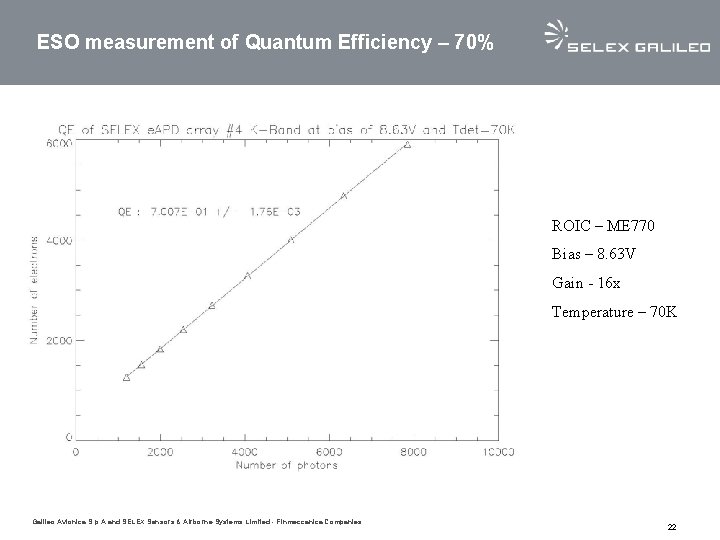
ESO measurement of Quantum Efficiency – 70% ROIC – ME 770 Bias – 8. 63 V Gain - 16 x Temperature – 70 K Galileo Avionica S. p. A and SELEX Sensors & Airborne Systems Limited - Finmeccanica Companies 22
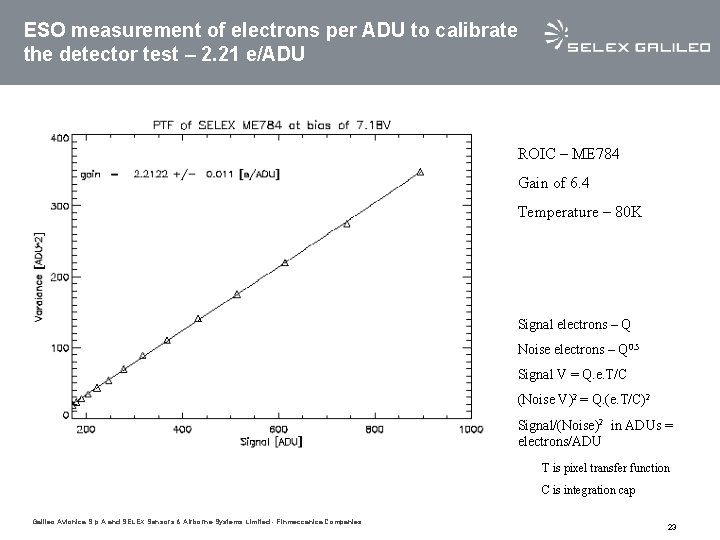
ESO measurement of electrons per ADU to calibrate the detector test – 2. 21 e/ADU ROIC – ME 784 Gain of 6. 4 Temperature – 80 K Signal electrons – Q Noise electrons – Q 0. 5 Signal V = Q. e. T/C (Noise V)2 = Q. (e. T/C)2 Signal/(Noise)2 in ADUs = electrons/ADU T is pixel transfer function C is integration cap Galileo Avionica S. p. A and SELEX Sensors & Airborne Systems Limited - Finmeccanica Companies 23
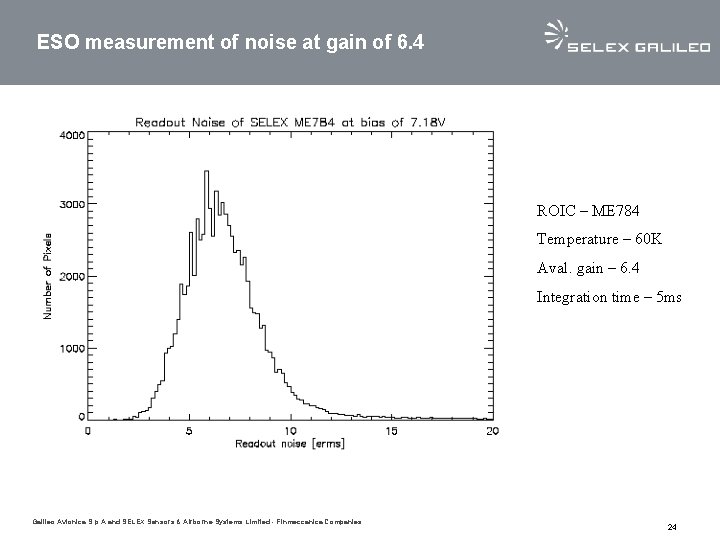
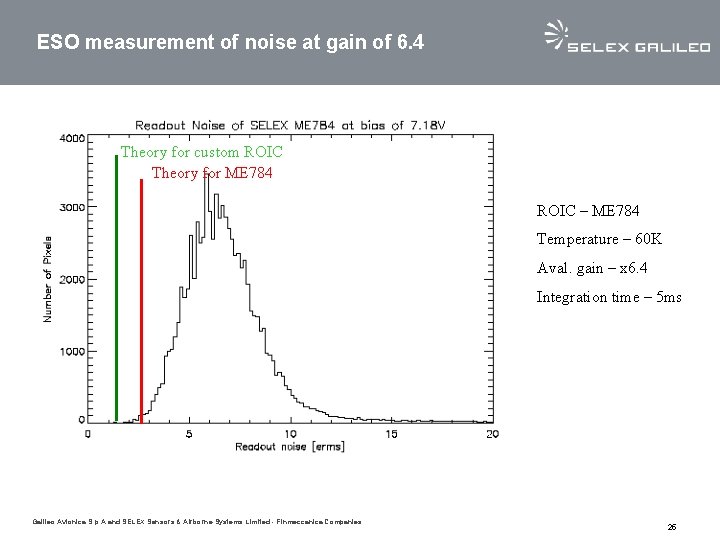
ESO measurement of noise at gain of 6. 4 ROIC – ME 784 Temperature – 60 K Aval. gain – 6. 4 Integration time – 5 ms Galileo Avionica S. p. A and SELEX Sensors & Airborne Systems Limited - Finmeccanica Companies 24
ESO measurement of noise at gain of 6. 4 Theory for custom ROIC Theory for ME 784 ROIC – ME 784 Temperature – 60 K Aval. gain – x 6. 4 Integration time – 5 ms Galileo Avionica S. p. A and SELEX Sensors & Airborne Systems Limited - Finmeccanica Companies 25
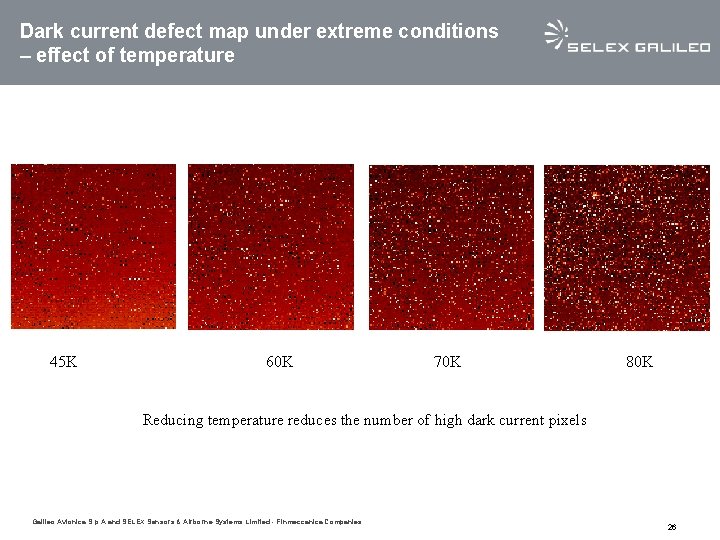
Dark current defect map under extreme conditions – effect of temperature 45 K 60 K 70 K 80 K Reducing temperature reduces the number of high dark current pixels Galileo Avionica S. p. A and SELEX Sensors & Airborne Systems Limited - Finmeccanica Companies 26
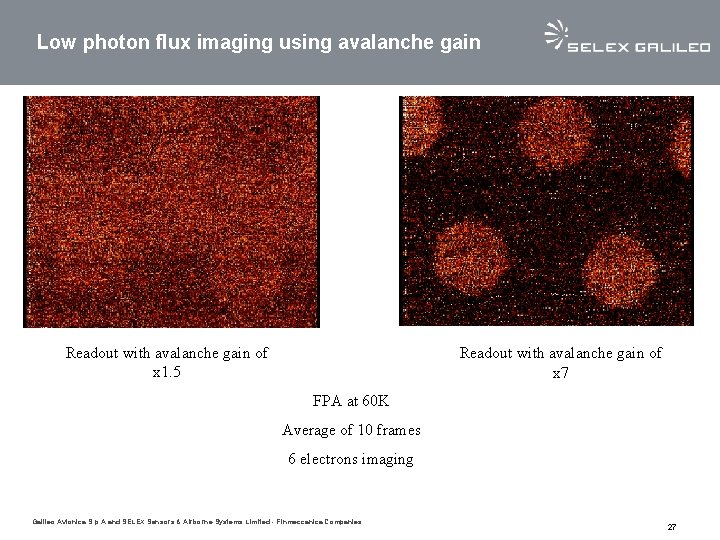
Low photon flux imaging using avalanche gain Readout with avalanche gain of x 1. 5 Readout with avalanche gain of x 7 FPA at 60 K Average of 10 frames 6 electrons imaging Galileo Avionica S. p. A and SELEX Sensors & Airborne Systems Limited - Finmeccanica Companies 27
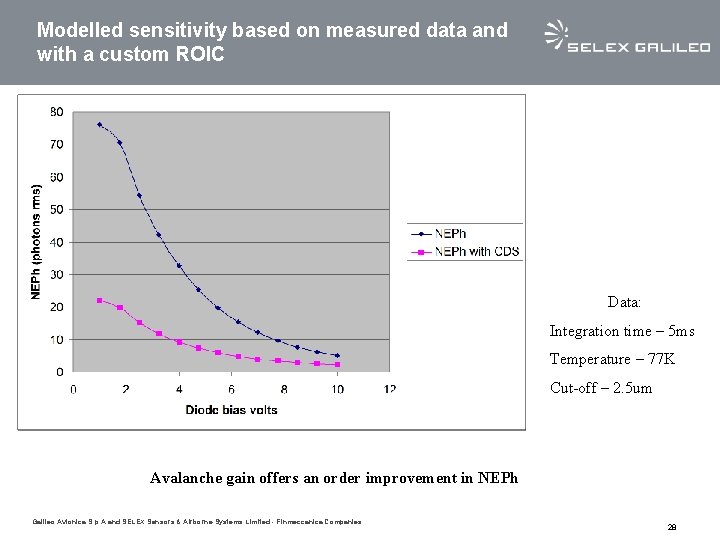
Modelled sensitivity based on measured data and with a custom ROIC Data: Integration time – 5 ms Temperature – 77 K Cut-off – 2. 5 um Avalanche gain offers an order improvement in NEPh Galileo Avionica S. p. A and SELEX Sensors & Airborne Systems Limited - Finmeccanica Companies 28
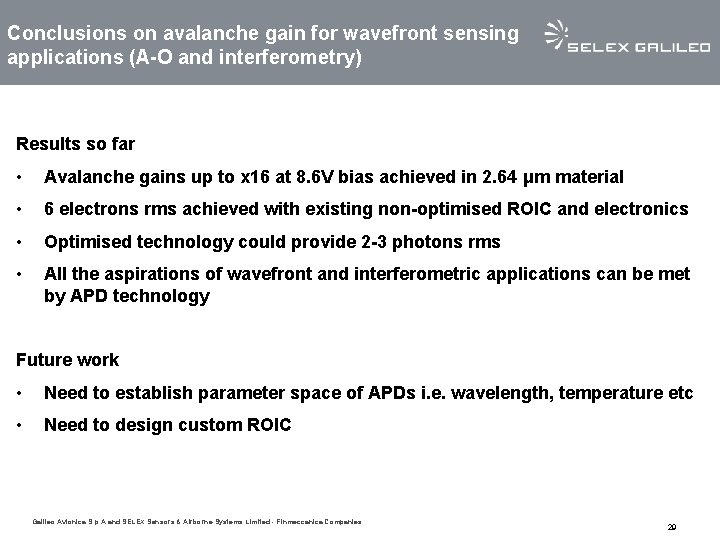
Conclusions on avalanche gain for wavefront sensing applications (A-O and interferometry) Results so far • Avalanche gains up to x 16 at 8. 6 V bias achieved in 2. 64 μm material • 6 electrons rms achieved with existing non-optimised ROIC and electronics • Optimised technology could provide 2 -3 photons rms • All the aspirations of wavefront and interferometric applications can be met by APD technology Future work • Need to establish parameter space of APDs i. e. wavelength, temperature etc • Need to design custom ROIC Galileo Avionica S. p. A and SELEX Sensors & Airborne Systems Limited - Finmeccanica Companies 29