
HFOV Theory of Operation and Controls Disclosure Slides


- Slides: 84
HFOV: Theory of Operation and Controls
Disclosure • Slides provided by Viasys free of charge for educational purposes • I have no financial affiliation with Viasys or any other medical company VIASYS Healthcare, Inc.
Objectives • To understand theory of operation for the 3100 A • Identify appropriate ventilator manipulations for desired effects on neonates • Understand the clinical care startegies while on the 3100 A HFOV VIASYS Healthcare, Inc.
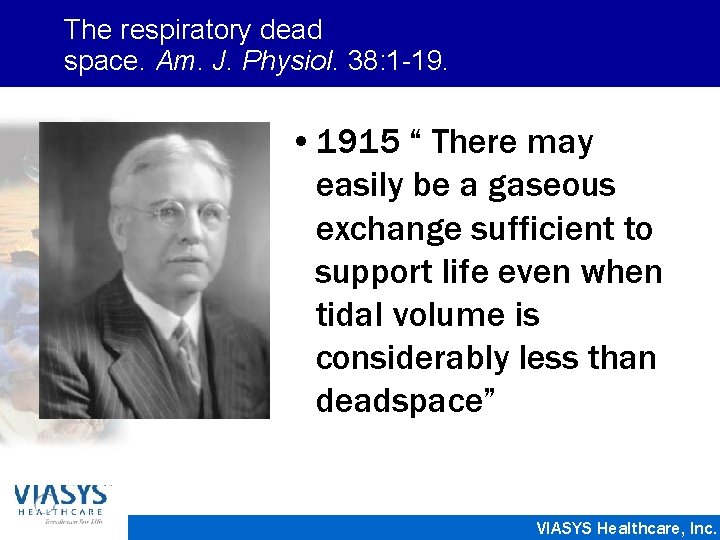
Dr Henderson–describes sub-anatomical Vt in panting dogs 1915 VIASYS Healthcare, Inc.
The respiratory dead space. Am. J. Physiol. 38: 1 -19. • 1915 “ There may easily be a gaseous exchange sufficient to support life even when tidal volume is considerably less than deadspace” VIASYS Healthcare, Inc.
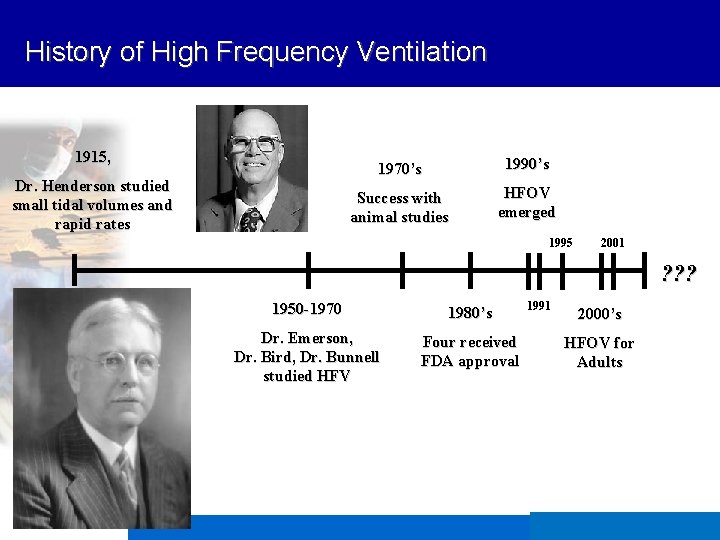
History of High Frequency Ventilation 1915, Dr. Henderson studied small tidal volumes and rapid rates 1970’s 1990’s Success with animal studies HFOV emerged 1995 2001 ? ? ? 1950 -1970 1980’s Dr. Emerson, Dr. Bird, Dr. Bunnell studied HFV Four received FDA approval 1991 2000’s HFOV for Adults VIASYS Healthcare, Inc.
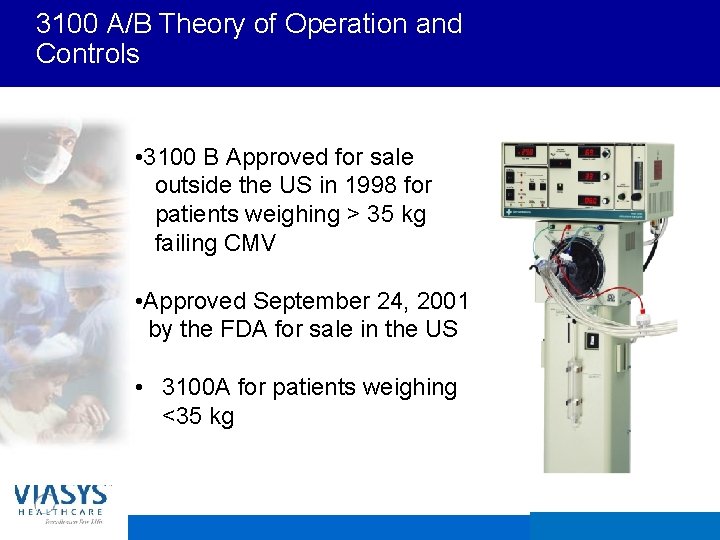
3100 A/B Theory of Operation and Controls • 3100 B Approved for sale outside the US in 1998 for patients weighing > 35 kg failing CMV • Approved September 24, 2001 by the FDA for sale in the US • 3100 A for patients weighing <35 kg VIASYS Healthcare, Inc.
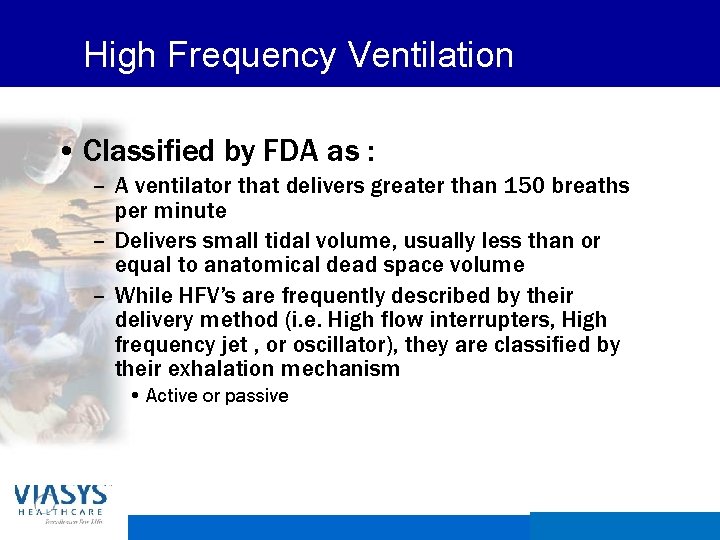
High Frequency Ventilation • Classified by FDA as : – A ventilator that delivers greater than 150 breaths per minute – Delivers small tidal volume, usually less than or equal to anatomical dead space volume – While HFV’s are frequently described by their delivery method (i. e. High flow interrupters, High frequency jet , or oscillator), they are classified by their exhalation mechanism • Active or passive VIASYS Healthcare, Inc.
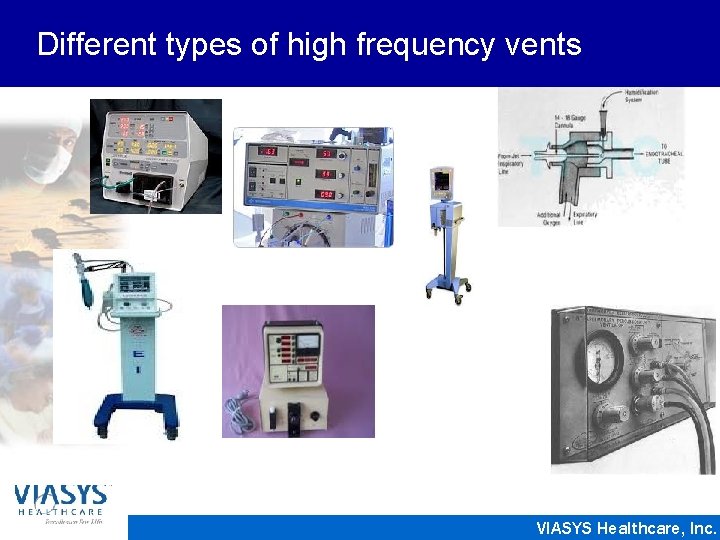
Different types of high frequency vents VIASYS Healthcare, Inc.
What Causes Lung Damage? • Pressure ? • Volume ? • Are there more mechanisms at play here? VIASYS Healthcare, Inc.
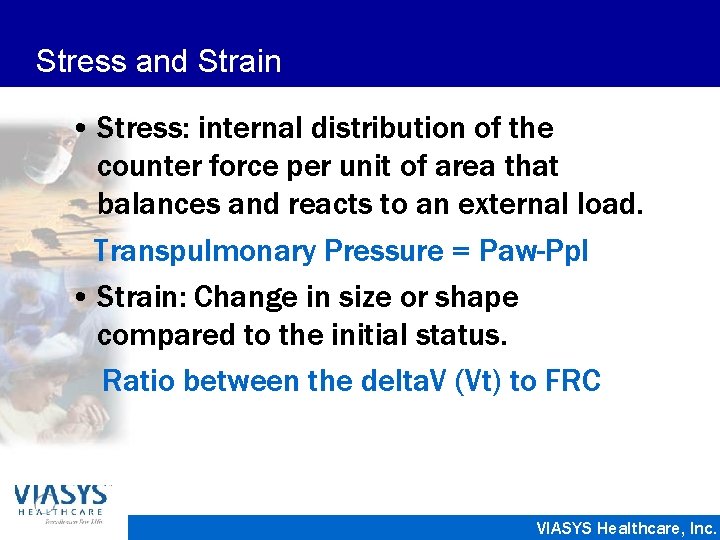
Stress and Strain • Stress: internal distribution of the counter force per unit of area that balances and reacts to an external load. Transpulmonary Pressure = Paw-Ppl • Strain: Change in size or shape compared to the initial status. Ratio between the delta. V (Vt) to FRC VIASYS Healthcare, Inc.
Ventilator Induced Lung Injury • All forms of positive pressure ventilation (PPV) can result in ventilator induced lung injury (VILI) • VILI is the result of a combination of the following processes – Barotrauma – Volutrauma – Atelectrauma- Repetitive opening and closing of the alveolus – Biotrauma VIASYS Healthcare, Inc.
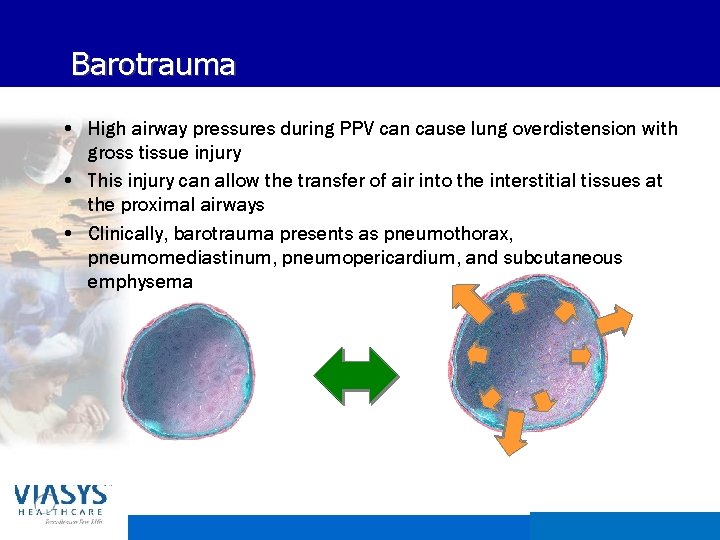
Barotrauma • High airway pressures during PPV can cause lung overdistension with gross tissue injury • This injury can allow the transfer of air into the interstitial tissues at the proximal airways • Clinically, barotrauma presents as pneumothorax, pneumomediastinum, pneumopericardium, and subcutaneous emphysema VIASYS Healthcare, Inc.
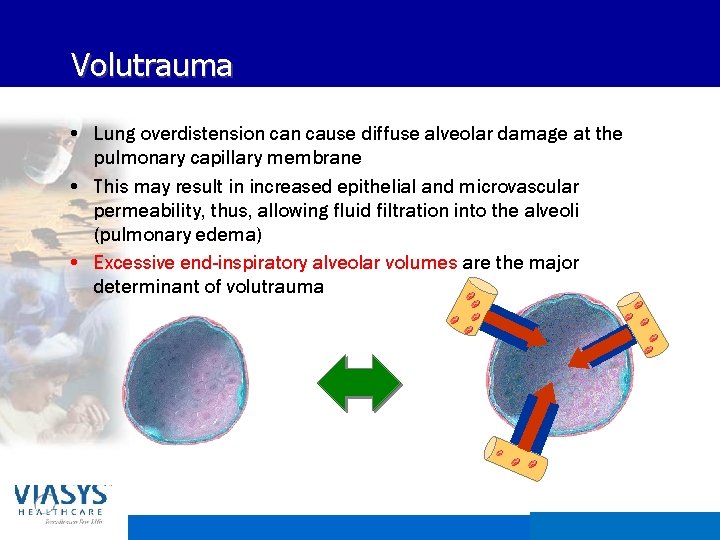
Volutrauma • Lung overdistension cause diffuse alveolar damage at the pulmonary capillary membrane • This may result in increased epithelial and microvascular permeability, thus, allowing fluid filtration into the alveoli (pulmonary edema) • Excessive end-inspiratory alveolar volumes are the major determinant of volutrauma VIASYS Healthcare, Inc.
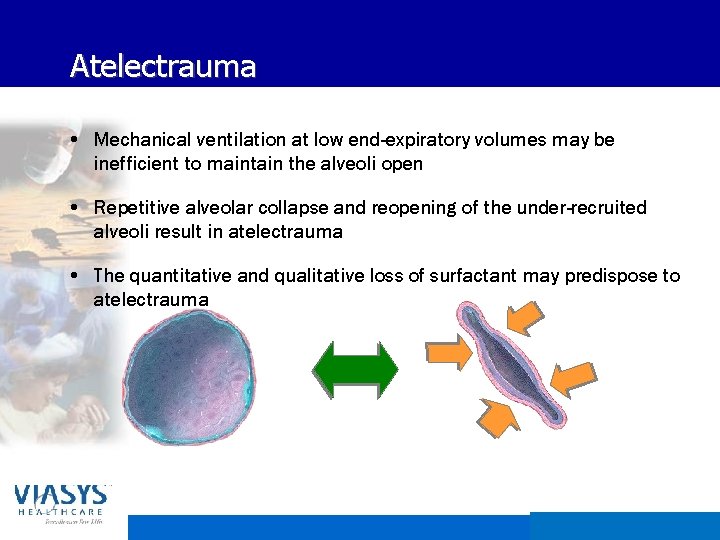
Atelectrauma • Mechanical ventilation at low end-expiratory volumes may be inefficient to maintain the alveoli open • Repetitive alveolar collapse and reopening of the under-recruited alveoli result in atelectrauma • The quantitative and qualitative loss of surfactant may predispose to atelectrauma VIASYS Healthcare, Inc.
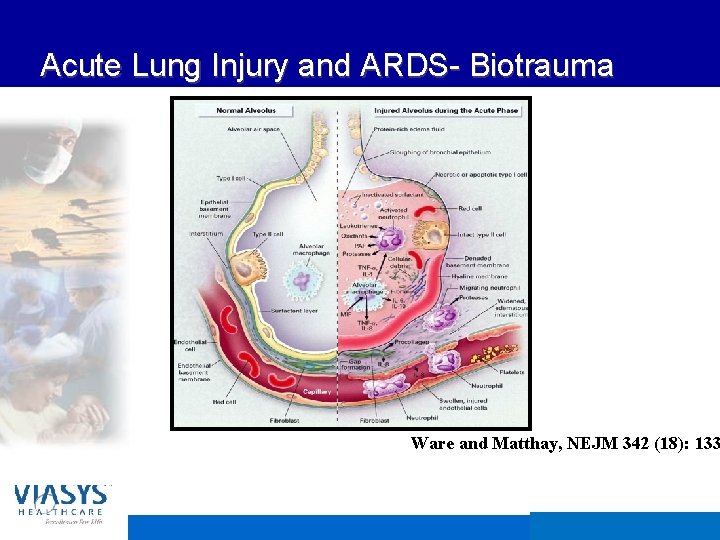
Acute Lung Injury and ARDS- Biotrauma Ware and Matthay, NEJM 342 (18): 133 VIASYS Healthcare, Inc.
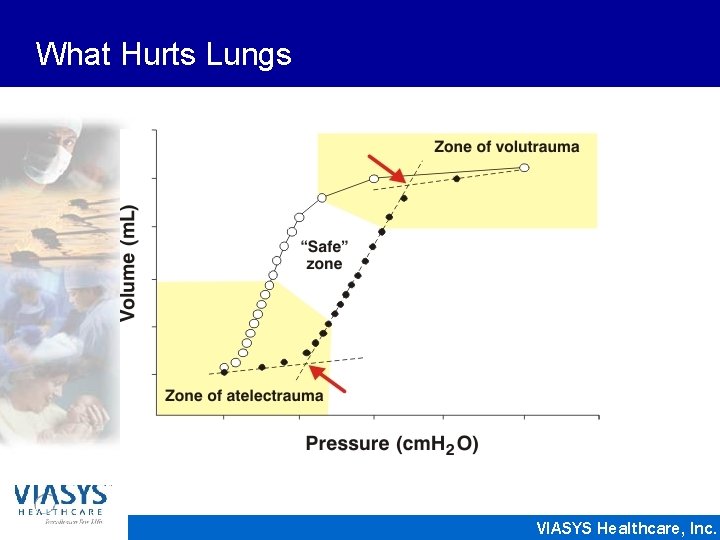
What Hurts Lungs VIASYS Healthcare, Inc.
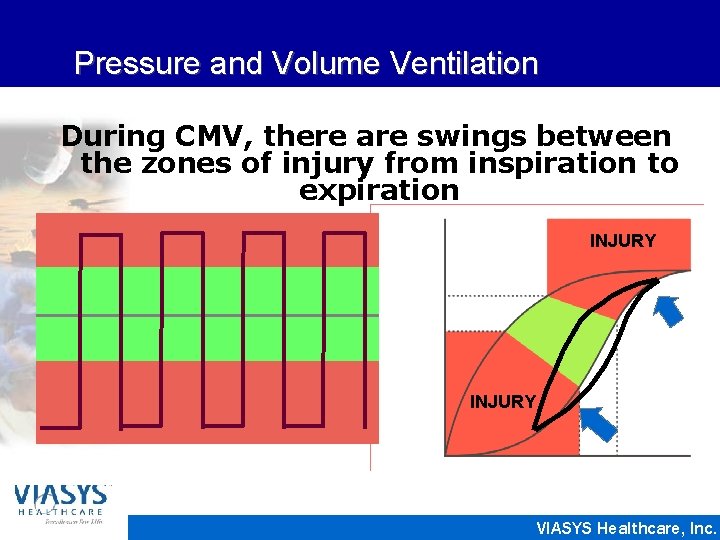
Pressure and Volume Ventilation During CMV, there are swings between the zones of injury from inspiration to expiration INJURY VIASYS Healthcare, Inc.
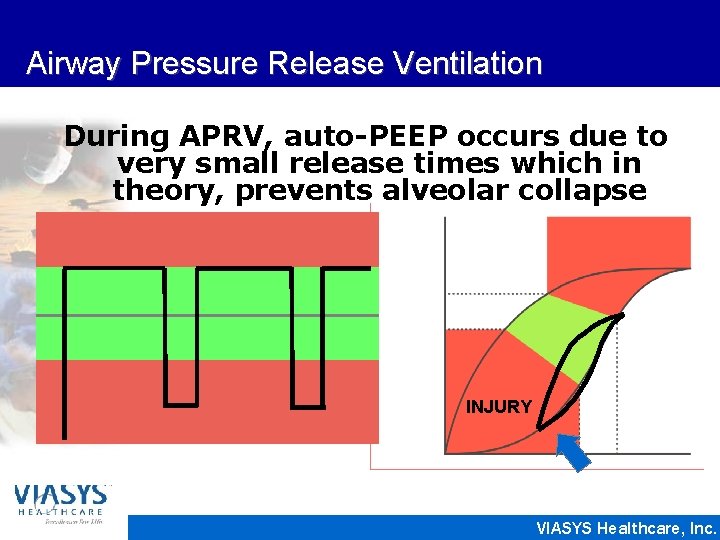
Airway Pressure Release Ventilation During APRV, auto-PEEP occurs due to very small release times which in theory, prevents alveolar collapse INJURY VIASYS Healthcare, Inc.
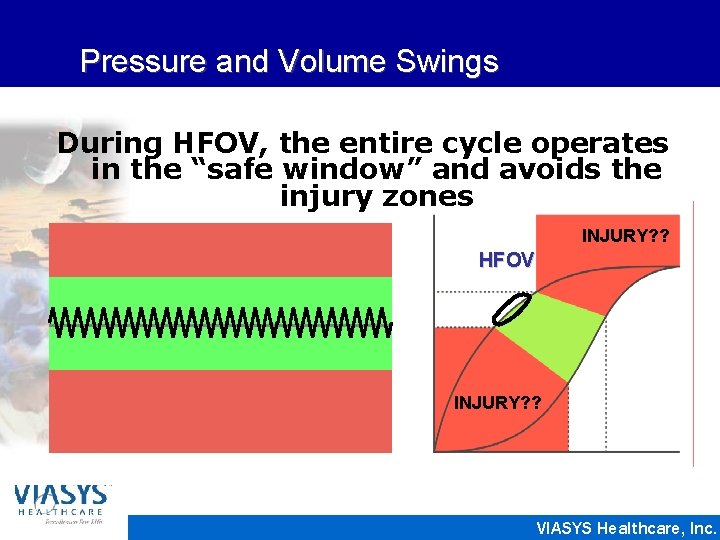
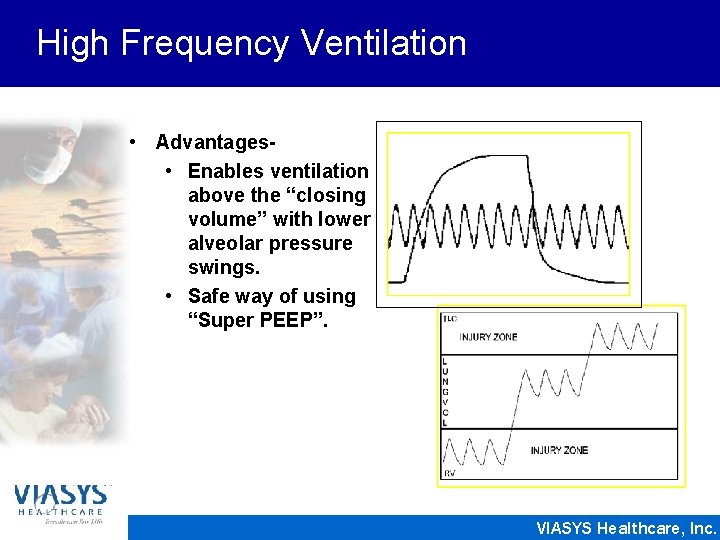
Pressure and Volume Swings During HFOV, the entire cycle operates in the “safe window” and avoids the injury zones INJURY? ? HFOV INJURY? ? VIASYS Healthcare, Inc.
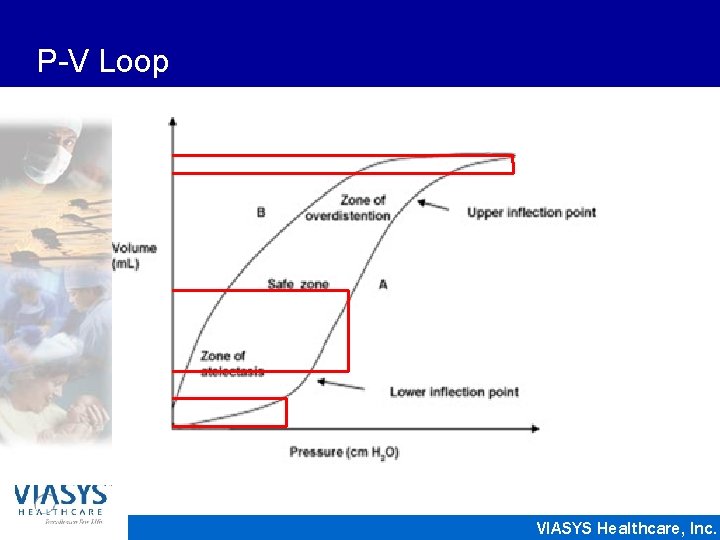
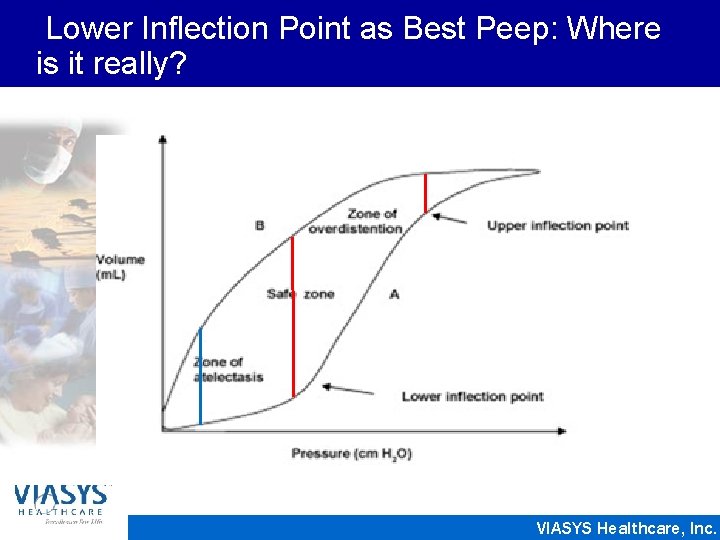
P-V Loop VIASYS Healthcare, Inc.
Lower Inflection Point as Best Peep: Where is it really? VIASYS Healthcare, Inc.
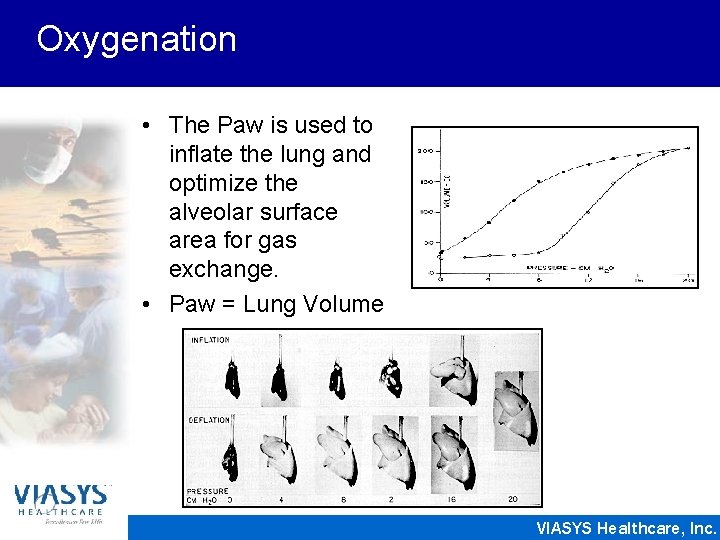
Oxygenation • The Paw is used to inflate the lung and optimize the alveolar surface area for gas exchange. • Paw = Lung Volume VIASYS Healthcare, Inc.
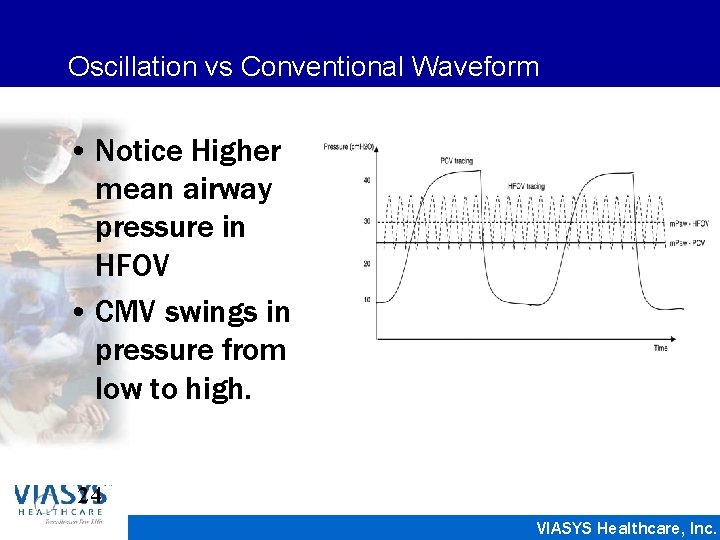
Oscillation vs Conventional Waveform • Notice Higher mean airway pressure in HFOV • CMV swings in pressure from low to high. 24 VIASYS Healthcare, Inc.
High Frequency Ventilation • Advantages • Enables ventilation above the “closing volume” with lower alveolar pressure swings. • Safe way of using “Super PEEP”. VIASYS Healthcare, Inc.
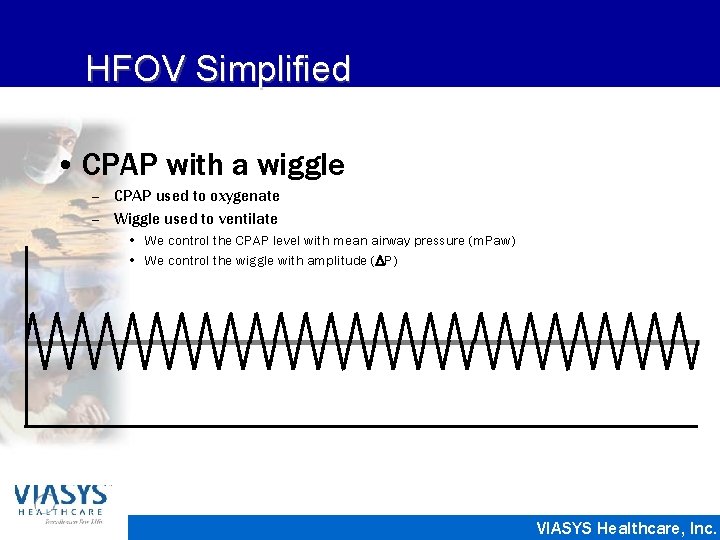
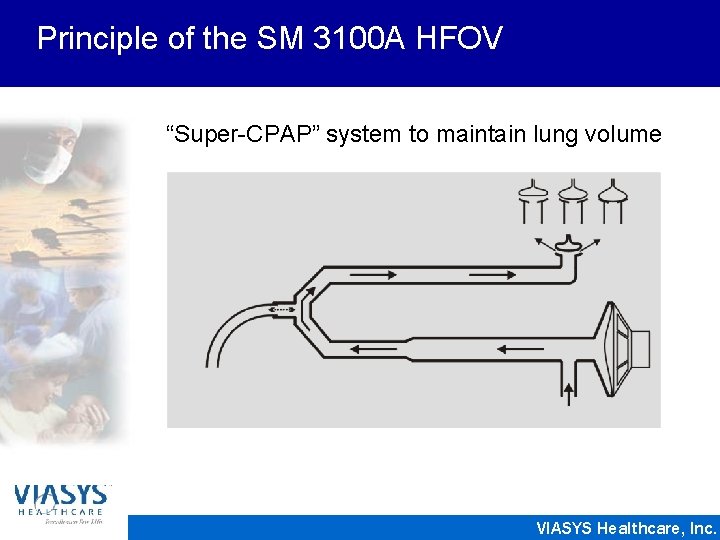
HFOV Simplified • CPAP with a wiggle – CPAP used to oxygenate – Wiggle used to ventilate • We control the CPAP level with mean airway pressure (m. Paw) • We control the wiggle with amplitude ( P) VIASYS Healthcare, Inc.
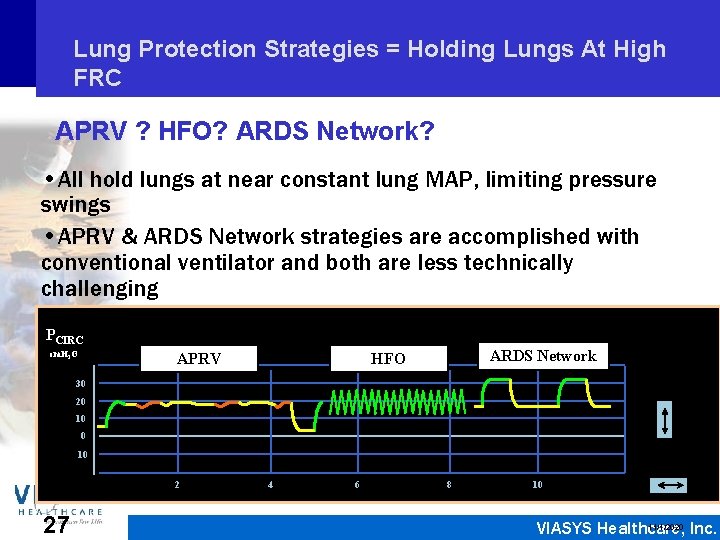
Lung Protection Strategies = Holding Lungs At High FRC APRV ? HFO? ARDS Network? • All hold lungs at near constant lung MAP, limiting pressure swings • APRV & ARDS Network strategies are accomplished with conventional ventilator and both are less technically challenging PCIRC cm. H 2 O APRV 40 ARDS Network HFO 30 20 10 -20 0 27 2 4 6 8 10 12 s 11/1/2020 VIASYS Healthcare, Inc.
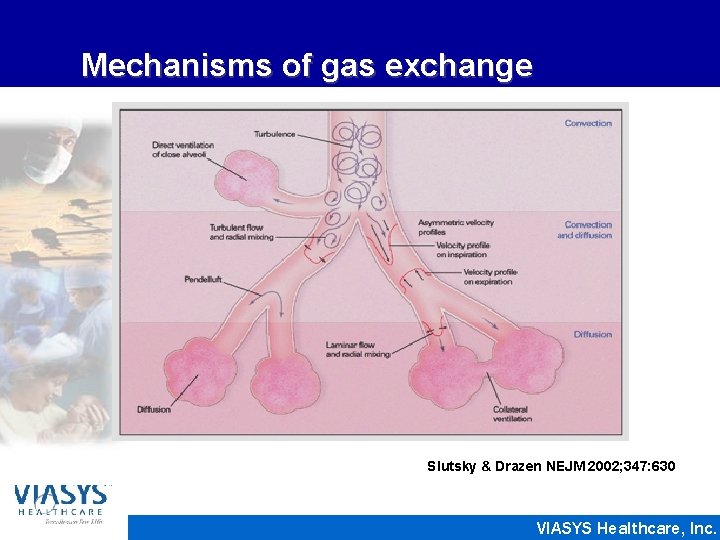
Mechanisms of gas exchange Slutsky & Drazen NEJM 2002; 347: 630 VIASYS Healthcare, Inc.
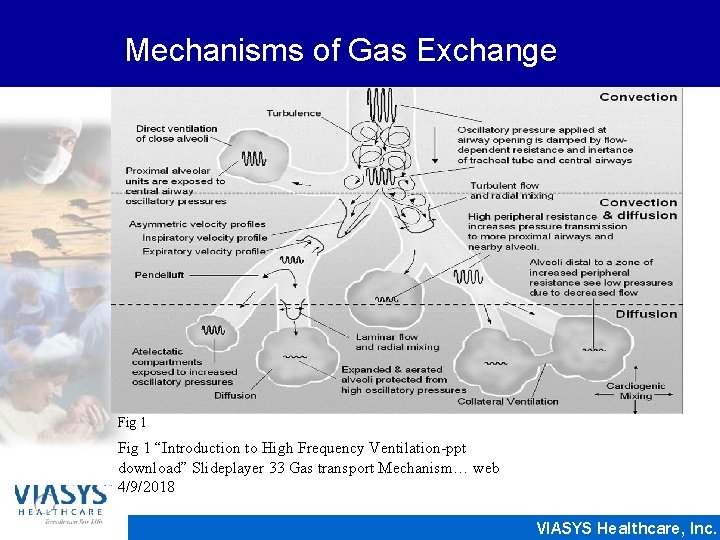
Mechanisms of Gas Exchange Fig 1 “Introduction to High Frequency Ventilation-ppt download” Slideplayer 33 Gas transport Mechanism… web 4/9/2018 VIASYS Healthcare, Inc.
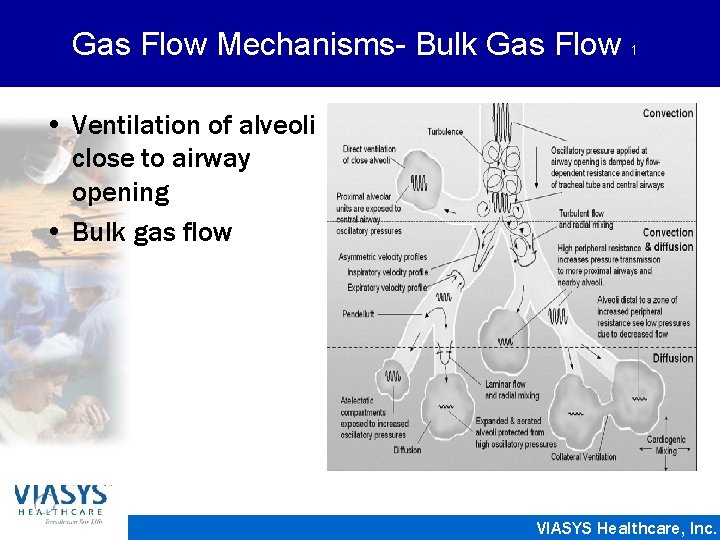
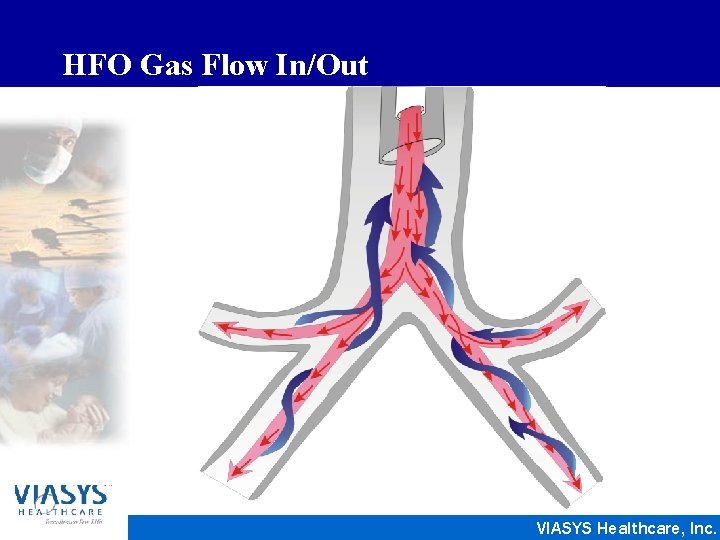
Gas Flow Mechanisms- Bulk Gas Flow 1 • Ventilation of alveoli close to airway opening • Bulk gas flow VIASYS Healthcare, Inc.
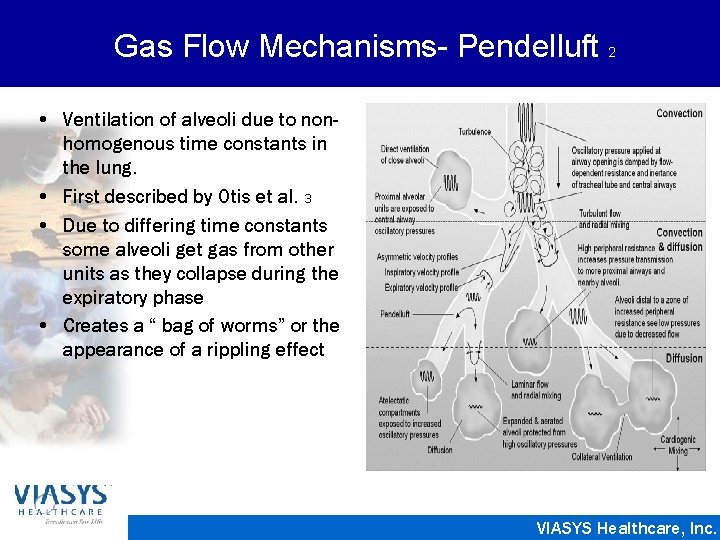
Gas Flow Mechanisms- Pendelluft 2 • Ventilation of alveoli due to nonhomogenous time constants in the lung. • First described by Otis et al. 3 • Due to differing time constants some alveoli get gas from other units as they collapse during the expiratory phase • Creates a “ bag of worms” or the appearance of a rippling effect VIASYS Healthcare, Inc.
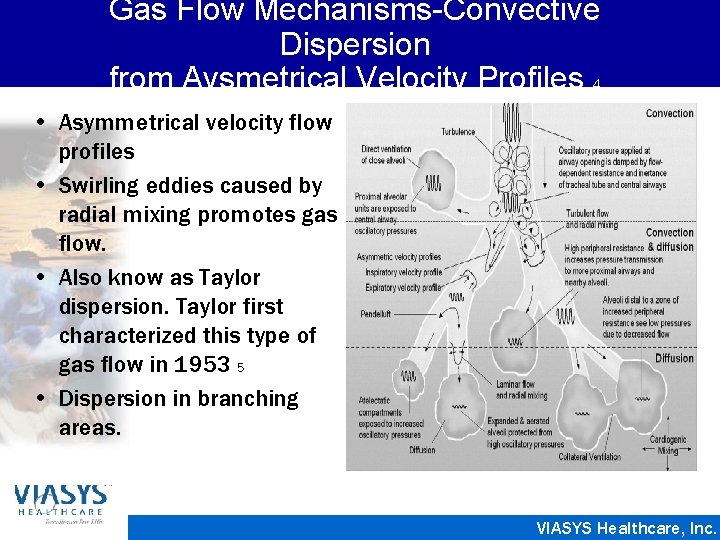
Gas Flow Mechanisms-Convective Dispersion from Aysmetrical Velocity Profiles 4 • Asymmetrical velocity flow profiles • Swirling eddies caused by radial mixing promotes gas flow. • Also know as Taylor dispersion. Taylor first characterized this type of gas flow in 1953 5 • Dispersion in branching areas. VIASYS Healthcare, Inc.
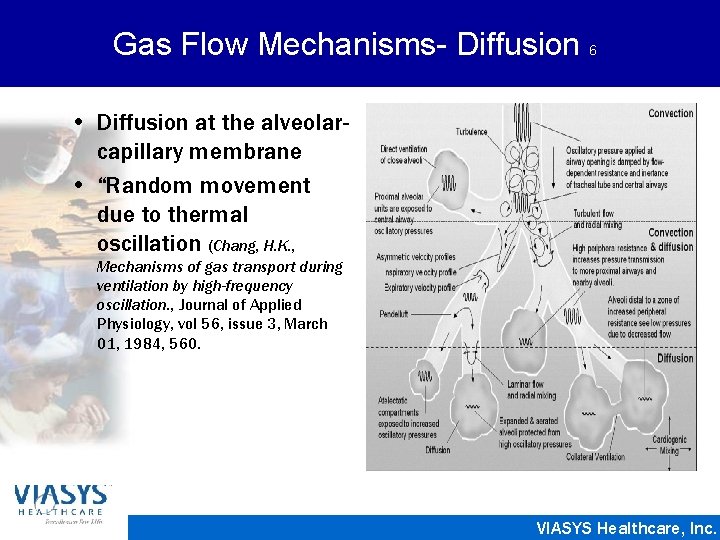
Gas Flow Mechanisms- Diffusion 6 • Diffusion at the alveolarcapillary membrane • “Random movement due to thermal oscillation (Chang, H. K. , Mechanisms of gas transport during ventilation by high-frequency oscillation. , Journal of Applied Physiology, vol 56, issue 3, March 01, 1984, 560. VIASYS Healthcare, Inc.
HFO Gas Flow In/Out VIASYS Healthcare, Inc.
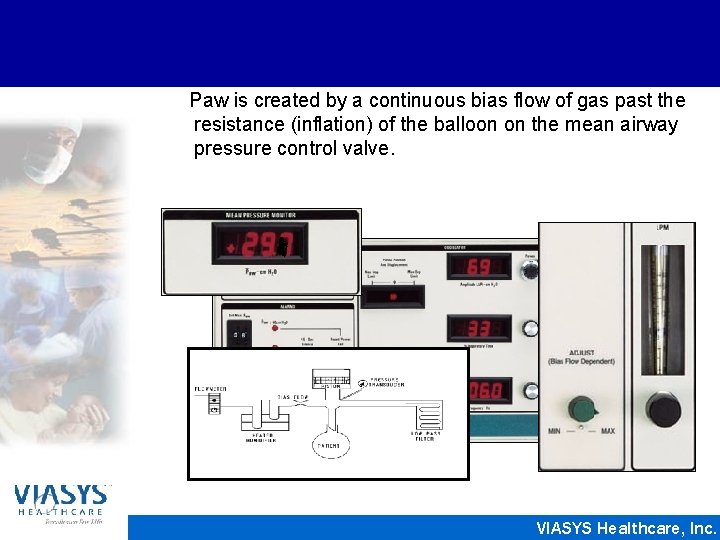
Paw is created by a continuous bias flow of gas past the resistance (inflation) of the balloon on the mean airway pressure control valve. VIASYS Healthcare, Inc.
Principle of the SM 3100 A HFOV “Super-CPAP” system to maintain lung volume VIASYS Healthcare, Inc.
Knob-ology 101 • CO 2 elimination 1. Amplitude 2. Hz 3. Ti (minimal effect in small endotracheal tubes) • Pa. O 2 support 1. MAP 2. Fi. O 2 VIASYS Healthcare, Inc.
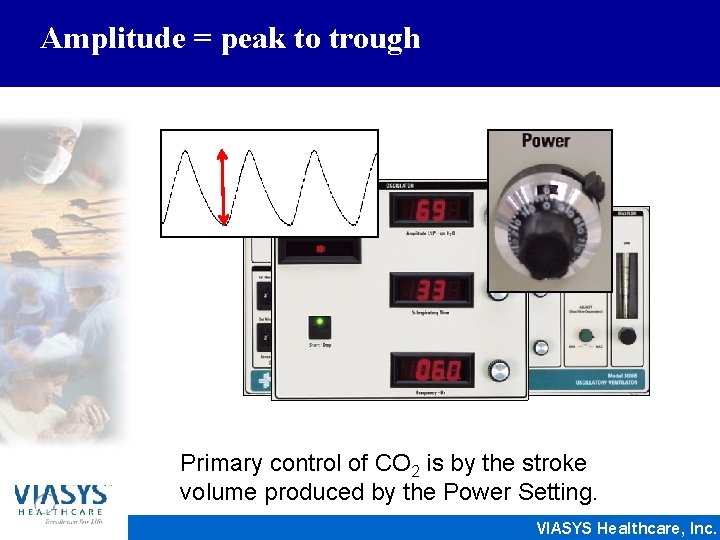
Amplitude = peak to trough Primary control of CO 2 is by the stroke volume produced by the Power Setting. VIASYS Healthcare, Inc.
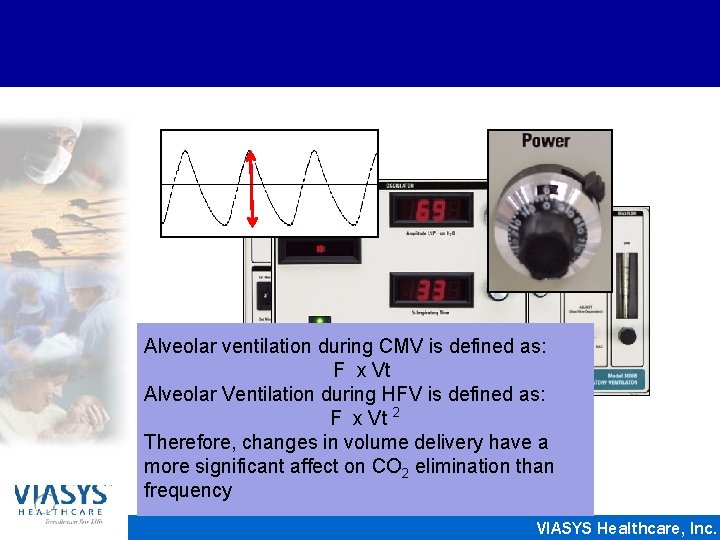
Alveolar ventilation during CMV is defined as: F x Vt Alveolar Ventilation during HFV is defined as: F x Vt 2 Therefore, changes in volume delivery have a more significant affect on CO 2 elimination than frequency VIASYS Healthcare, Inc.
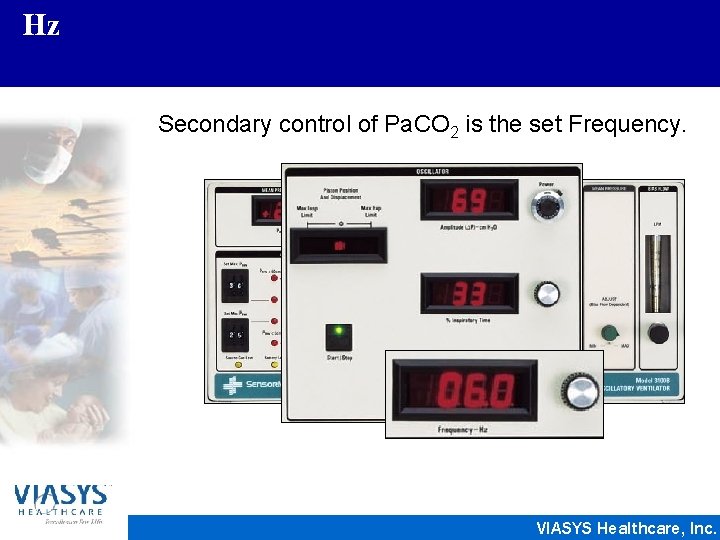
Hz Secondary control of Pa. CO 2 is the set Frequency. VIASYS Healthcare, Inc.
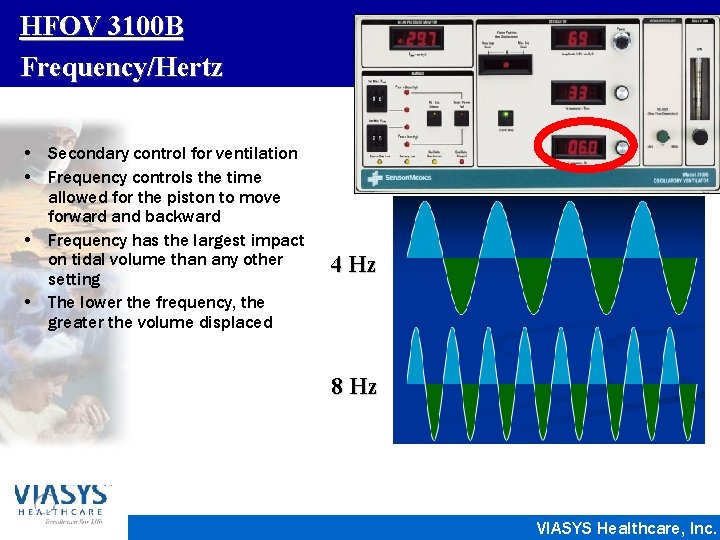
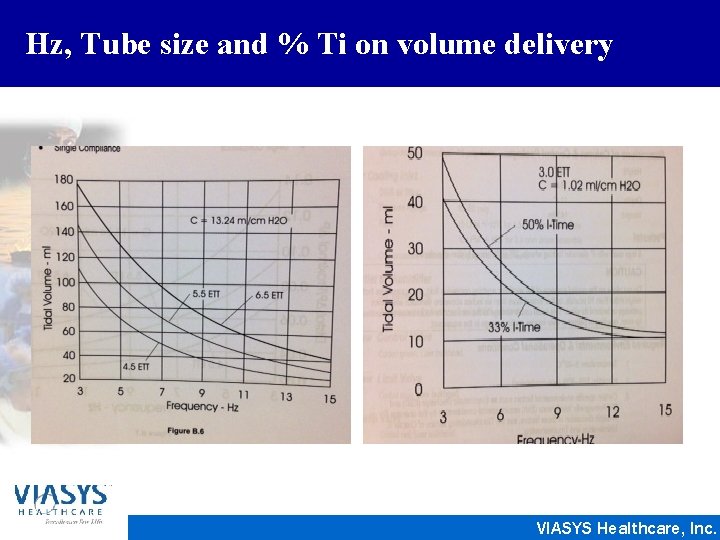
HFOV 3100 B Frequency/Hertz • Secondary control for ventilation • Frequency controls the time allowed for the piston to move forward and backward • Frequency has the largest impact on tidal volume than any other setting • The lower the frequency, the greater the volume displaced 4 Hz 8 Hz VIASYS Healthcare, Inc.
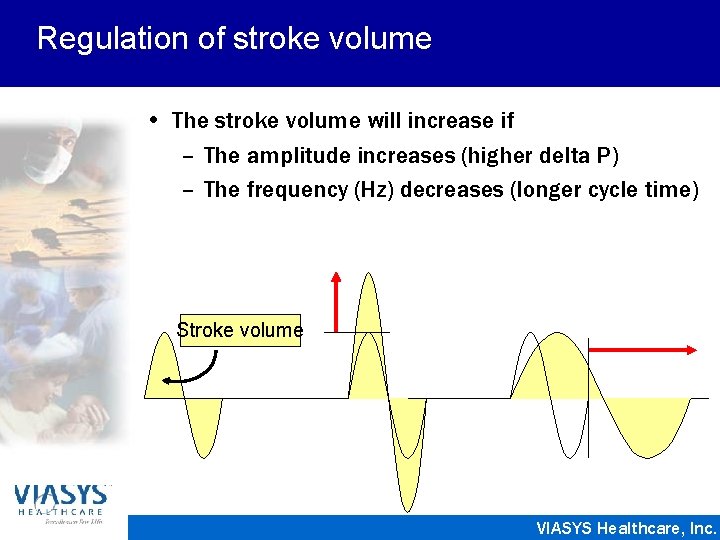
Regulation of stroke volume • The stroke volume will increase if – The amplitude increases (higher delta P) – The frequency (Hz) decreases (longer cycle time) Stroke volume VIASYS Healthcare, Inc.
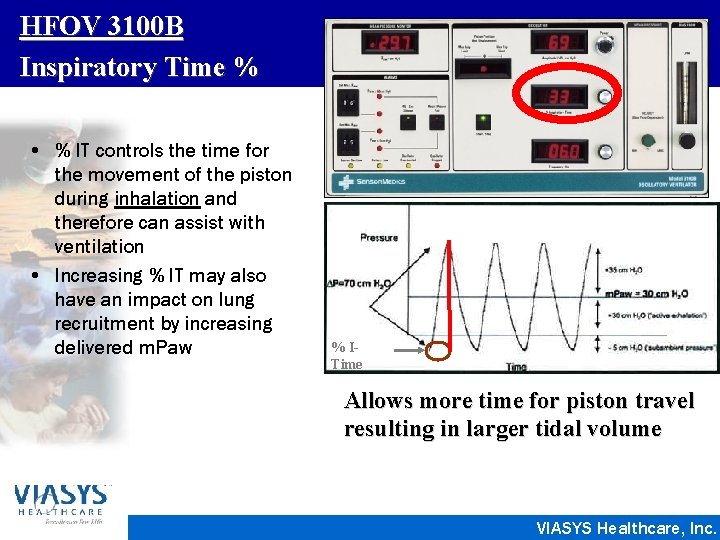
HFOV 3100 B Inspiratory Time % • % IT controls the time for the movement of the piston during inhalation and therefore can assist with ventilation • Increasing % IT may also have an impact on lung recruitment by increasing delivered m. Paw % ITime Allows more time for piston travel resulting in larger tidal volume VIASYS Healthcare, Inc.
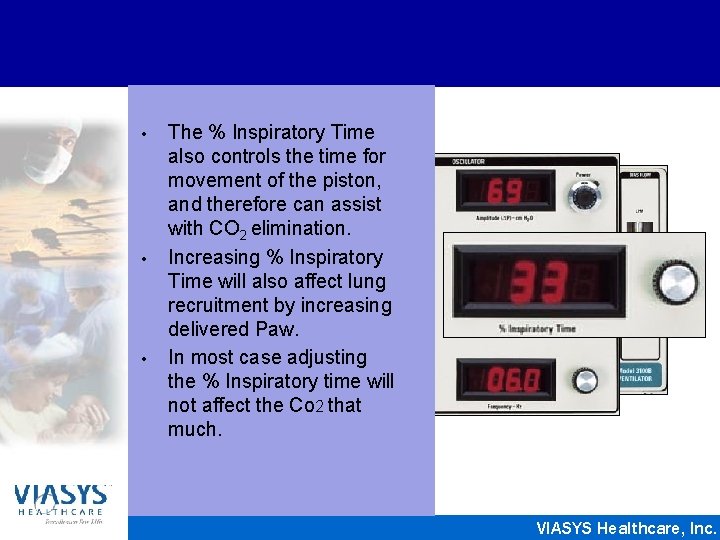
• • • The % Inspiratory Time also controls the time for movement of the piston, and therefore can assist with CO 2 elimination. Increasing % Inspiratory Time will also affect lung recruitment by increasing delivered Paw. In most case adjusting the % Inspiratory time will not affect the Co 2 that much. VIASYS Healthcare, Inc.
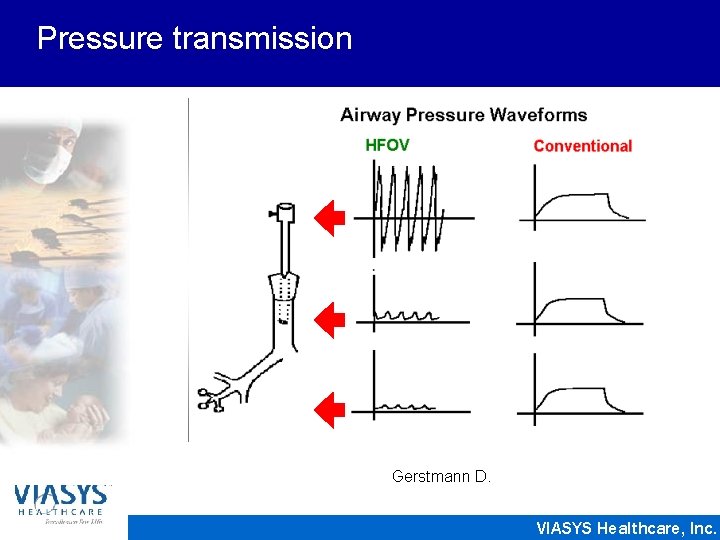
Pressure transmission Gerstmann D. VIASYS Healthcare, Inc.
Hz, Tube size and % Ti on volume delivery VIASYS Healthcare, Inc.
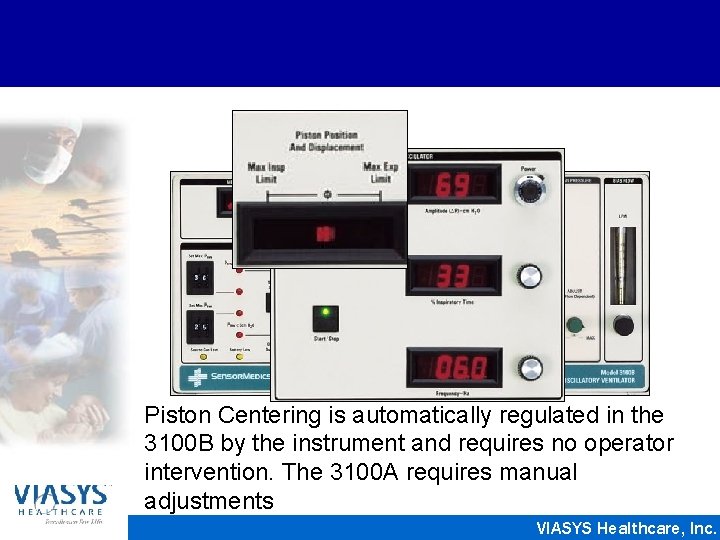
Piston Centering is automatically regulated in the 3100 B by the instrument and requires no operator intervention. The 3100 A requires manual adjustments VIASYS Healthcare, Inc.
Oxygenation • As with any mechanical breathing device oxygenation is a function of MAP. • Mean airway pressure is set 5 cm. H 20 above conventional MAP to start. • Fi. O 2 is always considered with oxygenation issues. Once the patients recruits alveoli and O 2 sats improve, wean Fi. O 2 until you are below 60%. Then wean MAP. VIASYS Healthcare, Inc.
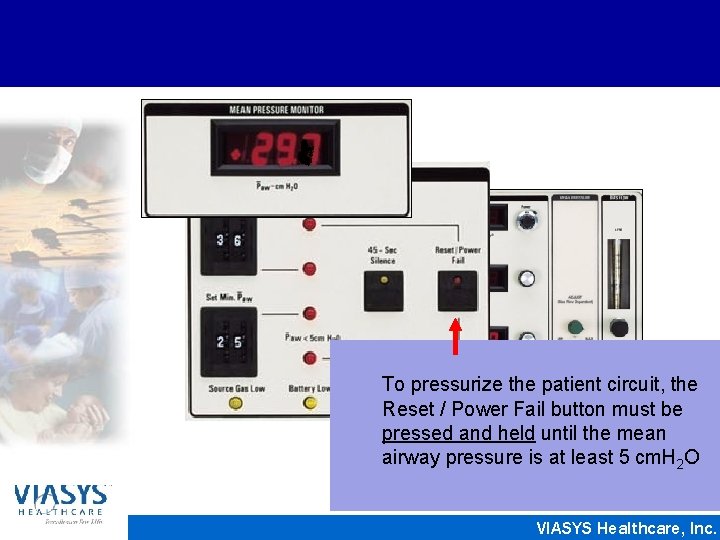
To pressurize the patient circuit, the Reset / Power Fail button must be pressed and held until the mean airway pressure is at least 5 cm. H 2 O VIASYS Healthcare, Inc.
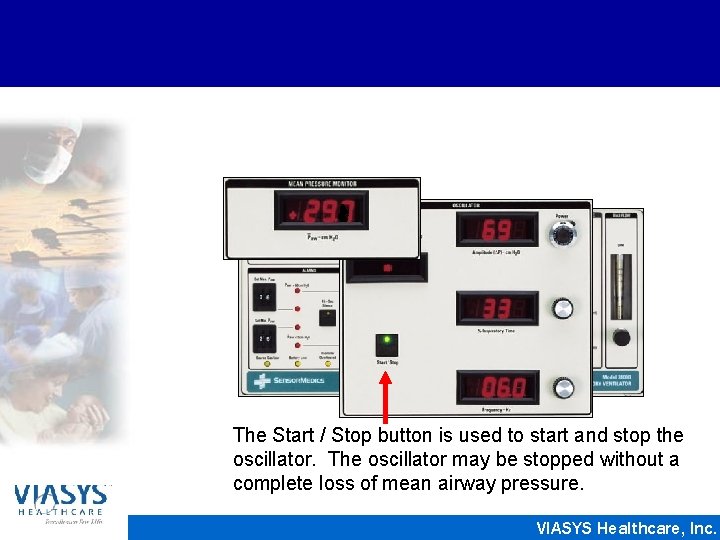
The Start / Stop button is used to start and stop the oscillator. The oscillator may be stopped without a complete loss of mean airway pressure. VIASYS Healthcare, Inc.
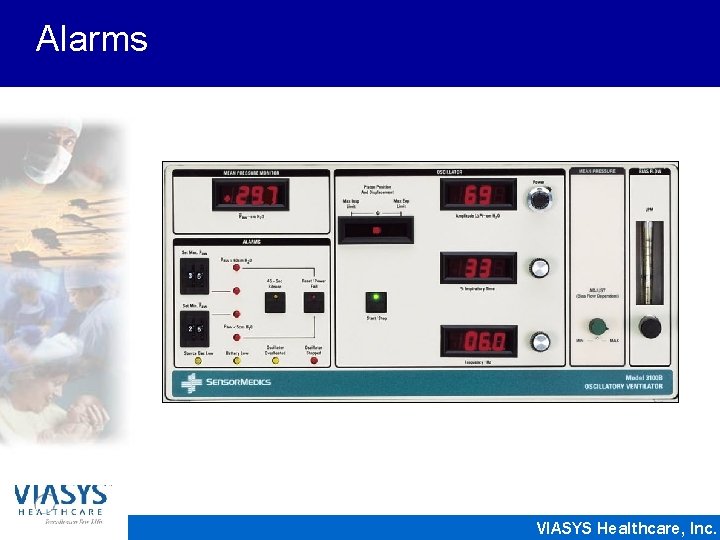
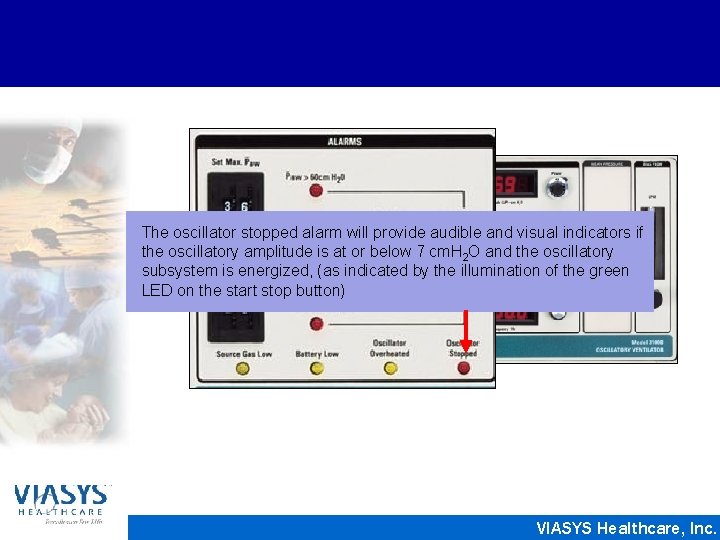
Alarms VIASYS Healthcare, Inc.
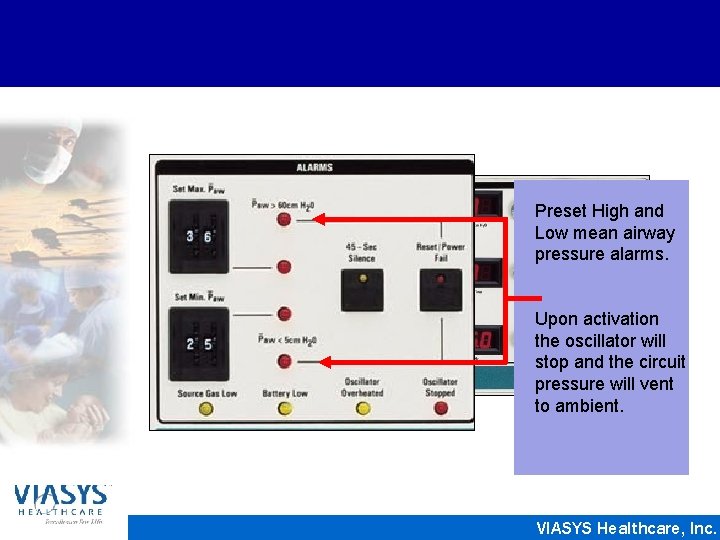
Preset High and Low mean airway pressure alarms. Upon activation the oscillator will stop and the circuit pressure will vent to ambient. VIASYS Healthcare, Inc.
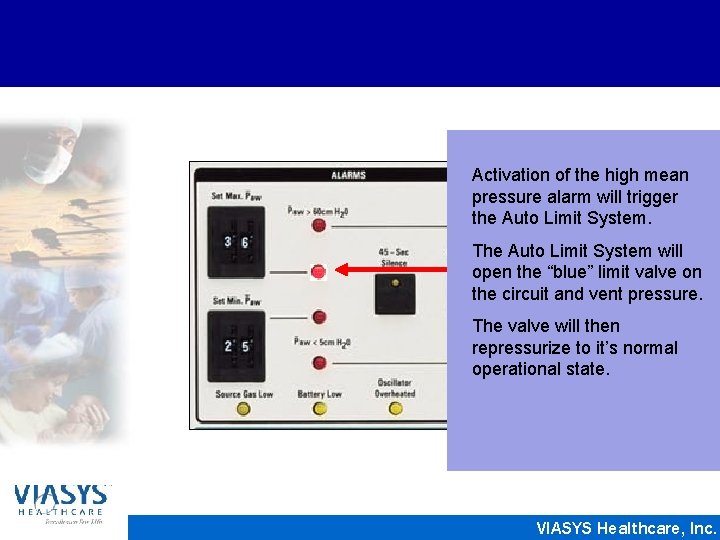
Activation of the high mean pressure alarm will trigger the Auto Limit System. The Auto Limit System will open the “blue” limit valve on the circuit and vent pressure. The valve will then repressurize to it’s normal operational state. VIASYS Healthcare, Inc.
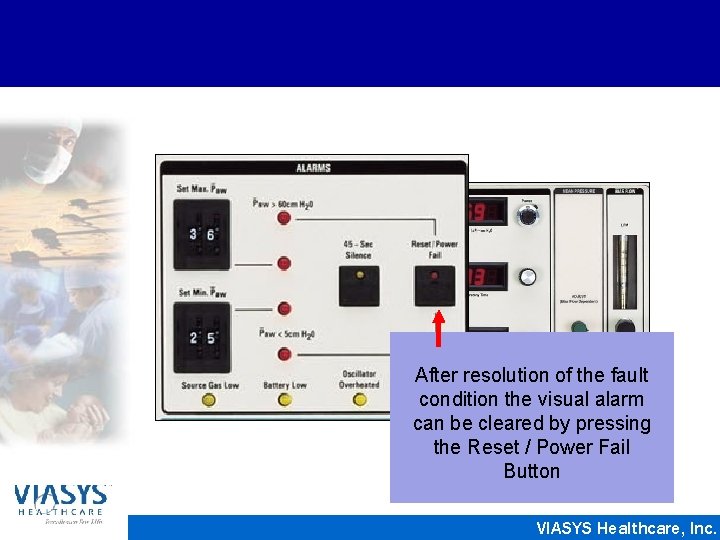
After resolution of the fault condition the visual alarm can be cleared by pressing the Reset / Power Fail Button VIASYS Healthcare, Inc.
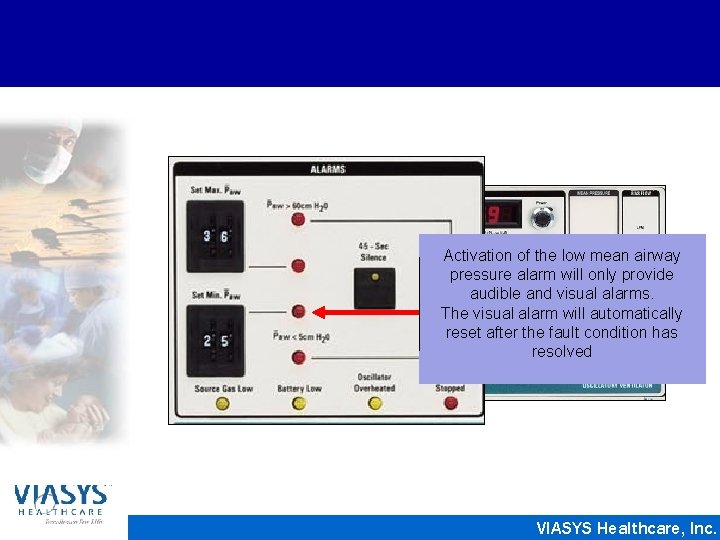
Activation of the low mean airway pressure alarm will only provide audible and visual alarms. The visual alarm will automatically reset after the fault condition has resolved VIASYS Healthcare, Inc.
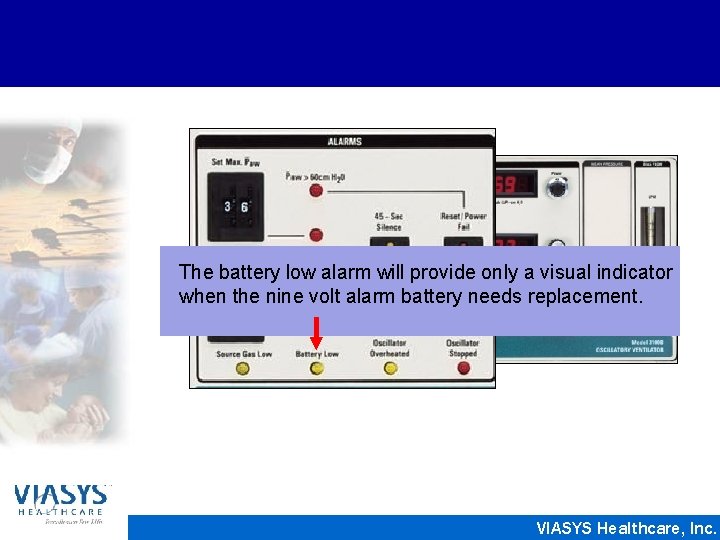
The battery low alarm will provide only a visual indicator when the nine volt alarm battery needs replacement. VIASYS Healthcare, Inc.
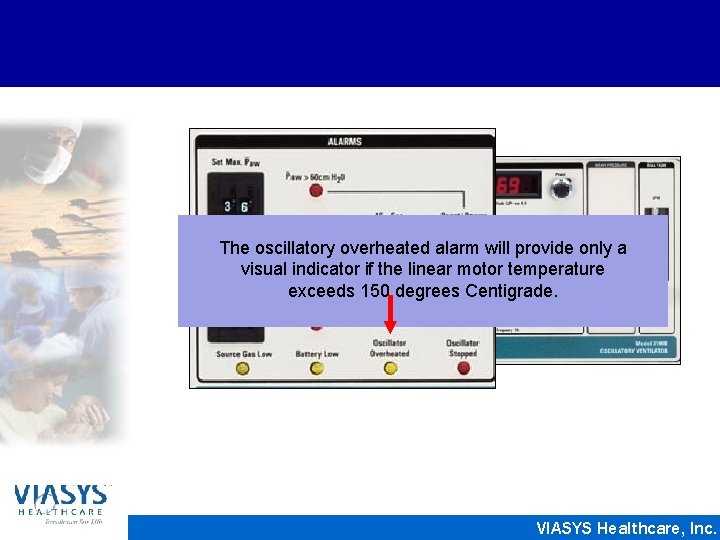
The oscillatory overheated alarm will provide only a visual indicator if the linear motor temperature exceeds 150 degrees Centigrade. VIASYS Healthcare, Inc.
The oscillator stopped alarm will provide audible and visual indicators if the oscillatory amplitude is at or below 7 cm. H 2 O and the oscillatory subsystem is energized, (as indicated by the illumination of the green LED on the start stop button) VIASYS Healthcare, Inc.
What is our Goal? ? • Break the pulmonary injury sequence!!! – Lung Recruitment • Open the lung with sustained inflation • Prevent alveolar collapse – Lung Protection • Provide small alveolar volume swings • Provide minimal alveolar pressure swings • Provide lower peak airway pressures VIASYS Healthcare, Inc.
When Should HFOV be Initiated? § If FIO 2 >. 60 on normal or elavated PEEP levels and unable to maintain Sp. O 2 > 88% § High ventilatory rates § Unable to maintain Pplat < 20 cm. H 2 O § m. Paw on CV is > 24 cm. H 2 O § Patient requiring paralysis for oxygenation Earlier intervention produces better outcomes!!!! Derdak S et al. Am J Respir Crit Care Med. 2002; 166: 801 -808 VIASYS Healthcare, Inc.
Initial HFOV Settings, Management and Weaning VIASYS Healthcare, Inc.
Initial HFOV Settings • Adult patients needs proper sedated and/or paralyzed, not so much for pediatric patients • Oxygenation – Set Fi. O 2 to 100% or maintain current Fi. O 2 for sats >88 – Set m. Paw 5 cm. H 2 O above the m. Paw measurement during conventional ventilation • Ventilation – Set Amplitude and increase for proper chest movement – Set Frequency at appropriate setting for patient size • 6 -10 Peds • 11 -15 (Neonates) – Set I-time % to 33 – Set Bias Flow; Neonates 10 -20 lpm, bigger peds 20 -40 lpm VIASYS Healthcare, Inc.
Oxygenation -Clinical Guidelines • Initiate HFOV – Fi. O 2 of 1. 0 or Fi. O 2 for Sp. O 2 > 88% – m. Paw of 5 cm. H 2 O greater than m. Paw on CMV • Increase m. Paw by 1 -4 cm. H 2 O to achieve optimal lung volume – Optimal lung volume is determined by increasing Sp. O 2 while maintain Fi. O 2 or weaning Fi. O 2 • Maintain m. Paw while weaning Fi. O 2 to <. 60 VIASYS Healthcare, Inc.
Oxygenation - Clinical Guidelines • Follow CXR 1 hour post initiation to assess lung expansion, then daily. – Degree of opacification – What is the shape of the diaphragm? – Evidence of rib scalloping? – Normal cardiac borders • Should be able to wean Fi. O 2 to <. 60 in first 12 hours – If unable to reach Fi. O 2. 60, consider recruitment of collapsed alveoli by increasing m. Paw (sustained inflation) VIASYS Healthcare, Inc.
Oxygenation - Clinical Guidelines • Ensure adequate intravascular volume and cardiac output • Consider volume loading or initiate inotropes – Improves V/Q matching – High intrathoracic pressures can impede venous return and adversely affect cardiac output • Closely monitor hemodynamic status • Utilize pulse oximeters and to set appropriate HFOV settings in between ABGs VIASYS Healthcare, Inc.
Oxygenation Strategies • m. Paw until Sp. O 2 stabilizes 88 94% and begin to Fi. O 2 to 60% • Avoid hyperinflation on CXR • Optimize preload, myocardial function VIASYS Healthcare, Inc.
Ventilation – Clinical Guidelines • Amplitude – Set for adequate chest wiggle – Clavicle to groin in neonates • Frequency – Set for appropriate patient size • I-time % – Set to 33% VIASYS Healthcare, Inc.
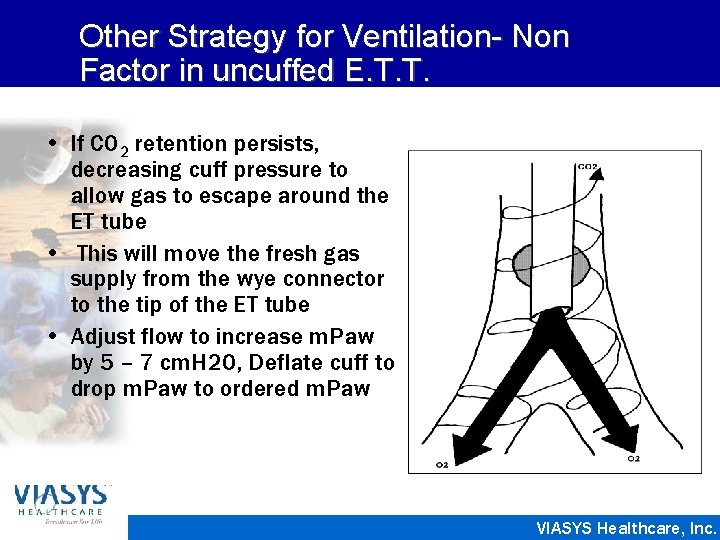
Other Strategy for Ventilation- Non Factor in uncuffed E. T. T. • If CO 2 retention persists, decreasing cuff pressure to allow gas to escape around the ET tube • This will move the fresh gas supply from the wye connector to the tip of the ET tube • Adjust flow to increase m. Paw by 5 – 7 cm. H 2 O, Deflate cuff to drop m. Paw to ordered m. Paw VIASYS Healthcare, Inc.
Other Considerations of HFOV • Adequate sedation and paralysis ü May need less • Consider ETT cuff leak ü Pressures will vary ü May need to deflate cuff and increase bias flow to allow CO 2 to escape • Need to Travel ü HFOV patients cannot travel on machine • Aerosolized nebulizers ü Normally not given with SVN due to the nature of gas flow in the circuit and patient. New Aerogen nebulizers have been shown to deliver medication in vivo. 7 VIASYS Healthcare, Inc.
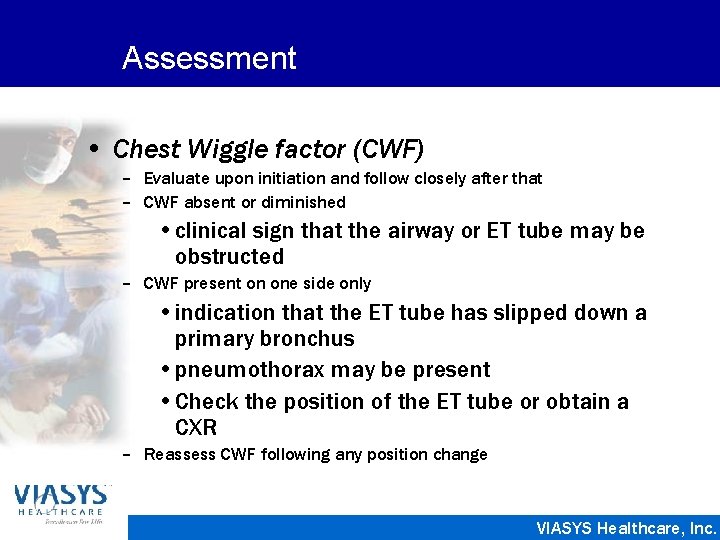
Assessment • Chest Wiggle factor (CWF) – Evaluate upon initiation and follow closely after that – CWF absent or diminished • clinical sign that the airway or ET tube may be obstructed – CWF present on one side only • indication that the ET tube has slipped down a primary bronchus • pneumothorax may be present • Check the position of the ET tube or obtain a CXR – Reassess CWF following any position change VIASYS Healthcare, Inc.
Assessment • Auscultation – Breath sounds • Identifying normal “breathsounds” is difficult unless spontaneous breathing (pause oscillations) – HFOV is not ventilation with a bulk flow of gas through the airway so “spontaneous breath sounds” are not present. – Don’t just hang up your stethoscope - Listen anyway! • Listen to the “intensity or sound” that the piston makes, it should be equal throughout • If not the same sound, re-assess the patient to determine if a chest x-ray is necessary at this time VIASYS Healthcare, Inc.
Assessment • Auscultation- Heart or GI Sounds – Stop the piston (the patient is now on CPAP) – Listen to the heart or GI sounds quickly (how long can you hold your breath) – Start the piston back up – Removing the patient from the ventilator may result in loss of lung volume. VIASYS Healthcare, Inc.
Assessment • Heart Function – Pulse – Blood Pressure • Mean Arterial Pressure – Pulse Pressure – CVP / PWP – Perfusion Status VIASYS Healthcare, Inc.
Monitoring • Chest X-rays – Obtain the first x-ray at 1 hour, then daily. – Do not wait greater than 4 hour mark to determine the lung volume at that time. – Paw may need to be re-adjusted accordingly. – Always obtain a CXR – if unsure as to whether the patient is hyper-inflated or has de-recruited the lung. VIASYS Healthcare, Inc.
Monitoring • Chest X-rays Procedure – Do not stop the piston, or re-positioning the head – Do not remove the patient from HFOV and manually ventilate – A therapist, physician, or nurse should be at bedside to assure the patency of the airway and the patient’s position. VIASYS Healthcare, Inc.
Monitoring • Chest x-rays: – Used to “guesstimate” Lung Volume – Monitor for • Decreased opacification • Diaphragms domed not flattened or inverted • Heart borders are normalized • No evidence of “Rib Scalloping” VIASYS Healthcare, Inc.
Monitoring • Perfusion Status – – Persistent Metabolic Acidosis Capillary re-fill Skin turgor / color Decreased Urine Output VIASYS Healthcare, Inc.
Procedures • Suctioning – When: – Indicated by decreased or absence CWF – Decrease in O 2 saturation – Closed suction catheters may mitigate – de-recruitment – Consider temporarily Paw or Fi. O 2 VIASYS Healthcare, Inc.
Procedures • Suctioning – If using a closed suction catheter remember to: • Remove the suction catheter all the way from the ET tube. • There is no need to suction on a routine basis, unless the patient has copious amounts of secretions. VIASYS Healthcare, Inc.
Procedures • Positioning – Assure position of head and ET tube to prevent risk of kink in ET tube or 3100 A circuit – The neonate can be in any position but monitor carefully to prevent risk of extubation – “lay” the circuit in the bed with the patient VIASYS Healthcare, Inc.
Procedures • Humidification of bias flow – Circuit connects to commercially available humidifiers – 3100 A flexible circuit requires the heated wire connection to be utilized – Maintain 37 degrees C at ET tube port – Visually monitor for evidence of adequate humidification being delivered – Drain condensate frequently if necessary VIASYS Healthcare, Inc.
Procedures • Bronchodilator Therapy – Due to high Bias Flow, most medication delivered in a SVN is washed out of circuit rather than delivered to patient – Aerogen nebulizer may offer better deposition of particles based on MMAD. VIASYS Healthcare, Inc.
References: • 1, 2, 4, 5, 6 Chang, H. K. , (1984) Mechanisms of gas transport during ventilation by high-frequency oscillation. Journal of Applied Physiology, vol 56, (3), pages 553 -563. https: //doi. org/10. 1152/jappl. 1984. 56. 3. 553 -563 • 3 Otis, A. B. , C. B. Mc. Kerrow, R. A. Bartlett, J. Mead, M. B. Mc. Ilroy, N. J. Selverston, and E. P. Radford, Jr. (1956) Mechanical factors in distribution of pulmonary ventilation. Journal of Applied Physiology, vol 8, pages 427 -443 • 7 Sood, B. G. , Shen, Y. , Latif, Z. , Galli, B. , Dawe, E. J. , Haacke, E. M. , (2010). Effective aerosol delivery during high-frequency ventilation in neonatal pigs. Respirology, 15 (3): 551 -5 https: //onlinelibrary. wiley. com/doi/epdf/10. 1111/j. 14401843. 2010. 01714. x VIASYS Healthcare, Inc.
VIASYS Healthcare, Inc.