
HF Propagation An Introduction By Gary Sutcliffe W
HF Propagation An Introduction By Gary Sutcliffe, W 9 XT Revised August 2018
Topics to be Covered What are the HF Bands? How HF Propagation works Band by Band Overview Where we are in the sunspot cycle How can I learn more? W 9 XT 2
Amateur Bands A range of frequencies. Different modes allowed on different frequency ranges of the band Usually referred to by wavelength i. e. “ 40 Meters” Historical – in early days of radio wavelengths were used to designate frequency Wave length = 300/frequency in MHz W 9 XT 3
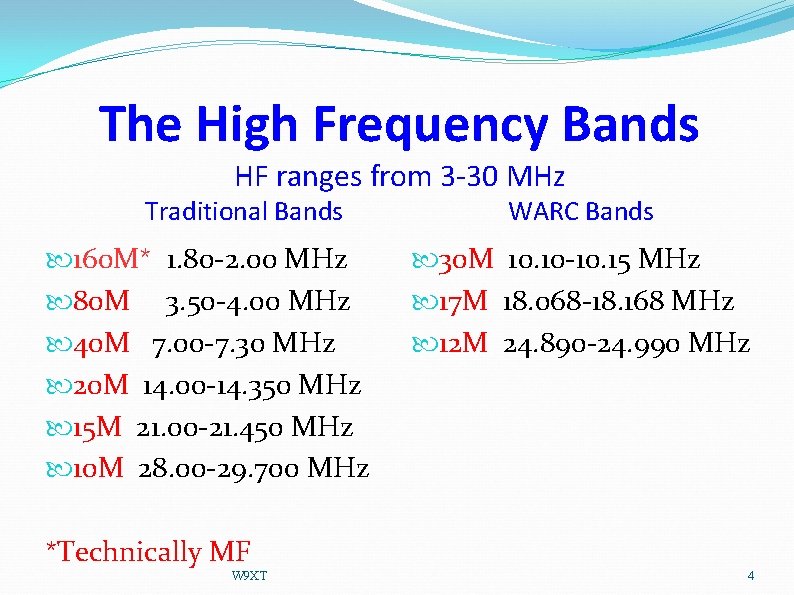
The High Frequency Bands HF ranges from 3 -30 MHz Traditional Bands 160 M* 1. 80 -2. 00 MHz 80 M 3. 50 -4. 00 MHz 40 M 7. 00 -7. 30 MHz 20 M 14. 00 -14. 350 MHz 15 M 21. 00 -21. 450 MHz 10 M 28. 00 -29. 700 MHz WARC Bands 30 M 10. 10 -10. 15 MHz 17 M 18. 068 -18. 168 MHz 12 M 24. 890 -24. 990 MHz *Technically MF W 9 XT 4
What Makes Long Distance HF Communications Work? W 9 XT 5

The Ionosphere makes HF exciting Upper altitudes ~30 -620 miles (ISS is ~220 miles) An ion is an atom with a charge Caused when UV light knocks electrons off molecules Ionization varies with Solar activity – 11 year sun spot cycle number of sunspots 10. 7 cm solar flux Sunspots and solar flux are a marker for UV levels Season Time of day W 9 XT 6
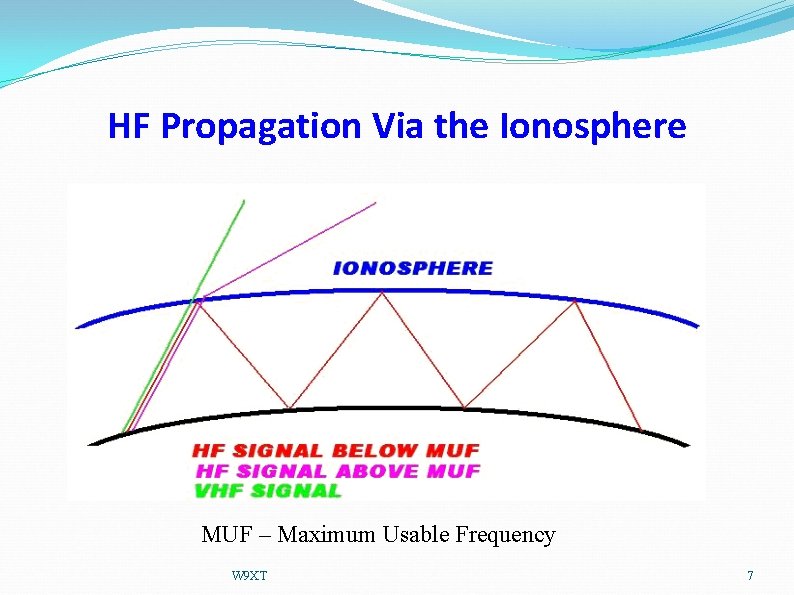
HF Propagation Via the Ionosphere MUF – Maximum Usable Frequency W 9 XT 7
Ionosphere Layers W 9 XT 8
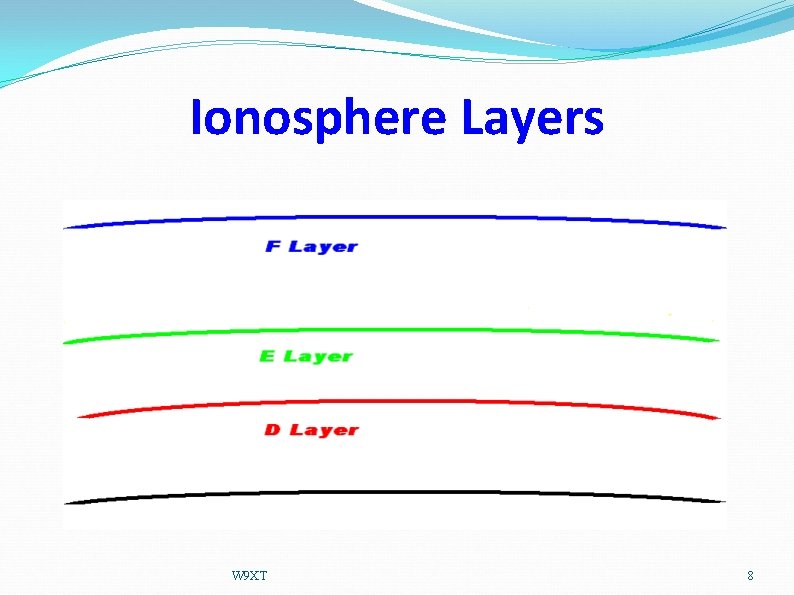
D Layer – Lowest Layer Caused by UV light & X-rays Forms during the day Disappears at night Absorbs lower frequency signals (<10 MHz most affected) Reason for hearing only local AM broadcast stations during the day W 9 XT 9
E Layer – Middle Layer Often occurs as Sporadic E (Es) Thought to be caused by wind shear Not usually intense enough to be noticed Can last minutes to hours Most common May-July Can be very intense Usually effective 50 MHz (6 Meters) and below Rare at 144 MHz (2 Meters) and above W 9 XT 10
Sporadic E (Es) Can happen any time Most common May-July Secondary peak period Dec-Jan Most apparent on 10 Meters and up but happens on 20 & 15 Up to ~1500 miles, multi-hop possible Openings can be very localized or wide spread Can result in very strong signals W 9 XT 11
F Layer – Highest Layer Responsible for most HF propagation Caused by UV light from sun Forms during day, dissipates at night MUF varies with ionization level Usually splits into F 1 and F 2 during the day F 2 is the one most useful to hams W 9 XT 12
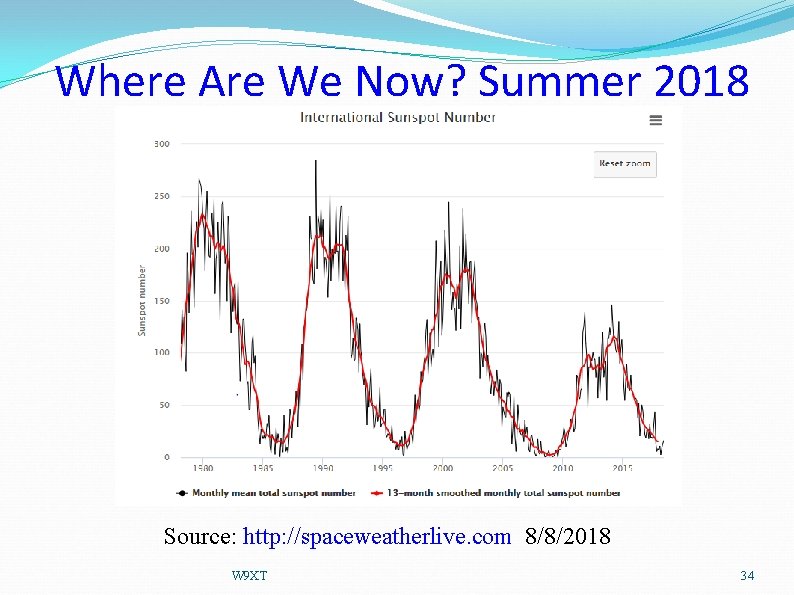
Ionization and the Sun Ionization level corresponds closely to sun spots Sunspots do not cause ionization, UV light does Sunspots are a good indication of UV levels Sun spots follow an 11 year cycle Sun spots range from 0 to ~ 150 Smoothed number used (average +/- 6 months) Solar flux – 10. 7 cm radiation Another marker for UV levels Ranges from ~60 to ~250 W 9 XT 13
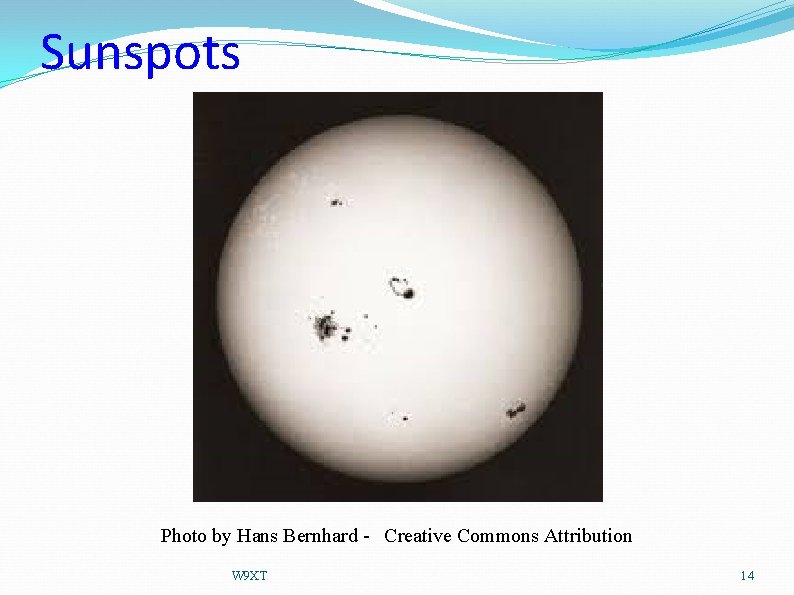
Sunspots Photo by Hans Bernhard - Creative Commons Attribution W 9 XT 14
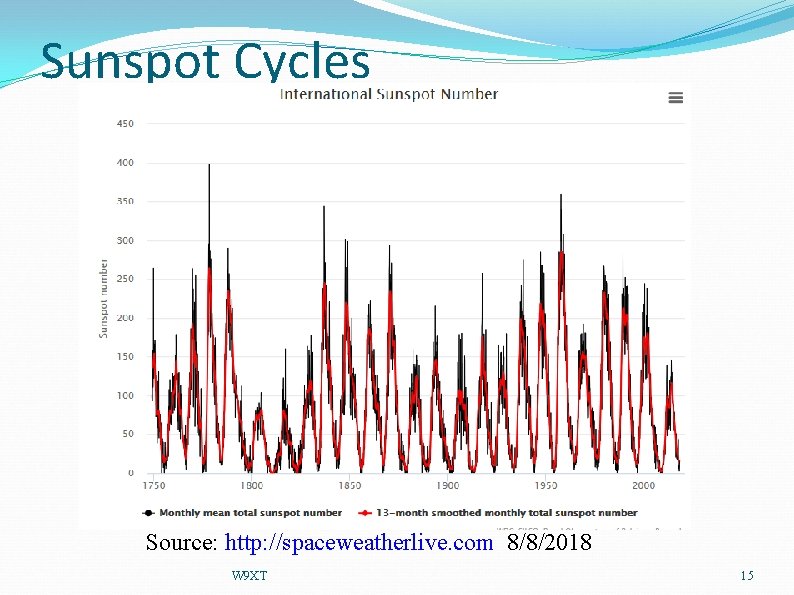
Sunspot Cycles Source: http: //spaceweatherlive. com 8/8/2018 W 9 XT 15
Geomagnetic Field Disrupted by charged particles from the sun Indices rate stability of magnetic field of Earth Reported as A & K indices K single site A Planetary index Low index = stable / high index = unstable Charged particles from sun cause high A & K Geomagnetic storm Often result in auroras Absorption of radio waves on polar paths W 9 XT 16
Solar Flares, CMEs, SIDs Coronal Mass Ejection Charged particles ejected into space Often associated with solar flares but there are other causes Solar Flares X-ray burst can cause HF radio black out (Sudden Ionospheric Disturbance) X-rays cause dense D-layer ionization HF absorption, VLF enhancement Charged particles released W 9 XT 17
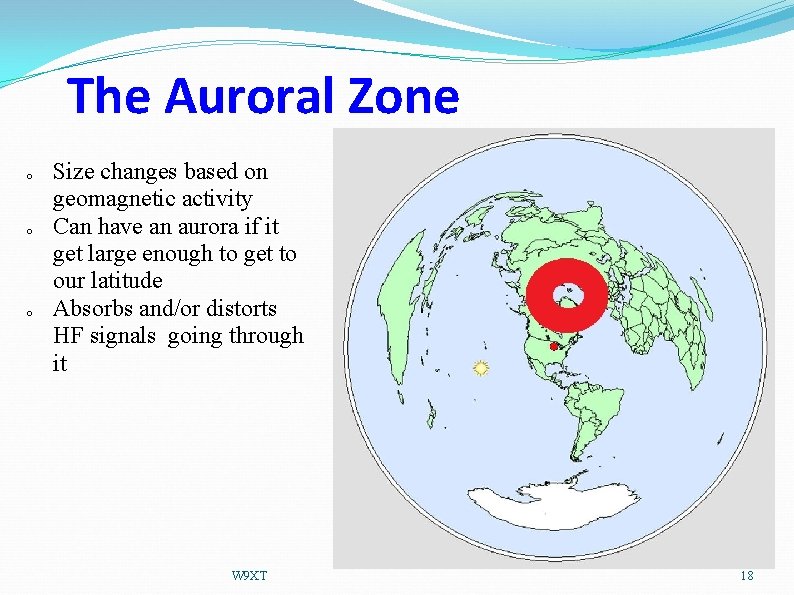
The Auroral Zone o o o Size changes based on geomagnetic activity Can have an aurora if it get large enough to get to our latitude Absorbs and/or distorts HF signals going through it W 9 XT 18
Propagation Numbers �Sources �WWV 18 minutes after the hour �Various Internet sites �High SF (solar flux) means higher MUF �Need high numbers for 10 & 15 Meters to open �Lower levels best for 160 & 80 Meter DXing �Low A & K mean Geo-magnetic field stability �Low needed for polar paths (mid-west USA to Northern Europe, Japan) �North-South paths not affected as much by geomagnetic field W 9 XT 19
Paths Radio Wave Follow More or less follow great circle path Long path – the long way around the world Most common on 40 - 15 Meters Back Scatter – no direct path open Signals scatter off area with common propagation Grey Line Low frequency signals follow terminator Sunrise or sunset at each end W 9 XT 20
Band by Band Characteristics W 9 XT 21
160 M (1. 8 -2. 0 MHz) Day – Local to a few hundred miles Night – Long distances possible Often noisy (thunder storm static) A very challenging DX band Antennas difficult because of size – Dipole ~260' Technician: No operation permitted W 9 XT 22
80 Meters (3. 5 -4. 0 MHz) Day – Local to several hundred miles Night – World wide possible Often noisy (lightning static) - especially in the summer Challenging DX band Phone band sometimes called 75 Meters Popular band for nets Antennas difficult in small lot Dipole ~ 133’ Big band difficult to cover with one antenna Technician: CW (Phone & data privileges proposed) W 9 XT 23
40 Meters (7. 0 -7. 3 MHz) Day – Local to 1000 miles or more Night – World wide possible A reliable band – almost always open somewhere Antennas manageable Dipole ~ 66' Verticals with good radials effective DX antenna Beams large but manageable with heavy duty rotor Technician: CW (Phone & data privileges proposed) W 9 XT 24
W 9 XT 25

30 Meters 10. 10 -10. 15 MHz Day- 1000 miles or more Night - World wide possible Similar to 40 M Antennas manageable Dipole ~46' Vertical very effective DX antenna WARC Band, CW & Data only, 200 W max No contesting Technician: No operation permitted W 9 XT 26
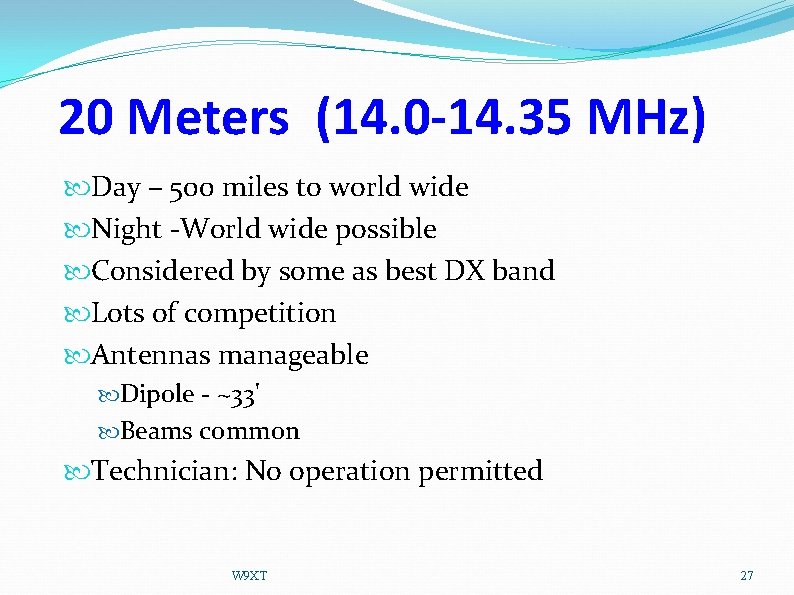
20 Meters (14. 0 -14. 35 MHz) Day – 500 miles to world wide Night -World wide possible Considered by some as best DX band Lots of competition Antennas manageable Dipole - ~33' Beams common Technician: No operation permitted W 9 XT 27
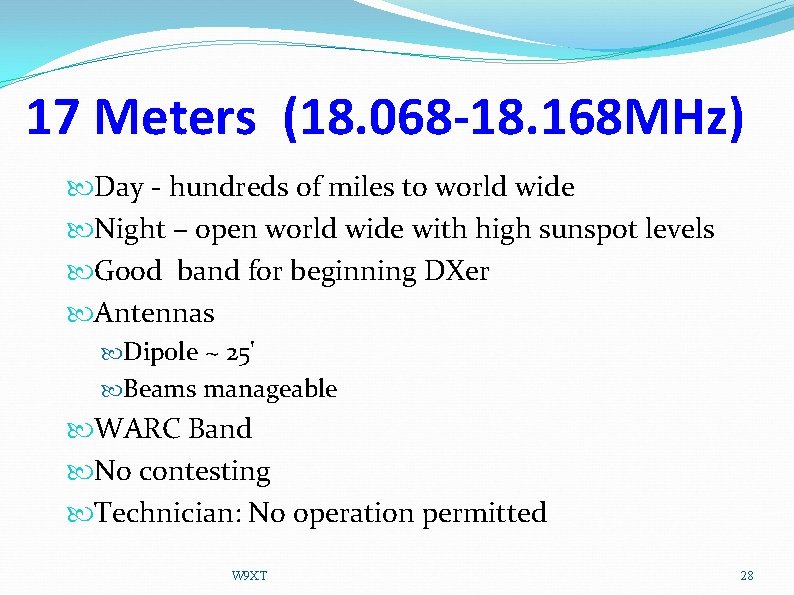
17 Meters (18. 068 -18. 168 MHz) Day - hundreds of miles to world wide Night – open world wide with high sunspot levels Good band for beginning DXer Antennas Dipole ~ 25' Beams manageable WARC Band No contesting Technician: No operation permitted W 9 XT 28
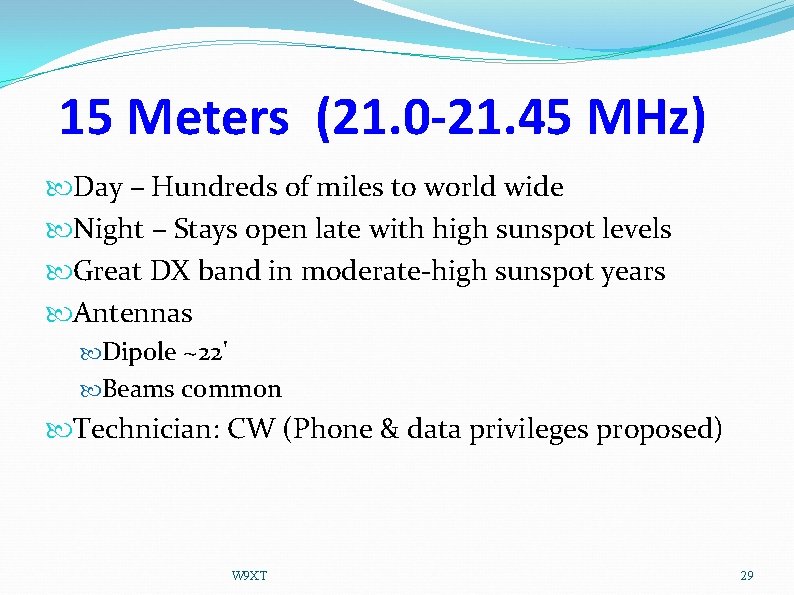
15 Meters (21. 0 -21. 45 MHz) Day – Hundreds of miles to world wide Night – Stays open late with high sunspot levels Great DX band in moderate-high sunspot years Antennas Dipole ~22' Beams common Technician: CW (Phone & data privileges proposed) W 9 XT 29
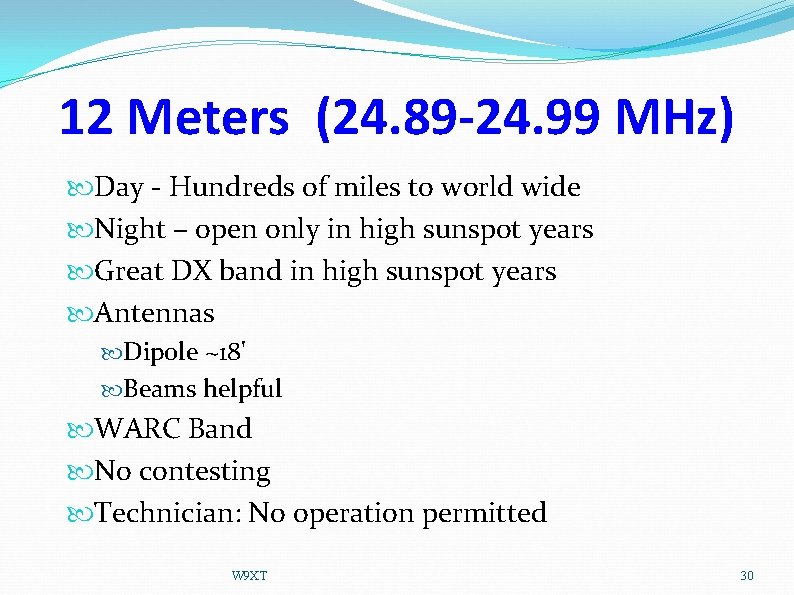
12 Meters (24. 89 -24. 99 MHz) Day - Hundreds of miles to world wide Night – open only in high sunspot years Great DX band in high sunspot years Antennas Dipole ~18' Beams helpful WARC Band No contesting Technician: No operation permitted W 9 XT 30
10 Meters (28. 0 -29. 7 MHz) Day - Hundreds of miles to world wide Night – open several hours in high sunspot years Excellent DX band in high sunspot years Very quiet Modest stations effective Very large band– stations can spread out to avoid QRM Fun band for Es in late spring / early summer Antennas Dipole ~18' Beams common W 9 XT 31
10 Meters (continued) Many propagation modes F (with moderate to high sunspot levels) Es Aurora Technician: CW, data, phone W 9 XT 32
Where are We in the Sunspot Cycle? Summer 2018 W 9 XT 33
Where Are We Now? Summer 2018 Source: http: //spaceweatherlive. com 8/8/2018 W 9 XT 34
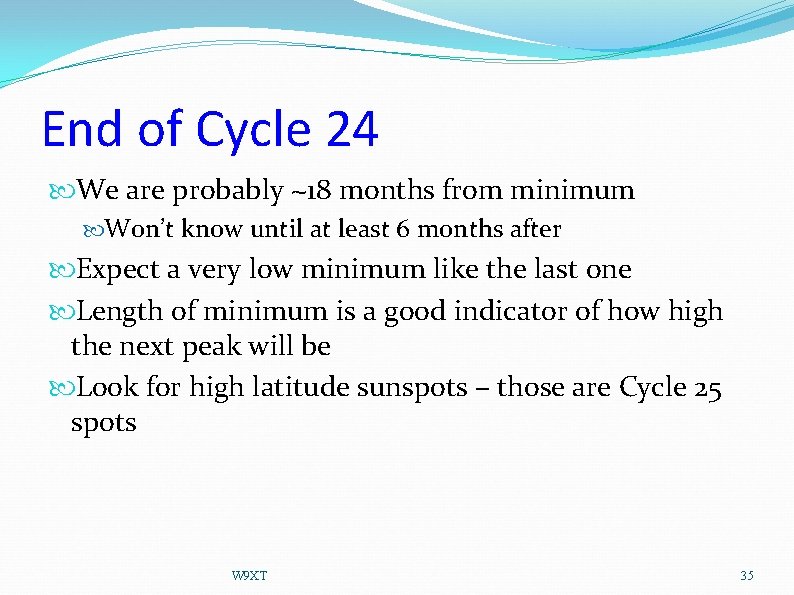
End of Cycle 24 We are probably ~18 months from minimum Won’t know until at least 6 months after Expect a very low minimum like the last one Length of minimum is a good indicator of how high the next peak will be Look for high latitude sunspots – those are Cycle 25 spots W 9 XT 35
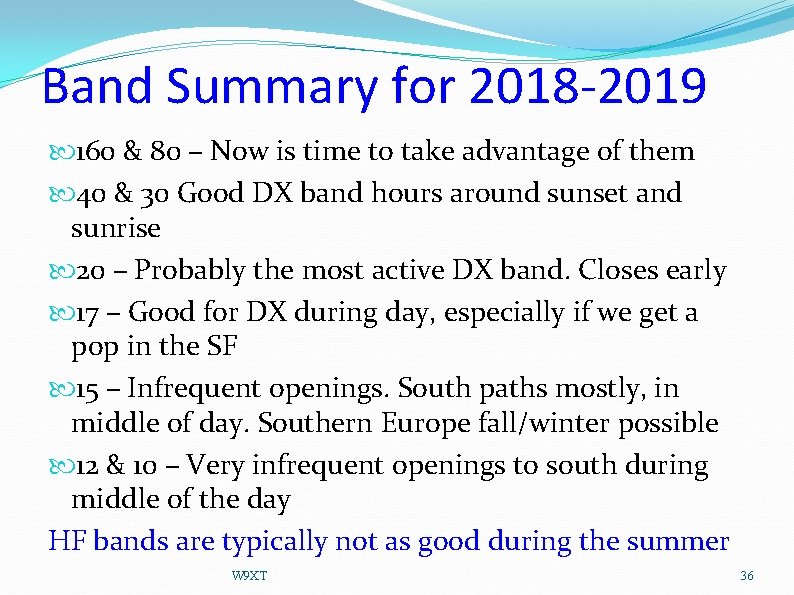
Band Summary for 2018 -2019 160 & 80 – Now is time to take advantage of them 40 & 30 Good DX band hours around sunset and sunrise 20 – Probably the most active DX band. Closes early 17 – Good for DX during day, especially if we get a pop in the SF 15 – Infrequent openings. South paths mostly, in middle of day. Southern Europe fall/winter possible 12 & 10 – Very infrequent openings to south during middle of the day HF bands are typically not as good during the summer W 9 XT 36
Learning Propagation W 9 XT 37
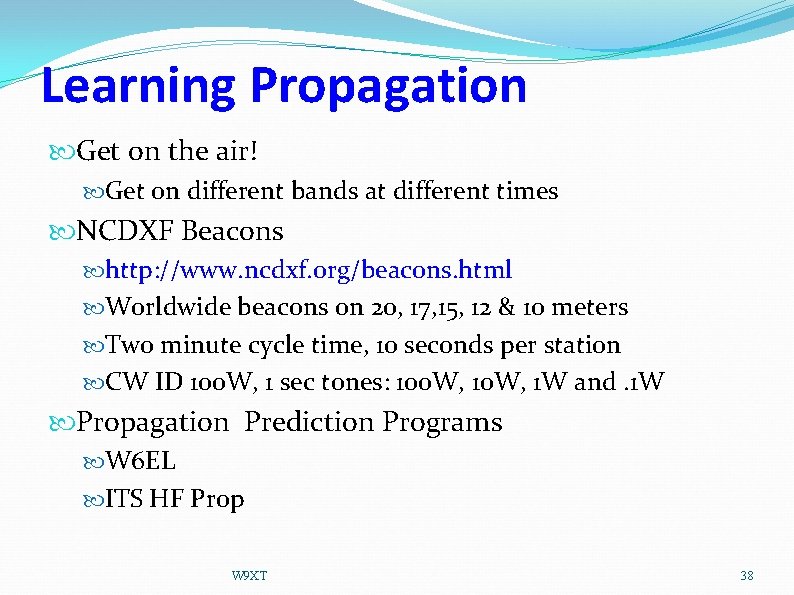
Learning Propagation Get on the air! Get on different bands at different times NCDXF Beacons http: //www. ncdxf. org/beacons. html Worldwide beacons on 20, 17, 15, 12 & 10 meters Two minute cycle time, 10 seconds per station CW ID 100 W, 1 sec tones: 100 W, 1 W and. 1 W Propagation Prediction Programs W 6 EL ITS HF Prop W 9 XT 38
WSPR – Weak Signal Propagation Reporter World wide beacon network – You can be a beacon! All bands To get on Download WSJT software (free) Interface radio to PC See what stations you can hear Log on http: //wspr. net to see map of who is hearing who Maps of who is hearing who Database of nearly 1 billion spots available W 9 XT 39
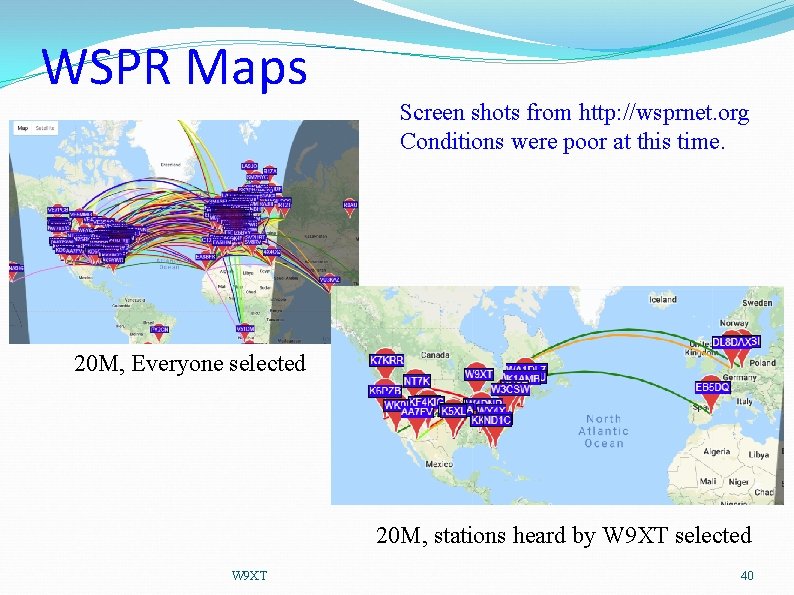
WSPR Maps Screen shots from http: //wsprnet. org Conditions were poor at this time. 20 M, Everyone selected 20 M, stations heard by W 9 XT selected W 9 XT 40
On the Air Learning Operating activities that help learn propagation Work on awards Worked All States DXCC – work 100 countries Contests The increased activity gives a good indication of band openings Call CQ on a dead band – you might be surprised what comes back! Predicting propagation is like predicting the weather. There will always be surprises! W 9 XT 41

Summary HF provides a life time of challenges and fun Opens the whole world “Takes five minutes to learn, a lifetime to master”* *With apologies to Mike Sexton of the World Poker Tour This presentation will be available at www. w 9 xt. com W 9 XT 42
- Slides: 42