
Hey Ive Got A Job Interview Whats going
“Hey, I’ve Got A Job Interview!” What’s going to happen during the interview? Who is conducting the interview? What is the interview intended to accomplish? How long will the interview last? Where will the interview be conducted? How will I be evaluated?
Types of Interviews One-on-one most often used Informal: Interviewer has a general idea of what will be asked, but after first question, follows conversation trend. Structured: Questions will be written out based on job requirements, and will be asked of every candidate. Unstructured: After one or two questions, the interviewer may sit back and wait for you to make the next move. Group you will meet with more than one person at a time Teamwork is important. They want to see how effective you are as part of a group. Take it one question at a time Answer the person who asked the question. After finish look around & see if anyone needs further clarification. Make eye contact with each member of the group.
The Job Interview The most crucial thirty- to sixty-minute opportunity you have in your job seeking efforts. The culmination of all your preparation, including education, and the key to opening the door to your career. Your goals for effective job interviewing: Get the job offer Land a stimulating & rewarding job Interviewer’s goals in effective job interviewing: Can you do the job? Will you get along with the other employees?

Interviewer’s Worst Fear 1. 2. 3. 4. 5. 6. 7. 8. If hired, you’ll be incompetent. Or, you’ll need too much time to learn the job. You won’t take your work seriously and someone must constantly check your work. That you’ll be lazy, giving only the minimum effort and have to be told when to do everything. That you’ll frequently call in sick, arrive late, leave early and constantly ask for raises. That you’re a quitter and you’ll walk out when they need you. That you’re a constant complainer, a braggart, or someone who blames others for your mistakes, sloppy work, etc. That you’re arrogant, rude, pushy, broody, or moody. That you show no pride in your work or appearance.
Interview Strategy Have advance knowledge of the company and the answers to the “Fear Factor” questions. Know what the interviewer is asking and trying to discover about you. Be prepared to convince the interviewer you can accomplish his three goals: 1) you can do the job, 2) you will do the job, 3) you will get along with other employees. Most interviews are pleasant and friendly. Try to enjoy it.
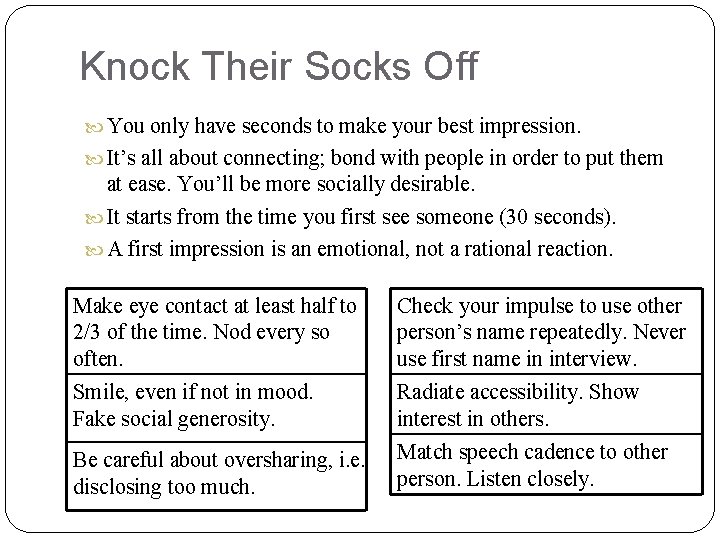
Knock Their Socks Off You only have seconds to make your best impression. It’s all about connecting; bond with people in order to put them at ease. You’ll be more socially desirable. It starts from the time you first see someone (30 seconds). A first impression is an emotional, not a rational reaction. Make eye contact at least half to 2/3 of the time. Nod every so often. Check your impulse to use other person’s name repeatedly. Never use first name in interview. Smile, even if not in mood. Fake social generosity. Radiate accessibility. Show interest in others. Be careful about oversharing, i. e. disclosing too much. Match speech cadence to other person. Listen closely.
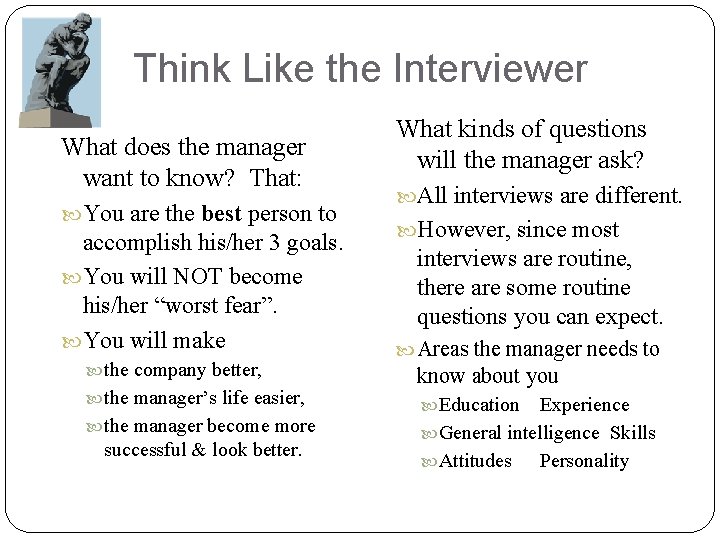
Think Like the Interviewer What does the manager want to know? That: You are the best person to accomplish his/her 3 goals. You will NOT become his/her “worst fear”. You will make the company better, the manager’s life easier, the manager become more successful & look better. What kinds of questions will the manager ask? All interviews are different. However, since most interviews are routine, there are some routine questions you can expect. Areas the manager needs to know about you Education Experience General intelligence Skills Attitudes Personality
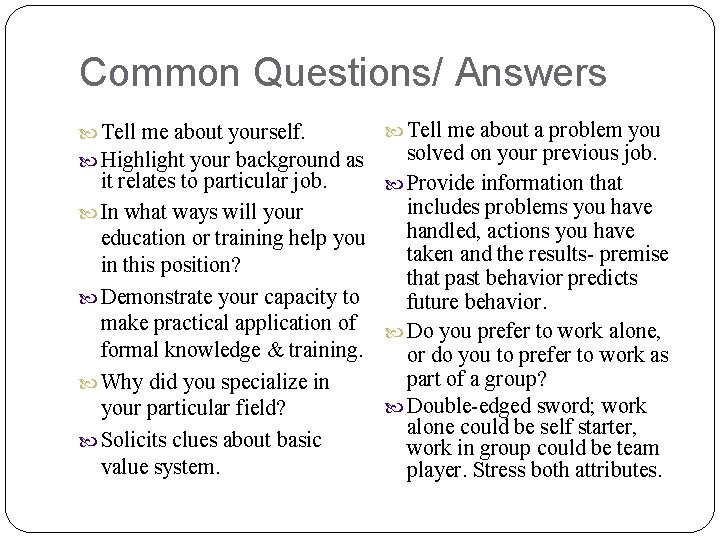
Common Questions/ Answers Tell me about yourself. Highlight your background as Tell me about a problem you solved on your previous job. it relates to particular job. Provide information that includes problems you have In what ways will your handled, actions you have education or training help you taken and the results- premise in this position? that past behavior predicts Demonstrate your capacity to future behavior. make practical application of Do you prefer to work alone, formal knowledge & training. or do you to prefer to work as part of a group? Why did you specialize in Double-edged sword; work your particular field? alone could be self starter, Solicits clues about basic work in group could be team value system. player. Stress both attributes.
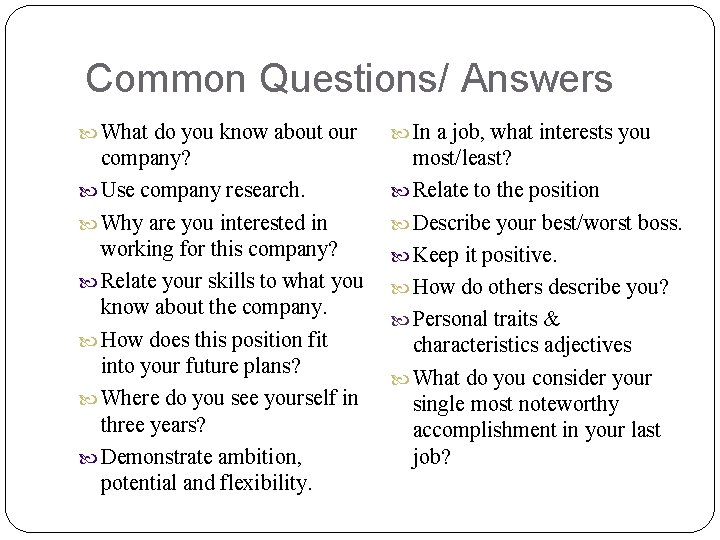
Common Questions/ Answers What do you know about our In a job, what interests you company? Use company research. Why are you interested in working for this company? Relate your skills to what you know about the company. How does this position fit into your future plans? Where do you see yourself in three years? Demonstrate ambition, potential and flexibility. most/least? Relate to the position Describe your best/worst boss. Keep it positive. How do others describe you? Personal traits & characteristics adjectives What do you consider your single most noteworthy accomplishment in your last job?
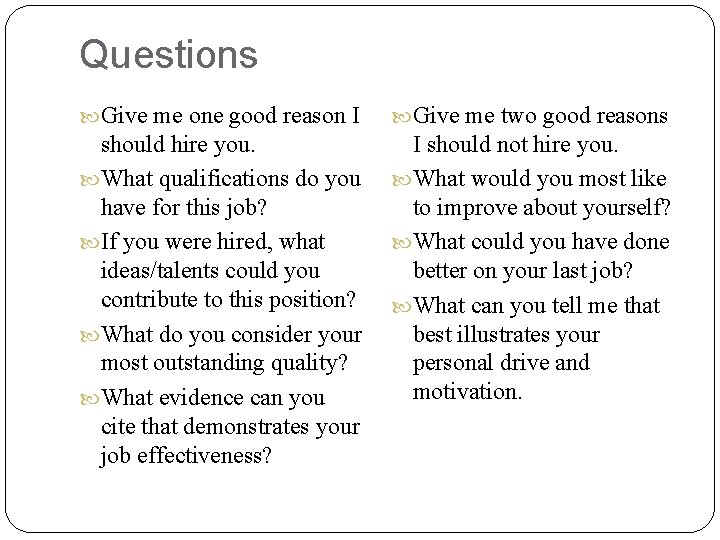
Questions Give me one good reason I Give me two good reasons should hire you. What qualifications do you have for this job? If you were hired, what ideas/talents could you contribute to this position? What do you consider your most outstanding quality? What evidence can you cite that demonstrates your job effectiveness? I should not hire you. What would you most like to improve about yourself? What could you have done better on your last job? What can you tell me that best illustrates your personal drive and motivation.
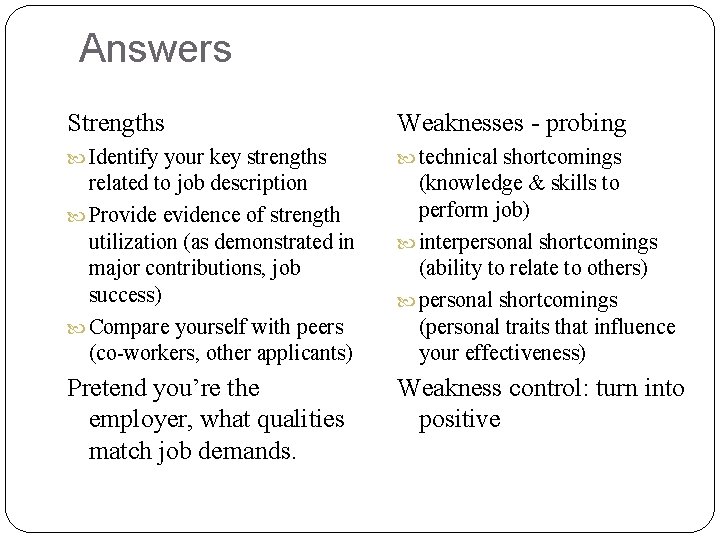
Answers Strengths Weaknesses - probing Identify your key strengths technical shortcomings related to job description Provide evidence of strength utilization (as demonstrated in major contributions, job success) Compare yourself with peers (co-workers, other applicants) (knowledge & skills to perform job) interpersonal shortcomings (ability to relate to others) personal shortcomings (personal traits that influence your effectiveness) Pretend you’re the employer, what qualities match job demands. Weakness control: turn into positive
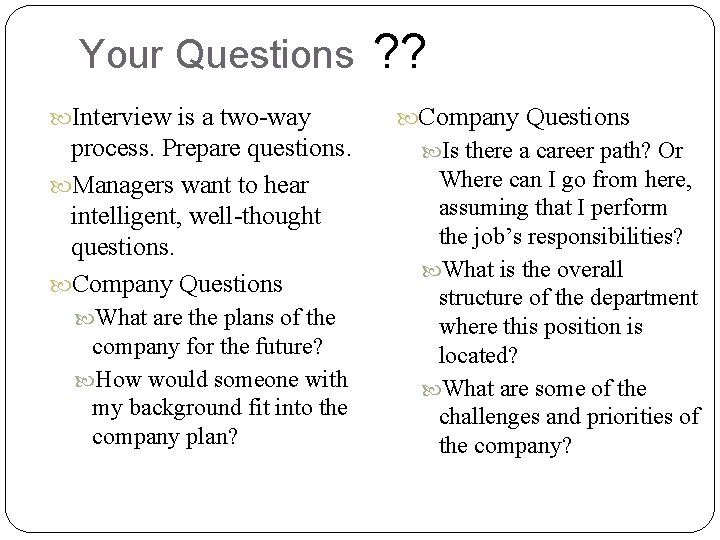
Your Questions Interview is a two-way process. Prepare questions. Managers want to hear intelligent, well-thought questions. Company Questions What are the plans of the company for the future? How would someone with my background fit into the company plan? ? ? Company Questions Is there a career path? Or Where can I go from here, assuming that I perform the job’s responsibilities? What is the overall structure of the department where this position is located? What are some of the challenges and priorities of the company?
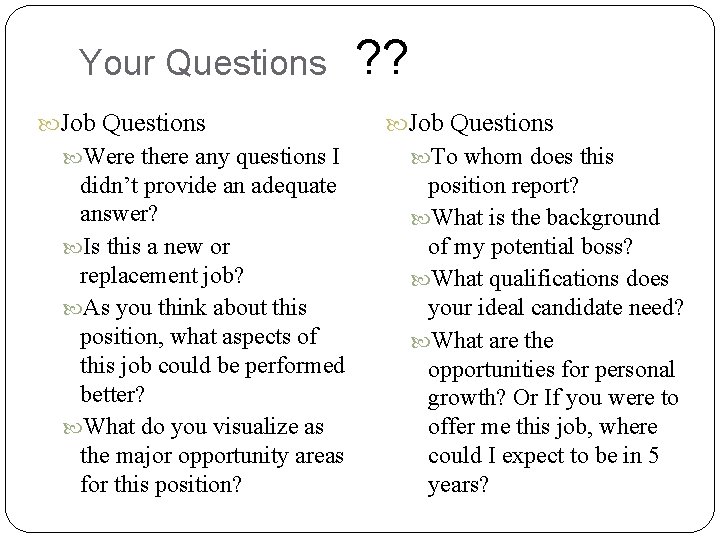
Your Questions Job Questions ? ? Job Questions Were there any questions I To whom does this didn’t provide an adequate answer? Is this a new or replacement job? As you think about this position, what aspects of this job could be performed better? What do you visualize as the major opportunity areas for this position? position report? What is the background of my potential boss? What qualifications does your ideal candidate need? What are the opportunities for personal growth? Or If you were to offer me this job, where could I expect to be in 5 years?
Your Questions Compensation Issues Never ask about salary. The company will discuss salary when appropriate; usually reserved for the second interview or when there is a firm offer. When the offer is made, ask: Is there a sign-on bonus or commission in addition to salary? How often are the reviews? Benefits questions. Company benefits are often worth 25% to 50% or more of cash salary offered. Ask: When am I eligible for the plan? Do I have a choice of benefits available? Negotiations. Everything can be negotiated after you have received an offer. Know the market and request consideration in terms of salary, benefits and perks.
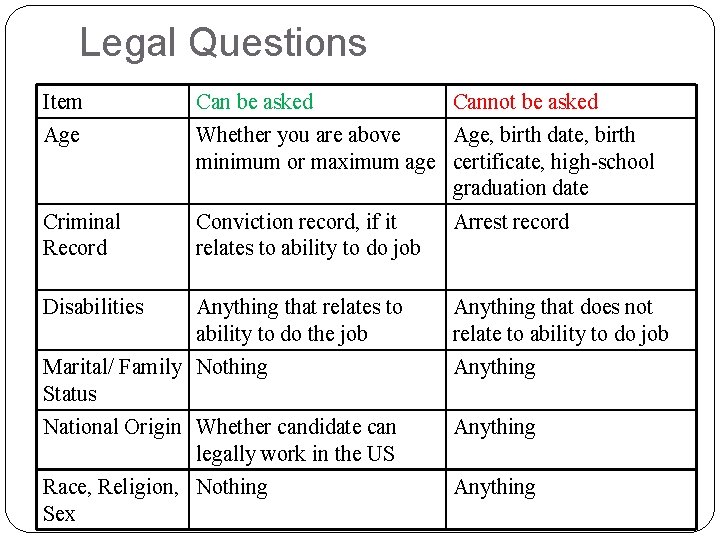
Legal Questions Item Can be asked Cannot be asked Age Whether you are above Age, birth date, birth minimum or maximum age certificate, high-school graduation date Criminal Record Conviction record, if it relates to ability to do job Arrest record Disabilities Anything that relates to ability to do the job Anything that does not relate to ability to do job Marital/ Family Nothing Status Anything National Origin Whether candidate can legally work in the US Anything Race, Religion, Nothing Sex Anything
Tips Bathe and use deodorant-antiperspirant before the interview. Bring only essential items to the interview (resume, references, portfolio, datebook, transcripts of college work, licenses, etc. ). Organize items so can refer to them readily in interview. Know location of office and how to get there. Make a trial trip getting to the interview. Arrive 15 minutes early for actual interview. Be pleasant, polite and friendly but businesslike to everyone you meet, including office staff. Check your appearance before going in. If you have bad breath, take a breath mint.
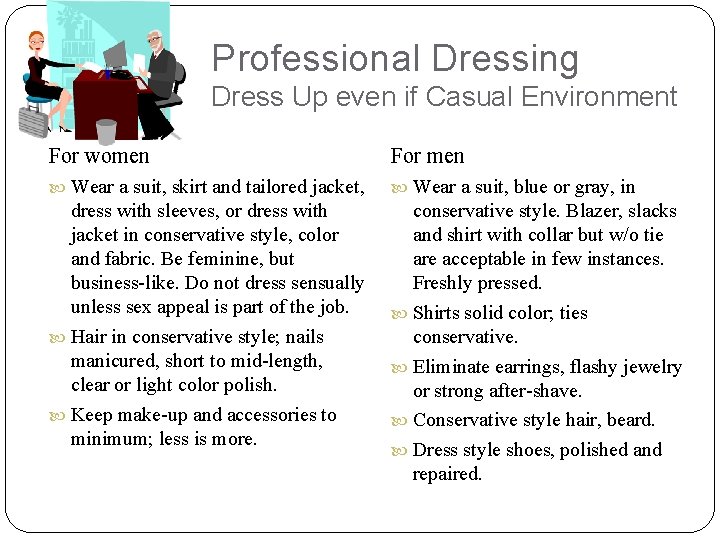
Professional Dressing Dress Up even if Casual Environment For women For men Wear a suit, skirt and tailored jacket, Wear a suit, blue or gray, in dress with sleeves, or dress with jacket in conservative style, color and fabric. Be feminine, but business-like. Do not dress sensually unless sex appeal is part of the job. Hair in conservative style; nails manicured, short to mid-length, clear or light color polish. Keep make-up and accessories to minimum; less is more. conservative style. Blazer, slacks and shirt with collar but w/o tie are acceptable in few instances. Freshly pressed. Shirts solid color; ties conservative. Eliminate earrings, flashy jewelry or strong after-shave. Conservative style hair, beard. Dress style shoes, polished and repaired.
Non-verbal Always offer your hand; use a firm, but not crushing handshake. Use eye contact without staring; avoiding contact is a sign of deception, disinterest, or lack of confidence. If a place of sitting is not indicated, choose a chair closest to the interviewer. Sit relaxed, but do not slouch. Leaning slightly forward shows interest, but do not lean on desk or knees. Use hands naturally to emphasize a point; do not cover mouth, hold your head or twist hands.
Summary Deadly Interview Mistakes 1. 2. 3. 4. 5. 6. 7. 8. Arrives late for the interview. Indicates he is late because the directions he was given were not good. Looks disheveled and inappropriately dressed. Slouches in his seat. Does not maintain good eye contact with interviewer. Assumes he will find out about the company in the interview. Asks interviewer “What do you do here? ” Does not link what he can do with the needs of the employer. Brags about how great he is , but cites no evidence.
Summary Deadly Interview Mistakes 9. 10. 11. 12. 13. 14. 15. 16. Responses have no clear focus, seem disorganized and rambling. Is low-key; does not project enthusiasm nor appear to want the job; what are you going to do for me attitude. Answers most questions with short “yes” and “no”. Appears desperate for a job – any job. Calls the interviewer by his first name repeatedly or uses the wrong name. Badmouths his former boss and the company. Gives memorized responses and forgets parts. Asks “How am I doing? Are you going to hire
After the Interview Review & analyze your performance. Take notes, modify any items to improve your next interview. Send a thank you note to the manager immediately after the interview. Don’t put this off! Make a return visit or a telephone call two or three days after your interview. Reintroduce yourself and remind which job you interviewed for. Add any additional thoughts you may not have covered when interviewed. Emphasize your strengths for the job. Find out if a hiring decision has been made. If decision has been made and you’re not it, ask for suggestions for creating a better impression. Thank the interviewer for speaking to you & for his time.
- Slides: 21