
Heuristics pragmatism and naturalism Konrad TalmontKaminski KLI UMCS




- Slides: 18
Heuristics, pragmatism and naturalism Konrad Talmont-Kaminski, KLI & UMCS
Aims • To place Herbert Simon’s work within the context of particular versions of pragmatism and naturalism • To give some grounds for supporting the resultant position
Nailing theses • “Right wing” Peircean pragmatism – Thought motivated by a conflict, between what is real and our beliefs, made evident by action – Intimate connection between action and belief • Methodological naturalism – Rejection of a priori methods – Epistemic methods as natural phenomena • Fellow travellers? – – – – Hook Haack Hooker Hacking Hookway and, sometimes, Nicholas Rescher
Plan • • Varieties of heuristics Properties of heuristics Heuristics and Peirce on habits Heuristics and Hume on habits
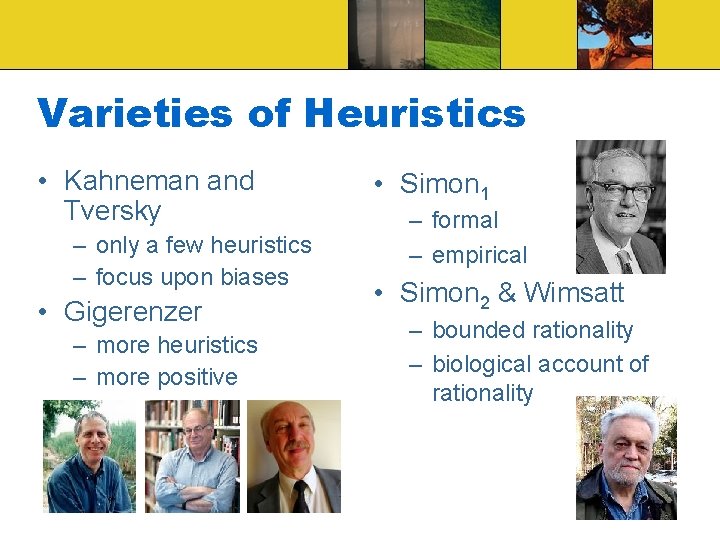
Varieties of Heuristics • Kahneman and Tversky – only a few heuristics – focus upon biases • Gigerenzer – more heuristics – more positive • Simon 1 – formal – empirical • Simon 2 & Wimsatt – bounded rationality – biological account of rationality
Varieties of heuristics • Examples – Double-blind testing – Use of laser light to measure distance – Biological adaptations • Ways biological systems manage their interactions with their environment – – Very broad category Danger of triviality Concrete examples vital Very weak distinction between theory and practice
Varieties of heuristics • A range of approaches to research – Combines • Thorough theoretical grounding • Detailed empirical studies – Allows • Robust scientific investigation • Significant philosophical work – Exemplifies the values sought
Properties of heuristics • • • Lacking guarantees Cost-effective Systematically biased Problem transforming Purpose relative Inter-related Wiliam Wimsatt Re-engineering Philosophy for Limited Beings 2007
Properties of heuristics By contrast with truth-preserving algorithms or other procedures for which they might be substituted, heuristics make no guarantees that they will produce a solution to a problem. • Fallibilist • Algorithms only used in special cases
Properties of heuristics By comparison with procedures for which they are substituted, heuristics are cost-effective in terms of demands on memory, computation, and other limited resources • Viable epistemic methods not idealisations
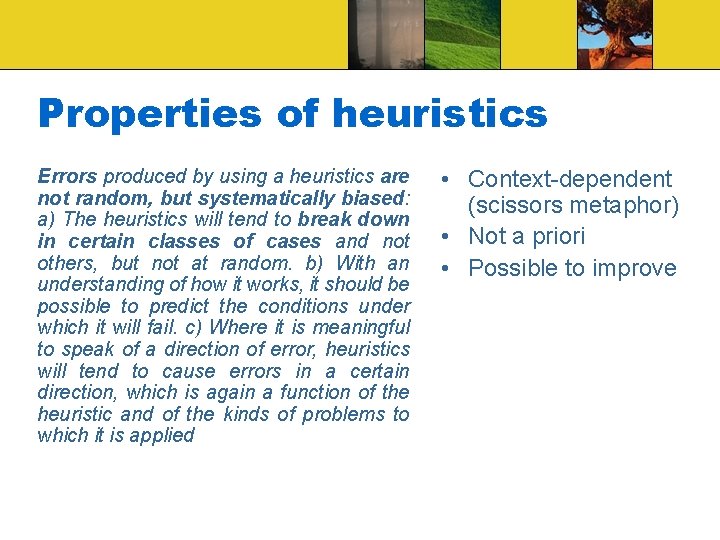
Properties of heuristics Errors produced by using a heuristics are not random, but systematically biased: a) The heuristics will tend to break down in certain classes of cases and not others, but not at random. b) With an understanding of how it works, it should be possible to predict the conditions under which it will fail. c) Where it is meaningful to speak of a direction of error, heuristics will tend to cause errors in a certain direction, which is again a function of the heuristic and of the kinds of problems to which it is applied • Context-dependent (scissors metaphor) • Not a priori • Possible to improve
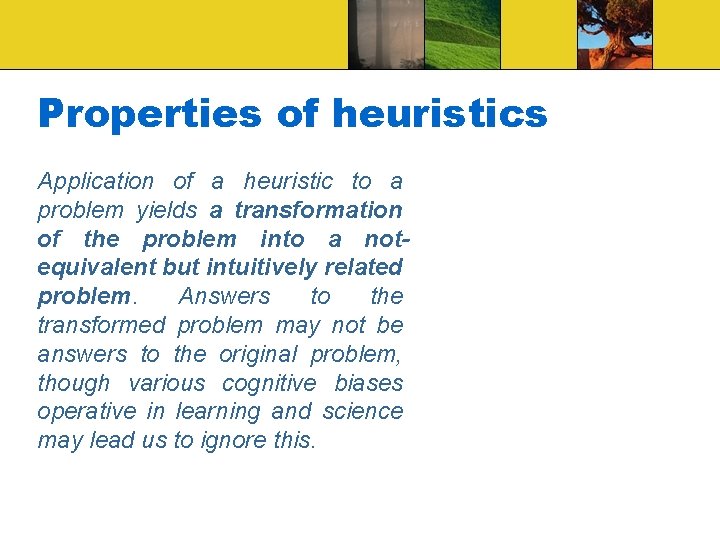
Properties of heuristics Application of a heuristic to a problem yields a transformation of the problem into a notequivalent but intuitively related problem. Answers to the transformed problem may not be answers to the original problem, though various cognitive biases operative in learning and science may lead us to ignore this.
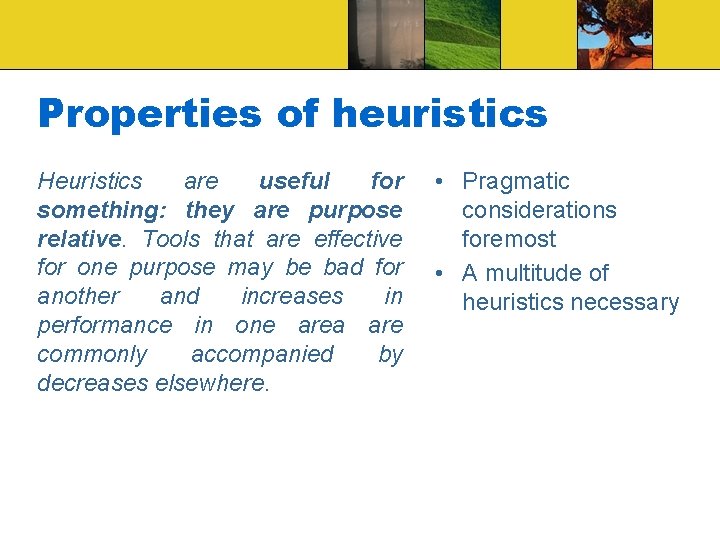
Properties of heuristics Heuristics are useful for something: they are purpose relative. Tools that are effective for one purpose may be bad for another and increases in performance in one area are commonly accompanied by decreases elsewhere. • Pragmatic considerations foremost • A multitude of heuristics necessary
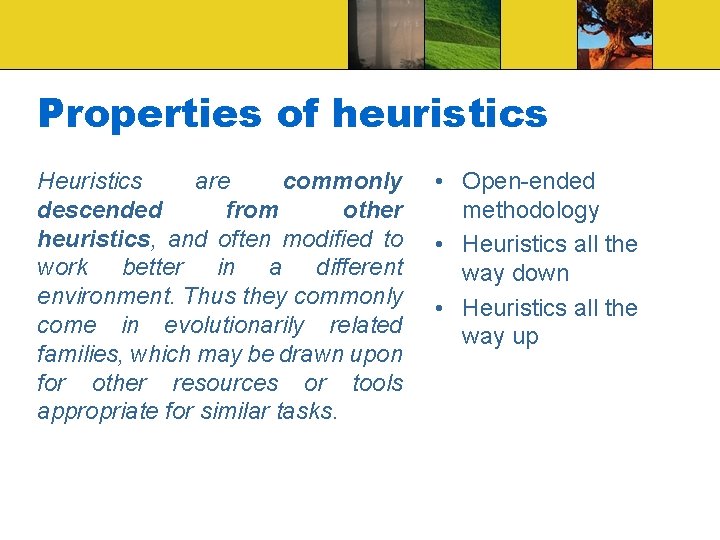
Properties of heuristics Heuristics are commonly descended from other heuristics, and often modified to work better in a different environment. Thus they commonly come in evolutionarily related families, which may be drawn upon for other resources or tools appropriate for similar tasks. • Open-ended methodology • Heuristics all the way down • Heuristics all the way up
Heuristics & Peirce on habits • Peirce – Belief as habit of action – Doubt caused by conflict with reality revealed by action • Heuristics – Heuristics as methods for fixating beliefs – Scientific heuristics continuous with / build upon existing heuristics – More specific than “method of science” – More plausible than triad of deduction, induction and abduction – Make methods subject to examination by methods
Heuristics & Hume on habits • Hume – People forced to rely upon habits due to problem of induction – Nature of habits left open • Heuristics – Heuristics as habits – Research programme investigating nature of habits/heuristics – Problem of induction entails we use heuristics – Naturalism as the attempt to see what we can do in the “humean condition”
Bibliography • • Simon, H. (1947) Administrative Behavior Simon, H. (1969) The Sciences of the Artificial Simon, H. (1983) Reason in Human Affairs Wimsatt, W. (2007) Re-engineering Philosophy for Limited Beings
Thank you E-mail: konrad@talmont. com