
Heuristics in Ancient Arabic and Chinese Mathematics and
Heuristics in Ancient Arabic and Chinese Mathematics and its use in textbooks Prof. Dr. Bernd Zimmermann from University of Jena at University of Xi‘an August 2002 B. Zimmermann ICM Beijing 2002

Heuristics: n Methods to find conjectures n Methods to find proofs n Methods to (re)invent mathematics n By analysis of history one might find methods/heuristics, which proved to be most fruitful (“invariants”) B. Zimmermann ICM Beijing 2002
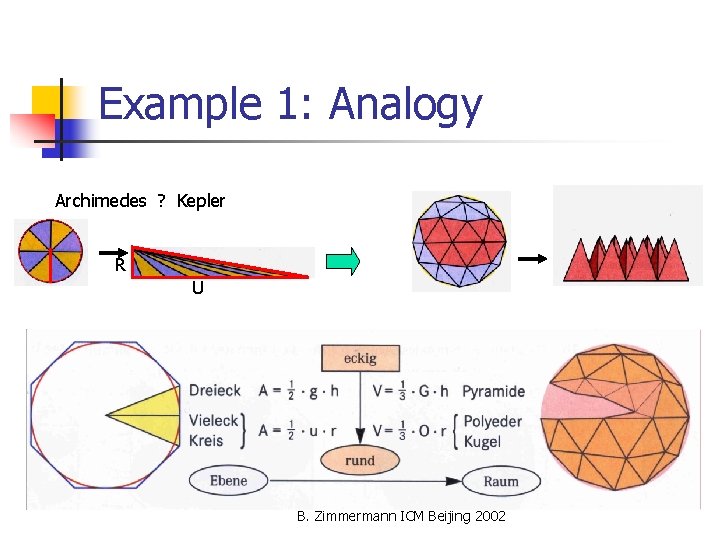
Example 1: Analogy Archimedes ? Kepler R U B. Zimmermann ICM Beijing 2002
Example 2: Analysis n n “Now, analysis is the path from what one is seeking, as if it were established, by way of its consequences, to something that is established by synthesis. That is to say, in analysis we assume what is sought as if it has been achieved, and look for the thing from which it follows, and again what comes before that, until by regressing in this way we come upon some one of the things that are already known, or that occupy the rank of a first principle. We call this kind of method 'analysis', as if to say anapalin lysis (reduction backward). In synthesis, by reversal, we assume what was obtained last in the analysis to have been achieved already, and, setting now in natural order, as precedents, what before were following, and fitting them to each other, we attain the end of the construction of what was sought. This is what we call 'synthesis'. ” (Pappos in Jones A. (ed. &. transl. ): Pappus of Alexandria. Book 7 of the Collection. Part 1. Springer, New York 1986, p. 82) B. Zimmermann ICM Beijing 2002
Ibn al Haitham, the method of analysis and perfect numbers n Jaouiche, K. : Ibn al Haitham: Kitab at-tahlil wa-ttarkib. Ouvrage d’al-H, . asan ibn al Haitham sur l’analyse et la synthèse. Unpublished manuscript Paris 1991. n n Rashed, R. : Ibn al-Haytham et les nombres parfaits. In: Historia Mathematica 16 (1989), 343 -352. Hogendijk, J. P. : Review of Rashed 1989, Mathematical Reviews Sections, 91 d: 01002 01 A 30 01 A 20 11 -03, S. 1822, April 1991 -Issue 91 d. B. Zimmermann ICM Beijing 2002
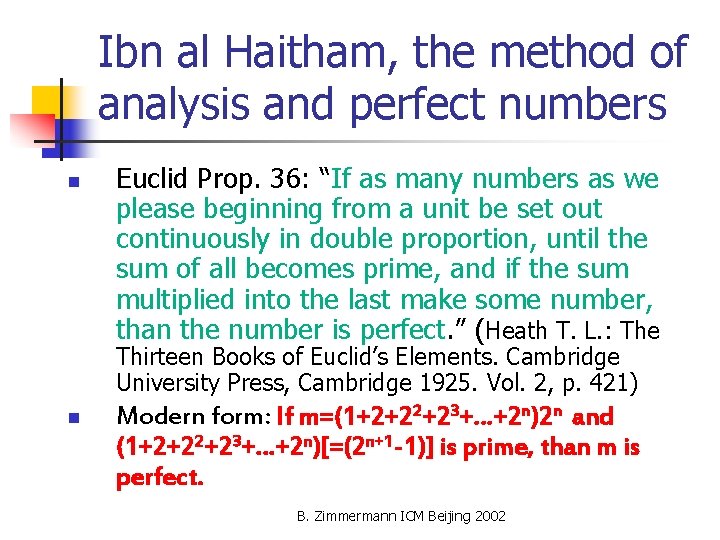
Ibn al Haitham, the method of analysis and perfect numbers n Euclid Prop. 36: “If as many numbers as we please beginning from a unit be set out continuously in double proportion, until the sum of all becomes prime, and if the sum multiplied into the last make some number, than the number is perfect. ” (Heath T. L. : The Thirteen Books of Euclid’s Elements. Cambridge University Press, Cambridge 1925. Vol. 2, p. 421) n Modern form: If m=(1+2+22+23+…+2 n)2 n and (1+2+22+23+…+2 n)[=(2 n+1 -1)] is prime, than m is perfect. B. Zimmermann ICM Beijing 2002
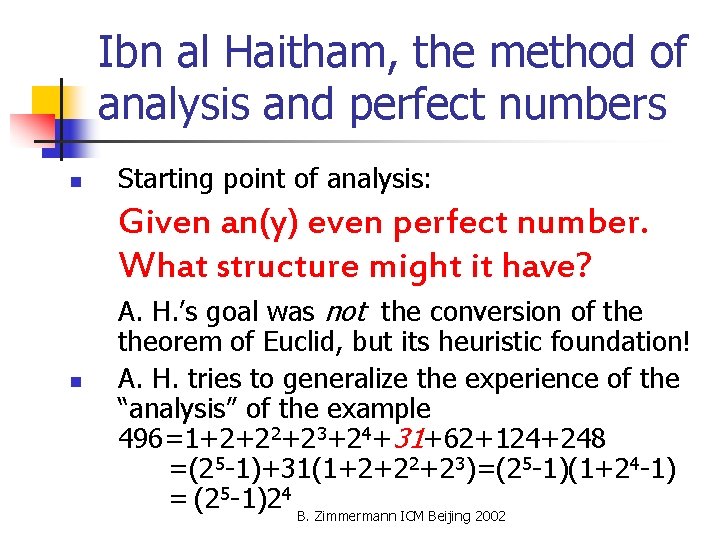
Ibn al Haitham, the method of analysis and perfect numbers n Starting point of analysis: Given an(y) even perfect number. What structure might it have? n A. H. ’s goal was not the conversion of theorem of Euclid, but its heuristic foundation! A. H. tries to generalize the experience of the “analysis” of the example 496=1+2+22+23+24+31+62+124+248 =(25 -1)+31(1+2+22+23)=(25 -1)(1+24 -1) = (25 -1)24 B. Zimmermann ICM Beijing 2002
Ibn Sinan and heuristics n n Bellosta, H. : Ibrahim ibn Sinan: On Analysis and Synthesis. In: Arabic Sciences and Philosophy, vol. I (1991), pp. 211 - 232 Content: Classification of problems; analysis and its role in the determination of the class of each problem; synthesis; reaction to criticism B. Zimmermann ICM Beijing 2002
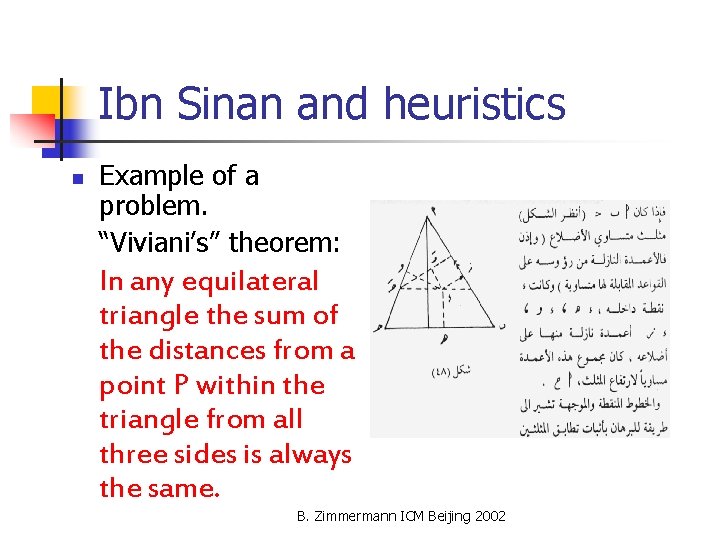
Ibn Sinan and heuristics n Example of a problem. “Viviani’s” theorem: In any equilateral triangle the sum of the distances from a point P within the triangle from all three sides is always the same. B. Zimmermann ICM Beijing 2002
Al Sijzi and problem fields B. Zimmermann ICM Beijing 2002
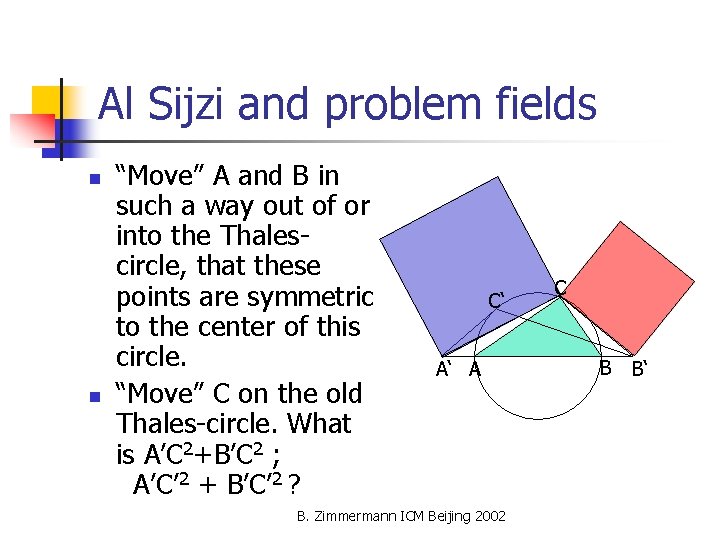
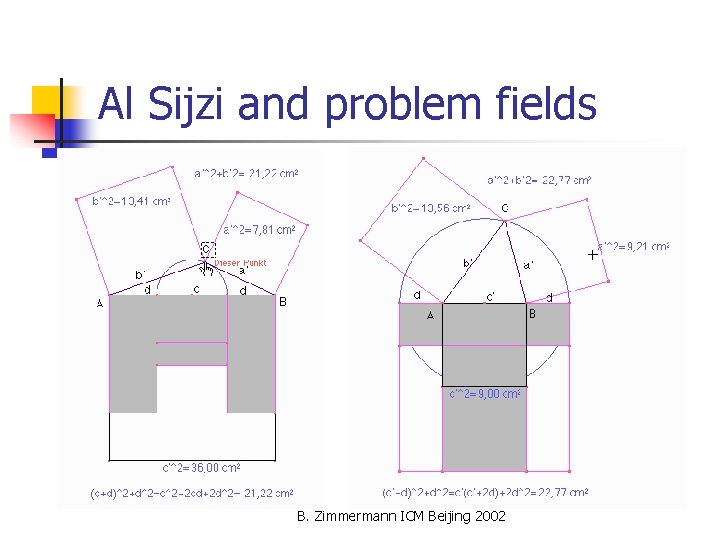
Al Sijzi and problem fields n n “Move” A and B in such a way out of or into the Thalescircle, that these points are symmetric to the center of this circle. “Move” C on the old Thales-circle. What is A’C 2+B’C 2 ; A’C’ 2 + B’C’ 2 ? C‘ A‘ A B. Zimmermann ICM Beijing 2002 C B B‘
Al Sijzi and problem fields B. Zimmermann ICM Beijing 2002
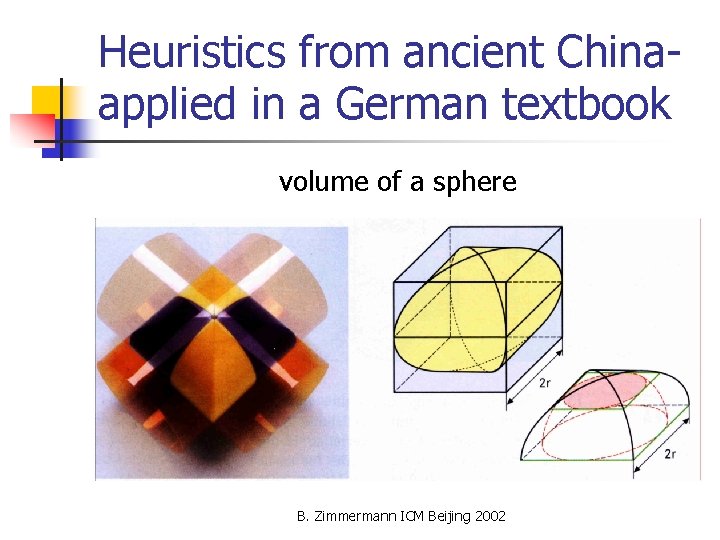
Heuristics from ancient Chinaapplied in a German textbook volume of a sphere B. Zimmermann ICM Beijing 2002
Some questions about occurrence of heuristics in ancient China What about other testimonies concerning use of heuristic methods in ancient China? n In which way the results from the „Nine Chapters of Mathematical Technique“ or other famous ancient books were created? n B. Zimmermann ICM Beijing 2002
- Slides: 14