
Heuristic Search Best FS and A Computer Science
Heuristic Search: Best. FS and A* Computer Science cpsc 322, Lecture 8 (Textbook Chpt 3. 6) January, 20010 CPSC 322, Lecture 8 Slide 1
Course Announcements Posted on Web. CT • Second Practice Exercise (uninformed Search) • Assignment 1 DEPARTMENT OF COMPUTER SCIENCE ~~~~~~~~~~~~~~~~ Distinguished Lecture Series 2008 - 2009 Speaker: Michael Littman Rutgers University Date: Thursday, January 22, 2009 Time: 3: 30 - 4: 50 pm Venue: Hugh Dempster Pavilion Room 310 Title: Efficiently Learning to Behave Efficiently CPSC 322, Lecture 7 Slide 2

Lecture Overview • Recap Heuristic Function • Best First Search • A* CPSC 322, Lecture 8 Slide 3
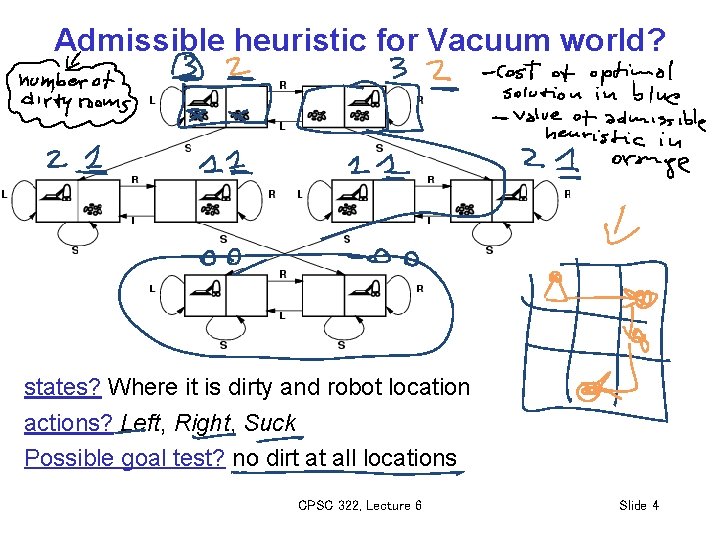
Admissible heuristic for Vacuum world? states? Where it is dirty and robot location actions? Left, Right, Suck Possible goal test? no dirt at all locations CPSC 322, Lecture 6 Slide 4
Lecture Overview • Recap Heuristic Function • Best First Search • A* CPSC 322, Lecture 8 Slide 5
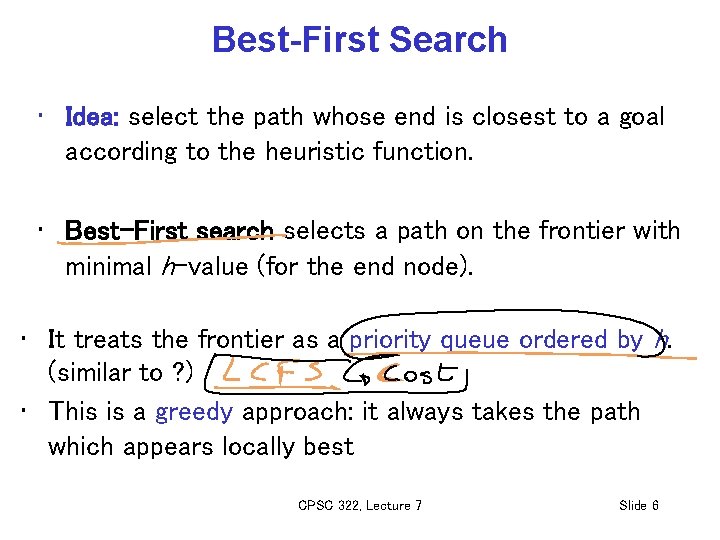
Best-First Search • Idea: select the path whose end is closest to a goal according to the heuristic function. • Best-First search selects a path on the frontier with minimal h-value (for the end node). • It treats the frontier as a priority queue ordered by h. (similar to ? ) • This is a greedy approach: it always takes the path which appears locally best CPSC 322, Lecture 7 Slide 6
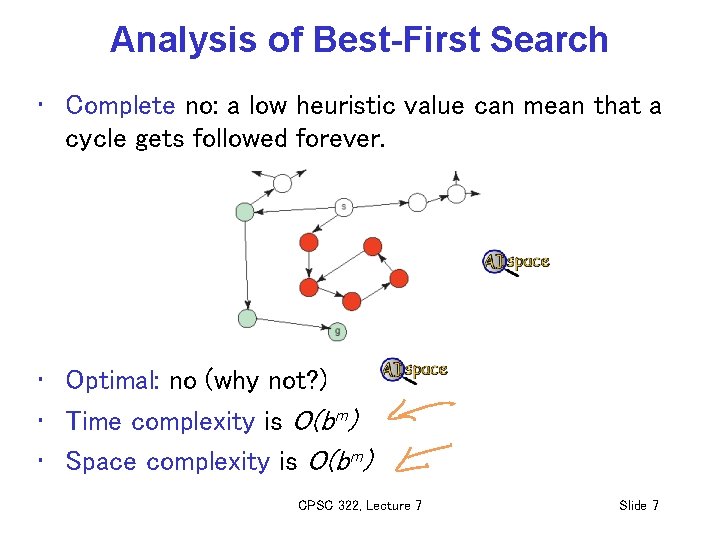
Analysis of Best-First Search • Complete no: a low heuristic value can mean that a cycle gets followed forever. • Optimal: no (why not? ) • Time complexity is O(bm) • Space complexity is O(bm) CPSC 322, Lecture 7 Slide 7
Lecture Overview • Recap Heuristic Function • Best First Search • A* Search Strategy CPSC 322, Lecture 8 Slide 8
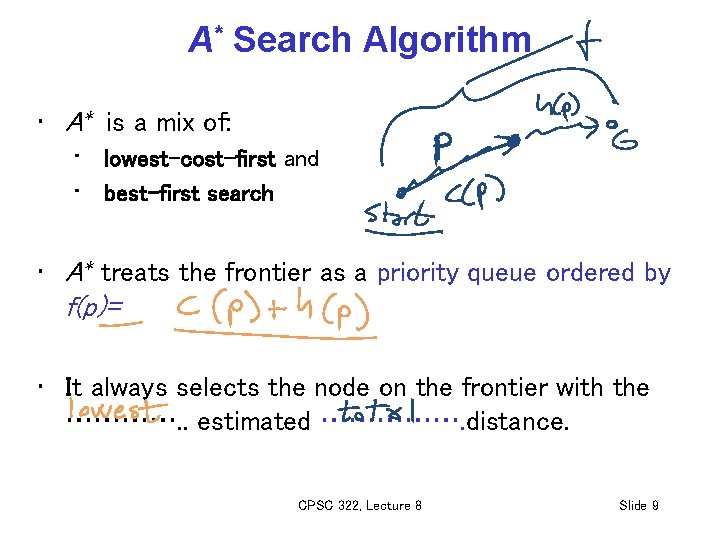
A* Search Algorithm • A* is a mix of: • lowest-cost-first and • best-first search • A* treats the frontier as a priority queue ordered by f(p)= • It always selects the node on the frontier with the …………. . estimated ……………. distance. CPSC 322, Lecture 8 Slide 9
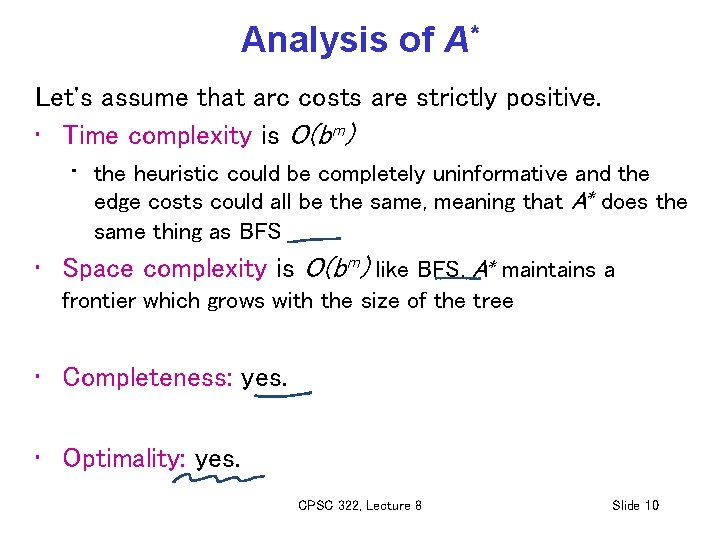
Analysis of A* Let's assume that arc costs are strictly positive. • Time complexity is O(bm) • the heuristic could be completely uninformative and the edge costs could all be the same, meaning that A* does the same thing as BFS • Space complexity is O(bm) like BFS, A* maintains a frontier which grows with the size of the tree • Completeness: yes. • Optimality: yes. CPSC 322, Lecture 8 Slide 10
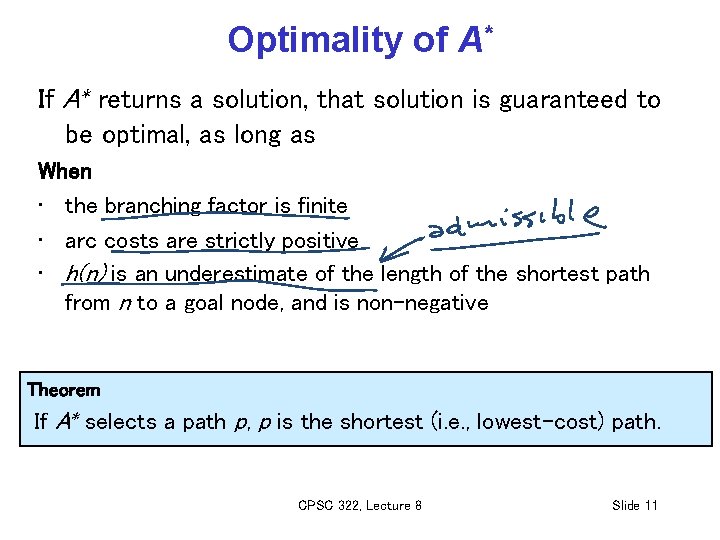
Optimality of A* If A* returns a solution, that solution is guaranteed to be optimal, as long as When • the branching factor is finite • arc costs are strictly positive • h(n) is an underestimate of the length of the shortest path from n to a goal node, and is non-negative Theorem If A* selects a path p, p is the shortest (i. e. , lowest-cost) path. CPSC 322, Lecture 8 Slide 11
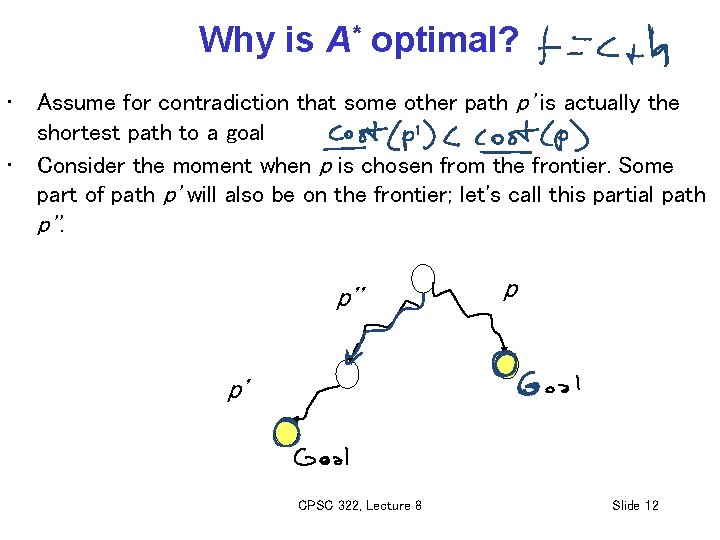
Why is A* optimal? • • Assume for contradiction that some other path p' is actually the shortest path to a goal Consider the moment when p is chosen from the frontier. Some part of path p' will also be on the frontier; let's call this partial path p'' p p' CPSC 322, Lecture 8 Slide 12
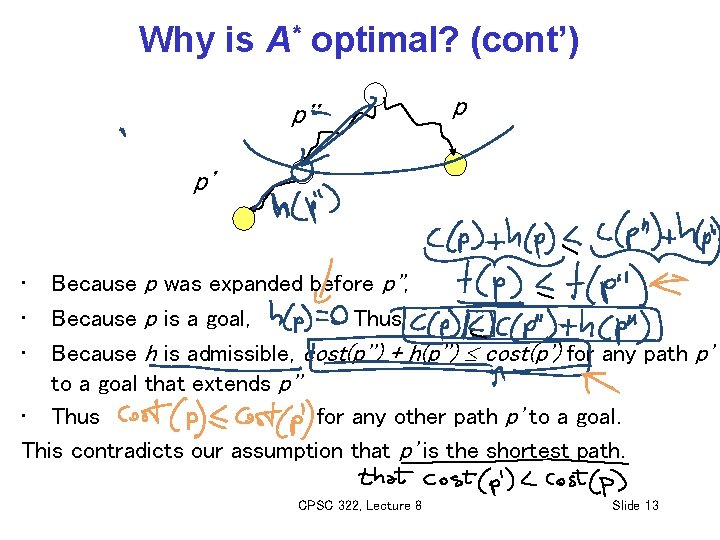
Why is A* optimal? (cont’) p'' p p' Because p was expanded before p'', Because p is a goal, Thus Because h is admissible, cost(p'') + h(p'') cost(p') for any path p' to a goal that extends p'' • Thus for any other path p' to a goal. This contradicts our assumption that p' is the shortest path. • • • CPSC 322, Lecture 8 Slide 13
Optimal efficiency of A* • In fact, we can prove something even stronger about A*: in a sense (given the particular heuristic that is available) no search algorithm could do better! • Optimal Efficiency: Among all optimal algorithms that start from the same start node and use the same heuristic h, A* expands the minimal number of paths. CPSC 322, Lecture 8 Slide 14
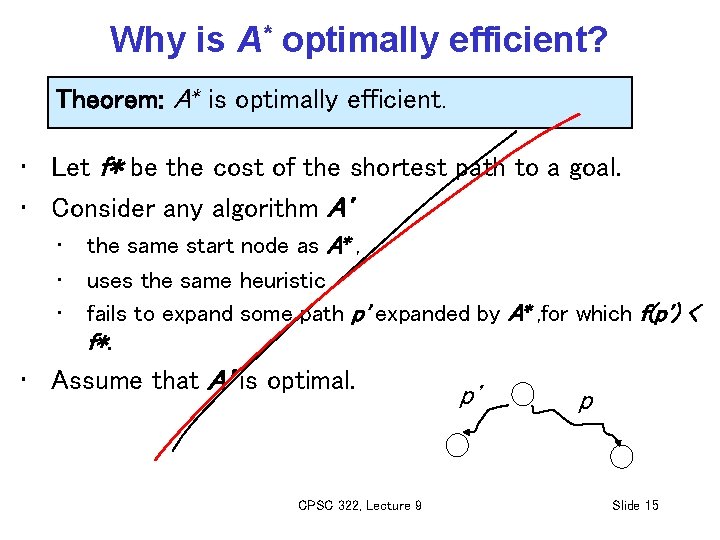
Why is A* optimally efficient? Theorem: A* is optimally efficient. • Let f* be the cost of the shortest path to a goal. • Consider any algorithm A' • • • the same start node as A* , uses the same heuristic fails to expand some path p' expanded by A* , for which f(p') < f*. • Assume that A' is optimal. CPSC 322, Lecture 9 p' p Slide 15
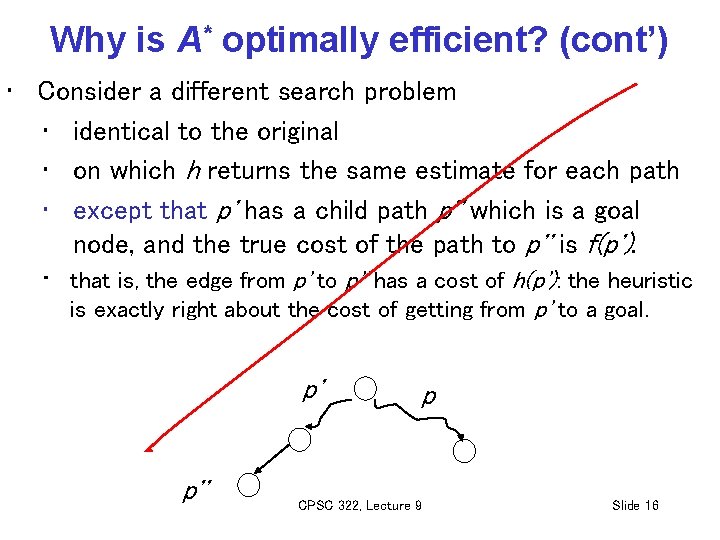
Why is A* optimally efficient? (cont’) • Consider a different search problem • identical to the original • on which h returns the same estimate for each path • except that p' has a child path p'' which is a goal node, and the true cost of the path to p'' is f(p'). • that is, the edge from p' to p'' has a cost of h(p'): the heuristic is exactly right about the cost of getting from p' to a goal. p' p'' p CPSC 322, Lecture 9 Slide 16
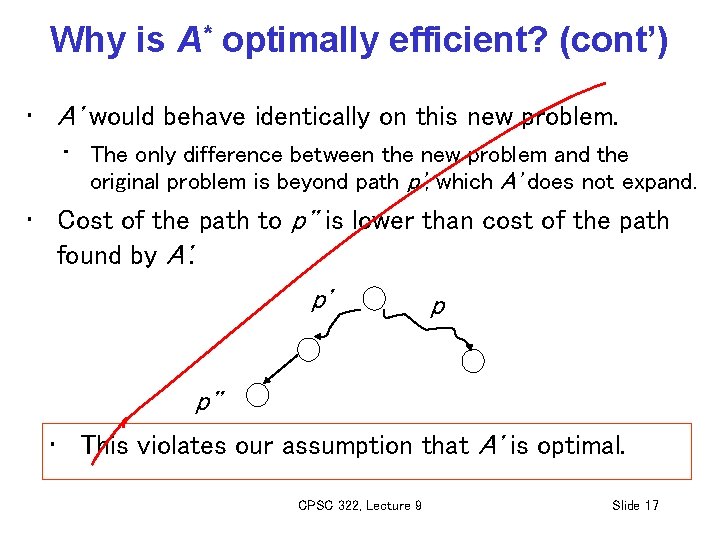
Why is A* optimally efficient? (cont’) • A' would behave identically on this new problem. • The only difference between the new problem and the original problem is beyond path p', which A' does not expand. • Cost of the path to p'' is lower than cost of the path found by A'. p' p p'' • This violates our assumption that A' is optimal. CPSC 322, Lecture 9 Slide 17
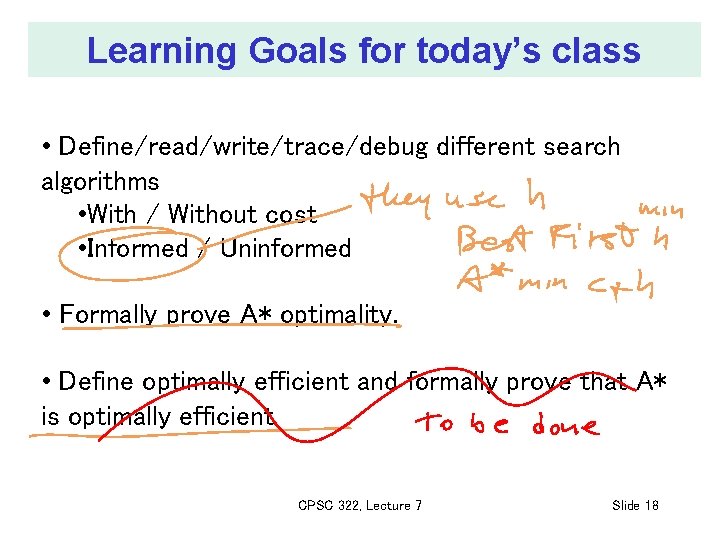
Learning Goals for today’s class • Define/read/write/trace/debug different search algorithms • With / Without cost • Informed / Uninformed • Formally prove A* optimality. • Define optimally efficient and formally prove that A* is optimally efficient CPSC 322, Lecture 7 Slide 18
Next class Finish Search (finish Chpt 3) • Branch-and-Bound • A* enhancements • Non-heuristic Pruning • Backward Search • Dynamic Programming CPSC 322, Lecture 8 Slide 19
- Slides: 19