
Heterospory and Seed habit History of Heterospory Pteridophytes

Heterospory and Seed habit History of Heterospory: • Pteridophytes are the first true land plants. Being the first successful colonisers in land habit pteridophytes show both homospory and heterospory. • Most of the pteridophytes are homosporous, produce isospores which are morphologically and physiologically identical. On exosporic germination the spores produce monoecious gametophytes bearing both antheridia and archegonia. • While, heterospory has been reported in nine genera namely, Selaginella, Isoetes, Stylites, Pilularia, Regnellidium, Marsilea, Salvinia, Azolla and Platyzoma. Heterosporous forms produce two kinds of spores: microspores produced in microsporangia and megaspores within megasporangia. Microspores germinate to produce male gametophytes, while megaspores give rise to female gametophytes. Both the spores germinate endosporically to produce gametophytes. • The existence of heterospory has importance in the origin and evolution of seed. Thus the origin of the seed habit is a logical progression that began with homospory, was followed by stages of heterospory, and culminated into the seed.

Incipience of Heterospory • It has been universally accepted that the homosporous condition is primitive and heterospory is derived. The sex determination in homosporous forms might have occurred where some of the isospores produced either exosporic male or female gametophyte. • Thus, heterospory might have first appeared in plants where each sporangium contained both microspores and megaspores. So one might expect some conditions showing incipient heterospory. • Although Equisetum is a homosporous pteridophyte, sometimes it produces two types of gametophytes — male prothallus is smaller in size, while female one is larger. This sex differentiation appears to be related to environmental condition. • Some of the population of male gametophytes remained male throughout the successive generations, while the larger population bearing archegonia become hermaphrodite if fertilisation is delayed. So Equisetum gametophytes are potentially bisexual where sex determination is related to environmental factors, though they did not lose their male potentiality. . •

Incipience of Heterospory • The monotypic Ceratopteris thalictroides is a homosporous leptosporangiate fern, but shows incipient heterospory. The spores are alike but produce two types of gametophytes; the small, strap shaped, slow growing male gametophytes and the large lobed, fast growing female gametophyte. The female gametophyte may bear antheridia if fertilisation fails. • Platyzoma, a northern Australian heterosporous fern, shows anisospory. The plants bear two types of sporangia — the smaller ones produce 32 spores and the larger ones produce 16 spores. The larger spores (megaspores) are twice the diameter of smaller spores (microspores). • Microspores germinate to produce filamentous gametophyte bearing antheridia. While, megaspores germinate to form spathulate gametophyte that bear archegonia. If fertilisation fails the female gametophytes produce antheridia on lobes. So Platyzoma is an intermediate between incipient heterospory and complete heterospory. • Thus from the above evidences it may be concluded that heterothallism might have preceded heterospory in evolution

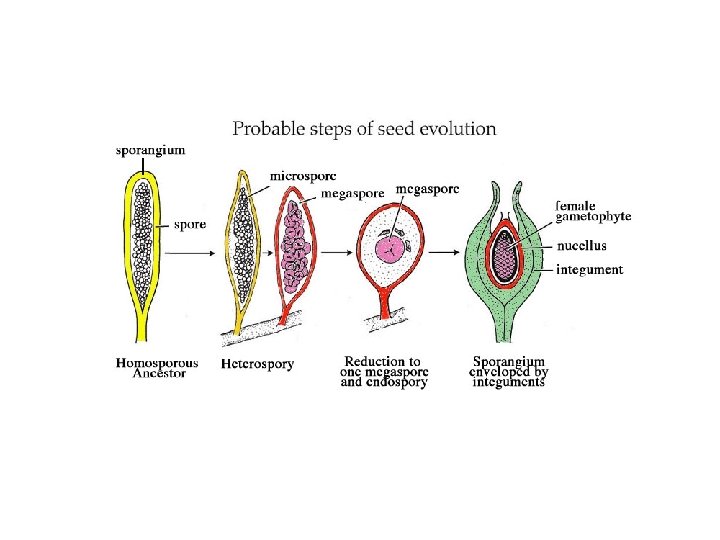
Origin of Heterospory • The fossil evidence indicates that some sporangia of the plant contained both small and large spores, though the size differences are not so pronounced. So a single sporangium contained both microspores and megaspores. At a later period, the microsporangia and megasporangia might have been differentiated. • Microsporangia contained a number of microspores and megasporangia — either on the same plant or on another plant of the same species — contained a small number of megaspores. Pteridophytes are free sporing, so both the microspores and megaspores with their endosporic gametophytes are shed. • In heterosporous members, there is a tendency to reduce the number of megaspores from many to one functional megaspore. It has been evidenced that in some members, such as Lepidocarpon and Miadesmia, the megaspores with their mega gametophytes are retained in a dehisced megaspo rangium.
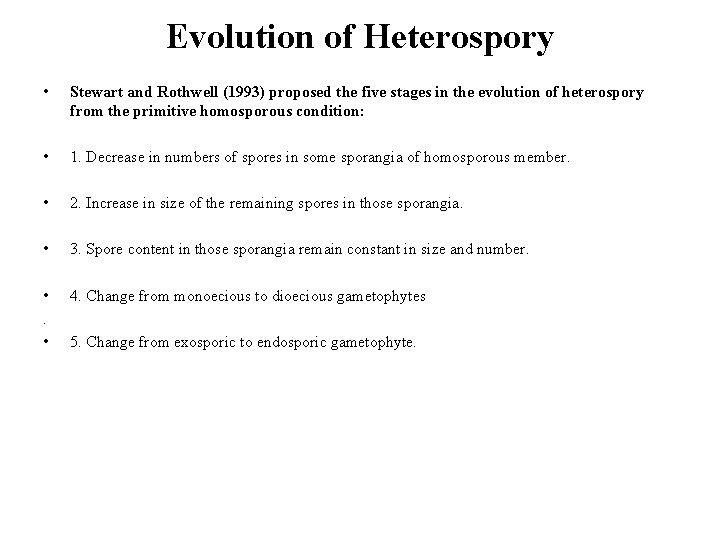
Evolution of Heterospory • Stewart and Rothwell (1993) proposed the five stages in the evolution of heterospory from the primitive homosporous condition: • 1. Decrease in numbers of spores in some sporangia of homosporous member. • 2. Increase in size of the remaining spores in those sporangia. • 3. Spore content in those sporangia remain constant in size and number. • 4. Change from monoecious to dioecious gametophytes 5. Change from exosporic to endosporic gametophyte.

FIGURE 5: A reconstruction of the megasporangium (b) and adjacent telomes (a) of Archaeosperma arnoldii. Each sporangium contained only one large megaspore; the other three products of the spore mother cell meiosis apparently degenerated early. Tissue immediately around the megaspore was the megasporangium wall. Attached to it and extending upward as finger like projections was a layer called an integument. The exact nature of the integument is not known, but it may have been derived from telomes adjacent to the sporangium (see Fig. 6). Above the sporangium was a space surrounded by integument tissue, a calm, wind free pollen chamber where pollen or spores settled. Around each megasporangium and integument was another set of partially fused telomes.


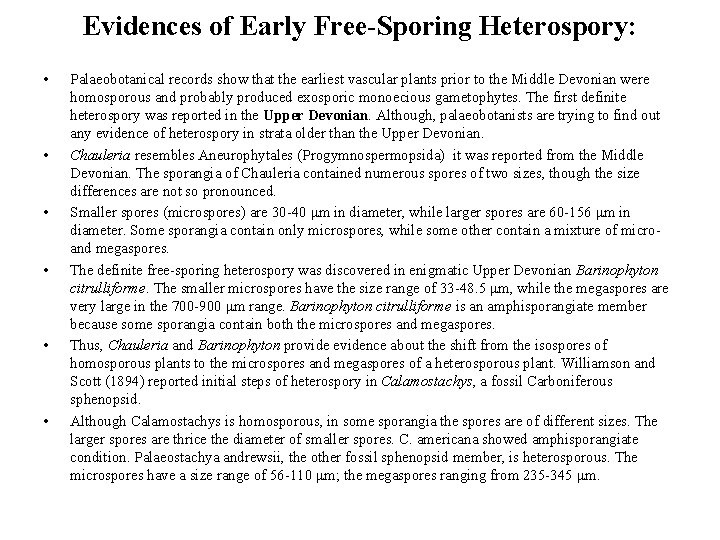
Evidences of Early Free-Sporing Heterospory: • • • Palaeobotanical records show that the earliest vascular plants prior to the Middle Devonian were homosporous and probably produced exosporic monoecious gametophytes. The first definite heterospory was reported in the Upper Devonian. Although, palaeobotanists are trying to find out any evidence of heterospory in strata older than the Upper Devonian. Chauleria resembles Aneurophytales (Progymnospermopsida) it was reported from the Middle Devonian. The sporangia of Chauleria contained numerous spores of two sizes, though the size differences are not so pronounced. Smaller spores (microspores) are 30 40 μm in diameter, while larger spores are 60 156 μm in diameter. Some sporangia contain only microspores, while some other contain a mixture of micro and megaspores. The definite free sporing heterospory was discovered in enigmatic Upper Devonian Barinophyton citrulliforme. The smaller microspores have the size range of 33 48. 5 μm, while the megaspores are very large in the 700 900 μm range. Barinophyton citrulliforme is an amphisporangiate member because some sporangia contain both the microspores and megaspores. Thus, Chauleria and Barinophyton provide evidence about the shift from the isospores of homosporous plants to the microspores and megaspores of a heterosporous plant. Williamson and Scott (1894) reported initial steps of heterospory in Calamostachys, a fossil Carboniferous sphenopsid. Although Calamostachys is homosporous, in some sporangia the spores are of different sizes. The larger spores are thrice the diameter of smaller spores. C. americana showed amphisporangiate condition. Palaeostachya andrewsii, the other fossil sphenopsid member, is heterosporous. The microspores have a size range of 56 110 μm; the megaspores ranging from 235 345 μm.

Evidences of Early Free-Sporing Heterospory • • • The further important steps in heterospory, i. e. the differentiation of micro and megaspo rangia, and reduction in number of megaspores have been revealed in Archaeopteris, an Upper Devonian progymnosperm. True heterospory has been reported in two spices of Archaeopteris (A. halliana and A. macilenta). Arnold (1939) reported a marked difference in sporangium size, spore dimension and spore content in A. halliana. Here megasporangia are broad, contained 8 16 megaspores up to 300 μm in diameter, while the slender microsporangia contained 100 microspores about 30 μm in diameter. The further reduction in the number of megaspores has been reported in Stauropteris burntislandica, an Upper Devonian heterosporous coenopterid fern. Here a spindle shaped megasporangia bore two functional and two abortive megaspores. The next important step in heterospory, i. e. , the formation of a functional megaspore in the sporangium, has been revealed in Lepidocarpon, Miadesmia (Carboniferous lycopods) and Calamocarpon (Carboniferous sphenopsid). In all the members, there is a single functional megaspore in the megasporangium. The megagametophytes retained inside the dehisced megasporangia and were shed as a unit from the cone. On the basis of the features revealed in the above three members the origin of seed habit can be evaluated.

Biological Advantages of Heterospory • 1. In heterosporous forms, the endosporic gametophytes are independent of external conditions and self supportive in food supply. Thus, the female gametophyte that developed within the large megaspore, at the expense of reserve food, is in a better situation for the initiation of embryo. Whereas, the free living exosporic gameto phytes of homosporous members are totally dependent on external conditions. • 2. Heterospory induces a drastic reduction in the sizes of their gametophytes. There is an extreme reduction in the male gametophyte and, in most cases, it is nothing but an antheridium. The female gametophyte never outgrows the limits of the megaspore. • 3. In heterosporous forms the differentiation of sex can be predicted at the spore stages. Thus the sex differentiation can be extended from the early stage of gametophyte to the sporophyte.
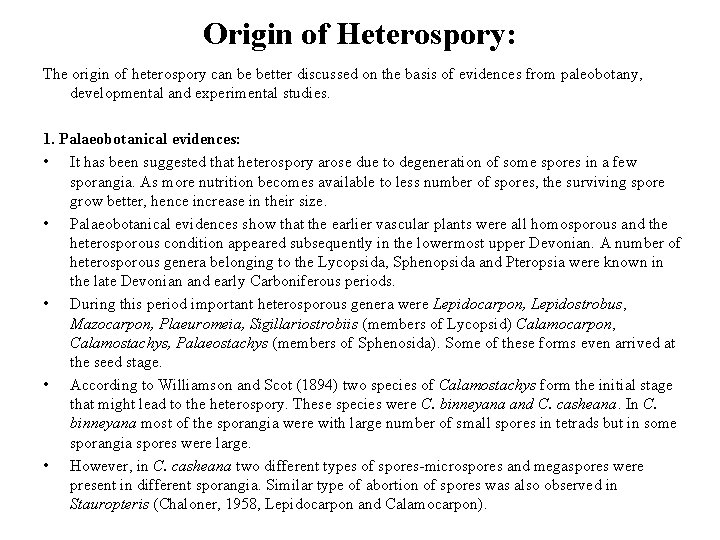
Origin of Heterospory: The origin of heterospory can be better discussed on the basis of evidences from paleobotany, developmental and experimental studies. 1. Palaeobotanical evidences: • It has been suggested that heterospory arose due to degeneration of some spores in a few sporangia. As more nutrition becomes available to less number of spores, the surviving spore grow better, hence increase in their size. • Palaeobotanical evidences show that the earlier vascular plants were all homosporous and the heterosporous condition appeared subsequently in the lowermost upper Devonian. A number of heterosporous genera belonging to the Lycopsida, Sphenopsida and Pteropsia were known in the late Devonian and early Carboniferous periods. • During this period important heterosporous genera were Lepidocarpon, Lepidostrobus, Mazocarpon, Plaeuromeia, Sigillariostrobiis (members of Lycopsid) Calamocarpon, Calamostachys, Palaeostachys (members of Sphenosida). Some of these forms even arrived at the seed stage. • According to Williamson and Scot (1894) two species of Calamostachys form the initial stage that might lead to the heterospory. These species were C. binneyana and C. casheana. In C. binneyana most of the sporangia were with large number of small spores in tetrads but in some sporangia spores were large. • However, in C. casheana two different types of spores microspores and megaspores were present in different sporangia. Similar type of abortion of spores was also observed in Stauropteris (Chaloner, 1958, Lepidocarpon and Calamocarpon).

Origin of Heterospory 2. Evidences from Developmental Studies: • In heterosporous Pteridophytes the development of micro and megasporangia follow the same pattern. They have identical organization but for their size. While in megasporangia most of the spore mother cells degenerate but in microsporangia only a few mother cells are disorganize. • The phenomenon of heterospory becomes distinct either before or after meiosis. In Selaginella Isoetes it is distinct before meiosis. In the microsporangium all the sporocytes undergo meiosis and form a large number of microspores. However, in megasporangium, a part of the sporogenous tissue degenerates they provide nutrition to growing sporocytes (megaspores). • In Isoetes there are only 50 300 megaspores in megasporangium. In Selaginella erythropus megasporangium contains only one megaspore which is functional. • In Marsilea, Salvinia and Azolla the phenomenon of heterospory becomes distinct after meiosis. In Marsilea 64 microspores and 64 megaspores are formed after meiosis in microsporangium and megasporangium respectively. In microsporangium all the microspores are functional while in magasporangium one megaspore is functional and rest degenerate.
Origin of Heterospory 3. Evidences from Experimental Studies: • Experimental studies on Selaginella (Goebel, 1905) and Marsilea (Shattuck, 1910) suggest that nutritional factors mainly govern the heterospory. Under conditions of low light intensity, the photosynthetic activity of Selaginella was retarted and it produced microsporangia. By sudden lowering of the temperature, the size of the microspores in the sporocarp of Marsilea increases by six times.
Biological Significance of Heterospory The phenomenon of heterospory is of great biological significance on account of the following facts: • (i) The development of the female gametophyte starts while the megaspore is still inside the megasporangium. • (ii) Same is true of microspores i. e. , they also start germinating into male gametophytes while they are still inside microsporangium. • (iii) The female gametophyte derives its nourishment from the sporophyte i. e. , female gametophyte is dependent on sporophyte for its nourishment. • (iv) The dependence of female gametophyte on sporophyte for its nourishment provides better starting point for the development of new embryo than an independent green prothallus which has to manufacture its own food.
Seed Habit in Pteridophytes • The adoption of heterospory and the retention and germination of a single megaspore within megasporangium to form a female gametophyte, led to the phenomenon of “seed habit”, a characteristic feature of the spermatophytes. A seed is that ovule which contains an embryo developed as a result of fertilization. The origin of seed habit is associated with the following: • (i) Production of two types of spores (heterospory). • (ii) Reduction in the number of megaspores finally to one per megasporangium. • (iii) Retention and germination of the megaspores and fertilization of the egg. • (iv) Continued development of the fertilized egg into the embryo while still in situ.
Seed Habit in Pteridophytes From the above observations it is concluded that the life history of Selaginella approaches towards seed habit because of the following features: • 1. The occurrence of the phenomenon of heterospory. • 2. Germination of megaspore inside megasporangium. • 3. Retention of megaspore inside megasporangium either till the formation of female gametophyte or even after fertilization. • 4. Development of only one megaspore per megasporangium for example, in Selaginella monospora, S. rupestris, S. erythropus etc. Though Selaginella as well as lower Spermatophytes shows homologies in their structure as follows: Selaginella: • 1. Megasporangium. • 2. Megaspore. • 3. Female gamestophyte. • 4. Archegonium. • 5. Egg.
Seed Habit in Pteridophytes Lower Spermatophytes (Gymnosperms): • 1. Nucellus of ovule. • 2. Megaspore (Embryosac). • 3. Endosperm. • 4. Archegonium. • 5. Egg. • • Even the seeds are not formed in Selaginella because: 1. Megasporangium is not surrounded by integument. 2. The retention of megaspore permanently inside the megasporangium has not been well established. 3. The embryo immediately gives rise to the sporophyte without undergoing a resting period.
- Slides: 19