
Heterogeneous Homogenous Mixtures Solutions Phases of matter Solid
- Slides: 27
Heterogeneous Homogenous Mixtures Solutions
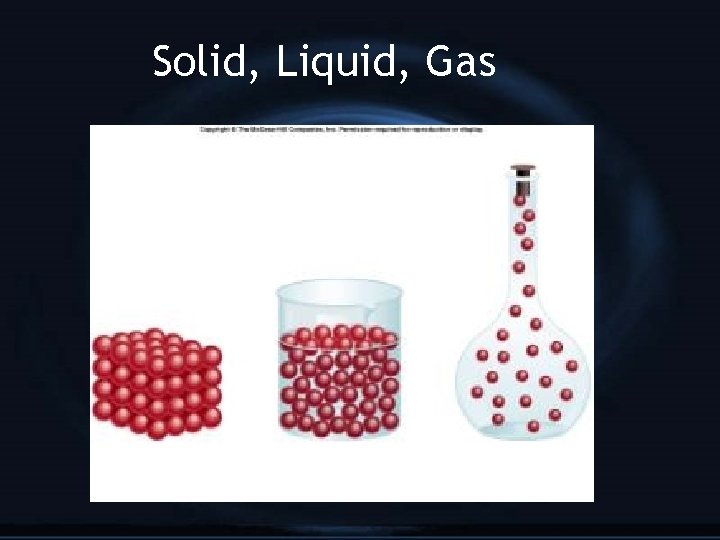
Phases of matter: Solid G Solid: atoms and/or molecules packed very close together. Hard, dense, fixed location. G Crystalline solid v. amorphous: Crystalline Atoms and molecules are in geometric patterns that repeat. Amorphous solids they are in random order and can be somewhat flexible like glass or rubber.
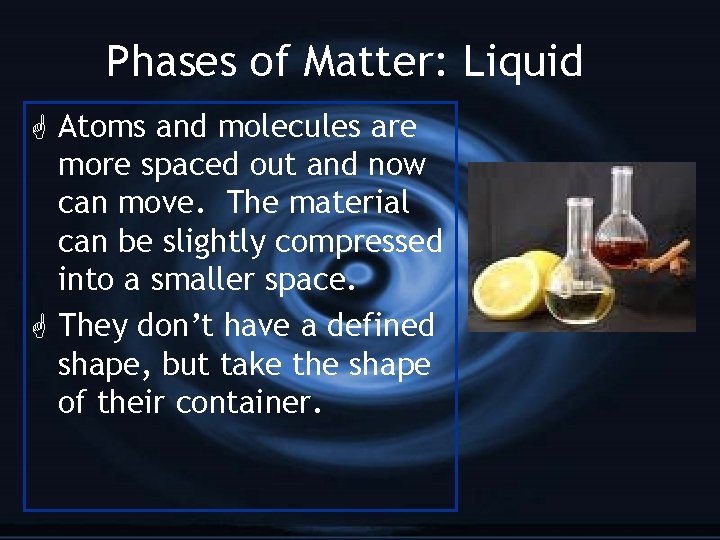
Phases of Matter: Liquid G Atoms and molecules are more spaced out and now can move. The material can be slightly compressed into a smaller space. G They don’t have a defined shape, but take the shape of their container.
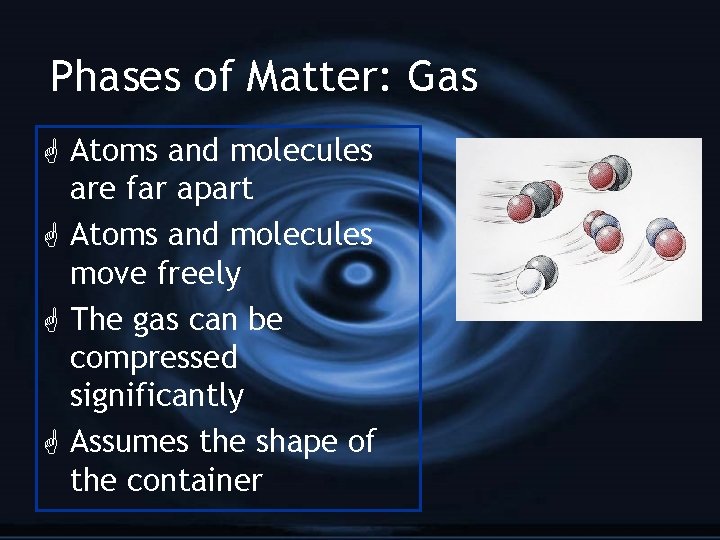
Phases of Matter: Gas G Atoms and molecules are far apart G Atoms and molecules move freely G The gas can be compressed significantly G Assumes the shape of the container
Solid, Liquid, Gas
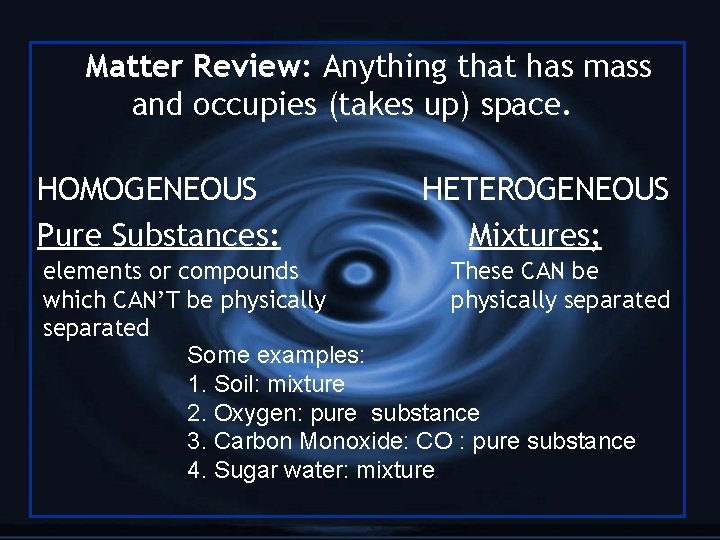
Matter Review: Anything that has mass and occupies (takes up) space. HOMOGENEOUS Pure Substances: HETEROGENEOUS Mixtures; elements or compounds These CAN be which CAN’T be physically separated Some examples: 1. Soil: mixture 2. Oxygen: pure substance 3. Carbon Monoxide: CO : pure substance 4. Sugar water: mixture
Additional Terms to Know G Elements: The most basic different types of matter. You can’t break it down into other substances. G Atoms: The smallest distinguishable unit of an element. G Molecules: 2+ more atoms bonded together.
Elements, Compounds, Mixtures G If there is only 1 atom type or molecule type in a given space we call it a pure substance G If there are 2 or more atom types or molecules in a given space we call it a mixture.
Elements G Can’t be broken down into simpler or other substances. G For example: you can do whatever you want to pure copper. You can’t find a simpler version of copper. G You can do whatever you want to pure sulfur. You can’t find a simpler version of sulfur.
Compounds G Compounds are substances composed of 2 or more elements in fixed and definite proportions (ratios). G You can mess with compounds to turn them back into elements. G You can have a pure compound, where in a contained space it’s only made up of that one compound, for example, pure water H 2 O, pure carbon dioxide CO 2, etc.
Mixture G G You get a mixture when you combine at least two pure elements, at least two pure compounds, or at least 1 pure element and 1 pure compound into the same space.
Homogeneous Mixtures G A homogeneous mixture is a uniform mixture where you can’t otherwise tell that there are multiple phases. G If it’s gases it’s homogeneous G if it’s solids you have to look at it. Steel is a mixture of iron and carbon, but you wouldn’t know. A box of copper and steel nuts you can tell apart.
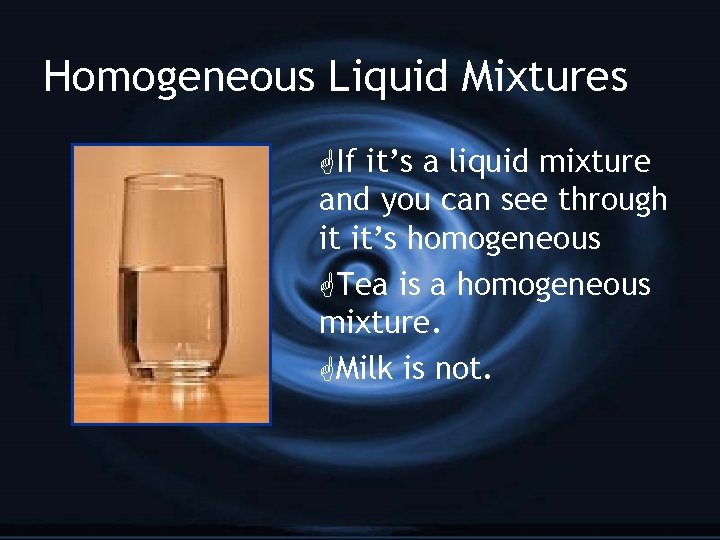
Homogeneous Liquid Mixtures GIf it’s a liquid mixture and you can see through it it’s homogeneous GTea is a homogeneous mixture. GMilk is not.
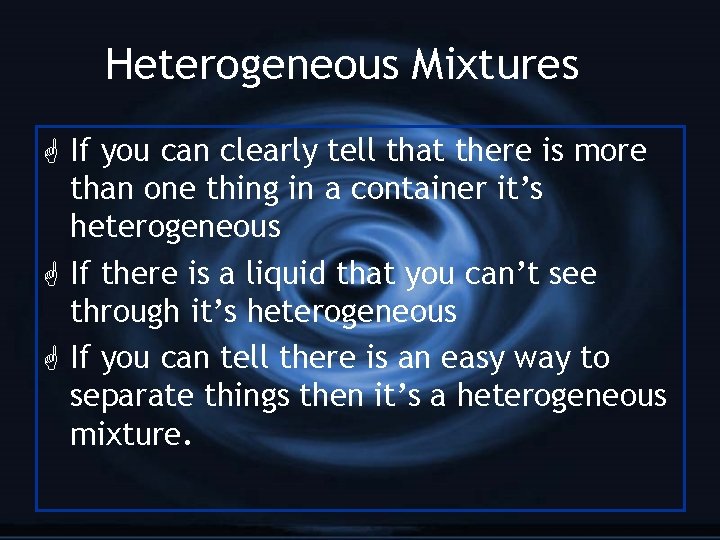
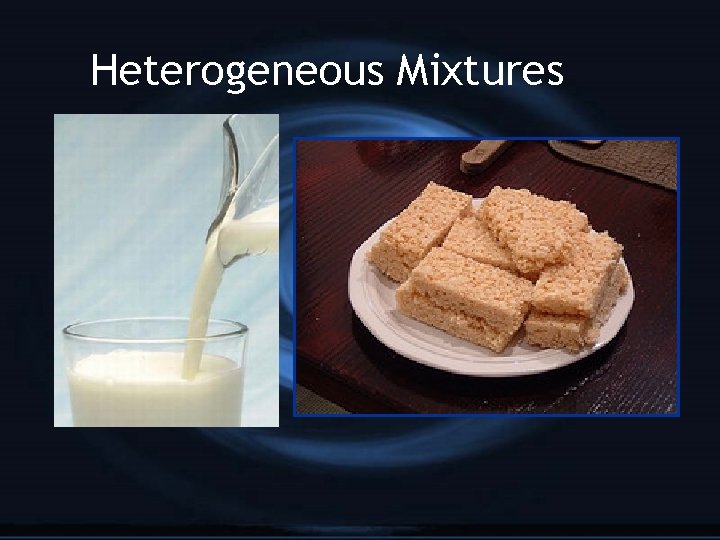
Heterogeneous Mixtures G If you can clearly tell that there is more than one thing in a container it’s heterogeneous G If there is a liquid that you can’t see through it’s heterogeneous G If you can tell there is an easy way to separate things then it’s a heterogeneous mixture.
Heterogeneous Mixtures
5. Homogeneous and Heterogeneous Mixtures
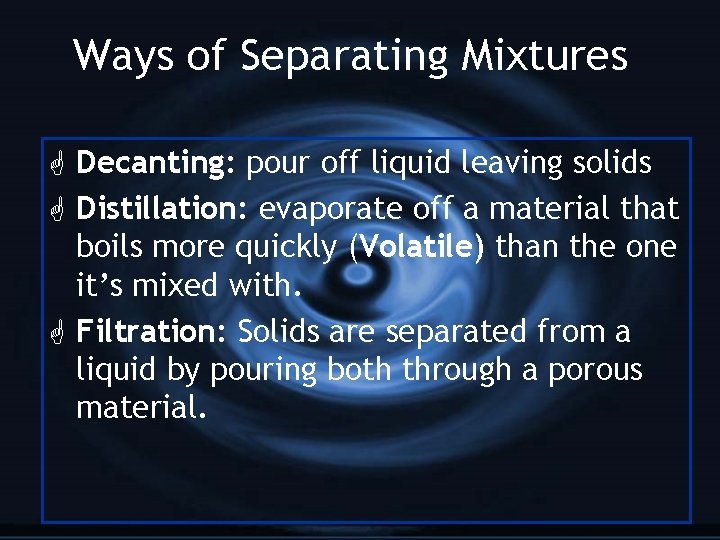
Ways of Separating Mixtures G Decanting: pour off liquid leaving solids G Distillation: evaporate off a material that boils more quickly (Volatile) than the one it’s mixed with. G Filtration: Solids are separated from a liquid by pouring both through a porous material.
6. Separation in a Sand Mixture
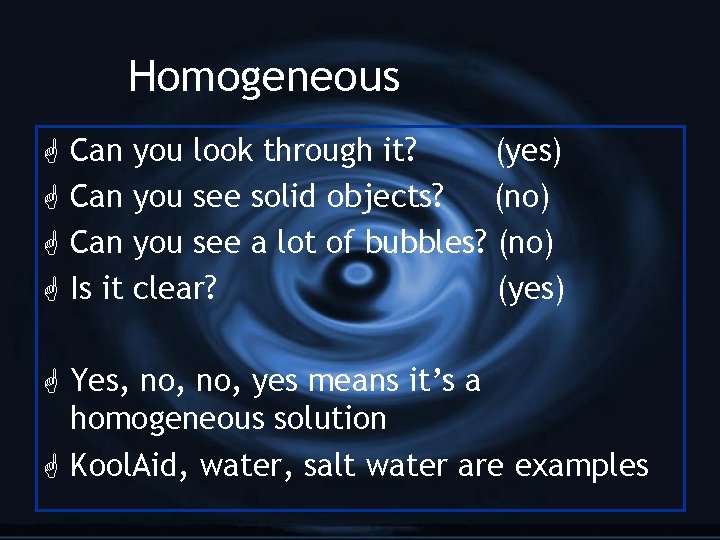
Homogeneous G G Can you look through it? (yes) Can you see solid objects? (no) Can you see a lot of bubbles? (no) Is it clear? (yes) G Yes, no, yes means it’s a homogeneous solution G Kool. Aid, water, salt water are examples
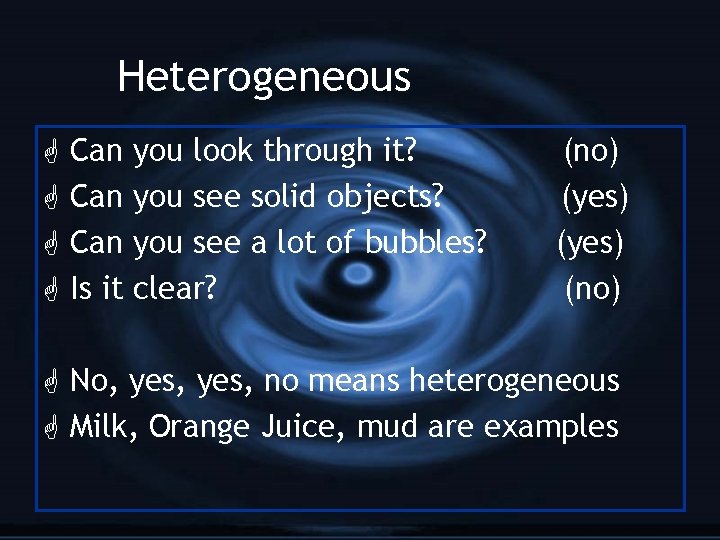
Heterogeneous G G Can you look through it? Can you see solid objects? Can you see a lot of bubbles? Is it clear? (no) (yes) (no) G No, yes, no means heterogeneous G Milk, Orange Juice, mud are examples
Solutions G G Homogeneous: Heterogeneous: Homo-same, similar Hetero-Different G Homogeneous solution is all the same G Heterogeneous solution has different parts
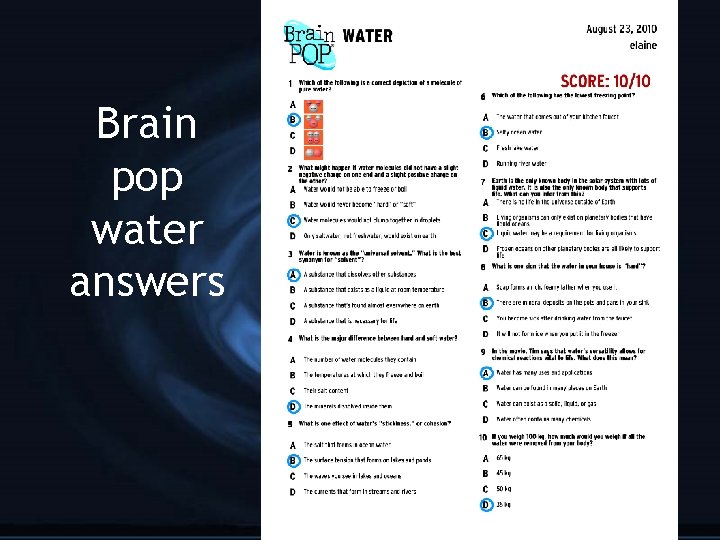
Aqueous solutions G Aqua means water G These are solutions in water G Like dissolving sugar in water makes an aqueous sugar solution G Dissolving salt in water makes an aqueous salt solution G Brain Pop: Water
Brain pop water answers
2. Solute & Solvent-Dissolving Review
Solvent and Solute G The chemical that is the majority of the mass and is dissolving another compound is the solvent. G The compound making up the smaller share of the mass and is being dissolved is the solute.
Determining Solubility G The amount of a substance that can dissolve in a certain amount of liquid at a specific temperature (because temp effects solubility). G 100 g water at 25 C can hold 36 g of Na. Cl (salt). G If water has that salt much it’s called saturated. G If water has less than 36 g of salt/100 g of water it’s called unsaturated. G If you heat the water, dissolve more than 25 g, and then cool it down it will be supersaturated.
7. Soluble & Insoluble