
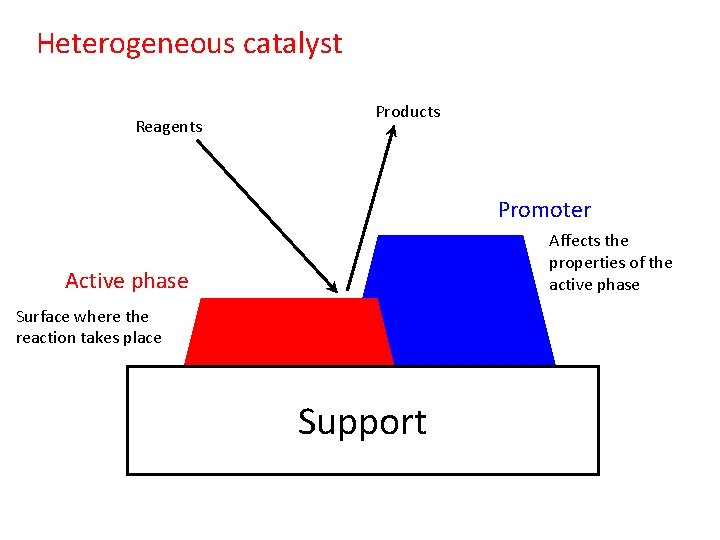
Heterogeneous catalyst Reagents Products Promoter Affects the properties


- Slides: 70
Heterogeneous catalyst Reagents Products Promoter Affects the properties of the active phase Active phase Surface where the reaction takes place Support
Bonding to surfaces When atoms or molecules adsorb on ordered crystal surface, they usually form ordered surface structure over a wide range of temperature and surface coverages. Two factors which decide the surface ordering of adsorbates are Adsorbate-adsorbate (AA) interaction and adsorbate-substrate (AS) interaction Chemisorption – adsorbate-substrate interaction is stronger than adsorbate interaction, so the adsorbate locations are determined by the optimum adsorbate-substrate bonding, while adsorbate-adsorbate interaction decides the long-range ordering of the overlayer. Physisorption or physical adsorption – AA interaction dominates the AS interaction – the surface could exhibit incommensurate structures.
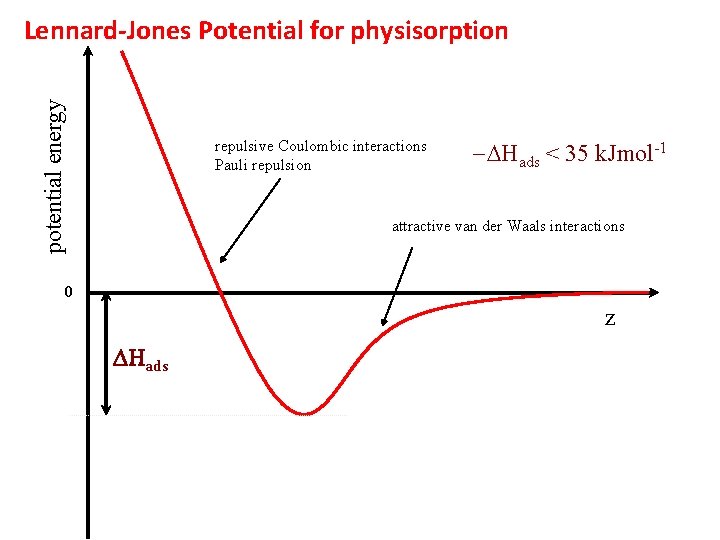
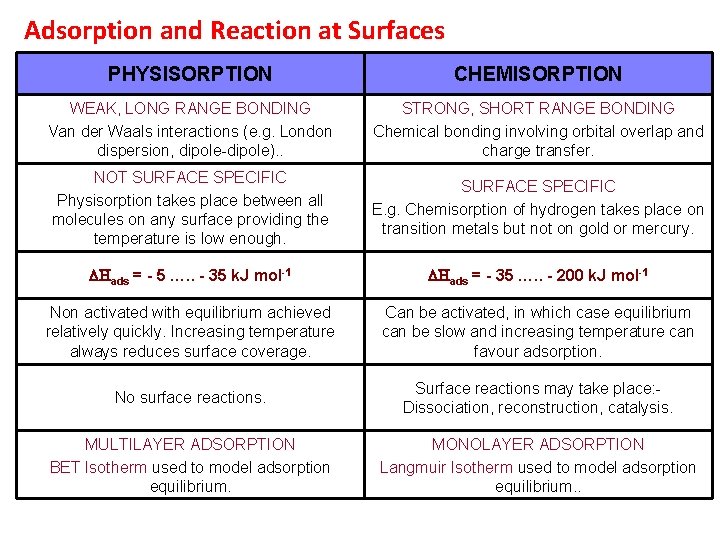
Bonding to surfaces Two classifications distinguished by the magnitude of their enthalpies of adsorption ØPhysisorption: long-range but weak van der Waals-type interactions with negligible exchange of electrons and enthalpies ~DHcond (-DHAD<35 k. J/mol) ØChemisorption: formation of a chemical bond (covalent, ionic, metallic) with exchange of electrons and –DHAD>35 k. J/mol Enthalpy of chemisorption depends strongly on surface coverage (interactions)
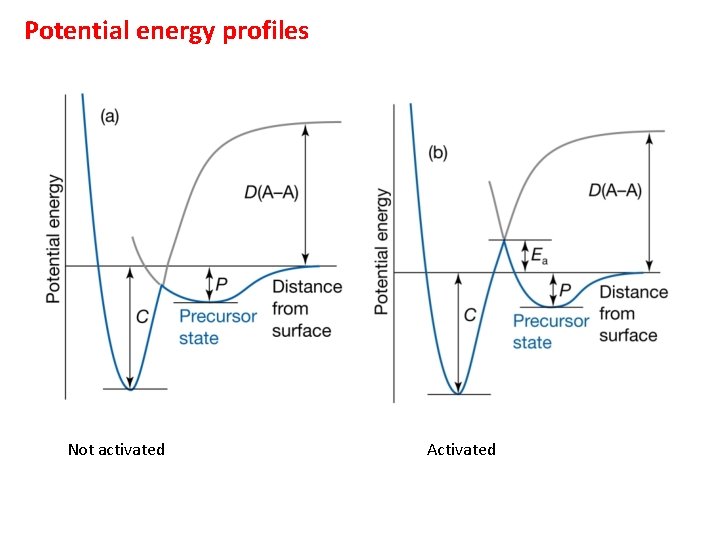
Precursor state If adsorbate collides with the surface and doesn’t stick, it may not simply rebound, but rather form a weak bond (physisorption) and diffuse for a period (losing energy) until a vacant site is located for chemisorption to occur. For adsorption to proceed, the gas needs to “dump” energy into the solid, if not it will desorb. The longer the gas molecule resides on the surface, the more likely is energy exchange with the surface. Can write an Arrhenius-type relationship between residence time and the enthalpy of adsorption at the precursor adsorption site.
potential energy Lennard-Jones Potential for physisorption repulsive Coulombic interactions Pauli repulsion -DHads < 35 k. Jmol-1 attractive van der Waals interactions 0 z DHads
Potential energy profiles Not activated Activated
Adsorption and Reaction at Surfaces PHYSISORPTION CHEMISORPTION WEAK, LONG RANGE BONDING Van der Waals interactions (e. g. London dispersion, dipole-dipole). . STRONG, SHORT RANGE BONDING Chemical bonding involving orbital overlap and charge transfer. NOT SURFACE SPECIFIC Physisorption takes place between all molecules on any surface providing the temperature is low enough. SURFACE SPECIFIC E. g. Chemisorption of hydrogen takes place on transition metals but not on gold or mercury. DHads = - 5 …. . - 35 k. J mol-1 DHads = - 35 …. . - 200 k. J mol-1 Non activated with equilibrium achieved relatively quickly. Increasing temperature always reduces surface coverage. Can be activated, in which case equilibrium can be slow and increasing temperature can favour adsorption. No surface reactions. Surface reactions may take place: Dissociation, reconstruction, catalysis. MULTILAYER ADSORPTION BET Isotherm used to model adsorption equilibrium. MONOLAYER ADSORPTION Langmuir Isotherm used to model adsorption equilibrium. .
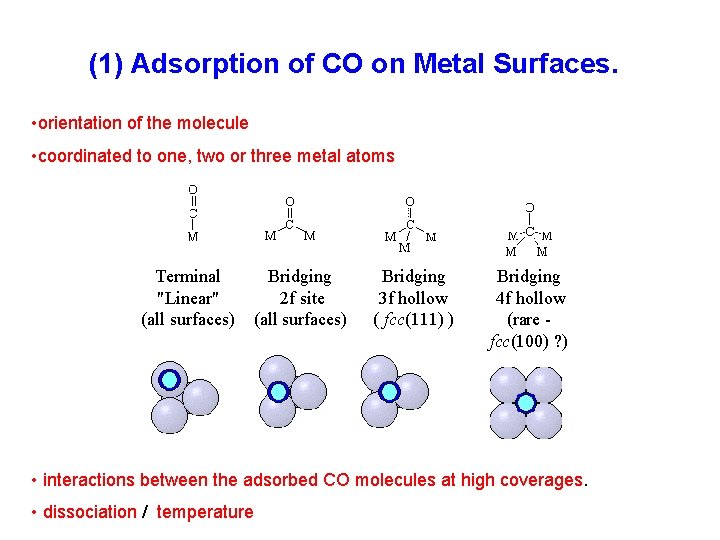
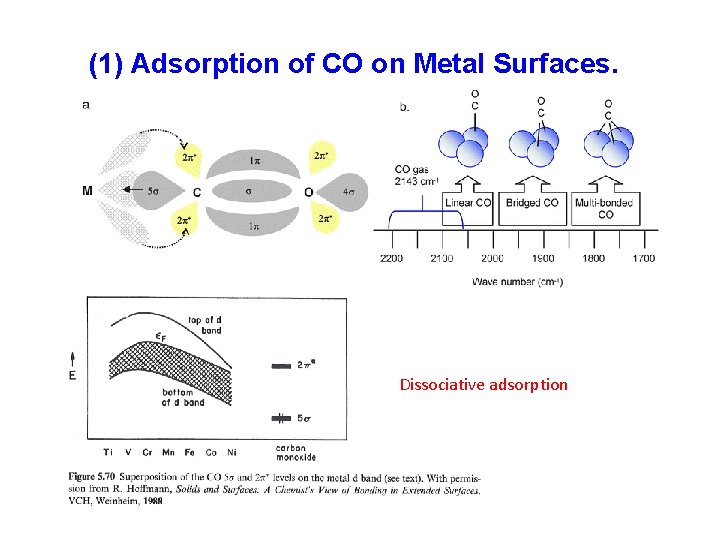
(1) Adsorption of CO on Metal Surfaces. • orientation of the molecule • coordinated to one, two or three metal atoms Terminal "Linear" (all surfaces) Bridging 2 f site (all surfaces) Bridging 3 f hollow ( fcc(111) ) Bridging 4 f hollow (rare fcc(100) ? ) • interactions between the adsorbed CO molecules at high coverages. • dissociation / temperature
(1) Adsorption of CO on Metal Surfaces. Dissociative adsorption
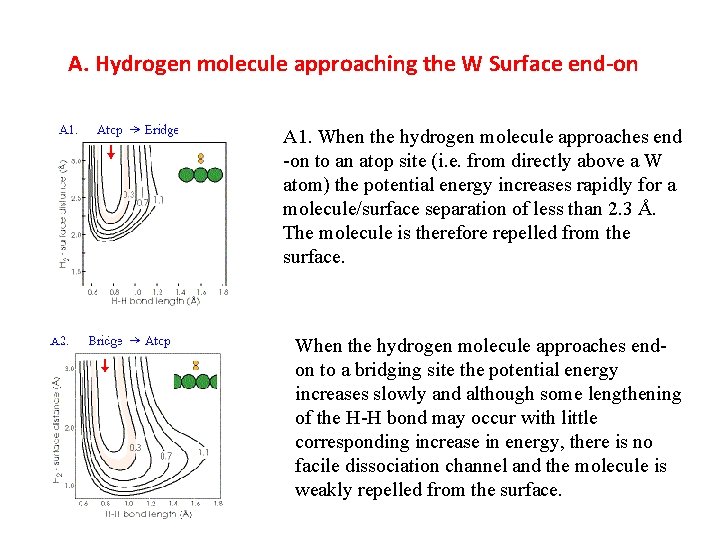
A. Hydrogen molecule approaching the W Surface end-on A 1. When the hydrogen molecule approaches end -on to an atop site (i. e. from directly above a W atom) the potential energy increases rapidly for a molecule/surface separation of less than 2. 3 Å. The molecule is therefore repelled from the surface. When the hydrogen molecule approaches endon to a bridging site the potential energy increases slowly and although some lengthening of the H-H bond may occur with little corresponding increase in energy, there is no facile dissociation channel and the molecule is weakly repelled from the surface.
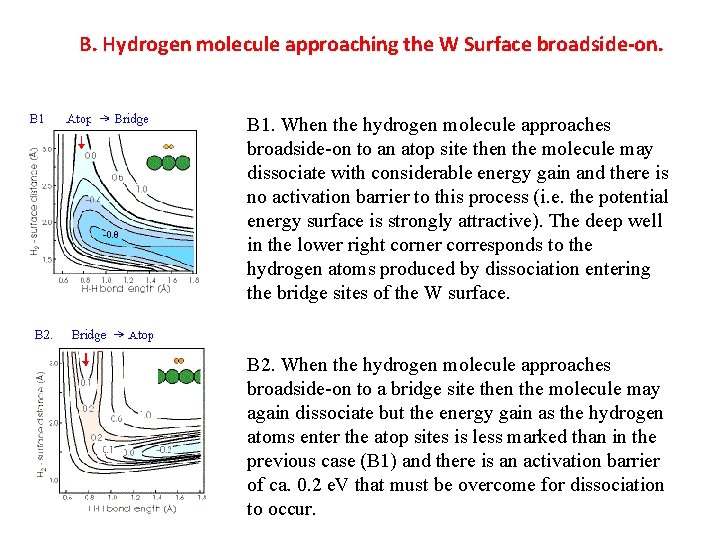
B. Hydrogen molecule approaching the W Surface broadside-on. B 1. When the hydrogen molecule approaches broadside-on to an atop site then the molecule may dissociate with considerable energy gain and there is no activation barrier to this process (i. e. the potential energy surface is strongly attractive). The deep well in the lower right corner corresponds to the hydrogen atoms produced by dissociation entering the bridge sites of the W surface. B 2. When the hydrogen molecule approaches broadside-on to a bridge site then the molecule may again dissociate but the energy gain as the hydrogen atoms enter the atop sites is less marked than in the previous case (B 1) and there is an activation barrier of ca. 0. 2 e. V that must be overcome for dissociation to occur.
Oxygen on metal surfaces Generally dissociative adsorption Molecular adsorption (e. g. Ag, Pt). Molecular adsorption state the interaction between the molecule and the surface is relatively weak. Molecules aligned such that the internuclear axis is parallel to the surface plane may bond to a single metal atom of the surface via both 1. s-donor interaction, in which the charge transfer is from the occupied molecular p-bonding molecular orbital of the molecule into vacant orbitals of s-symmetry on the metal (i. e. M O 2 ), and 2. p-acceptor interaction, in which an occupied metal d-orbital of the correct symmetry overlaps with empty p* orbitals of the molecule and the charge transfer is from the surface to the molecule (i. e. M O 2 ).
Oxygen on metal surfaces Although the interaction of the molecule with the surface is generally weak, one might expect that there might be a substantial barrier to dissociation due to the high strength (and high dissociation enthalpy) of the O=O bond. Nevertheless on most metal surfaces, dissociation of oxygen is observed to be facile which is related to the manner in which the interaction with the surface can mitigate the high intrinsic bond energy and thereby facilitate dissociation. Once formed, oxygen atoms are strongly bound to the surface and, as noted previously, will tend to occupy the highest available co-ordination site. The strength of the interaction between adsorbate and substrate is such that the adjacent metal atoms are often seen to undergo significant displacements from the equilibrium positions that they occupy on the clean metal surface. This displacement may simply lead to a distortion of the substrate surface in the immediate vicinity of the adsorbed atom (so that, for example, the adjacent metal atoms are drawn in towards the oxygen and the metal-oxygen bond distance is reduced) or to a more extended surface reconstruction.
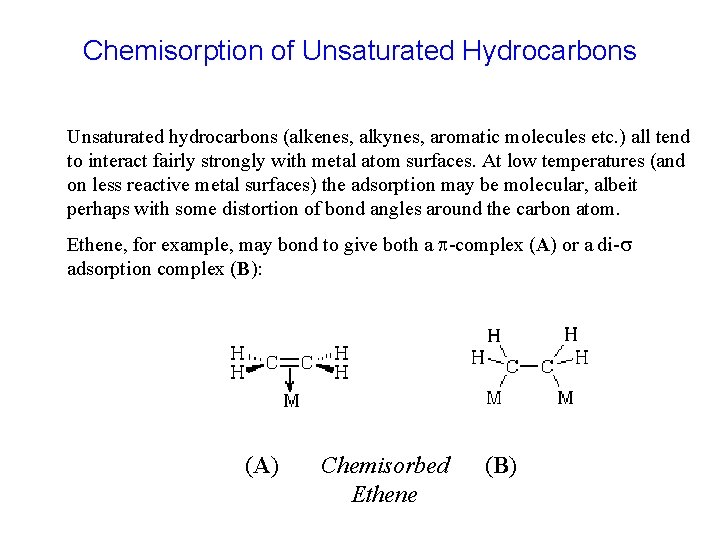
Chemisorption of Unsaturated Hydrocarbons Unsaturated hydrocarbons (alkenes, alkynes, aromatic molecules etc. ) all tend to interact fairly strongly with metal atom surfaces. At low temperatures (and on less reactive metal surfaces) the adsorption may be molecular, albeit perhaps with some distortion of bond angles around the carbon atom. Ethene, for example, may bond to give both a p-complex (A) or a di-s adsorption complex (B): (A) Chemisorbed Ethene (B)
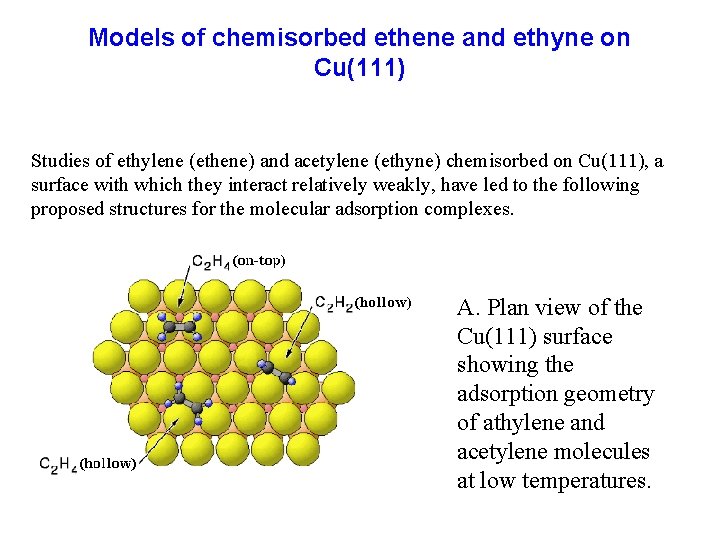
Models of chemisorbed ethene and ethyne on Cu(111) Studies of ethylene (ethene) and acetylene (ethyne) chemisorbed on Cu(111), a surface with which they interact relatively weakly, have led to the following proposed structures for the molecular adsorption complexes. A. Plan view of the Cu(111) surface showing the adsorption geometry of athylene and acetylene molecules at low temperatures.
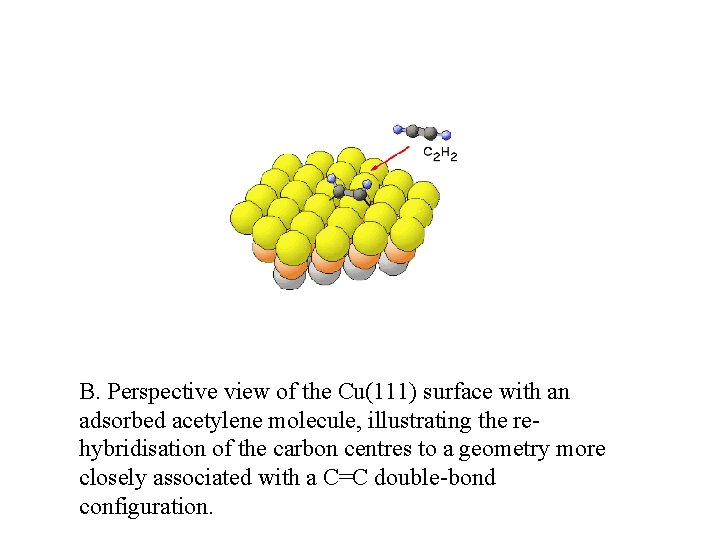
B. Perspective view of the Cu(111) surface with an adsorbed acetylene molecule, illustrating the rehybridisation of the carbon centres to a geometry more closely associated with a C=C double-bond configuration.
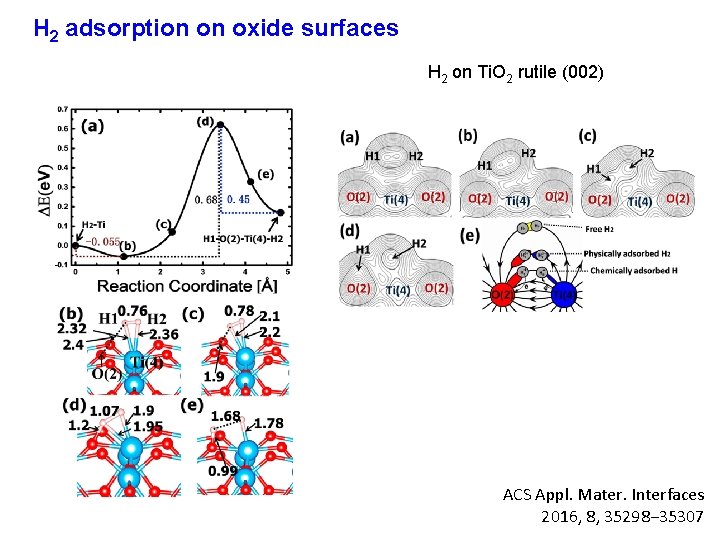
H 2 adsorption on oxide surfaces H 2 on Ti. O 2 rutile (002) ACS Appl. Mater. Interfaces 2016, 8, 35298− 35307
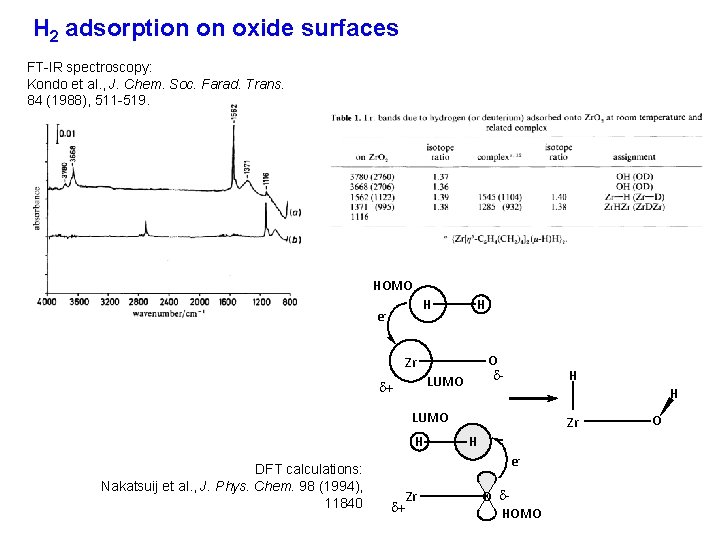
H 2 adsorption on oxide surfaces FT-IR spectroscopy: Kondo et al. , J. Chem. Soc. Farad. Trans. 84 (1988), 511 -519. HOMO H e- H O - Zr LUMO + H H LUMO H DFT calculations: Nakatsuij et al. , J. Phys. Chem. 98 (1994), 11840 Zr H e- + Zr O HOMO O
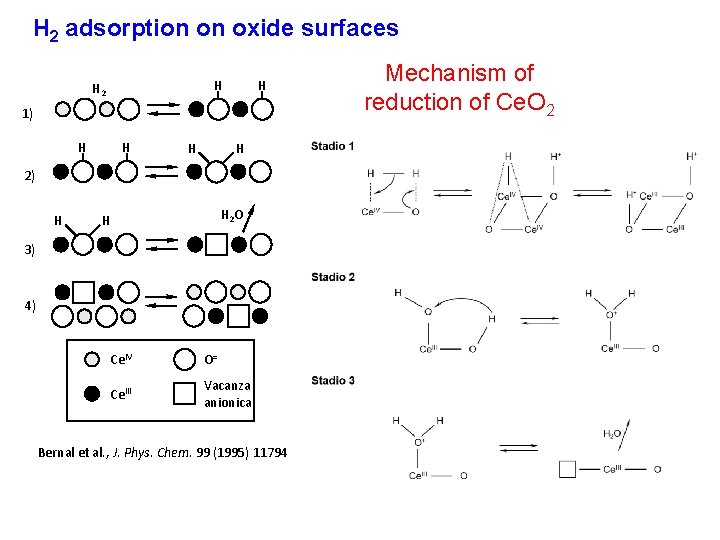
H 2 adsorption on oxide surfaces H H 2 H 1) H H 2) H H 2 O H 3) 4) Ce. IV O= Ce. III Vacanza anionica Bernal et al. , J. Phys. Chem. 99 (1995) 11794 Mechanism of reduction of Ce. O 2
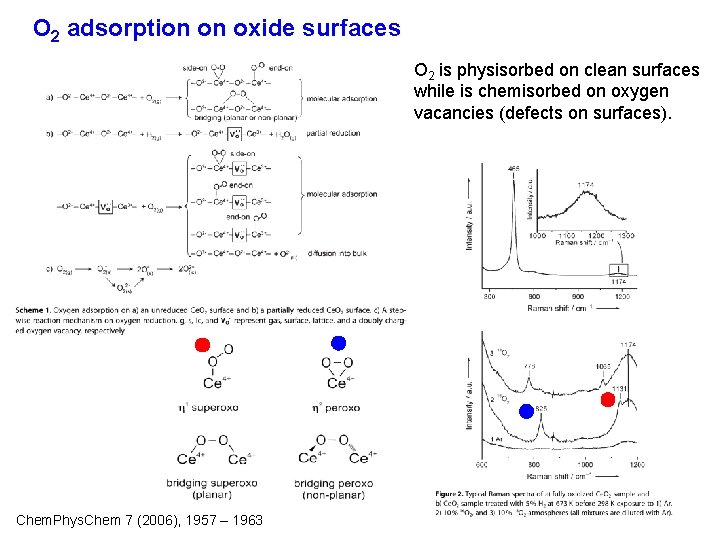
O 2 adsorption on oxide surfaces O 2 is physisorbed on clean surfaces while is chemisorbed on oxygen vacancies (defects on surfaces). Chem. Phys. Chem 7 (2006), 1957 – 1963
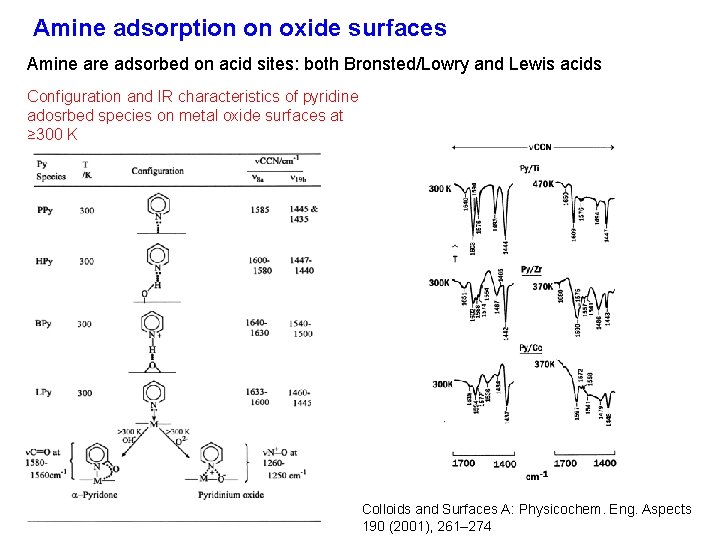
Amine adsorption on oxide surfaces Amine are adsorbed on acid sites: both Bronsted/Lowry and Lewis acids Configuration and IR characteristics of pyridine adosrbed species on metal oxide surfaces at ≥ 300 K Colloids and Surfaces A: Physicochem. Eng. Aspects 190 (2001), 261– 274
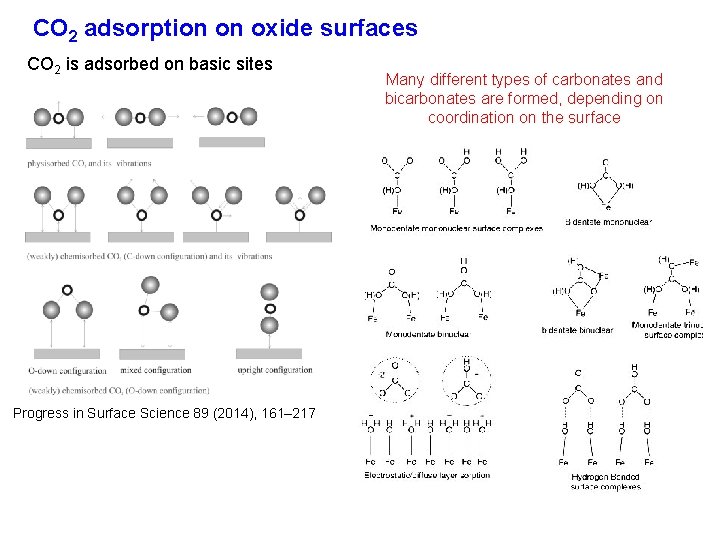
CO 2 adsorption on oxide surfaces CO 2 is adsorbed on basic sites Progress in Surface Science 89 (2014), 161– 217 Many different types of carbonates and bicarbonates are formed, depending on coordination on the surface
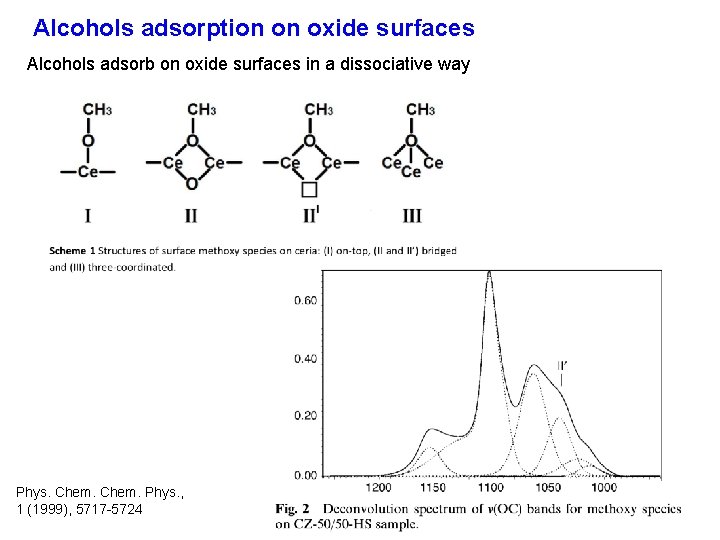
Alcohols adsorption on oxide surfaces Alcohols adsorb on oxide surfaces in a dissociative way Phys. Chem. Phys. , 1 (1999), 5717 -5724
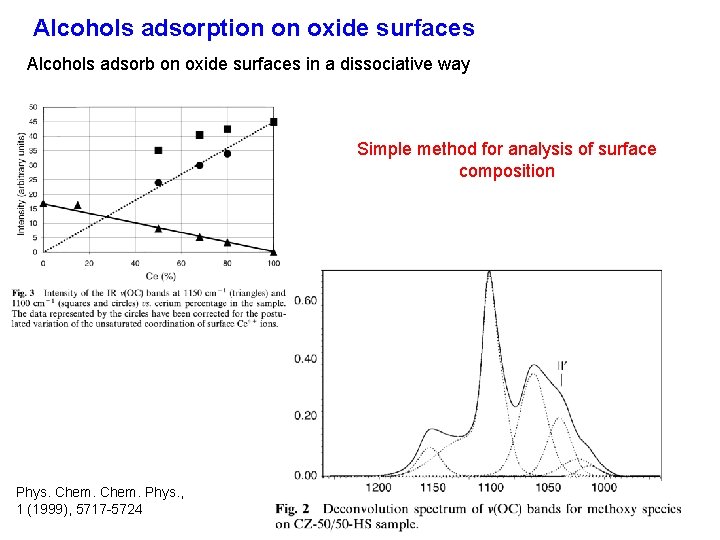
Alcohols adsorption on oxide surfaces Alcohols adsorb on oxide surfaces in a dissociative way Simple method for analysis of surface composition Phys. Chem. Phys. , 1 (1999), 5717 -5724
Measurement of Porosity and Specific Surface Area by Gas Adsorption
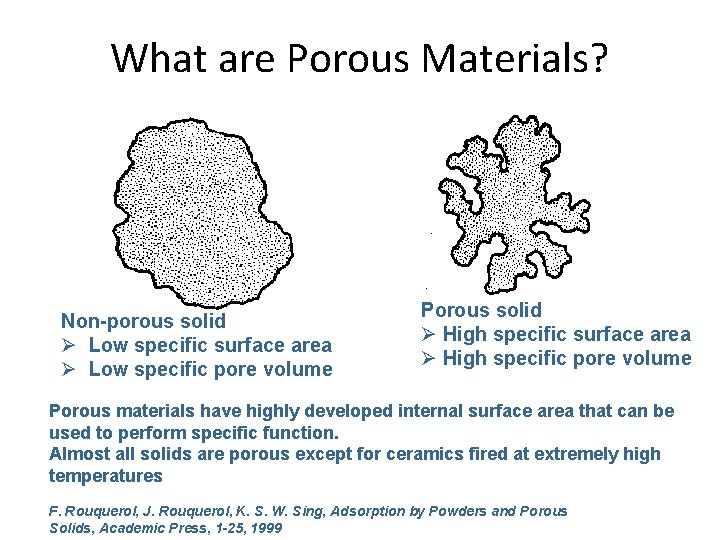
What are Porous Materials? Non-porous solid Ø Low specific surface area Ø Low specific pore volume Porous solid Ø High specific surface area Ø High specific pore volume Porous materials have highly developed internal surface area that can be used to perform specific function. Almost all solids are porous except for ceramics fired at extremely high temperatures F. Rouquerol, J. Rouquerol, K. S. W. Sing, Adsorption by Powders and Porous Solids, Academic Press, 1 -25, 1999
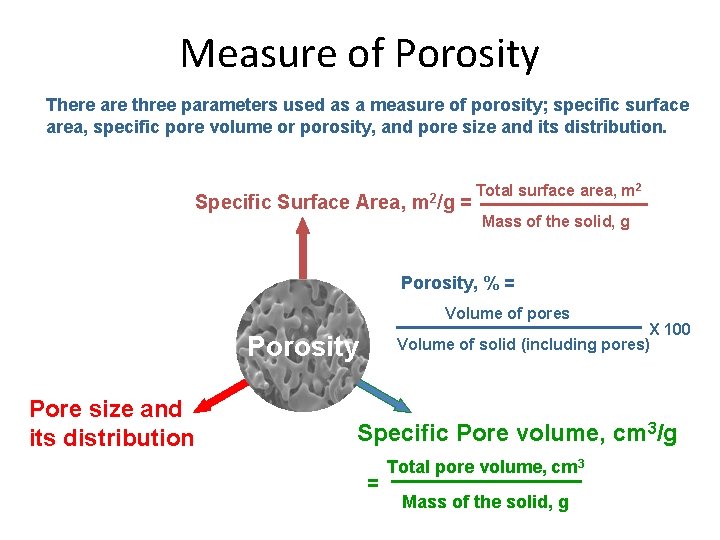
Measure of Porosity There are three parameters used as a measure of porosity; specific surface area, specific pore volume or porosity, and pore size and its distribution. Specific Surface Area, m 2/g = Total surface area, m 2 Mass of the solid, g Porosity, % = Volume of pores X 100 Volume of solid (including pores) Porosity Pore size and its distribution Specific Pore volume, cm 3/g = Total pore volume, cm 3 Mass of the solid, g
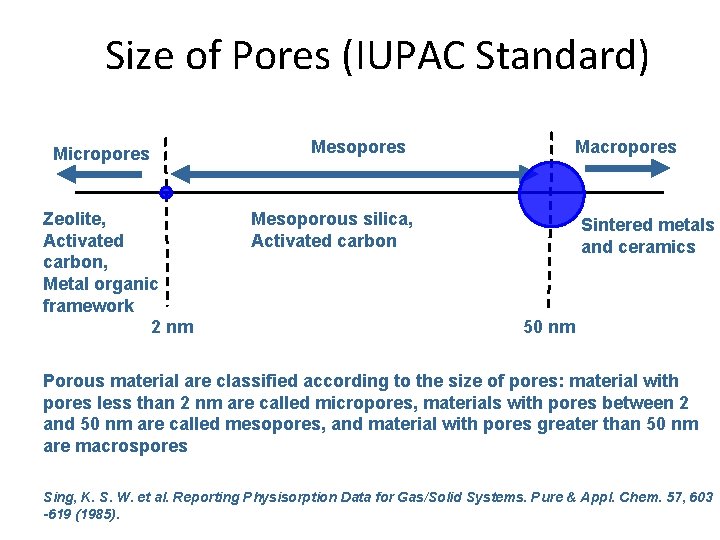
Size of Pores (IUPAC Standard) Micropores Zeolite, Activated carbon, Metal organic framework 2 nm Mesopores Macropores Mesoporous silica, Activated carbon Sintered metals and ceramics 50 nm Porous material are classified according to the size of pores: material with pores less than 2 nm are called micropores, materials with pores between 2 and 50 nm are called mesopores, and material with pores greater than 50 nm are macrospores Sing, K. S. W. et al. Reporting Physisorption Data for Gas/Solid Systems. Pure & Appl. Chem. 57, 603 -619 (1985).
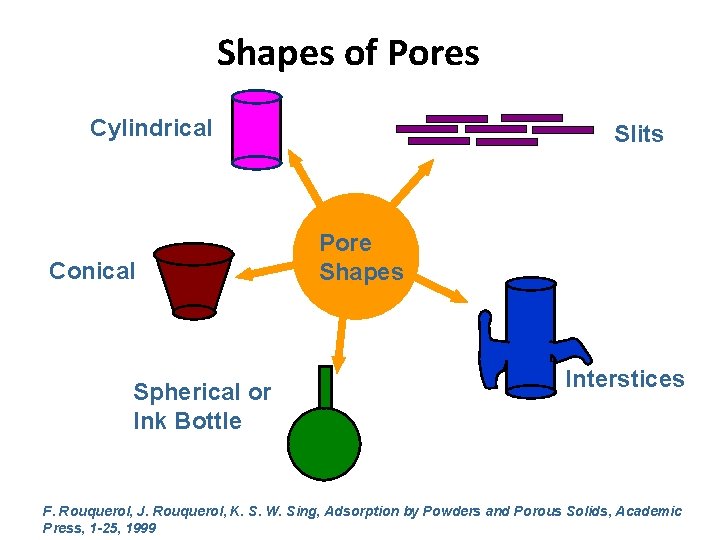
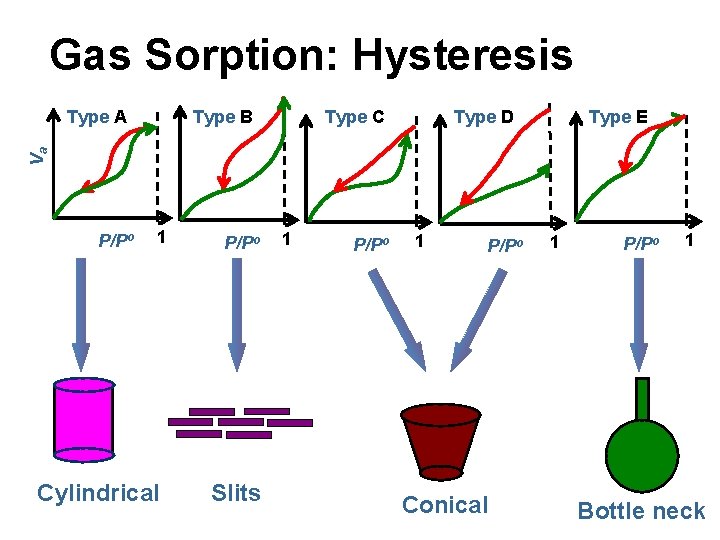
Shapes of Pores Cylindrical Conical Spherical or Ink Bottle Slits Pore Shapes Interstices F. Rouquerol, J. Rouquerol, K. S. W. Sing, Adsorption by Powders and Porous Solids, Academic Press, 1 -25, 1999
Isoterme di fisiasorbimento
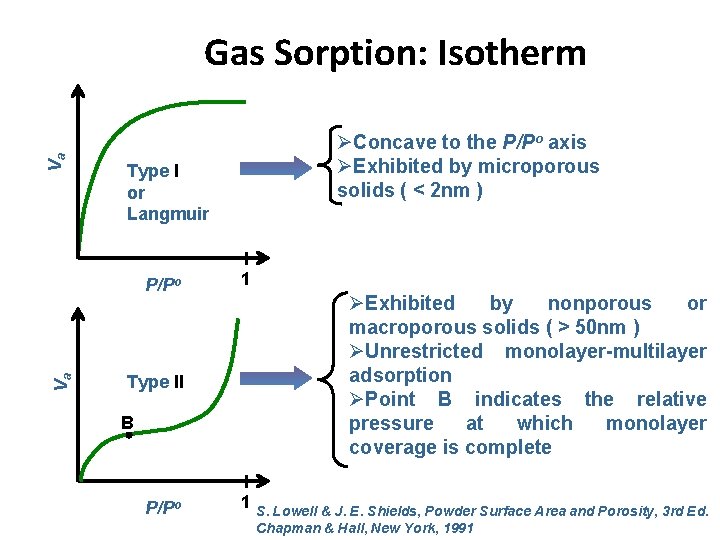
Va Gas Sorption: Isotherm Type I or Langmuir P/Po Va ØConcave to the P/Po axis ØExhibited by microporous solids ( < 2 nm ) Type II B P/Po 1 ØExhibited by nonporous or macroporous solids ( > 50 nm ) ØUnrestricted monolayer-multilayer adsorption ØPoint B indicates the relative pressure at which monolayer coverage is complete 1 S. Lowell & J. E. Shields, Powder Surface Area and Porosity, 3 rd Ed. Chapman & Hall, New York, 1991
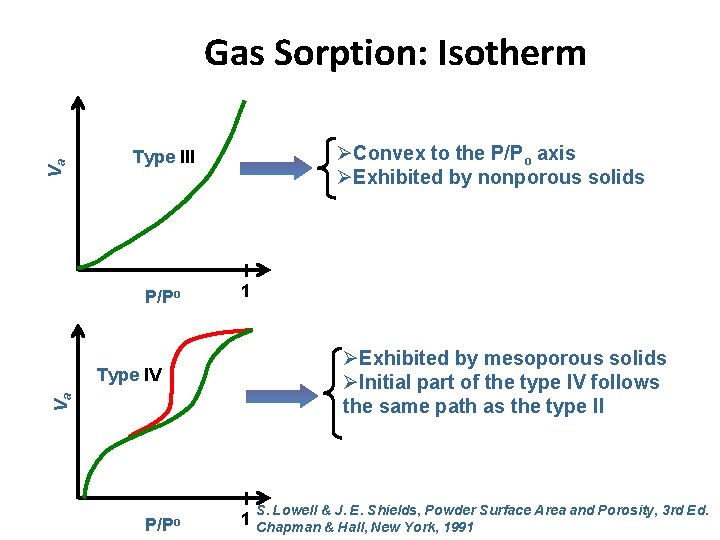
Va Gas Sorption: Isotherm ØConvex to the P/Po axis ØExhibited by nonporous solids Type III P/Po Va Type IV P/Po 1 ØExhibited by mesoporous solids ØInitial part of the type IV follows the same path as the type II S. Lowell & J. E. Shields, Powder Surface Area and Porosity, 3 rd Ed. 1 Chapman & Hall, New York, 1991
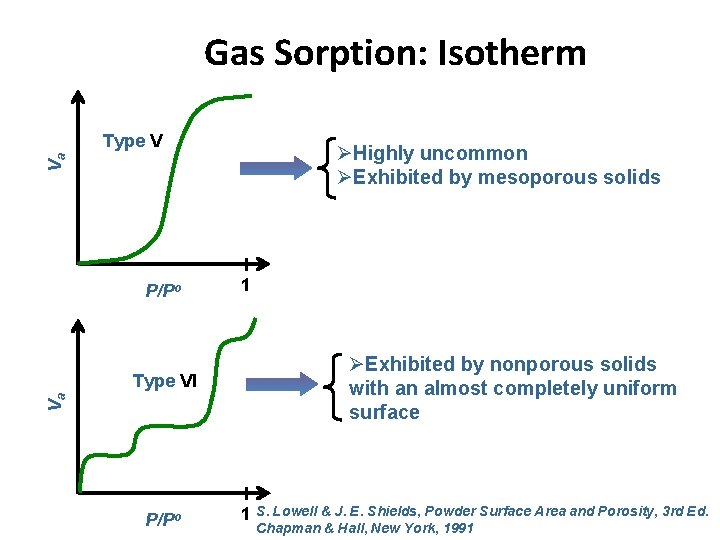
Gas Sorption: Isotherm Type V Va ØHighly uncommon ØExhibited by mesoporous solids P/Po Va Type VI P/Po 1 ØExhibited by nonporous solids with an almost completely uniform surface 1 S. Lowell & J. E. Shields, Powder Surface Area and Porosity, 3 rd Ed. Chapman & Hall, New York, 1991
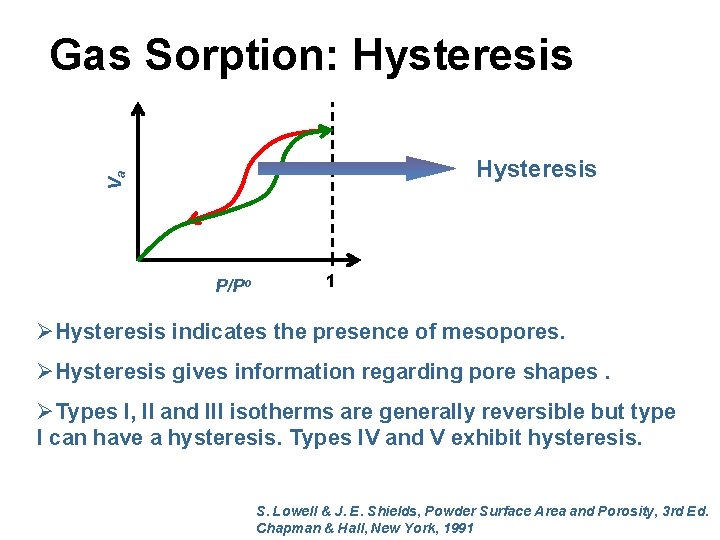
Gas Sorption: Hysteresis Va Hysteresis P/Po 1 ØHysteresis indicates the presence of mesopores. ØHysteresis gives information regarding pore shapes. ØTypes I, II and III isotherms are generally reversible but type I can have a hysteresis. Types IV and V exhibit hysteresis. S. Lowell & J. E. Shields, Powder Surface Area and Porosity, 3 rd Ed. Chapman & Hall, New York, 1991
Gas Sorption: Hysteresis Type B Type C Type E Type D Va Type A P/Po 1 Cylindrical P/Po Slits 1 P/Po Conical 1 P/Po 1 Bottle neck
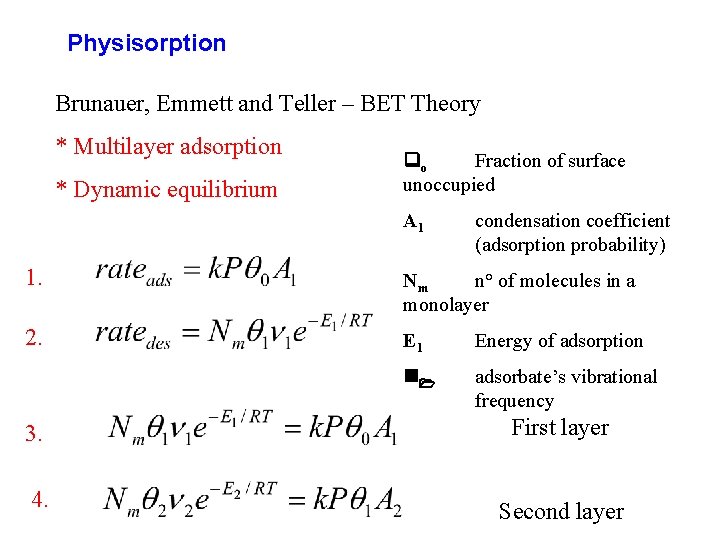
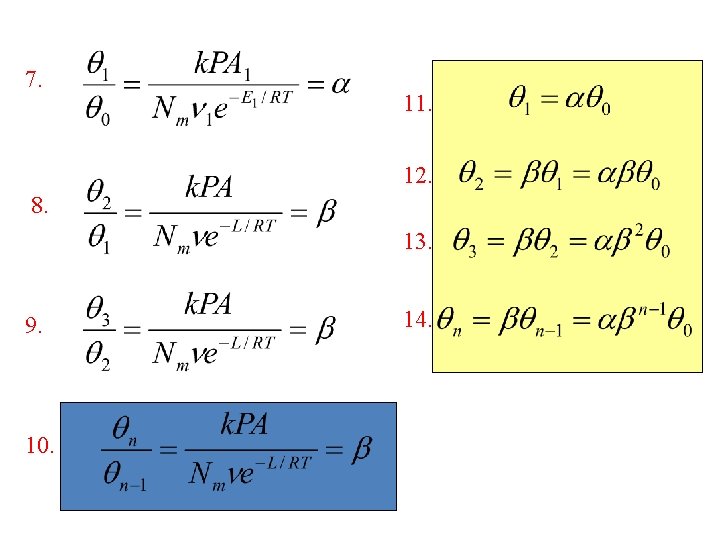
Physisorption Brunauer, Emmett and Teller – BET Theory * Multilayer adsorption * Dynamic equilibrium qo Fraction of surface unoccupied A 1 condensation coefficient (adsorption probability) 1. Nm n° of molecules in a monolayer 2. E 1 Energy of adsorption n 1 adsorbate’s vibrational frequency 3. First layer 4. Second layer
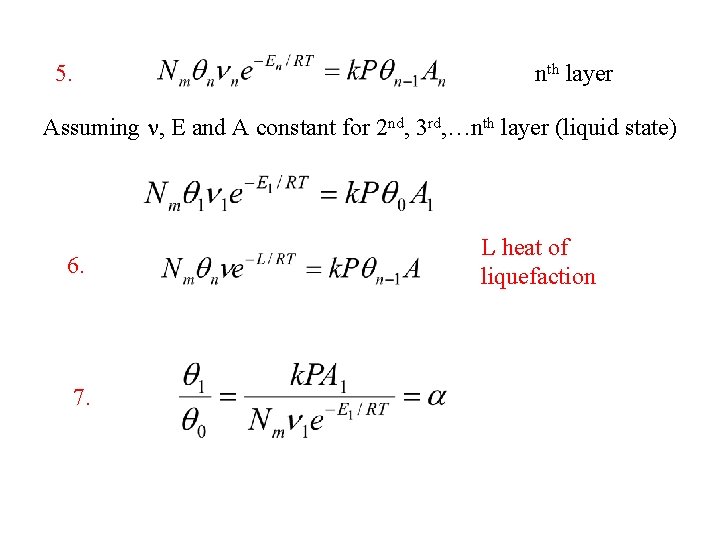
5. nth layer Assuming n, E and A constant for 2 nd, 3 rd, …nth layer (liquid state) 6. 7. L heat of liquefaction
7. 11. 12. 8. 13. 9. 10. 14.
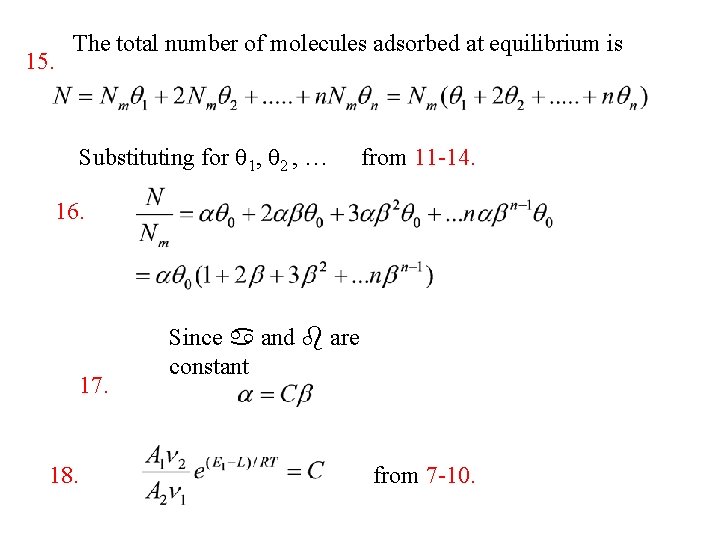
15. The total number of molecules adsorbed at equilibrium is Substituting for q 1, q 2 , … from 11 -14. 16. 17. 18. Since a and b are constant from 7 -10.
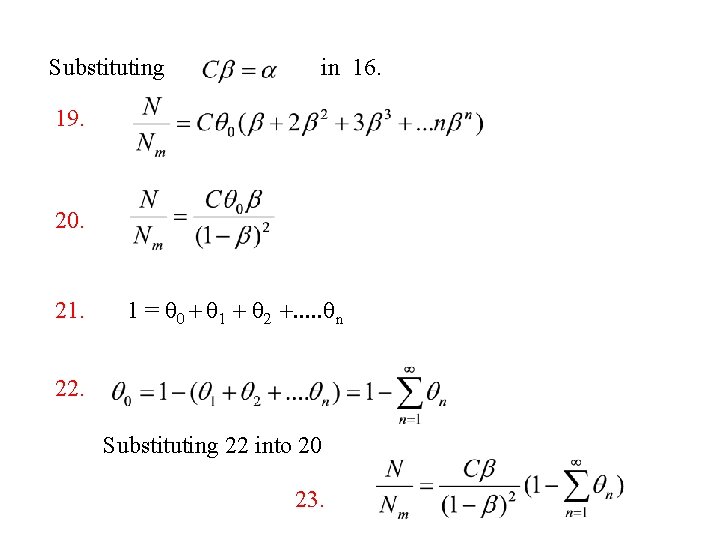
Substituting in 16. 19. 20. 21. 1 = q 0 + q 1 + q 2 +. . . qn 22. Substituting 22 into 20 23.
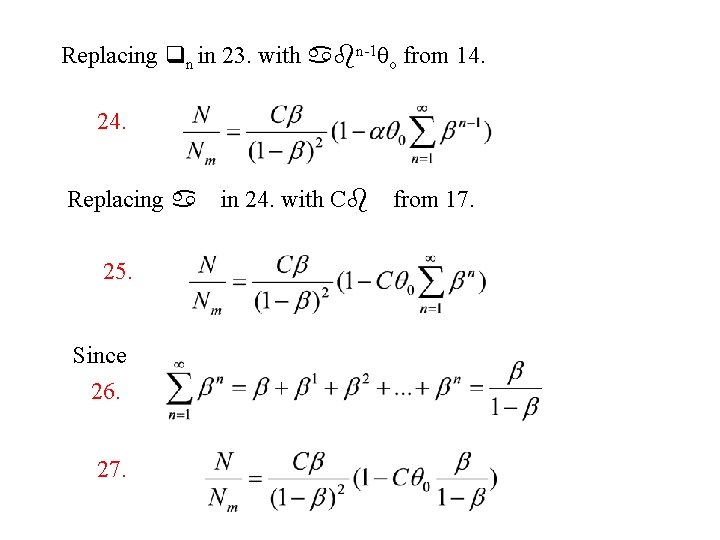
Replacing qn in 23. with abn-1 qo from 14. 24. Replacing a 25. Since 26. 27. in 24. with Cb from 17.
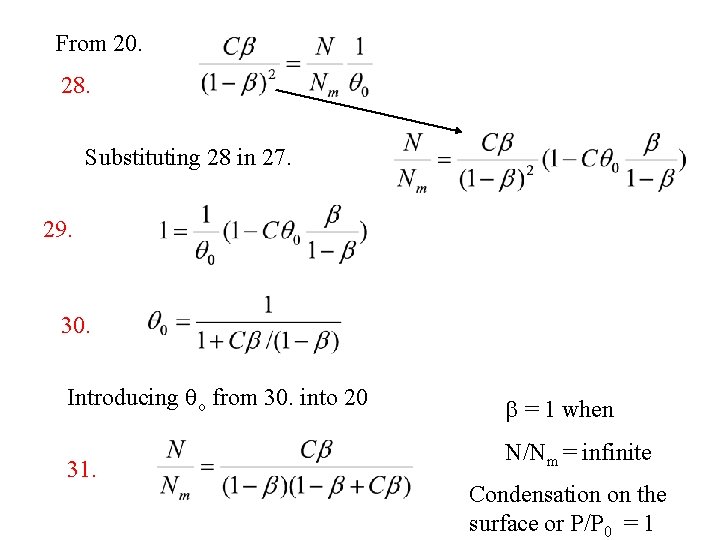
From 20. 28. Substituting 28 in 27. 29. 30. Introducing qo from 30. into 20 31. b = 1 when N/Nm = infinite Condensation on the surface or P/P 0 = 1
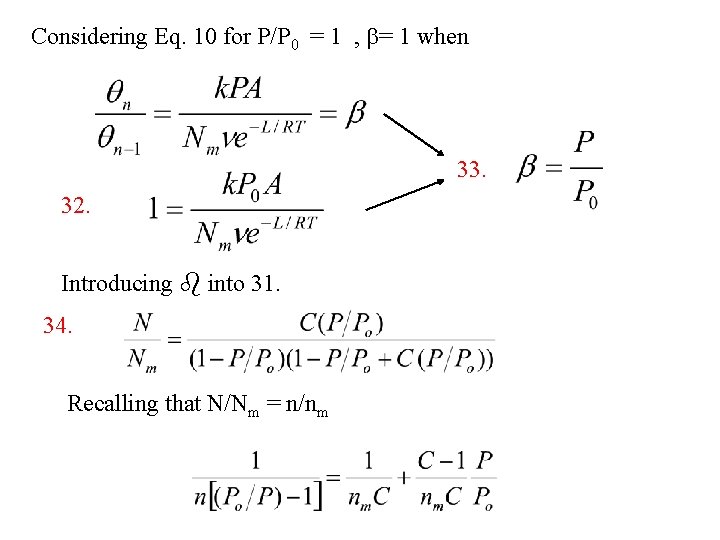
Considering Eq. 10 for P/P 0 = 1 , b= 1 when 33. 32. Introducing b into 31. 34. Recalling that N/Nm = n/nm
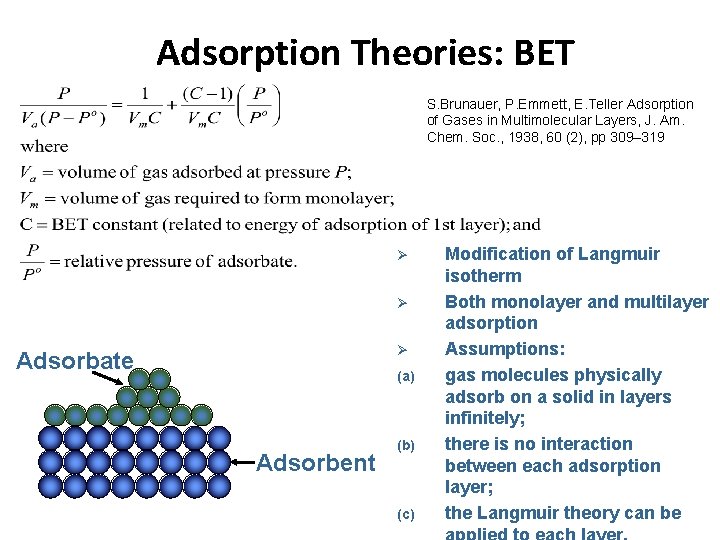
Adsorption Theories: BET S. Brunauer, P. Emmett, E. Teller Adsorption of Gases in Multimolecular Layers, J. Am. Chem. Soc. , 1938, 60 (2), pp 309– 319 Ø Ø Ø Adsorbate (a) Adsorbent (b) (c) Modification of Langmuir isotherm Both monolayer and multilayer adsorption Assumptions: gas molecules physically adsorb on a solid in layers infinitely; there is no interaction between each adsorption layer; the Langmuir theory can be
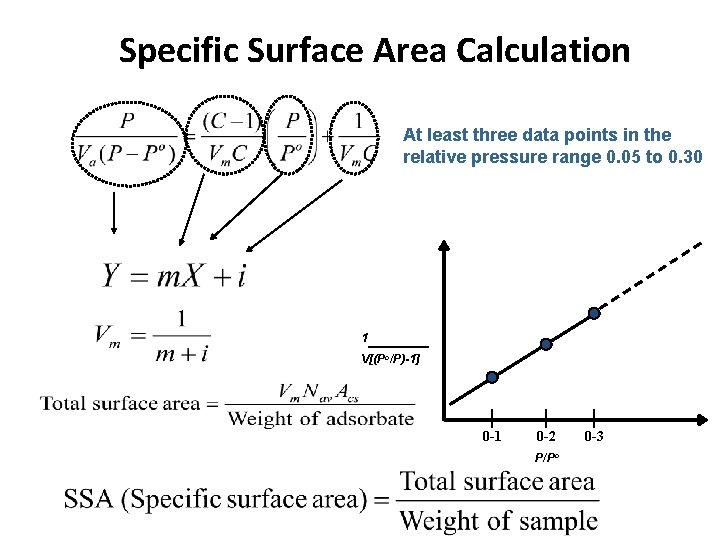
Specific Surface Area Calculation At least three data points in the relative pressure range 0. 05 to 0. 30 1 V[(Po/P)-1] 0 -1 0 -2 P/Po 0 -3
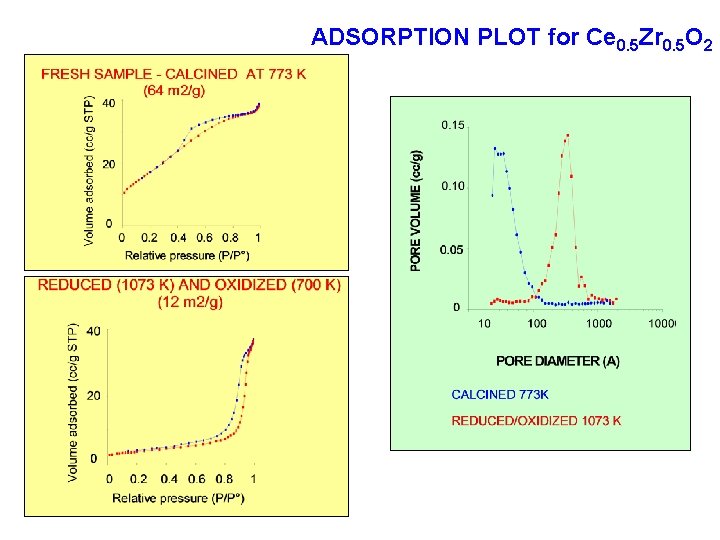
ADSORPTION PLOT for Ce 0. 5 Zr 0. 5 O 2
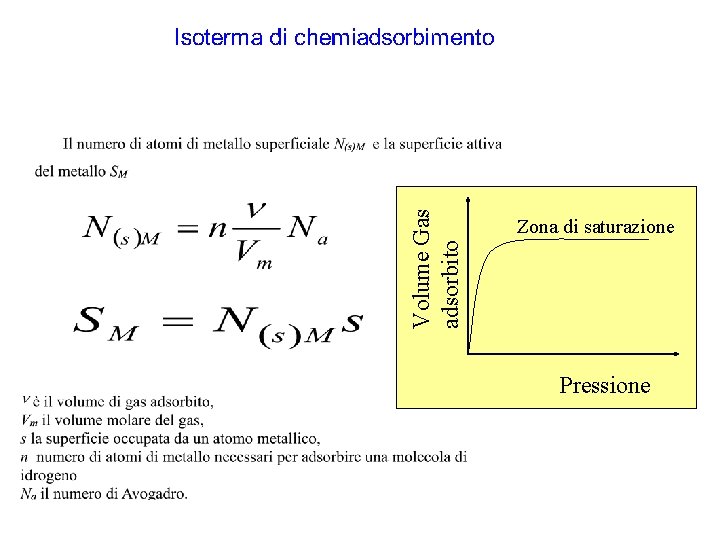
Volume Gas adsorbito Zona di saturazione Pressione
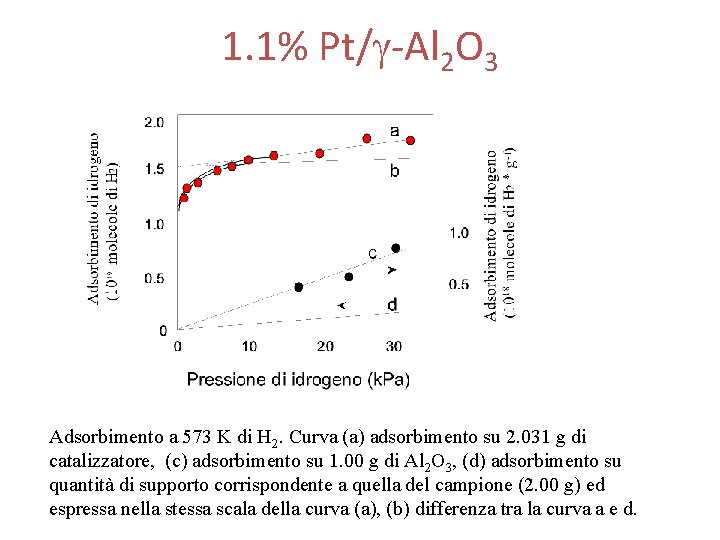
1. 1% Pt/g-Al 2 O 3 Adsorbimento a 573 K di H 2. Curva (a) adsorbimento su 2. 031 g di catalizzatore, (c) adsorbimento su 1. 00 g di Al 2 O 3, (d) adsorbimento su quantità di supporto corrispondente a quella del campione (2. 00 g) ed espressa nella stessa scala della curva (a), (b) differenza tra la curva a e d.
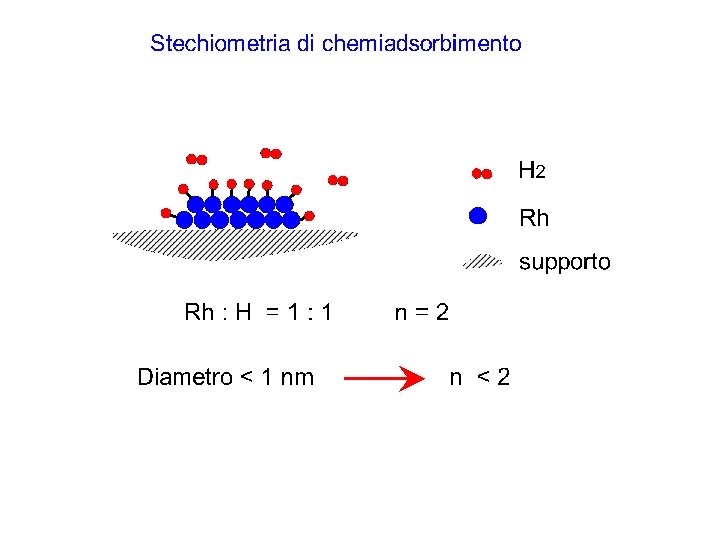
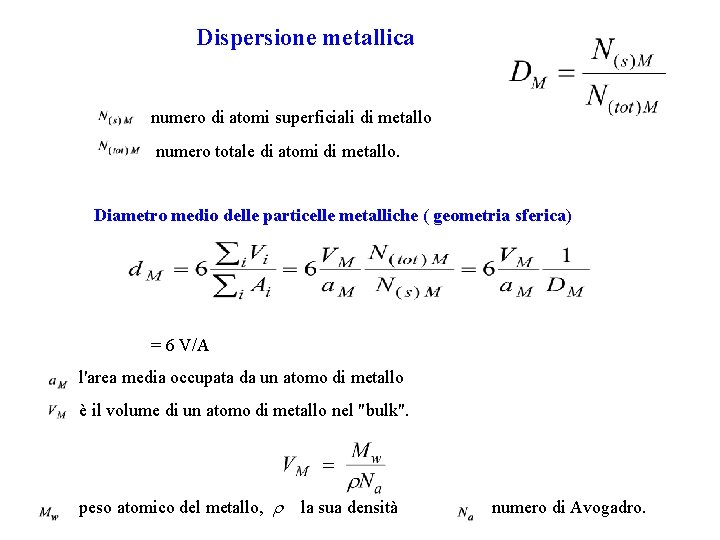
Dispersione metallica numero di atomi superficiali di metallo numero totale di atomi di metallo. Diametro medio delle particelle metalliche ( geometria sferica) = 6 V/A l'area media occupata da un atomo di metallo è il volume di un atomo di metallo nel "bulk". peso atomico del metallo, la sua densità numero di Avogadro.
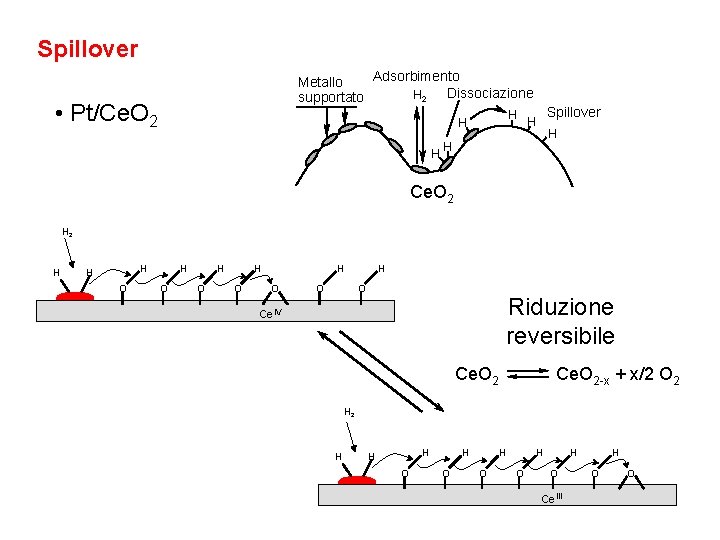
Spillover Adsorbimento Metallo Dissociazione H 2 supportato • Pt/Ce. O 2 H H H Spillover H H H Ce. O 2 H H H O H O H O Riduzione reversibile Ce. IV Ce. O 2 -x + x/2 O 2 H H H O H O H O Ce. III H O O
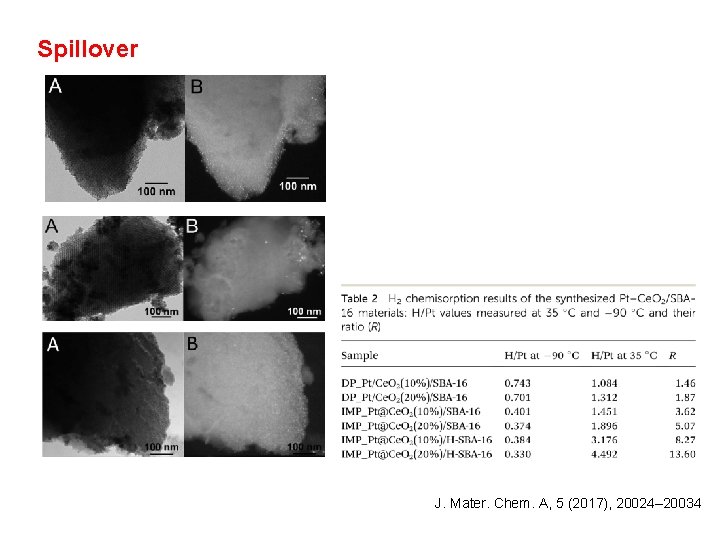
Spillover J. Mater. Chem. A, 5 (2017), 20024– 20034
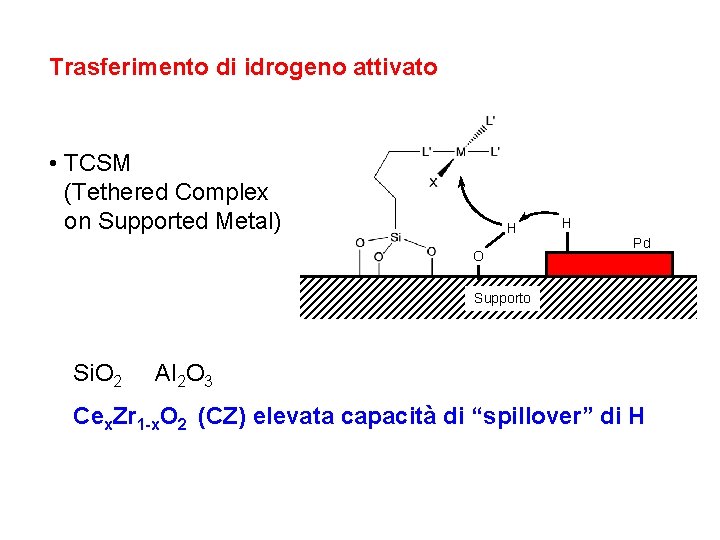
Trasferimento di idrogeno attivato • TCSM (Tethered Complex on Supported Metal) H O H Pd Supporto Si. O 2 Al 2 O 3 Cex. Zr 1 -x. O 2 (CZ) elevata capacità di “spillover” di H
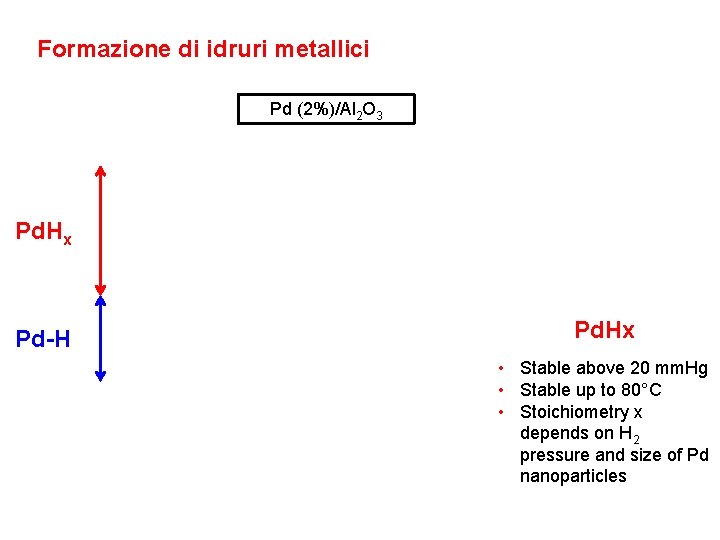
Formazione di idruri metallici Pd (2%)/Al 2 O 3 Pd. Hx Pd-H Pd. Hx • Stable above 20 mm. Hg • Stable up to 80°C • Stoichiometry x depends on H 2 pressure and size of Pd nanoparticles
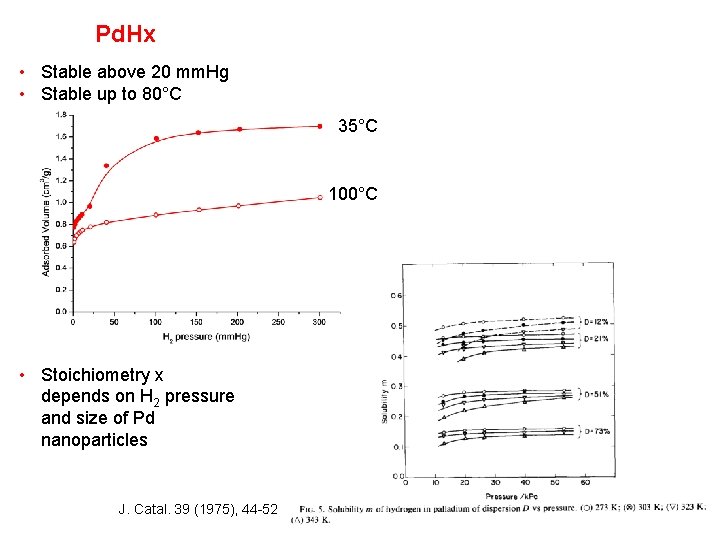
Pd. Hx • Stable above 20 mm. Hg • Stable up to 80°C 35°C 100°C • Stoichiometry x depends on H 2 pressure and size of Pd nanoparticles J. Catal. 39 (1975), 44 -52
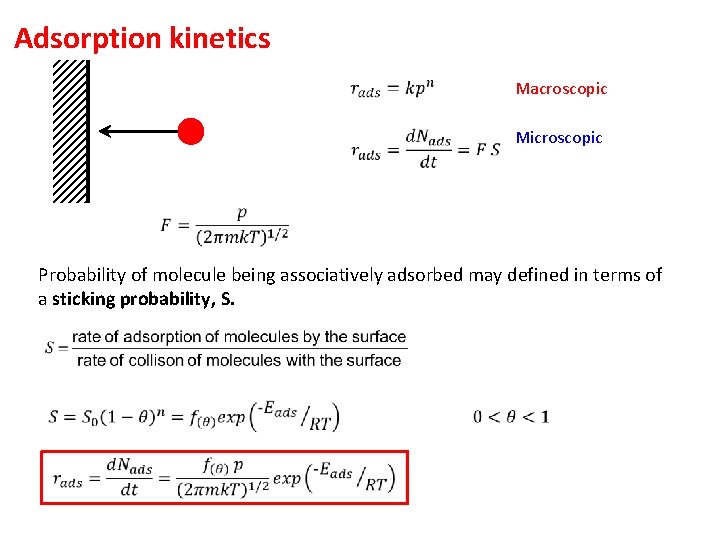
Adsorption kinetics Macroscopic Microscopic Probability of molecule being associatively adsorbed may defined in terms of a sticking probability, S.
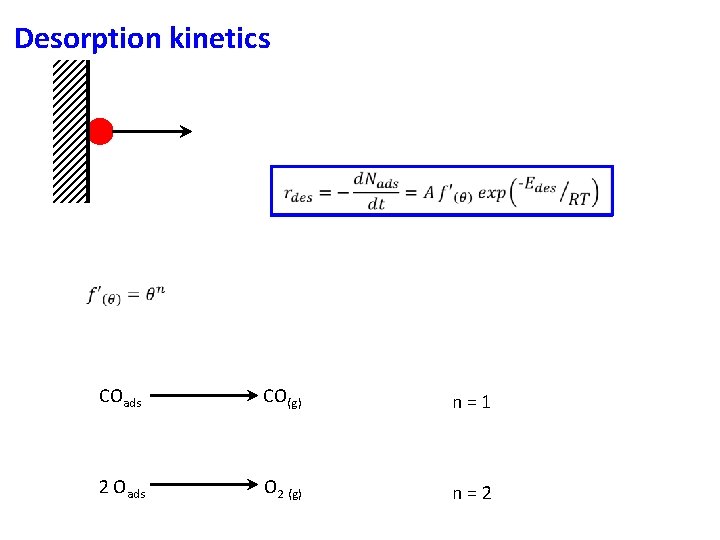
Desorption kinetics COads CO(g) n=1 2 Oads O 2 (g) n=2
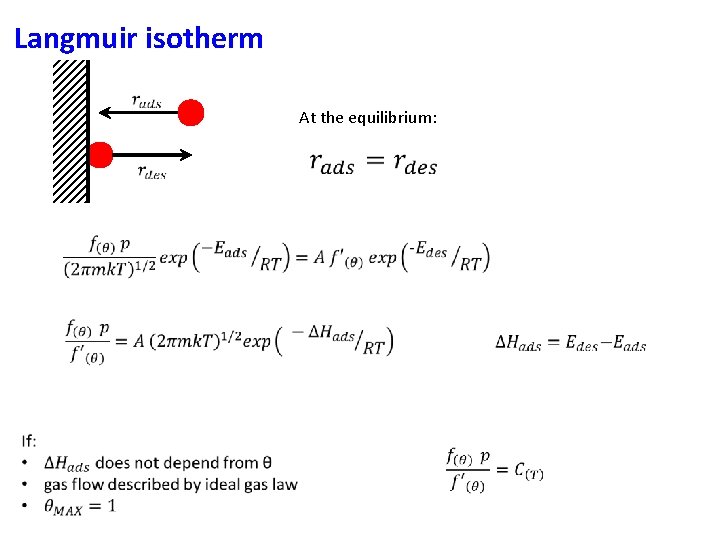
Langmuir isotherm At the equilibrium:
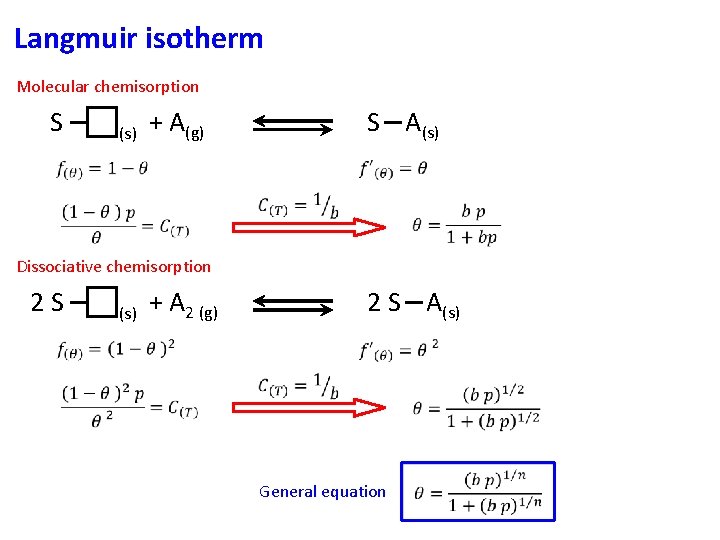
Langmuir isotherm Molecular chemisorption S (s) + A(g) S A(s) Dissociative chemisorption 2 S (s) + A 2 (g) 2 S A(s) General equation
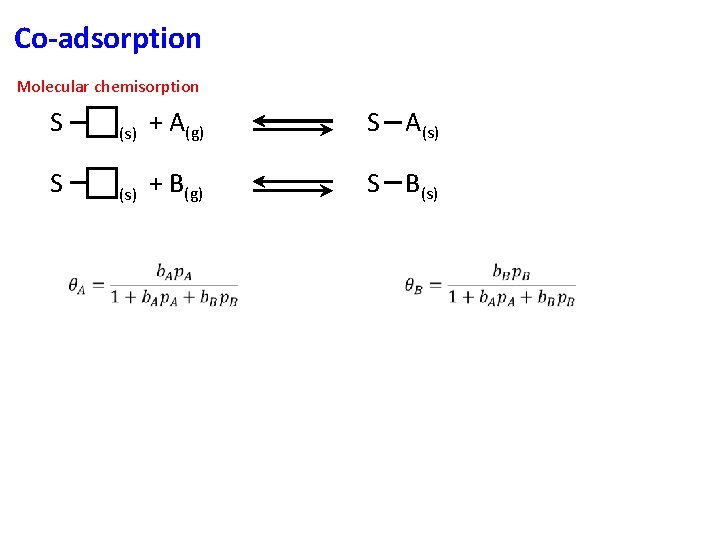
Co-adsorption Molecular chemisorption S (s) + A(g) S A(s) S (s) + B(g) S B(s)
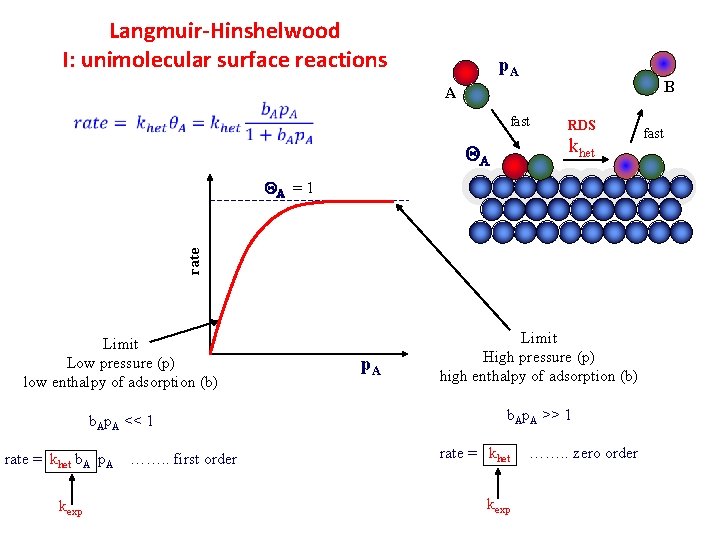
Langmuir-Hinshelwood I: unimolecular surface reactions p. A B A fast RDS khet QA rate QA = 1 Limit Low pressure (p) low enthalpy of adsorption (b) b. Ap. A << 1 rate = khet b. A p. A kexp ……. . first order p. A Limit High pressure (p) high enthalpy of adsorption (b) b. Ap. A >> 1 rate = khet kexp ……. . zero order fast
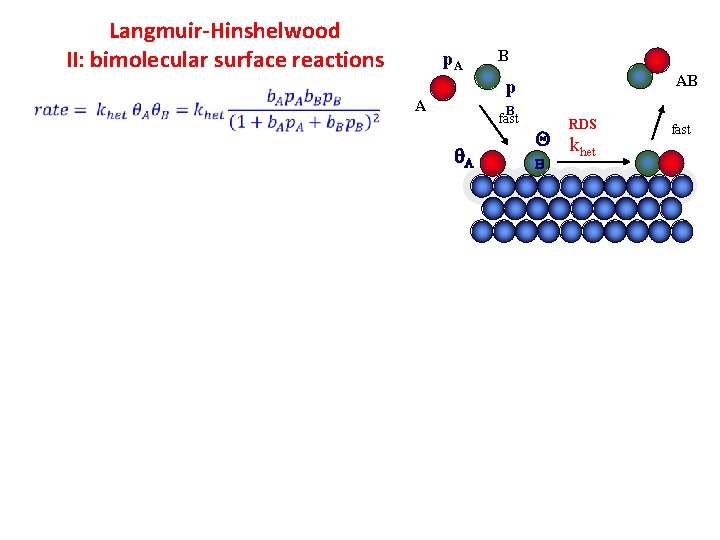
Langmuir-Hinshelwood II: bimolecular surface reactions p. A B AB p A B fast A RDS Q k het B fast
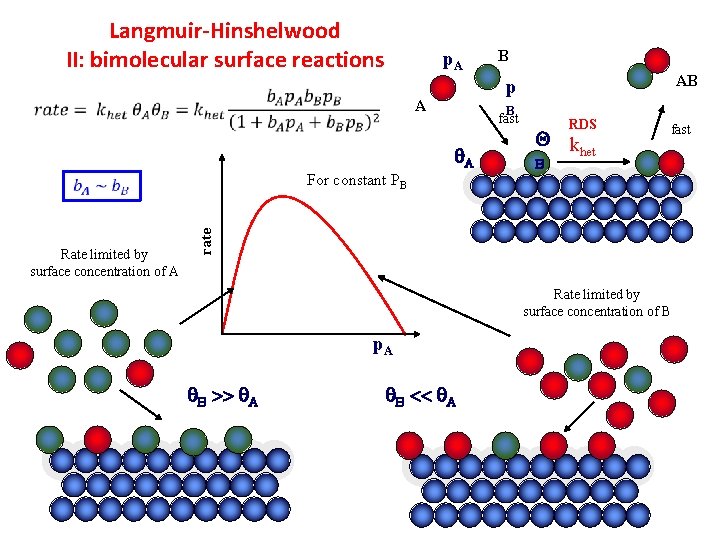
Langmuir-Hinshelwood II: bimolecular surface reactions p. A AB p A B fast A RDS Q k het fast B rate For constant PB Rate limited by surface concentration of A B Rate limited by surface concentration of B p. A B >> A B << A
Langmuir-Hinshelwood II: bimolecular surface reactions p. A B AB p A B fast A RDS Q k het fast B O 2 needs 2 sites to dissociate and react. As p. CO increases, the number of adjacent sites decreases, reducing the rate of the reaction.
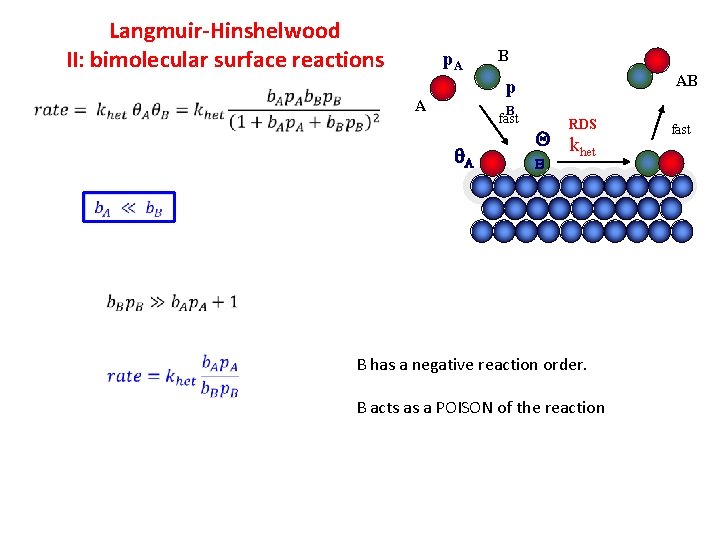
Langmuir-Hinshelwood II: bimolecular surface reactions p. A B AB p A B fast A RDS Q k het B B has a negative reaction order. B acts as a POISON of the reaction fast
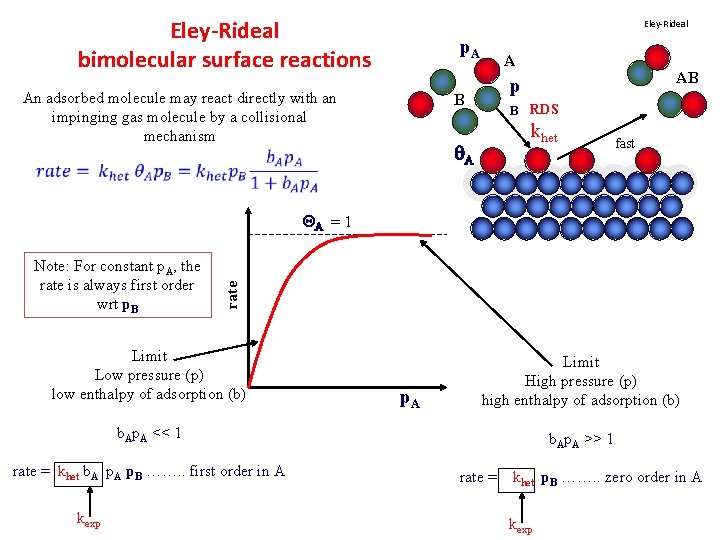
Eley-Rideal bimolecular surface reactions Eley-Rideal p. A An adsorbed molecule may react directly with an impinging gas molecule by a collisional mechanism A AB p B B RDS khet A fast Note: For constant p. A, the rate is always first order wrt p. B rate QA = 1 Limit Low pressure (p) low enthalpy of adsorption (b) p. A Limit High pressure (p) high enthalpy of adsorption (b) b. Ap. A << 1 rate = khet b. A p. B ……. . first order in A kexp b. Ap. A >> 1 rate = khet p. B ……. . zero order in A kexp
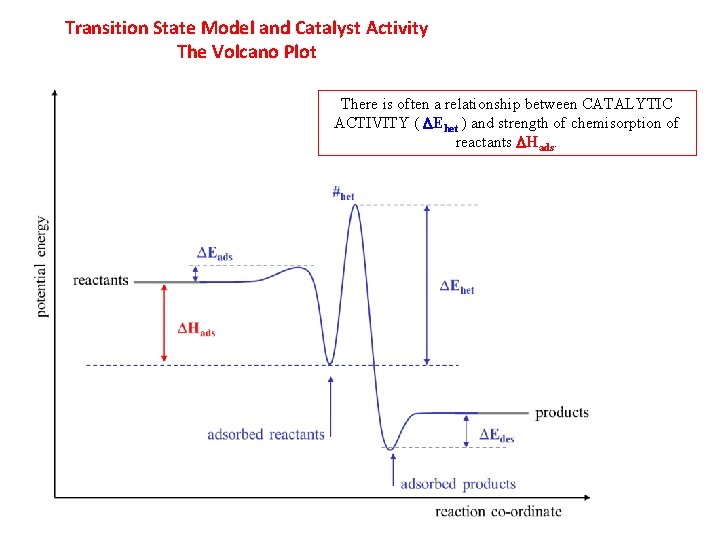
Transition State Model and Catalyst Activity The Volcano Plot There is often a relationship between CATALYTIC ACTIVITY ( DEhet ) and strength of chemisorption of reactants DHads.
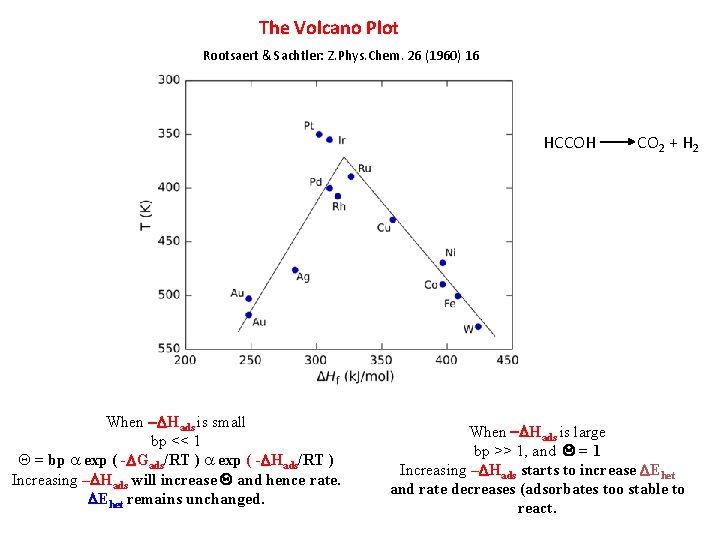
The Volcano Plot Rootsaert & Sachtler: Z. Phys. Chem. 26 (1960) 16 HCCOH When -DHads is small bp << 1 Q = bp a exp ( -DGads/RT ) a exp ( -DHads/RT ) Increasing –DHads will increase Q and hence rate. DEhet remains unchanged. CO 2 + H 2 When -DHads is large bp >> 1, and Q = 1 Increasing –DHads starts to increase DEhet and rate decreases (adsorbates too stable to react.
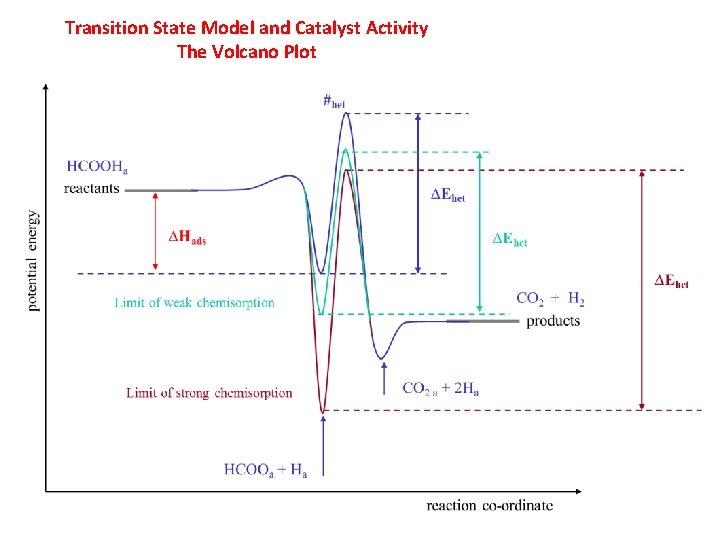
Transition State Model and Catalyst Activity The Volcano Plot