
Heterocyclic Aromatics u Heterocyclic compound A compound that
- Slides: 40
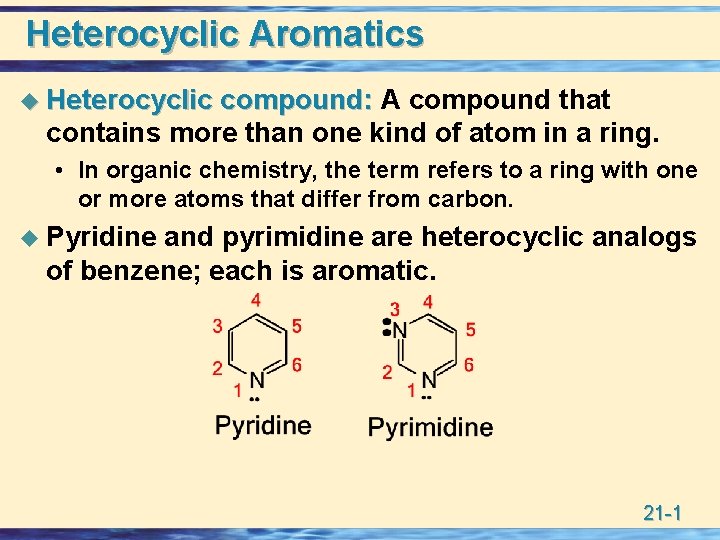
Heterocyclic Aromatics u Heterocyclic compound: A compound that contains more than one kind of atom in a ring. • In organic chemistry, the term refers to a ring with one or more atoms that differ from carbon. u Pyridine and pyrimidine are heterocyclic analogs of benzene; each is aromatic. 21 -1
Database for unknown compounds 21 -2
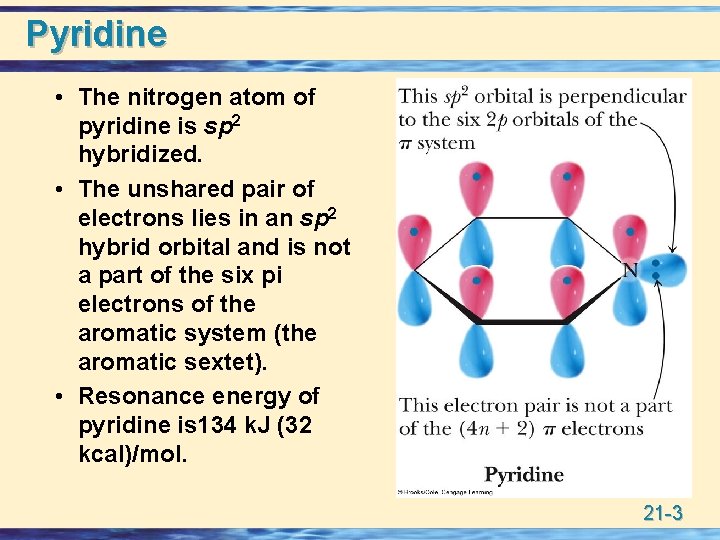
Pyridine • The nitrogen atom of pyridine is sp 2 hybridized. • The unshared pair of electrons lies in an sp 2 hybrid orbital and is not a part of the six pi electrons of the aromatic system (the aromatic sextet). • Resonance energy of pyridine is 134 k. J (32 kcal)/mol. 21 -3
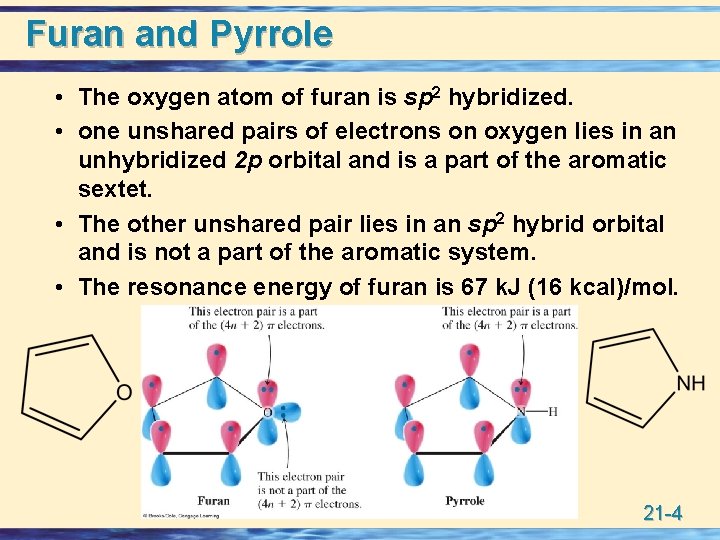
Furan and Pyrrole • The oxygen atom of furan is sp 2 hybridized. • one unshared pairs of electrons on oxygen lies in an unhybridized 2 p orbital and is a part of the aromatic sextet. • The other unshared pair lies in an sp 2 hybrid orbital and is not a part of the aromatic system. • The resonance energy of furan is 67 k. J (16 kcal)/mol. 21 -4
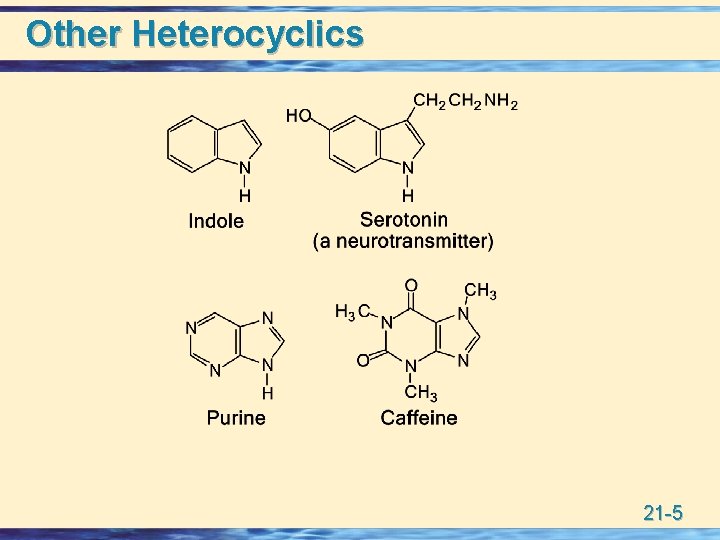
Other Heterocyclics 21 -5
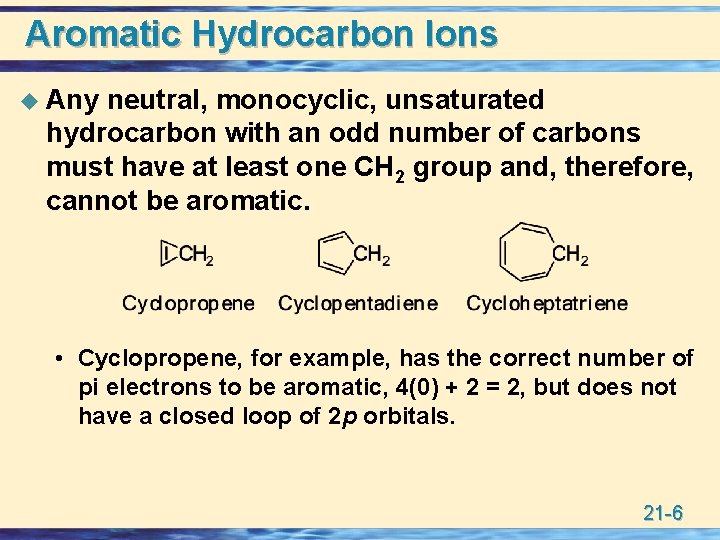
Aromatic Hydrocarbon Ions u Any neutral, monocyclic, unsaturated hydrocarbon with an odd number of carbons must have at least one CH 2 group and, therefore, cannot be aromatic. • Cyclopropene, for example, has the correct number of pi electrons to be aromatic, 4(0) + 2 = 2, but does not have a closed loop of 2 p orbitals. 21 -6
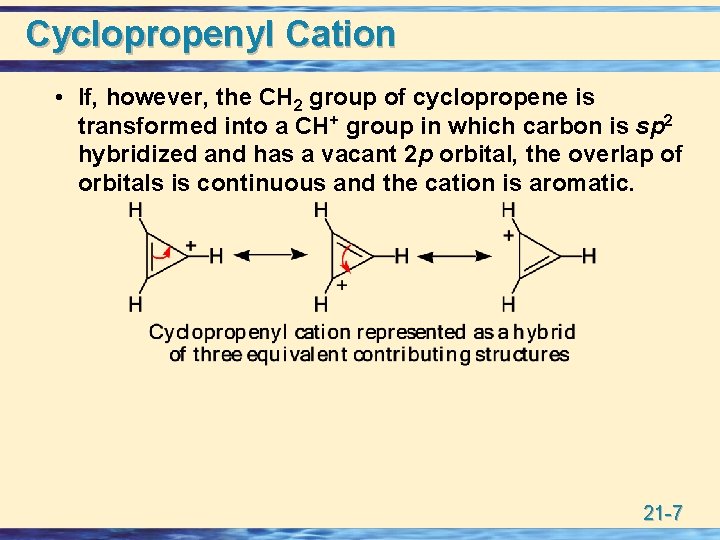
Cyclopropenyl Cation • If, however, the CH 2 group of cyclopropene is transformed into a CH+ group in which carbon is sp 2 hybridized and has a vacant 2 p orbital, the overlap of orbitals is continuous and the cation is aromatic. 21 -7
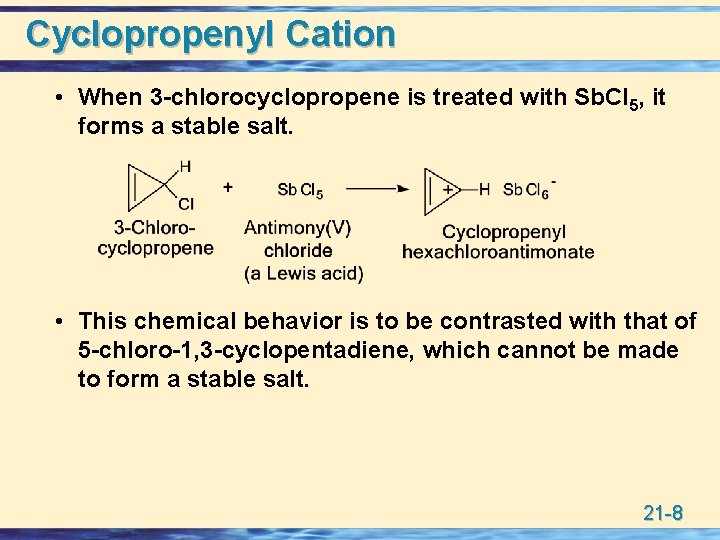
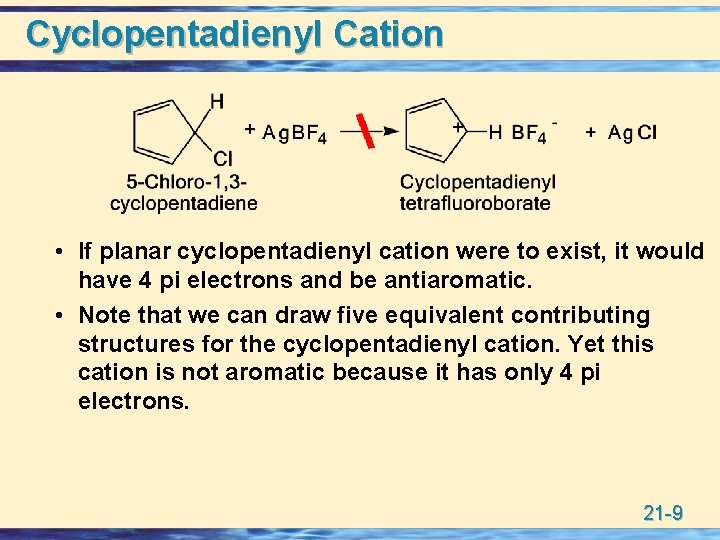
Cyclopropenyl Cation • When 3 -chlorocyclopropene is treated with Sb. Cl 5, it forms a stable salt. • This chemical behavior is to be contrasted with that of 5 -chloro-1, 3 -cyclopentadiene, which cannot be made to form a stable salt. 21 -8
Cyclopentadienyl Cation • If planar cyclopentadienyl cation were to exist, it would have 4 pi electrons and be antiaromatic. • Note that we can draw five equivalent contributing structures for the cyclopentadienyl cation. Yet this cation is not aromatic because it has only 4 pi electrons. 21 -9
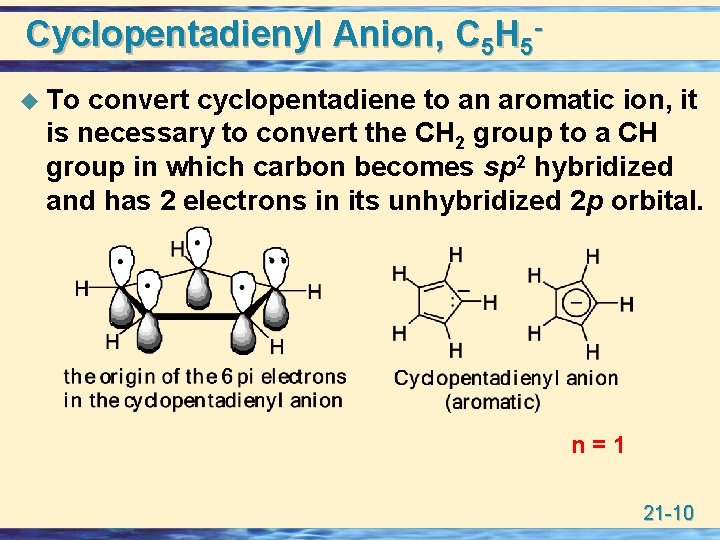
Cyclopentadienyl Anion, C 5 H 5 u To convert cyclopentadiene to an aromatic ion, it is necessary to convert the CH 2 group to a CH group in which carbon becomes sp 2 hybridized and has 2 electrons in its unhybridized 2 p orbital. n=1 21 -10
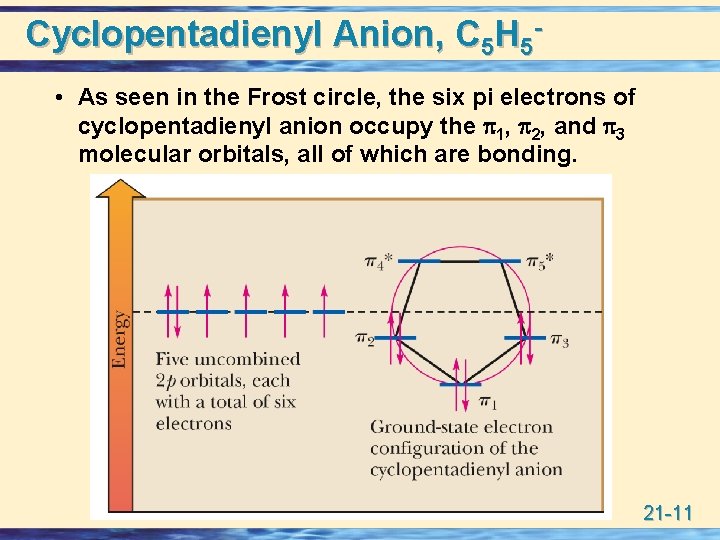
Cyclopentadienyl Anion, C 5 H 5 • As seen in the Frost circle, the six pi electrons of cyclopentadienyl anion occupy the p 1, p 2, and p 3 molecular orbitals, all of which are bonding. 21 -11
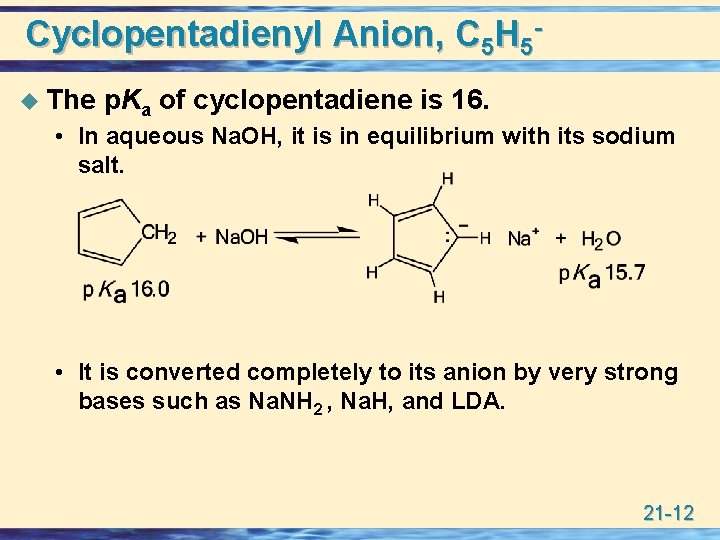
Cyclopentadienyl Anion, C 5 H 5 u The p. Ka of cyclopentadiene is 16. • In aqueous Na. OH, it is in equilibrium with its sodium salt. • It is converted completely to its anion by very strong bases such as Na. NH 2 , Na. H, and LDA. 21 -12
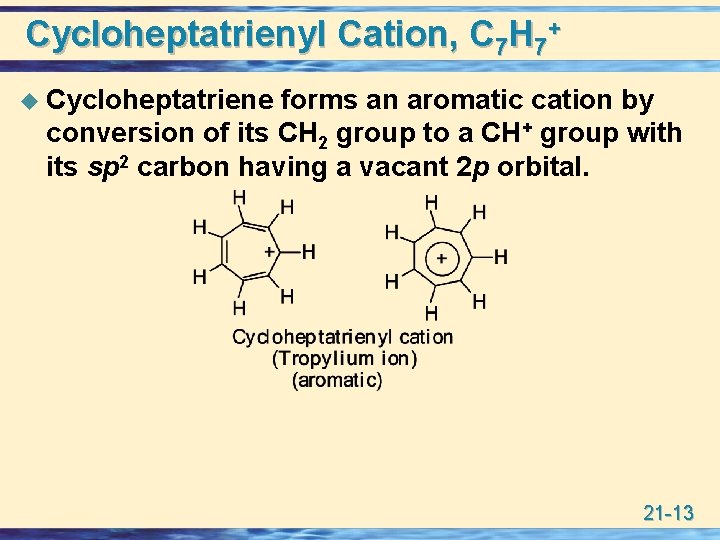
Cycloheptatrienyl Cation, C 7 H 7+ u Cycloheptatriene forms an aromatic cation by conversion of its CH 2 group to a CH+ group with its sp 2 carbon having a vacant 2 p orbital. 21 -13
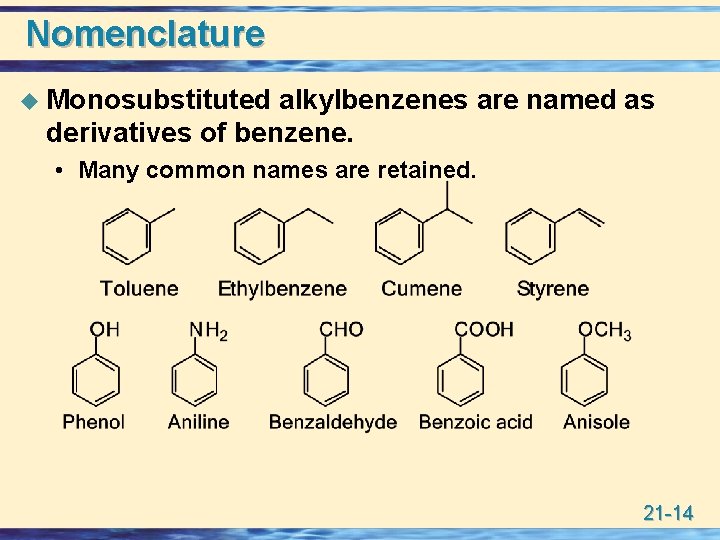
Nomenclature u Monosubstituted alkylbenzenes are named as derivatives of benzene. • Many common names are retained. 21 -14
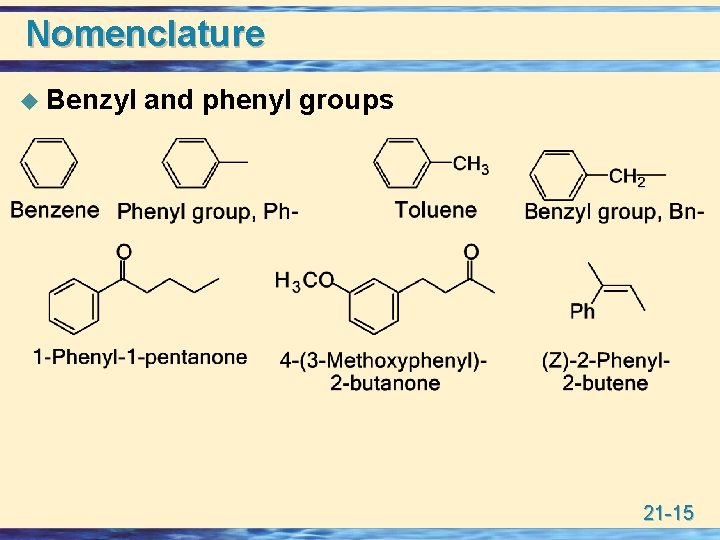
Nomenclature u Benzyl and phenyl groups 21 -15
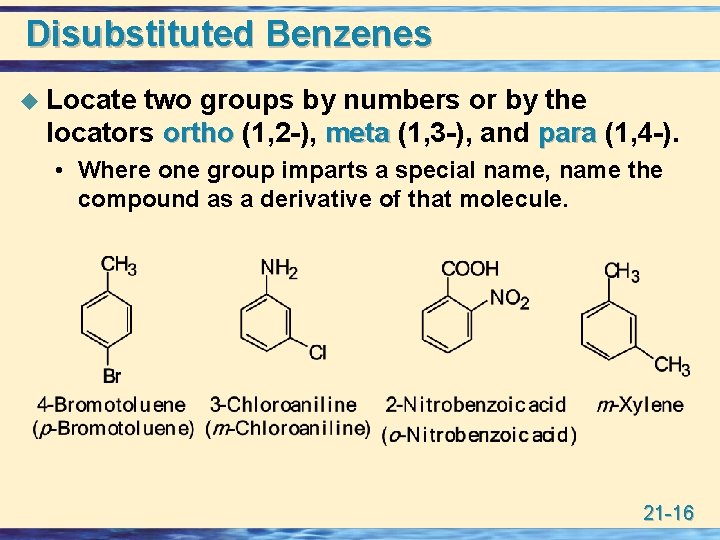
Disubstituted Benzenes u Locate two groups by numbers or by the locators ortho (1, 2 -), meta (1, 3 -), and para (1, 4 -). • Where one group imparts a special name, name the compound as a derivative of that molecule. 21 -16
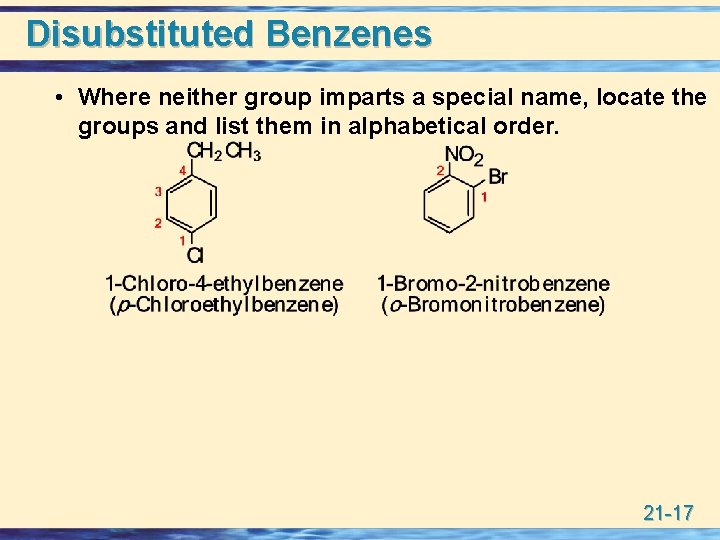
Disubstituted Benzenes • Where neither group imparts a special name, locate the groups and list them in alphabetical order. 21 -17
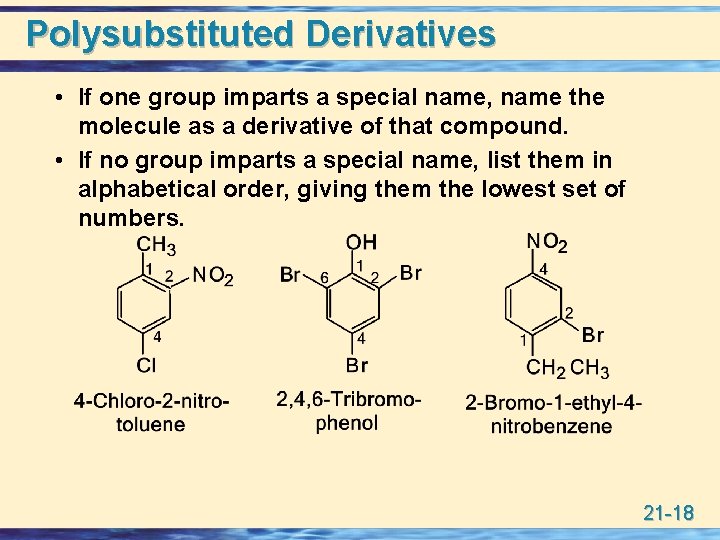
Polysubstituted Derivatives • If one group imparts a special name, name the molecule as a derivative of that compound. • If no group imparts a special name, list them in alphabetical order, giving them the lowest set of numbers. 21 -18
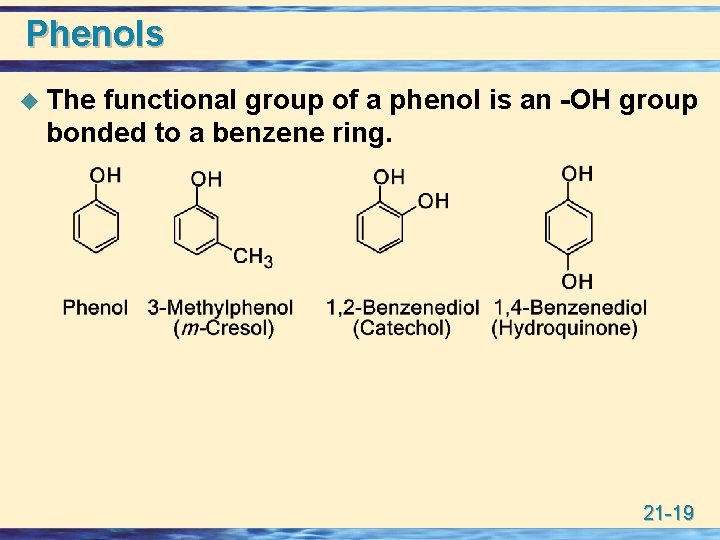
Phenols u The functional group of a phenol is an -OH group bonded to a benzene ring. 21 -19
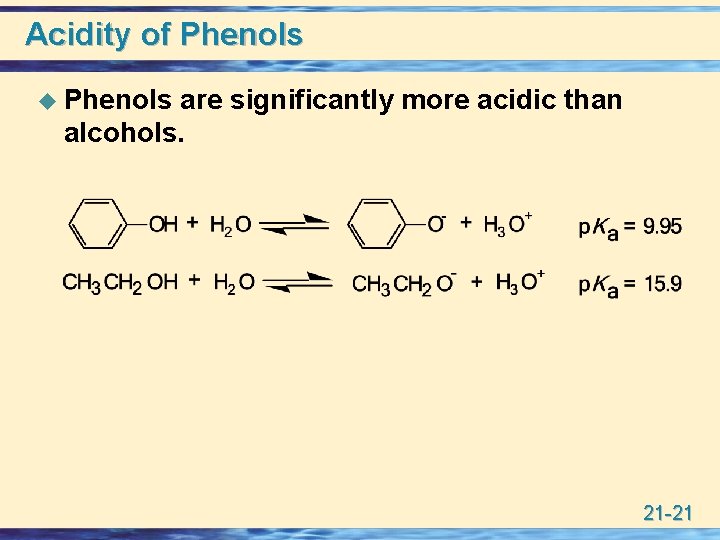
Acidity of Phenols u Phenols are significantly more acidic than alcohols. 21 -21
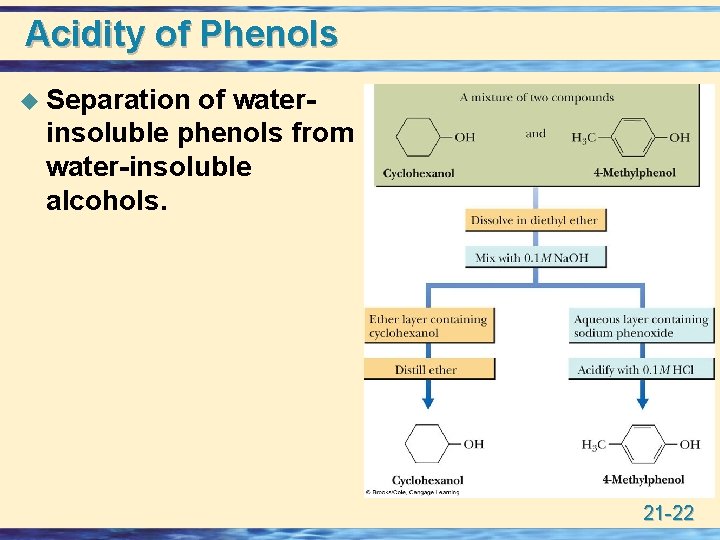
Acidity of Phenols u Separation of waterinsoluble phenols from water-insoluble alcohols. 21 -22
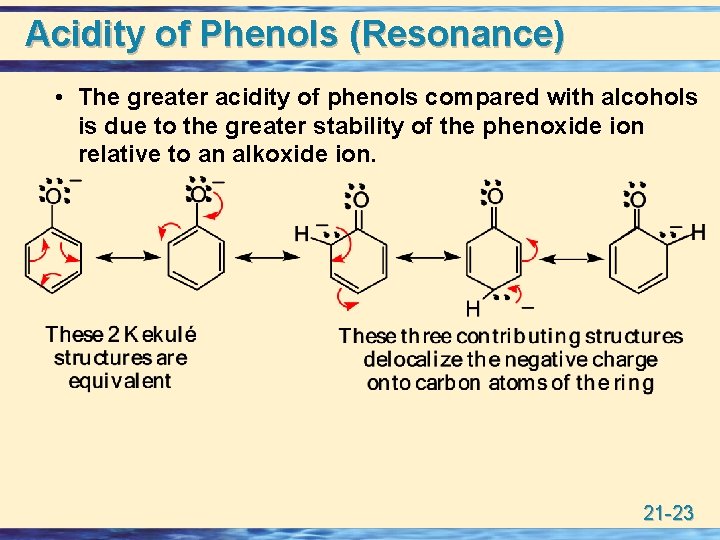
Acidity of Phenols (Resonance) • The greater acidity of phenols compared with alcohols is due to the greater stability of the phenoxide ion relative to an alkoxide ion. 21 -23
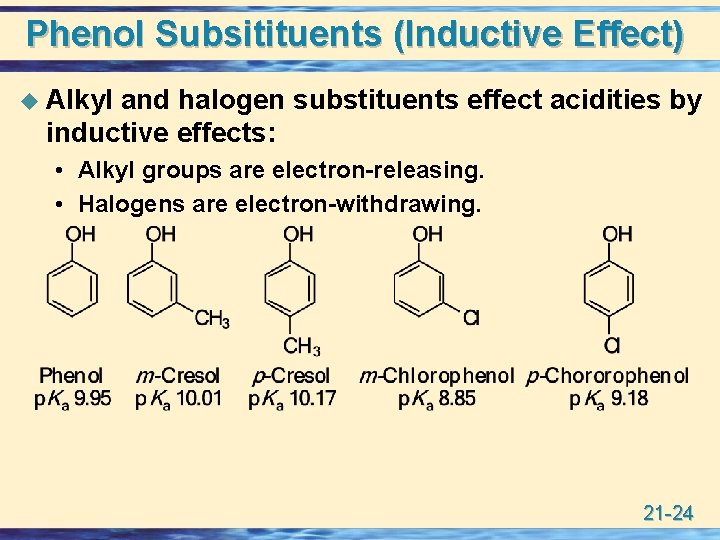
Phenol Subsitituents (Inductive Effect) u Alkyl and halogen substituents effect acidities by inductive effects: • Alkyl groups are electron-releasing. • Halogens are electron-withdrawing. 21 -24
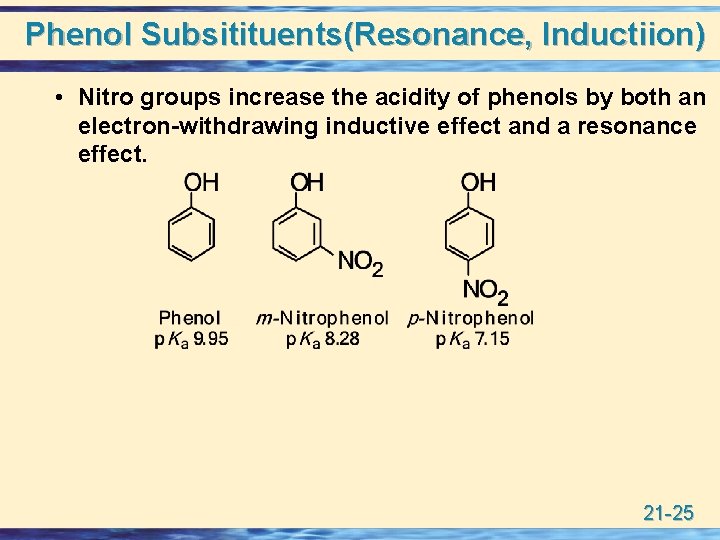
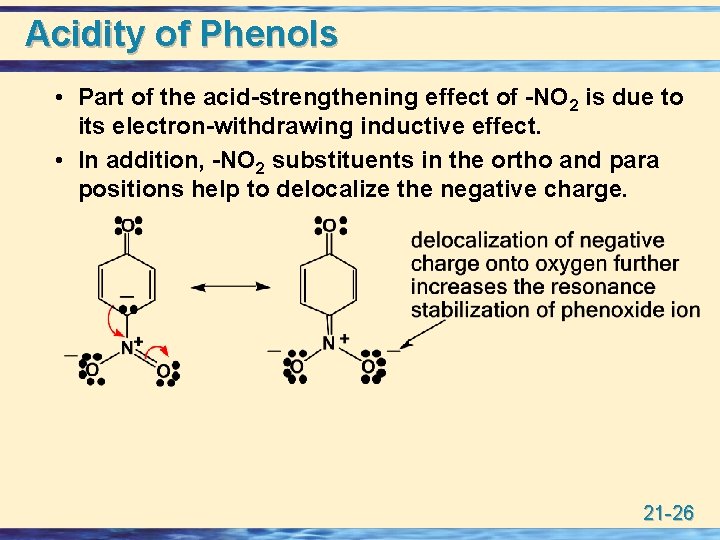
Phenol Subsitituents(Resonance, Inductiion) • Nitro groups increase the acidity of phenols by both an electron-withdrawing inductive effect and a resonance effect. 21 -25
Acidity of Phenols • Part of the acid-strengthening effect of -NO 2 is due to its electron-withdrawing inductive effect. • In addition, -NO 2 substituents in the ortho and para positions help to delocalize the negative charge. 21 -26
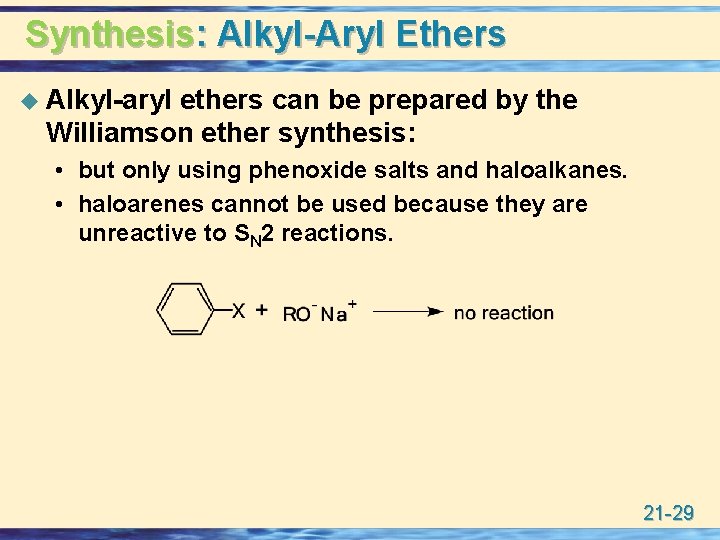
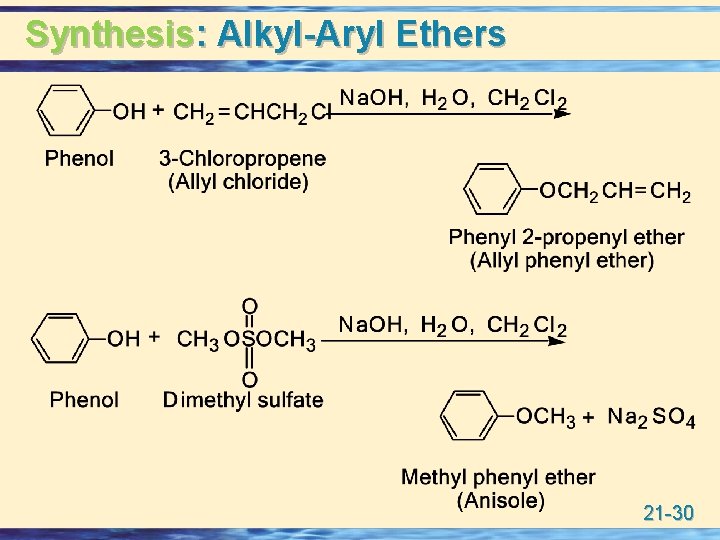
Synthesis: Alkyl-Aryl Ethers u Alkyl-aryl ethers can be prepared by the Williamson ether synthesis: • but only using phenoxide salts and haloalkanes. • haloarenes cannot be used because they are unreactive to SN 2 reactions. 21 -29
Synthesis: Alkyl-Aryl Ethers 21 -30
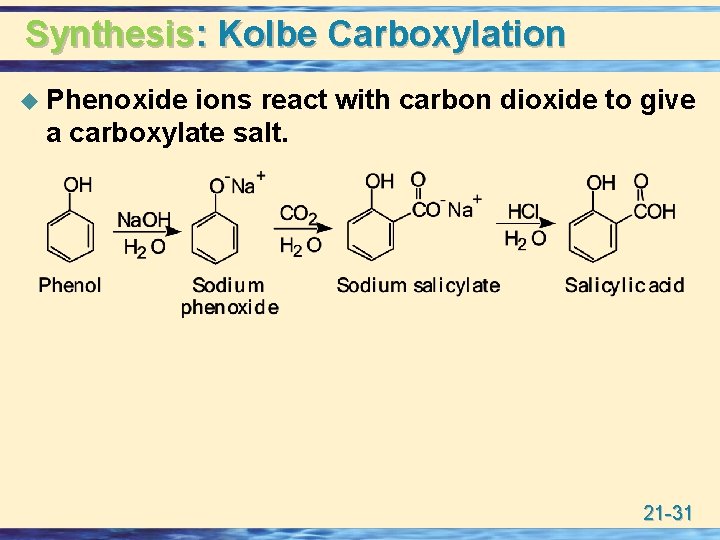
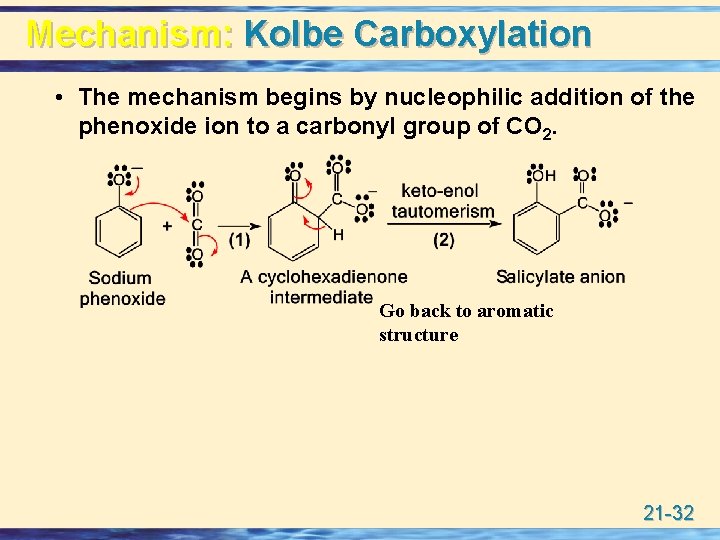
Synthesis: Kolbe Carboxylation u Phenoxide ions react with carbon dioxide to give a carboxylate salt. 21 -31
Mechanism: Kolbe Carboxylation • The mechanism begins by nucleophilic addition of the phenoxide ion to a carbonyl group of CO 2. Go back to aromatic structure 21 -32
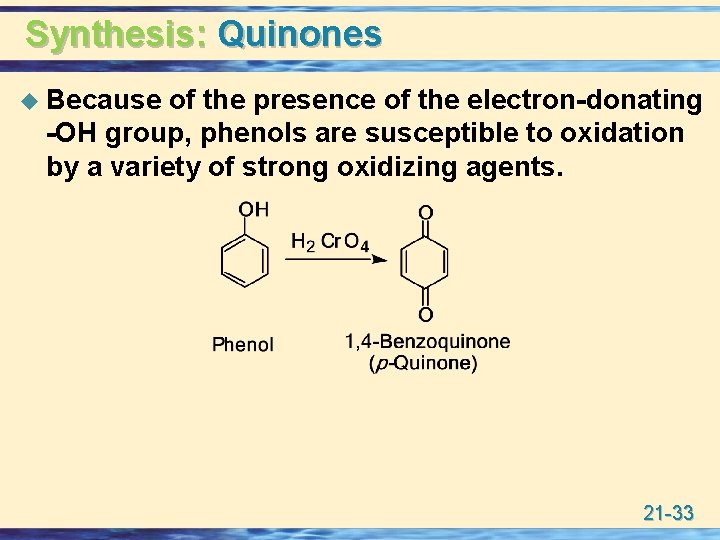
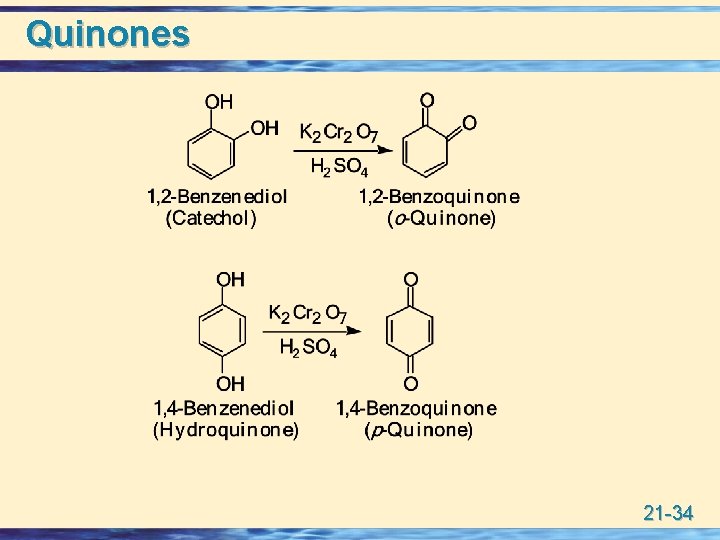
Synthesis: Quinones u Because of the presence of the electron-donating -OH group, phenols are susceptible to oxidation by a variety of strong oxidizing agents. 21 -33
Quinones 21 -34
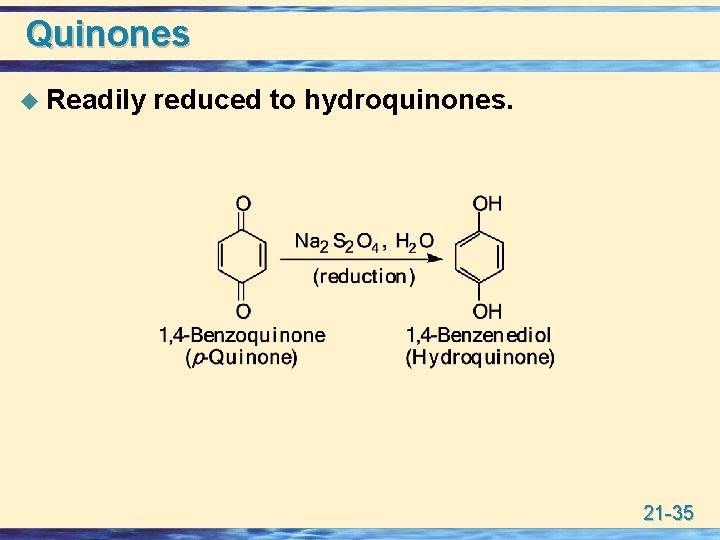
Quinones u Readily reduced to hydroquinones. 21 -35
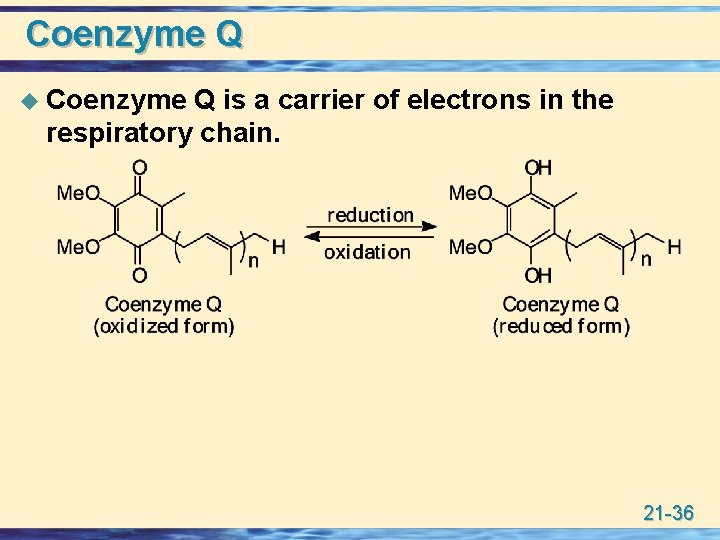
Coenzyme Q u Coenzyme Q is a carrier of electrons in the respiratory chain. 21 -36
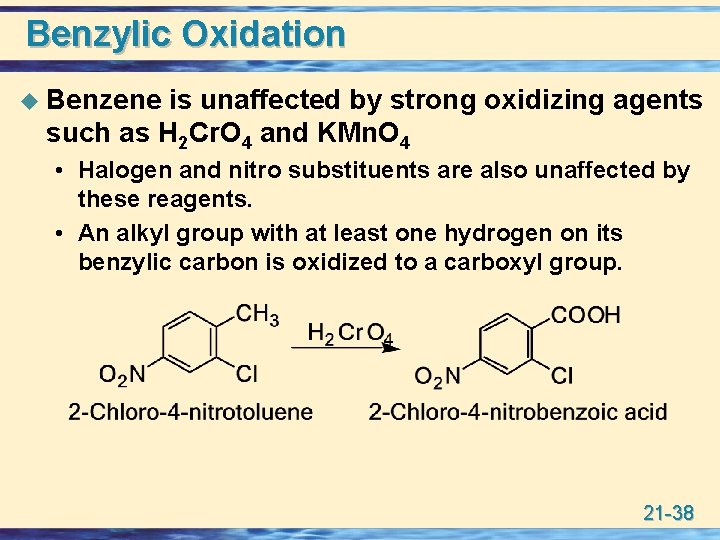
Benzylic Oxidation u Benzene is unaffected by strong oxidizing agents such as H 2 Cr. O 4 and KMn. O 4 • Halogen and nitro substituents are also unaffected by these reagents. • An alkyl group with at least one hydrogen on its benzylic carbon is oxidized to a carboxyl group. 21 -38
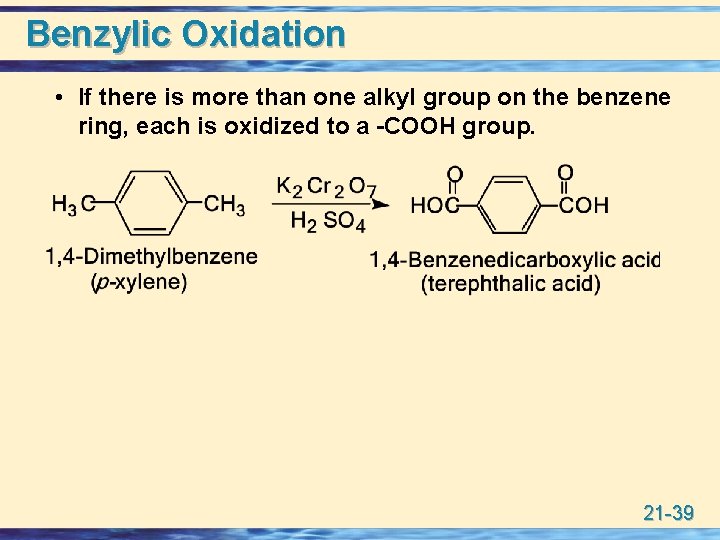
Benzylic Oxidation • If there is more than one alkyl group on the benzene ring, each is oxidized to a -COOH group. 21 -39
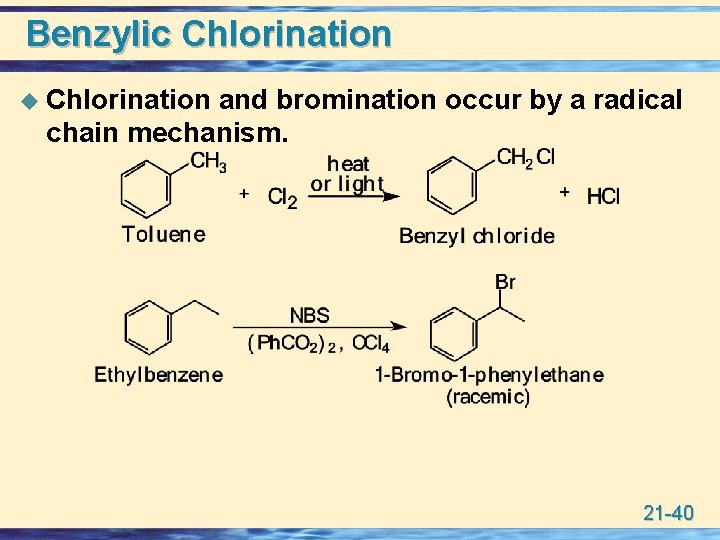
Benzylic Chlorination u Chlorination and bromination occur by a radical chain mechanism. 21 -40
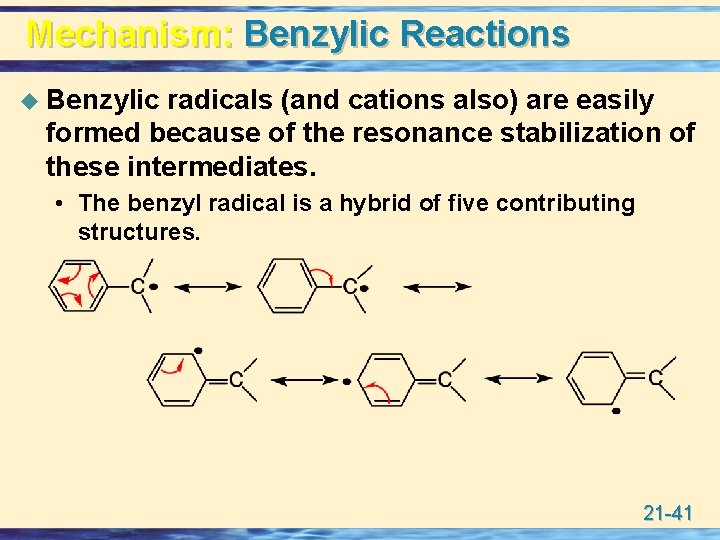
Mechanism: Benzylic Reactions u Benzylic radicals (and cations also) are easily formed because of the resonance stabilization of these intermediates. • The benzyl radical is a hybrid of five contributing structures. 21 -41
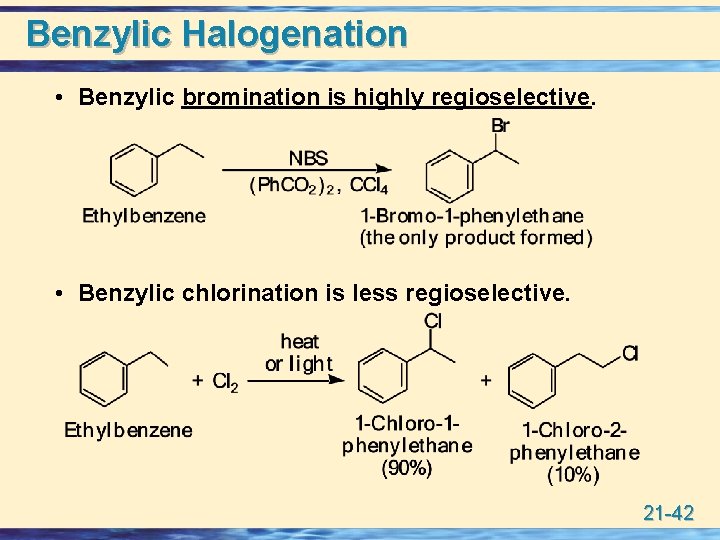
Benzylic Halogenation • Benzylic bromination is highly regioselective. • Benzylic chlorination is less regioselective. 21 -42
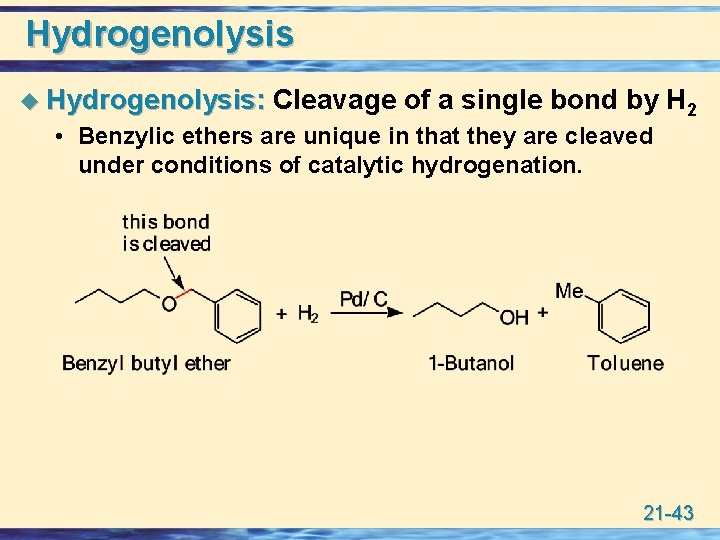
Hydrogenolysis u Hydrogenolysis: Cleavage of a single bond by H 2 • Benzylic ethers are unique in that they are cleaved under conditions of catalytic hydrogenation. 21 -43
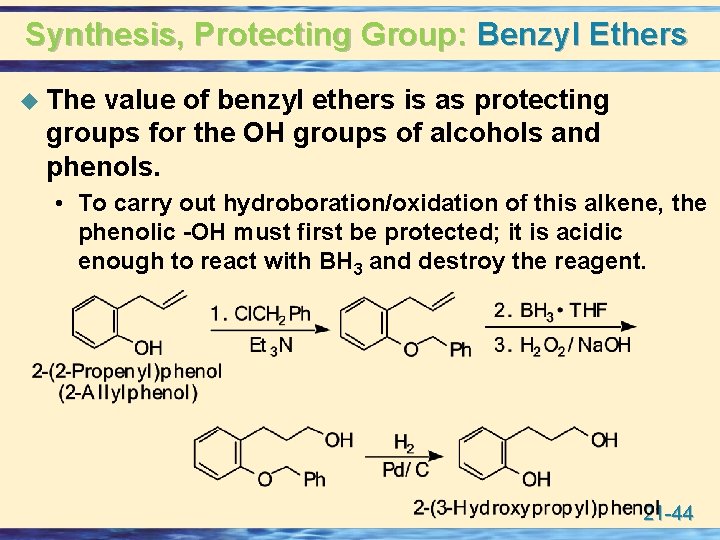
Synthesis, Protecting Group: Benzyl Ethers u The value of benzyl ethers is as protecting groups for the OH groups of alcohols and phenols. • To carry out hydroboration/oxidation of this alkene, the phenolic -OH must first be protected; it is acidic enough to react with BH 3 and destroy the reagent. 21 -44