
Hesss Law Germain Henri Hess A Hesss Law
- Slides: 9
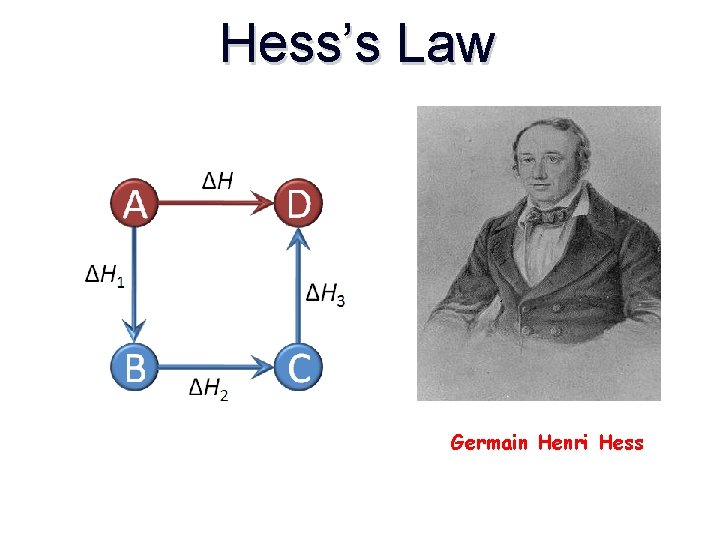
Hess’s Law Germain Henri Hess
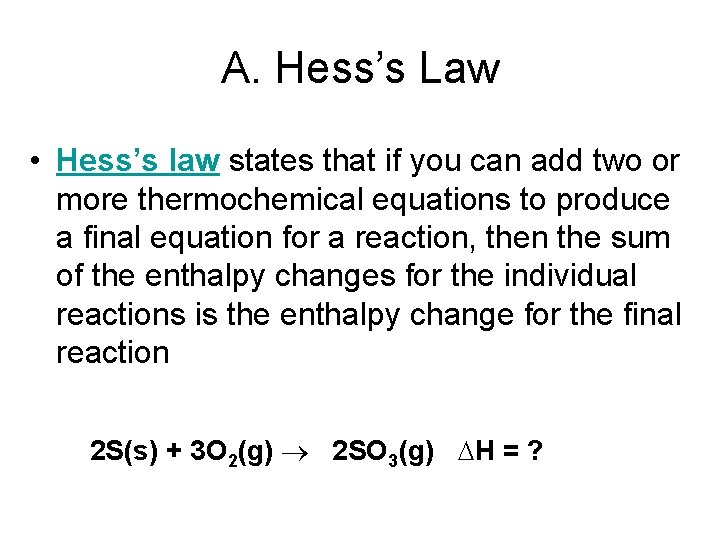
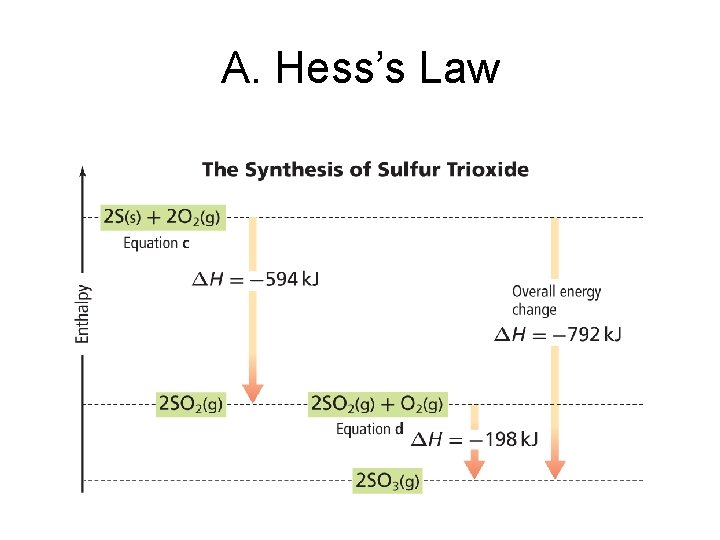
A. Hess’s Law • Hess’s law states that if you can add two or more thermochemical equations to produce a final equation for a reaction, then the sum of the enthalpy changes for the individual reactions is the enthalpy change for the final reaction 2 S(s) + 3 O 2(g) 2 SO 3(g) H = ?
A. Hess’s Law
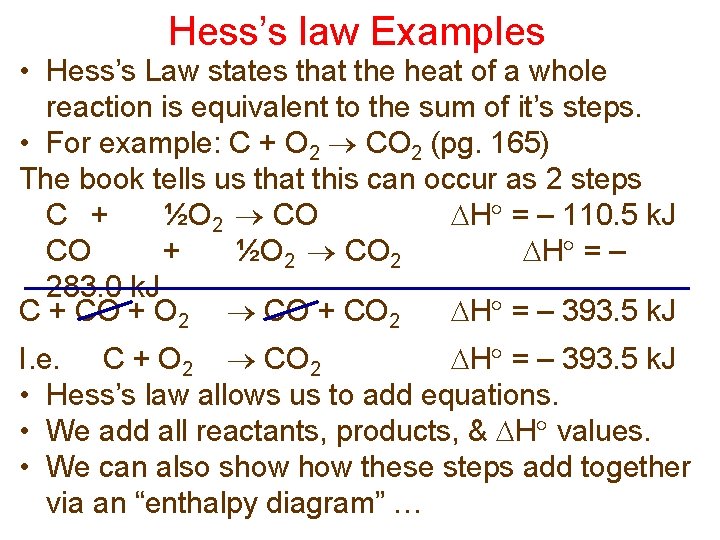
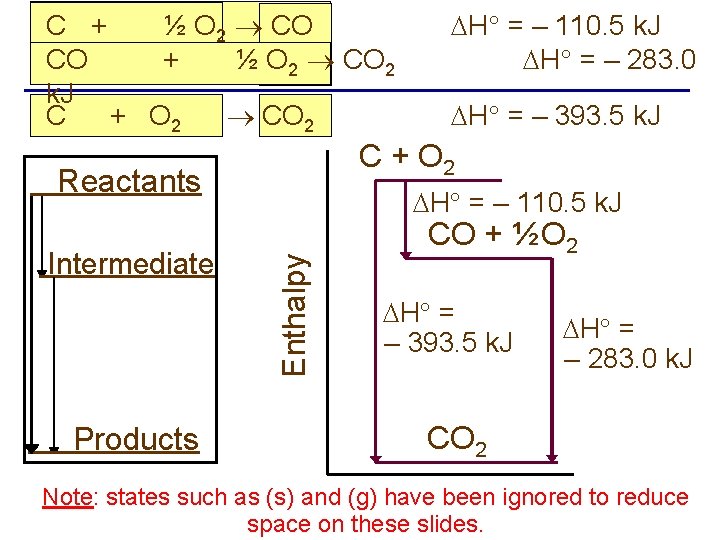
Hess’s law Examples • Hess’s Law states that the heat of a whole reaction is equivalent to the sum of it’s steps. • For example: C + O 2 CO 2 (pg. 165) The book tells us that this can occur as 2 steps C + ½O 2 CO H = – 110. 5 k. J CO + ½O 2 CO 2 H = – 283. 0 k. J C + CO + O 2 CO + CO 2 H = – 393. 5 k. J I. e. C + O 2 CO 2 H = – 393. 5 k. J • Hess’s law allows us to add equations. • We add all reactants, products, & H values. • We can also show these steps add together via an “enthalpy diagram” …
C + ½ O 2 CO CO + ½ O 2 CO 2 k. J C + O 2 CO 2 Products H = – 393. 5 k. J C + O 2 Reactants H = – 110. 5 k. J Enthalpy Intermediate H = – 110. 5 k. J H = – 283. 0 CO + ½ O 2 H = – 393. 5 k. J H = – 283. 0 k. J CO 2 Note: states such as (s) and (g) have been ignored to reduce space on these slides.
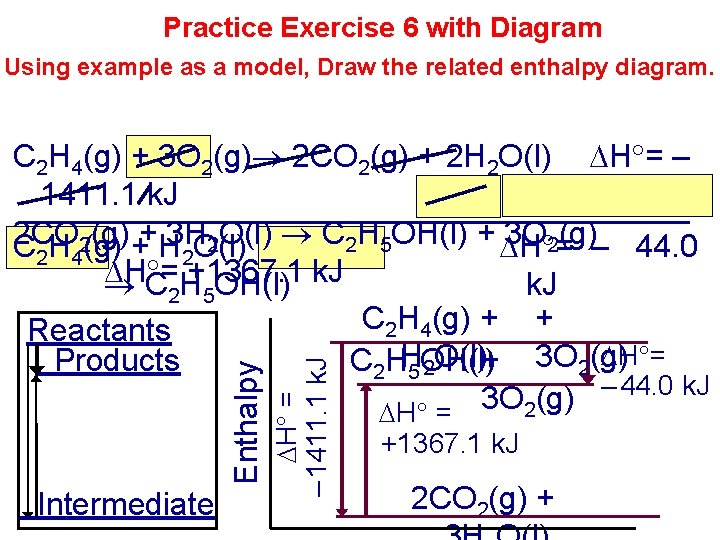
Practice Exercise 6 with Diagram Using example as a model, Draw the related enthalpy diagram. Intermediate H = – 1411. 1 k. J Enthalpy C 2 H 4(g) + 3 O 2(g) 2 CO 2(g) + 2 H 2 O(l) H = – 1411. 1 k. J 2 CO (g) + 3 H O(l) C H OH(l) + 3 O (g) 2 2 2 5 2 C 2 H 4(g) + H 2 O(l) H = – 44. 0 H = k. J C 2 H+1367. 1 OH(l) k. J 5 C 2 H 4(g) + + Reactants H = 3 O 2(g) Products C 2 HH 5 OH(l) 2 O(l)+ – 44. 0 k. J H = 3 O 2(g) +1367. 1 k. J 2 CO 2(g) +
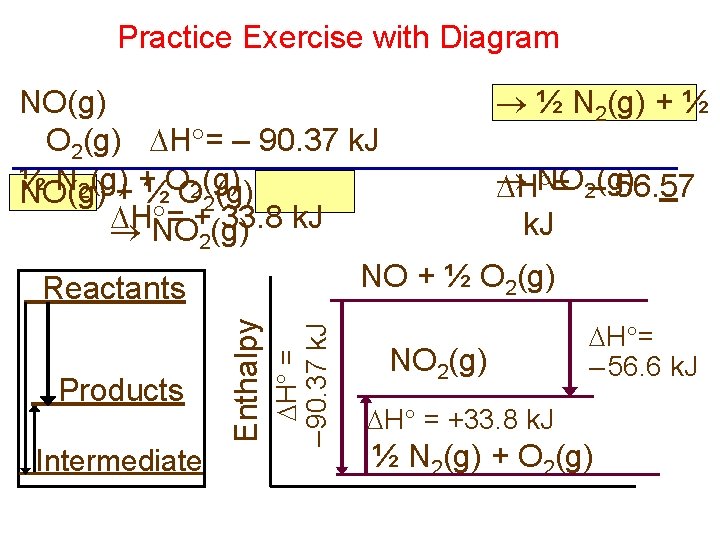
Practice Exercise with Diagram ½ N 2(g) + ½ NO(g) O 2(g) H = – 90. 37 k. J ½ N 2(g)+ +½OO 2(g) NO(g) 2(g) H = + 33. 8 k. J NO (g) NO 2–(g) H = 56. 57 k. J 2 NO + ½ O 2(g) Intermediate H = – 90. 37 k. J Products Enthalpy Reactants NO 2(g) H = – 56. 6 k. J H = +33. 8 k. J ½ N 2(g) + O 2(g)
THE END