
Hesss Law Chapter 5 part 3 Hesss Law

- Slides: 8
Hess’s Law Chapter 5 part 3
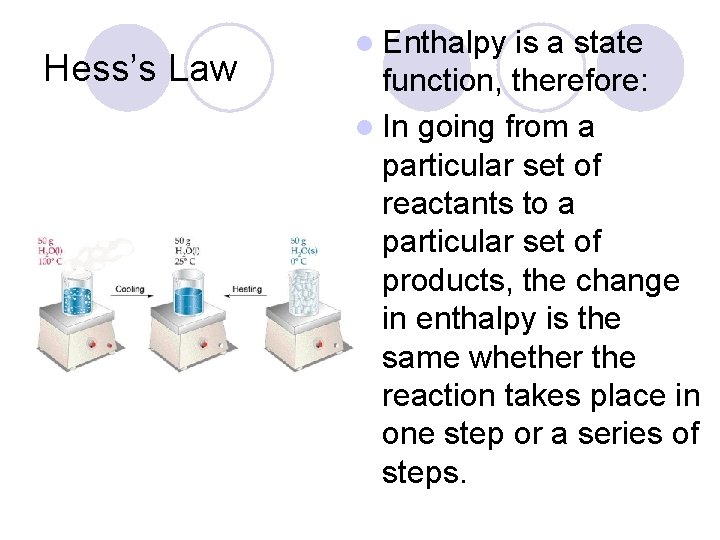
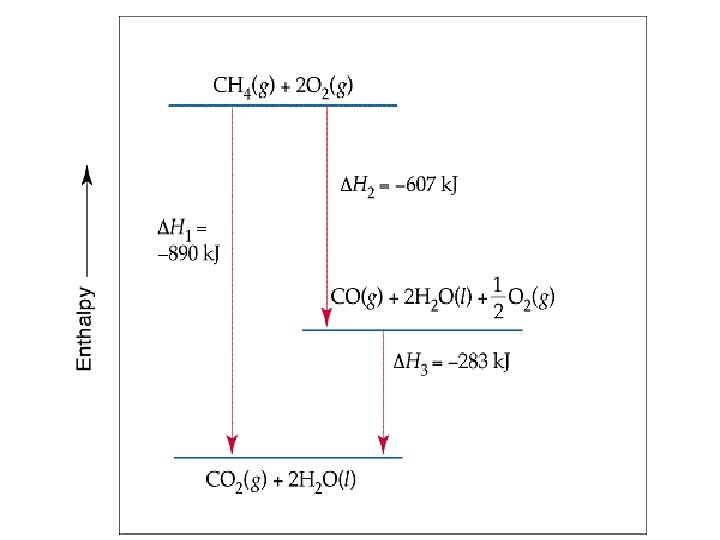
Hess’s Law l Enthalpy is a state function, therefore: l In going from a particular set of reactants to a particular set of products, the change in enthalpy is the same whether the reaction takes place in one step or a series of steps.
Since ΔH is a state function… l It doesn’t matter the route. In any reaction the change in enthalpy is the same whether the reaction takes place in one step or in a series of steps. l Therefore, one may sum up the enthalpies of a series of reaction just as one adds up a series of reactions. l But…, if the reaction is reversed, so is the sign of the enthalpy. l If the reaction is multiplied, so is the enthalpy.
Some ΔH’s cannot be measured in a Calorimeter: l Example: l C graphite C diamond l Yes this reaction is real!! l This cannot be measured directly. l Why? ? ?
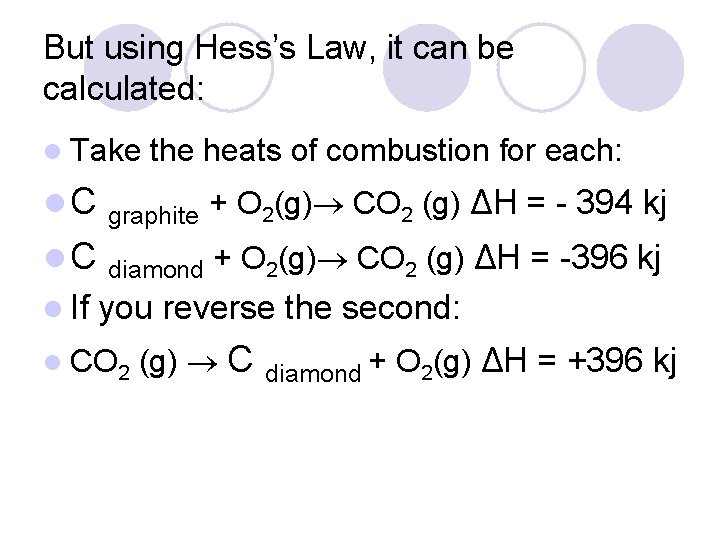
But using Hess’s Law, it can be calculated: l Take the heats of combustion for each: l C graphite + O 2(g) CO 2 (g) ΔH = - 394 kj l C diamond + O 2(g) CO 2 (g) ΔH = -396 kj l If you reverse the second: l CO 2 (g) C diamond + O 2(g) ΔH = +396 kj
Hess’s Law of Summation (g) C diamond + O 2(g) ΔH = +396 kj l C graphite + O 2(g) CO 2 (g) ΔH = -394 kj l Equals l C graphite C diamond ΔH = +2 kj l CO 2 l Is this reaction endothermic l or exothermic?
Worksheet!!!