
Herpes Viruses Prof Dr Asem Shehabi Faculty of
Herpes Viruses Prof. Dr. Asem Shehabi Faculty of Medicine University of Jordan
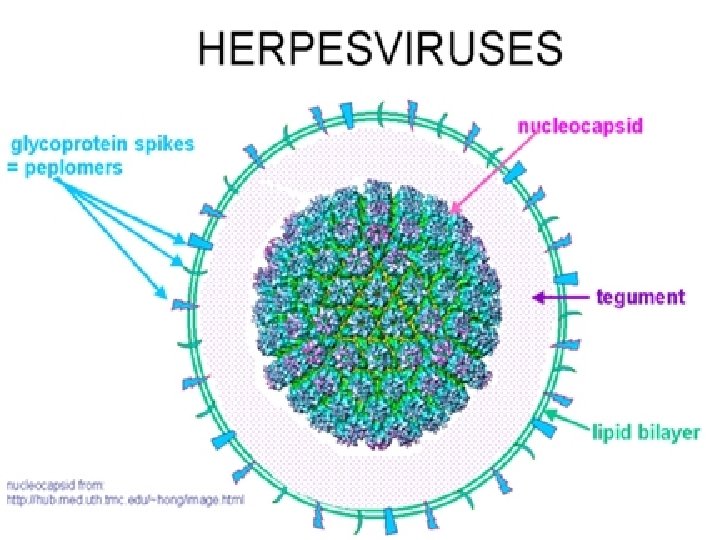
Classification-1 § Herpesviruses : All composed of large ds-linear DNA, amorphous protein layers(Tequment) attached to Capsid (162 capsomeres) & Lipid Envelope (11 Glycoproteins) spikes/peplomeres. § 8 Herpes groups: All Herpes viruses have ability to infect various types of host cells & replicate in them. § All are replicated in a similar multi-step process. . First Virus genome enter cellular cytoplasm. . transported to the cell nucleus. . Tegument proteins activate genes & viral structural proteins are expressed in nucleus. . Progeny virus released from membranes of both nucleus & cell membrane by budding. . accompanied mostly by cell lysis /death. Replication Herpesviruses is not always efficient with a high ratio of noninfectious viral particles.
Herpesviruse Groups § Latency: A unique characteristic of all Herpes viruses is their ability to establish latent infection. Each virus type has the potential to establish latency in specific host cells. § latent viral genome may be either extra-chromosomal DNA as Episome or direct integrated into DNA host cells. . Later any time can be reactivated & causing disease. § Alpha-herpesviruses: Herpes simplex virus (HSV-1, HSV-2). both are closely related with nearly 70 % genomic DNA homology. . only human infection. § Both types are characterized by an extremely short reproductive cycle (8 -16 hours), prompt destruction of the infected cell. . Ability to replicate in a wide variety of host tissues. . Causing nuclear inclusion bodies, multinucleate giant cells & mostly death of cells.
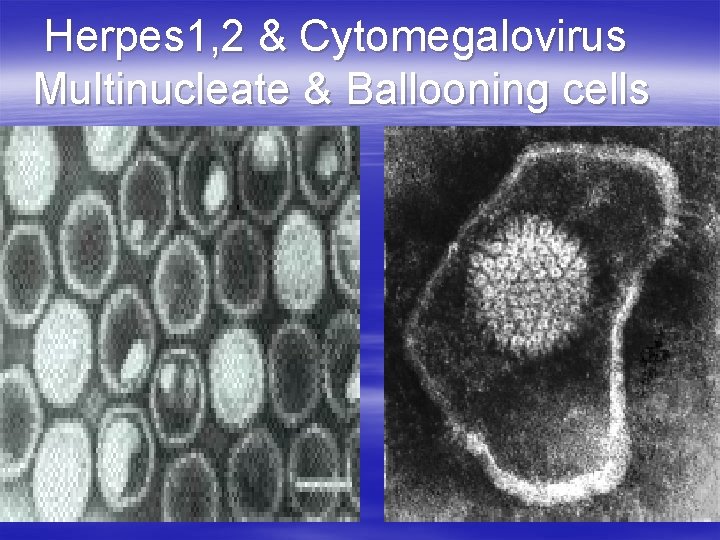
Herpes 1, 2 & Cytomegalovirus Multinucleate & Ballooning cells
Herpes simplex virus (1, 2) § Primary HSV-1: Mostly infect oral mucosa. . Rarely genital mucosa. . Transmitted by direct contact. . kissing , saliva , fingers. . 90% infects mouth & lips during early childhood. . May spread to Nose, Eye, Skin face, rarely reach blood & CNS of infants. § Vesicles eruption usually develop between 1 -3 days. . contain fluid , multinucleate cells, inclusion bodies. . Developing lesion/ulcer. . often associated with mild fever and cervical lymphadenopathy. . Herpes ulcer on skin ended with developing crusts after one week. § Oral lesions usually heal within 2 weeks. § Recurrence lesions remains mostly localized to the first site of inoculation. . mild -severe erythema, one or more vesicles/ulcers may occurs every few months or after years. . Long Live latent infection.
Latency HSV-1 § Latent HSV-1 DNA persists as free circular episomal form integrated into nucleus of the Orofacial trigeminal ganglia. . few genes expressed in latent stage & cause again infection on the same body site/ mostly oral mucosa § State of latency may persist for many months to years before reactivation. . 5% of infected Children. § Virus particles travel down the axon to infect nerve cell ending which supply skin or mucous membrane. . causing vesicles, ulcerations. § Virus Reactivation may be provoked by a number of stimuli: including sunlight, stress, febrile illnesses, trauma, menstruation, immunosuppression, Reactivation may be clinically asymptomatic/ symptomatic including rarely meningitis or Encephalitis.

HSV 1 and HSV 2 can establish latent infection in the sensory ganglia cells: Orofacial trigeminal ganglia or Genital sacral ganglia (1% neuron cells carry viral DNA) that supply the site of the primary infection. During Reactivation Virus travel via axon to infect nerve ending.
Common HSV-1 Diseases-1 § Mucocutaneous: junction of lips are the most common clinical manifestations of 99% primarily HSV-1 infection rarely HSV-2. § Gingivostomatitis: Cold sores/ Fever blisters. . followed by the development of vesicular & ulcerative lesions on the oralpharyngeal mucosa , Tongue. . characterized by fever, sore throat/ erythematic lesion. . caused mostly by HSV-1. . in children less than five years. § Herpetic stomatitis occurs in older children, young adults. . rarely may disseminate to blood & internal organs. § Recurrent HSV-1 infections mostly appear on the lips. . . Intraoral lesions/ Oropharynx are uncommon in the normal host found frequently with immunodeficiency
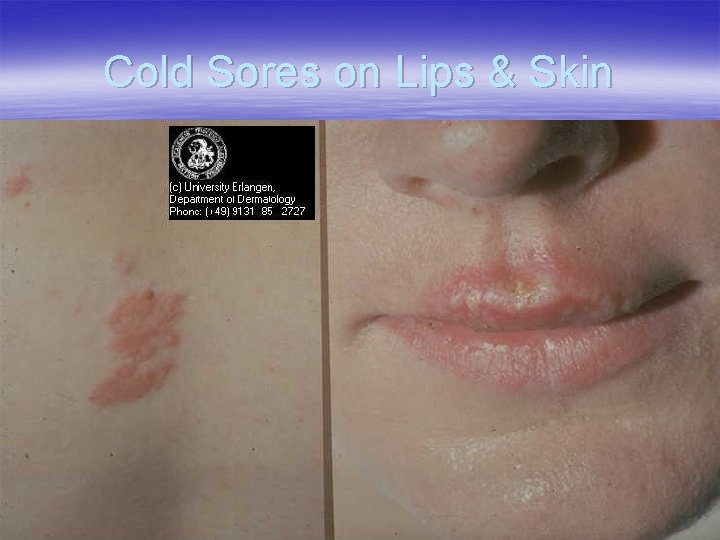
Cold Sores on Lips & Skin
Follow/2 § Herpes keratitis is usually caused by HSV-1 accompanied by keratoconjunctivitis. . corneal ulceration /scarring in many cases. . may result in vision loss without treatment. . Occurs mostly in old persons. § Skin manifestations: HSV-1 infections can manifest at any skin body site. . Common among health care workers. . lesions on skin of the Index finger & Thumb. . herpetic whitlow. . painful. . heals slowly within one month or more. § Eczema herpeticum can be severe. . mostly children. § Herpes encephalitis : mostly caused by HSV-1 . . characterized by hemorrhagic necrosis of temporal lobe in Brain. . Rare cases. . Highly fatal.
Immunity to Herpes-1, 2 § During first viral infection. . Natural Killer cells, cytotoxic T cells & helper T lymphocytes. . play a significant role to stop the virus multiplication. . § Specific antibodies & induced delayed hypersensitivity. . Both important in recovery. § Level of specific Antibodies (Ig. G) reduce the severity of infection. § Newborn baby normally protected against HSV-1 infection during first 6 months by maternal antibodies § Infection with HSV-2 protects against infection with HSV-1, but HSV-1 can only slightly prevent HSV-2 infection. § HSV-1& 2 infection may disseminate to blood, other organs causing serious diseases. . Aseptic meningitis & Encephalitis. in immunocompromised persons.
Genital Herpes § Genital herpes is caused mostly by HSV-2. . Recent § § § years increasing number of cases caused by HSV-1 or both at same time. . About 50% of genital infections are asymptomatic. . not recognized. . increased risk transmission with other Sexually transmitted diseases. Primary infection in women usually involves mucosa vulva, vagina, and cervix. . painful ulceration. . frequently associated with dysuria, urethritis, fever, vaginal discharge, regional lymphadenopathy. In men, initial infection is mostly associated with lesions on glans male organ & surrounding skin. . associated with fever, malaise, urethritis, regional lymphadenopathy Recurrent genital Herpes: Varies significantly. . Twothird cases have approximately 3 recurrences or more each year. . second attacks milder & shorter.
Neonatal Herpes Virus Infection § Neonatal herpes: Most cases caused by HSV-2. through infected mother. . contact of the fetus with maternal genital secretions/ genital ulceration at the time of delivery. § Neonatal HSV-1 infection mostly acquired by contact with infected person in hospital or family. § Manifestations of both neonatal herpes infection are divided into three categories: § 1 - Common conjunctivitis, mouth & skin lesions 2 - Rarely systemic infection. . Pneumonia, fever, poor feeding, jaundice & skin lesions. . Meningitis / Encephalitis. . high mortality. § Cesarean delivery is recommended in case mother has herpes
Diagnosis & Treatment of HSV-1, 2 § Tissue culture used in research & to detect resistant Herpesvirus strains. . § Rapid direct detection DNA HSV particles in vesicle fluid, blood, CSF, vaginal swabs by PCR. § Serology: Specific antibodies (Ig. G) are not always very useful because there is a high prevalence of herpes antibodies in the normal population. § A high antibodies titer for HSV-1/2 indicates acute infection by Enzyme immunoassay. § Treatment: Aciclovir /Valaciclovir should be given in early acute infection. . Inhibits viral DNA. . Topical, Oral, Intravenous drugs. . according the clinical case. . § Viral latency can’t be eradicated by treatment. . No Vaccine.
Varicella-Zoster virus § Classifided as Gamma Herpesvirus (HSV-3) has the most limited host cells infection. . replicate in lymphoid cells causing lytic effects in certain targeted cells. § Varicella-Zoster virus: Causing 2 clinical diseases: 1 -Chickenpox is primary acute infection occurs mostly young children 5 -10 years. . Spread by Respiratory droplets or skin contact. . infect mucosa Resp. Tract / conjunctive or both at the same time. § Varicella-zoster virus spread mostly through airborne droplet from RT. . Rarely through skin contact. Virus multiples first lymph tissues RT. . spread to blood & reticulo-endothelial system. . Following viraemia. . develop a characteristic vesicular skin rash, oral mucosal lesions, Mild fever. . Incubation 1 -2 weeks. §
2 / § Skin rash begins on the face, head, trunk and spreads to all body sites. The lesions are initially small vesicles, become pustular, crusting & healing within 10 days. § Serious complications are rarely seen in children. . More in young adult & compromised host. . § Secondary bacterial & viral infection. . Pneumonia, Myocarditis, Arthritis. Rarely affects CNS. § Neonatal/ Congential varicella. . Acute encephalitis may occur before or after delivery. . New borne babies of new infected mothers should be protected by Passive Immunization with immunoglobulin. § Latent virus infection can be demonstrated in human.
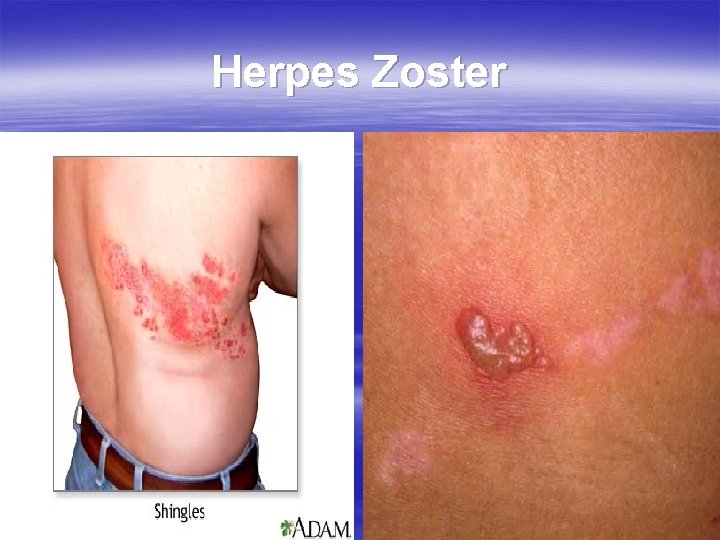
3/ § Immunity: Lack enough of cell-mediated immunity, Cytotoxic T cells & specific antibodies affect rapid skin healing and more associated with complications. § Generally most children & young adult who infected naturally develop enough antibodies against Varicellazoster virus. § All primary infection, varicella-zoster virus establish latency in nerve cell bodies, mostly dorsal root ganglia. . less in cranial nerve & lymphoid tissue 2 - Herpes zoster/shingles: This clinical feature is a reactivation of latent virus. . Virus travel along the spinal axon nerve. . affect one dermatome & skin area served by that nerve. . most skin vesicles appears as clusters on chest. § 1 -2% Persons over 50 year develop zoster
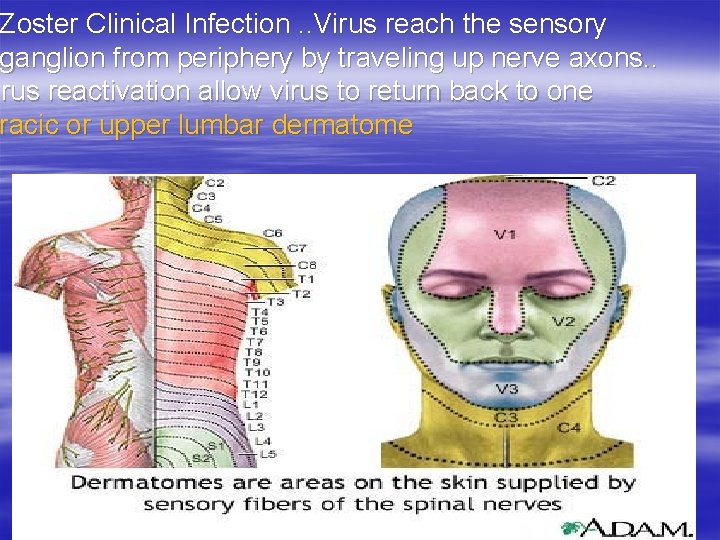
Zoster Clinical Infection. . Virus reach the sensory ganglion from periphery by traveling up nerve axons. . irus reactivation allow virus to return back to one racic or upper lumbar dermatome oracic or upper lumbar dermatome
Herpes Zoster
4/ § Typically Zoster manifests as a localized vesicular rash limited to thoracic or upper lumbar regions. . associated with erythema & burning sensation, itching followed development of clear vesicles & healing § Acute herpes zoster neuritis & postherpetic neuralgia very painful disease. . may be persist few weeks-months , complications may involve internal organs, lung & brain in immunocompromised. § Ocular zoster affects ophthalmic trigeminal nerve. . associated with 25% Zoster cases. . corneal ulceration, keratitis , scarring & blindness. § The average time to healing for shingles ranges from 2 -4 weeks. . depending upon the age and immune status of the person. . Total specific antibodies. . Early oral or intravenous Aciclovir reduce the severity of infection. . Available vaccine protects to some extent.
Epstein-Barr Virus § HSV 4 (EBV): EBV) Infect & replicate in two major cell types: the outer oropharyngeal epithelial cells of the salivary gland & B lymphocytes (B-cells). . Human host. § EBV produces about 100 different large glycoproteins during the active phase of the viral replication, Infection develops first in the salivary gland. . Large amounts of the virus released in the saliva for Few weeks. . Highly infectious for close contact. § latent infection persist in memorial B lymphocytes, Most people become infected during their childhood. Infants become susceptible to EBV as soon as maternal antibody protection disappears. § Most EBV infection in children are usually asymptomatic or with symptomatic with Mild Respt. tract illnesses. . sore throat, fever, enlargement of regional lymph nodes for few days.
2/ § Asymptomatic infection increased with immunosuppresion. . Infection of B-cells causes them to proliferate as atypical Lymphocytes. . Can be detected in blood. . Lack of immune response of both humoral & cellular represents a high risk of developing a form of cancer. § Latent infection may develop autoimmune disease. . Latent infection Rheumatoid arthritis, multiple sclerosis. § Infectious mononucleosis/ glandular fever is most common clinical disease associated with EBV. § Occurs commonly in Young Adults. . Mild to sever forms. . Most symptoms are fever, sore throat, and swollen lymph glands. . Less a swollen spleen or liver. § Common clinical features: myalgia, pharyngitis, cervical adenopathy, atypical lymphocytosis, oral Hairy Leucoplakia. . white lesions on cheek mucosa & sides of tongue. . Common in AIDS patients
3/ Other Diseases of EBV § T cell lymphoma, Immunoplastic lymphoma. . infected B lymphocytes. . Hodgkin’s disease is second common EB disease. . Develop mostly in highly immunodeficient individuals. . affects heart & bone marrow / common in organ transplant patients. § Burkitt’s Lymphoma. . Tumor of Jaw. . develop African Children & Adults. § Nasopharyngeal Carcinoma. . Long Latent EBV infection associated with undifferentiated nasopharyngeal epithelium. . Affects mostly males of Chinese Origin. . Rare in other countries. § Lab Diagnosis: Saliva/throat washing/ blood , presence atypical B-lymphocytes, heterophile antibodies. Detection Type-specific antibodies (Ig. A, Ig. G, Ig. M) or nuclear /capsid antigens by PCR. . Aciclovir treatment. . No vaccine
Human Cytomegalovirus § Beta-herpesviruses: HSV-5 / CMV many genotypes Has a large genome. . slow growth in infected tissues (4 -8 weeks). § HSV-5 replicate in epithelial cells Respiratory Tract, salivary glands, Kidney causing Endothial multinucleate giant cells. § CMV endemic throughout the world. . Generally Infection occurs in most children. . More common in developing countries with lower hygiene & socioeconomic conditions. § CMV. . Spread orally by close contact with body fluids. . urine, saliva, breast milk, blood, tears, semen, and vaginal fluids. .
2/CMV § During acute & latent CMV infection. . Virus shed mainly in saliva & urine. . For weeks-years. § CMV remains stable for few days outside the body. . persist life-long in host mononuclear cells. . At the same time in various tissues (kidney, liver, lung). . § Latent infection stage is often associated with kidney tissues more than other body organs § Recurrence may follow reactivation of latent virus or due to infection with new strain. § Congenital CMV. . Primary intrauterine infection. . Mostly asymptomatic. . Few may develop serious. . symptomatic disease. . Cytomegalic Inclusion body disease. . Associate with Brain defects. . Mental retardation Down syndrome, Hearing & Vision loss, Gastrointestinal disorder.
3/ § New born babies acquired CMV infection. . developing permanent disabilities. . Each year about 100, 000 cases worldwide. § In healthy persons primary infection persist 4 -6 weeks often asymptomatic. § Immunity: Host response associated with develop Ig. M, Ig. G, T cell. . cell mediated immunity. . important to control CMV infection. § Lack of sufficient immunoresponse can cause serious illness in immuno-compromised patients. . Retinitis, Pneumonitis, Colitis, Hepatitis, Encephalitis, Pancreatitis. § CMV infection cause secondary increases microbial opportunistic infections immunosuppressed.
4/ § Primary CMV infection in patients may weakened immune systems can lead to serious disease. . including organ transplant recipients, hemodiaylsis, immunosuppressive drugs, Cancer patients. § CMV is the most common viral opportunistic infection after bone marrow / organ transplantation. . Mortality rate may reach 90% if it is left untreated. § CMV infection in infant / children/young adults. . begins with signs and symptoms of fever, malaise, leukopenia . . rarely mononucleosis. § Invasive disease. . Blood sepsis. . spread into many organs. . CMV has mutagenic effects. . A possible role in oncogenesis. § Sexual transmission. . is common & asymptomatic in healthy persons.
5/ § Diagnosis: A newborn has congenital CMV infection if the virus is found in urine, saliva, or blood during the first 3 weeks after birth. § Antigen Detection by TORCH Test: Examination blood & urine for Toxoplasma, Rubella, CMV, HSV-2. . § Ig. M antibodies indicate recent Infection. . Ig. G antibodies old infection. § Virus DNA can be detected by PCR § Ganciclovir treatment. . Suppress DNA virus multiplication. . Early treatment may prevent hearing loss in infants born with congenital CMV. . § Available vaccine protective up to 90%.
Human Herpesvirus 6 and 7 § Human herpesvirus 6 and 7 classified as a gamma herpesvirus infect CD 4 T cells. . Can be found in blood of patients with Lymphoma. . Both are related genetically to CMV. . Infect Human, animals § HSV-6, more than -7 cause Rosella Infants disease/ Roseola infantum. . Common among 6 months- 3 years children. . illness is characterized by 1 - 5 days of fever, respiratory illness, cervical lymphadenopathy, macular rash mostly on face. . Rare neurological complications or hepatitis. § Early children infection starts in family through close contact with oropharyngeal secretions & Saliva. . mostly asymptomatic § HSV -6 may cause infection adult patients. . Hepatitis, central nervous system. . Results in rejection of transplanted kidneys. . No viral treatmentt, No vaccine
2/ § Herpesvirus-8 : Causes Kaposi's Sarcoma. . KS Virus is partially homologous to the DNA of EBV. . affects endothelial cells of vascular and lymph origin. . transmitted by sexual route. . less blood. § Sarcoma is a cancer that develops in connective tissues. . fibrous tissues below the skin surface, mucous membranes of the mouth, nose, anus. . Common in AIDS patients & Homosexual persons. . Highly mortality § Sarcoma cutaneous lesions spread at multiple body sites. . with or without internal organ involvement. . oral cavity, gastrointestinal tract, lymph nodes. § HV 8 has been found in patients with B cell Lymphoma with AIDS. . Most KS cases developed in association with (HIV) infection. . Surgical treatment, Cryotherapy, Radiotherapy, Topical immunotherapy, Ganciclovir
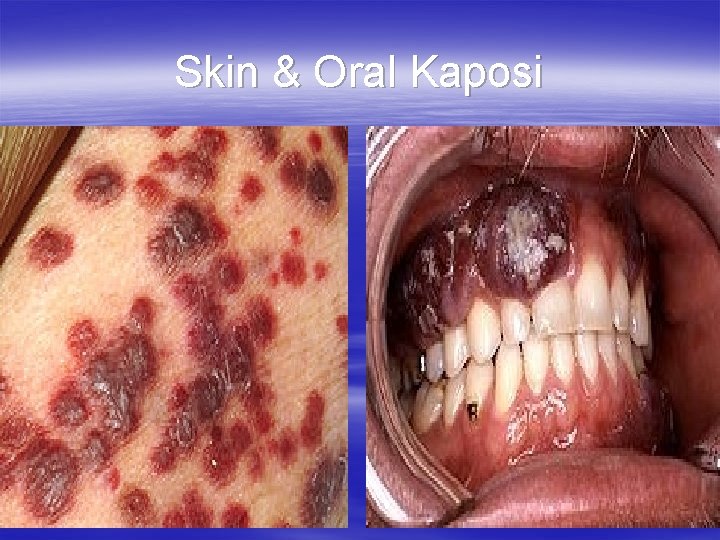
Skin & Oral Kaposi
- Slides: 32