
Herpes Viruses Dr Sara Asser Lecturer of Microbiology
Herpes Viruses Dr. Sara Asser Lecturer of Microbiology

Common properties of Herpes Viruses • Large, ds DNA, enveloped with icosahedral symmetry Copyright © 2004 Pearson Education, Inc. publishing as Benjamin Cummings

Common properties of Herpes Viruses • Easily isolated in cell culture producing giant cells and intranuclear inclusion bodies (except EBV). Copyright © 2004 Pearson Education, Inc. publishing as Benjamin Cummings
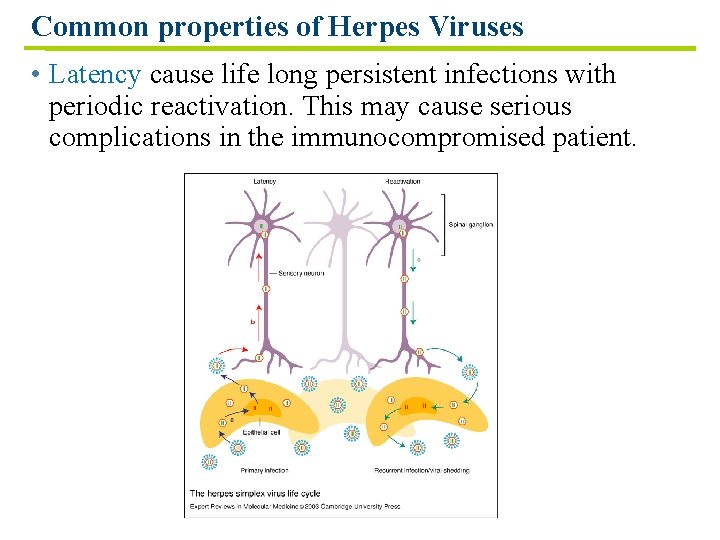
Common properties of Herpes Viruses • Latency cause life long persistent infections with periodic reactivation. This may cause serious complications in the immunocompromised patient. Copyright © 2004 Pearson Education, Inc. publishing as Benjamin Cummings

Classification of Herpesviridae Subfamily of Herpes Virinae Human Herpes Virus Common name Alpha 1 2 3 Beta 5 6 7 Herpes Simplex Virus type 1 (HSV-1) Herpes Simplex Virus type 2 (HSV 2) Varicella Zoster Virus (VZV) Cytomegalovirus (CMV) Human Herpes Virus-6 (HHV-6) Human Herpes Virus-7 (HHV-7) Gamma 4 8 Epstein-Barr Virus (EBV) Kaposi’s sarcoma-associated herpes virus (KSHV) Copyright © 2004 Pearson Education, Inc. publishing as Benjamin Cummings

Varicella-Zoster Virus Infections • Commonly referred to as VZV • Causes two diseases • Varicella • Is the primary disease • Often called chicken pox: generalized vesicular eruption of the skin and m. m. • Typically occurs in children • Herpes zoster • Is the recurrent form • Also called shingles • Usually occurs in adults and immunocompromised Copyright © 2004 Pearson Education, Inc. publishing as Benjamin Cummings
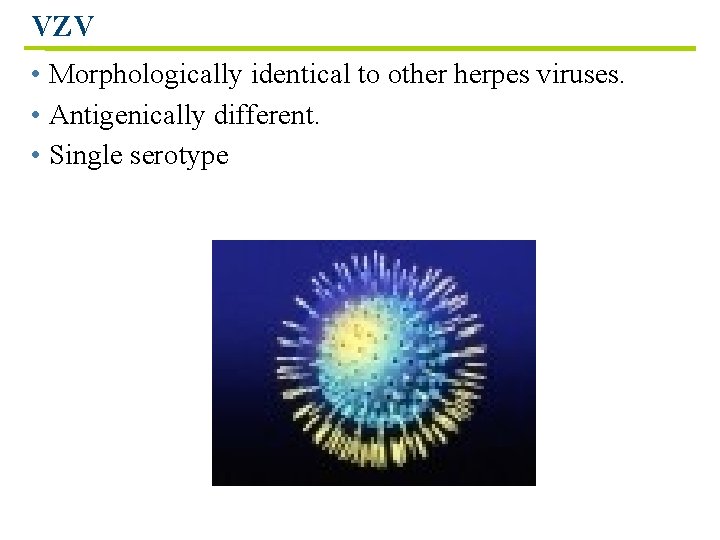
VZV • Morphologically identical to other herpes viruses. • Antigenically different. • Single serotype Copyright © 2004 Pearson Education, Inc. publishing as Benjamin Cummings
Transmission and Epidemiology of VZV Infections • Chickenpox is a highly contagious disease seen most often in children • Viruses enter through the respiratory tract and the eyes: • Respiratory droplets. • Direct contact with lesions. Copyright © 2004 Pearson Education, Inc. publishing as Benjamin Cummings
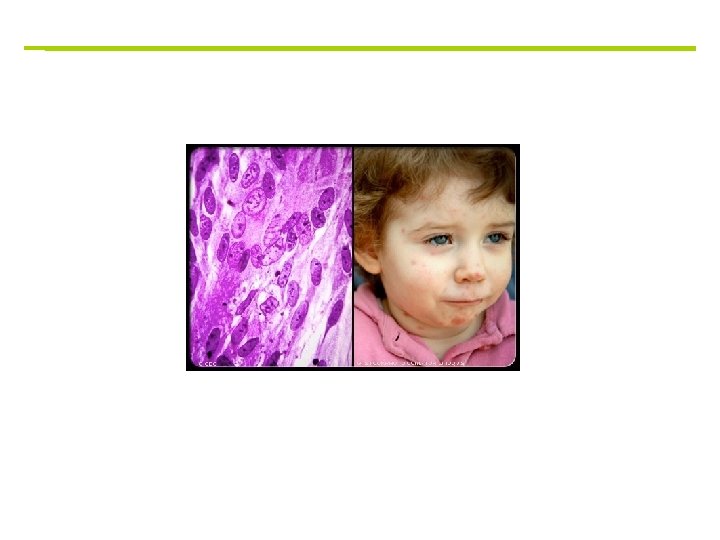
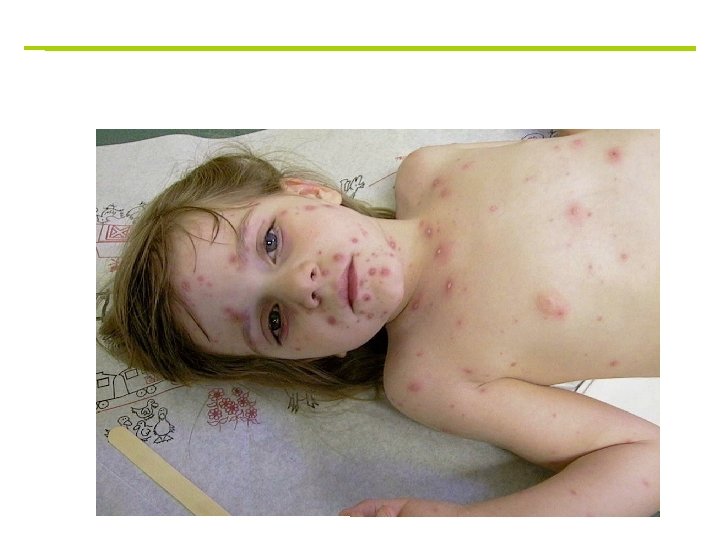
Pathogenesis and Immunity of VZV Infections • Virus infects the mucosa of the URT or conjunctiva. • It replicates in regional LNs. • Then travels via the blood throughout the body and to the skin (typical vesicular rash) • Swelling of epithelial cells, ballooning and degeneration with accumulation of tissue fluid result in vesicle formation. • Characteristic skin lesions appear 2 -3 weeks after infection • Immunity to varicella is lifelong, but zoster can occur (one serotype) Copyright © 2004 Pearson Education, Inc. publishing as Benjamin Cummings
Copyright © 2004 Pearson Education, Inc. publishing as Benjamin Cummings
Copyright © 2004 Pearson Education, Inc. publishing as Benjamin Cummings
Pathogenesis of VZV Infections • After recovery, the virus becomes latent in the dorsal root ganglia • Latent virus can reactivate producing a rash known as shingles • The rash is characteristic for its localization along a dermatome • Activation can occur due to reduced cell mediated immunity or local trauma Copyright © 2004 Pearson Education, Inc. publishing as Benjamin Cummings
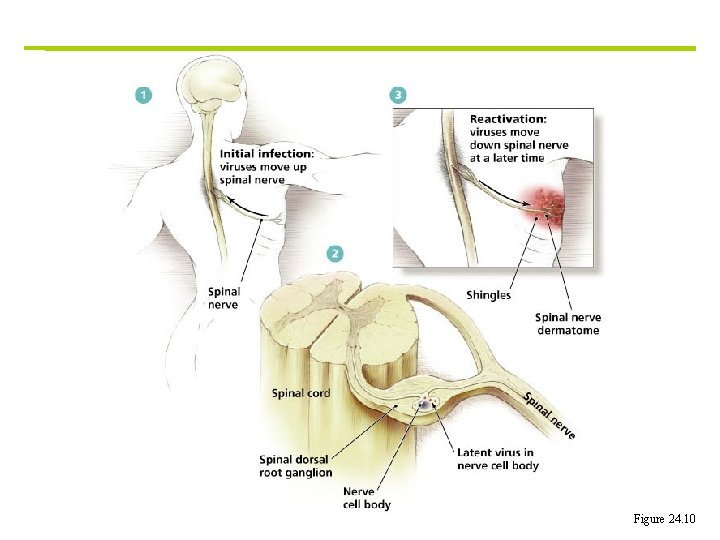
Copyright © 2004 Pearson Education, Inc. publishing as Benjamin Cummings Figure 24. 10
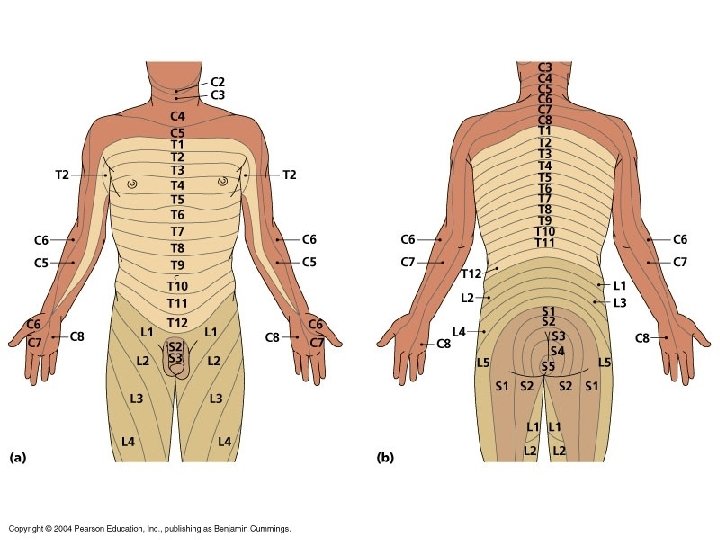
Copyright © 2004 Pearson Education, Inc. publishing as Benjamin Cummings
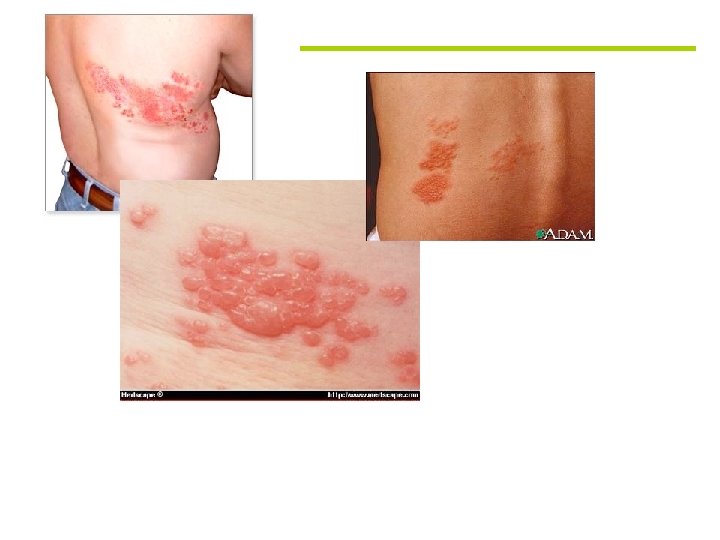
Copyright © 2004 Pearson Education, Inc. publishing as Benjamin Cummings
Clinical Features of Varicella • Incubation period 10 -21 days • Prodrome is brief (fever, malaise) • Papulovesicular rash in crops (lasting for 5 days) • Macules • Papules • Vesicles • Crusts • Rare complications: • Varicella pneumonia • Encephalitis Copyright © 2004 Pearson Education, Inc. publishing as Benjamin Cummings
Clinical Features of Zoster • Sporadic disease of adult patient or immunocompromised • Starts with severe pain in an area innervated by a single dorsal root ganglion • Vesicular rash along the course of a spinal nerve (similar to varicella) • Most common complication: • Post-herpetic neuralgia Copyright © 2004 Pearson Education, Inc. publishing as Benjamin Cummings
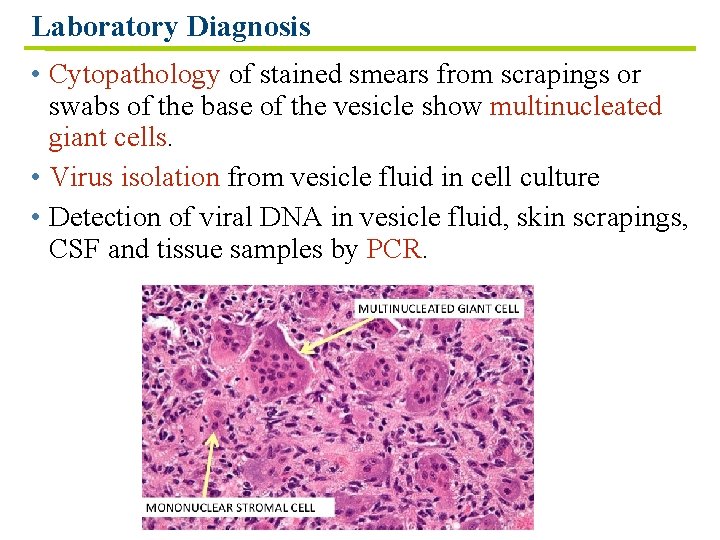
Laboratory Diagnosis • Cytopathology of stained smears from scrapings or swabs of the base of the vesicle show multinucleated giant cells. • Virus isolation from vesicle fluid in cell culture • Detection of viral DNA in vesicle fluid, skin scrapings, CSF and tissue samples by PCR. Copyright © 2004 Pearson Education, Inc. publishing as Benjamin Cummings
Treatment • Chickenpox is usually self-limiting • No antiviral therapy is necessary • Systemic disease in immunocompromised patients treated with acyclovir or valacyclovir • Shingles treatment involves management of the symptoms and bed rest Copyright © 2004 Pearson Education, Inc. publishing as Benjamin Cummings
Prevention • Live attenuated VZV propagated in human diploid cell culture. A single dose is effective at inducing protection from varicella in children. • A herpes zoster (shingles) vaccine was licensed in 2006 in the US. It is a more potent version of varicella vaccine and was shown to reduce the frequency of zoster and the severity of the disease. Copyright © 2004 Pearson Education, Inc. publishing as Benjamin Cummings
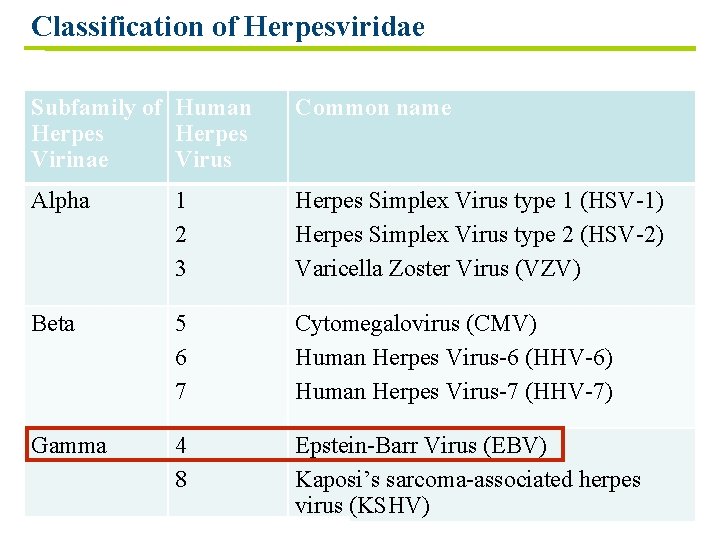
Classification of Herpesviridae Subfamily of Human Herpes Virinae Virus Common name Alpha 1 2 3 Herpes Simplex Virus type 1 (HSV-1) Herpes Simplex Virus type 2 (HSV-2) Varicella Zoster Virus (VZV) Beta 5 6 7 Cytomegalovirus (CMV) Human Herpes Virus-6 (HHV-6) Human Herpes Virus-7 (HHV-7) Gamma 4 8 Epstein-Barr Virus (EBV) Kaposi’s sarcoma-associated herpes virus (KSHV) Copyright © 2004 Pearson Education, Inc. publishing as Benjamin Cummings
Epstein-Barr Virus Infections • Also referred to as EBV • Can cause a number of different diseases • it is the agent of infectious mononucleosis (glandular fever). • It is associated with Burkitt’s lymphoma, other B cell lymphomas and nasopharyngeal carcinoma. Copyright © 2004 Pearson Education, Inc. publishing as Benjamin Cummings
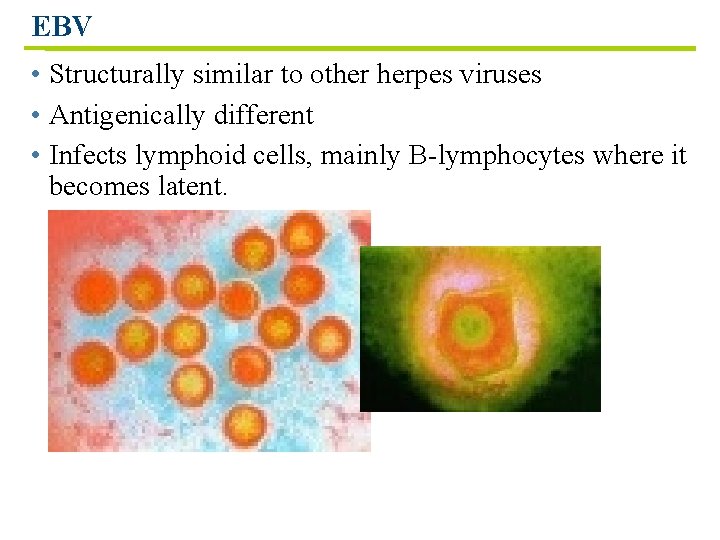
EBV • Structurally similar to other herpes viruses • Antigenically different • Infects lymphoid cells, mainly B-lymphocytes where it becomes latent. Copyright © 2004 Pearson Education, Inc. publishing as Benjamin Cummings
Epidemiology and Transmission • Transmission of EBV usually occurs via saliva • Very common worldwide • Asymptomatic in young children • Later in life, symptomatic infections more common Copyright © 2004 Pearson Education, Inc. publishing as Benjamin Cummings
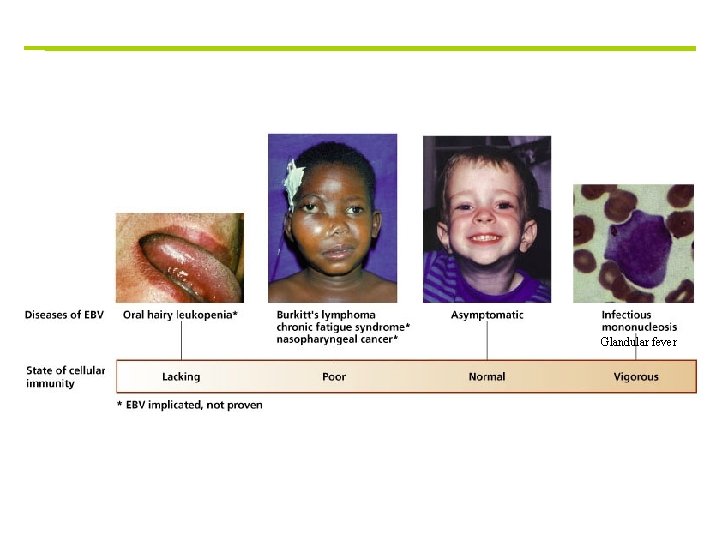
Glandular fever Copyright © 2004 Pearson Education, Inc. publishing as Benjamin Cummings
Pathogenesis of EBV Infections • Virions initially infect epithelial & lymphoid cells of the oropharynx • Infected B lymphocytes spread the infection from oropharynx throughout the body. • T cells react against infected B lymphocytes (giving “atypical lymphocytes” in the blood smear) • Heterophile refers to Abs detected by tests using Ags different from Ags that induced them. • Heterophile Abs formed in infectious mononucleosis agglutinate sheep or horse RBCs. They disappear within 6 months after recovery. Copyright © 2004 Pearson Education, Inc. publishing as Benjamin Cummings
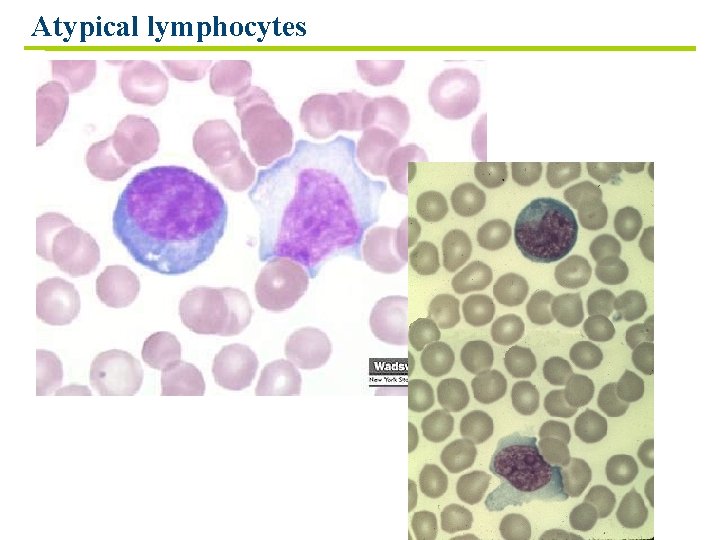
Atypical lymphocytes Copyright © 2004 Pearson Education, Inc. publishing as Benjamin Cummings
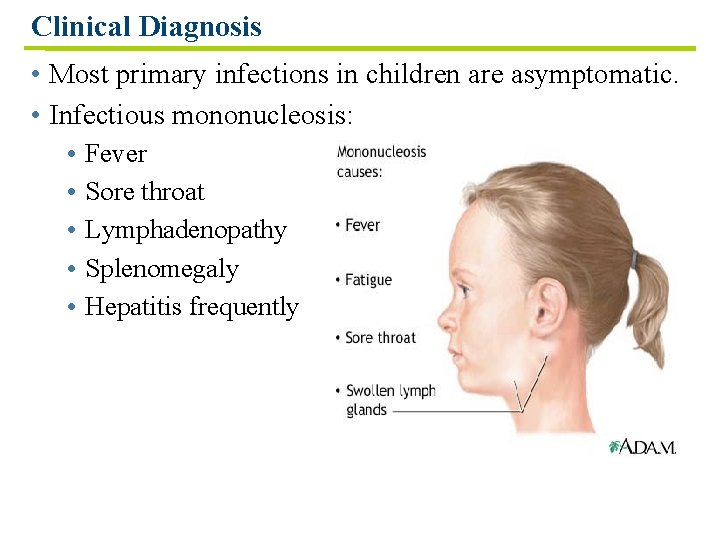
Clinical Diagnosis • Most primary infections in children are asymptomatic. • Infectious mononucleosis: • Fever • Sore throat • Lymphadenopathy • Splenomegaly • Hepatitis frequently Copyright © 2004 Pearson Education, Inc. publishing as Benjamin Cummings
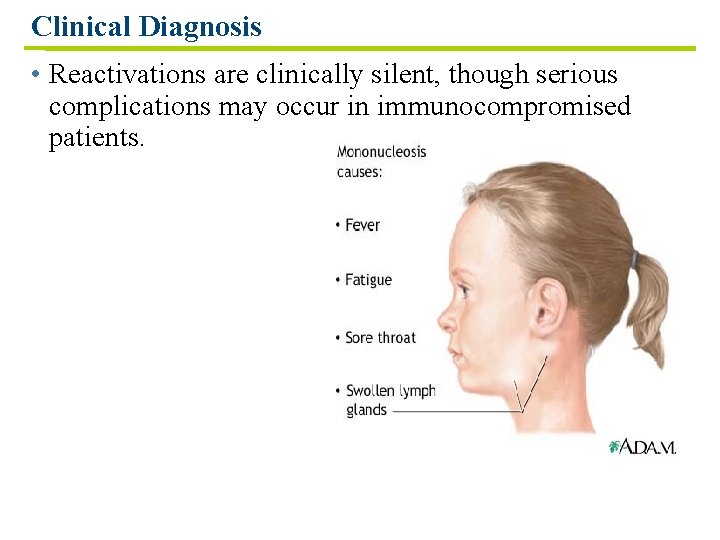
Clinical Diagnosis • Reactivations are clinically silent, though serious complications may occur in immunocompromised patients. Copyright © 2004 Pearson Education, Inc. publishing as Benjamin Cummings
Lab Diagnosis • Large, atypical lymphocytes in blood smear (glandular fever cells) • Direct detection of EBV DNA by PCR or nucleic acid probes: most sensitive • Serology: • Specific EBV antibodies: Ig. M (to detect early illness), Ig. G (to detect previous infection) • Non- specific Heterophile antibodies: this is useful for the early diagnosis of infectious mononucleosis. (disappear 6 months after recovery): Monospot test (a slide test) Copyright © 2004 Pearson Education, Inc. publishing as Benjamin Cummings
Treatment • Symptomatic • No vaccine • No proven benefit of Acyclovir. Copyright © 2004 Pearson Education, Inc. publishing as Benjamin Cummings
THANK YOU
- Slides: 32