
Heroes by Robert Cormier A Knowledge Organiser Characters

‘Heroes’ by Robert Cormier: A Knowledge Organiser Characters Francis Cassavant Protagonist and narrator. He battles with the idea of being a hero. Loves Nicole but fails to protect her from Larry. Sustains horrific injuries at war. Seeks revenge on Larry La. Salle. Introverted, romantic, solitary, emasculated, vengeful, selfloathing, self-depreciating, damaged, tortured, cowardly, vulnerable, helpless Larry La. Salle A local hero who is loved and respected by the people of Frenchtown. Earns a Silver Star in combat but returns on leave and rapes Nicole. Kills himself when confronted by Francis. Charismatic, admired, revered, enigmatic, mysterious, teacher, abuser, predatory, dualistic, ambiguous, remorseless, deceptive, sinister Nicole Renard Francis’ childhood sweetheart who is cruelly singled out and raped by Larry La. Salle. She becomes a recluse and moves away from Frenchtown. Innocent, saintly, solitary, optimistic, vulnerable, violated, abused, victimised, suffering, strong, defiant, feminist Arthur Rivier War veteran. He recognises Francis in Frenchtown. Suffers from PTSD. Damaged, traumatised, scared, pessimistic, angry, betrayed, realist, haunted Mrs. Belander - Francis’ landlady in Frenchtown Enrico Rucelli - Spent time with Francis in hospital Joey Le. Blanc - Francis’ school friend in Frenchtown Dr Abrams – The doctor who treats Francis’ injuries Marie La Croix – Francis’ neighbour and friends with Nicole The Nuns – The teachers at the Roman Catholic school Plot 1 -3 After being badly injured at war, Francis Cassavant returns to Frenchtown with severe facial injuries. He covers his face to avoid recognition and carries a gun with which he intends to commit murder. Francis is haunted by his first meeting with Nicole Renard and his immediate attraction to her and visits the place she used to live. The horror of his wartime experiences returns to him in his dreams. 4 -5 Francis talks to Arthur Rivier in St Jude’s bar. He keeps his identity a secret. Unlike him, the other veterans are optimistic about the future. Francis visits the Wreck Centre. Larry La. Salle is introduced. He is presented as a leader and teacher who becomes an inspiration to the children of Frenchtown. An air of mystery surrounds Larry; this is the man Francis plans to kill. 6 -10 The veterans at St Jude’s talk about Larry La. Salle’s bravery at war. Arthur Rivier recognises Francis’ voice but agrees to keep his identity a secret. Francis recalls the time that he became a table tennis champion. In a flashback, we see the development of Francis and Nicole’s relationship. A newsreel clip shows Larry celebrated as a hero. Significant Aspects of Writer’s Craft Narrative Style First person narration, told through the voice of the protagonist Francis Cassavant. Sentences are varied for purposes of description and drama. Cormier’s biggest asset is perhaps the richness of his language – his use of description and symbolism not only provide detail to events and characters but firmly anchors key themes throughout the text. Narrative Structure Unconventional, non-chronological structure presented in present tense and flashbacks. Cormier’s choice of form builds tension as the information is revealed much more slowly to the reader. Metafictional text – we are reading the novel that Francis is planning to write at the end. Symbolism Francis’ scarf Symbolic of Francis’ need to hide his identity, both publically and personally. It is a disguise, symbolising his shame, guilt and desire for anonymity. It is a reminder of the consequences of war and the ambiguity of heroism. The duffel bag Might be viewed as a physical symbol of Francis’ emotional burden. The gun he carries is a constant reminder of self-loathing, sin and guilt. The carries it around with him like a disease (a “tumour”) by way of self-inflicted punishment. Table Tennis Symbolic of Larry’s manipulation and game-playing; he exerts power over Francis in a way that defies public perception. Representative of Francis’ flawed heroism. Wreck Centre A place of bad luck and tragedy. Its chequered history forebodes how Francis and Nicole’s lives are wrecked by Larry La. Salle. This location symbolises the best and worst of times for the characters. References and Allusions Fred Astaire An American dancer, singer and actor whose hugely successful career spanned a total of 76 years. The Hunchback of Notre Dame A French Gothic novel by Victor Hugo. The protagonist, a mute and blind hunchback, rarely ventures outside, since people despise and shun him for his appearance. The Great Gatsby is a great literary ‘hero’ with a complex psychology, who is ready to shift the boundaries between RIGHT AND WRONG in order to pursue an idealised romantic love. Ernest Hemingway asserted that men should live by a code – one which bound them to act within a set of personal values – integrity, courage, dignity, loyalty etc. rather than expect rely on notions of natural justice and equality to right wrongs. The Pied Piper The Piped Piper of Hamelin is a German folk tale. The piper is a rat-catcher, hired by the town to lure rats away with his magic pipe. When the citizens refuse to pay for this service, he retaliates by using his instrument's magical power on their children, leading them away as he had the rats. The Fall of Man The biblical story of how Adam and Eve lost their innocence. Genesis says that Adam and Eve ate from the Tree of Knowledge even after God told them it was not allowed, after being tempted by the words of serpent. Adam and Eve lost their innocence and were thrown out of the Garden of Eden. In Christian religion, all of man lost their innocence because Adam and Eve disobeyed God and had to be punished, so man can now tell good from bad and life from death. 11 -12 The flashback to wartime Frenchtown continues. Larry La. Salle returns on furlough and rapes Nicole Renard after the celebration party held in his honour. Francis overhears the attack but is too frightened to stop it. Francis’ guilt leads him to visit Nicole, but she blames him for not trying to help her. Francis considers suicide but instead lies about his age and enlists in the army. 13 -14 Back in the present day, Francis discovers that Larry has returned to Frenchtown. He visits his home intending to kill him in revenge for what he did to Nicole. Larry admits to his actions and tells Francis to go; he has already made plans to kill himself. After Francis leaves, Larry commits suicide. 15 -17 Francis visits Nicole, seeking her forgiveness and to tell her of Larry’s death. It is clear that their relationship will not be rekindled. Francis considers his options for the future, which include writing a book. Carrying his bag containing the gun which he bought to Frenchtown with him to kill Larry, he boards a train. Key concepts and context: Think about… Depression Many of the flashbacks in the novel refer to the Great Depression which was an effect of the Wall Street Crash of 1929. Many families then were poor and underfed. in 1932, Franklin Roosevelt was elected. He began the New Deal, which aimed to solve some of the problems within the country, such as unemployment. One of the schemes was for the government to employ people, like the people who renovate the 'Wreck Centre‘. Second World War On 7 December 1941, the Japanese Empire carried out through the attack on Pearl Harbour, a Hawaiian island. The US then came into the Second World War taking them out of the policy of isolationism. Fighting occurs both in Europe, where Francis is deployed, and in the Pacific. The novel explores the effects of Pearl Harbour on Frenchtown, as the Wreck Centre closes because of Larry's absence. Many men are recruited to the armed forces, and women are given service jobs in the local factories to make products for the war effort The GI Bill is mentioned in the text in regards to the later plans of the veterans, which they discuss in the St Jude Club. Joe La. Fontaine speaks about how the government would be willing to pay for his college education and intends to become a teacher. However, the positive outlook is shown to be false, as the veterans are later presented as pessimistic people, especially Arthur Rivier, who struggles to cope with not talking about the war. Frenchtown is a section of the small town of Monument where the French Canadians have settled. Robert Cormier has based this town on a place where he lived for much of his life, renaming his hometown of Leominster (Massachusetts) as Monument. Frenchtown represents the suburb of French Hill in the town. Heroism (masculinity) The question of what makes a hero is asked all the way through the novel. All of the male role models in young Francis’ life are stereotypically masculine; Francis finds his hero in Larry La. Salle. But what does one have to do to be a hero? Francis aspires to be a hero to Nicole, only to fail her when needed most. Larry betrays his heroic status. And what of the veterans in St Judes – “the boys of Frenchtown”? Are there any real heroes in the novel? War and Conflict How important is the war time setting to the novel? While on the lookout for a foreign enemy, Frenchtown is attacked by the enemy within. The war provides Larry with the status to mask his predatory traits. Francis’ war wounds reinforce his anonymity. Nicole is a silent victim of the war. Francis and the veterans expose the realities of war in graphic detail. Trust, Betrayal and Revenge Francis trusts Larry, who betrays him repeatedly throughout the novel. Larry abuses the trust of those to adore him when he attacks Nicole. Francis’ quest for atonement/ retribution is the driving force of the narrative. But who is he seeking revenge from – Larry or himself? Guilt, Shame, Forgiveness Which actions in the novel are shameful? Francis feels shame for allowing Nicole to be attacked. He also considers the shame that his suicide would bring on his family name. Nicole’s unmerited shame drives her to become a recluse and ultimately leave Frenchtown. Larry feels no shame for his actions, only for his inability to continue with his predatory ways. Innocence and Childhood Both Francis and Nicole have their innocence stolen by Larry La. Salle. Francis revisits this theme through his accounts of war; he describes killing two German soldiers barely old enough to shave and considers himself and his friends to be merely “boys in uniform”. Nicole becomes a recluse and is living a sedentary life when we meet her again at the end. Religion and Sin Religious imagery is deeply ingrained in the novel. Francis compares Nicole to St. Therese to signify her purity. He introduces us to Larry when he prays for him in at start and is chastised by his religion when he considers suicide. Larry is presented as an omniscient and godly figure, yet shrouded by serpentine imagery linking him to sin. Concealment and Revealment Identity and anonymity, appearance and reality are important themes. Francis appears to be a hero, yet he is not. He conceals his identity to separate himself from his former and future actions. Larry appears to be a good man, yet he is revealed to be a monster. Behind the good looks and charisma, he hides a sinister and dangerous nature.
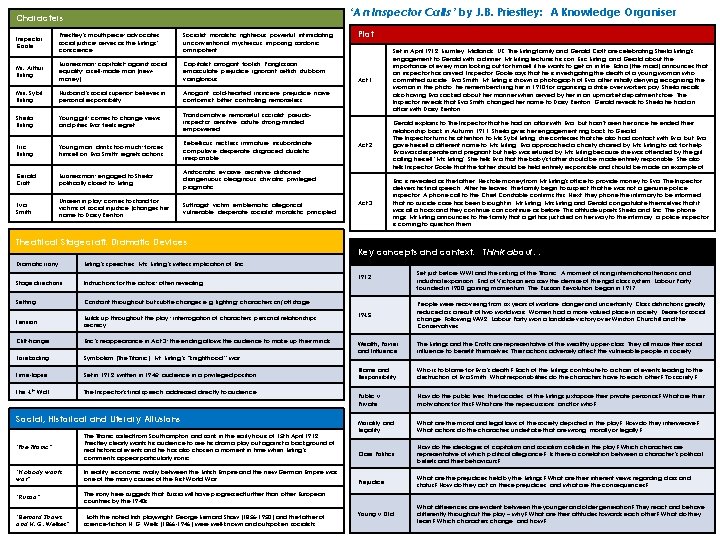
‘An Inspector Calls ’ by J. B. Priestley: A Knowledge Organiser Characters Inspector Goole Priestley’s mouthpiece; advocates social justice; serves as the Birlings’ conscience Socialist, moralistic, righteous, powerful, intimidating, unconventional, mysterious, imposing, sardonic, omnipotent Mr. Arthur Birling Businessman; capitalist; against social equality; a self-made man (newmoney) Capitalist, arrogant, foolish, Panglossian, emasculate, prejudice, ignorant, selfish, stubborn, vainglorious Mrs. Sybil Birling Husband’s social superior; believes in personal responsibility Arrogant, cold-hearted, insincere, prejudice, naïve, conformist, bitter, controlling, remorseless Sheila Birling Young girl; comes to change views and pities Eva; feels regret Transformative, remorseful, socialist, pseudoinspector, sensitive, astute, strong-minded, empowered Eric Birling Young man, drinks too much; forces himself on Eva Smith; regrets actions Rebellious, reckless, immature, insubordinate, compulsive, desperate, disgraced, dualistic, irresponsible Gerald Croft Businessman; engaged to Sheila; politically closest to Birling Aristocratic, evasive, secretive, dishonest, disingenuous, oleaginous, chivalric, privileged, pragmatic Eva Smith Unseen in play; comes to stand for victims of social injustice (changes her name to Daisy Renton Suffragist, victim, emblematic, allegorical, vulnerable, desperate, socialist, moralistic, principled Theatrical Stagecraft: Dramatic Devices Plot Act 1 Set in April 1912, Brumley, Midlands, UK. The Birling family and Gerald Croft are celebrating Sheila Birling's engagement to Gerald with a dinner. Mr Birling lectures his son, Eric Birling, and Gerald about the importance of every man looking out for himself if he wants to get on in life. Edna (the maid) announces that an inspector has arrived. Inspector Goole says that he is investigating the death of a young woman who committed suicide, Eva Smith. Mr Birling is shown a photograph of Eva, after initially denying recognising the woman in the photo, he remembers firing her in 1910 for organising a strike over workers pay. Sheila recalls also having Eva sacked about her manner when served by her in an upmarket department store. The Inspector reveals that Eva Smith changed her name to Daisy Renton. Gerald reveals to Sheila he had an affair with Daisy Renton. Act 2 Gerald explains to The Inspector that he had an affair with Eva, but hasn't seen her since he ended their relationship back in Autumn 1911. Sheila gives her engagement ring back to Gerald. The Inspector turns his attention to Mrs Sybil Birling, she confesses that she also had contact with Eva, but Eva gave herself a different name to Mrs Birling. Eva approached a charity chaired by Mrs Birling to ask for help. Eva was desperate and pregnant but help was refused by Mrs Birling because she was offended by the girl calling herself 'Mrs Birling'. She tells Eva that the baby's father should be made entirely responsible. She also tells Inspector Goole that the father should be held entirely responsible and should be made an example of. Act 3 Eric is revealed as the father. He stole money from Mr Birling's office to provide money to Eva. The Inspector delivers his final speech. After he leaves, the family begin to suspect that he was not a genuine police inspector. A phone call to the Chief Constable confirms this. Next, they phone the infirmary to be informed that no suicide case has been brought in. Mr Birling, Mrs Birling and Gerald congratulate themselves that it was all a hoax and they continue can continue as before. This attitude upsets Sheila and Eric. The phone rings. Mr Birling announces to the family that a girl has just died on her way to the infirmary, a police inspector is coming to question them Key concepts and context: Think about… Dramatic irony Birling’s speeches, Mrs. Birling’s witless implication of Eric Stage directions Instructions for the actors; often revealing Setting Constant throughout but subtle changes e. g. lighting; characters on/off stage Tension Builds up throughout the play ; interrogation of characters, personal relationships, secrecy 1945 People were recovering from six years of warfare, danger and uncertainty. Class distinctions greatly reduced as a result of two world wars. Women had a more valued place in society. Desire for social change. Following WW 2, Labour Party won a landslide victory over Winston Churchill and the Conservatives. Cliff-hanger Eric’s reappearance in Act 3; the ending allows the audience to make up their minds Foreboding Symbolism (The Titanic), Mr. Birling’s “knighthood”, war Wealth, Power and Influence The Birlings and the Crofts are representative of the wealthy upper-class. They all misuse their social influence to benefit themselves. Their actions adversely affect the vulnerable people in society. Time-lapse Set in 1912, written in 1945; audience in a privileged position. Blame and Responsibility Who is to blame for Eva’s death? Each of the Birlings contribute to a chain of events leading to the destruction of Eva Smith. What responsibilities do the characters have to each other? To society? The 4 th Wall The Inspector’s final speech addressed directly to audience. Public v Private How do the public lives, the facades, of the Birlings juxtapose their private personas? What are their motivations for this? What are the repercussions, and for who? Morality and Legality What are the moral and legal laws of the society depicted in the play? How do they interweave? What actions do the characters undertake that are wrong, morally or legally? Class Politics How do the ideologies of capitalism and socialism collide in the play? Which characters are representative of which political allegiance? Is there a correlation between a character’s political beliefs and their behaviours? Prejudice What are the prejudices held by the Birlings? What are their inherent views regarding class and status? How do they act on these prejudices, and what are the consequences? Young v Old What differences are evident between the younger and older generation? They react and behave differently throughout the play – why? What are their attitudes towards each other? What do they learn? Which characters change, and how? Social, Historical and Literary Allusions “the Titanic” The Titanic sailed from Southampton and sank in the early hours of 15 th April 1912. Priestley clearly wants his audience to see his drama play out against a background of real historical events and he has also chosen a moment in time when Birling’s comments appear particularly ironic. “Nobody wants war” In reality, economic rivalry between the British Empire and the new German Empire was one of the many causes of the First World War. “Russia” The irony here suggests that Russia will have progressed further than other European countries by the 1940 s. “Bernard Shaws and H. G. Wellses” Both the noted Irish playwright George Bernard Shaw (1856 -1950) and the father of science-fiction H. G. Wells (1866 -1946) were well-known and outspoken socialists. 1912 Set just before WWI and the sinking of the Titanic. A moment of rising international tensions and industrial expansion. End of Victorian era saw the demise of the rigid class system. Labour Party, founded in 1900, gaining momentum. The Russian Revolution began in 1917.
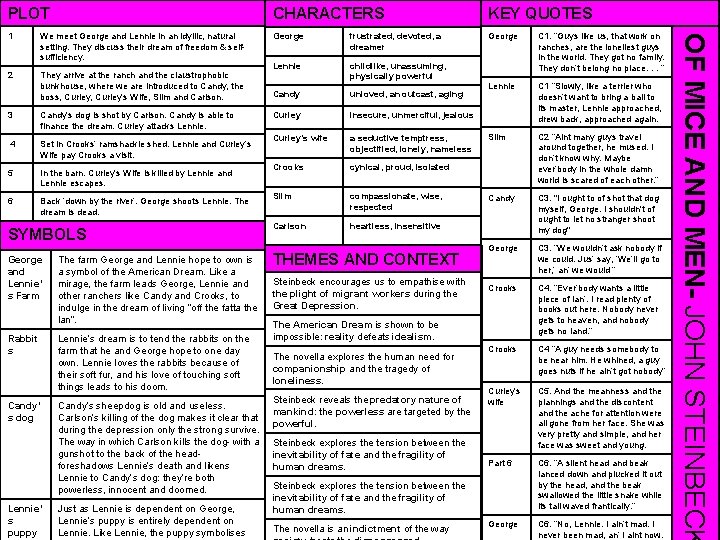
CHARACTERS KEY QUOTES 1 We meet George and Lennie in an idyllic, natural setting. They discuss their dream of freedom & selfsufficiency. George frustrated, devoted, a dreamer George 2 They arrive at the ranch and the claustrophobic bunkhouse, where we are introduced to Candy, the boss, Curley’s Wife, Slim and Carlson. Lennie childlike, unassuming, physically powerful C 1. “Guys like us, that work on ranches, are the loneliest guys in the world. They got no family. They don’t belong no place. . . “ Candy unloved, an outcast, aging Lennie Curley insecure, unmerciful, jealous C 1 “Slowly, like a terrier who doesn’t want to bring a ball to its master, Lennie approached, drew back, approached again. Curley’s wife a seductive temptress, objectified, lonely, nameless Slim Crooks cynical, proud, isolated C 2 “Aint many guys travel around together, he mused. I don’t know why. Maybe ever’body in the whole damn world is scared of each other. ’’ Slim compassionate, wise, respected Candy Carlson heartless, insensitive C 3. "I ought to of shot that dog myself, George. I shouldn't of ought to let no stranger shoot my dog" George C 3. “We wouldn’t ask nobody if we could. Jus’ say, ‘We’ll go to her, ’ an’ we would “ Crooks C 4. “Ever’body wants a little piece of lan’. I read plenty of books out here. Nobody never gets to heaven, and nobody gets no land. ” Crooks C 4 “A guy needs somebody to be near him. He whined, a guy goes nuts if he ain’t got nobody” Curley’s wife C 5. And the meanness and the plannings and the discontent and the ache for attention were all gone from her face. She was very pretty and simple, and her face was sweet and young. Part 6 C 6. “A silent head and beak lanced down and plucked it out by the head, and the beak swallowed the little snake while its tail waved frantically. ” George C 6. “No, Lennie. I ain’t mad. I never been mad, an’ I aint now. 3 Candy’s dog is shot by Carlson. Candy is able to finance the dream. Curley attacks Lennie. 4 Set in Crooks’ ramshackle shed. Lennie and Curley’s Wife pay Crooks a visit. 5 In the barn. Curley’s Wife is killed by Lennie and Lennie escapes. 6 Back ‘down by the river’. George shoots Lennie. The dream is dead. SYMBOLS George and Lennie’ s Farm The farm George and Lennie hope to own is a symbol of the American Dream. Like a mirage, the farm leads George, Lennie and other ranchers like Candy and Crooks, to indulge in the dream of living “off the fatta the lan”. Rabbit s Lennie’s dream is to tend the rabbits on the farm that he and George hope to one day own. Lennie loves the rabbits because of their soft fur, and his love of touching soft things leads to his doom. Candy’ s dog Lennie’ s puppy Candy’s sheepdog is old and useless. Carlson’s killing of the dog makes it clear that during the depression only the strong survive. The way in which Carlson kills the dog- with a gunshot to the back of the headforeshadows Lennie’s death and likens Lennie to Candy’s dog: they’re both powerless, innocent and doomed. Just as Lennie is dependent on George, Lennie’s puppy is entirely dependent on Lennie. Like Lennie, the puppy symbolises THEMES AND CONTEXT Steinbeck encourages us to empathise with the plight of migrant workers during the Great Depression. The American Dream is shown to be impossible: reality defeats idealism. The novella explores the human need for companionship and the tragedy of loneliness. Steinbeck reveals the predatory nature of mankind: the powerless are targeted by the powerful. Steinbeck explores the tension between the inevitability of fate and the fragility of human dreams. The novella is an indictment of the way OF MICE AND MEN- JOHN STEINBECK PLOT
- Slides: 3