
Herodotus The Histories Books 5 28 6 32

Herodotus, The Histories Books 5. 28 – 6. 32 The Ionian Revolt
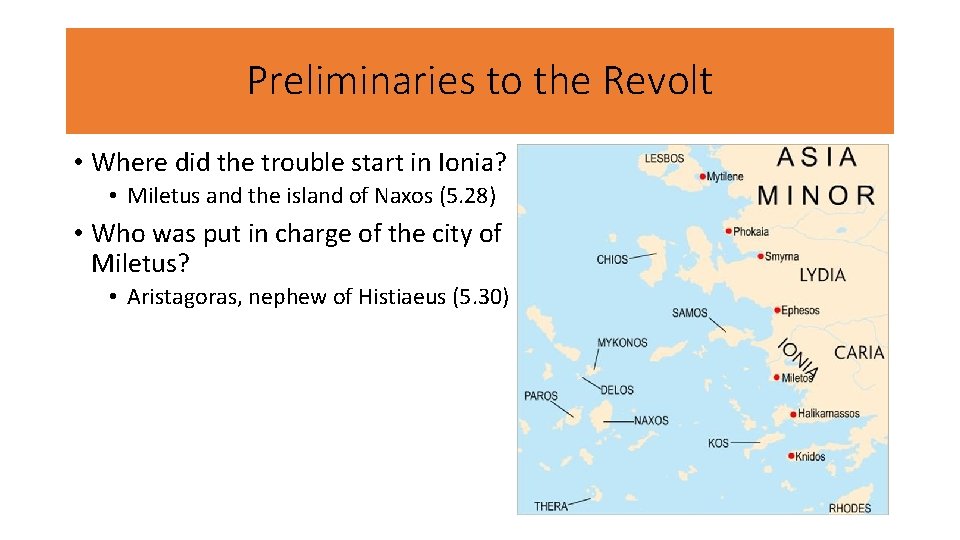
Preliminaries to the Revolt • Where did the trouble start in Ionia? • Miletus and the island of Naxos (5. 28) • Who was put in charge of the city of Miletus? • Aristagoras, nephew of Histiaeus (5. 30)
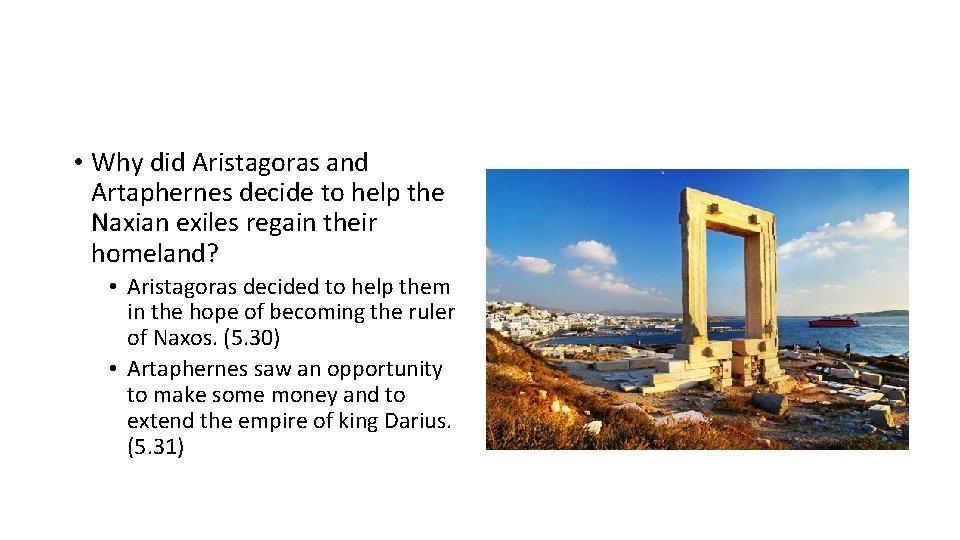
• Why did Aristagoras and Artaphernes decide to help the Naxian exiles regain their homeland? • Aristagoras decided to help them in the hope of becoming the ruler of Naxos. (5. 30) • Artaphernes saw an opportunity to make some money and to extend the empire of king Darius. (5. 31)
• What did Megabates do after his confrontation with Aristagoras? • Megabates sent a party to warn the people at Naxos that they were about to be attacked in order to frustrate Aritagoras’ plan, which he did. (5. 34)
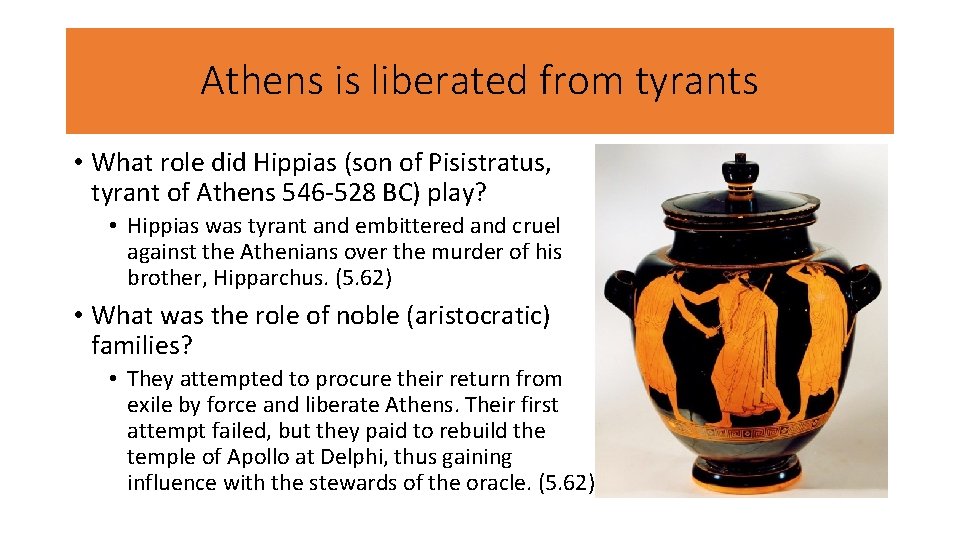
Athens is liberated from tyrants • What role did Hippias (son of Pisistratus, tyrant of Athens 546 -528 BC) play? • Hippias was tyrant and embittered and cruel against the Athenians over the murder of his brother, Hipparchus. (5. 62) • What was the role of noble (aristocratic) families? • They attempted to procure their return from exile by force and liberate Athens. Their first attempt failed, but they paid to rebuild the temple of Apollo at Delphi, thus gaining influence with the stewards of the oracle. (5. 62)
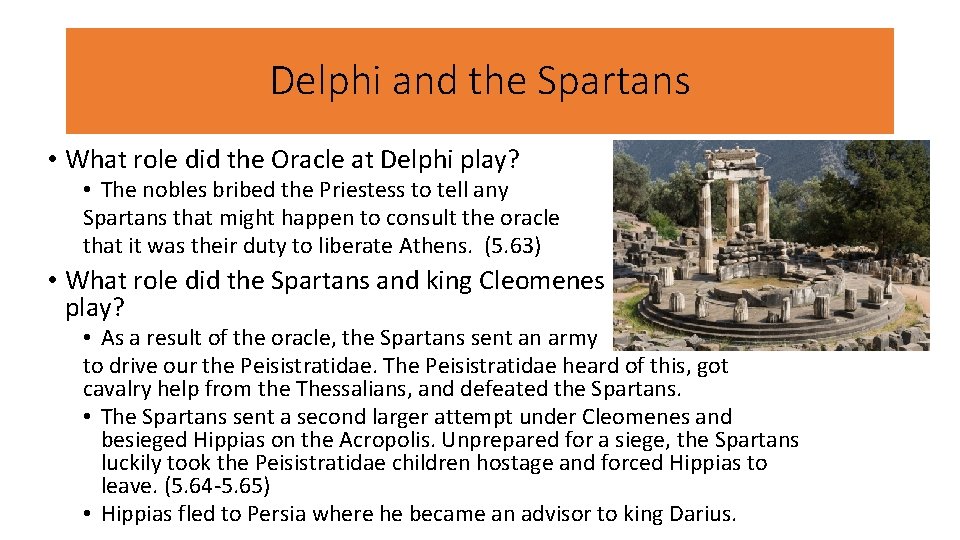
Delphi and the Spartans • What role did the Oracle at Delphi play? • The nobles bribed the Priestess to tell any Spartans that might happen to consult the oracle that it was their duty to liberate Athens. (5. 63) • What role did the Spartans and king Cleomenes play? • As a result of the oracle, the Spartans sent an army to drive our the Peisistratidae. The Peisistratidae heard of this, got cavalry help from the Thessalians, and defeated the Spartans. • The Spartans sent a second larger attempt under Cleomenes and besieged Hippias on the Acropolis. Unprepared for a siege, the Spartans luckily took the Peisistratidae children hostage and forced Hippias to leave. (5. 64 -5. 65) • Hippias fled to Persia where he became an advisor to king Darius.
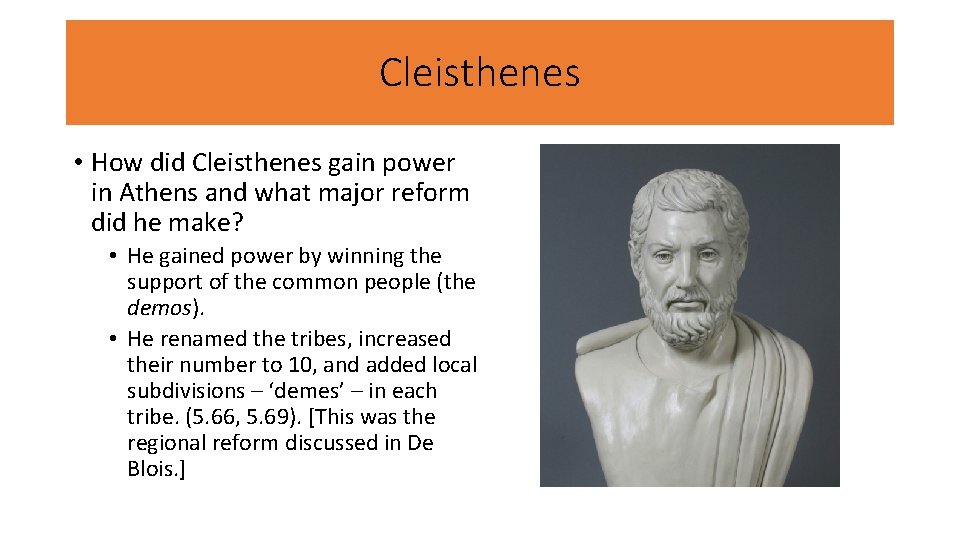
Cleisthenes • How did Cleisthenes gain power in Athens and what major reform did he make? • He gained power by winning the support of the common people (the demos). • He renamed the tribes, increased their number to 10, and added local subdivisions – ‘demes’ – in each tribe. (5. 66, 5. 69). [This was the regional reform discussed in De Blois. ]
Athenians seek an alliance with Persia • Why did the Athenians seek an alliance with Persia? What were the Persian terms for an alliance? Did the Athenians agree to these terms? • At the request of Isagoras, an aristocratic rival of Cleisthenes, Cleomenes returns to Athens to oust Cleisthenes and expel 700 Athenian families, the ‘Accursed’. When he attempted to abolish the Council, the Athenians united against him and he occupied the Acropolis. The Athenians repulsed Cleomenes and executed his Athenian allies. • After this, they knew they were in a state of war with Sparta, so to strengthen their position they sent representatives to Sardis. Artaphernes, the Satrap of Sardis, said Darius would make a pact with them if they signified their submission by the usual gift of earth and water. The envoys, acting wrongly on their own initiative, accepted the terms. (5. 69 -5. 73)
Cleomenes and Demaratus • What new law in Sparta emerged as a result of the disagreement between the two Spartan kings, Cleomenes and Demaratus, when they opposed the Athenians at Eleusis? • Cleomenes wanted to fight the Athenians, but Demaratus thought they were wrong to fight and ordered a withdrawal. This divergence in a matter of policy gave rise to the new law that it was now illegal for both kings to go out with the army, and that one had to remain in the capital. (5. 75) • Herodotus said, “How noble a thing equality before the law is…” Why? • Herodotus was referring to the success of the Athenians when they threw off tyranny and were free men. He believed they were more successful because they knew they were working for their own good. (5. 78) [read p. 340]
Athens vs Persia • How did the Athenians end up in a state of open hostility toward Persia? • When they appealed to Artapherenes not to listen to the exiles, he responded that, if they wanted to avoid trouble, they must take Hippias back as a tyrant. They refused. (5. 96) • Who showed up in Athens at that moment? Why? • Aristagoras of Miletus showed up seeking aid in his rebellion against Darius. (5. 97) • What did Herodotus say about the Athenians giving in to the bribery of Aristagoras? • “Apparently it is easier to impose upon a crowd than an individual, for Aristagoras, who failed to impose upon Cleomenes, succeeded with thirty thousand Athenians. (5. 97
Sardis • What were the “beginnings of evils” for the Greeks and barbarians? • The 20 ships that the Athenians sent in response to the appeal of Aristagoras were the beginning of evils for the Greeks and barbarians. (5. 97) • How did Aristagoras plan to reward the Athenians for their part in aiding his plan? • He did not plan to reward them; in fact he did not intend any good for them at all. He simply wanted to use them to annoy Darius. (5. 98) • To what city did Aristagoras send the Athenians and allied soldiers to first attack? What did they do there? • He sent them to Sardis. They took the whole city without opposition, except for the acropolis, which was guarded by Artapherenes himself. They then burned the town, including a temple. (5. 99 -5. 102)
The demise of Aristagoras • Did the Athenians continue to aid the Ionian rebellion after this battle? • No, they did not. (5. 603) • What did Darius do upon hearing of the disaster at Sardis? • Darius asked who the Athenians were, and then shot his bow up toward the heaven imploring divine assistance in punishing them. Then he commanded one of his servants to say to him repeatedly at every meal, “Master, remember the Athenians. ” (5. 105) • Was Darius deceived by Histiaeus when he was questioned as this part in the rebellion? How? • Yes, Darius was deceived. Histiaeus said it was entirely of the others’ own accord, and that had he been present it would not have happened. Darius then let him go in order to put down the rebellion and then return to Susa. (5. 106 -5. 107) • As the battles raged and Aristagoras realized he had no chance against Darius, what did he do? • He looked for a way to escape. In Thrace, to where he had fled, he was later killed while besieging a town. (5. 124 -5. 126)
Do you believe Histiaeus? • Describe the meeting between Artaphernes and Histiaeus upon Histiaeus’ arrival back in Miletus. • Artaphernes asked Histiaeus what had caused the revolt. Histiaeus pretended complete ignorance. • Artphernes knew he was lying and told Histiaeus “ you made the shoe and Aristagoras put it on. ” • Histiaeus, knowing now that Artaphernes knew the truth, fled to the Ionian coast. (6. 1 -6. 2) • What was Histiaeus’ true purpose in the rebellion? • His real purpose in retuning to Ionia was to take over command of the Ionians and lead the rebellion. (6. 2) • Did Miletus take Histiaeus back? Why? • No. They had a taste of liberty and were too happy over getting rid of Aristagoras to be willing to welcome another tyrant. (6. 5)
The Ionians fight • Did any of the Ionians respond to the exiled tyrants’ invitations to treachery? • Each town thought they were the only recipients of the request and therefore refused the invitation. (6. 10) • Describe Dionysius’ speech to the Greek forces. How did the Ionians respond to his speech? • They are on the “edge between being free men or slave. ” • If they submit to strict discipline for a few more days they will defeat the Persians and keep their liberty. • If, however, they continue to be soft, they will lose and be punished by Darius. • This appeal worked and the Ionians agreed to take orders from Dionysius. (6. 11 -6. 12) • How did this project (the Ionians response in the previous question) proceed? • They obeyed for seven days and then began to grumble. • As a result, they fled or fought poorly and lost the naval battle. (6. 12 -6. 16)
The end of the Ionian Revolt • What happened to Miletus after this battle? • After the Phoenician victory over the Ionian fleet, the Persians laid siege to Miletus. • They dug saps under the walls and brought rams to collapse the walls. • After overwhelming the city the Persians conquered Miletus. • They killed most of the men, enslaved the women and children, and plundered and burnt the city. (6. 18) • How was Histiaeus received by the Persians when Harpagus and his troops found him? • Knowing that Darius would likely pardon him, Artaphernes and Harpagus resolved to kill Histiaeus. They impaled Histiaeus, cut off his head, mummified it, and sent it to Darius was upset and gave Histiaeus an honorable burial. (6. 30)
- Slides: 15