
Hernia Repair TEP Incisional and Umbilical By Chayse
Hernia Repair; TEP, Incisional, and Umbilical By Chayse Thompson

TEP (Totally Extraperitoneal)
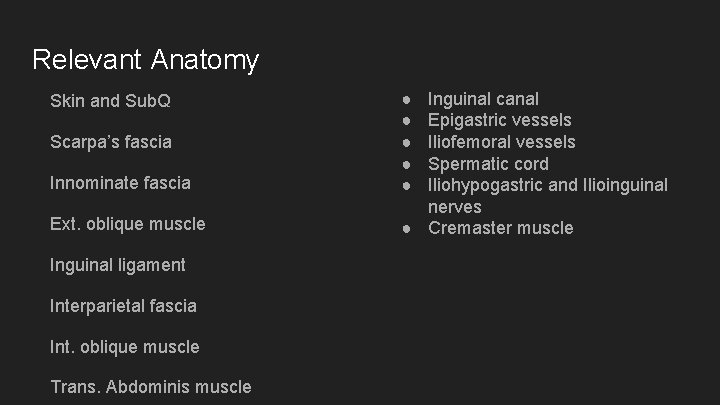
Relevant Anatomy Skin and Sub. Q Scarpa’s fascia Innominate fascia Ext. oblique muscle Inguinal ligament Interparietal fascia Int. oblique muscle Trans. Abdominis muscle ● ● ● Inguinal canal Epigastric vessels Iliofemoral vessels Spermatic cord Iliohypogastric and Ilioinguinal nerves ● Cremaster muscle
Physiology and Pathophysiology The transversalis fascia is the main source of herniation, it’s weak and a hernia occurs through a tear or weakness here.
Diagnostic Exams Hx&Px Observation of hernia-inguinal bulge Scrotal digital exam
Surgical Intervention Implication of polypropylene mesh(laparoscopically) to secure and reinforce abdominal wall to prevent herniation of bowel and other tissues.

Special Considerations Age Weight Comorbidities
Anesthesia and Positioning General Spinal and conscious sedation Epidural Local The pt will be placed in the supine position

Skin Prep The pt will be prepped with a wide abdominal prep -mid chest to the symphysis pubis, and as laterally as far as possible
Draping The surgical site will be squared off with four towels using the same anatomical points of reference as the skin prep. Abdominal laparoscopy drape
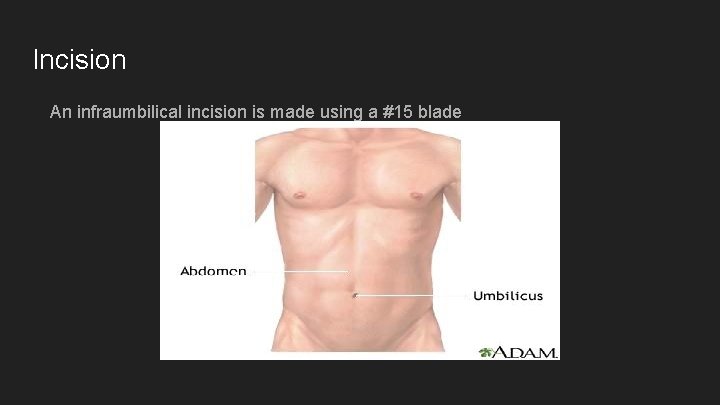
Incision An infraumbilical incision is made using a #15 blade
Supplies Dissecting balloon Polypropylene mesh and suture Loop ligature
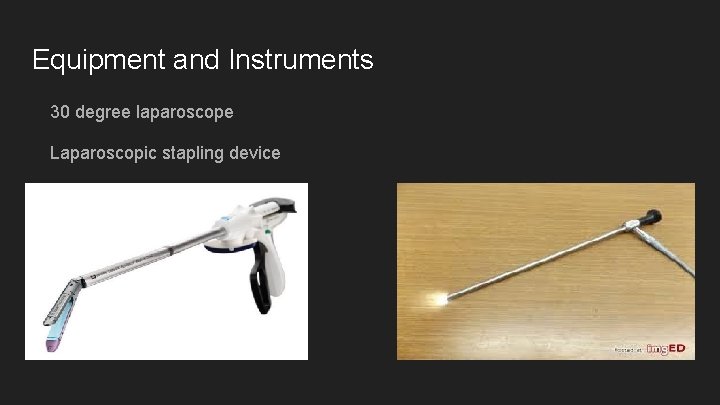
Equipment and Instruments 30 degree laparoscope Laparoscopic stapling device Major laparotomy set

Procedure Steps Infraumbilical incision-#15 blade Anterior rectus sheath is incised, then the ipsilateral rectus abdominis muscle is retracted laterally Blunt dissection-creates space beneath the rectus abdominis muscle Dissection balloon is inserted and placed on the posterior rectus(anterior side). The balloon is then moved to create a tunnel into the pubic symphysis in the preperitoneal space. After, its inflated to create a cavity, and then it’s removed and replaced with a blunt tipped trocar. The preperitoneal space gets insufflated and followed up with the insertion of
Procedure Steps (continued) The inf. Epigastric vessels are identified and retracted anteriorly Cooper’s ligament is identified and dissected so that it’s free from the pubic symphysis medially to the level of the ext. Iliac vein Then the iliopubic tract, genitofemoral, and lateral femoral cutaneous nerves are identified-prevents damage to the nerves Lateral dissection occurs on the anterior iliac spine, and the spermatic cord is dissected free
Procedure Steps (continued) Direct hernia- reduced by traction. Indirect hernia (small)-freed from the spermatic cord and reduced into the peritoneal cavity. Indirect hernia (large)-divided with cautery near the inguinal ring, then the proximal peritoneal sac is closed with loop ligature During reduction of the hernia, polypropylene mesh is inserted through a trocar to cover the direct, indirect, femoral spaces, and the spermatic cord. The mesh is then secured by a tacking stapler The balloon, laparoscope, and trocars are removed. This is then followed with closure, either suture or closure strips.
Counts and Specimen Initial count Count as the laparoscopic equipment is being removed from the abdomen Count as the subcutaneous layer is being closed Final count Anaerobic and aerobic
Dressings and Prognosis Small pressure dressings Suture Steri-strips If no complications, the pt can be discharged the same day of Sx. The pt will be able to return to normal activities in 2 -4 weeks.
Complications Hernia recurrence Nerve damage Fluid build up at the site of the mesh implant Postop SSI
Wound Classification/Management Clean case, unless an entrance is made into the alimentary tract. The pt must avoid putting strain on the abdomen

Ventral (Incisional)
Relevant Anatomy is the same as the TEP herniorrhaphy Anatomy will change based on the site of the incision Most common site of incision; vertical midline
Physiology and Pathophysiology Ventral herniaweakened area that occurs along a primary abdominal incision. Identified by a bulge in the abdomen.
Diagnostic Exams and Surgical Intervention Hx&Px An incision is made with a #10 blade(most commonly) in the abdomen and the hernia is repaired either with a mesh implant or suture the laparoscopic equipment.
Special Considerations Age Weight Comorbidities Attending surgeon’s techniques
Anesthesia and Positioning Pt will be placed in the supine position General, spinal, epidural, or local anesthesia.
Skin Prep and Draping Lower or upper R or L quadrant Umbilicus down to the symphysis pubis or umbilicus up to the sternum and laterally as far as possible Square off the surgical site with four towels Laparotomy sheet
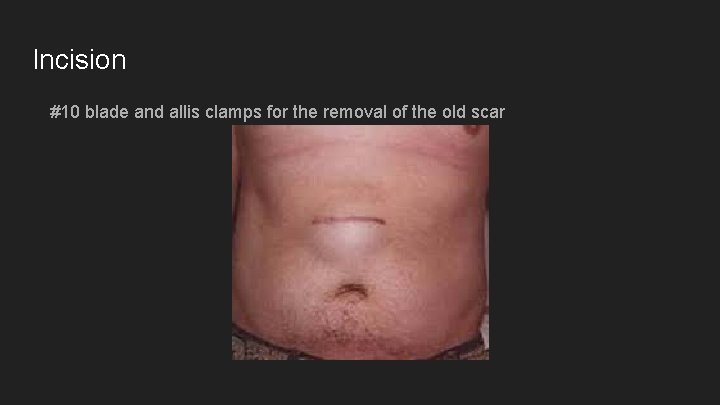
Incision #10 blade and allis clamps for the removal of the old scar
Supplies Synthetic mesh Suture or staples for mesh
Equipment and Instruments Laparoscopic equipment Major instrument set #10 blade for initial incision Allis clamps for removal of old scar
Procedure Steps Removal of the old abdominal scar with #10 blade *tech follows along the surgeon with the allis clamped to the scar providing gentle traction The verres needle is then placed into the abdomen for insufflation Three trocars are then placed laterally to the incision An atraumatic laparoscopic clamp(curved) is used to pull the internal abdominal contents(omentum) away from the hernia site and then back into its normal anatomical position,
Procedure Steps (continued) Next, lyse the adhesions either with a bovie or harmonic scalpel A spinal is placed through the skin and visualized through the laparoscope to help with measuring the size of the hernia, and mesh required for repair. *The mesh is then cut to size(larger than the hernia). The surgeon will then mark the correct side of the mesh with a marking pen and place non-absorbable monofilament sutures in the corners of the mesh to serves as markers for placement. *The mesh is then placed into the abdomen through a trocar and positioned
Procedure Steps (continued) A suture passer/retriever is inserted and used to grab the corners of the sutures, they are then brought and tied at the skin level. The mesh is secured to the abdominal wall using mattress sutures that were placed through different incision sites. Tacking staples are then placed in between the sutures to secure the mesh further and prevent tissue from protruding.
Counts and Specimen Initial count Count before the mesh is secured to the abdominal wall closing the herniation Count before the subcutaneous layer is closed Final count Aerobic and anaerobic specimens taken
Dressings and Prognosis Small pressure dressing Suture Steri-strips If no complications; pt is discharged the same day and can return to their normal ADL’s within two to four weeks.
Complications & Wound Classification/Management Hernia recurrence Nerve damage Fluid build up at the site of the mesh Postop SSI Clean case unless entrance to the alimentary tract Pt will be instructed to not put any strain on the abdomen

Umbilical

Physiology, Pathophysiology and Sx Intervention The umbilicus is formed from the umbilical ring of the linea alba The ligamentum teres(round ligament) and the paraumbilical veins combine superiorly at the umbilicus while the obliterated urachus(umbilical ligament) enters the umbilicus inferiorly Congenital in infants and usually close spontaneously Sx treated after age 5 most commonly

Diagnostic Exams Hx&Px
Special Considerations Pt’s body temperature, pediatric pt’s will need radiant heat Age
Anesthesia and Positioning Supine position General anesthesia
Draping and Skin Prep Square off around the infraumbilical site Pediatric laparotomy drape Mid chest to symphysis pubis and laterally as far as possible
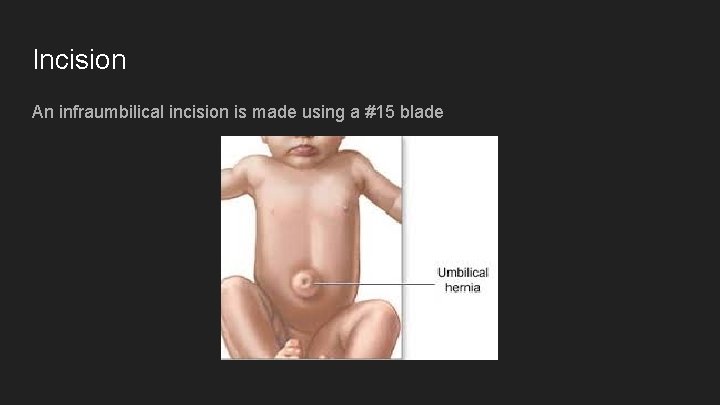
Incision An infraumbilical incision is made using a #15 blade
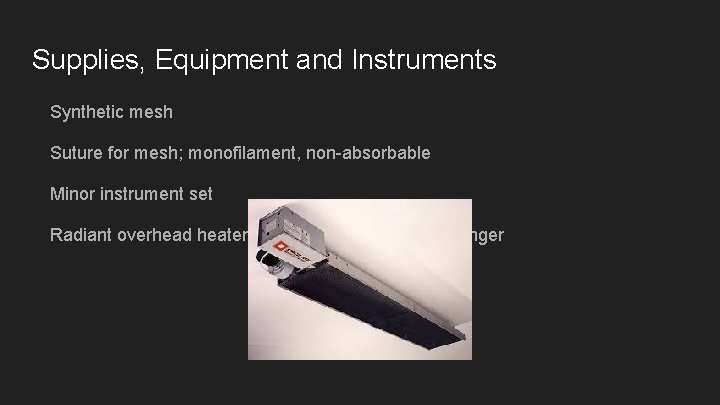
Supplies, Equipment and Instruments Synthetic mesh Suture for mesh; monofilament, non-absorbable Minor instrument set Radiant overhead heater-pediatric pt’s 2 yrs and younger
Procedure Steps Infraumbilical incision is made with a #15 blade Senn retractors are used to retract the skin and subcutaneous tissue in order to visualize the rectus fascia and hernia The hernia sac is located between the rectus abdominis muscle sheaths and is bluntly dissected free Once free, the sac may be ligated or excised If ligated, a peanut sponge on a mosquito will be placed inside the sac to gently push down the hernia sac contents while the suture is being placed A brown or mayo needle holder should be loaded with the suture
Procedure Steps (continued) *The peritoneum is closed with suture-continuous The rectus fascia is closed using an interrupted suturing technique; 3 -0 or 4 -0 non-absorbable Then a continuous suture with a small gauge absorbable suture is used to close the subcutaneous layer A small pressure dressing is placed
Counts and Specimens Initial count Count before the peritoneum is closed Count before the rectus fascia and subcutaneous layer are closed Final count If the hernia sac was excised, then it will become a specimen
Dressings and Prognosis If no complications the pt will be discharged the same day and can return to normal ADL’s within 2 -4 weeks Parents or gaurdians of pt will have to ensure that strain isn’t put on the wound
Complications Hernia recurrence Hemorrhaging Postop SSI
Wound Classification/Management Clean Parents receive postop education in particular to being alert about signs and symptoms of SSI’s
- Slides: 50