
Heredity Why dont you look like a rhinoceros

- Slides: 136
Heredity Why don’t you look like a rhinoceros? The answer to this question seems simple: Neither of your parents is a rhinoceros. But there is more to this answer than meets the eye.
Heredity As it turns out, heredity, or the passing of traits from parents to offspring, is more complicated than you might think. For example, you might have curly hair, while both of your parents have straight hair. You might have blue eyes even though both of your parents have brown eyes. How does this happen? People have investigated this question for a long time. About 150 years ago, Gregor Mendel performed important experiments. His discoveries helped scientists begin to find some answers to these questions.
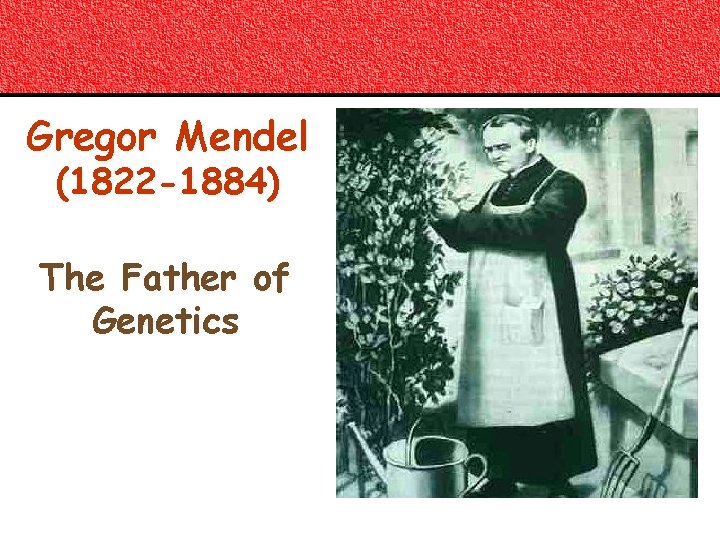
Gregor Mendel (1822 -1884) The Father of Genetics
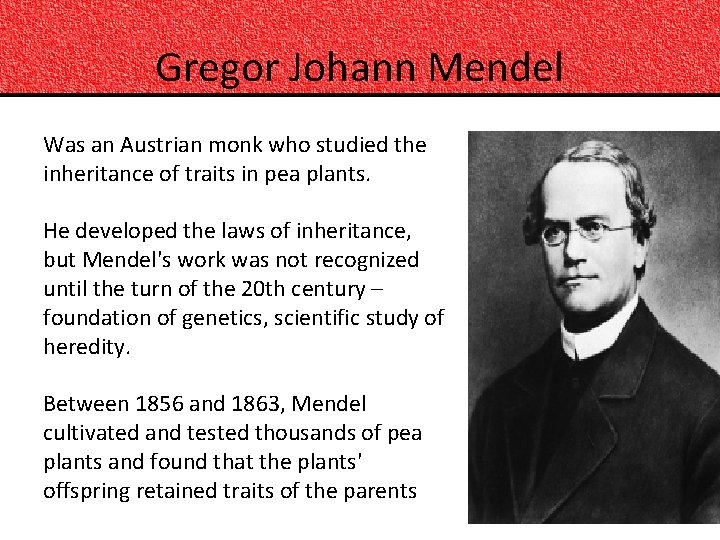
Gregor Johann Mendel Was an Austrian monk who studied the inheritance of traits in pea plants. He developed the laws of inheritance, but Mendel's work was not recognized until the turn of the 20 th century – foundation of genetics, scientific study of heredity. Between 1856 and 1863, Mendel cultivated and tested thousands of pea plants and found that the plants' offspring retained traits of the parents
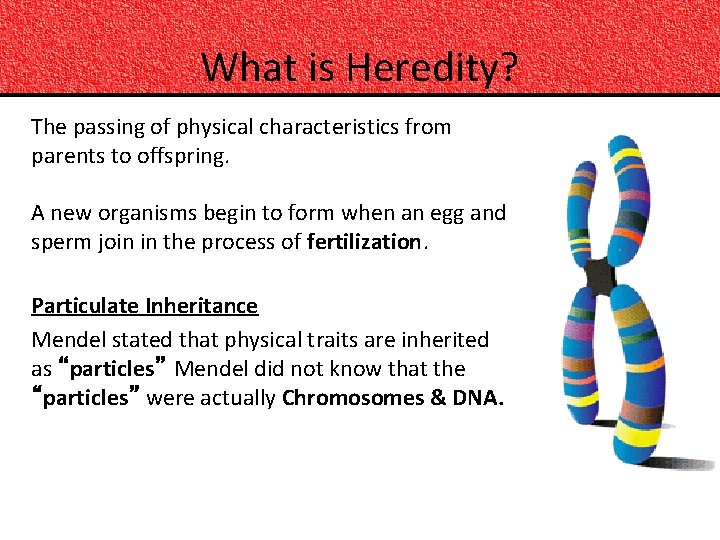
What is Heredity? The passing of physical characteristics from parents to offspring. A new organisms begin to form when an egg and sperm join in the process of fertilization. Particulate Inheritance Mendel stated that physical traits are inherited as “particles” Mendel did not know that the “particles” were actually Chromosomes & DNA.
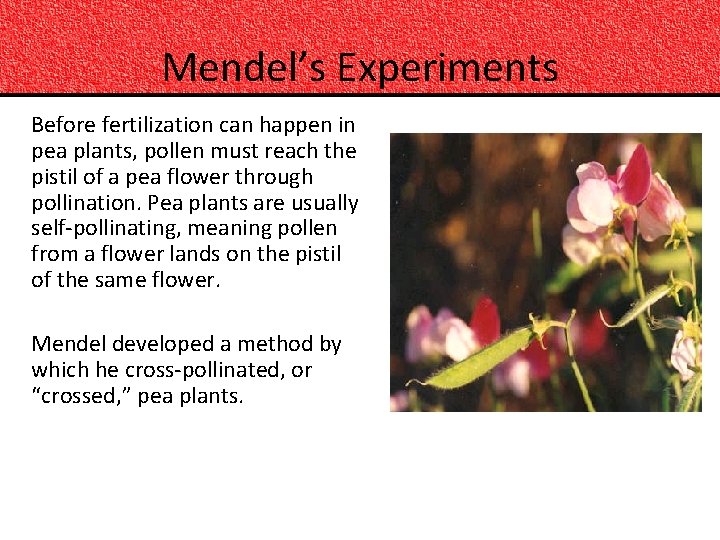
Mendel’s Experiments Before fertilization can happen in pea plants, pollen must reach the pistil of a pea flower through pollination. Pea plants are usually self-pollinating, meaning pollen from a flower lands on the pistil of the same flower. Mendel developed a method by which he cross-pollinated, or “crossed, ” pea plants.
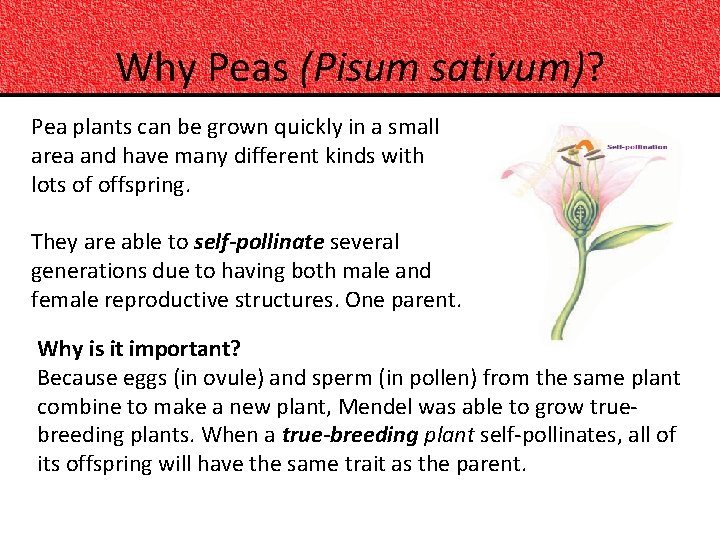
Why Peas (Pisum sativum)? Pea plants can be grown quickly in a small area and have many different kinds with lots of offspring. They are able to self-pollinate several generations due to having both male and female reproductive structures. One parent. Why is it important? Because eggs (in ovule) and sperm (in pollen) from the same plant combine to make a new plant, Mendel was able to grow truebreeding plants. When a true-breeding plant self-pollinates, all of its offspring will have the same trait as the parent.
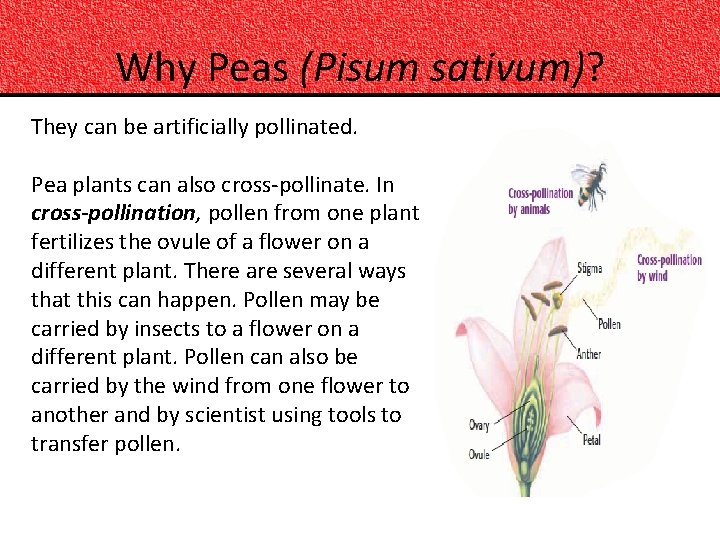
Why Peas (Pisum sativum)? They can be artificially pollinated. Pea plants can also cross-pollinate. In cross-pollination, pollen from one plant fertilizes the ovule of a flower on a different plant. There are several ways that this can happen. Pollen may be carried by insects to a flower on a different plant. Pollen can also be carried by the wind from one flower to another and by scientist using tools to transfer pollen.
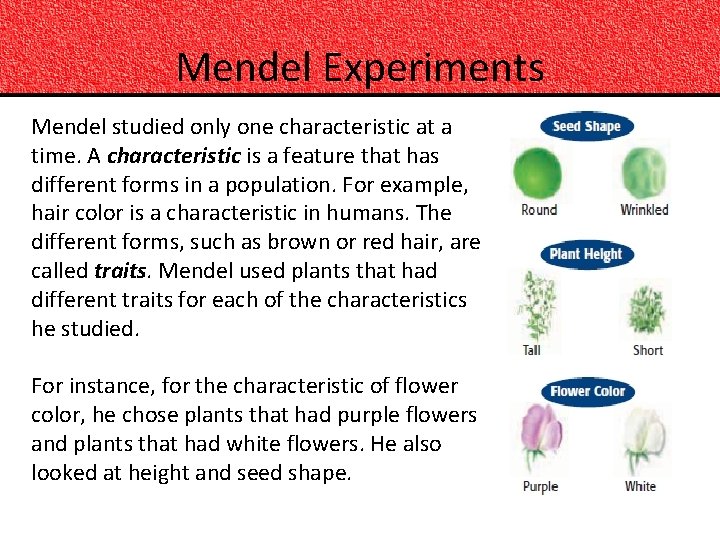
Mendel Experiments Mendel studied only one characteristic at a time. A characteristic is a feature that has different forms in a population. For example, hair color is a characteristic in humans. The different forms, such as brown or red hair, are called traits. Mendel used plants that had different traits for each of the characteristics he studied. For instance, for the characteristic of flower color, he chose plants that had purple flowers and plants that had white flowers. He also looked at height and seed shape.
Mendel Experiments He used plants that were true breeding for each of the traits he was studying. By doing so, he would know what to expect if his plants were to self-pollinate. He decided to find out what would happen if he bred, or crossed, two plants that had different traits of a single characteristic.
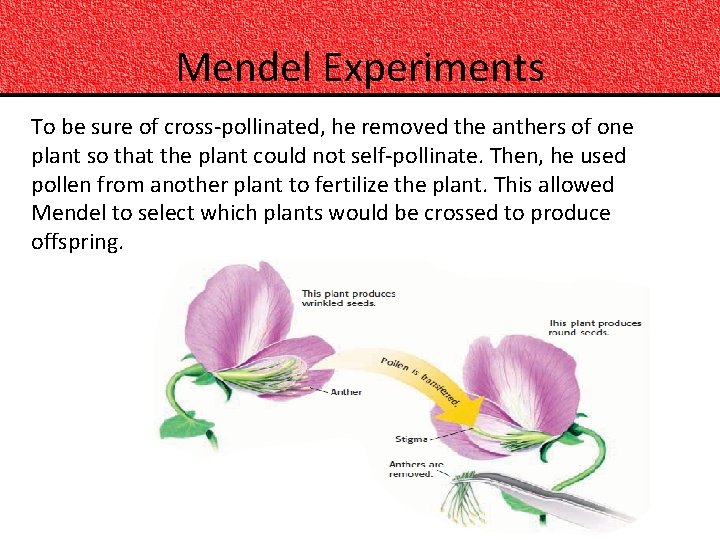
Mendel Experiments To be sure of cross-pollinated, he removed the anthers of one plant so that the plant could not self-pollinate. Then, he used pollen from another plant to fertilize the plant. This allowed Mendel to select which plants would be crossed to produce offspring.
Mendel Experiments Mendel crossed two pea plants that differed in height. He crossed purebred tall plants with purebred short plants. These parent plants, the P generation, were purebred because they always produced offspring with the same trait as the parent. In all of Mendel’s crosses, only one form of the trait appeared in the F 1 generation. However, in the F 2 generation, the “lost” form of the trait always reappeared in about one fourth of the plants. From his results, Mendel reasoned that individual factors, one from each parent, control the inheritance of traits. Today, scientists call the factors that control traits genes. The different or multiple forms of the same gene is called alleles.
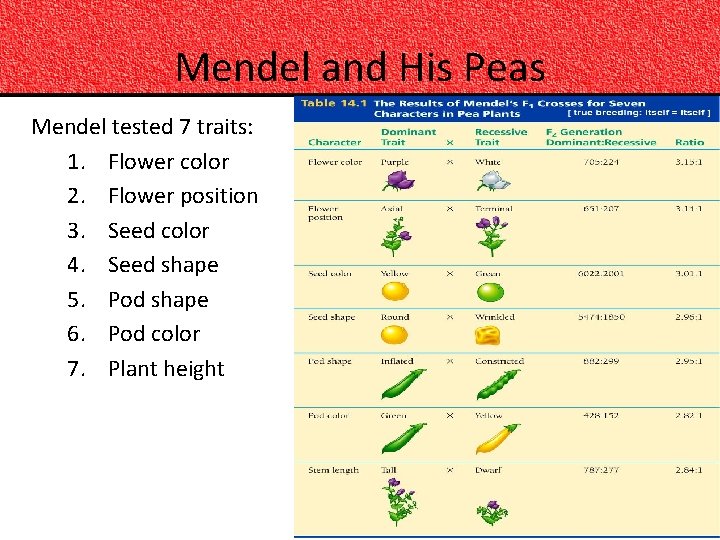
Mendel and His Peas Mendel tested 7 traits: 1. Flower color 2. Flower position 3. Seed color 4. Seed shape 5. Pod shape 6. Pod color 7. Plant height
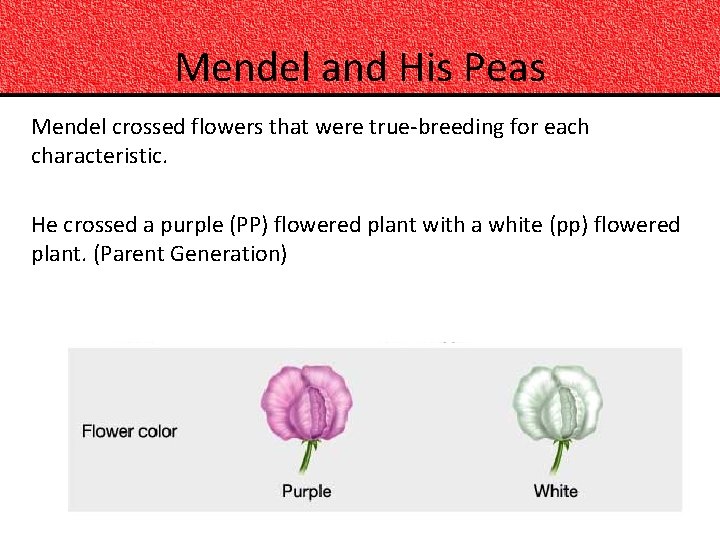
Mendel and His Peas Mendel crossed flowers that were true-breeding for each characteristic. He crossed a purple (PP) flowered plant with a white (pp) flowered plant. (Parent Generation)
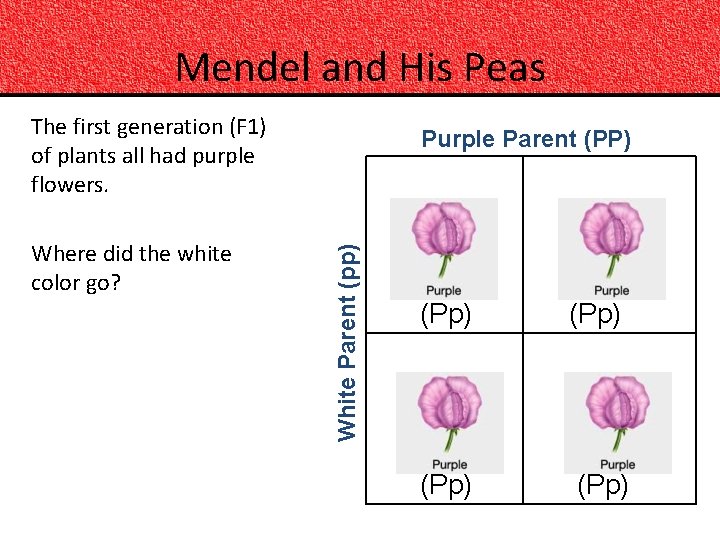
Mendel and His Peas The first generation (F 1) of plants all had purple flowers. White Parent (pp) Where did the white color go? Purple Parent (PP) (Pp) (Pp)
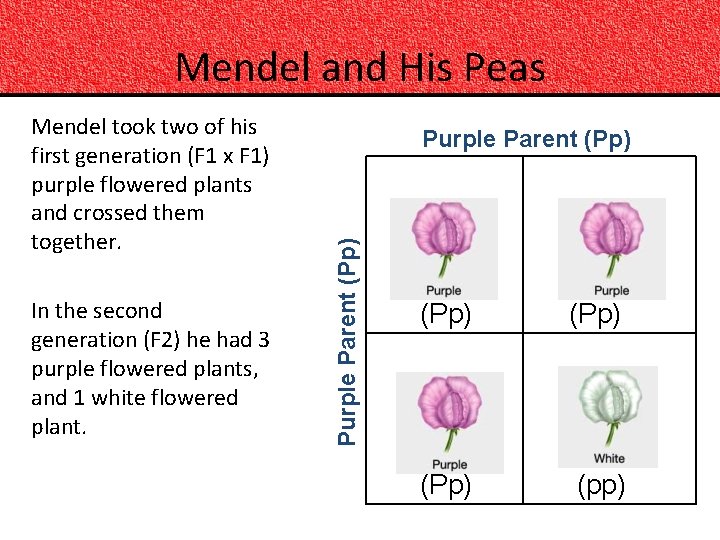
Mendel and His Peas In the second generation (F 2) he had 3 purple flowered plants, and 1 white flowered plant. Purple Parent (Pp) Mendel took two of his first generation (F 1 x F 1) purple flowered plants and crossed them together. (Pp) (Pp) (pp)
Mendel’s Experiments Symbols for alleles Dominant alleles are shown with a capital letter. Recessive alleles are shown with a lowercase letter. • • • Dominant example for tall = T Recessive example for short = t Two dominants alleles for tall = TT Two recessives alleles for short = tt Inheriting both alleles = Tt
Mendel’s Experiments An organism’s traits are controlled by the alleles it inherits from its parents. Some alleles are dominant, while other alleles are recessive. A dominant allele is one whose trait always shows up in the organism when the allele is present. A recessive allele is hidden whenever the dominant allele is present. A trait controlled by a recessive allele will only show up if the organism does not have the dominant allele
Mendel and His Peas Mendel noticed in the first generation, all of the white flowers seemed to disappear. He called this a recessive trait (to recede means “to go away or back off. ”). This trait reappears in the 2 nd generation after disappearing in the 1 st generation when parents with different traits are bred. The white color faded into the background at first. It showed up in the next generation when he pollinated the flowers.
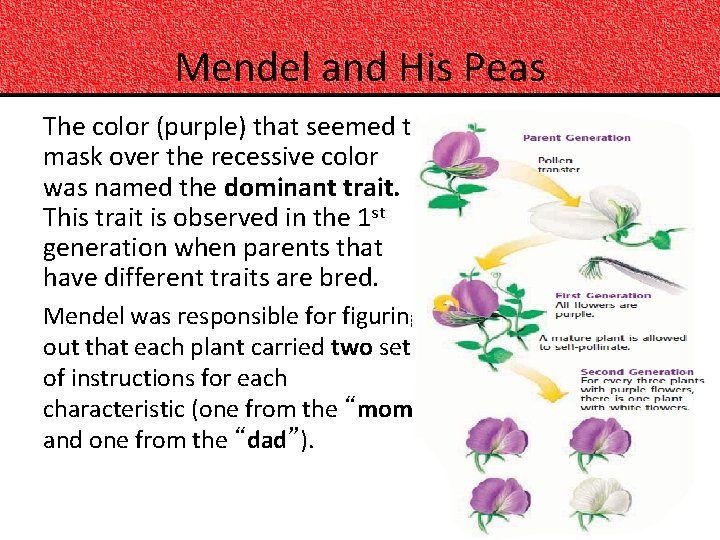
Mendel and His Peas The color (purple) that seemed to mask over the recessive color was named the dominant trait. This trait is observed in the 1 st generation when parents that have different traits are bred. Mendel was responsible for figuring out that each plant carried two sets of instructions for each characteristic (one from the “mom” and one from the “dad”).
Mendel’s Experiments • In Mendel’s cross, the purebred tall plant has two alleles for tall stems. The purebred short plant has two alleles for short stems. The F 1 plants are all hybrids: they have two different alleles for the trait —one allele for tall stems and one for short stems. Geneticists use a capital letter to represent a dominant allele and a lowercase version of the same letter for the recessive allele. • Like many scientists, his work was not accepted until after his death.
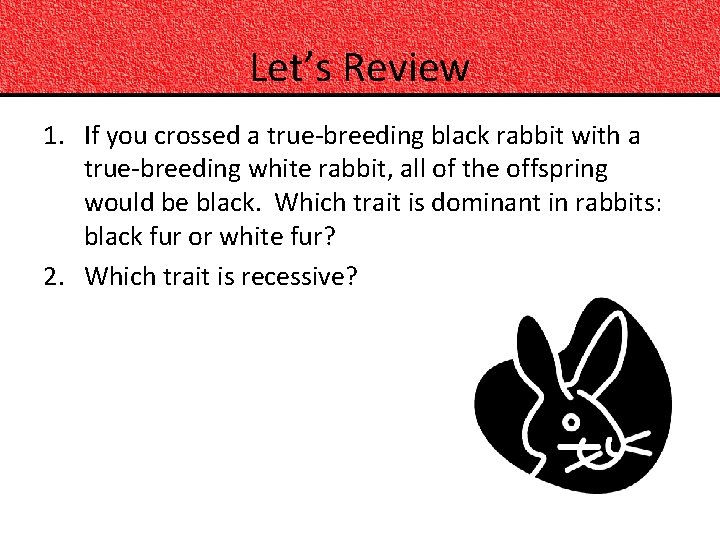
Let’s Review 1. If you crossed a true-breeding black rabbit with a true-breeding white rabbit, all of the offspring would be black. Which trait is dominant in rabbits: black fur or white fur? 2. Which trait is recessive?
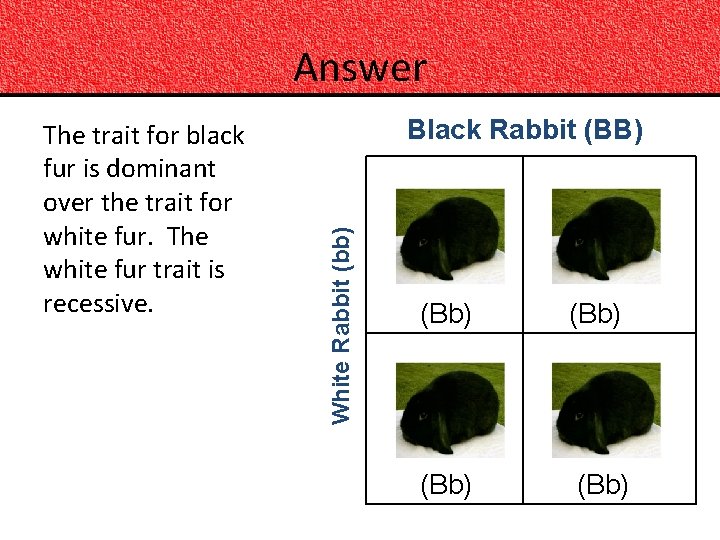
Answer Black Rabbit (BB) White Rabbit (bb) The trait for black fur is dominant over the trait for white fur. The white fur trait is recessive. (Bb) (Bb)
Traits and Inheritance Mendel calculated the ratio of dominant traits to recessive traits. He found a ratio of 3: 1. What did this tell him about how traits are passed from parents to offspring?
Traits and Inheritance Mendel knew from his experiments with pea plants that there must be two sets of instructions for each characteristic. The first-generation plants carried the instructions for both the dominant trait and the recessive trait. Scientists now call these instructions for an inherited trait genes. (a segment of DNA that carries hereditary instructions and is passed from parent to offspring) Each parent gives one set of genes to the offspring. The offspring then has two forms of the same gene for every characteristic— one from each parent. The different or multiple forms (often dominant and recessive) of a gene are known as alleles (uh LEELZ).
What are Traits? Physical Traits Can be seen by others Eye color, hair color, height, left handed Acquired Traits Learned skills Playing sports, riding a bike, playing musical instruments Behavioral Traits Instinctual actions Nest building and migration
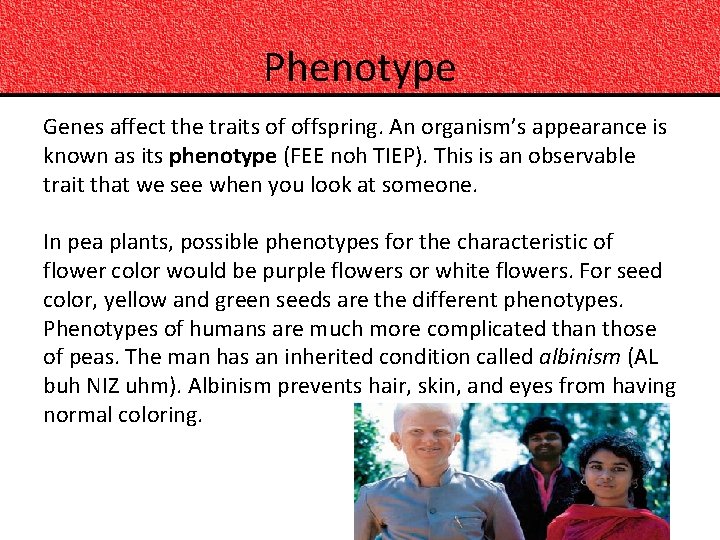
Phenotype Genes affect the traits of offspring. An organism’s appearance is known as its phenotype (FEE noh TIEP). This is an observable trait that we see when you look at someone. In pea plants, possible phenotypes for the characteristic of flower color would be purple flowers or white flowers. For seed color, yellow and green seeds are the different phenotypes. Phenotypes of humans are much more complicated than those of peas. The man has an inherited condition called albinism (AL buh NIZ uhm). Albinism prevents hair, skin, and eyes from having normal coloring.
Genotype Both inherited alleles from your biological parents together form an organism’s genotype. Genes control your traits. Because the allele for purple flowers (P) is dominant, only one P allele is needed for the plant to have purple flowers. What is the difference between homozygous and heterozygous? A plant or individual that has identical alleles of a gene two dominant or two recessive alleles is homozygous (HOH moh ZIE guhs). A plant or individual that has non identical alleles of a gene or genotype Pp is heterozygous (HET uhr OH ZIE guhs).
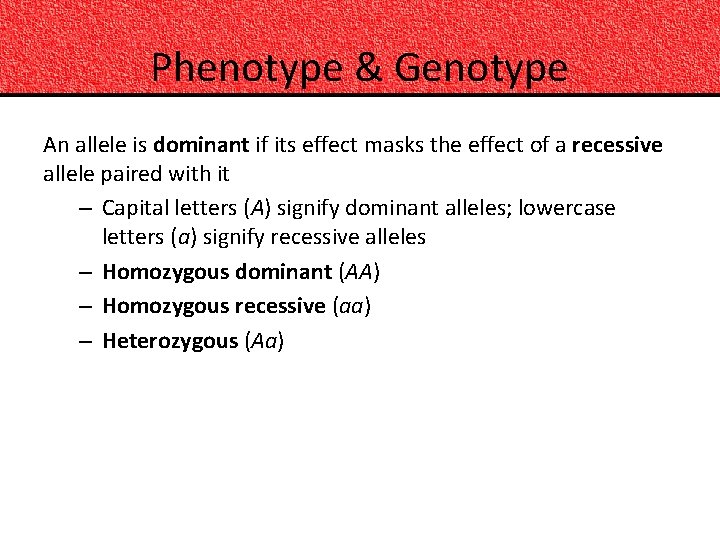
Phenotype & Genotype An allele is dominant if its effect masks the effect of a recessive allele paired with it – Capital letters (A) signify dominant alleles; lowercase letters (a) signify recessive alleles – Homozygous dominant (AA) – Homozygous recessive (aa) – Heterozygous (Aa)
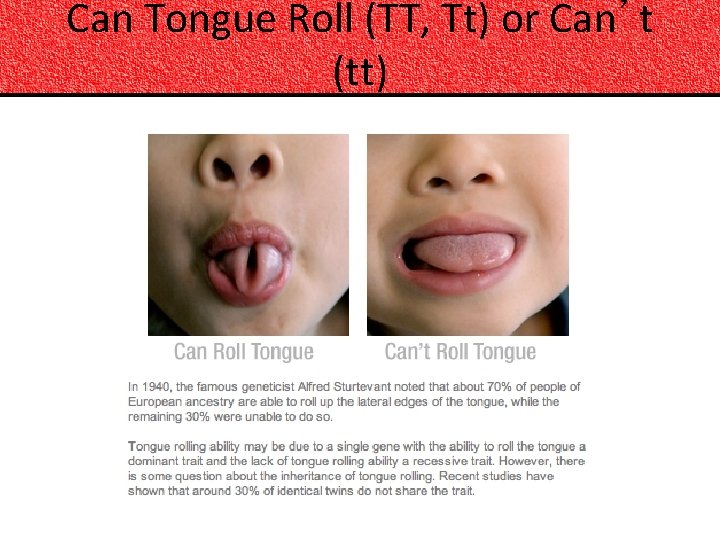
Can Tongue Roll (TT, Tt) or Can’t (tt)
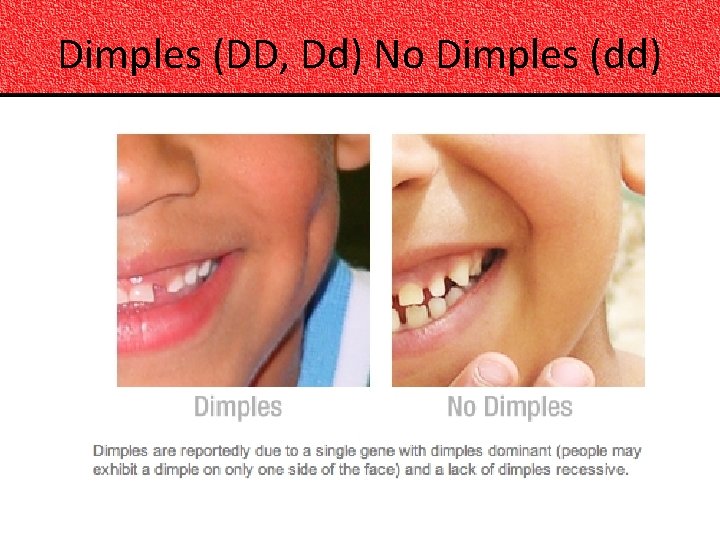
Dimples (DD, Dd) No Dimples (dd)
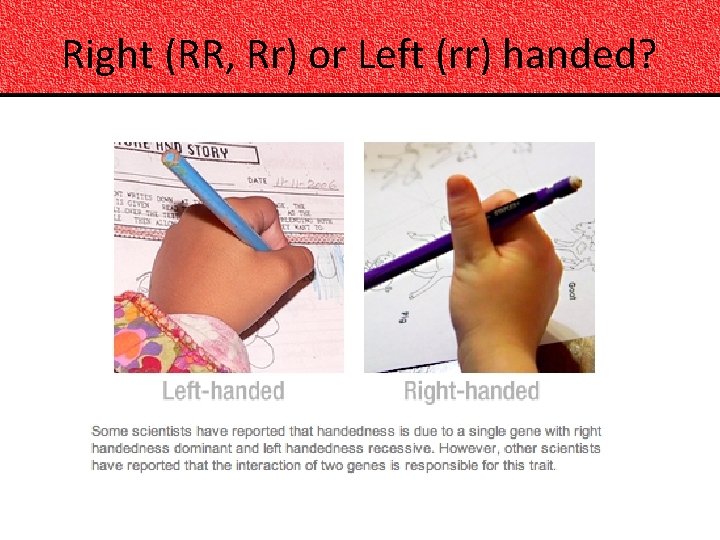
Right (RR, Rr) or Left (rr) handed?
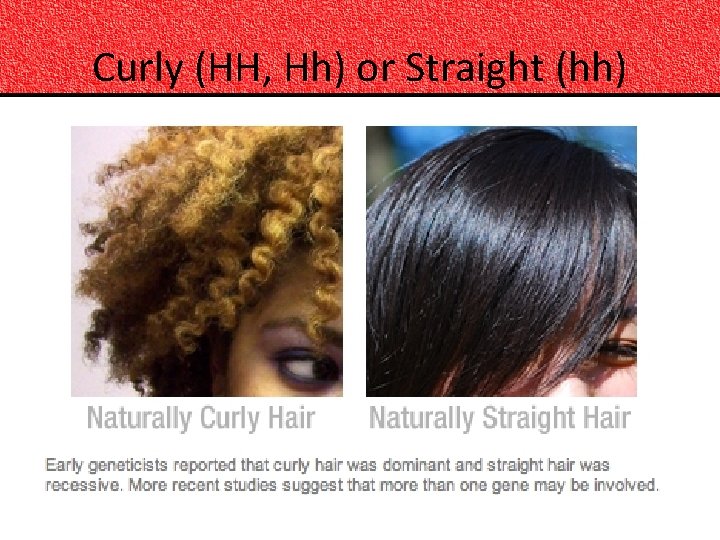
Curly (HH, Hh) or Straight (hh)
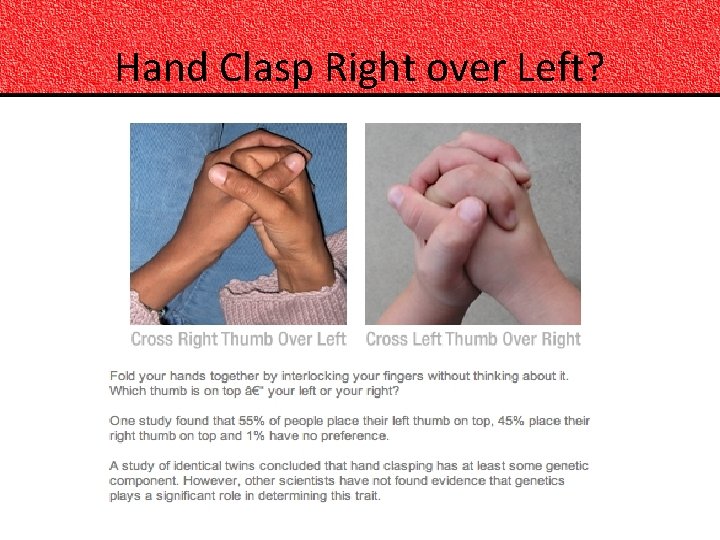
Hand Clasp Right over Left?
Allergies (AA, Aa) or No Allergies (aa)
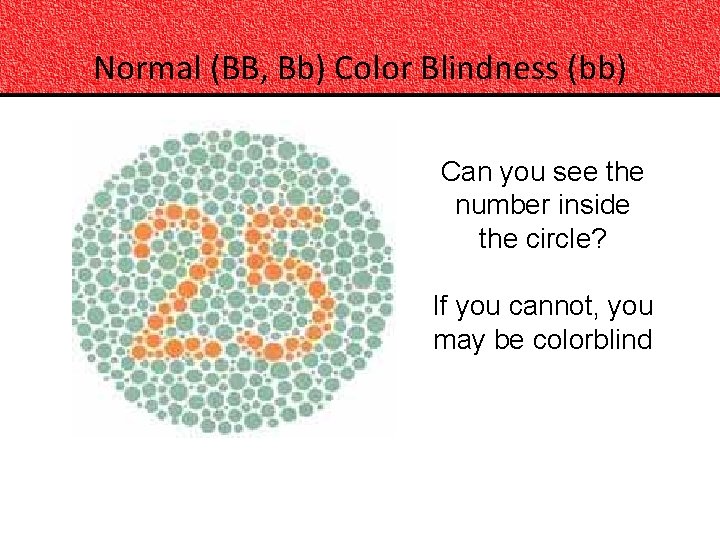
Normal (BB, Bb) Color Blindness (bb) Can you see the number inside the circle? If you cannot, you may be colorblind
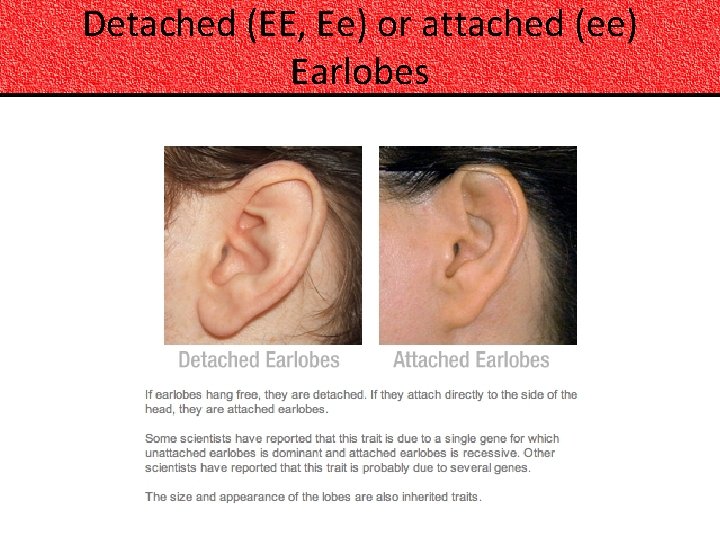
Detached (EE, Ee) or attached (ee) Earlobes
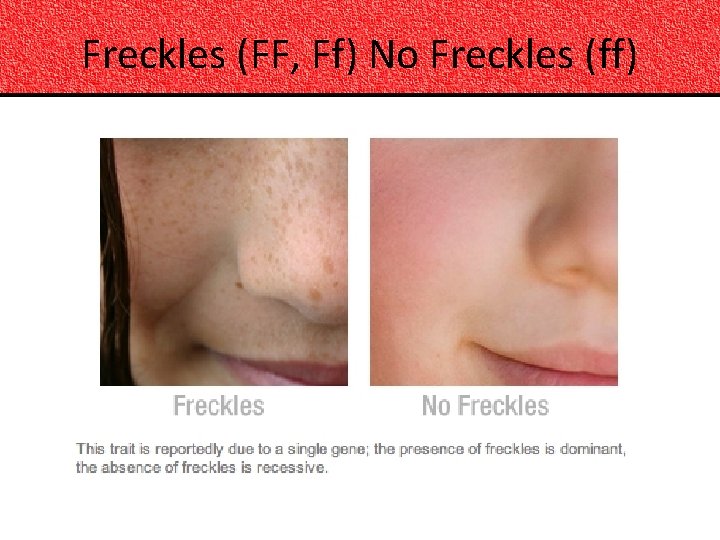
Freckles (FF, Ff) No Freckles (ff)
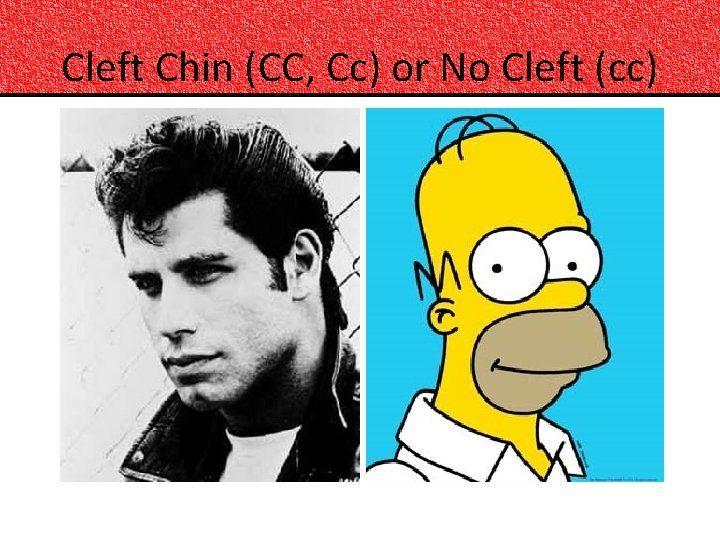
Cleft Chin (CC, Cc) or No Cleft (cc)
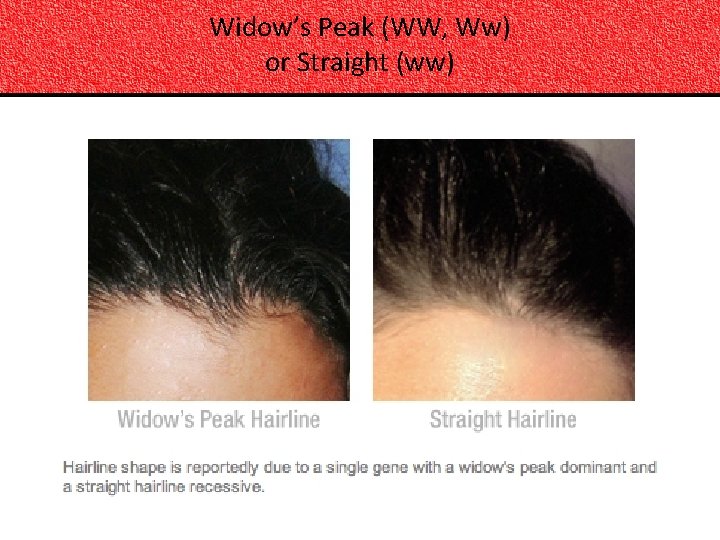
Widow’s Peak (WW, Ww) or Straight (ww)
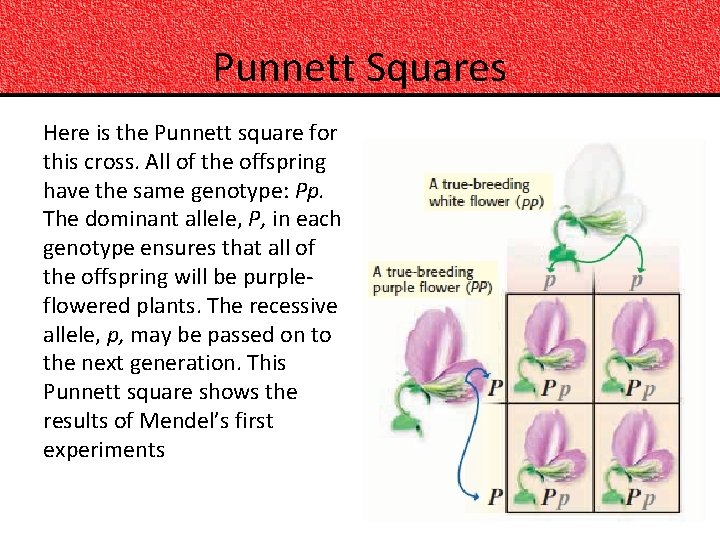
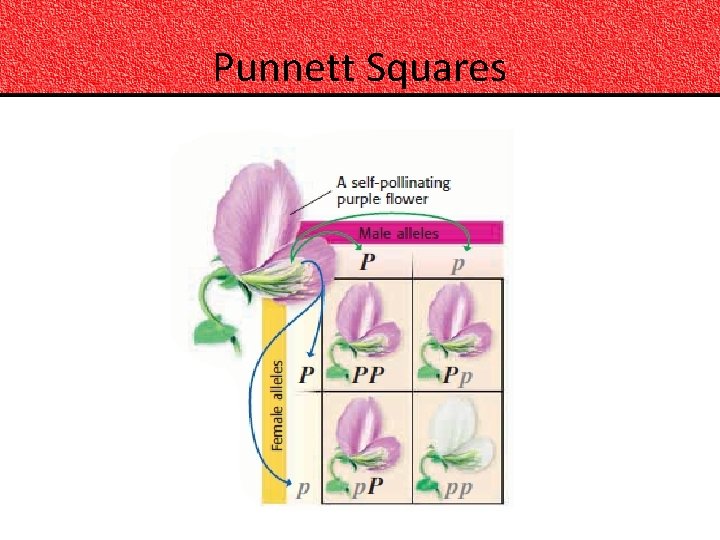
Punnett Squares A Punnett square is used to organize all the possible combinations of offspring from particular parents. The alleles for a true-breeding, purple-flowered plant are written as PP. The alleles for a true-breeding, white-flowered plant are written as pp. The Punnett square for this cross is shown on the next slide. All of the offspring have the same genotype: Pp. The dominant allele, P, in each genotype ensures that all of the offspring will be purple-flowered plants. The recessive allele, p, may be passed on to the next generation. This Punnett square shows the results of Mendel’s first experiments.
Punnett Squares Here is the Punnett square for this cross. All of the offspring have the same genotype: Pp. The dominant allele, P, in each genotype ensures that all of the offspring will be purpleflowered plants. The recessive allele, p, may be passed on to the next generation. This Punnett square shows the results of Mendel’s first experiments
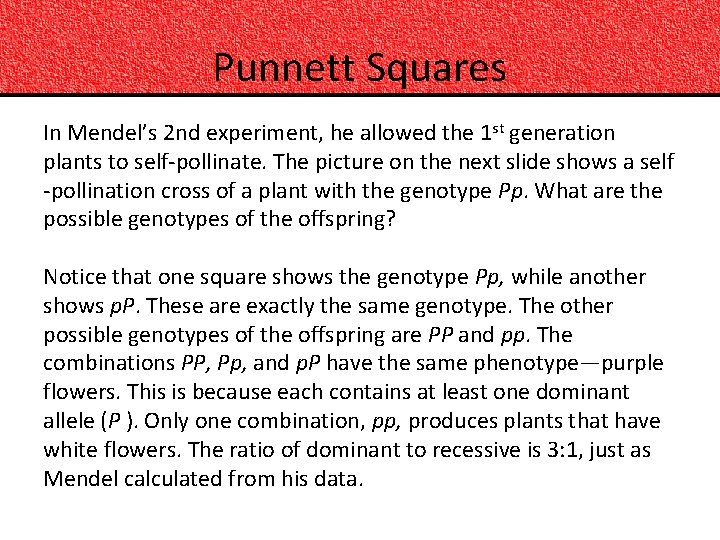
Punnett Squares In Mendel’s 2 nd experiment, he allowed the 1 st generation plants to self-pollinate. The picture on the next slide shows a self -pollination cross of a plant with the genotype Pp. What are the possible genotypes of the offspring? Notice that one square shows the genotype Pp, while another shows p. P. These are exactly the same genotype. The other possible genotypes of the offspring are PP and pp. The combinations PP, Pp, and p. P have the same phenotype—purple flowers. This is because each contains at least one dominant allele (P ). Only one combination, pp, produces plants that have white flowers. The ratio of dominant to recessive is 3: 1, just as Mendel calculated from his data.
Punnett Squares
Punnett Squares In a Punnett square, all the possible alleles from one parent are written across the top. All the possible alleles from the other parent are written down the left side. The combined alleles in the boxes of the Punnett square represent all the possible combinations in the offspring. In a genetic cross, the allele that each parent will pass on to its offspring is based on probability.
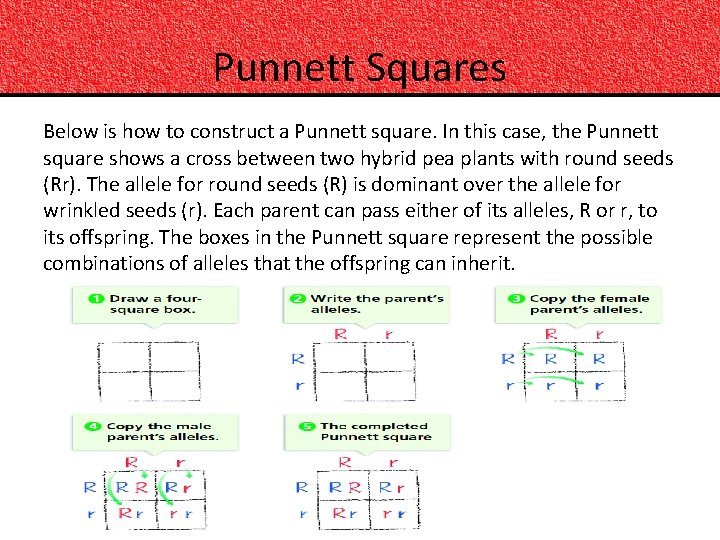
Punnett Squares Below is how to construct a Punnett square. In this case, the Punnett square shows a cross between two hybrid pea plants with round seeds (Rr). The allele for round seeds (R) is dominant over the allele for wrinkled seeds (r). Each parent can pass either of its alleles, R or r, to its offspring. The boxes in the Punnett square represent the possible combinations of alleles that the offspring can inherit.
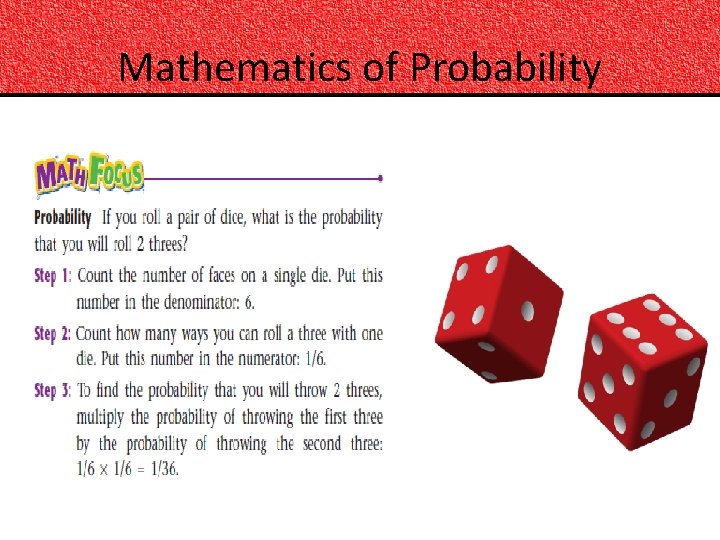
Probability Each parent has two alleles for each gene. When these alleles are different, as in Pp, offspring are equally likely to receive either allele. Think of a coin toss. There is a 50% chance you’ll get heads and a 50% chance you’ll get tails. The chance of receiving one allele or another is as random as a coin toss. The mathematical chance that something will happen is known as probability. It is how likely an event will occur, not necessarily what will occur. Probability is most often written as a fraction or percentage. If you toss a coin, the probability of tossing tails is 1/2—you will get tails half the time. The result of one coin toss does not affect the result of the next toss.
Mathematics of Probability
Probability and Genetics When Gregor Mendel analyzed the results of his crosses in peas, he carefully counted all the offspring. Over time, he realized that he could apply the principles of probability to his crosses. Mendel was the first scientist to recognize that the principles of probability can be used to predict the results of genetic crosses. To have white flowers, a pea plant must receive a p allele from each parent. Each offspring of a Pp x Pp cross has a 50% chance of receiving either allele from either parent. So, the probability of inheriting two p alleles is 1/2 x 1/2, which equals 1/4, or 25%. Traits in pea plants are easy to predict because there are only two choices for each trait, such as purple or white flowers and round or wrinkled seeds.
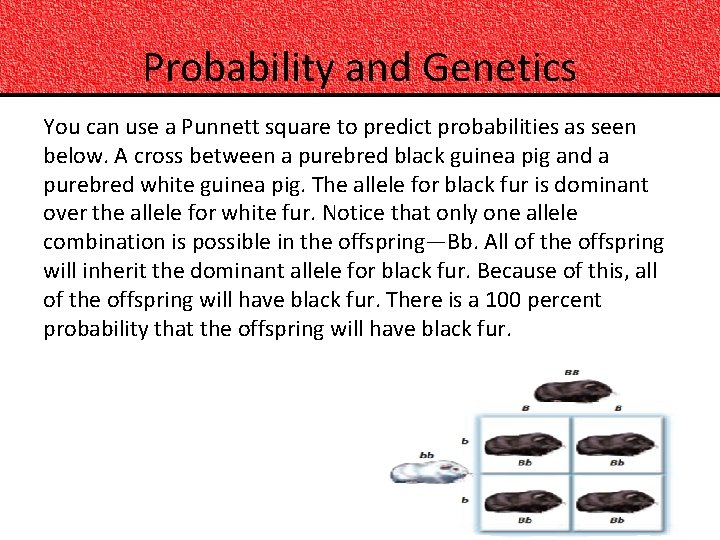
Probability and Genetics You can use a Punnett square to predict probabilities as seen below. A cross between a purebred black guinea pig and a purebred white guinea pig. The allele for black fur is dominant over the allele for white fur. Notice that only one allele combination is possible in the offspring—Bb. All of the offspring will inherit the dominant allele for black fur. Because of this, all of the offspring will have black fur. There is a 100 percent probability that the offspring will have black fur.
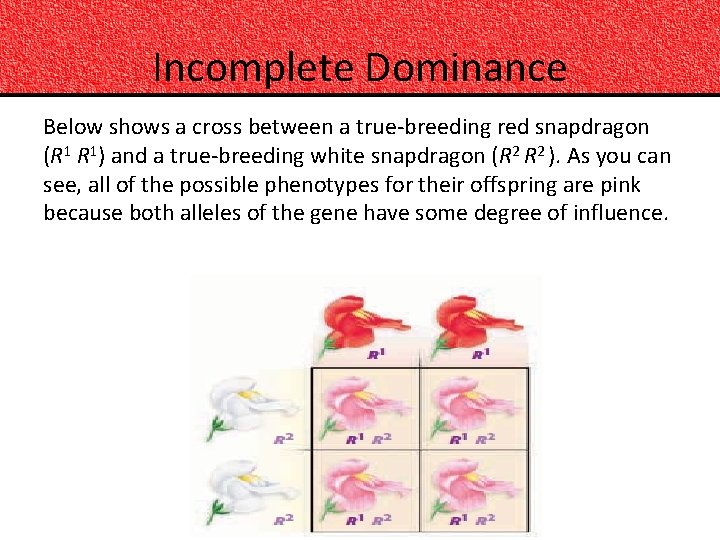
Incomplete Dominance Since Mendel’s discoveries, researchers have found that sometimes one trait is not completely dominant over another. These traits do not blend together, but each allele has its own degree of influence. This is known as incomplete dominance. A curly-haired parent and a straight-haired parent have wavyhaired children because of incomplete dominance. A classic example of incomplete dominance is found in the snapdragon flower.
Incomplete Dominance Below shows a cross between a true-breeding red snapdragon (R 1 R 1) and a true-breeding white snapdragon (R 2 ). As you can see, all of the possible phenotypes for their offspring are pink because both alleles of the gene have some degree of influence.
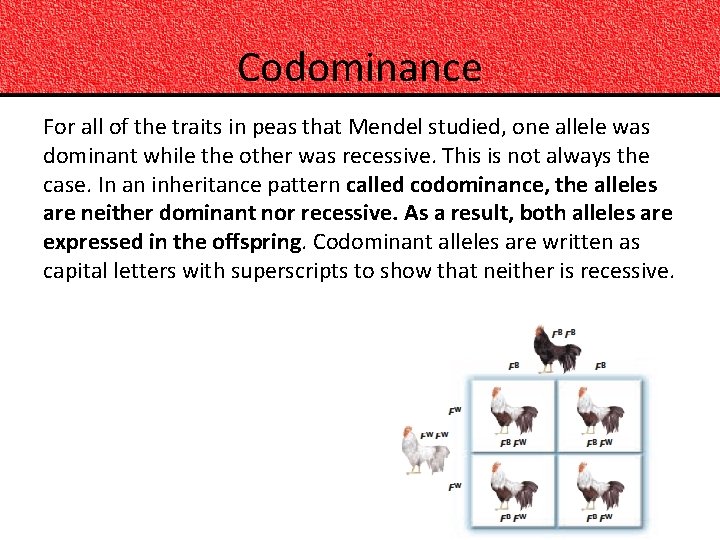
Codominance For all of the traits in peas that Mendel studied, one allele was dominant while the other was recessive. This is not always the case. In an inheritance pattern called codominance, the alleles are neither dominant nor recessive. As a result, both alleles are expressed in the offspring. Codominant alleles are written as capital letters with superscripts to show that neither is recessive.
Importance of Environment The effects of genes are often altered by the environment—the organism’s surroundings. Many of a person’s characteristics are determined by an interaction between genes and the environment. Several genes determine human height. However, environment also influences people’s heights. People’s diets can affect their height. A poor diet can prevent a person from growing as tall as might be possible. Environmental factors can also affect human skills, such as playing a musical instrument. For example, physical traits such as muscle coordination and a good sense of hearing will help a musician play well. But the musician also needs instruction on how to play the instrument. Musical instruction is an environmental factor.
Meiosis Where are genes located? How do genes pass information? Understanding reproduction can provide some answers. Two kinds of reproduction: asexual and sexual. Asexual reproduction results in offspring with genotypes that are exact copies of their parent’s genotype. Sexual reproduction produces offspring that share traits with their parents but are not exactly like either parent. In fact, offspring that share the same two parents vary a lot from each other, as well.
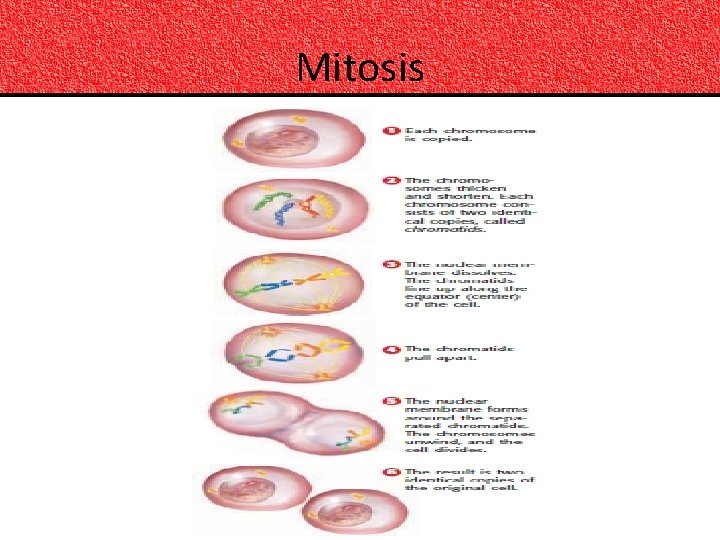
Reproduction In asexual reproduction, only one parent cell is needed. The structures inside the cell are copied, and then the parent cell divides, making two exact copies. This type of cell reproduction is known as mitosis. Most of the cells in your body and most single-celled organisms reproduce in this way. In sexual reproduction, two parent cells join together to form offspring that are different from both parents. The parent cells are called sex cells. Sex cells are different from ordinary body cells. Human body cells have 46, or 23 pairs of, chromosomes.
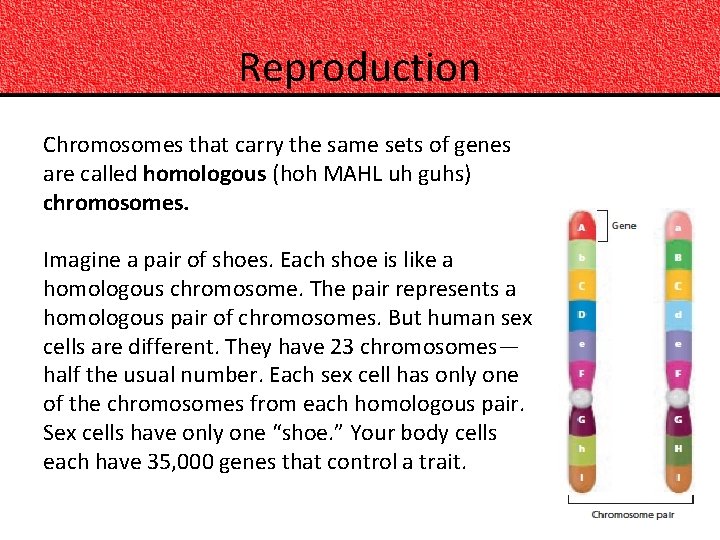
Reproduction Chromosomes that carry the same sets of genes are called homologous (hoh MAHL uh guhs) chromosomes. Imagine a pair of shoes. Each shoe is like a homologous chromosome. The pair represents a homologous pair of chromosomes. But human sex cells are different. They have 23 chromosomes— half the usual number. Each sex cell has only one of the chromosomes from each homologous pair. Sex cells have only one “shoe. ” Your body cells each have 35, 000 genes that control a trait.
Mitosis
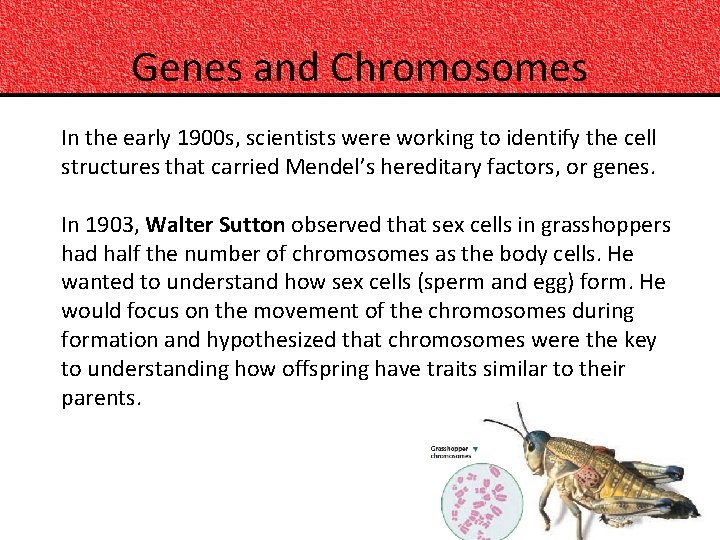
Genes and Chromosomes In the early 1900 s, scientists were working to identify the cell structures that carried Mendel’s hereditary factors, or genes. In 1903, Walter Sutton observed that sex cells in grasshoppers had half the number of chromosomes as the body cells. He wanted to understand how sex cells (sperm and egg) form. He would focus on the movement of the chromosomes during formation and hypothesized that chromosomes were the key to understanding how offspring have traits similar to their parents.
Genes and Chromosomes Sutton noticed that grasshoppers body cells have 24 chromosomes and when he looked closer he found that each sex cell had only 12 chromosomes. Each grasshopper offspring had exactly the same number of chromosomes in its body cells as each of the parents. He reasoned that the chromosomes in body cells actually occurred in pairs, with one chromosome in each pair coming from the male and the other coming from the female. From his observations, Sutton concluded that genes are located on chromosomes. He proposed the chromosome theory of inheritance. According to the chromosome theory of inheritance, genes are carried from parents to their offspring on chromosomes.
Genes and Chromosomes When chromosome pairs separate, so do the alleles carried on the chromosomes. One allele from each pair goes to each sex cell. Chromosomes are made up of many genes joined together like beads on a string. Each chromosome contains a large number of genes, each gene controlling a particular trait. Each chromosome pair has the same genes. The genes are lined up in the same order on both chromosomes. However, the alleles for some of the genes might differ from each other, making the organism heterozygous for some traits. If the alleles are the same, the organism is homozygous for those traits.
Genes and Chromosomes Organisms produce sex cells during meiosis. Meiosis is the process by which the number of chromosomes is reduced by half to form sex cells—sperm and eggs. During meiosis, the chromosome pairs separate and are distributed to two different cells. The resulting sex cells have only half as many chromosomes as the other cells in the organism. When they combine, each sex cell contributes half the number of chromosomes to produce offspring with the correct number of chromosomes. Before meiosis begins, every chromosome in the parent cell is copied. Centromeres hold the two chromatids together.
Meiosis Sex cells are made during meiosis (mie OH sis). Meiosis is a copying process that produces cells with half the usual number of chromosomes. Each sex cell receives one-half of each homologous pair. For example, a human egg cell has 23 chromosomes, and a sperm cell has 23 chromosomes. The new cell that forms when an egg cell and a sperm cell join has 46 chromosomes. Because the genes of the parents are sorted and recombined randomly in the offspring, the offspring is different from the parents. If the same parents have more offspring, the genes will be sorted again, and these offspring will be different from each other as well as from the parents.
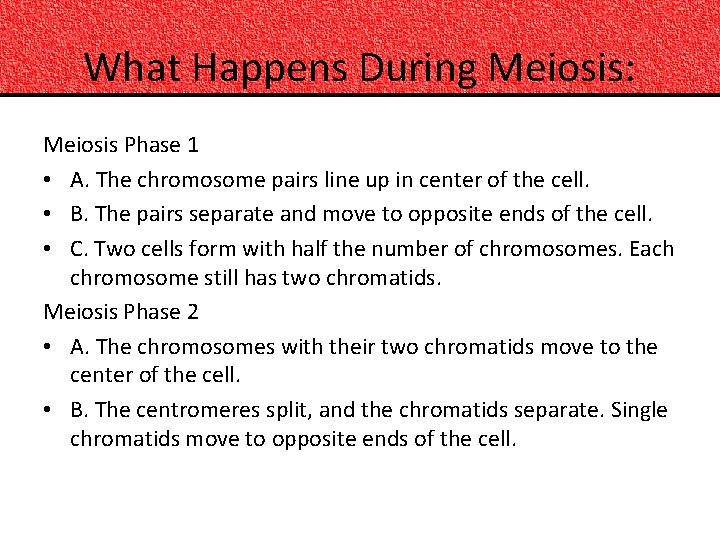
What Happens During Meiosis: Meiosis Phase 1 • A. The chromosome pairs line up in center of the cell. • B. The pairs separate and move to opposite ends of the cell. • C. Two cells form with half the number of chromosomes. Each chromosome still has two chromatids. Meiosis Phase 2 • A. The chromosomes with their two chromatids move to the center of the cell. • B. The centromeres split, and the chromatids separate. Single chromatids move to opposite ends of the cell.
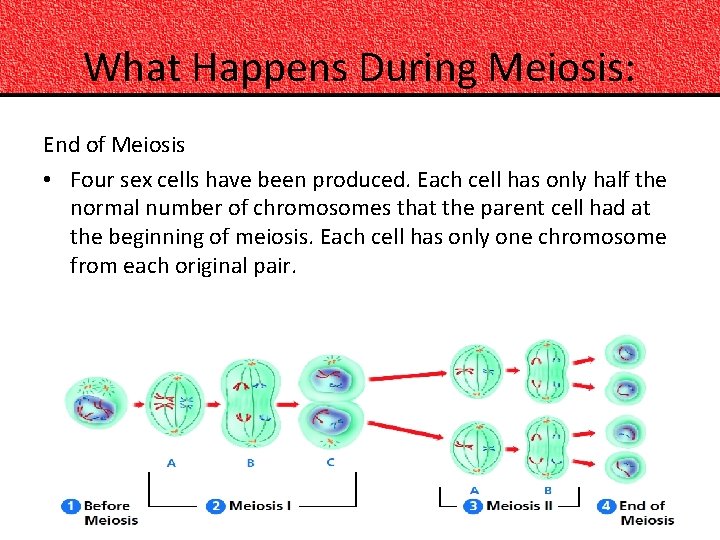
What Happens During Meiosis: End of Meiosis • Four sex cells have been produced. Each cell has only half the normal number of chromosomes that the parent cell had at the beginning of meiosis. Each cell has only one chromosome from each original pair.
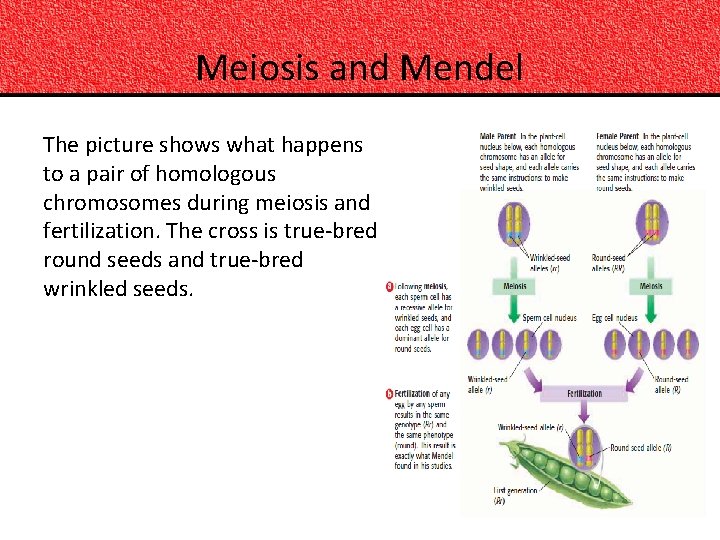
Meiosis and Mendel The picture shows what happens to a pair of homologous chromosomes during meiosis and fertilization. The cross is true-bred round seeds and true-bred wrinkled seeds.
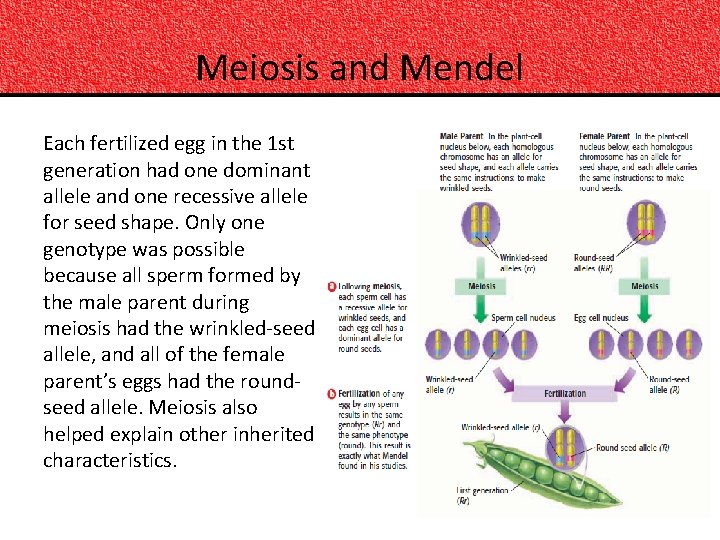
Meiosis and Mendel Each fertilized egg in the 1 st generation had one dominant allele and one recessive allele for seed shape. Only one genotype was possible because all sperm formed by the male parent during meiosis had the wrinkled-seed allele, and all of the female parent’s eggs had the roundseed allele. Meiosis also helped explain other inherited characteristics.
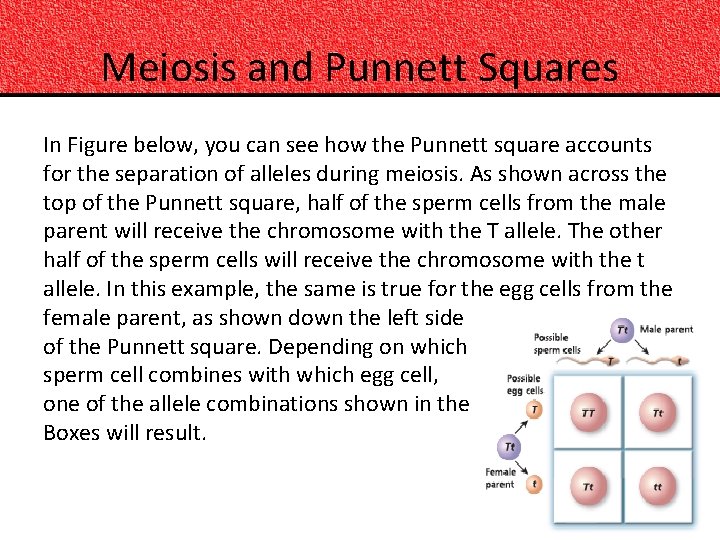
Meiosis and Punnett Squares In Figure below, you can see how the Punnett square accounts for the separation of alleles during meiosis. As shown across the top of the Punnett square, half of the sperm cells from the male parent will receive the chromosome with the T allele. The other half of the sperm cells will receive the chromosome with the t allele. In this example, the same is true for the egg cells from the female parent, as shown down the left side of the Punnett square. Depending on which sperm cell combines with which egg cell, one of the allele combinations shown in the Boxes will result.
Human Inheritance In humans traits can be controlled by either: 1. Single genes with two alleles 2. Single genes with multiple alleles 3. Multiple genes with multiple alleles.
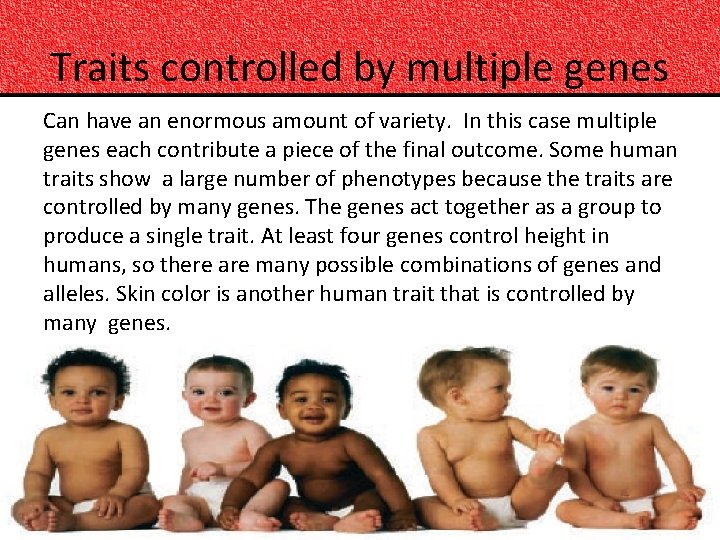
Human Inheritance Some human traits are controlled by single genes with two alleles, and others by single genes with multiple alleles. Still other traits are controlled by many genes that act together. Height and skin color are both examples of human traits controlled by many genes. When more than one gene controls a trait, there are many possible combinations of genes and alleles. There is an enormous variety of phenotypes for height, for example, and human skin color ranges from almost white to nearly black, with many shades in between.
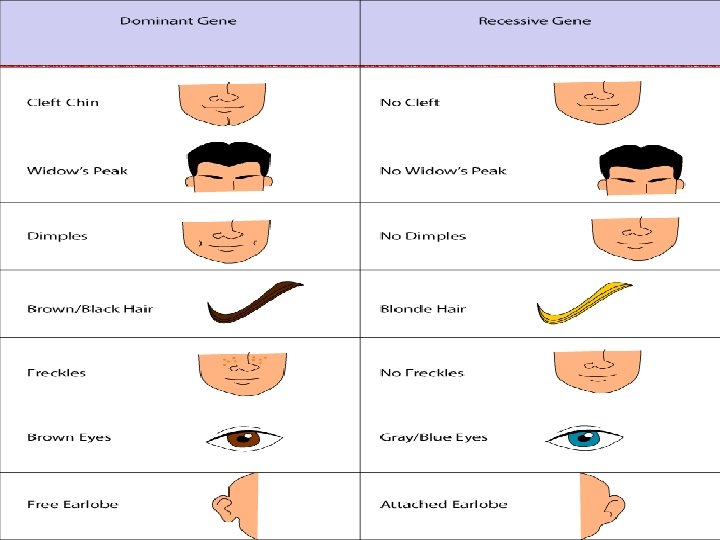
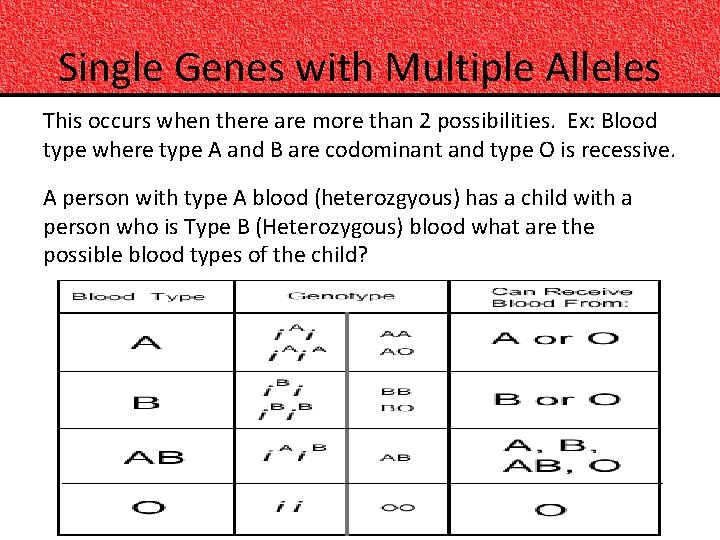
Human Inheritance Many human traits are controlled by a single gene with one dominant allele and one recessive allele. As with tall and short pea plants, these human traits have two distinctly different phenotypes, or physical appearances. For example, the allele for a widow’s peak, which is a hairline that comes to a point in the middle of the forehead, is dominant over the allele for a straight hairline. Some human traits are controlled by a single gene that has more than two alleles. Such a gene is said to have multiple alleles— three or more forms of a gene that code for a single trait. An example of a human trait that is controlled by a gene with multiple alleles is blood type. There are four main blood types— A, B, AB, and O— controlled by three alleles.
Single Genes with Multiple Alleles This occurs when there are more than 2 possibilities. Ex: Blood type where type A and B are codominant and type O is recessive. A person with type A blood (heterozgyous) has a child with a person who is Type B (Heterozygous) blood what are the possible blood types of the child?
Traits controlled by multiple genes Can have an enormous amount of variety. In this case multiple genes each contribute a piece of the final outcome. Some human traits show a large number of phenotypes because the traits are controlled by many genes. The genes act together as a group to produce a single trait. At least four genes control height in humans, so there are many possible combinations of genes and alleles. Skin color is another human trait that is controlled by many genes.
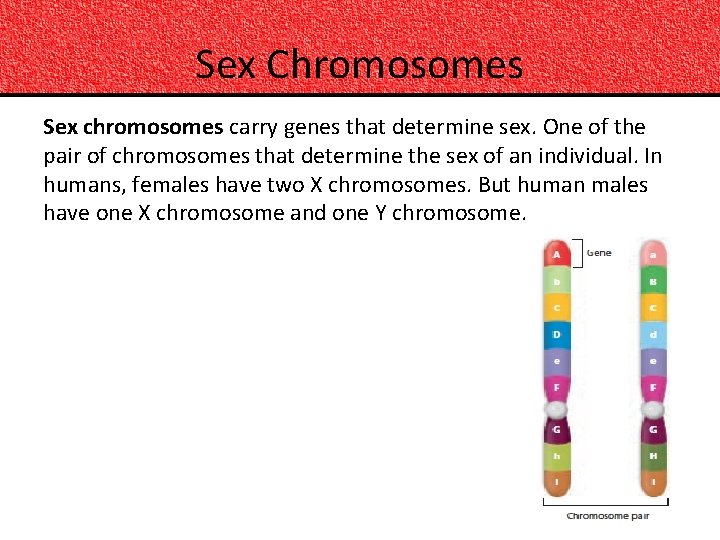
Sex Chromosomes Sex chromosomes carry genes that determine sex. One of the pair of chromosomes that determine the sex of an individual. In humans, females have two X chromosomes. But human males have one X chromosome and one Y chromosome.
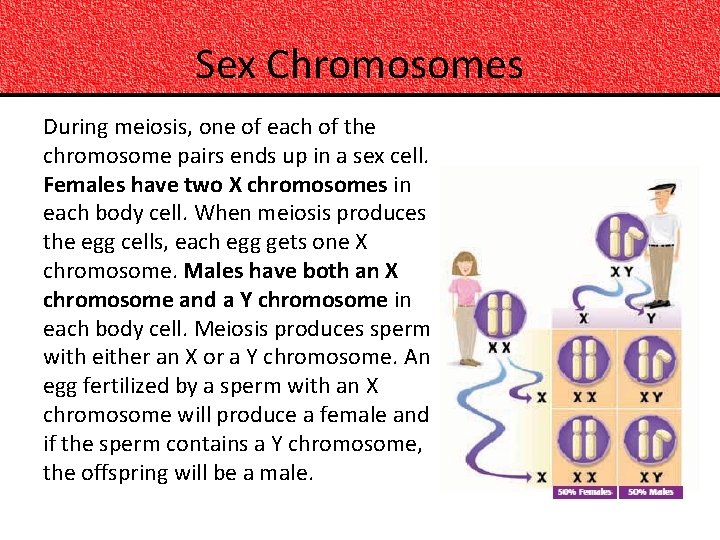
Sex Chromosomes During meiosis, one of each of the chromosome pairs ends up in a sex cell. Females have two X chromosomes in each body cell. When meiosis produces the egg cells, each egg gets one X chromosome. Males have both an X chromosome and a Y chromosome in each body cell. Meiosis produces sperm with either an X or a Y chromosome. An egg fertilized by a sperm with an X chromosome will produce a female and if the sperm contains a Y chromosome, the offspring will be a male.
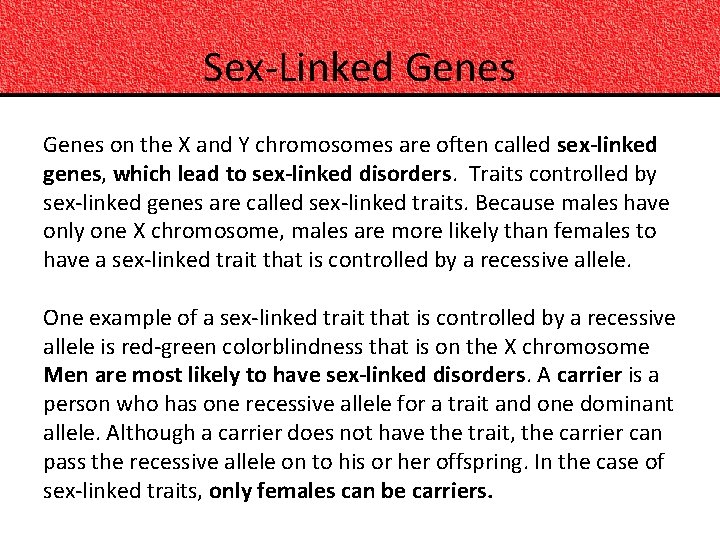
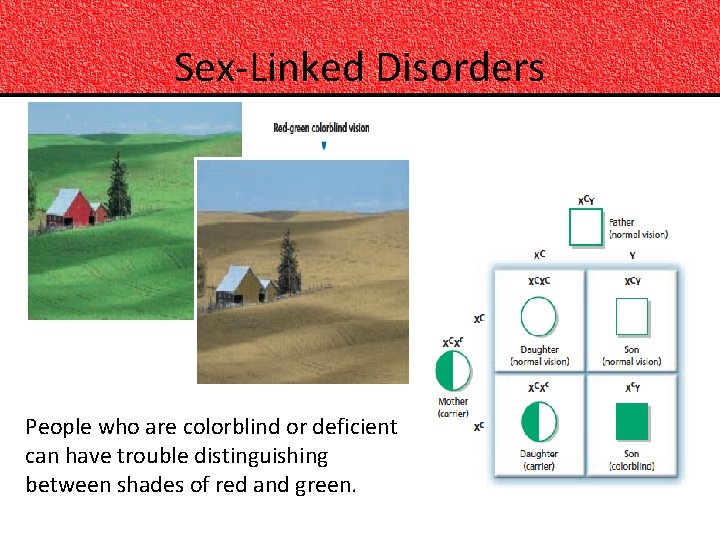
Sex-Linked Genes on the X and Y chromosomes are often called sex-linked genes, which lead to sex-linked disorders. Traits controlled by sex-linked genes are called sex-linked traits. Because males have only one X chromosome, males are more likely than females to have a sex-linked trait that is controlled by a recessive allele. One example of a sex-linked trait that is controlled by a recessive allele is red-green colorblindness that is on the X chromosome Men are most likely to have sex-linked disorders. A carrier is a person who has one recessive allele for a trait and one dominant allele. Although a carrier does not have the trait, the carrier can pass the recessive allele on to his or her offspring. In the case of sex-linked traits, only females can be carriers.
Sex-Linked Genes A genetic disorder is an abnormal condition that a person inherits through genes or chromosomes. Some genetic disorders are caused by mutations in the DNA of genes. Other disorders are caused by changes in the overall structure or number of chromosomes.
Sex-Linked Disorders People who are colorblind or deficient can have trouble distinguishing between shades of red and green.
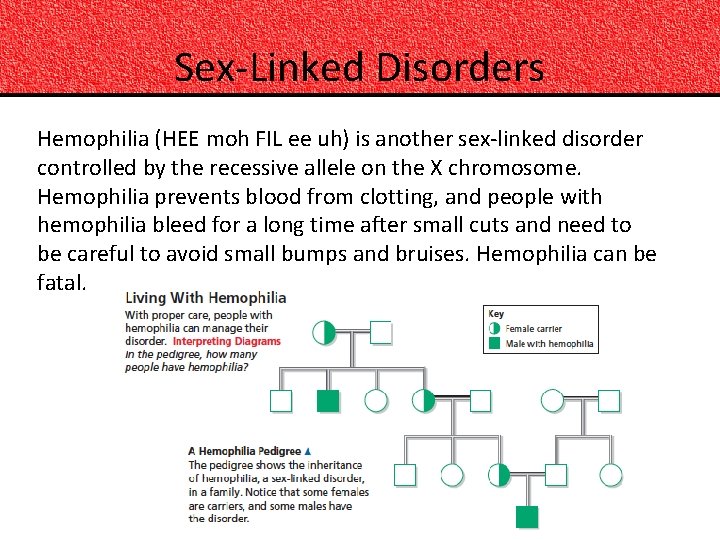
Sex-Linked Disorders Hemophilia (HEE moh FIL ee uh) is another sex-linked disorder controlled by the recessive allele on the X chromosome. Hemophilia prevents blood from clotting, and people with hemophilia bleed for a long time after small cuts and need to be careful to avoid small bumps and bruises. Hemophilia can be fatal.
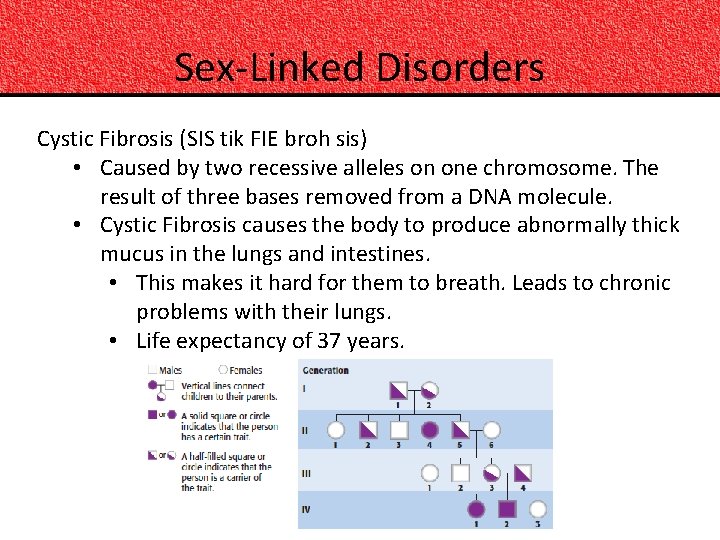
Sex-Linked Disorders Cystic Fibrosis (SIS tik FIE broh sis) • Caused by two recessive alleles on one chromosome. The result of three bases removed from a DNA molecule. • Cystic Fibrosis causes the body to produce abnormally thick mucus in the lungs and intestines. • This makes it hard for them to breath. Leads to chronic problems with their lungs. • Life expectancy of 37 years.
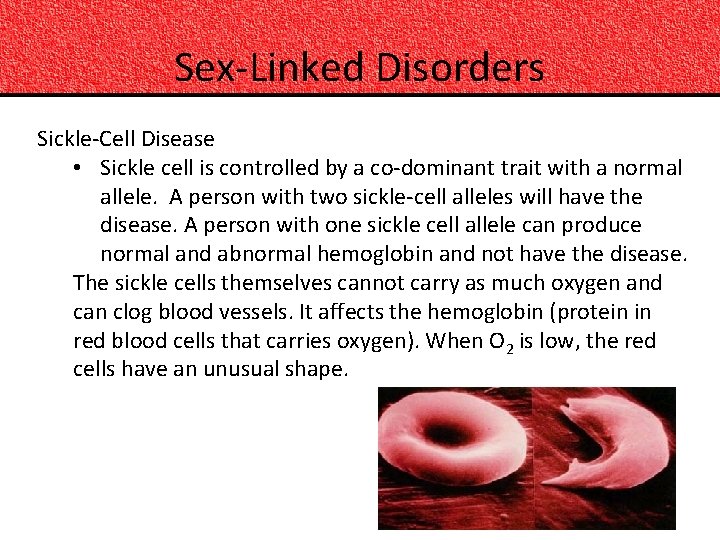
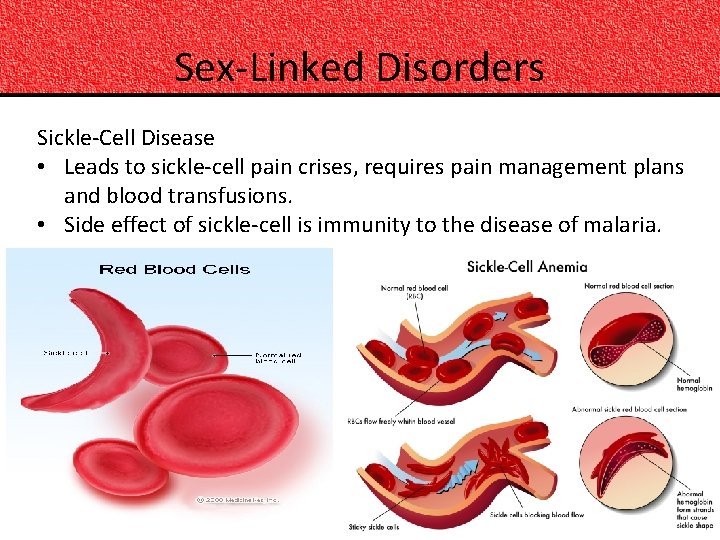
Sex-Linked Disorders Sickle-Cell Disease • Sickle cell is controlled by a co-dominant trait with a normal allele. A person with two sickle-cell alleles will have the disease. A person with one sickle cell allele can produce normal and abnormal hemoglobin and not have the disease. The sickle cells themselves cannot carry as much oxygen and can clog blood vessels. It affects the hemoglobin (protein in red blood cells that carries oxygen). When O 2 is low, the red cells have an unusual shape.
Sex-Linked Disorders Sickle-Cell Disease • Leads to sickle-cell pain crises, requires pain management plans and blood transfusions. • Side effect of sickle-cell is immunity to the disease of malaria.
Chromosomal Disorder Down Syndrome – Caused by a person have an extra copy of chromosome 21, which means that they have three of that chromosome instead of the normal pair. – Caused by a failure of the chromosomes to separate during meiosis. – Effects brain development, other symptoms can vary. – Most common to have other severe health defects along with down syndrome, to include some mental deficits. Heart defects are common and can be treated. – No treatment for any of the disorders mentioned. – Symptoms are treated by a combination of drugs and care, and can result in a productive normal life.
Pedigrees How would you trace the occurrence of a genetic disorder through several generations of a family? One important tool that geneticists use to trace the inheritance of traits in humans is a pedigree. A pedigree is a chart or “family tree” that tracks which members of a family have a particular trait. The trait in a pedigree can be an ordinary trait, such as a widow ’s peak, or a genetic disorder, such as cystic fibrosis. By making a pedigree, a counselor can often predict whether a person is a carrier of a hereditary disease.
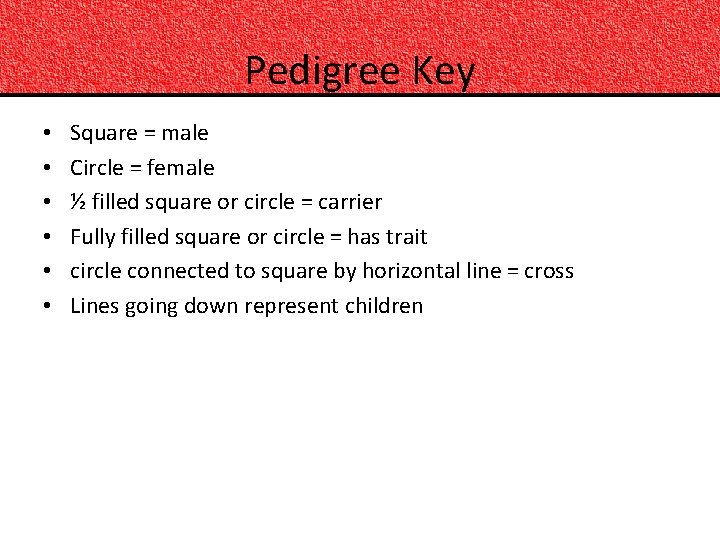
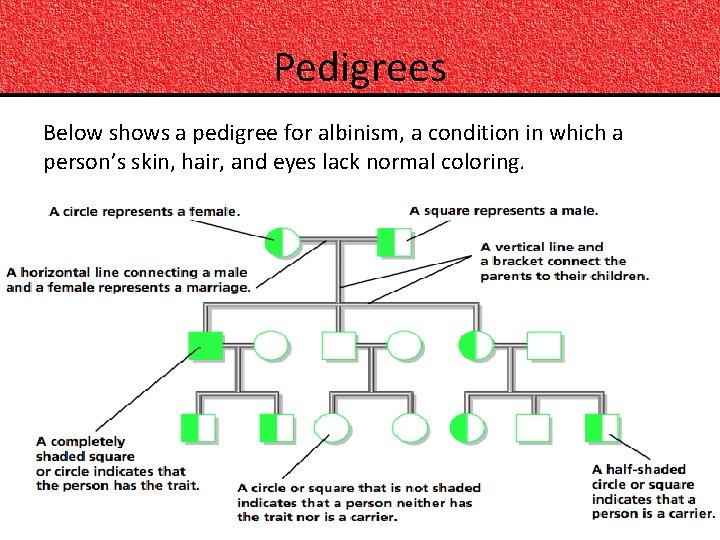
Pedigree Key • • • Square = male Circle = female ½ filled square or circle = carrier Fully filled square or circle = has trait circle connected to square by horizontal line = cross Lines going down represent children
Pedigrees Below shows a pedigree for albinism, a condition in which a person’s skin, hair, and eyes lack normal coloring.
Managing Genetic Disorders Years ago, doctors had only Punnett squares and pedigrees to help them predict whether a child might have a genetic disorder. Today, doctors use tools such as karyotypes to help diagnose genetic disorders. People with genetic disorders are helped through medical care, education, job training, and other methods. Karyotypes To detect chromosomal disorders such as Down syndrome, a doctor examines the chromosomes from a person’s cells. The doctor uses a karyotype to examine the chromosomes. A karyotype (KA ree uh ty p) is a picture of all the chromosomes in a cell. The chromosomes in a karyotpe arranged in pairs. A karyotype can reveal whether a person has the correct number of chromosomes in his or her cells. If you did the Discover activity, you saw a karyotype from a girl with Down syndrome.
Genetic Counseling A couple that has a family history of a genetic disorder may turn to a genetic counselor for advice. Genetic counselors help couples understand their chances of having a child with a particular genetic disorder. Genetic counselors use tools such as karyotypes, pedigree charts, and Punnett squares to help them in their work.
Dealing with Genetic Disorders People with genetic disorders face serious challenges, but help is available. Medical treatments help people with some disorders. For example, physical therapy helps remove mucus from the lungs of people with cystic fibrosis. People with sickle-cell disease take folic acid, a vitamin, to help their bodies manufacture red blood cells. Because of education and job training, adults with Down syndrome can find work in hotels, banks, restaurants, and other places of employment. Fortunately, most genetic disorders do not prevent people from living active, productive lives.
Selective Breeding Genetic techniques have enabled people to produce organisms with desirable traits. Selective breeding, cloning, and genetic engineering are three methods for developing organisms with desirable traits. The process of selecting organisms with desired traits to be parents of the next generation is called selective breeding. Examples include farmers saving seeds from the healthiest plants that produced the best food. They would then plant those seeds over and over to develop plants that produced better corps. People have used selective breeding with many different plants and animals. Two selective breeding techniques are inbreeding and hybridization.
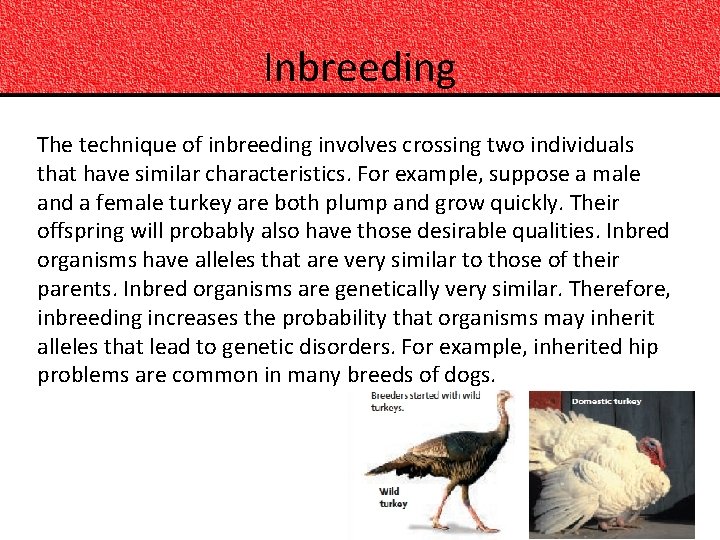
Inbreeding The technique of inbreeding involves crossing two individuals that have similar characteristics. For example, suppose a male and a female turkey are both plump and grow quickly. Their offspring will probably also have those desirable qualities. Inbred organisms have alleles that are very similar to those of their parents. Inbred organisms are genetically very similar. Therefore, inbreeding increases the probability that organisms may inherit alleles that lead to genetic disorders. For example, inherited hip problems are common in many breeds of dogs.
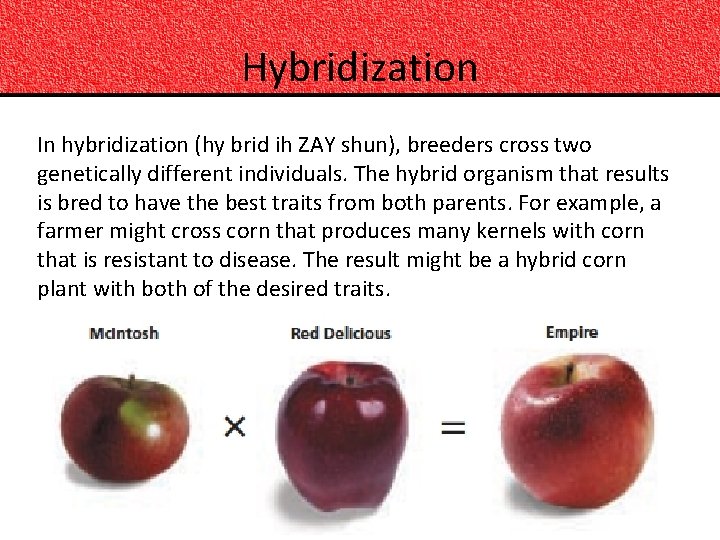
Hybridization In hybridization (hy brid ih ZAY shun), breeders cross two genetically different individuals. The hybrid organism that results is bred to have the best traits from both parents. For example, a farmer might cross corn that produces many kernels with corn that is resistant to disease. The result might be a hybrid corn plant with both of the desired traits.
Cloning For some organisms, a technique called cloning can be used to produce offspring with desired traits. A clone is an organism that has exactly the same genes as the organism from which it was produced. It isn’t hard to clone some kinds of plants, such as an African violet. Just cut a stem from one plant, and put the stem in soil. Water it, and soon you will have a whole new plant. The new plant is genetically identical to the plant from which the stem was cut. Researchers have also cloned animals such as sheep and pigs. The methods for cloning these animals are complex. They involve taking the nucleus of an animal’s body cell and using that nucleus to produce a new animal.
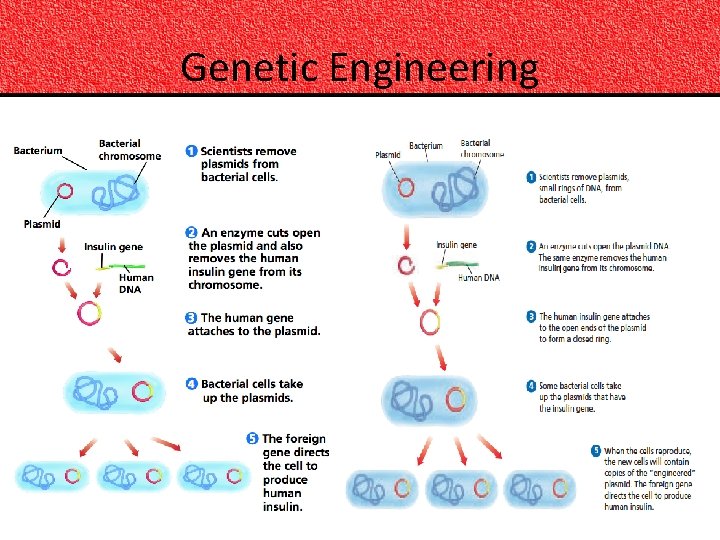
Genetic Engineering Geneticists have developed another powerful technique for producing organisms with desired traits. Scientists can manipulate individual genes within organisms. This kind of manipulation is called genetic engineering. In this process, called genetic engineering, genes from one organism are transferred into the DNA of another organism. Genetic engineering can produce medicines, fabrics, and improve food crops.
Genetic Engineering in Bacteria One type of genetically engineered bacteria produces a protein called insulin. Injections of insulin are needed by many people with diabetes. Recall that bacteria have a single DNA molecule in the cytoplasm. Some bacterial cells also contain small circular pieces of DNA called plasmids. On the next slide you can see how scientists insert the DNA for a human gene into the plasmid of a bacterium. Once the gene is inserted into the plasmid, the bacterial cell and all its offspring will contain this human gene. As a result, the bacteria produce the protein that the human gene codes for—in this case, insulin. Because bacteria reproduce quickly, large amounts of insulin can be produced in a short time.
Genetic Engineering
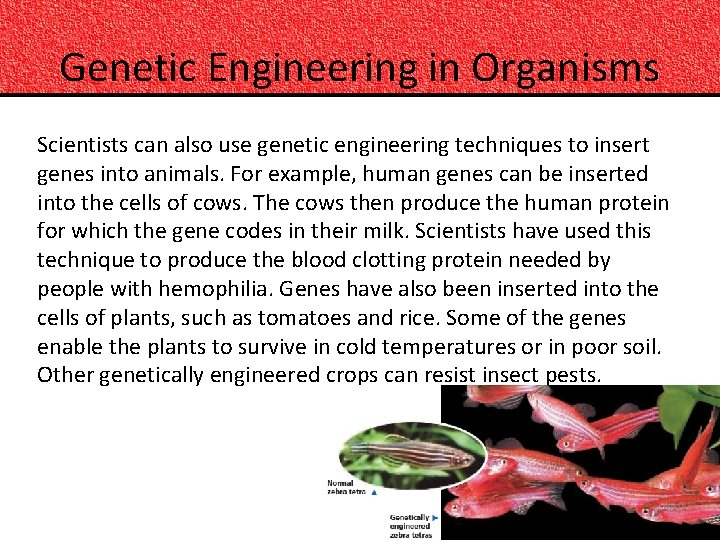
Genetic Engineering in Organisms Scientists can also use genetic engineering techniques to insert genes into animals. For example, human genes can be inserted into the cells of cows. The cows then produce the human protein for which the gene codes in their milk. Scientists have used this technique to produce the blood clotting protein needed by people with hemophilia. Genes have also been inserted into the cells of plants, such as tomatoes and rice. Some of the genes enable the plants to survive in cold temperatures or in poor soil. Other genetically engineered crops can resist insect pests.
Genetic Engineering- Gene Therapy Someday it may be possible to use genetic engineering to correct some genetic disorders in humans. This process, called gene therapy, will involve inserting copies of a gene directly into a person’s cells. For example, doctors may be able to treat hemophilia by replacing the defective allele on the X chromosome. The person’s blood would then clot normally.
Concerns on Genetic Engineering Some people are concerned about the long-term effects of genetic engineering. For example, some people think that genetically engineered crops may not be entirely safe. People fear that these crops may harm the environment or cause health problems in humans. To address such concerns, scientists are trying to learn more about the effects of genetic engineering.
Learning About Human Genetics Recent advances have enabled scientists to learn a great deal about human genetics. The Human Genome Project and DNA fingerprinting are two applications of this new knowledge.
Learning About Human Genetics The Human Genome Project Imagine trying to crack a code that is 6 billion letters long. That’s exactly what scientists working on the Human Genome Project have been doing. A genome is all the DNA in one cell of an organism. The main goal of the Human Genome Project has been to identify the DNA sequence of every gene in the human genome. The Human Genome Project has completed a “first draft” of the human genome. The scientists have learned that the DNA of humans has at least 30, 000 genes. The average gene has about 3, 000 bases. Scientists will someday know the DNA sequence of every human gene.
Learning About Human Genetics DNA Fingerprinting DNA technology used in the Human Genome Project can also identify people and show whether people are related. DNA fingerprinting identifies the unique patterns in an individual’s DNA samples are now used as evidence in crimes. DNA from a person’s cells is broken down into small pieces, or fragments. Selected fragments are used to produce a pattern called a DNA fingerprint. Except for identical twins, no two people have exactly the same DNA fingerprint.
Learning About Human Genetics DNA Fingerprinting Scientists are now able to create something like a twin, called a clone. A clone is a new organism that has an exact copy of another organism’s genes. Clones of several types of organisms, including some mammals, have been developed by scientists. However, the possibility of cloning humans is still being debated among both scientists and politicians. .
DNA For many years, the structure of a DNA molecule was a puzzle to scientists. In the 1950 s, two scientists deduced the structure while experimenting with chemical models. They later won a Nobel Prize for helping solve this puzzle!
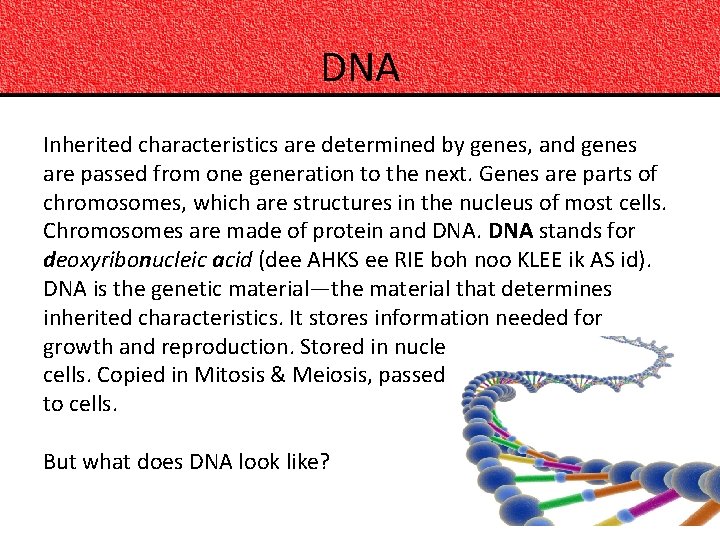
DNA Inherited characteristics are determined by genes, and genes are passed from one generation to the next. Genes are parts of chromosomes, which are structures in the nucleus of most cells. Chromosomes are made of protein and DNA stands for deoxyribonucleic acid (dee AHKS ee RIE boh noo KLEE ik AS id). DNA is the genetic material—the material that determines inherited characteristics. It stores information needed for growth and reproduction. Stored in nucleus of all cells. Copied in Mitosis & Meiosis, passed to cells. But what does DNA look like?
DNA Scientists knew that the material that makes up genes must be able to do two things. First, it must be able to give instructions for building and maintaining cells. Second, it must be able to be copied each time a cell divides, so that each cell contains identical genes. Scientists thought that these things could be done only by complex molecules, such as proteins. They were surprised to learn how much the DNA molecule could do.
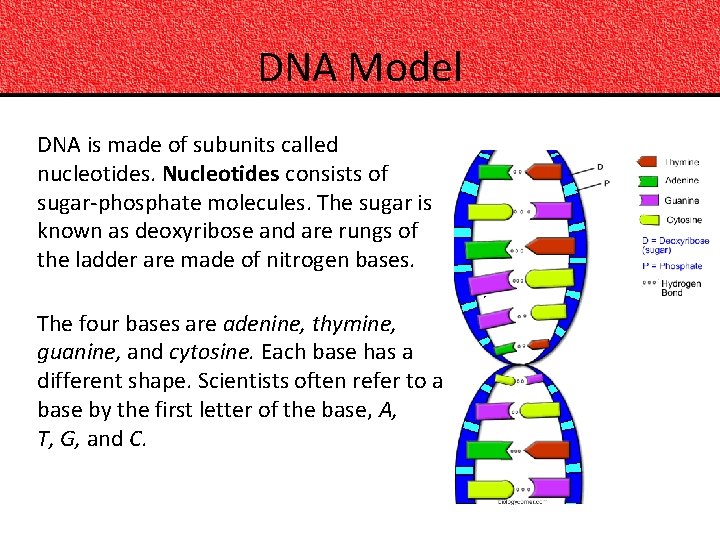
DNA Model DNA is made of subunits called nucleotides. Nucleotides consists of sugar-phosphate molecules. The sugar is known as deoxyribose and are rungs of the ladder are made of nitrogen bases. The four bases are adenine, thymine, guanine, and cytosine. Each base has a different shape. Scientists often refer to a base by the first letter of the base, A, T, G, and C.
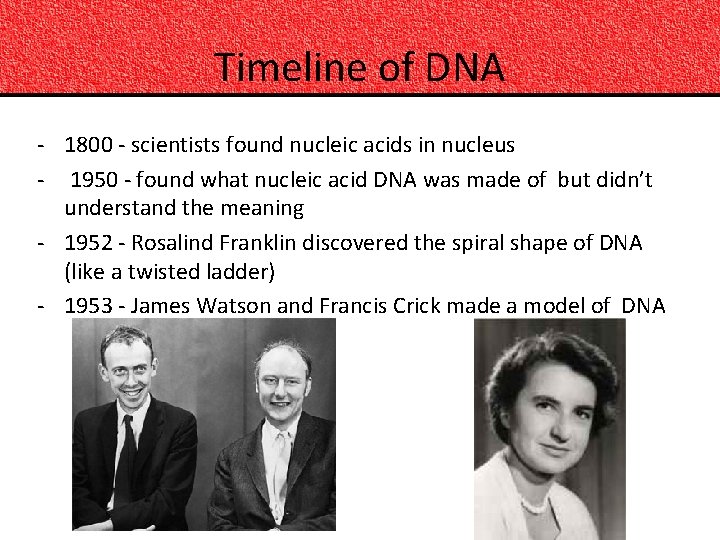
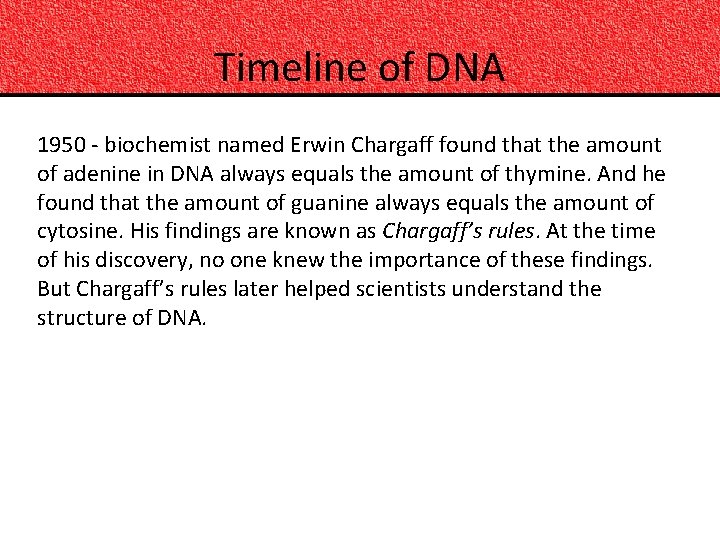
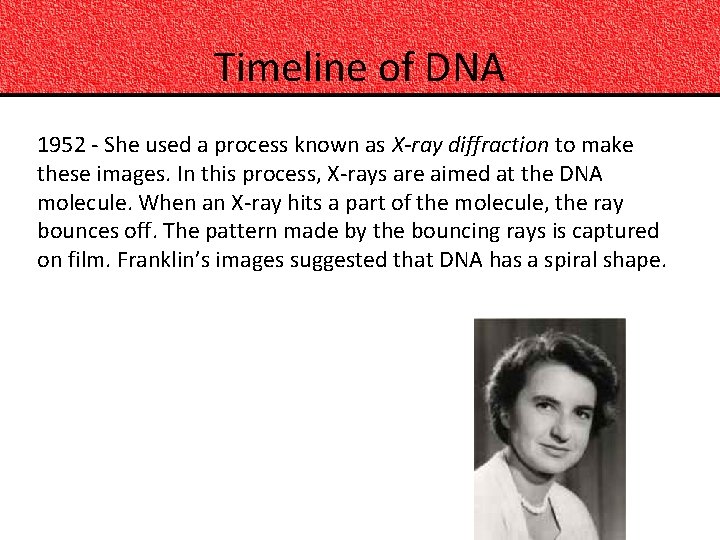
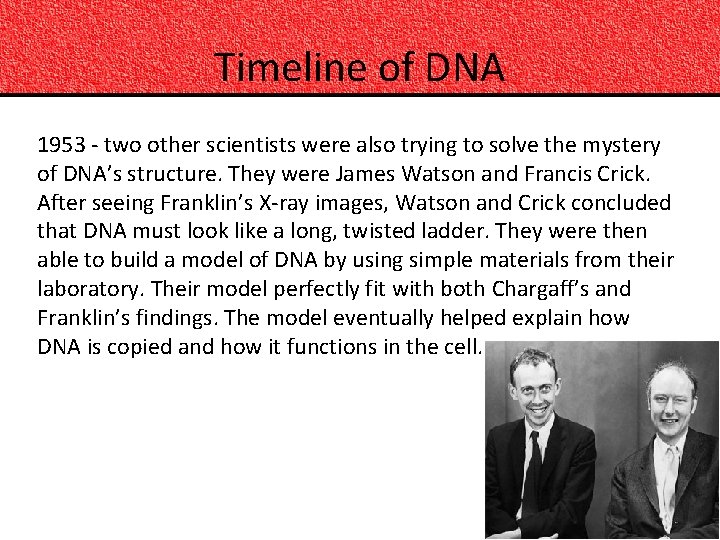
Timeline of DNA - 1800 - scientists found nucleic acids in nucleus - 1950 - found what nucleic acid DNA was made of but didn’t understand the meaning - 1952 - Rosalind Franklin discovered the spiral shape of DNA (like a twisted ladder) - 1953 - James Watson and Francis Crick made a model of DNA
Timeline of DNA 1950 - biochemist named Erwin Chargaff found that the amount of adenine in DNA always equals the amount of thymine. And he found that the amount of guanine always equals the amount of cytosine. His findings are known as Chargaff’s rules. At the time of his discovery, no one knew the importance of these findings. But Chargaff’s rules later helped scientists understand the structure of DNA.
Timeline of DNA 1952 - She used a process known as X-ray diffraction to make these images. In this process, X-rays are aimed at the DNA molecule. When an X-ray hits a part of the molecule, the ray bounces off. The pattern made by the bouncing rays is captured on film. Franklin’s images suggested that DNA has a spiral shape.
Timeline of DNA 1953 - two other scientists were also trying to solve the mystery of DNA’s structure. They were James Watson and Francis Crick. After seeing Franklin’s X-ray images, Watson and Crick concluded that DNA must look like a long, twisted ladder. They were then able to build a model of DNA by using simple materials from their laboratory. Their model perfectly fit with both Chargaff’s and Franklin’s findings. The model eventually helped explain how DNA is copied and how it functions in the cell.
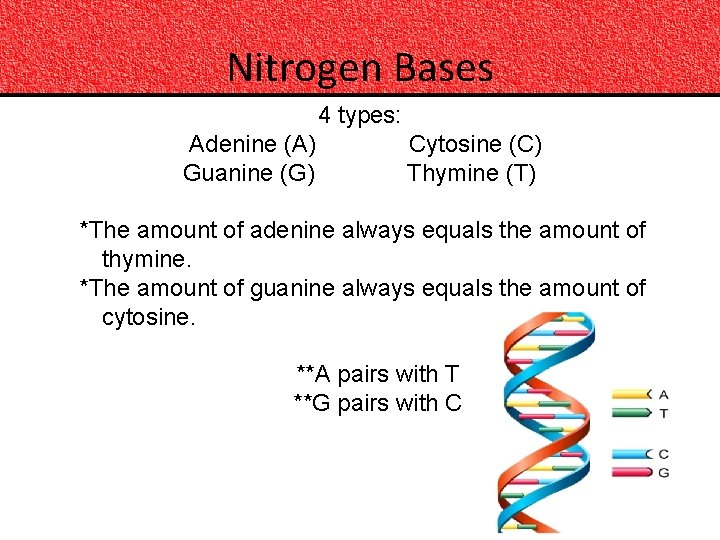
DNA’s Double Structure A strand of DNA looks like a twisted ladder. This shape is known as a double helix (DUB uhl HEE LIKS). The two sides of the ladder are made of alternating sugar parts and phosphate parts. The rungs of the ladder are made of a pair of bases. Adenine on one side of a rung always pairs with thymine on the other side. Guanine always pairs with cytosine.
DNA’s Double Structure Notice how the double helix structure matches Chargaff’s observations. When Chargaff separated the parts of a sample of DNA, he found that the matching bases were always present in equal amounts. To model how the bases pair, Watson and Crick tried to match Chargaff’s observations. They also used information from chemists about the size and shape of each of the nucleotides. As it turned out, the width of the DNA ladder matches the combined width of the matching bases. Only the correct pairs of bases fit within the ladder’s width.
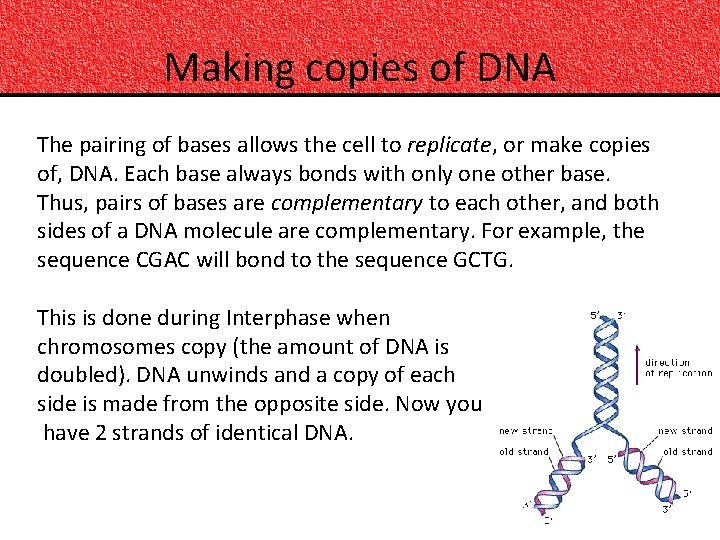
Making copies of DNA The pairing of bases allows the cell to replicate, or make copies of, DNA. Each base always bonds with only one other base. Thus, pairs of bases are complementary to each other, and both sides of a DNA molecule are complementary. For example, the sequence CGAC will bond to the sequence GCTG. This is done during Interphase when chromosomes copy (the amount of DNA is doubled). DNA unwinds and a copy of each side is made from the opposite side. Now you have 2 strands of identical DNA.
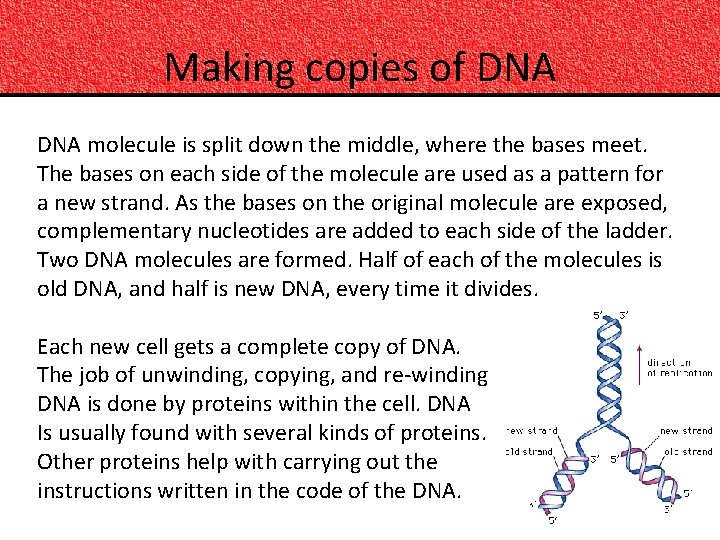
Making copies of DNA molecule is split down the middle, where the bases meet. The bases on each side of the molecule are used as a pattern for a new strand. As the bases on the original molecule are exposed, complementary nucleotides are added to each side of the ladder. Two DNA molecules are formed. Half of each of the molecules is old DNA, and half is new DNA, every time it divides. Each new cell gets a complete copy of DNA. The job of unwinding, copying, and re-winding DNA is done by proteins within the cell. DNA Is usually found with several kinds of proteins. Other proteins help with carrying out the instructions written in the code of the DNA.
How DNA Works Almost every cell in your body contains about 2 m of DNA. How does all of the DNA fi t in a cell? And how does the DNA hold a code that affects your traits? DNA is found in the cells of all organisms, including bacteria, mosquitoes, and humans. Each organism has a unique set of DNA. But DNA functions the same way in all organisms.
Unraveling DNA is often wound around proteins, coiled into strands, and then bundled up even more. In a cell that lacks a nucleus, each strand of DNA forms a loose loop within the cell. In a cell that has a nucleus, the strands of DNA and proteins are bundled into chromosomes. The structure of DNA allows DNA to hold information. The order of the bases on one side of the molecule is a code that carries information. A gene consists of a string of nucleotides that give the cell information about how to make a specific trait. There is an enormous amount of DNA, so there can be a large variety of genes.
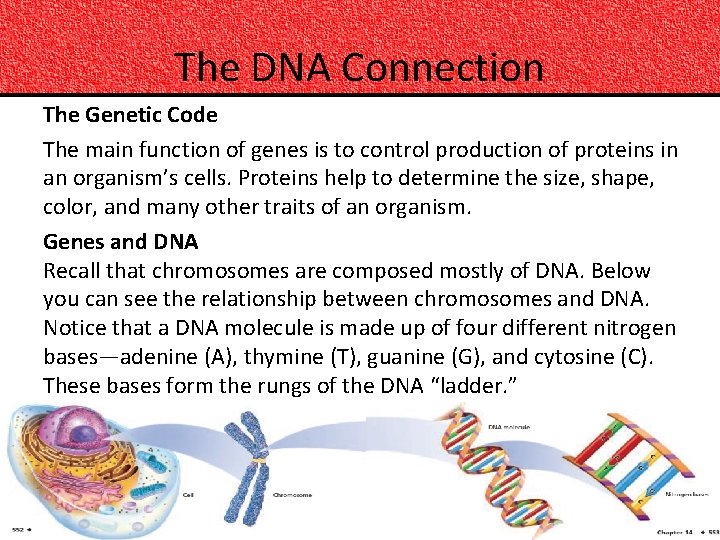
The DNA Connection The Genetic Code The main function of genes is to control production of proteins in an organism’s cells. Proteins help to determine the size, shape, color, and many other traits of an organism. Genes and DNA Recall that chromosomes are composed mostly of DNA. Below you can see the relationship between chromosomes and DNA. Notice that a DNA molecule is made up of four different nitrogen bases—adenine (A), thymine (T), guanine (G), and cytosine (C). These bases form the rungs of the DNA “ladder. ”
The DNA Connection A gene is a section of a DNA molecule that contains the information to code for one specific protein. A gene is made up of a series of bases in a row. The bases in a gene arranged in a specific order—for example, ATGACGTAC. A single gene on a chromosome may contain anywhere from several hundred to a million or more of these bases. Each gene is located at a specific place on a chromosome.
The DNA Connection Order of the Bases A gene contains the code that determines the structure of a protein. The order of the nitrogen bases along a gene forms a genetic code that specifies what type of protein will be produced. Remember that proteins are long-chain molecules made of individual amino acids. In the genetic code, a group of three DNA bases codes for one specific amino acid. For example, the base sequence CGT (cytosineguanine-thymine) always codes for the amino acid alanine. The order of the three-base code units determines the order in which amino acids are put together to form a protein. A sequence of three bases that codes for one amino acid. There are 20 amino acids in the human body.
Nitrogen Bases 4 types: Adenine (A) Cytosine (C) Guanine (G) Thymine (T) *The amount of adenine always equals the amount of thymine. *The amount of guanine always equals the amount of cytosine. **A pairs with T **G pairs with C
How Cells Make Protein The production of proteins is called protein synthesis. During protein synthesis, amino acids link to form proteins through this process. The cell uses information from a gene on a chromosome to produce a specific protein. Protein synthesis takes place on the ribosomes in the cytoplasm of a cell. As you know, the cytoplasm is outside the nucleus. The chromosomes, however, are found inside the nucleus. How, then, does the information needed to produce proteins get out of the nucleus and into the cytoplasm? The Role of RNA (ribonucleic acid - (RIE boh noo KLEE ik AS id). Before protein synthesis can take place, a “messenger” must first carry the genetic code from the DNA inside the nucleus into the cytoplasm. This genetic messenger is called ribonucleic acid, or RNA.
How Cells Make Protein Although RNA is similar to DNA, the two molecules differ in some important ways. Unlike DNA, which has two strands, RNA has only one strand. RNA also contains a different sugar molecule from the sugar found in DNA. Another difference between DNA and RNA is in their nitrogen bases. Like DNA, RNA contains adenine, guanine, and cytosine. However, instead of thymine, RNA contains uracil (YOOR uh sil). Types of RNA There are several types of RNA involved in protein synthesis. Messenger RNA copies the coded message from the DNA in the nucleus, and carries the message to the ribosome in the cytoplasm. Another type of RNA, called transfer RNA, carries amino acids to the ribosome during protein synthesis.
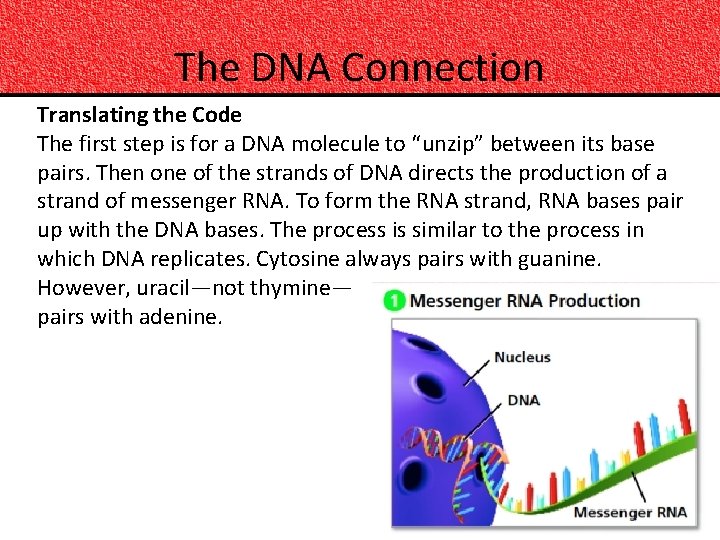
The DNA Connection Translating the Code The first step is for a DNA molecule to “unzip” between its base pairs. Then one of the strands of DNA directs the production of a strand of messenger RNA. To form the RNA strand, RNA bases pair up with the DNA bases. The process is similar to the process in which DNA replicates. Cytosine always pairs with guanine. However, uracil—not thymine— pairs with adenine.
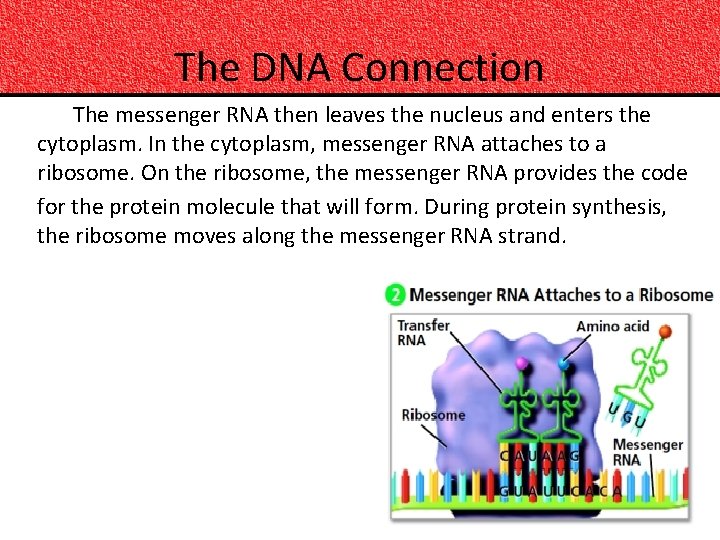
The DNA Connection The messenger RNA then leaves the nucleus and enters the cytoplasm. In the cytoplasm, messenger RNA attaches to a ribosome. On the ribosome, the messenger RNA provides the code for the protein molecule that will form. During protein synthesis, the ribosome moves along the messenger RNA strand.
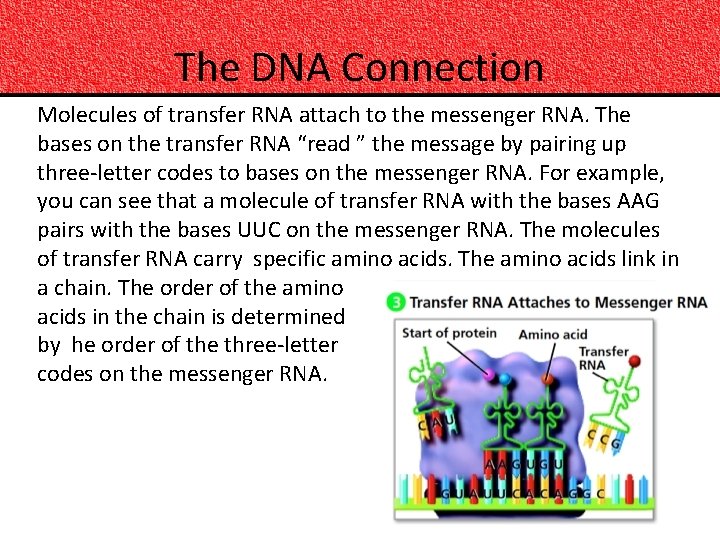
The DNA Connection Molecules of transfer RNA attach to the messenger RNA. The bases on the transfer RNA “read ” the message by pairing up three-letter codes to bases on the messenger RNA. For example, you can see that a molecule of transfer RNA with the bases AAG pairs with the bases UUC on the messenger RNA. The molecules of transfer RNA carry specific amino acids. The amino acids link in a chain. The order of the amino acids in the chain is determined by he order of the three-letter codes on the messenger RNA.
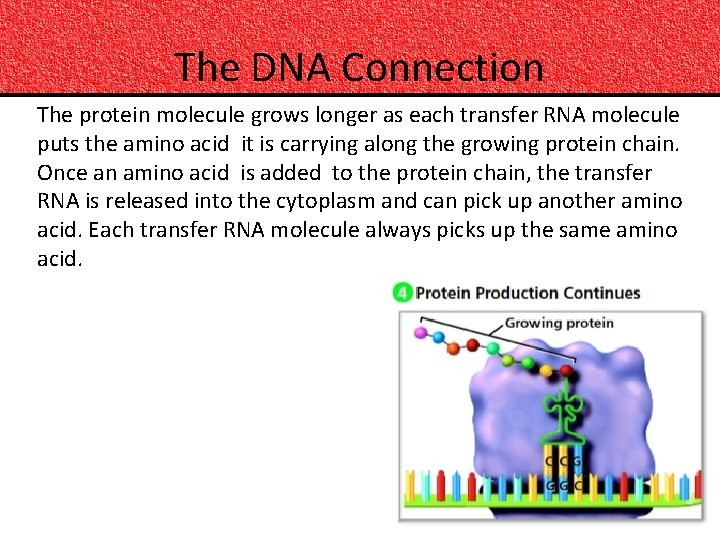
The DNA Connection The protein molecule grows longer as each transfer RNA molecule puts the amino acid it is carrying along the growing protein chain. Once an amino acid is added to the protein chain, the transfer RNA is released into the cytoplasm and can pick up another amino acid. Each transfer RNA molecule always picks up the same amino acid.
Changes in Genes Imagine that you have been invited to ride on a new roller coaster at the state fair. Before you climb into the front car, you are told that some of the metal parts on the coaster have been replaced by parts made of a different substance. Would you still want to ride this roller coaster? Perhaps a strong metal was used as a substitute. Or perhaps a material that is not strong enough was used. Imagine what would happen if cardboard were used instead of metal!
Mutations Substitutes in the roller coaster can accidentally happen in DNA. A mistake can occur in one gene of a chromosome. Instead of the base A, for example, the DNA molecule might have the base G. Any change in a gene or chromosome to include changes in the number, type, or order of bases on a piece of DNA is known as mutations. Such a mistake above is one type of mutation that can occur in a cell’s hereditary material. Recall that a mutation is any change in a gene or chromosome. Mutations can cause a cell to produce an incorrect protein during protein synthesis. Mutations can be harmful or neutral. As a result, the organism’s trait, or phenotype, may be different from what it normally would have been. In fact, the term mutation comes from a Latin word that means “change. ”
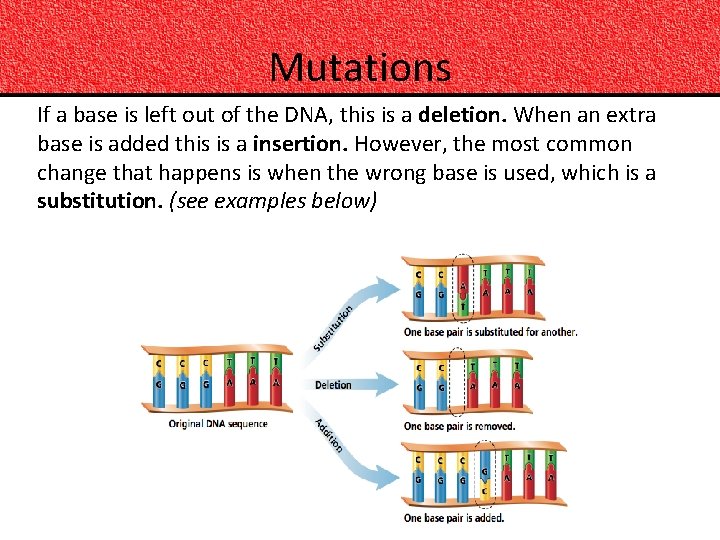
Mutations • An additional or deletion causes the entire rest of the DNA sequence to shift to make up for the space is called Frame shift. • A point mutation like a substitution happens in a specific place and does not affect the rest of the strand is called Point Mutation.
Mutations If a base is left out of the DNA, this is a deletion. When an extra base is added this is a insertion. However, the most common change that happens is when the wrong base is used, which is a substitution. (see examples below)
Mutations If a mutation occurs in a body cell, such as a skin cell, the mutation will not be passed on to the organism’s offspring. If, however, a mutation occurs in a sex cell, the mutation can be passed on to an offspring and affect the offspring’s phenotype. There are three possible consequences to changes in DNA: an improved trait, no change, or a harmful trait. Fortunately, cells make some proteins that can detect errors in DNA. When an error is found, it is usually fixed. But occasionally the repairs are not accurate, and the mistakes become part of the genetic message. If the mutation occurs in the sex cells, the changed gene can be passed from one generation to the next.
How do Mutations Happen? Some mutations are the result of small changes in an organism’s hereditary material. They happen regularly because of random errors when DNA is copied or damaged caused by abnormal things in cells. Any physical or chemical agent that can cause a mutation in DNA is called a mutagen. For example, a single base may be substituted for another, or one or more bases may be removed from a section of DNA. This type of mutation can occur during the DNA replication process. Other mutations may occur when chromosomes don’t separate correctly during meiosis. When this type of mutation occurs, a cell can end up with too many or too few chromosomes. The cell could also end up with extra segments of chromosomes.
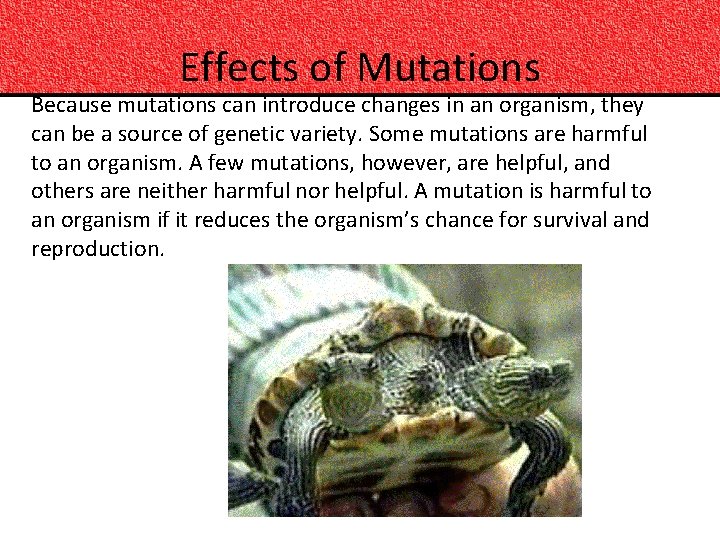
Effects of Mutations Because mutations can introduce changes in an organism, they can be a source of genetic variety. Some mutations are harmful to an organism. A few mutations, however, are helpful, and others are neither harmful nor helpful. A mutation is harmful to an organism if it reduces the organism’s chance for survival and reproduction.
Effects of Mutations Whether a mutation is harmful or not depends partly on the organism’s environment. The mutation that led to the production of a white lemur would probably be harmful to an organism in the wild. The lemur’s white color would make it more visible, and thus easier for predators to find. However, a white lemur in a zoo has the same chance for survival as a brown lemur. In a zoo, the mutation neither helps nor harms the lemur. Helpful mutations, on the other hand, improve an organism’s chances for survival and reproduction. Antibiotic resistance in bacteria is an example. Antibiotics are chemicals that kill bacteria. Gene mutations have enabled some kinds of bacteria to become resistant to certain antibiotics— that is, the antibiotics do not kill the bacteria that have the mutations. The mutations have improved the bacteria’s ability to survive and reproduce.