
Heredity Unit 8 Lesson 4 What did Gregor




- Slides: 12
Heredity Unit 8: Lesson 4
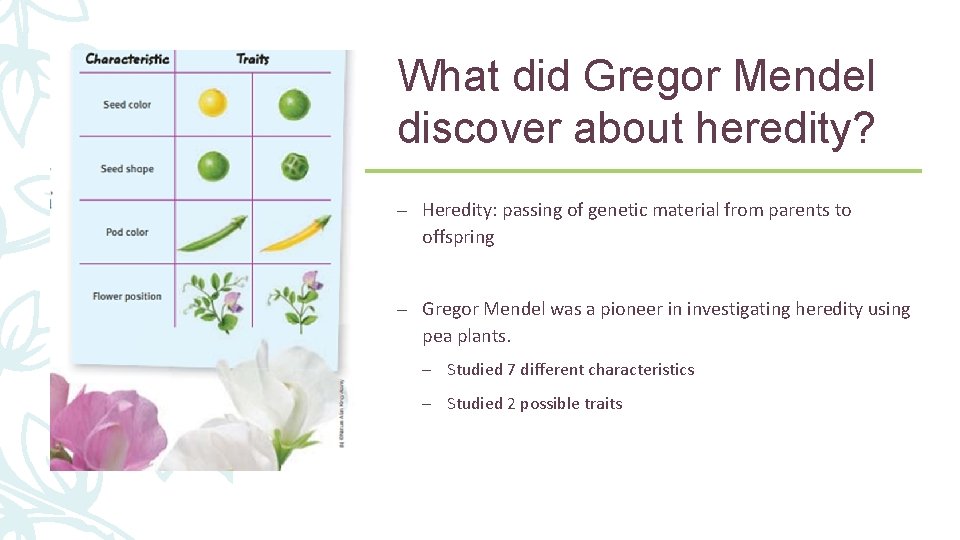
What did Gregor Mendel discover about heredity? – Heredity: passing of genetic material from parents to offspring – Gregor Mendel was a pioneer in investigating heredity using pea plants. – Studied 7 different characteristics – Studied 2 possible traits
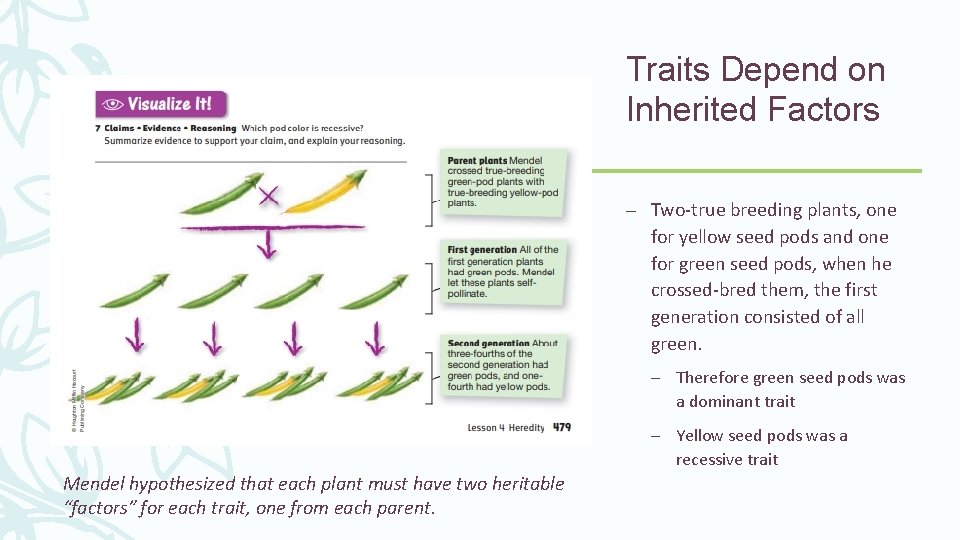
Traits Depend on Inherited Factors – Two-true breeding plants, one for yellow seed pods and one for green seed pods, when he crossed-bred them, the first generation consisted of all green. – Therefore green seed pods was a dominant trait – Yellow seed pods was a recessive trait Mendel hypothesized that each plant must have two heritable “factors” for each trait, one from each parent.
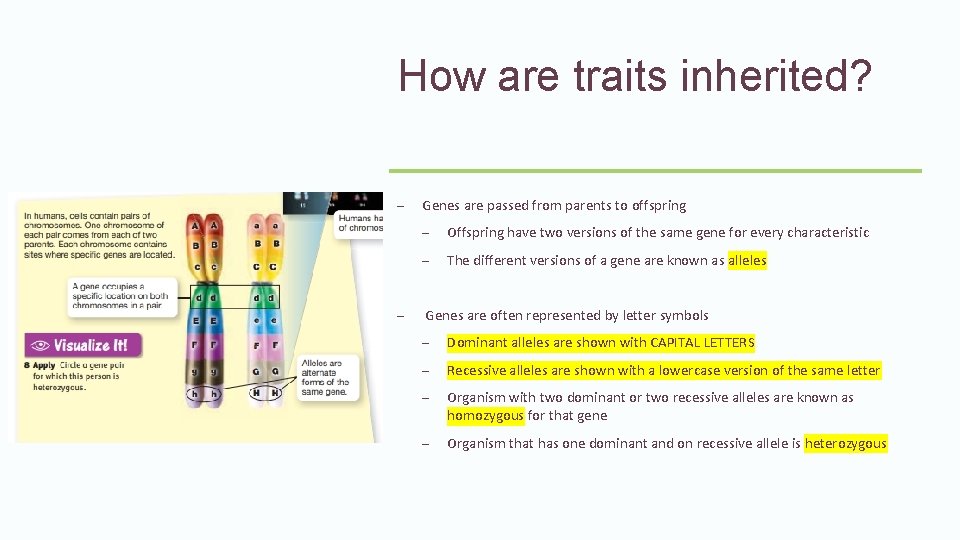
How are traits inherited? – – Genes are passed from parents to offspring – Offspring have two versions of the same gene for every characteristic – The different versions of a gene are known as alleles Genes are often represented by letter symbols – Dominant alleles are shown with CAPITAL LETTERS – Recessive alleles are shown with a lowercase version of the same letter – Organism with two dominant or two recessive alleles are known as homozygous for that gene – Organism that has one dominant and on recessive allele is heterozygous
Genes Influence Traits – Genotype: the combination of alleles that you inherited from your parents – Phenotype: your observable traits – Dominant: allele contributes to the phenotype if one or two copies are present in the genotype – Recessive: allele contributes to the phenotype only when two copies of it are present Some traits are dominant over others. Ex. Dimples this genes comes in two alleles: one for dimples and one for no dimples. If you have even one copy of the allele for dimples, you will have dimples because the allele for producing dimples is dominant. Now if you have no dimples, you inherited two no-dimple alleles, the characteristic shows complete dominance because one trait is completely dominant over the other
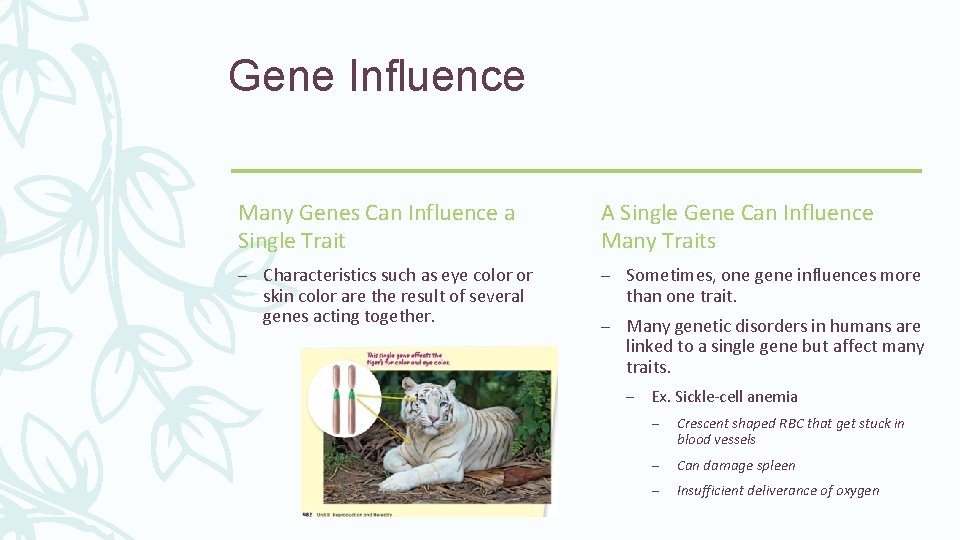
Gene Influence Many Genes Can Influence a Single Trait A Single Gene Can Influence Many Traits – Characteristics such as eye color or skin color are the result of several genes acting together. – Sometimes, one gene influences more than one trait. – Many genetic disorders in humans are linked to a single gene but affect many traits. – Ex. Sickle-cell anemia – Crescent shaped RBC that get stuck in blood vessels – Can damage spleen – Insufficient deliverance of oxygen
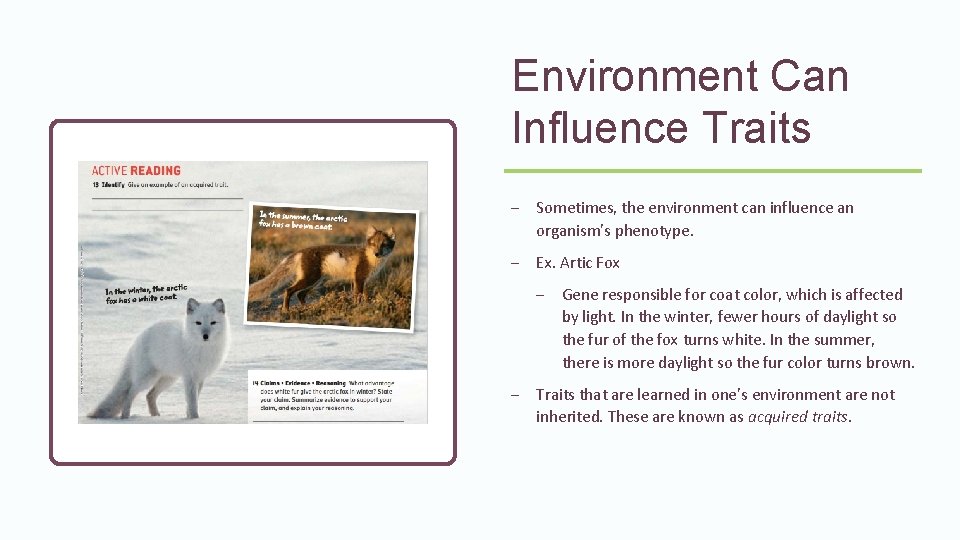
Environment Can Influence Traits – Sometimes, the environment can influence an organism's phenotype. – Ex. Artic Fox – Gene responsible for coat color, which is affected by light. In the winter, fewer hours of daylight so the fur of the fox turns white. In the summer, there is more daylight so the fur color turns brown. – Traits that are learned in one’s environment are not inherited. These are known as acquired traits.
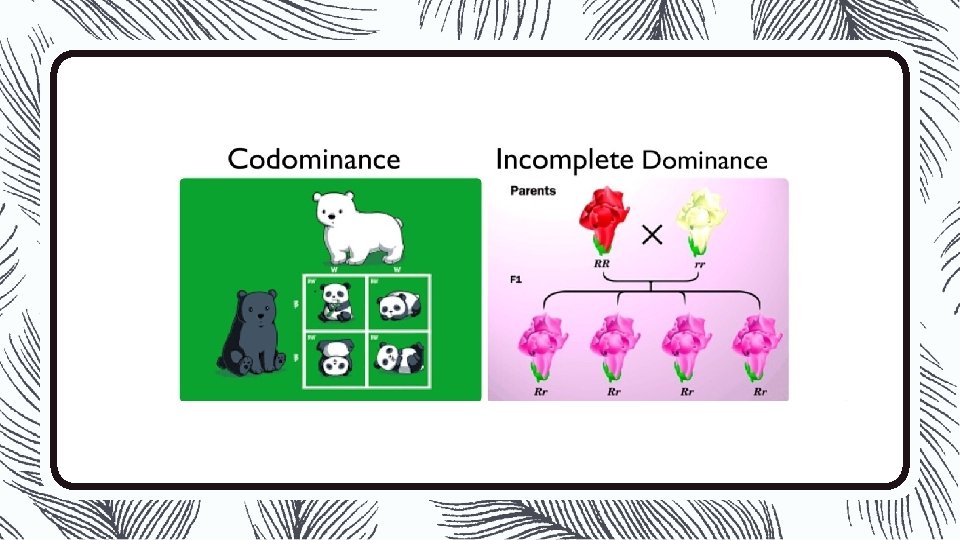
What are the exceptions to complete dominance? Incomplete Dominance Codominance – Each allele in a heterozygous individual influences the phenotype. – Both of the alleles in a heterozygous individual contribute to the phenotype. – The result is a blend of the phenotype of the parents. – Instead of having a blend, individuals have both of the traits associated with their two alleles. – Ex. Hair texture: parent with straight hair allele, and other parent with curly hair allele, will result in offspring having wavy hair – Ex. Human blood type: A, B, O. A and B are codominant, so someone with one A allele and one with B allele will have blood cells that are coated with A and B antigens on their RBCs. AB blood type.
Homework & Classwork – Homework – USA Test Prep – Due Friday, May 8 th – Classwork – In-class session lesson 4 quiz – Due May 6 th and May 7 th