
Heredity REPRODUCTION When new organisms OFFSPRING are formed
- Slides: 19
Heredity
REPRODUCTION • When new organisms (OFFSPRING) are formed from parent organisms, we call it REPRODUCTION. • This happens in one of two ways: – ASEXUAL REPRODUCTION – SEXUAL REPRODUCTION • In either case, most organisms begin as only one cell. – Cells must reproduce in order for organisms to reproduce or grow; there are two types of cellular reproduction • MITOSIS • MEIOSIS
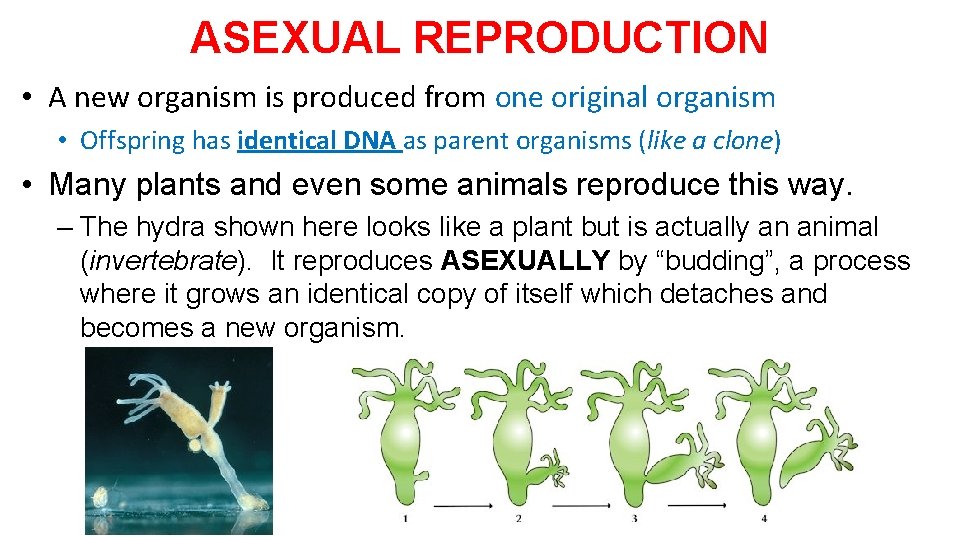
ASEXUAL REPRODUCTION • A new organism is produced from one original organism • Offspring has identical DNA as parent organisms (like a clone) • Many plants and even some animals reproduce this way. – The hydra shown here looks like a plant but is actually an animal (invertebrate). It reproduces ASEXUALLY by “budding”, a process where it grows an identical copy of itself which detaches and becomes a new organism.
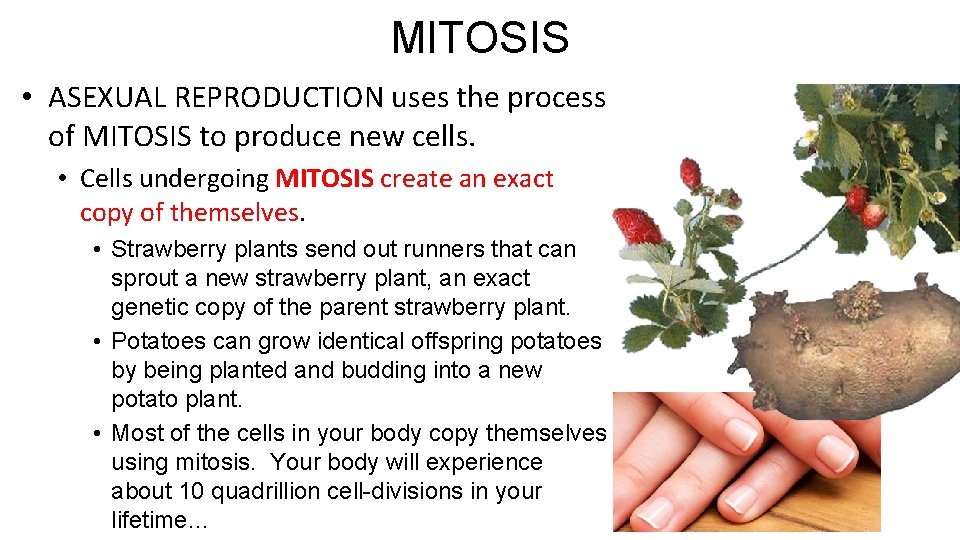
MITOSIS • ASEXUAL REPRODUCTION uses the process of MITOSIS to produce new cells. • Cells undergoing MITOSIS create an exact copy of themselves. • Strawberry plants send out runners that can sprout a new strawberry plant, an exact genetic copy of the parent strawberry plant. • Potatoes can grow identical offspring potatoes by being planted and budding into a new potato plant. • Most of the cells in your body copy themselves using mitosis. Your body will experience about 10 quadrillion cell-divisions in your lifetime…
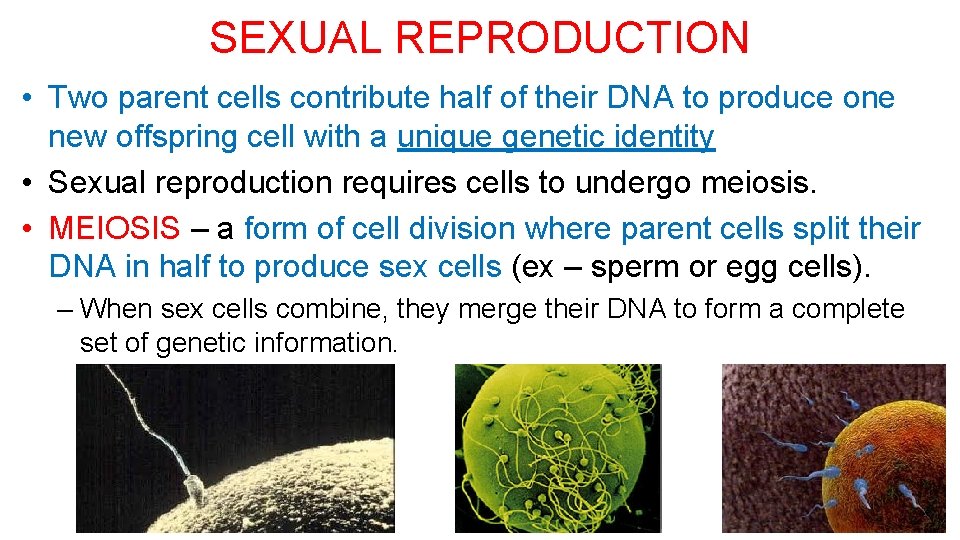
SEXUAL REPRODUCTION • Two parent cells contribute half of their DNA to produce one new offspring cell with a unique genetic identity • Sexual reproduction requires cells to undergo meiosis. • MEIOSIS – a form of cell division where parent cells split their DNA in half to produce sex cells (ex – sperm or egg cells). – When sex cells combine, they merge their DNA to form a complete set of genetic information.
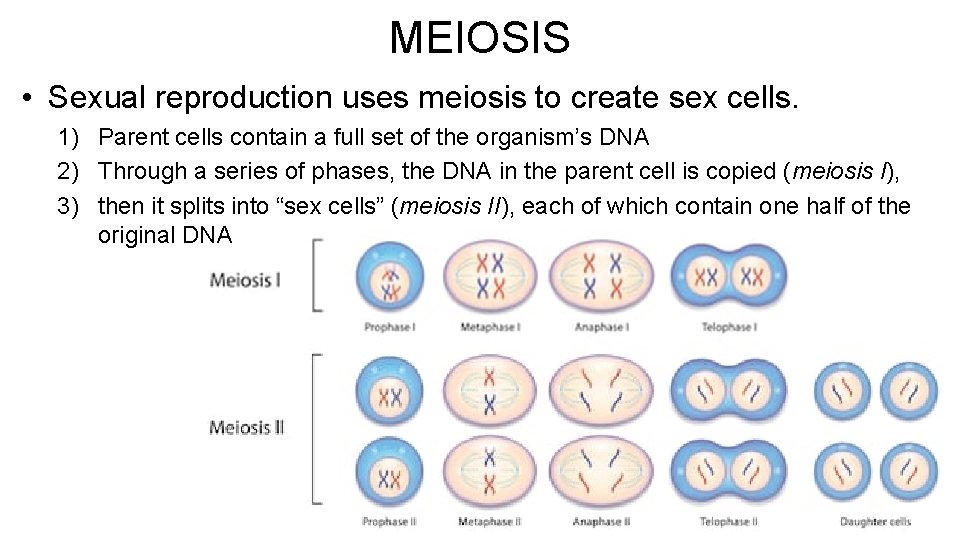
MEIOSIS • Sexual reproduction uses meiosis to create sex cells. 1) Parent cells contain a full set of the organism’s DNA 2) Through a series of phases, the DNA in the parent cell is copied (meiosis I), 3) then it splits into “sex cells” (meiosis II), each of which contain one half of the original DNA
MEIOSIS • This is how sperm cells and egg cells are created (for example, in mammals) – Sometimes, mistakes happen during this process • When an error occurs as the DNA is copied, it’s called a MUTATION • Sometimes, this results in significant physical changes (can be good and bad for the organism) • NOTE: THIS WILL BE VERY IMPORTANT NEXT WEEK!!! • When an error occurs as the cells split, it can result in the offspring failing to develop or developing abnormally
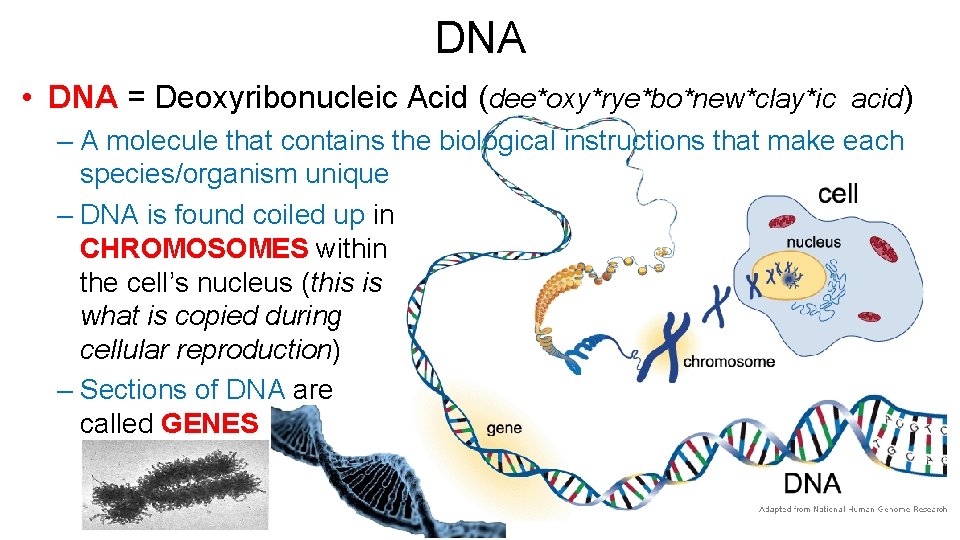
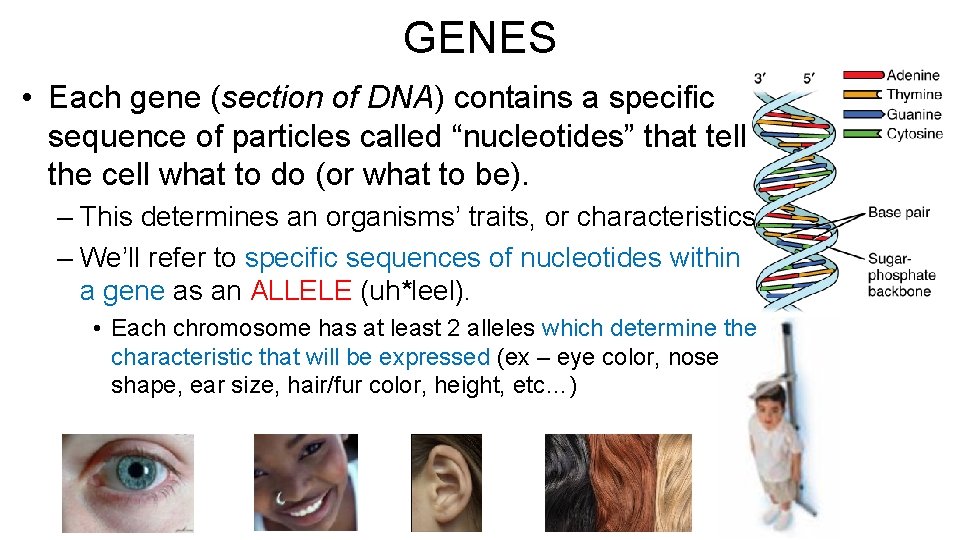
DNA • DNA = Deoxyribonucleic Acid (dee*oxy*rye*bo*new*clay*ic acid) – A molecule that contains the biological instructions that make each species/organism unique – DNA is found coiled up in CHROMOSOMES within the cell’s nucleus (this is what is copied during cellular reproduction) – Sections of DNA are called GENES
GENES • Each gene (section of DNA) contains a specific sequence of particles called “nucleotides” that tell the cell what to do (or what to be). – This determines an organisms’ traits, or characteristics. – We’ll refer to specific sequences of nucleotides within a gene as an ALLELE (uh*leel). • Each chromosome has at least 2 alleles which determine the characteristic that will be expressed (ex – eye color, nose shape, ear size, hair/fur color, height, etc…)
ALLELES • Basic traits have two alleles; one allele is DOMINANT and the other is RECESSIVE (note: this is waaaay over-simplified…just go with it) – A dominant allele will be expressed (shown) over a recessive allele – When discussing heredity, we usually represent alleles with letters • Capital letters represent dominant alleles • Lower-case letters represent recessive alleles • Let’s work through a basic example of how this works. . . – We’ll consider eye color in a population of bunnies.
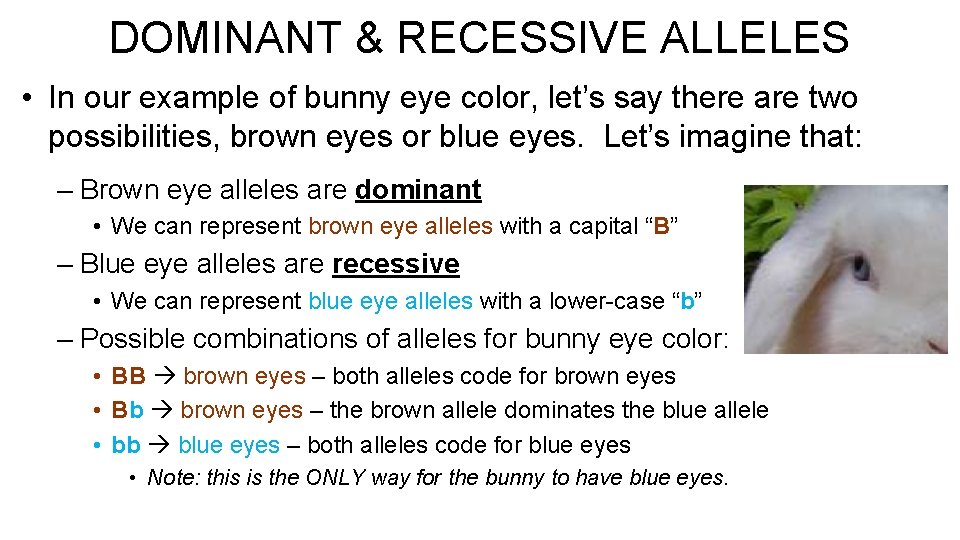
DOMINANT & RECESSIVE ALLELES • In our example of bunny eye color, let’s say there are two possibilities, brown eyes or blue eyes. Let’s imagine that: – Brown eye alleles are dominant • We can represent brown eye alleles with a capital “B” – Blue eye alleles are recessive • We can represent blue eye alleles with a lower-case “b” – Possible combinations of alleles for bunny eye color: • BB brown eyes – both alleles code for brown eyes • Bb brown eyes – the brown allele dominates the blue allele • bb blue eyes – both alleles code for blue eyes • Note: this is the ONLY way for the bunny to have blue eyes.
HOMOZYGOUS & HETEROZYGOUS • Combinations of the same allele are called HOMOZYGOUS – The prefix, “homo-”, means “same” • Combinations of different alleles are called HETEROZYGOUS – The prefix, “hetero-” means “different” • EXAMPLE: Bunny Eye-Color – BB “homozygous dominant” • two of the dominant alleles – Bb “heterozygous” • one of each allele – bb “homozygous recessive” • two of the recessive alleles
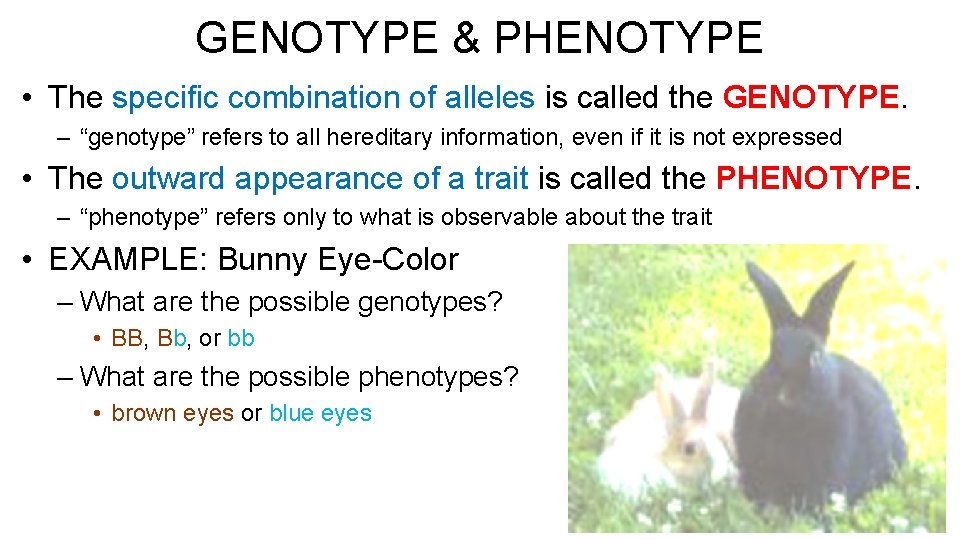
GENOTYPE & PHENOTYPE • The specific combination of alleles is called the GENOTYPE. – “genotype” refers to all hereditary information, even if it is not expressed • The outward appearance of a trait is called the PHENOTYPE. – “phenotype” refers only to what is observable about the trait • EXAMPLE: Bunny Eye-Color – What are the possible genotypes? • BB, Bb, or bb – What are the possible phenotypes? • brown eyes or blue eyes
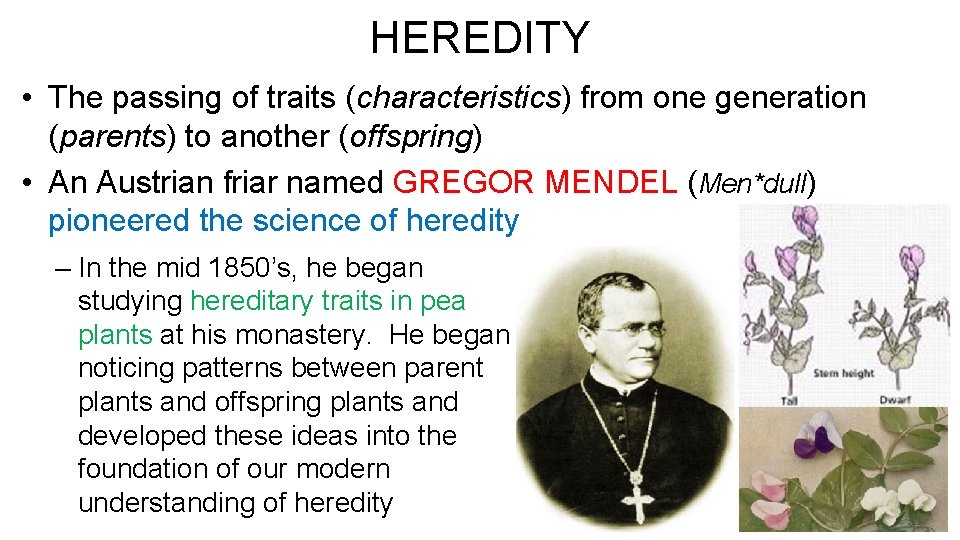
HEREDITY • The passing of traits (characteristics) from one generation (parents) to another (offspring) • An Austrian friar named GREGOR MENDEL (Men*dull) pioneered the science of heredity – In the mid 1850’s, he began studying hereditary traits in pea plants at his monastery. He began noticing patterns between parent plants and offspring plants and developed these ideas into the foundation of our modern understanding of heredity
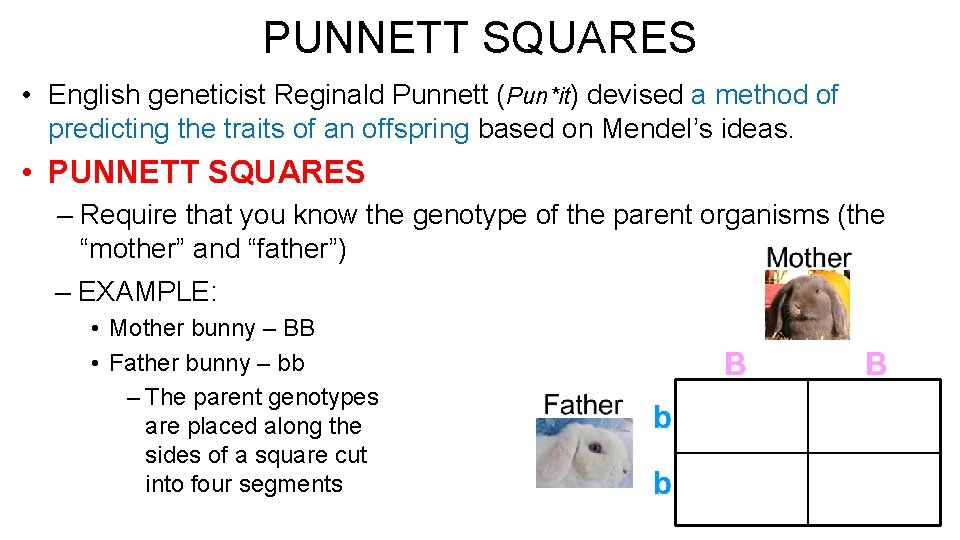
PUNNETT SQUARES • English geneticist Reginald Punnett (Pun*it) devised a method of predicting the traits of an offspring based on Mendel’s ideas. • PUNNETT SQUARES – Require that you know the genotype of the parent organisms (the “mother” and “father”) – EXAMPLE: • Mother bunny – BB • Father bunny – bb – The parent genotypes are placed along the sides of a square cut into four segments
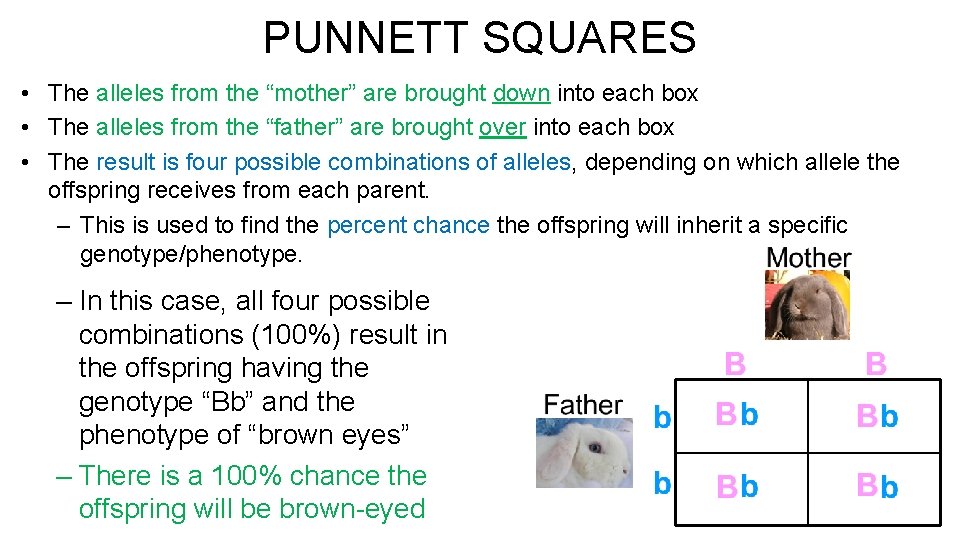
PUNNETT SQUARES • The alleles from the “mother” are brought down into each box • The alleles from the “father” are brought over into each box • The result is four possible combinations of alleles, depending on which allele the offspring receives from each parent. – This is used to find the percent chance the offspring will inherit a specific genotype/phenotype. – In this case, all four possible combinations (100%) result in the offspring having the genotype “Bb” and the phenotype of “brown eyes” – There is a 100% chance the offspring will be brown-eyed
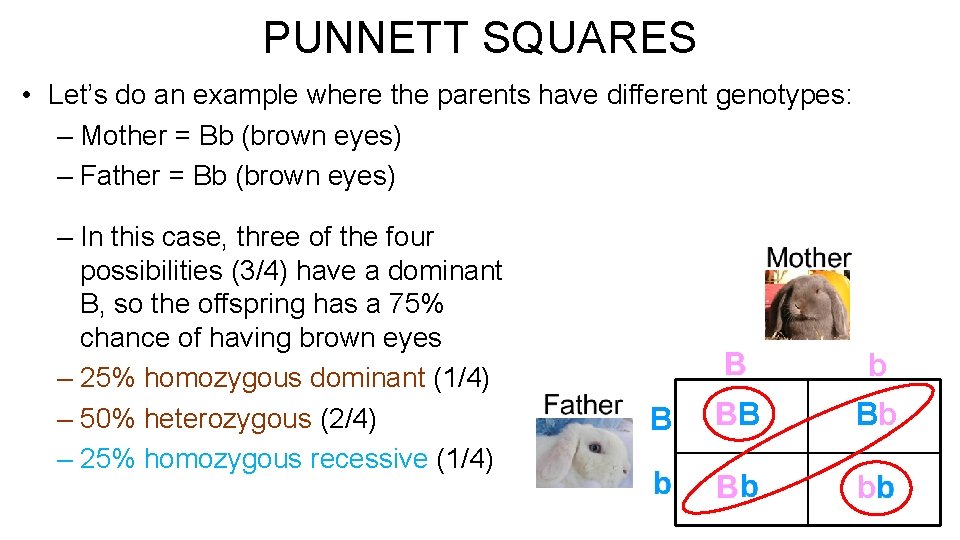
PUNNETT SQUARES • Let’s do an example where the parents have different genotypes: – Mother = Bb (brown eyes) – Father = Bb (brown eyes) – In this case, three of the four possibilities (3/4) have a dominant B, so the offspring has a 75% chance of having brown eyes – 25% homozygous dominant (1/4) – 50% heterozygous (2/4) – 25% homozygous recessive (1/4) b B B Bb b
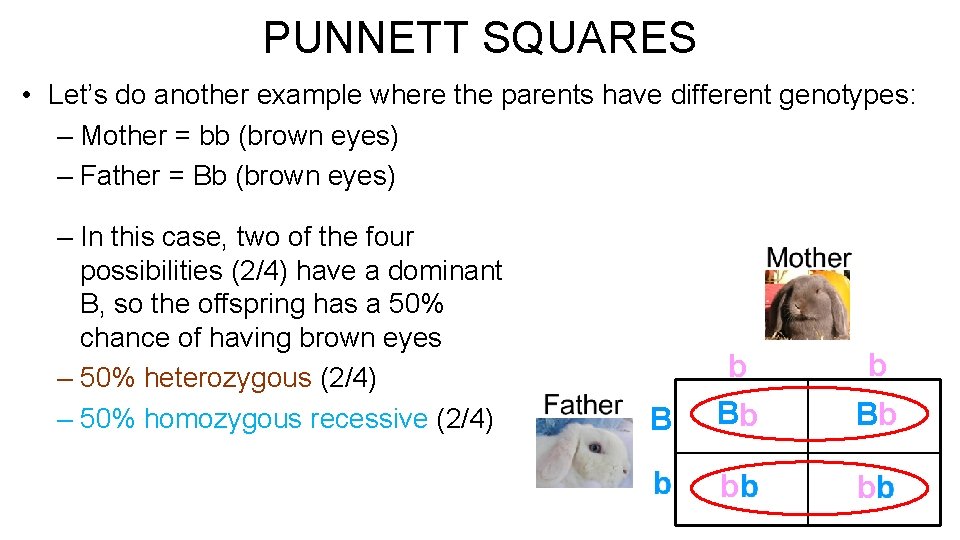
PUNNETT SQUARES • Let’s do another example where the parents have different genotypes: – Mother = bb (brown eyes) – Father = Bb (brown eyes) – In this case, two of the four possibilities (2/4) have a dominant B, so the offspring has a 50% chance of having brown eyes – 50% heterozygous (2/4) – 50% homozygous recessive (2/4) B b b Bb Bb b b
ADVANCED GENETICS • If you are interested in more, please view the other presentation on advanced genetics posted on my website – Incomplete Dominance (mixed traits) – Traits Based on Multiple Alleles (like blood-type) – Traits Based on Multiple Genes (like human skin color or eye color) – Genetic Disorders (like cystic fibrosis) – Pedigree Charts (to track specific traits through a family tree) – Genetic Engineering (uses & ethical concerns)