
Heredity Continued Heredity and Maturation Any discussion about
Heredity Continued… • Heredity and Maturation: • Any discussion about Heredity must include a discussion on maturation… • Maturation consists of patterns of individual growth that appear more or less automatically as an individual gets older – if the environment provides a necessary amount of support • i. e. a baby begins to crawl automatically during a specific stage of their development; they are not taught this and will not succeed at this if proper scenarios are not provided • Aside from humans, different organisms may inherit different rates of maturation • i. e. an eight week old puppy can run, eat from a dish, and do most things privy to grown dogs – an eight week old baby is still rather limited to what it can do… • A dog can take care of itself on its own, whereas a baby could not survive unless certain scenarios are provided to ensure continued development…
Maturation • Maturation and Human Learning: • Experiments on maturation and learning often use identical twins as subjects (same heredity) • Fraternal twins (not identical) are not used for these kinds of experiments • Any differences can be attributed to influences in their environment • i. e. while learning how to walk is a hereditary occurrence, environmental factors such as poor nutrition or exposure to lead-based paint may hinder in this maturation process
Maturation part 2 • Does Maturation guarantee Learning? • As we have seen, things such as learning to read and walk is something that doesn’t necessarily happen at a given time for all children • Biological and Environmental factors are both at work in the case of these developments • Growing up in a house of reading will lead to more of a strong reader than if reading is not a priority • The Moral of the Story: • Human learning is not a matter of maturation alone, however, learning does take place faster when it is keyed to the person’s degree of maturation • Children learn to read and perform other mental and physical tasks most efficiently if they are given instruction once they have reached the proper degree of maturation
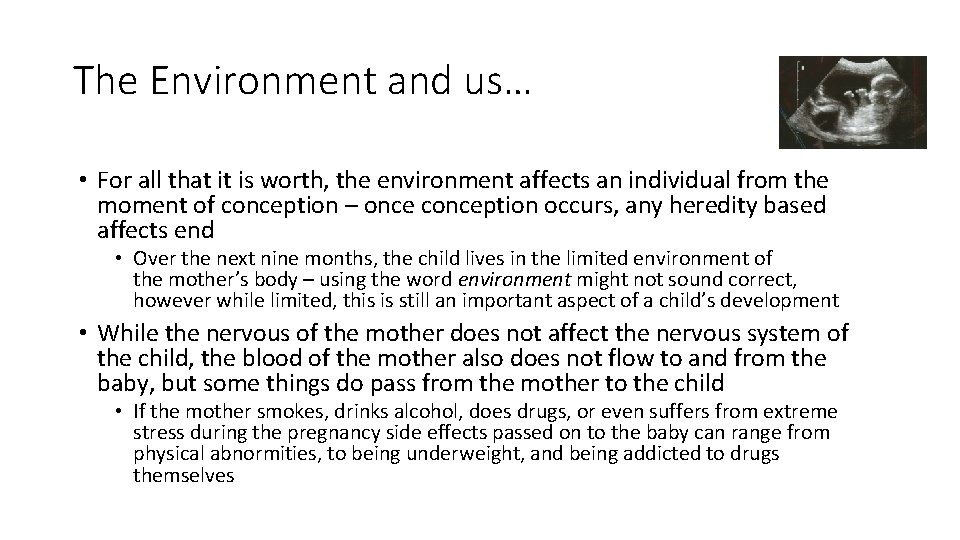
The Environment and us… • For all that it is worth, the environment affects an individual from the moment of conception – once conception occurs, any heredity based affects end • Over the next nine months, the child lives in the limited environment of the mother’s body – using the word environment might not sound correct, however while limited, this is still an important aspect of a child’s development • While the nervous of the mother does not affect the nervous system of the child, the blood of the mother also does not flow to and from the baby, but some things do pass from the mother to the child • If the mother smokes, drinks alcohol, does drugs, or even suffers from extreme stress during the pregnancy side effects passed on to the baby can range from physical abnormities, to being underweight, and being addicted to drugs themselves
Further issues for unborn/born child One of the biggest environmental factors that can influence both an unborn or born child is malnutrition • Malnutrition during pregnancy can • Malnutrition after birth also has serious effects, these “can” include: cause undesirable influences on • Year one: leads to lower the immediate and/or later intelligence scores versus a child development of the child, these with proper nutrition include: • Intellectual development restricted due to • Before year two: Males, evidence reduced number of brain cells supports being anti-social, • Lack of protein affects the development of “backward” behaving, and memory unhappy compared to nourished • Size at birth can be affected, undernourishment can result in a 15% males decrease in body and organ size Often through vitamin treatment, for both pregnant mothers and/or newborns can help correct this situation… in the end prevention is the key!
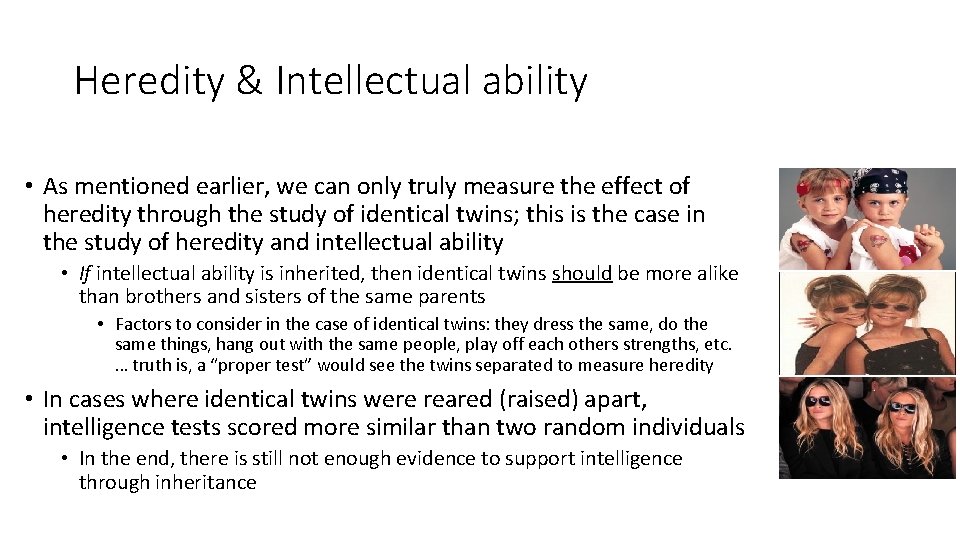
Heredity & Intellectual ability • As mentioned earlier, we can only truly measure the effect of heredity through the study of identical twins; this is the case in the study of heredity and intellectual ability • If intellectual ability is inherited, then identical twins should be more alike than brothers and sisters of the same parents • Factors to consider in the case of identical twins: they dress the same, do the same things, hang out with the same people, play off each others strengths, etc. … truth is, a “proper test” would see the twins separated to measure heredity • In cases where identical twins were reared (raised) apart, intelligence tests scored more similar than two random individuals • In the end, there is still not enough evidence to support intelligence through inheritance
Environment & intellectual ability • As in the case of any form of development, children who grow up in an environment where they are exposed to limited experiences (physical and/or intellectual), there is a correlation found in their levels of development… • However, aside from exposure/experience, other important factors must be considered when gathering and assessing information: • Sex, race, and attitude of tester (part of the test takers environment) • Cultural background of children (may not have come in contact with aspects being tested) • To counter this, tests have been generated to cover a wide spectrum of cultures, all test takers are at a potential advantage/disadvantage i. e. time to cook a hotdog or chitlings (hog intestines) • Class structure (lower class people view tests as punishment, tend not to do as well, tend to “throw” the test
Change in Environment… will this help? • To sum this up in one word… yes • Anytime someone is taken from a stressful, unsatisfactory condition (overcrowding, untrained care givers, little individual attention) and placed in a more beneficial situation their output levels of any kind should increase (health, intelligence, etc. ) • Think of how our “first world” positive environments change over time to garner results • In school you start as large group and then filter down into smaller sub-groups based on interest levels to gain greater exposure and higher results (post-secondary 101)
Heredity + Environment = one • It is next to impossible to separate heredity from environment when establishing how and why someone develops the way that they do/did… • Heredity may increase the chance of someone developing a particular disorder, but the environment that the person develops in will determine whether or not the disorder appears or flourishes • Look at the difference in the generations in your family, chances are through time the same inherited genes occurred, but the environment and what comes with it (health care, technology, awareness) has changed • Psychologists are less interested in the ways heredity and environment influence behaviour, with more of a focus being placed on how heredity and environment influence behaviour – more needs to be done looking at how inherited traits interact with the environment to produce behaviours…
Heredity (Genes) + Environmental Interaction/Stimulus Key is to focus on the first example vs. the second… but they both work
- Slides: 10