
Heredity Chapter 11 Transmission of characteristics from parent
- Slides: 24
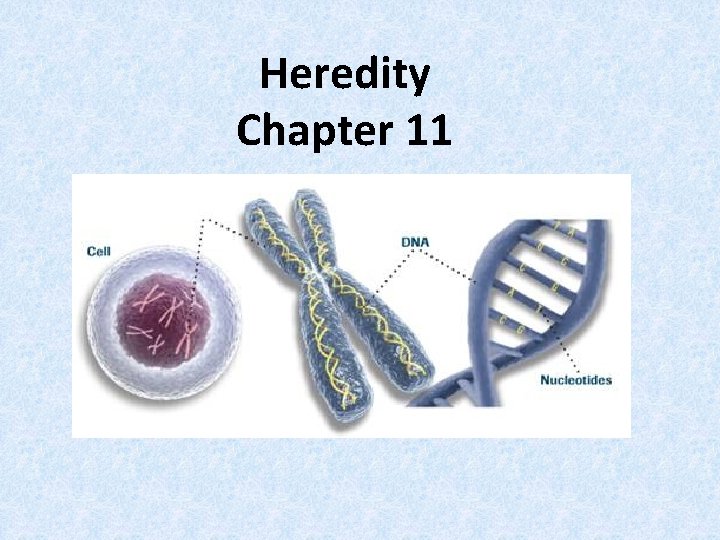
Heredity Chapter 11
Transmission of characteristics from parent to offspring is called heredity __________. The science that studies how those characteristics are passed on from one generation to the next is called Genetics __________
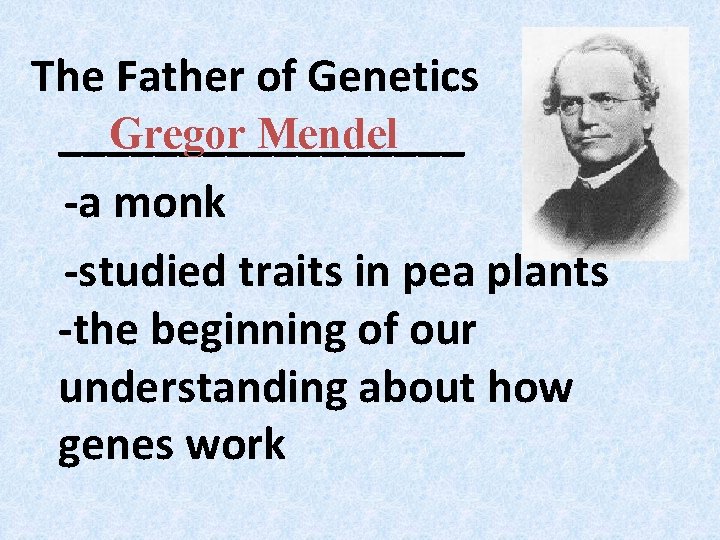
The Father of Genetics Gregor Mendel _________ -a monk -studied traits in pea plants -the beginning of our understanding about how genes work
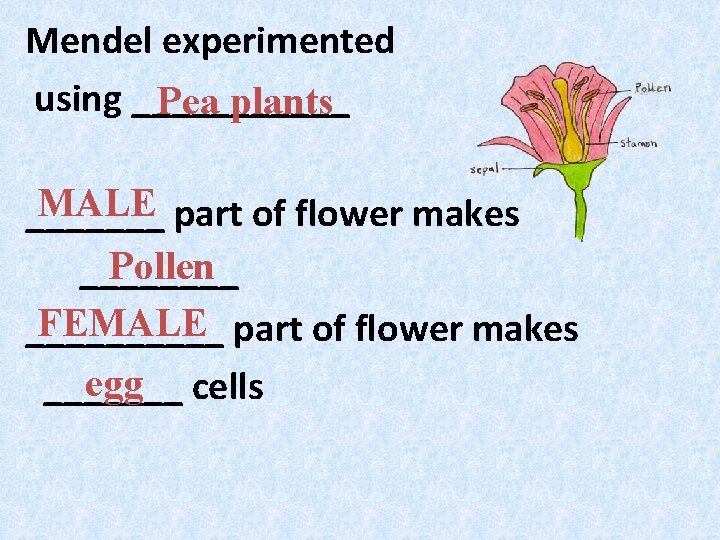
Mendel experimented using ______ Pea plants MALE part of flower makes _______ Pollen ____ FEMALE part of flower makes _____ egg cells _______
Pea plants are normally self-pollinating so seeds have one parent
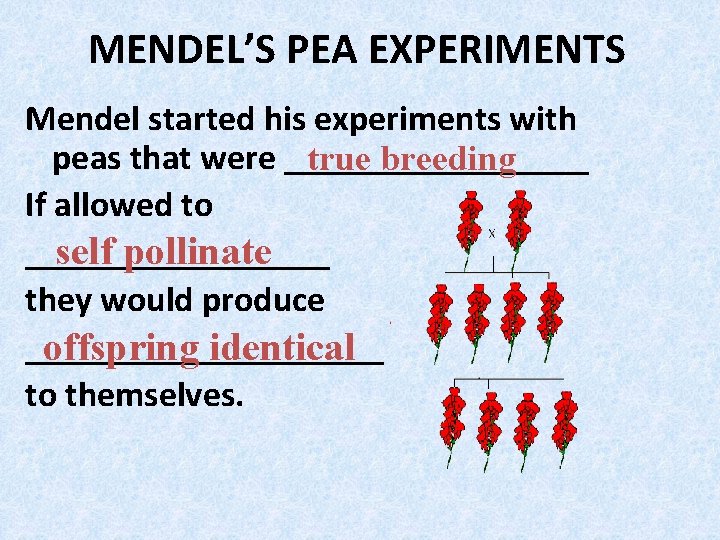
MENDEL’S PEA EXPERIMENTS Mendel started his experiments with peas that were _________ true breeding If allowed to _________ self pollinate they would produce __________ offspring identical to themselves.
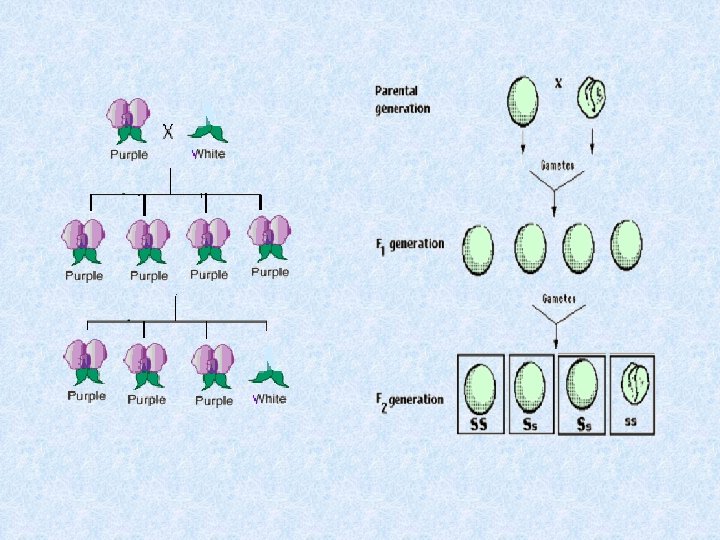
MENDEL’S EXPERIMENTS parental P 1 generation (_____) generation F 1 F 2 generation
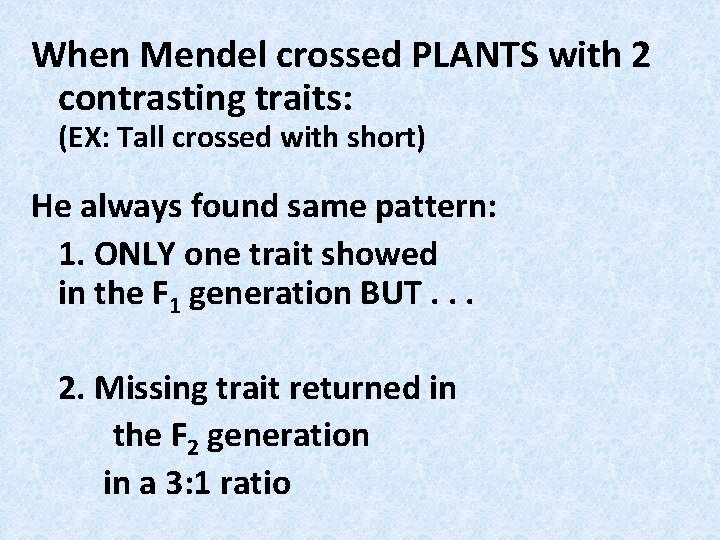
When Mendel crossed PLANTS with 2 contrasting traits: (EX: Tall crossed with short) He always found same pattern: 1. ONLY one trait showed in the F 1 generation BUT. . . 2. Missing trait returned in the F 2 generation in a 3: 1 ratio
Two Conclusions…. 1) Must be a pair of factors controlling a trait…one can hide the other
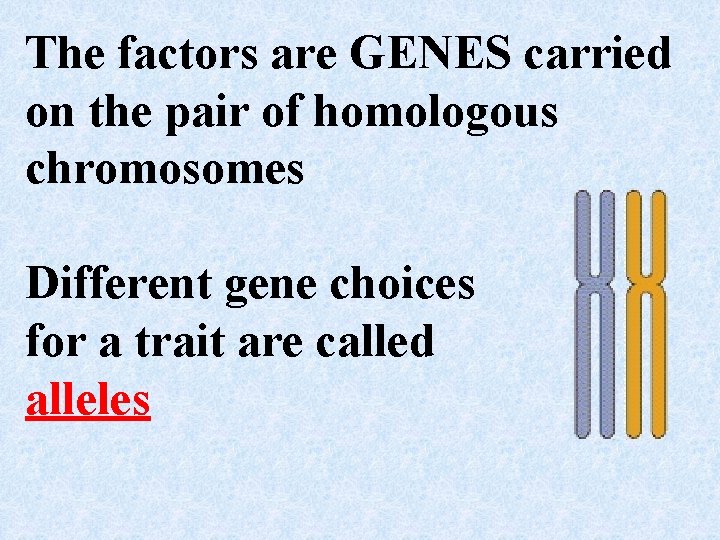
The factors are GENES carried on the pair of homologous chromosomes Different gene choices for a trait are called alleles
2 nd Conclusion… The Principle of dominance Some alleles are dominant and others are recessive
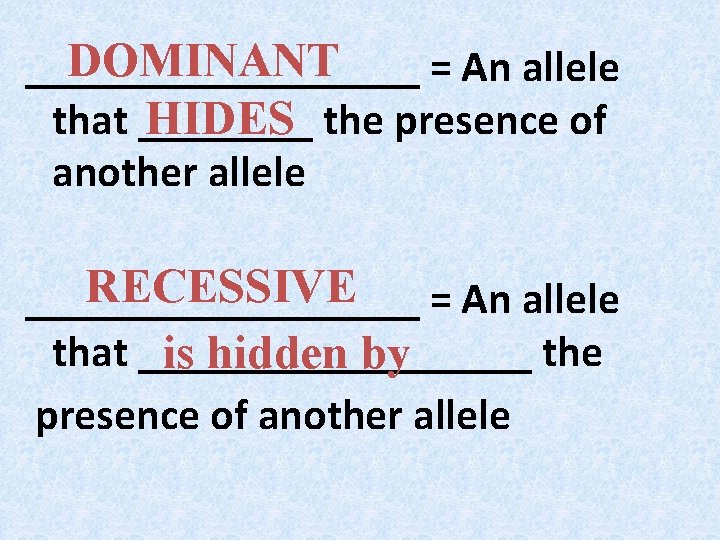
DOMINANT _________ = An allele that ____ HIDES the presence of another allele RECESSIVE _________ = An allele that _________ the is hidden by presence of another allele
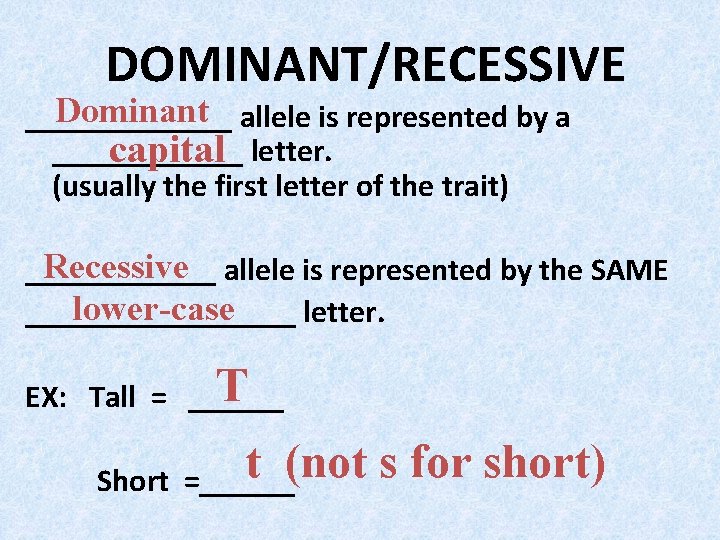
DOMINANT/RECESSIVE Dominant allele is represented by a _______ capital letter. (usually the first letter of the trait) Recessive allele is represented by the SAME ______ lower-case _________ letter. T EX: Tall = ______ t (not Short =______ s for short)
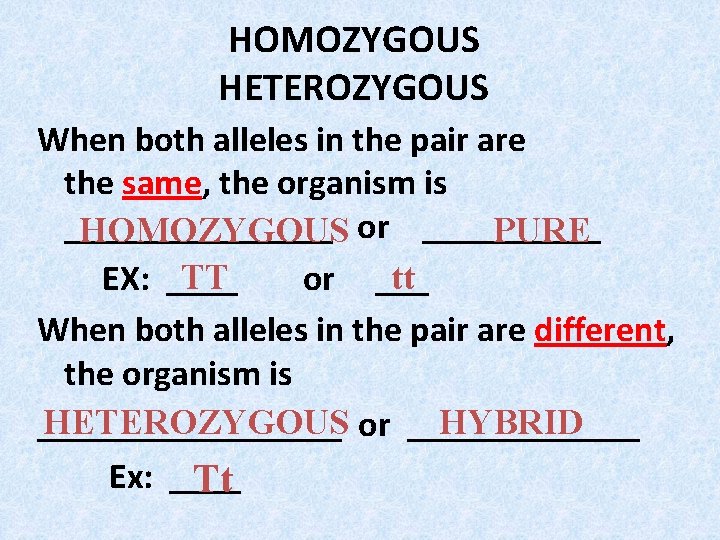
HOMOZYGOUS HETEROZYGOUS When both alleles in the pair are the same, the organism is ________ HOMOZYGOUS or _____ PURE TT tt EX: ____ or ___ When both alleles in the pair are different, the organism is HETEROZYGOUS or _______ HYBRID _________ Ex: ____ Tt
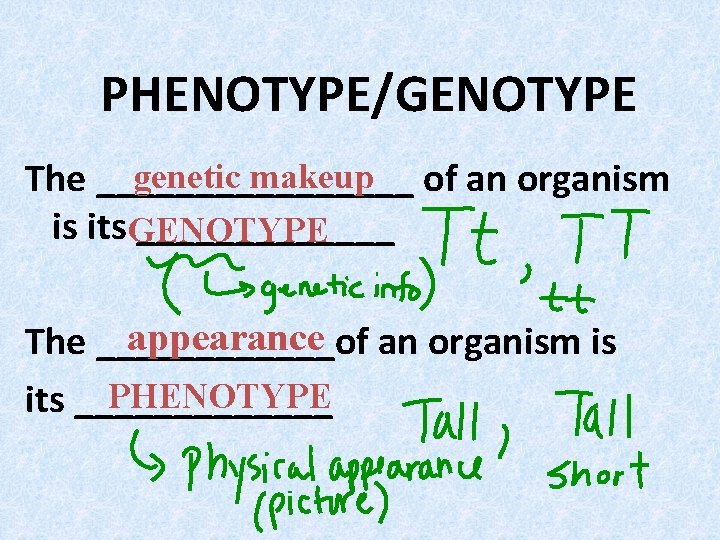
PHENOTYPE/GENOTYPE genetic makeup of an organism The ________ is its. GENOTYPE _______ appearance an organism is The ______of PHENOTYPE its _______
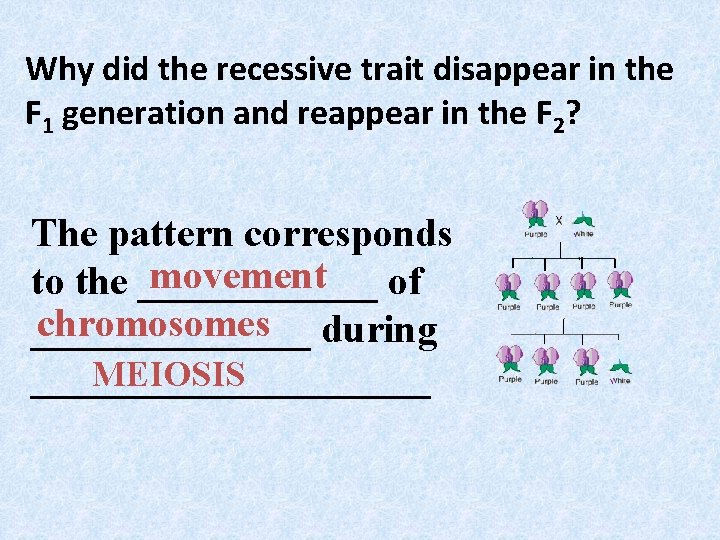
Why did the recessive trait disappear in the F 1 generation and reappear in the F 2? The pattern corresponds movement to the ______ of chromosomes during _______ MEIOSIS __________
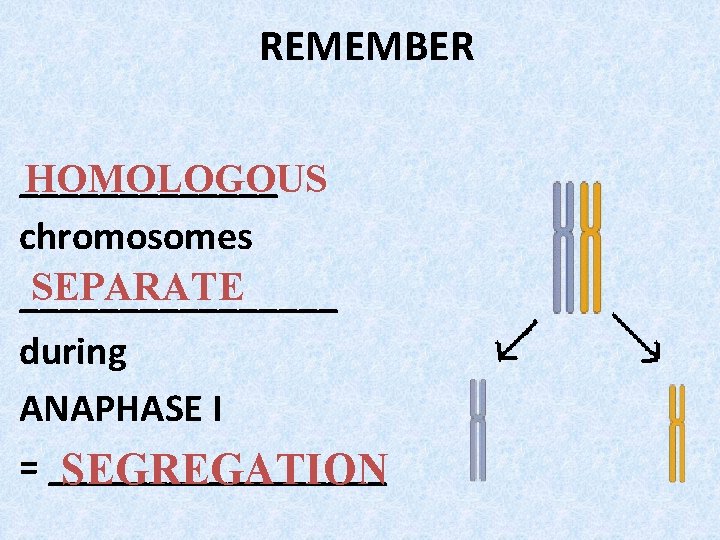
REMEMBER _______ HOMOLOGOUS chromosomes SEPARATE ________ during ANAPHASE I = _________ SEGREGATION
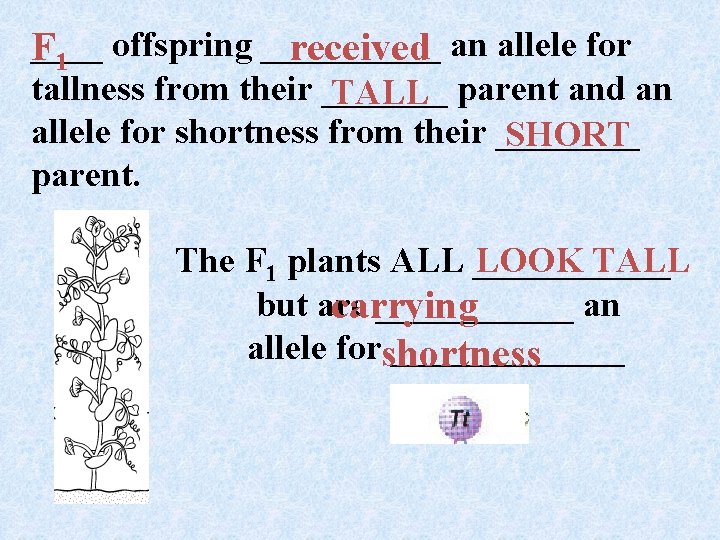
____ offspring _____ F received an allele for 1 tallness from their _______ TALL parent and an allele for shortness from their ____ SHORT parent. The F 1 plants ALL ______ LOOK TALL but are ______ an carrying allele forshortness _______
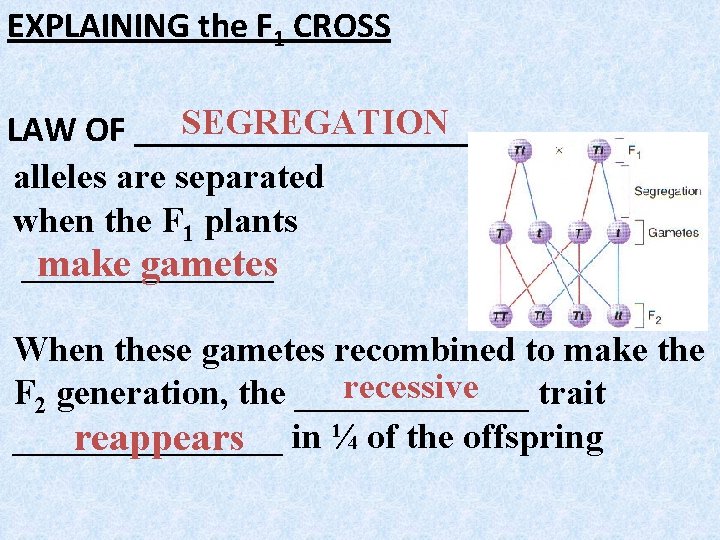
EXPLAINING the F 1 CROSS SEGREGATION LAW OF __________ alleles are separated when the F 1 plants _______ make gametes When these gametes recombined to make the recessive F 2 generation, the _______ trait ________ reappears in ¼ of the offspring
MAKING A CROSS for only ONE GENE trait = a _____ MONOHYBRID CROSS __________
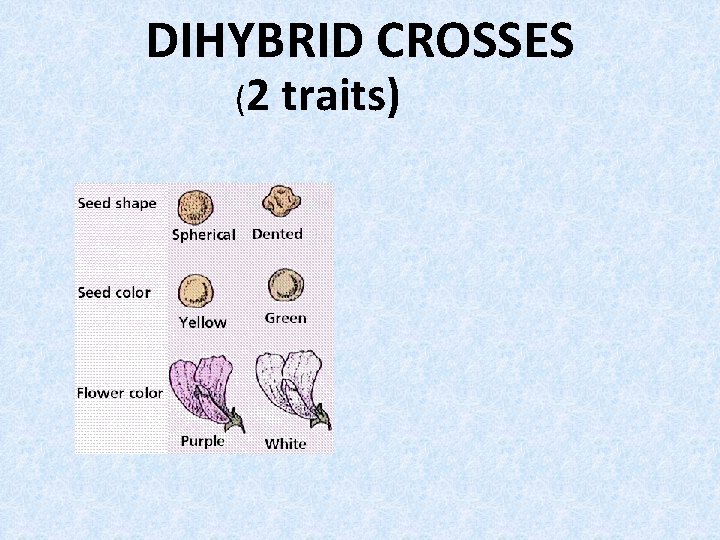
DIHYBRID CROSSES (2 traits)
MAKING A CROSS with TWO gene traits __________= DIHYBRID CROSS __________
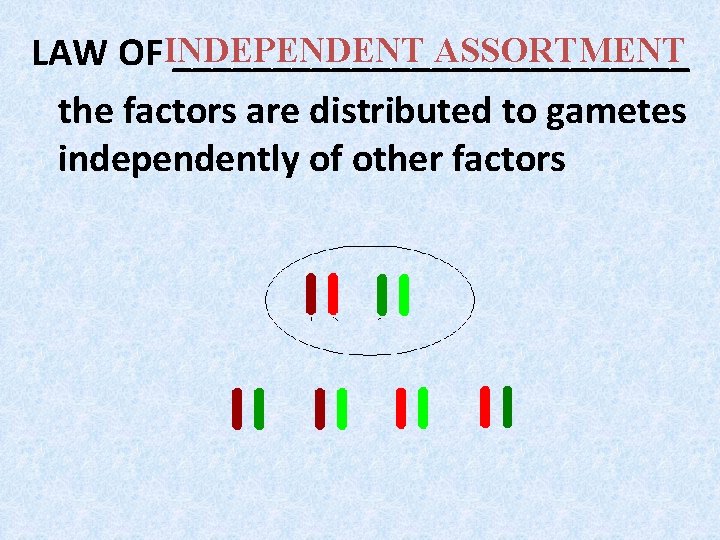
ASSORTMENT LAW OFINDEPENDENT _____________ the factors are distributed to gametes independently of other factors