
Heredity and Genetics Why do offspring look like
- Slides: 34
Heredity and Genetics Why do offspring look like their parents?
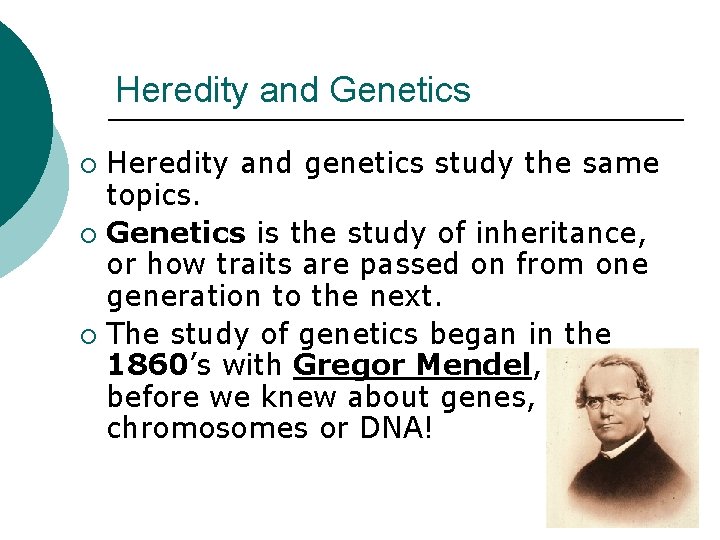
Heredity and Genetics Heredity and genetics study the same topics. ¡ Genetics is the study of inheritance, or how traits are passed on from one generation to the next. ¡ The study of genetics began in the 1860’s with Gregor Mendel, way before we knew about genes, chromosomes or DNA! ¡
Gregor Mendel ¡ ¡ Raised on a farm and understood the value of plant breeding to develop certain traits. At 21, entered priesthood and studied plant breeding in a monastery in the Czech Republic. Loved to read especially about natural sciences and was aware of Darwin’s findings. Studied the inheritance of traits in pea plants.
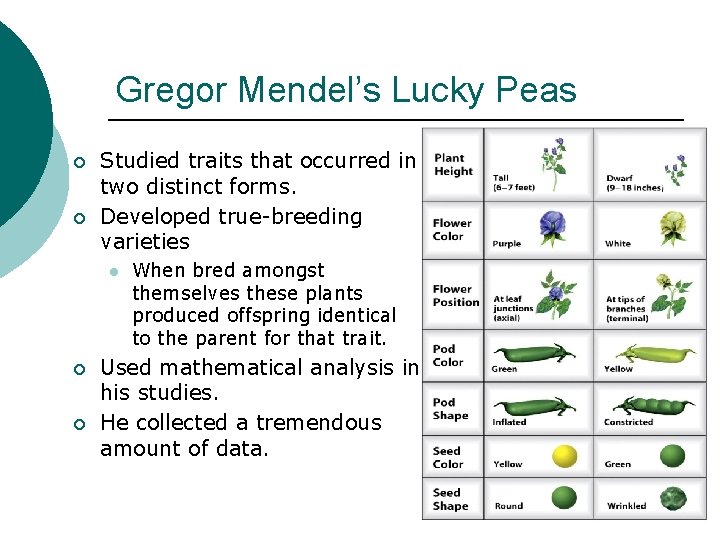
Gregor Mendel’s Lucky Peas ¡ ¡ Studied traits that occurred in two distinct forms. Developed true-breeding varieties l ¡ ¡ When bred amongst themselves these plants produced offspring identical to the parent for that trait. Used mathematical analysis in his studies. He collected a tremendous amount of data.
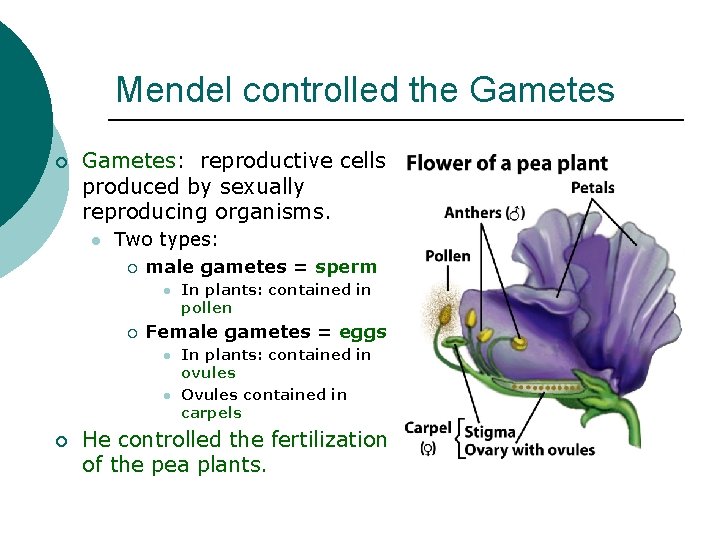
Mendel controlled the Gametes ¡ Gametes: reproductive cells produced by sexually reproducing organisms. l Two types: ¡ male gametes = sperm l ¡ Female gametes = eggs l l ¡ In plants: contained in pollen In plants: contained in ovules Ovules contained in carpels He controlled the fertilization of the pea plants.
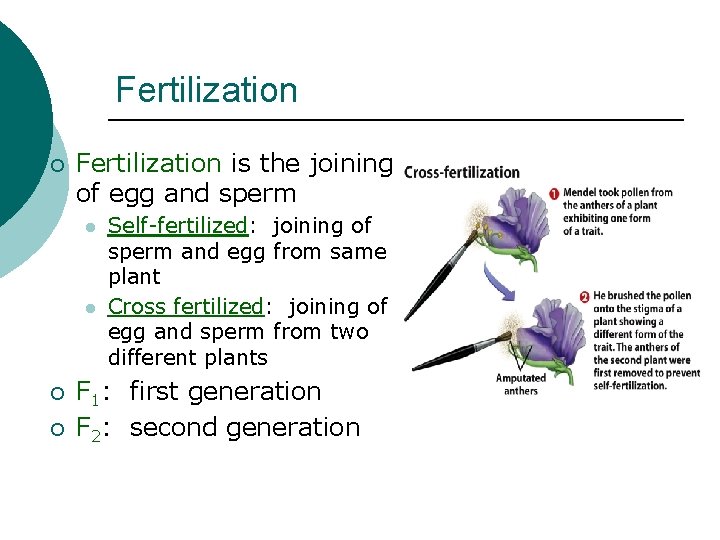
Fertilization ¡ Fertilization is the joining of egg and sperm l l ¡ ¡ Self-fertilized: joining of sperm and egg from same plant Cross fertilized: joining of egg and sperm from two different plants F 1: first generation F 2: second generation
Self-Fertilization Mendel used self fertilization to create true breeding varieties. ¡ This meant that the plants produced offspring identical to the parents. ¡ It is the sexual reproduction equivalent to fission. ¡ Then he crossed two true breeding varieties to see what would happen. ¡
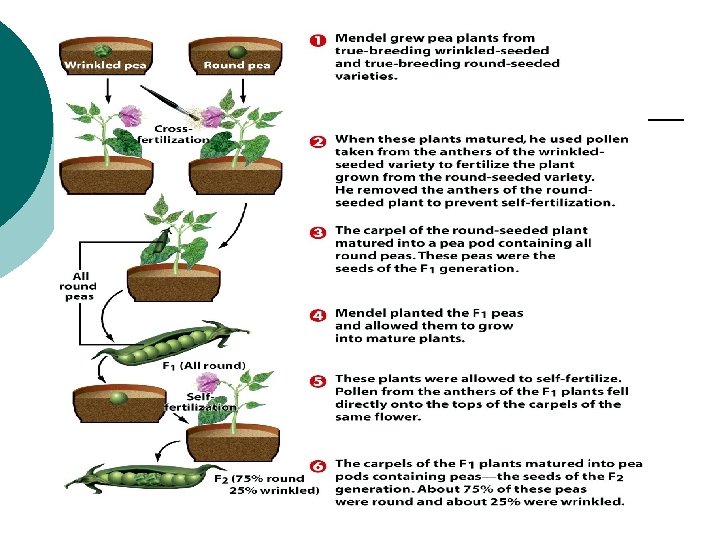
What happened? ? When he cross fertilized two true breeding plants, only one of the traits showed up. ¡ The other one disappeared. ¡ Round X Wrinkled =Round offspring ¡ Tall X Dwarf = Tall offspring ¡ The resulting plants were the F 1 generation. ¡ What happened to the other trait? ? ? ¡
Let’s do it again! Mendel was fascinated and couldn’t figure out what happened to the other trait so…… ¡ He self fertilized the F 1 generation to see what would happen. ¡ Since he self fertilized, no new genes or traits we added to the plants. ¡ What do you think happened? ? ? ¡
How did that get there? ? ? Mendel self fertilized the F 1 generation that were all round. ¡ Surprise! Some of the offspring were wrinkled! ¡ Where did the wrinkled trait come from? ? ? ¡ Mendel concluded that it must have been “hidden”. ¡
Mendel’s Conclusions Mendel figured that each trait must be controlled by two “factors. ” ¡ He felt that these factors are passed on to the offspring. ¡ One factor is found in the egg, the other factor is found in the sperm! ¡ In modern terms, a factor is called an allele. ¡
Boy was he smart! Mendel concluded that there were two “factors” or alleles for every trait, one from the female and one from the male. ¡ He also realized that sometimes only one factor is “expressed”, or can be seen. ¡ Sometimes the other allele is hidden. ¡
Dominant and Recessive Alleles ¡ Dominant vs. Recessive Allele l l ¡ Dominant: an allele that is expressed whenever it is present Recessive: an allele that is masked whenever the dominant allele is present. Dominant and recessive alleles influence an organisms traits!
Mendel’s Interpretations ¡ Modified to incorporate today’s vocabulary l l ¡ ¡ Genes: the hereditary information that determines a single trait Alleles: alternate forms of a gene When an organism inherits two identical alleles for a trait, organism is said to be homozygous for the trait. When an organism inherits to different alleles for one trait, the organism is called heterozygous for the trait.
Mendel’s Peas Mendel decided that his “true breeding” plants were homozygous for that trait, or that they had two identical alleles. ¡ He decided that the F 1 generation were heterozygous for the trait, or that they had one allele for each trait. ¡
Genotypes Genotype: Genetic makeup of an individual. It is determined by the alleles present for each trait. ¡ We use letters to represent the alleles. ¡ Capital letters are normally used to show dominant traits. ¡ Lower case letters are normally used to show recessive traits. ¡
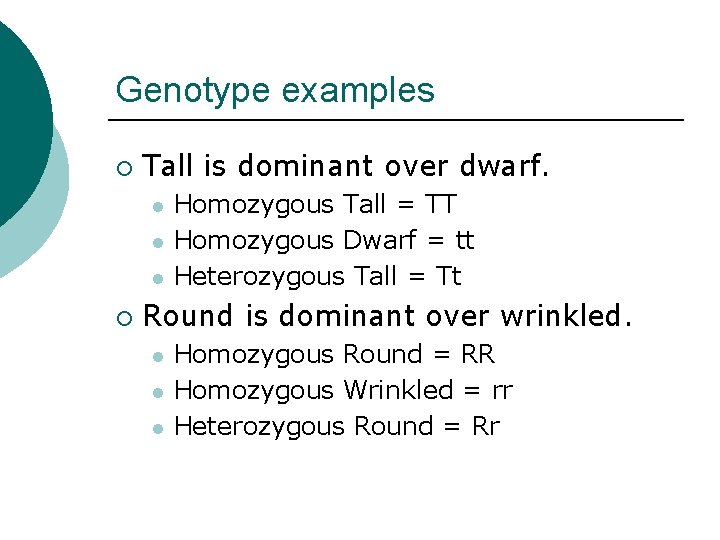
Genotype examples ¡ Tall is dominant over dwarf. l l l ¡ Homozygous Tall = TT Homozygous Dwarf = tt Heterozygous Tall = Tt Round is dominant over wrinkled. l l l Homozygous Round = RR Homozygous Wrinkled = rr Heterozygous Round = Rr
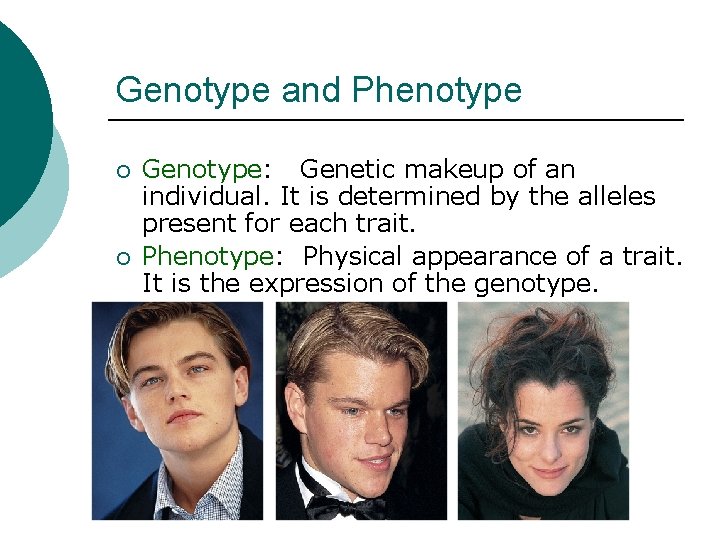
Genotype and Phenotype ¡ ¡ Genotype: Genetic makeup of an individual. It is determined by the alleles present for each trait. Phenotype: Physical appearance of a trait. It is the expression of the genotype.
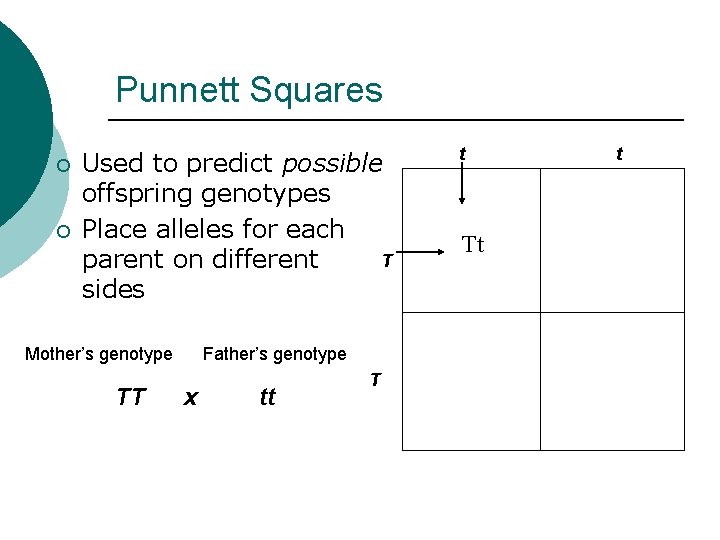
Punnett Squares ¡ ¡ Used to predict possible offspring genotypes Place alleles for each T parent on different sides Mother’s genotype TT Father’s genotype x tt T t Tt t
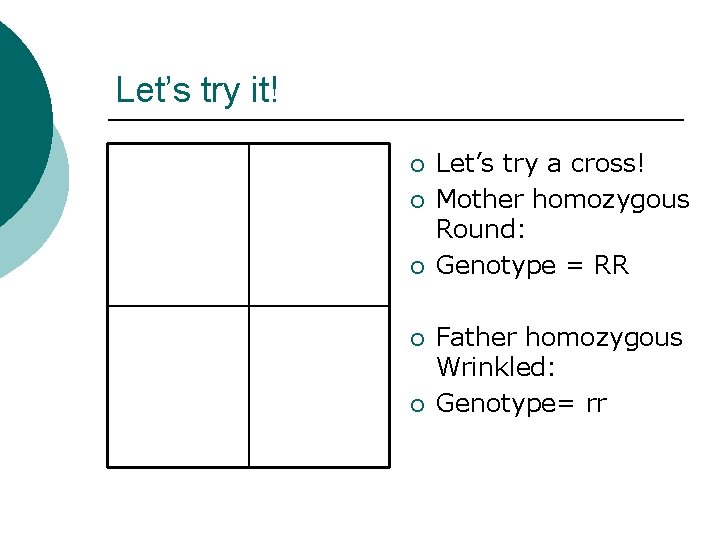
Let’s try it! ¡ ¡ ¡ Let’s try a cross! Mother homozygous Round: Genotype = RR Father homozygous Wrinkled: Genotype= rr
Mendel’s Laws ¡ Based on Mendel’s data, he formulated two laws: l l Law of Segregation: A parent contributes only one of its alleles for a trait to each offspring. If parent is heterozygous for a trait, the particular allele donated to the offspring is random.
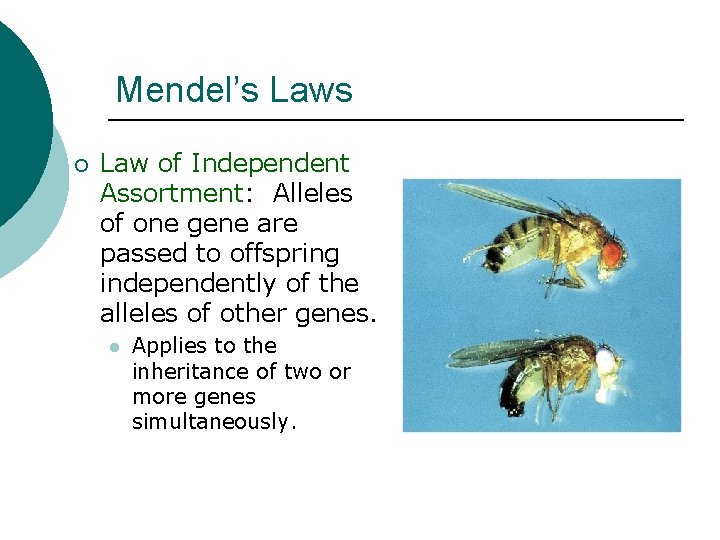
Mendel’s Laws ¡ Law of Independent Assortment: Alleles of one gene are passed to offspring independently of the alleles of other genes. l Applies to the inheritance of two or more genes simultaneously.
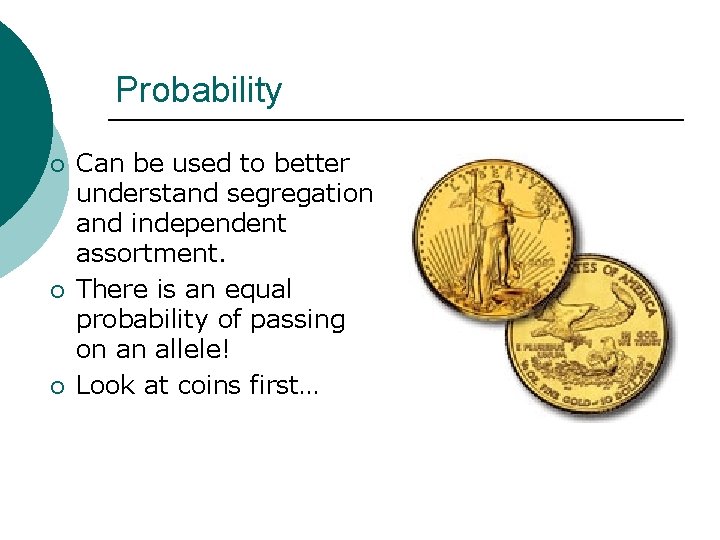
Probability ¡ ¡ ¡ Can be used to better understand segregation and independent assortment. There is an equal probability of passing on an allele! Look at coins first…
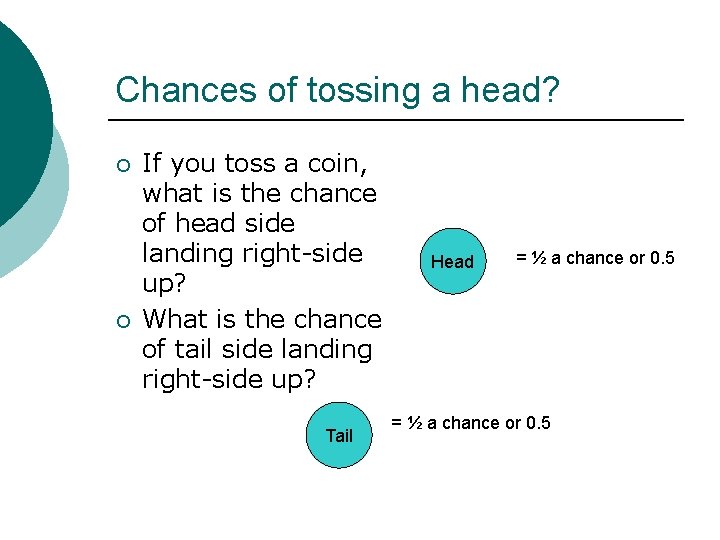
Chances of tossing a head? ¡ ¡ If you toss a coin, what is the chance of head side landing right-side up? What is the chance of tail side landing right-side up? Tail Head = ½ a chance or 0. 5
Mutations Definition = change in DNA sequence resulting the appearance of a new allele ¡ Can occur at any time, but not always beneficial ¡ Some can be harmful and result in death ¡ Some can result in the organism having traits that make them better suited to the environment ¡
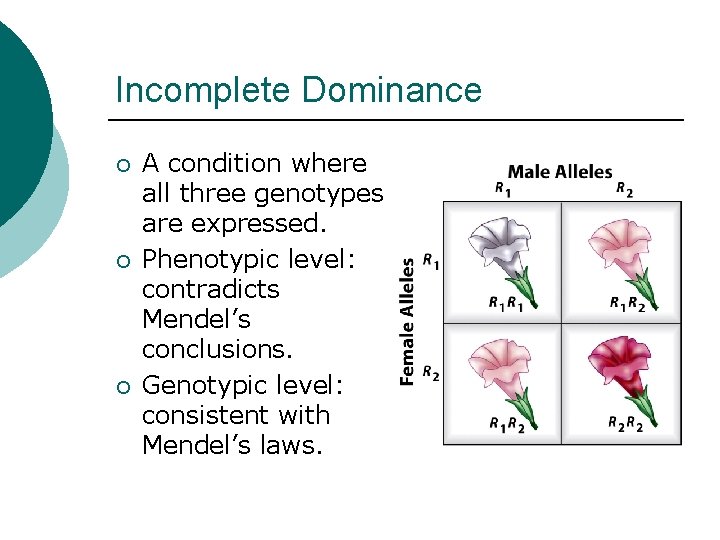
Incomplete Dominance ¡ ¡ ¡ A condition where all three genotypes are expressed. Phenotypic level: contradicts Mendel’s conclusions. Genotypic level: consistent with Mendel’s laws.
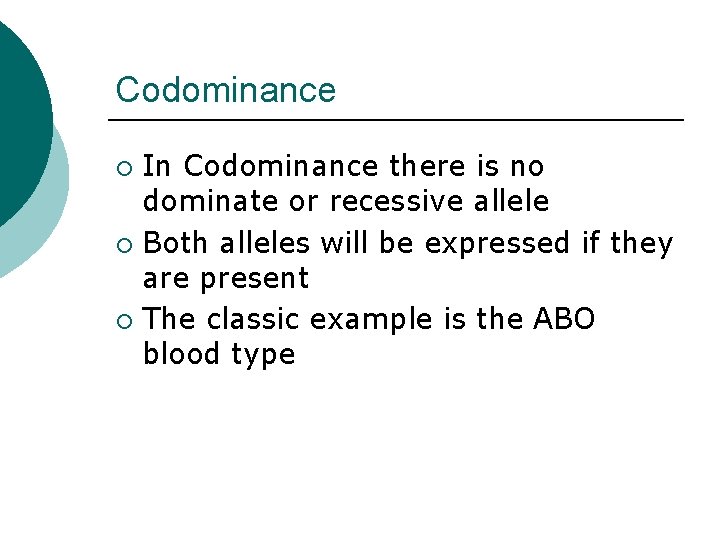
Codominance In Codominance there is no dominate or recessive allele ¡ Both alleles will be expressed if they are present ¡ The classic example is the ABO blood type ¡
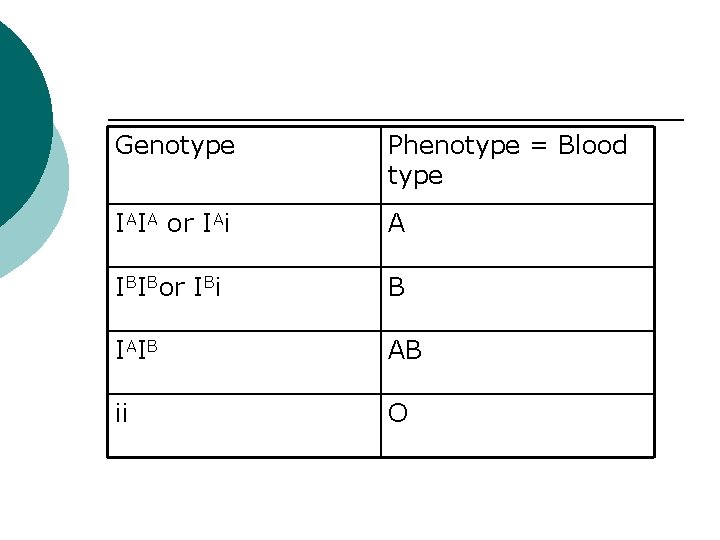
ABO Blood Groups Two alleles A and B ¡ Use a place holder to identify the trait (I) ¡ Determine the genotypes and the phenotypes ¡
Genotype Phenotype = Blood type IAIA or IAi A IBIBor IBi B I AI B AB ii O
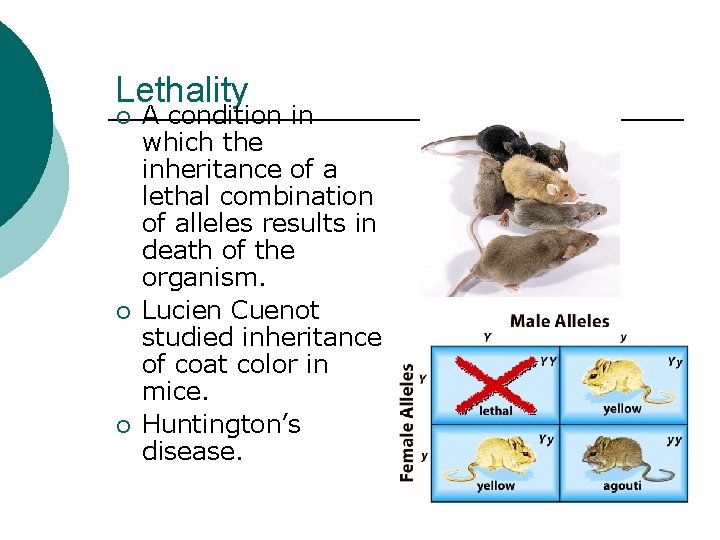
Lethality ¡ ¡ ¡ A condition in which the inheritance of a lethal combination of alleles results in death of the organism. Lucien Cuenot studied inheritance of coat color in mice. Huntington’s disease.
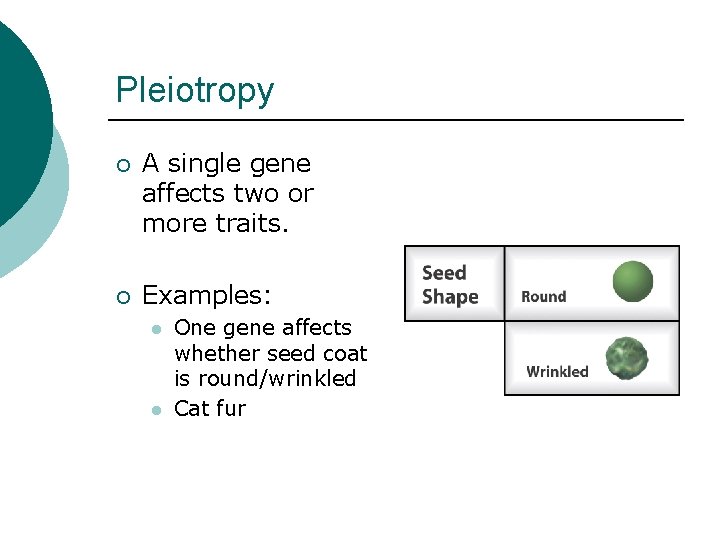
Pleiotropy ¡ A single gene affects two or more traits. ¡ Examples: l l One gene affects whether seed coat is round/wrinkled Cat fur
Polygenic vs. Monogenic inheritance ¡ Polygenic: A trait affected by many genes. l ¡ Examples: Height, weight, skin color Monogenic: Traits determined by single gene with two alleles. l Examples: Flower color in four-o’clock plants