
HERBICIDE ROTATION INTERVALS PLANTBACK RESTRICTIONS AND COVER CROP
HERBICIDE ROTATION INTERVALS (PLANT-BACK RESTRICTIONS) AND COVER CROP ISSUES; REVISITED POM-EQI APRIL 11 2016 Lebelle Hicks Ph. D DABT Maine Board of Pesticides Control 28 Statehouse Station Augusta ME 04333 lebelle. hicks@maine. gov 1
PROPOSED ISSUE PAPER ØExpand the summary and conclusions from the April 2015 discussion ØUse language that: ØWill be consistent from product to product, crop to crop ØUseful to USDA and EPA regarding use of herbicides in terminating cover crops ØProhibit the use of cover crops for food or feed 2
Here’s my take on expanding on the conclusions from my September 2015 talk. 3
CONCLUSIONS; EXPANDED ØDefine cover crops as nonfood, require this description on labels ØMake it illegal to feed cover crops to livestock or as food for humans ØThis would address concerns about illegal residues in food or feed 4
CONCLUSIONS; EXPANDED Ø Differentiate between guidelines for rotational intervals for cover crops (by plant type sensitive to carryover) and specify restrictions for rotated food/feed crops (illegal residues) ØUpdate PR notice 2000 -5 (1) regarding mandatory and advisory label language ØAdd a section to the Label Review Manual (2) on cover crop language (1) EPA 2000 e, PRN 2000 -5: Guidance for Mandatory and Advisory Labeling Statements (2) EPA 2014 j, Label Review Manual 5
CONCLUSIONS; EXPANDED Ø Encourage bioassays on labels ØBioassays provide growers specific information regarding effects of herbicides on cover crop growth ØParameters include: rates, plowing habits, method, soil; temperature, p. H, soil type, water; rainfall, irrigation 6
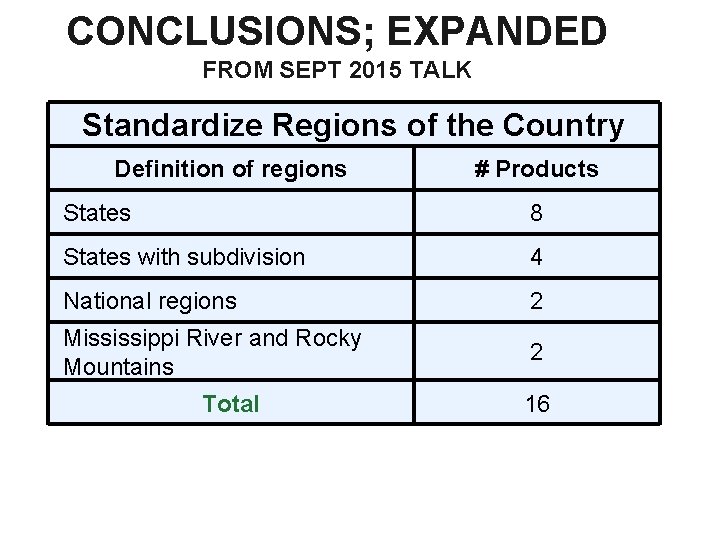
CONCLUSIONS; EXPANDED FROM SEPT 2015 TALK Standardize Regions of the Country Definition of regions # Products States 8 States with subdivision 4 National regions 2 Mississippi River and Rocky Mountains 2 Total 16 7

CROP ROTATION & COVER CROPS All cover crops are rotational crops; Not all rotational crops are cover crops Ø Crop rotation and cover crops are encouraged as good agricultural practices Ø EPA; Encourages crop rotation to reduce herbicide resistance (1) Ø USDA; Provides cost share assistance for cover crops (2) (1) EPA 2014 j, Label Review Manual (2) USDA 2015 b, 2015 Cover Crops, Crop Insurance, Cover Crops and NRCS Cover Crop Termination Guidelines, FAQs 8
HERBICIDES The cover crop may be terminated by natural causes such as frost, or intentionally terminated through chemical application, crimping, rolling, tillage, or cutting (1) 48% of cover crops from the SARE-CTIC 2014 survey were terminated with herbicides (2) (1) USDA 2014 a, NRCS Cover Crop Termination Guidelines; Sept 2014 Volume 3 (2) SARE and CTIC 2014, REPORT; A synopsis of the information collected during the 2013 -2014 cover crop survey. 2013 -2014 COVER CROP SURVEY 9
TERMINATION GUIDELINES California is in USDA Zone 1; Late Spring to Fall seeded cover crops in Zone 1 must be terminated at or within 35 Days after planting (of primary crop) but before plant emergence Maine is in USDA Zone 4; Cover crops in Zone 4 must be terminated at or within 5 Days after planting (of primary crop) but before plant emergence (1) USDA 2014 a, NRCS Cover Crop Termination Guidelines; Sept 2014 Volume 3 10
Pesticide Directions for Use Sites must be on the pesticide label (40 CFR 156. 10) (1) “Any limitations or restrictions on use to prevent unreasonable adverse effects such as: (A) Pre-harvest intervals (B) Rotational Intervals (C) Warnings for use on particular crops…. ” (2) (1) 40 CFR 156. 10 § (h) (2) (iii) (2) EPA 2014 j, Label Review Manual 11

SUMMARY AND CONCLUSIONS Ø Define cover crops as nonfood, require this description on labels Ø Differentiate between guidelines for rotational intervals for cover crops (by plant type sensitive to carryover) and restrictions for rotated food/feed crops (illegal residues) ØUpdate PR notice 2000 -5 (1) regarding mandatory and advisory label language ØAdd a section to the Label Review Manual (2) on cover crop language Ø Encourage bioassays as a means of assuring growers that their cover crops will grow Ø Standardize regions of the country; listing states with or without subdivisions (1) EPA 2000 e, PRN 2000 -5: Guidance for Mandatory and Advisory Labeling Statements (2) EPA 2014 j, Label Review Manual 12
- Slides: 12