
Herbert John Rogers King Lear Disinheriting Cordelia 1850
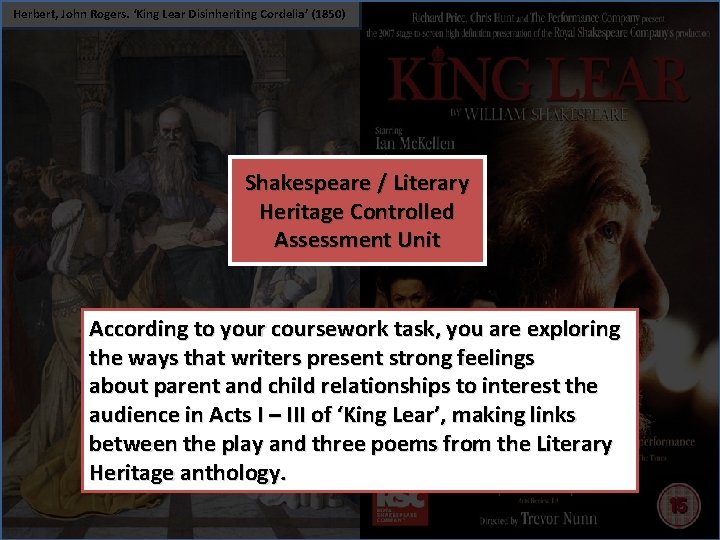
Herbert, John Rogers. ‘King Lear Disinheriting Cordelia’ (1850) Shakespeare / Literary Heritage Controlled Assessment Unit According to your coursework task, you are exploring the ways that writers present strong feelings about parent and child relationships to interest the audience in Acts I – III of ‘King Lear’, making links between the play and three poems from the Literary Heritage anthology.
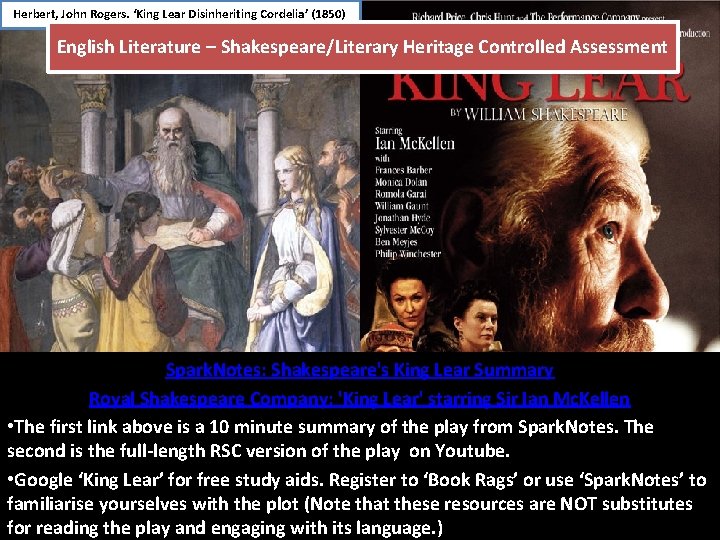
Herbert, John Rogers. ‘King Lear Disinheriting Cordelia’ (1850) English Literature – Shakespeare/Literary Heritage Controlled Assessment Spark. Notes: Shakespeare's King Lear Summary Royal Shakespeare Company: 'King Lear' starring Sir Ian Mc. Kellen • The first link above is a 10 minute summary of the play from Spark. Notes. The second is the full-length RSC version of the play on Youtube. • Google ‘King Lear’ for free study aids. Register to ‘Book Rags’ or use ‘Spark. Notes’ to familiarise yourselves with the plot (Note that these resources are NOT substitutes for reading the play and engaging with its language. )
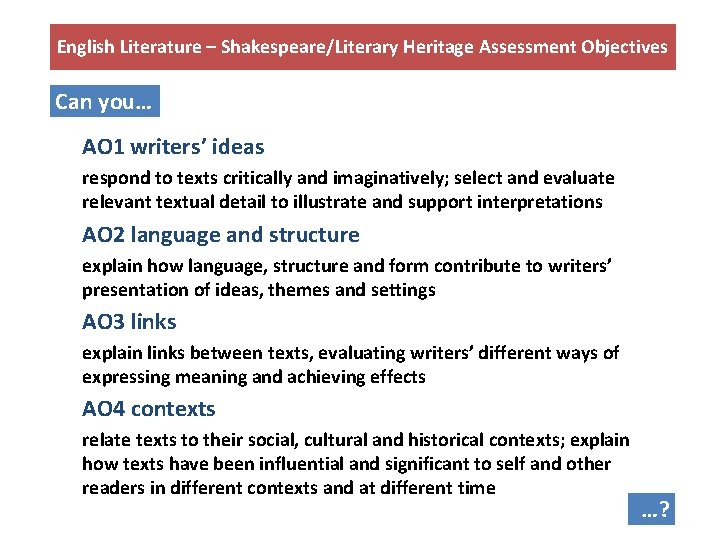
English Literature – Shakespeare/Literary Heritage Assessment Objectives Can you… AO 1 writers’ ideas respond to texts critically and imaginatively; select and evaluate relevant textual detail to illustrate and support interpretations AO 2 language and structure explain how language, structure and form contribute to writers’ presentation of ideas, themes and settings AO 3 links explain links between texts, evaluating writers’ different ways of expressing meaning and achieving effects AO 4 contexts relate texts to their social, cultural and historical contexts; explain how texts have been influential and significant to self and other readers in different contexts and at different time …?
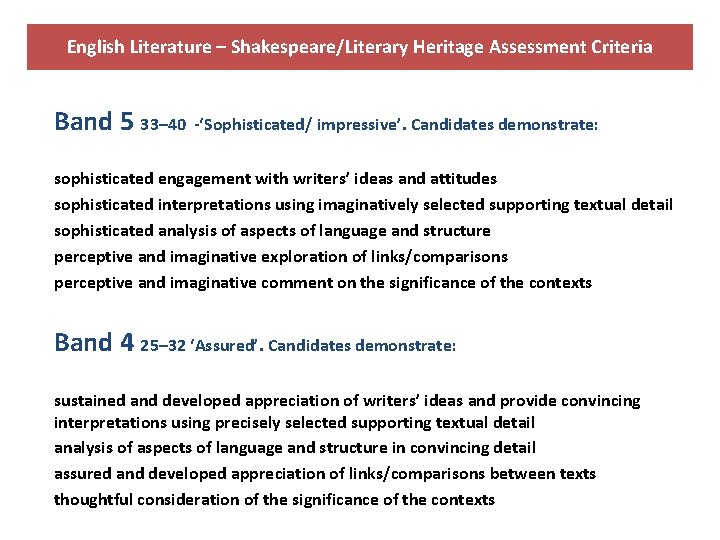
English Literature – Shakespeare/Literary Heritage Assessment Criteria Band 5 33– 40 -‘Sophisticated/ impressive’. Candidates demonstrate: sophisticated engagement with writers’ ideas and attitudes sophisticated interpretations using imaginatively selected supporting textual detail sophisticated analysis of aspects of language and structure perceptive and imaginative exploration of links/comparisons perceptive and imaginative comment on the significance of the contexts Band 4 25– 32 ‘Assured’. Candidates demonstrate: sustained and developed appreciation of writers’ ideas and provide convincing interpretations using precisely selected supporting textual detail analysis of aspects of language and structure in convincing detail assured and developed appreciation of links/comparisons between texts thoughtful consideration of the significance of the contexts
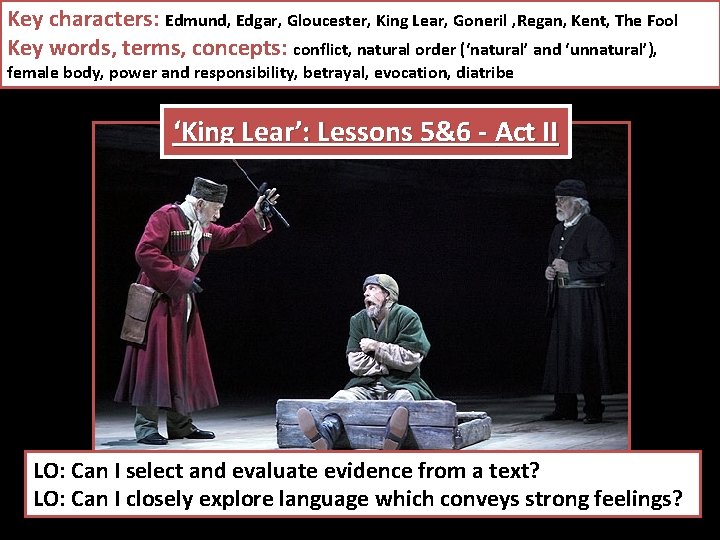
Key characters: Edmund, Edgar, Gloucester, King Lear, Goneril , Regan, Kent, The Fool Key words, terms, concepts: conflict, natural order (‘natural’ and ‘unnatural’), female body, power and responsibility, betrayal, evocation, diatribe ‘King Lear’: Lessons 5&6 - Act II LO: Can I select and evaluate evidence from a text? LO: Can I closely explore language which conveys strong feelings?
Act II, Scene I: Gloucester, Edmund and Edgar Q: Who do you find most interesting? Edmund or Edgar? Q: Is there any justification for the way Edmund behaves throughout the play? Q: Is Edgar believable? Is he too gullible? Q: Act II, Scene I: Why might an Elizabethan audience react differently to a modern audience? Q: How did Gloucester refer to / describe Edmund in the opening of the play? Q: Why does Gloucester now refer to Edmund as ‘loyal and natural boy’?
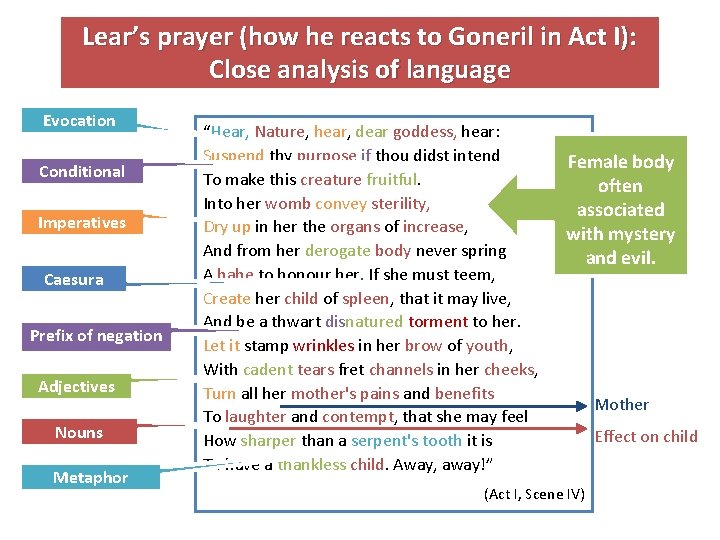
Lear’s prayer (how he reacts to Goneril in Act I): Close analysis of language Evocation Conditional Imperatives Caesura Prefix of negation Adjectives Nouns Metaphor “Hear, Nature, hear, dear goddess, hear: Suspend thy purpose if thou didst intend To make this creature fruitful. Into her womb convey sterility, Dry up in her the organs of increase, And from her derogate body never spring A babe to honour her. If she must teem, Create her child of spleen, that it may live, And be a thwart disnatured torment to her. Let it stamp wrinkles in her brow of youth, With cadent tears fret channels in her cheeks, Turn all her mother's pains and benefits To laughter and contempt, that she may feel How sharper than a serpent's tooth it is To have a thankless child. Away, away!” Female body often associated with mystery and evil. (Act I, Scene IV) Mother Effect on child
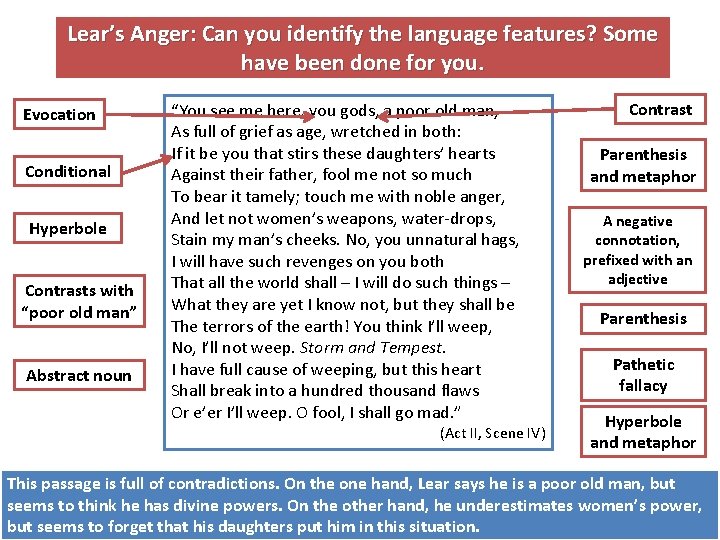
Lear’s Anger: Can you identify the language features? Some have been done for you. Evocation Conditional Hyperbole Contrasts with “poor old man” Abstract noun “You see me here, you gods, a poor old man, As full of grief as age, wretched in both: If it be you that stirs these daughters’ hearts Against their father, fool me not so much To bear it tamely; touch me with noble anger, And let not women’s weapons, water-drops, Stain my man’s cheeks. No, you unnatural hags, I will have such revenges on you both That all the world shall – I will do such things – What they are yet I know not, but they shall be The terrors of the earth! You think I’ll weep, No, I’ll not weep. Storm and Tempest. I have full cause of weeping, but this heart Shall break into a hundred thousand flaws Or e’er I’ll weep. O fool, I shall go mad. ” (Act II, Scene IV) Contrast Parenthesis and metaphor A negative connotation, prefixed with an adjective Parenthesis Pathetic fallacy Hyperbole and metaphor This passage is full of contradictions. On the one hand, Lear says he is a poor old man, but seems to think he has divine powers. On the other hand, he underestimates women’s power, but seems to forget that his daughters put him in this situation.
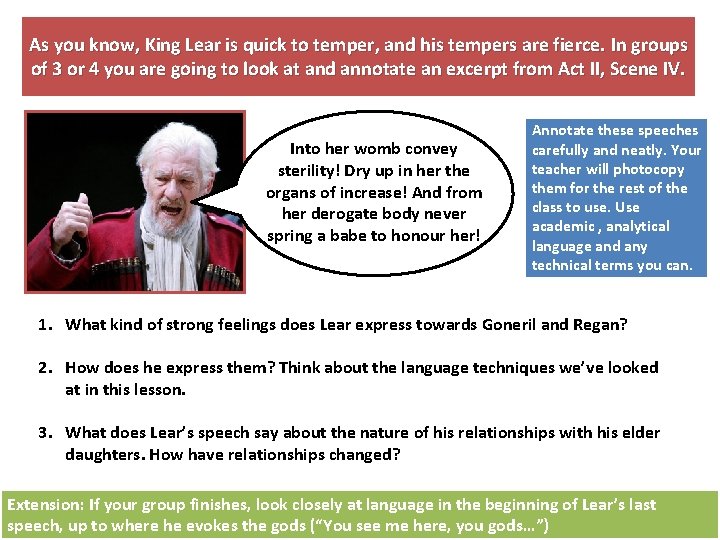
As you know, King Lear is quick to temper, and his tempers are fierce. In groups of 3 or 4 you are going to look at and annotate an excerpt from Act II, Scene IV. Into her womb convey sterility! Dry up in her the organs of increase! And from her derogate body never spring a babe to honour her! Annotate these speeches carefully and neatly. Your teacher will photocopy them for the rest of the class to use. Use academic , analytical language and any technical terms you can. 1. What kind of strong feelings does Lear express towards Goneril and Regan? 2. How does he express them? Think about the language techniques we’ve looked at in this lesson. 3. What does Lear’s speech say about the nature of his relationships with his elder daughters. How have relationships changed? Extension: If your group finishes, look closely at language in the beginning of Lear’s last speech, up to where he evokes the gods (“You see me here, you gods…”)
Lear’s Anger #1 KING LEAR The king would speak with Cornwall; the dear father Would with his daughter speak, commands her service: Are they inform'd of this? My breath and blood! Fiery? the fiery duke? Tell the hot duke that-No, but not yet: may be he is not well: Infirmity doth still neglect all office Whereto our health is bound; we are not ourselves When nature, being oppress'd, commands the mind To suffer with the body: I'll forbear; And am fall'n out with my more headier will, To take the indisposed and sickly fit For the sound man. Death on my state! Wherefore Looking on KENT Should he sit here? This act persuades me That this remotion of the duke and her Is practise only. Give me my servant forth. Go tell the duke and 's wife I'ld speak with them, Now, presently: bid them come forth and hear me, Or at their chamber-door I'll beat the drum Till it cry sleep to death. (Act II, Scene IV)
Lear’s Anger #2 KING LEAR Regan, I think you are; I know what reason I have to think so: if thou shouldst not be glad, I would divorce me from thy mother's tomb, Sepulchring an adultress. To KENT O, are you free? Some other time for that. Beloved Regan, Thy sister's naught: O Regan, she hath tied Sharp-tooth'd unkindness, like a vulture, here: Points to his heart I can scarce speak to thee; thou'lt not believe With how depraved a quality--O Regan! (Act II, Scene IV)
Lear’s Anger #3 KING LEAR Ask her forgiveness? Do you but mark how this becomes the house: 'Dear daughter, I confess that I am old; Kneeling Age is unnecessary: on my knees I beg That you'll vouchsafe me raiment, bed, and food. ' REGAN Good sir, no more; these are unsightly tricks: Return you to my sister. KING LEAR [Rising] Never, Regan: She hath abated me of half my train; Look'd black upon me; struck me with her tongue, Most serpent-like, upon the very heart: All the stored vengeances of heaven fall On her ingrateful top! Strike her young bones, You taking airs, with lameness! (Act II, Scene IV)
Lear’s Anger #4 CORNWALL Fie, sir, fie! KING LEAR You nimble lightnings, dart your blinding flames Into her scornful eyes! Infect her beauty, You fen-suck'd fogs, drawn by the powerful sun, To fall and blast her pride! REGAN O the blest gods! so will you wish on me, When the rash mood is on. KING LEAR No, Regan, thou shalt never have my curse: Thy tender-hefted nature shall not give Thee o'er to harshness: her eyes are fierce; but thine Do comfort and not burn. 'Tis not in thee To grudge my pleasures, to cut off my train, To bandy hasty words, to scant my sizes, And in conclusion to oppose the bolt Against my coming in: thou better know'st The offices of nature, bond of childhood, Effects of courtesy, dues of gratitude; Thy half o' the kingdom hast thou not forgot, Wherein I thee endow'd. (Act II, Scene IV)
Lear’s Anger #5 KING LEAR Who stock'd my servant? Regan, I have good hope Thou didst not know on't. Who comes here? O heavens, Enter GONERIL If you do love old men, if your sweet sway Allow obedience, if yourselves are old, Make it your cause; send down, and take my part! To GONERIL Art not ashamed to look upon this beard? O Regan, wilt thou take her by the hand? GONERIL Why not by the hand, sir? How have I offended? All's not offence that indiscretion finds And dotage terms so. KING LEAR O sides, you are too tough; Will you yet hold? How came my man i' the stocks? CORNWALL I set him there, sir: but his own disorders Deserved much less advancement. KING LEAR You! did you? (Act II, Scene IV)
Lear’s Anger #6 KING LEAR Return to her, and fifty men dismiss'd? No, rather I abjure all roofs, and choose To wage against the enmity o' the air; To be a comrade with the wolf and owl, -Necessity's sharp pinch! Return with her? Why, the hot-blooded France, that dowerless took Our youngest born, I could as well be brought To knee his throne, and, squire-like; pension beg To keep base life afoot. Return with her? Persuade me rather to be slave and sumpter To this detested groom. Pointing at OSWALD (Act II, Scene IV)
Lear’s Anger #7 KING LEAR I prithee, daughter, do not make me mad: I will not trouble thee, my child; farewell: We'll no more meet, no more see one another: But yet thou art my flesh, my blood, my daughter; Or rather a disease that's in my flesh, Which I must needs call mine: thou art a boil, A plague-sore, an embossed carbuncle, In my corrupted blood. But I'll not chide thee; Let shame come when it will, I do not call it: I do not bid the thunder-bearer shoot, Nor tell tales of thee to high-judging Jove: Mend when thou canst; be better at thy leisure: I can be patient; I can stay with Regan, I and my hundred knights. (Act II, Scene IV)
Plenary: Key quotes from Act I, Scene IV Which quote from your extract best illustrates Lear’s strong feelings in this scene?
Plenary: Key quotes from Act I, Scene IV Which quote from your extract best illustrates Lear’s strong feelings in this scene?
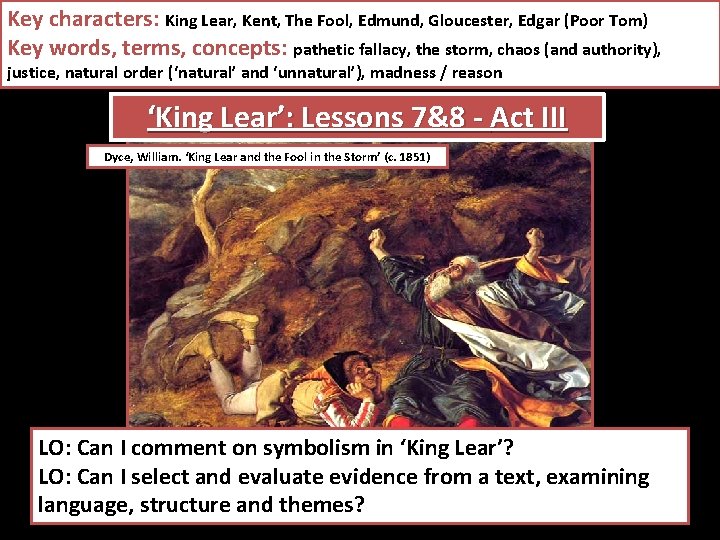
Key characters: King Lear, Kent, The Fool, Edmund, Gloucester, Edgar (Poor Tom) Key words, terms, concepts: pathetic fallacy, the storm, chaos (and authority), justice, natural order (‘natural’ and ‘unnatural’), madness / reason ‘King Lear’: Lessons 7&8 - Act III Dyce, William. ‘King Lear and the Fool in the Storm’ (c. 1851) LO: Can I comment on symbolism in ‘King Lear’? LO: Can I select and evaluate evidence from a text, examining language, structure and themes?
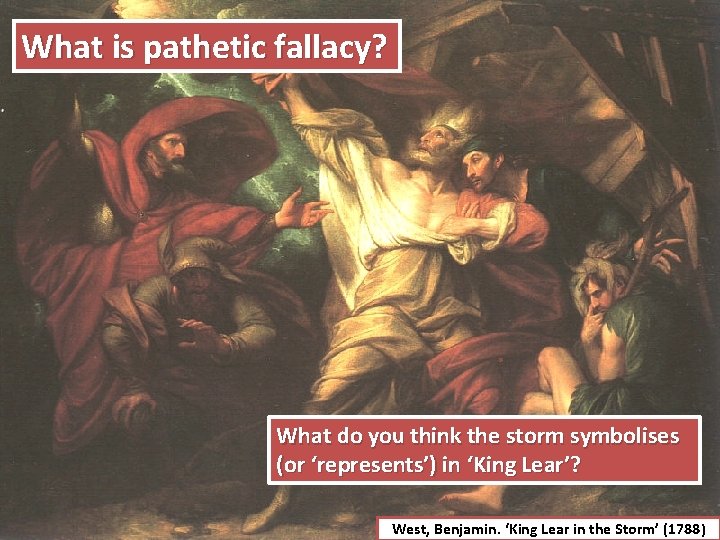
What is pathetic fallacy? What do you think the storm symbolises (or ‘represents’) in ‘King Lear’? West, Benjamin. ‘King Lear in the Storm’ (1788)
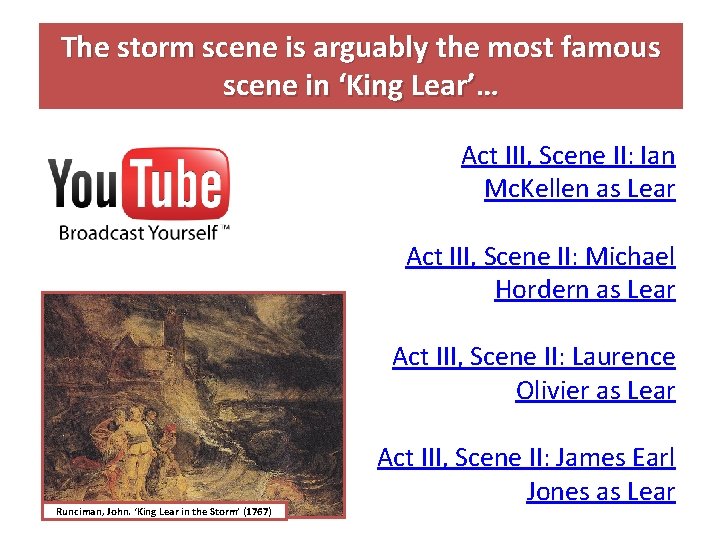
The storm scene is arguably the most famous scene in ‘King Lear’… Act III, Scene II: Ian Mc. Kellen as Lear Act III, Scene II: Michael Hordern as Lear Act III, Scene II: Laurence Olivier as Lear Runciman, John. ‘King Lear in the Storm’ (1767) Act III, Scene II: James Earl Jones as Lear
Lear in the storm 1: Act III, Scene II. Collect quotes which: a) Show Lear’s strength of feeling, b) Convey his thoughts about his daughters, c) Link to the symbolism of the storm / chaos / loss of natural order. Explode the quotes!
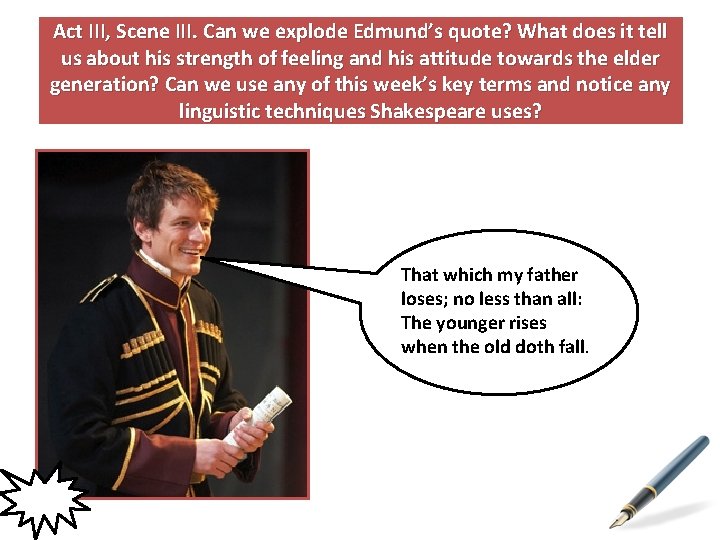
Act III, Scene III. Can we explode Edmund’s quote? What does it tell us about his strength of feeling and his attitude towards the elder generation? Can we use any of this week’s key terms and notice any linguistic techniques Shakespeare uses? That which my father loses; no less than all: The younger rises when the old doth fall.
Lear in the storm 2: Act III, Scene IV. Collect quotes which: a) Show Lear’s strength of feeling, b) Convey his thoughts about his daughters, c) Link to the symbolism of the storm / chaos / loss of natural order. Explode the quotes!
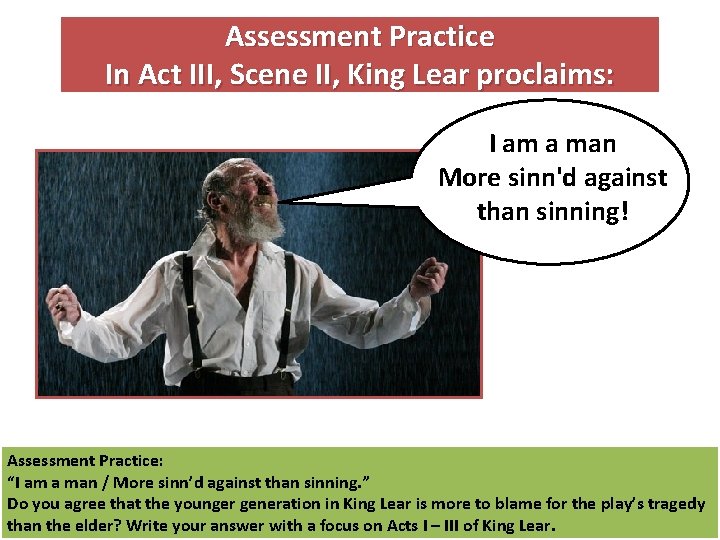
Assessment Practice In Act III, Scene II, King Lear proclaims: I am a man More sinn'd against than sinning! Assessment Practice: “I am a man / More sinn’d against than sinning. ” Do you agree that the younger generation in King Lear is more to blame for the play’s tragedy than the elder? Write your answer with a focus on Acts I – III of King Lear.
- Slides: 25