
Herbal Medicine in Pregnancy Birth and Lactation Mary
Herbal Medicine in Pregnancy, Birth, and Lactation Mary Bove ND Brattleboro Naturopathic Clinic www. bncvt. com
Issues Arising for Herbal Medicines in Pregnancy • Source of information: literature review, clinical trials, survey, clinical observation, empirical data • Safety and Toxicity: for fetus, mother, and pregnancy outcome • Ethical Issues • Lack of clinical research with this population • Treatment of a complaint arising during pregnancy or augmentation of labor versus treating the pregnancy • Less cautious attitude because herbs are natural
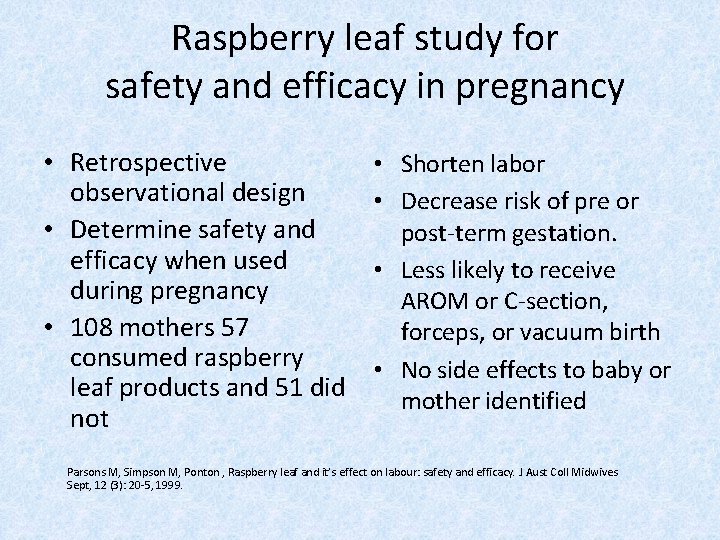
Raspberry leaf study for safety and efficacy in pregnancy • Retrospective observational design • Determine safety and efficacy when used during pregnancy • 108 mothers 57 consumed raspberry leaf products and 51 did not • Shorten labor • Decrease risk of pre or post-term gestation. • Less likely to receive AROM or C-section, forceps, or vacuum birth • No side effects to baby or mother identified Parsons M, Simpson M, Ponton , Raspberry leaf and it’s effect on labour: safety and efficacy. J Aust Coll Midwives Sept, 12 (3): 20 -5, 1999.

Ginger • A double-blind, random, crossover trial • Efficacy of ginger against placebo in the treatment of hyperemesis gravidarum • 30 women, 250 mg QID for 4 days • Showed a significantly greater reduction in the symptoms of nausea and vomiting in the ginger group (p=0. 035). Fisher-Rasmussen W, Kjaer SK, Dahl C, et al, Eur J Obstet Gynecol Reprod Boil 1990; 38 (1): 19 -24.
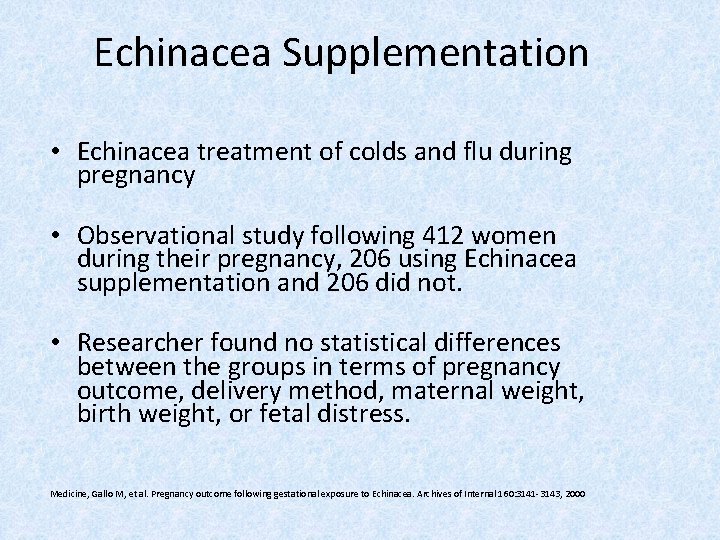
Echinacea Supplementation • Echinacea treatment of colds and flu during pregnancy • Observational study following 412 women during their pregnancy, 206 using Echinacea supplementation and 206 did not. • Researcher found no statistical differences between the groups in terms of pregnancy outcome, delivery method, maternal weight, birth weight, or fetal distress. Medicine, Gallo M, et al. Pregnancy outcome following gestational exposure to Echinacea. Archives of Internal 160: 3141 -3143, 2000
Considerations for Pregnancy § Most constituents will pass thru the placenta and reach the fetus. § The pregnant body under goes physiological changes in metabolic processes, which may influence the effect of herbal medicines in the body. § Take extra caution in the first trimester § All herbs have the potential to be harmful. Use medicinal herbs as medicines. § Choose herbal preparations which are appropriate and complementing to the pregnancy, such as teas, flower essences, extracts, and topical applications.
Herbal Contra-Indications in Pregnancy Ø True emmenagogues such as pennyroyal, tansy, wormwood, and cotton root bark Ø Anti-histamine herbs such as ephdra, and osha Ø Alkaloids this active constituent depresses the CNS, berberine, ephedrine Ø Diuretics of the irritating nature, those high in volatile oils like juniper berry, or buchu Ø Laxative herbs such as buckthorn, aloe, castor, and senna pods Ø Plants high in volatile should be avoided in the first trimester and used only in moderation during the second and third trimesters. Ø Most are ok in cooking or baking
Incorporating Botanical Medicines into the Prenatal Consult • Educating about the Use of Herbs – Culinary, Beverage, Tonic, Medicine – Internal or External • Herbal Pharmacy & Preparations – Appropriate, complementing pregnancy preps such as teas, flower essences, extracts, and topical applications • Dosing in Pregnancy & Lactation – Consider the Pregnant Physiology • Herbs for the Different Trimesters – First, Second, Third, Fourth

Magic Happens Here
Traditional Herbal Medicines used in Pregnancy Treatment of threaten miscarriage, cervical ripening, induction of labor, and augmentation of labor Single Herbs; Ø Raspberry leaf Rubus idaeus Ø Nettle leaf Urtica dioica Ø Partridge berry Mitchella repens Ø Black haw and cramp bark Viburnum sp
Partus Preparator Commonly used herbs include; ²Blue Cohosh (caulophylumm thalictroides) ²Black Cohosh (cimicifuga racemosa) ²False Unicorn (chamaerlirium lutuem) ²Black Haw (viburnum prunifolium) ²Partridge Berry (mitchella repens)
Botanical Preparations Used In Pregnancy • Oral; Infusions, decoctions, tinctures, glycerites, capsules, syrups, tablets, vinegars • Topical; baths, creams, salves, poultices, peri-wash, oils, floral water • Aromatherapy; essential oils topically
Essential Oils in Pregnancy For Topical Application Clary Sage EO Lavender EO Peppermint EO Rosemary EO
Lavender Essential Oil • Botanical: lavender angusifolia or officinale • Parts used: flowers • Actions: antimicrobial, analgesic, anti-inflammatory, GI relaxant, immune system stimulant, vulnerary, reduction of scar tissue, anti-depressant, carminative • Indications: colic and flatulence, headaches, wound healing , prevention & treatment of infection • Dose: Can be put on neat to the skin
Rosemary Essential Oil • Botanical Name: Rosmarinus officinalis • Parts Used: flowering tops/leaves • Actions: Increase circulation, reduces muscle pain, improves mood, stimulates nervous system and adrenals • Indications: headaches, fatigue, depression • C/I: high blood pressure
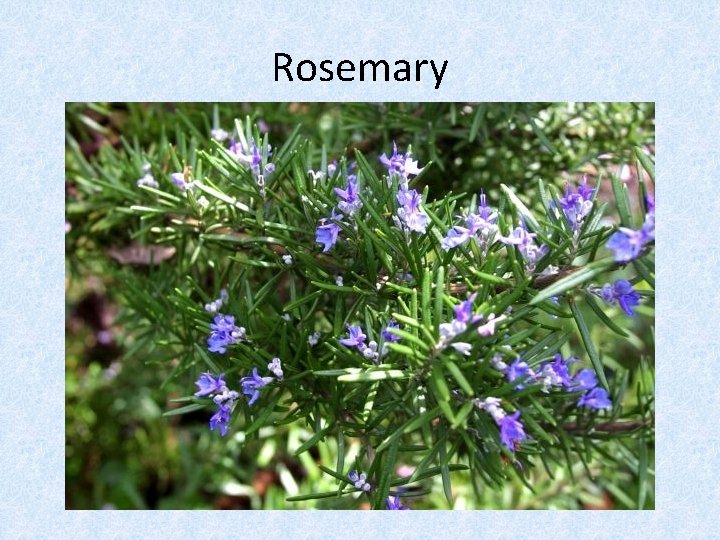
Rosemary
Case-Headaches in Pregnancy • 28 year old G 1 P 0 – Paged with acute onset of headache at 15 wks • client had taken two tylenol with no change • BP normal; well hydrated • Location: eyes/back of neck • Tx: steam with rosemary herb from her garden resolved the headache within minutes
Herbal Beverage and Tonic Teas used in Pregnancy • Anise or Fennel Seeds: Aromatic digestive herb, antispasmodic, carminative, expectorant, anti-microbial, and galactagogue • Burdock root: Alterative, tonic, lymphatic, hepatic • Chamomile flowers: Anti-nausea, anti-inflammatory, anti- bacterial, anti-spasmodic, carminative, relaxant, vulnerary • Lemon Balm whole herb: Carminative, relaxant, antispasmodic, diaphoretic, anti-viral, anti-microbial, stimulates limbic center in the brain • Nettles leaves: astringent, galactagogue, tonic, diuretic, circulatory stimulate, high in Vt C, calcium, Iron, silica
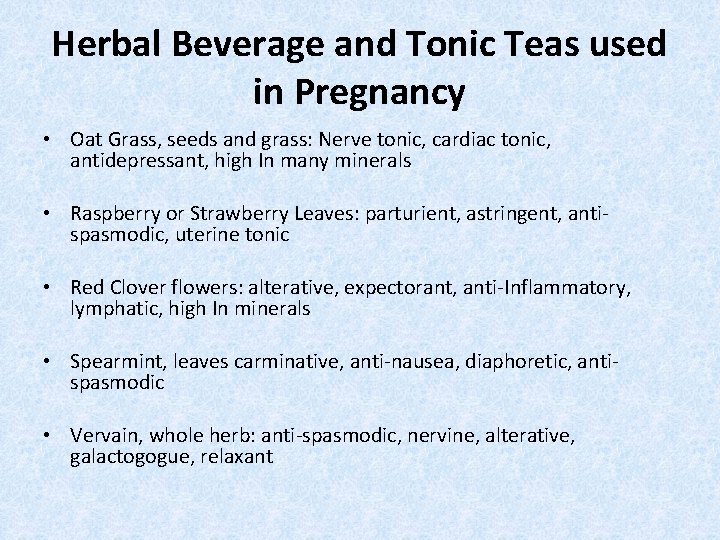
Herbal Beverage and Tonic Teas used in Pregnancy • Oat Grass, seeds and grass: Nerve tonic, cardiac tonic, antidepressant, high In many minerals • Raspberry or Strawberry Leaves: parturient, astringent, antispasmodic, uterine tonic • Red Clover flowers: alterative, expectorant, anti-Inflammatory, lymphatic, high In minerals • Spearmint, leaves carminative, anti-nausea, diaphoretic, antispasmodic • Vervain, whole herb: anti-spasmodic, nervine, alterative, galactogogue, relaxant
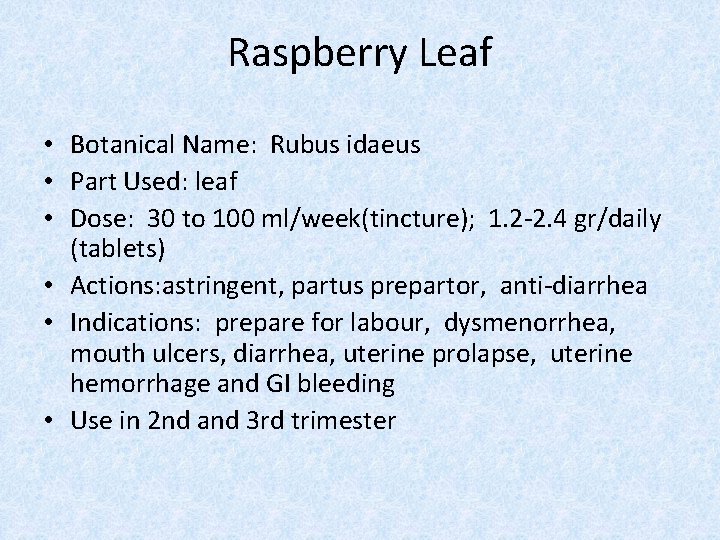
Raspberry Leaf • Botanical Name: Rubus idaeus • Part Used: leaf • Dose: 30 to 100 ml/week(tincture); 1. 2 -2. 4 gr/daily (tablets) • Actions: astringent, partus prepartor, anti-diarrhea • Indications: prepare for labour, dysmenorrhea, mouth ulcers, diarrhea, uterine prolapse, uterine hemorrhage and GI bleeding • Use in 2 nd and 3 rd trimester
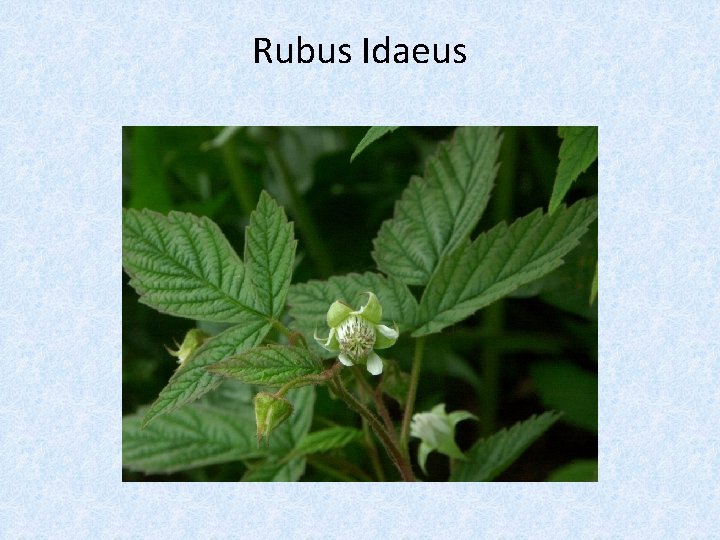
Rubus Idaeus
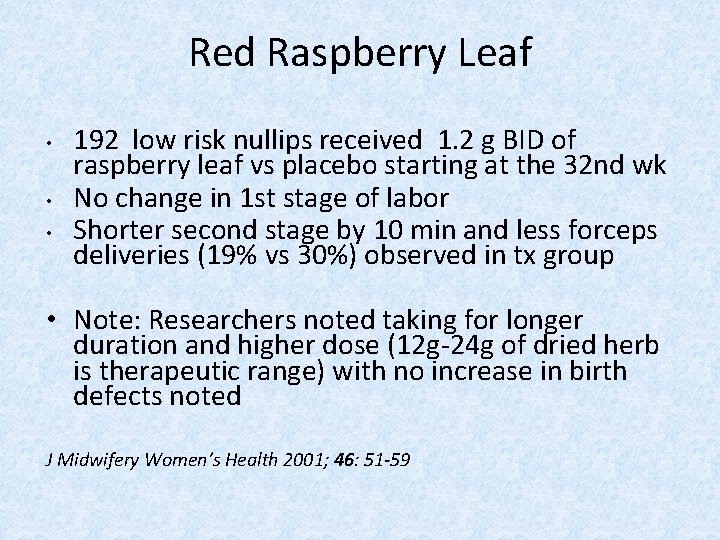
Red Raspberry Leaf • • • 192 low risk nullips received 1. 2 g BID of raspberry leaf vs placebo starting at the 32 nd wk No change in 1 st stage of labor Shorter second stage by 10 min and less forceps deliveries (19% vs 30%) observed in tx group • Note: Researchers noted taking for longer duration and higher dose (12 g-24 g of dried herb is therapeutic range) with no increase in birth defects noted J Midwifery Women’s Health 2001; 46: 51 -59
Pregnancy Tonic Tea • Raspberry Leaf • Nettle leaf • Rose petals • Spearmint leaf • Anise Seed Mix 15 grams of each in a large glass jar and mix well. Use 1 -2 tsp per cup boiling water steep 1 -3 minutes, strain, and drink
Herbal Punch Blend 1/2 oz of each of the following herbs in a large jar: • Chamomile flowers • Elder flowers • Lemon balm leaf • Nettle herb • Spearmint leaf • Strawberry leaf Use 2 tbsp herbal tea mix to 16 oz of boiling water steep 1 -3 minutes, strain, and mix with 1 cups of organic juice Drink as a beverage 1 -2 times daily Useful for colds and flu, sore throat, cough, upset tummy
Beautiful Belly Butter • 2 oz @of shea butter and coco butter • 1 oz apricot kernel oil (or herb infused oil) • 1/2 oz sea buckthorn oil Soften the butter so the oils may be mixed well into the butters. Store in airtight tubs Apply to belly, breasts, or perineum to keep skin healthy, hydrated, stretchy, and radiant!

The seeds of health and wellbeing. . . …. begin with a healthy mother and gestational period Maternal uterine environment influences the growing fetus’s health on several levels; physical development emotional wellbeing psychological health
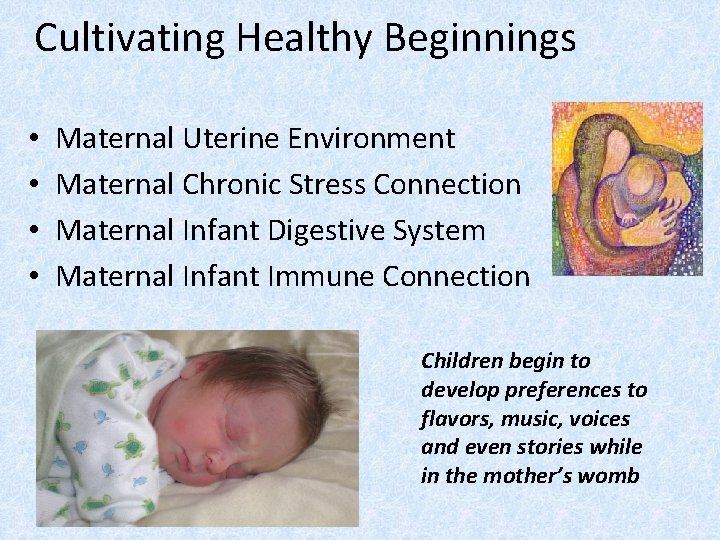
Cultivating Healthy Beginnings • • Maternal Uterine Environment Maternal Chronic Stress Connection Maternal Infant Digestive System Maternal Infant Immune Connection Children begin to develop preferences to flavors, music, voices and even stories while in the mother’s womb

The Peri-natal Period and Baby’s Emotional Wellbeing • New research suggests fetal consciousness exists. • Verny’s observations of fetal emotional response stimulated by the mothers feelings and the maternal hormonal response to the feeling. • Stress hormones are shared with the fetus.

Drs Klein and Taylor’s “Tend and Befriend” Notion • • Social ties reduce risk of disease Lowers blood pressure, heart rate, and cholesterol Friends help to improve longevity and quality of live Reducing stress without removing themselves from the community Taylor, S. E. , Klein, L. C. , et al, Female Responses to Stress: Tend and Befriend, Not Fight or Flight” Psychol Rev, 107(3): 410 -429, 2002

Women De-stress Best by: • • Cooking, food, social meals Caring for others and self Warmth, relaxing baths Sewing, quilting and knitting circles Women’s groups and gatherings Decorating the home Physical touch, sex, cuddling, eye contact
CNS Herbs • • Avena sativa – milky oats Lavendula officinalis- lavender flowers Melissa officinalis – lemon balm herb Rosa speices – rose petals Scutallaria officinalis- skullcap herb Valeriana officinalis- valerian root Viburnum opulus or prunifolium- cramp bark or black haw bark
Cultivating Healthy Beginnings Maternal Clinical Risks/Signs v. History of yeast infections, intestinal dysbiosis, IBS, insufficient digestive enzymes, low fiber diet, constipation v. Chronic stress, chronic inflammation, environmental toxic exposure, zinc deficiency, medications, allergies v. Immune Overload – allergen exposure, leaky gut, environmental toxic exposure, chronic stress, low SIg. A
Cultivating Healthy Beginnings Infant Connection • Immature digestive system • Establishment of healthy balanced microbiota • Immune system immaturity and hyperexposure in utero • Vaginal birth verse C-section • Breastfeeding or formula feeding

Getting a Good Start • Infants have a sterile gut leaving the womb • Exposed to bacteria via birth canal, skin, and meconium • Bifidobacteria develops rapidly in the first 3 days.
Role of Intestinal Microbiota • Lactobacillus, Bifidobacteria species play an important role – – – – Digestive function Fermentation of substates Competes with other bacteria Assimilation and absorption of vital nutrients Immune System – Innate & Adaptive Galt- gut associated lymphoid tissue Mucosal immunity, SIg. A, Barrier fxn (mucin) Healthy skin
Insights into the Microbiota • Up to 2 yrs to complete colonization of microbiota • Antibiotics disrupt normal microbiota growth and colonization “It is estimated that a course of antibiotics may disrupt normal microbiota colonization for up to three months post use. ” De la Cochetiere et al: Early intestinal bacterial colonization and nectrotizing enterocolitis in premature infants: the putative role of Clostridium, Pediatr Res Sep; 56(3): 366 -70, 2004
Prevention of Atopic Disease • A Finnish study; L. rhamnosus GG • Reducing atopic disease in infants • Administer to the pregnant mother in third trimester & breastfeeding and the infant. • Occurrence of atopic disease dropped 50% in the probiotic group a • Stayed low for full 4 years w/o further use of probiotics Kalliomaki M et al: Proibiotics and prevention of atopic disease: 4 year follow up of randomized placebo-controlled trial, Lancet 361: 1896 -1871, 2003
Probiotics • Observational study 1958 pregnancies • Vaginal samples 6 -22 weeks of gestation – Lactobacilli more likely absent in those who delivered preterm – 28% of women delivered <33 weeks lacked vaginal lactobacilli – 5% who delivered at term lacked vaginal lactobacilli – Absence of lactobacilli identified as independent risk factor • PMID: 12530101
Specific Indications for Probiotics during Pregnancy • Antibiotic Associated Diarrhea • Saccharomyses boulardii – 20 billion TID • Traveler’s Diarrhea • L. rhamnosus gg • • IBS- lactobacillus and bifidobacterium species Lactose Intolerance Constipation of Pregnancy - bifidobacteria Viral Gastroenteritis - shortens length and severity
Probiotics in Pregnancy Pregnant and nursing mothers • 50 to 200 billion daily after food • Bifidobacteria strains along with adult strains • Lactobacillus species including rhamnosus(GG), acidophilus, reuteri

Common Complaints Associated with Pregnancy • Nausea and vomiting • Heartburn • Constipation • Varicose veins • Hemorrhoids • Vaginitis - Candida & BV
Botanical Formula for Nausea/ Vomiting/Morning Sickness • Filipendula ulmaria/ Meadowsweet • Matricaria recutita/ Chamomile • Pimpenella anisum/ Anise Seed Mix 9 mls of each in a 1 oz bottle with • Zinzigber officinale/ Ginger -25 drops Use 10 -15 drops directly in the mouth or in 1 oz of warm water 4 -6 times daily
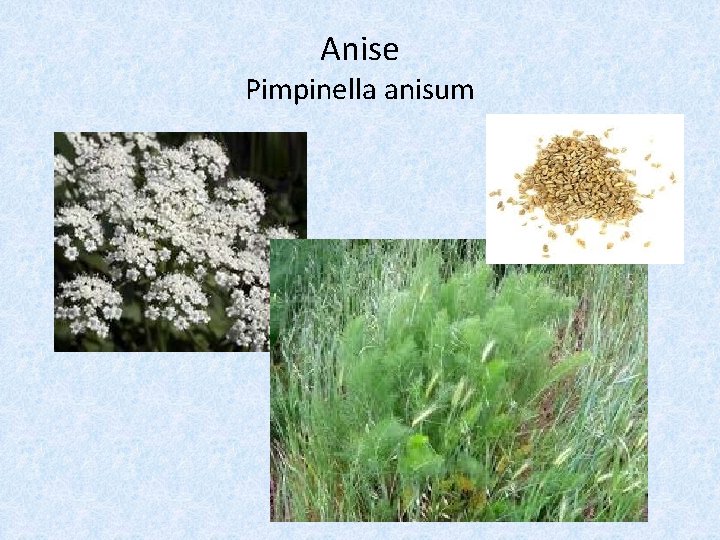
Anise Pimpinella anisum
Ginger Trials • • Double blind, randomized, cross over, placebo controlled trial 30 women with hyperemesis gravidarum 250 mg of ginger rhizome 4 x/day Significantly more effective on symptoms versus placebo European J of Obstet, Gyn, and Repro Biology, 38: 19 -24, 1990 • • Double blind study with 70 Thai women with nausea & vomiting 250 mg QID 80% reduction in vomiting and significant improvement in nausea Obstet Gynecol 2001; 97: 577 -582
Ginger Trial • • • Randomized controlled trial 120 women <20 wks pregnant w/ morning sickness 1500 mg x 4 days of ginger significant improvements in nausea and retching post delivery follow up revealed birth weights, gestational age, and APGAR scores within the normal limits congenital abnormalities were of those of the general population born at the time of the study – Aust N Z Obstet Gynecol 2003; 43: 139 -144
Heartburn in Pregnancy • Chew small amounts of anise, fennel, or dill seed • DGL powder or capsules; with meals/prn • Chewable Papaya enzymes/digestive plant enzymes before meals • Probiotics mix strains, 25 billion after meals TID • Eat small meals; avoid laying down up to one hour after meals • Avoid greasy, spicy foods, processed grain products
Constipation • Due to: – Decreased motility (progesterone) – Compression of intestines • Therapeutics – Water – Exercise – Prune, blueberry, purple grape juice – Electrolytes – Magnesium citrate 150 -300 mg 1 -2 times daily
Constipation • Therapeutics continued – Soak: prunes, raisins, apricots, pumpkin seeds in water, puree and add to foods – Fiber: legumes, fruits, veggies, oat bran – Stimulate bile secretion: lemon juice, artichokes, beets, raspberry vinegar – 1 -3 tsp organic flax or hemp oil – Avoid constipating foods: meat, white flour, excessive dairy, pizza, bananas
Constipation Avoid botanical medicines that act as strong laxatives, purgatives, or cathartics Consider these herbal actions; Aperative - dandelion root, turmeric Bulking Agents-Flax, Psyllium, or Chia seeds Autonomic Visceral Relaxants - Catnip, Lemon Balm, or Cramp Bark Use as tea, tincture, or powder several times daily
Varicosity – leg & labia • Herbs high In bioflavonoids which act to support connective tissue such as hawthrone berry, blueberry bilberry, raspberry & cranberry • Foods high in flavonoid include carrots, squash, beets, plums, cherries, grapes, and most yellow, orange or red fruits and vegetables • Astringent herbs such as witch hazel, oak bark, turmeric, or yarrow flowers can be used for sitz bathing or as cold fomentations applied daily to the area
Hemorrhoids Milk thistle seed helps with liver function and to decrease the pressure in the small vessels of the portal circulation Use the ground seed in hot cereal, as a tea, in a tincture dosed at 3 mls BID, or capsules dosed at 150 mg BID Astringent herbs can be used as a fomentation, applied cold or frozen on a gauze and applied consider witch hazel, oak bark, raspberry leaf, or yarrow flowers
Hemorrhoids Grated Potato and Slippery Elm Poultice v 1 medium potato grated v 2 -3 tsp slippery elm powder v Mix well, form into small patty and place on area for 10 -15 minutes, 1 -3 times a day. v This may be used on sore or cracked nipples as well
Vaginitis of Pregnancy • Bentonite Clay- rinse, dusting powder • Vaginal Steaming – herbs in steam bowl chair – rose, lavender, yarrow, myrrh, calendula, tea tree • Iodine Solution as rinse or low douche • Green tea infusion as peri-rinse • Licorice Root - anti-fungal & demulcent – rinse, gel, sitz, low douche • Oral Probiotics - L. acidophilus, L. rhamnosus GR/GG, L. fermentum dose at 50 -100 billion daily, topical vaginal application

Complaints in the Prenatal Period Vaginal bleeding/Threaten Miscarriages Colds, Flu, Fever, Cough, EENT Gestational Thrombocytopenia Insomnia Intrahepatic Cholestasis Prevention of Pre-term Labor Hypertension UTI
First Trimester Vaginal Bleeding Threaten Miscarriage Viburnum opulus/ Cramp bark Viburnum prunifolium/ Black haw Achillea / Yarrow flower Rubus/ Red Raspberry Withania/ Ashwaganda Use 1 -2 tsp in 1 cup water sip over an hour Take up to 4 times a day
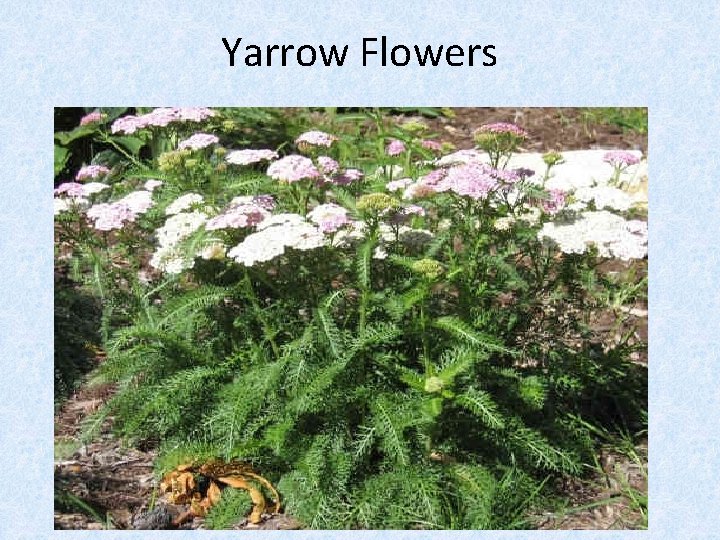
Yarrow Flowers
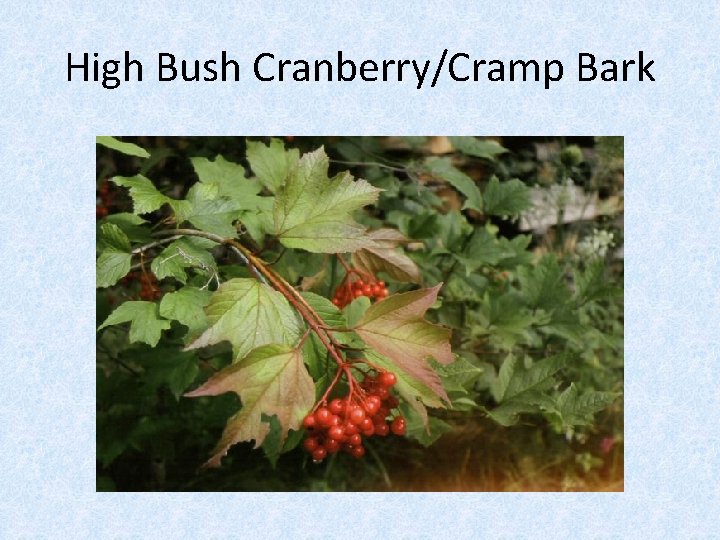
High Bush Cranberry/Cramp Bark
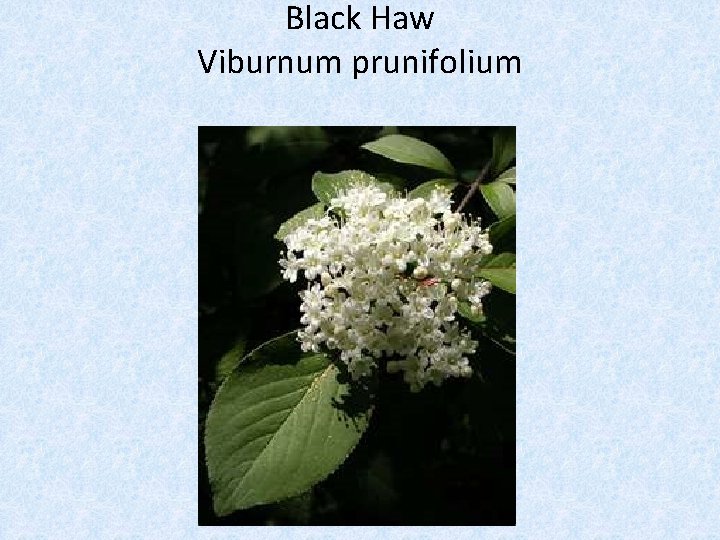
Black Haw Viburnum prunifolium
Colds and Flu • Herbal tea made from red clover flowers, elder flowers, chamomile flowers, spearmint, anise seeds, and nettle leaves are taken several times a day hot • Elder Berry Concentrate – 1 tbsp in 8 oz warm water • Rose Hip SE - 1 tsp BID • Echinacea used for the immune boosting action antiinflammatory activity, and anti-microbial action – – Tea; 1 tbsp rt/16 oz water, drink 1 -3 x /day Tincture 1: 3/5 use 2 -5 mls / TID or QID Capsules or tablets Powder 1 -2 grams in smoothies, applesauce or yogurt
Cough ¨ Onion Syrup base for adding tinctures of other cough and flu herbs such as thyme, echinacea, linden flowers, wild cherry bark, or mullein. ¨ Add equal amounts of tinctured herb mix to onion syrup, such as 1/4 oz. thyme tincture and 1/4 oz. echinacea tincture to 1/2 oz. onion syrup. Instructions • Layer 1 -2 cups sugar and slices of 1 medium onion in a glass jar until full; let sit in a cool place for 1 to 2 days. Strain out onion and bottle in an amber jar. Store in refrigerator or in a cool place. Use ½ to 1 tsp. 3 times a day.
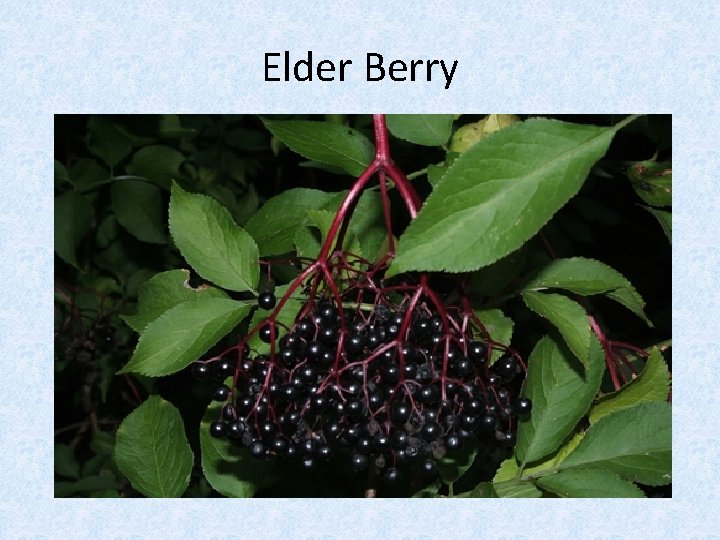
Elder Berry
Soothing Herbal Cough Syrup • Combine equal parts: • Raspberry leaf • Licorice root • Cramp Bark • Shatavari • Mullein leaf • Marshmallow root • Garlic Syrup (optional) ½ part • Ginger Glycerite ½ part • Elder Berry Syrup 2 parts Dose 1 tsp, 3 to 5 times daily
Cardiovascular Herbs • A: turmeric, garlic • B 1: passionflower, hawthorne, EPO • B 2: artichoke, dandelion, melissa, viburnum opulus • B 3: Leonurus
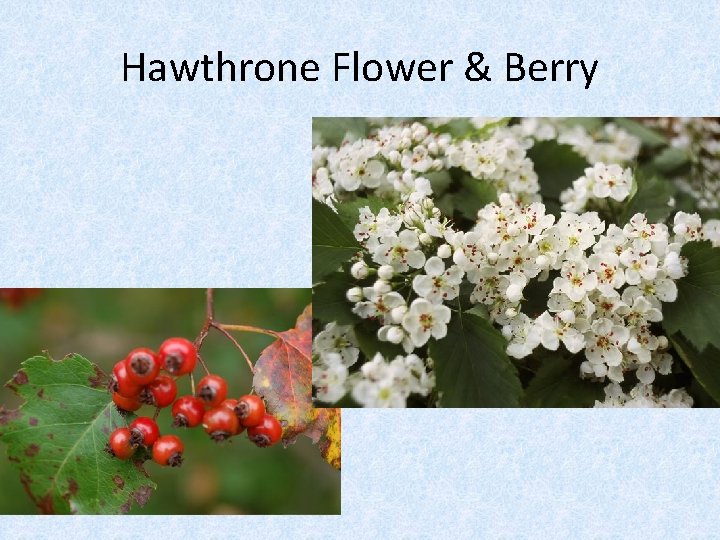
Hawthrone Flower & Berry
Blood Pressure Tincture for Pregnancy • • Viburnum Opulus Passiflora Incarnata Hawthorne Berries Taraxacum Leaf Melissa Officinalis Leonorus Cardiaca Equal parts of each Dose 1 tsp TID ac
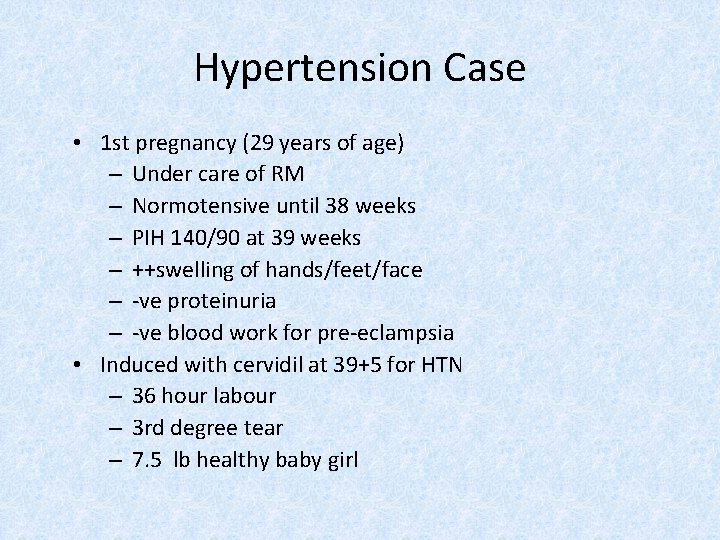
Hypertension Case • 1 st pregnancy (29 years of age) – Under care of RM – Normotensive until 38 weeks – PIH 140/90 at 39 weeks – ++swelling of hands/feet/face – -ve proteinuria – -ve blood work for pre-eclampsia • Induced with cervidil at 39+5 for HTN – 36 hour labour – 3 rd degree tear – 7. 5 lb healthy baby girl
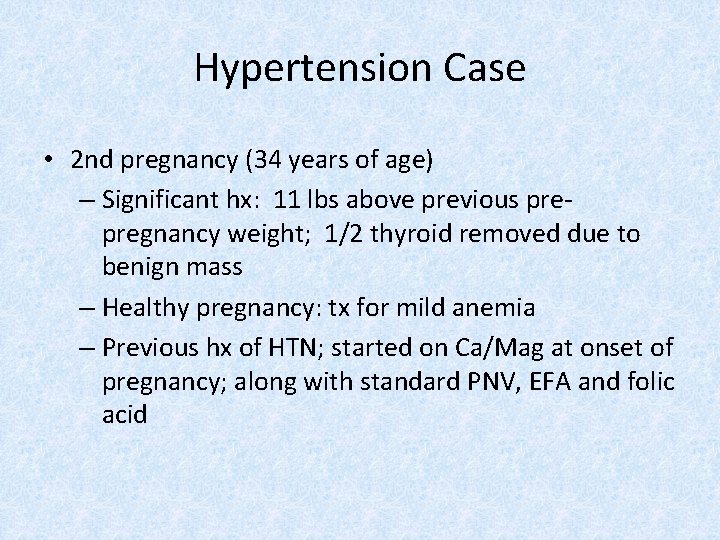
Hypertension Case • 2 nd pregnancy (34 years of age) – Significant hx: 11 lbs above previous prepregnancy weight; 1/2 thyroid removed due to benign mass – Healthy pregnancy: tx for mild anemia – Previous hx of HTN; started on Ca/Mag at onset of pregnancy; along with standard PNV, EFA and folic acid
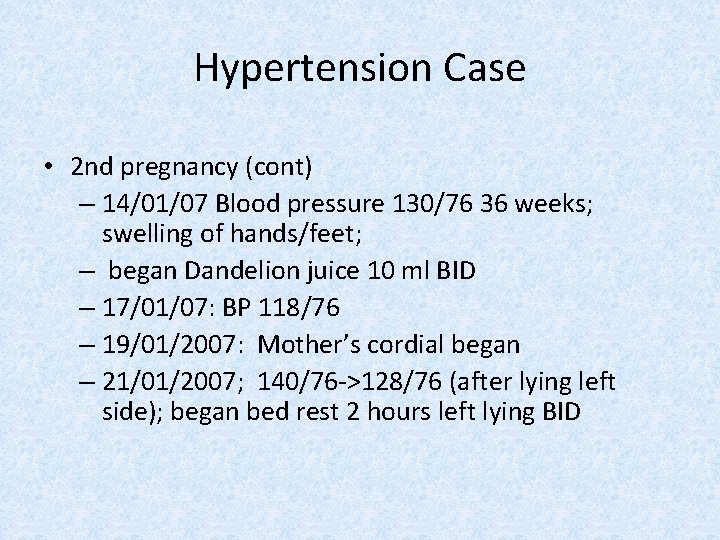
Hypertension Case • 2 nd pregnancy (cont) – 14/01/07 Blood pressure 130/76 36 weeks; swelling of hands/feet; – began Dandelion juice 10 ml BID – 17/01/07: BP 118/76 – 19/01/2007: Mother’s cordial began – 21/01/2007; 140/76 ->128/76 (after lying left side); began bed rest 2 hours left lying BID
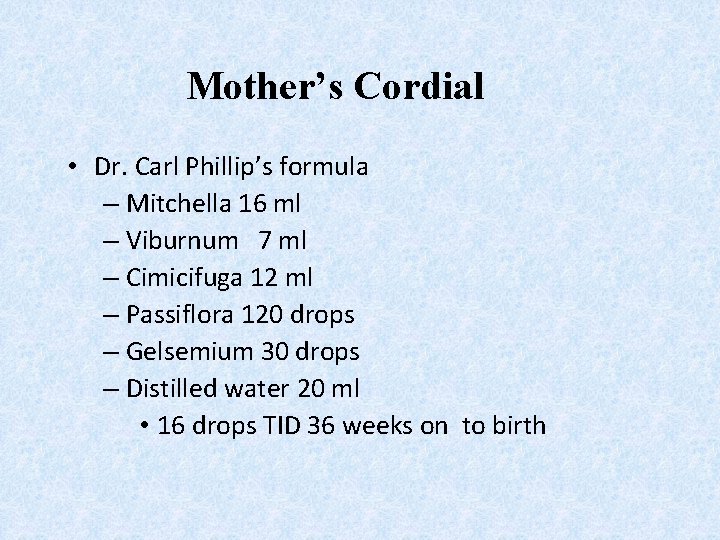
Mother’s Cordial • Dr. Carl Phillip’s formula – Mitchella 16 ml – Viburnum 7 ml – Cimicifuga 12 ml – Passiflora 120 drops – Gelsemium 30 drops – Distilled water 20 ml • 16 drops TID 36 weeks on to birth
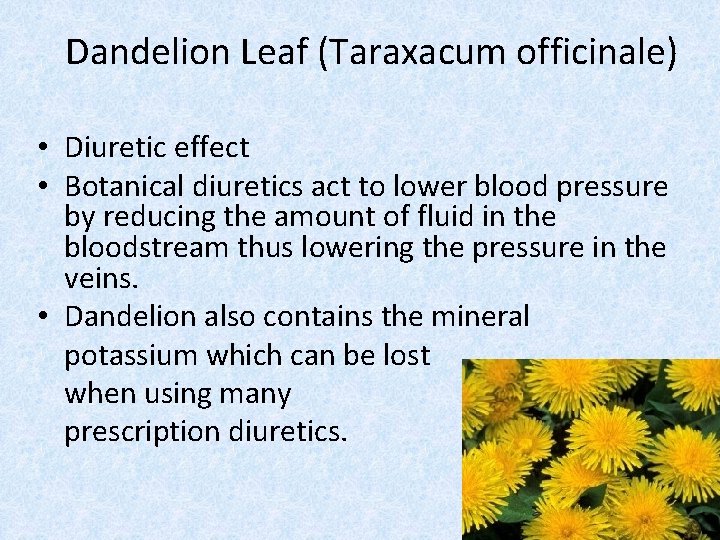
Dandelion Leaf (Taraxacum officinale) • Diuretic effect • Botanical diuretics act to lower blood pressure by reducing the amount of fluid in the bloodstream thus lowering the pressure in the veins. • Dandelion also contains the mineral potassium which can be lost when using many prescription diuretics.
Dandelion Leaf (Taraxacum officinale) • Nutritionally Dense - Vitamins A, C, B complex, Calcium, Fiber, Iron, Magnesium, Manganese, Phosphorus, Potassium, Selenium, Silicon, Sodium, Zinc. • Dose 3 -5 mls 1: 5 extract three times daily – Infusion/Juice/Leafy Green Vegetable • Safety Issues – Generally considered safe – No known Toxicity, SE, or Drug Interaction – Traditional use in pregnancy/lactation
Gestational Thrombocytopenia • Approximately 5% of women • Platelet count >150, 000/µL and < 70, 000/µL • GT characterized by: 1) asymptomatic, mild thrombocytopenia 2) with no past history of thrombocytopenia (except possibly during previous pregnancy) 3) occurs during late gestation 4) not associated with fetal thrombocytopenia like ITP 5) that resolves spontaneously after delivery
Gestational Thrombocytopenia 34 year, G 2, P 1 at 32 weeks presents with GT Platelet count 76, 000/µL Therapeutics: Vitamin K - 5 mg/ day Astragalus Root Capsules 300 mgs TID cc Shitaike Mushroom Capsules 300 mg TID cc Probiotic Mix 50 billion BID pc 4 weeks duration repeat CBC, platelets 180, 000/µL Continue protocol reduces to once daily
Intrahepatic Cholestasis • Accumulation of bile in the liver due excessive levels of sex hormones • Sx: cutaneous itching, jaundice or both • Usually occurs in the last trimester and disappears 2 weeks postpartum • Will resolve after delivery Therapeutics: • milk thistle seed • epsom salt or oatmeal baths • chickweed and chamomile cream
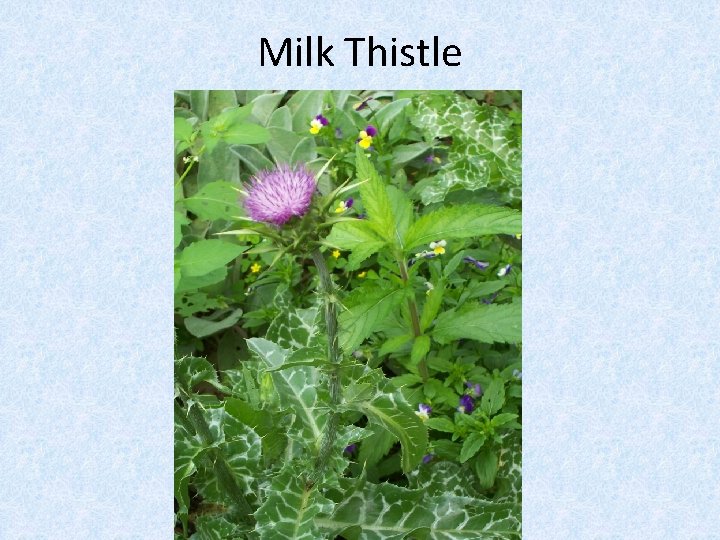
Milk Thistle
Intrahepatic Cholestasis • Milk Thistle Seed Extract • Silymarin was safely used in pregnancy • 6 women with intrahepatic cholestasis of pregnancy • Dose of 210 mg three times daily. • Duration of 15 days Hepatololgy, 8(5): 1356, 1988
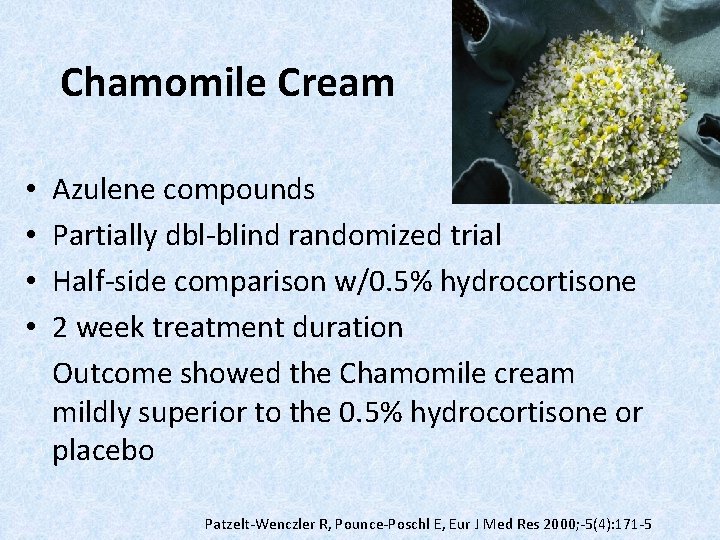
Chamomile Cream • • Azulene compounds Partially dbl-blind randomized trial Half-side comparison w/0. 5% hydrocortisone 2 week treatment duration Outcome showed the Chamomile cream mildly superior to the 0. 5% hydrocortisone or placebo Patzelt-Wenczler R, Pounce-Poschl E, Eur J Med Res 2000; -5(4): 171 -5

UTI and Vaginitis of Pregnancy • Increased risk during pregnancy • BV and UTI can increase risk of premature contractions • Metronidazole, clindamycin, and tinidazole are antibiotics that destroy some of the bacteria that cause symptoms of bacterial vaginosis. • However, clindamycin also targets the Lactobacillus organisms that normally thrive in a healthy vaginal environment.
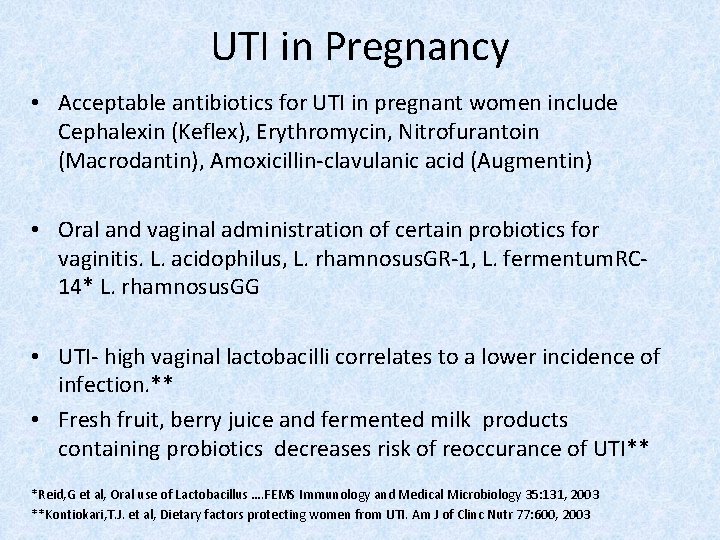
UTI in Pregnancy • Acceptable antibiotics for UTI in pregnant women include Cephalexin (Keflex), Erythromycin, Nitrofurantoin (Macrodantin), Amoxicillin-clavulanic acid (Augmentin) • Oral and vaginal administration of certain probiotics for vaginitis. L. acidophilus, L. rhamnosus. GR-1, L. fermentum. RC 14* L. rhamnosus. GG • UTI- high vaginal lactobacilli correlates to a lower incidence of infection. ** • Fresh fruit, berry juice and fermented milk products containing probiotics decreases risk of reoccurance of UTI** *Reid, G et al, Oral use of Lactobacillus …. FEMS Immunology and Medical Microbiology 35: 131, 2003 **Kontiokari, T. J. et al, Dietary factors protecting women from UTI. Am J of Clinc Nutr 77: 600, 2003
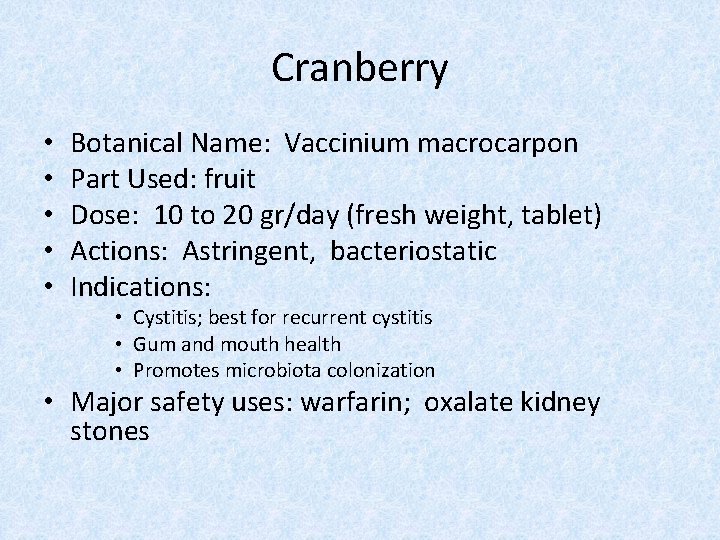
Cranberry • • • Botanical Name: Vaccinium macrocarpon Part Used: fruit Dose: 10 to 20 gr/day (fresh weight, tablet) Actions: Astringent, bacteriostatic Indications: • Cystitis; best for recurrent cystitis • Gum and mouth health • Promotes microbiota colonization • Major safety uses: warfarin; oxalate kidney stones
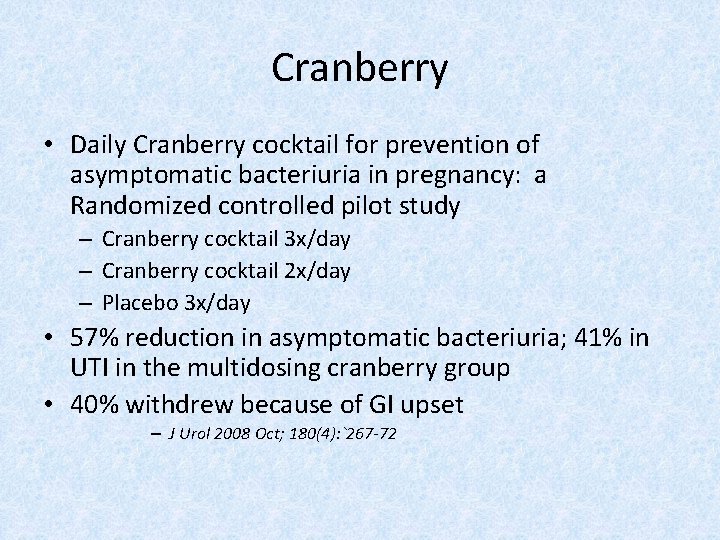
Cranberry • Daily Cranberry cocktail for prevention of asymptomatic bacteriuria in pregnancy: a Randomized controlled pilot study – Cranberry cocktail 3 x/day – Cranberry cocktail 2 x/day – Placebo 3 x/day • 57% reduction in asymptomatic bacteriuria; 41% in UTI in the multidosing cranberry group • 40% withdrew because of GI upset – J Urol 2008 Oct; 180(4): `267 -72
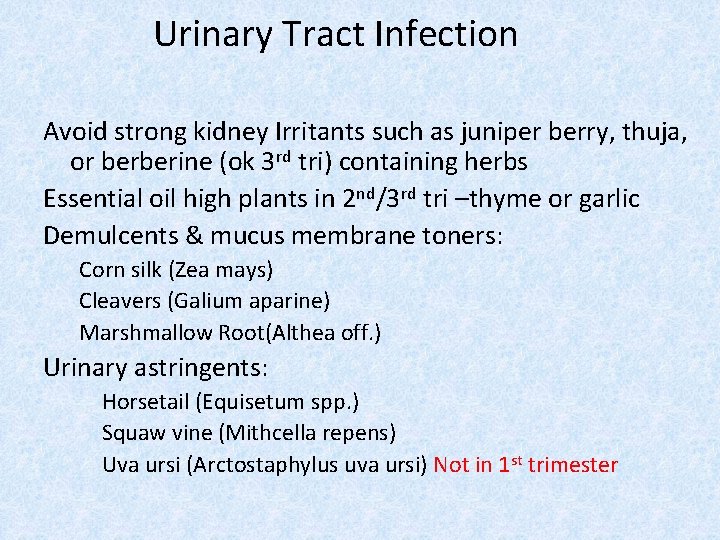
Urinary Tract Infection Avoid strong kidney Irritants such as juniper berry, thuja, or berberine (ok 3 rd tri) containing herbs Essential oil high plants in 2 nd/3 rd tri –thyme or garlic Demulcents & mucus membrane toners: Corn silk (Zea mays) Cleavers (Galium aparine) Marshmallow Root(Althea off. ) Urinary astringents: Horsetail (Equisetum spp. ) Squaw vine (Mithcella repens) Uva ursi (Arctostaphylus uva ursi) Not in 1 st trimester
Case UTI • G 3 P 2 26 year old – Hx of 7 UTI in 2 nd pregnancy; all tx with antibiotics – Advised increase dark pigmented berries and yogurt – Berry syrup with cranberry 1 tsp BID – Acidophilus 25 billion/1 cap BID – No UTI for duration of 3 rd pregnancy
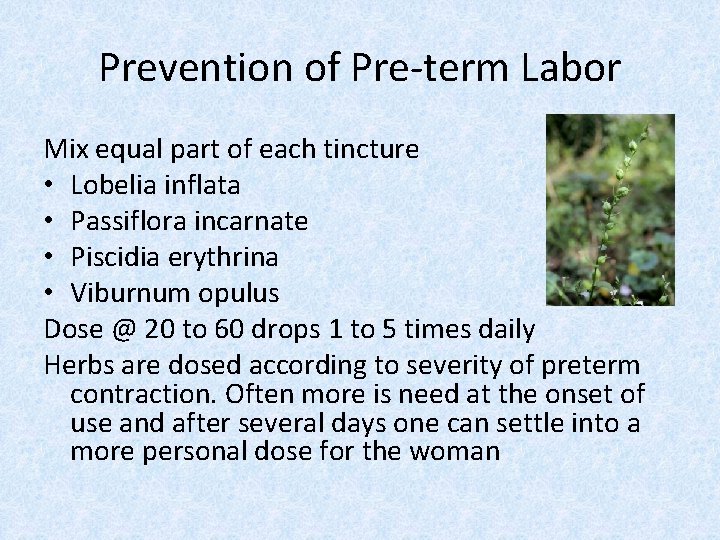
Prevention of Pre-term Labor Mix equal part of each tincture • Lobelia inflata • Passiflora incarnate • Piscidia erythrina • Viburnum opulus Dose @ 20 to 60 drops 1 to 5 times daily Herbs are dosed according to severity of preterm contraction. Often more is need at the onset of use and after several days one can settle into a more personal dose for the woman
Insomnia • Due to psychological factors, nocturia, muscoskeletal discomfort, adrenal issues, unstable blood sugar • Treatment: – CNS Herbal Sleep Aids – Adaptogens: withania, elethrococcus, Schizandra berries – Rhodiola – 600 mg dose in the evening – Seriphos – 2 dinner and bed
CNS Herbal Sleep Aids – – – Avena sativa – Milky oats Chamomile Flowers Hops/ Humulus lupulus Lemon balm Hypericum-St John’s Wort Lavendula officinalis- Lavender flowers Nepta cateria/catnip herb Passiflora- Passion flower Rosa spp – rose petals Scutallaria officinalis- skullcap herb Valeriana officinalis- valerian root
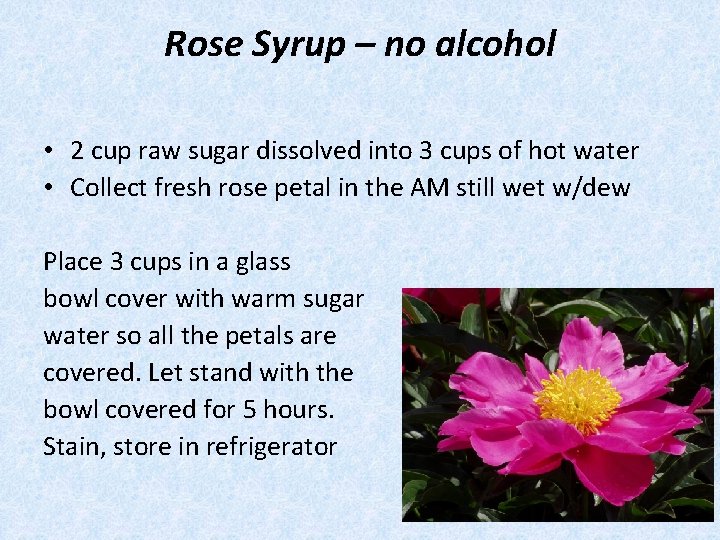
Rose Syrup – no alcohol • 2 cup raw sugar dissolved into 3 cups of hot water • Collect fresh rose petal in the AM still wet w/dew Place 3 cups in a glass bowl cover with warm sugar water so all the petals are covered. Let stand with the bowl covered for 5 hours. Stain, store in refrigerator
Rose Syrup – alcohol base • • 1 cup raw sugar dissolved in 2 cups of hot water 1 cup vodka 3 cups freshly picked rose petals Mix warm sugar water and vodka in container, place petals in a glass jar and cover with the warm liquid. Let stand overnight, strain, and bottle Sources: • Syrup of Rose- Avena Botanicals 1 -207 -594 -0694 • Tincture of Rosa dameska - www. avicennananatural. com
Pregnancy Term Issues • • Application of Partus Prepatory Herbs GBS Post Dates Immediate Postpartum – PPH – Retained placenta – Afterpains
Mother's Cordial Late Pregnancy Formula • These herbs are given in the last 4 weeks of pregnancy to tone and aid the uterus in preparation for delivery. • They encourage softening of the cervix and relaxation of the pelvic tissues. • They works on the muscular layer of the uterus to aid in making the contractions productive and to support contracting down of the postpartum uterus, thus decreasing the risk of postpartum bleeding.
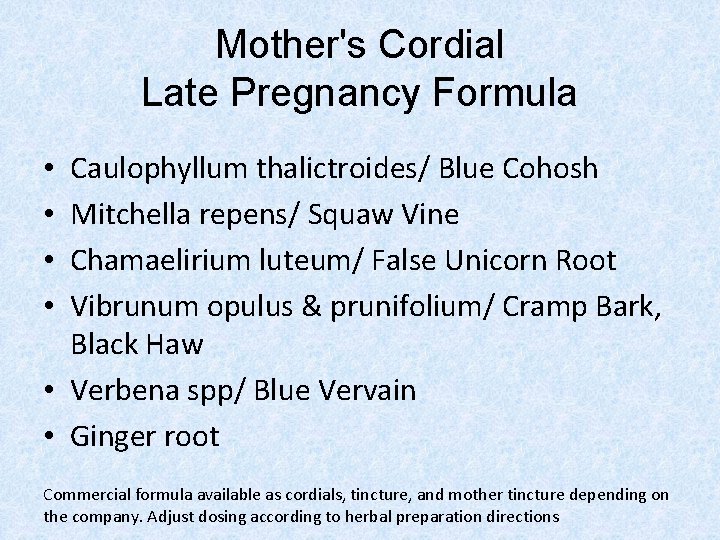
Mother's Cordial Late Pregnancy Formula Caulophyllum thalictroides/ Blue Cohosh Mitchella repens/ Squaw Vine Chamaelirium luteum/ False Unicorn Root Vibrunum opulus & prunifolium/ Cramp Bark, Black Haw • Verbena spp/ Blue Vervain • Ginger root • • Commercial formula available as cordials, tincture, and mother tincture depending on the company. Adjust dosing according to herbal preparation directions
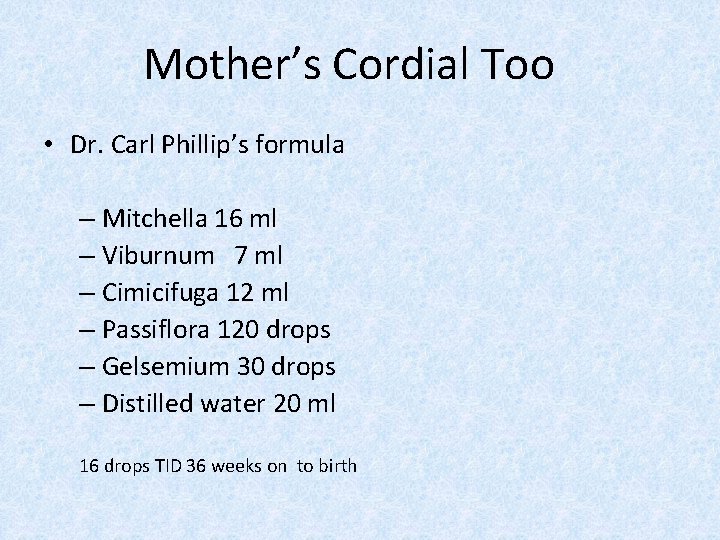
Mother’s Cordial Too • Dr. Carl Phillip’s formula – Mitchella 16 ml – Viburnum 7 ml – Cimicifuga 12 ml – Passiflora 120 drops – Gelsemium 30 drops – Distilled water 20 ml 16 drops TID 36 weeks on to birth
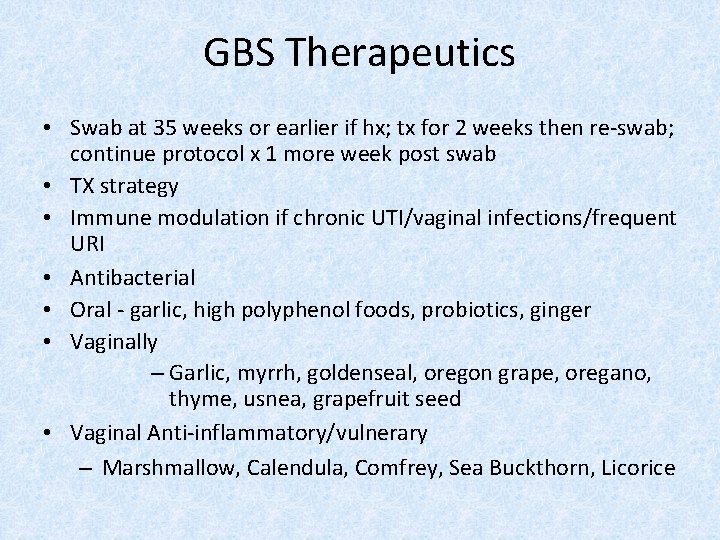
GBS Therapeutics • Swab at 35 weeks or earlier if hx; tx for 2 weeks then re-swab; continue protocol x 1 more week post swab • TX strategy • Immune modulation if chronic UTI/vaginal infections/frequent URI • Antibacterial • Oral - garlic, high polyphenol foods, probiotics, ginger • Vaginally – Garlic, myrrh, goldenseal, oregon grape, oregano, thyme, usnea, grapefruit seed • Vaginal Anti-inflammatory/vulnerary – Marshmallow, Calendula, Comfrey, Sea Buckthorn, Licorice
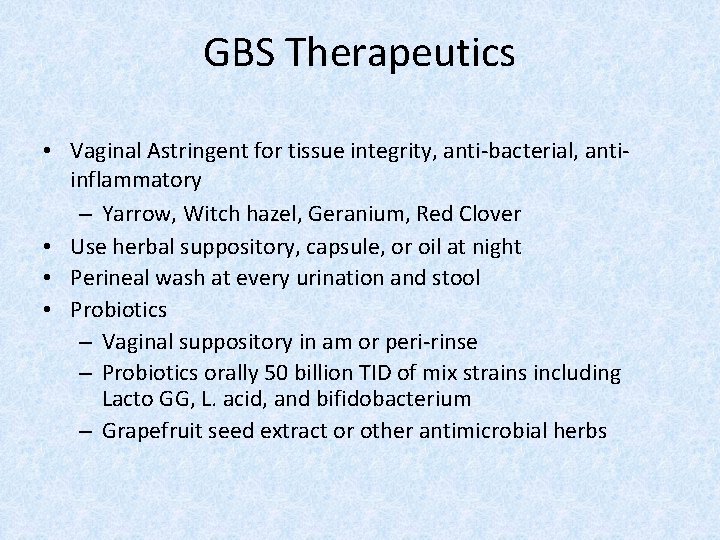
GBS Therapeutics • Vaginal Astringent for tissue integrity, anti-bacterial, antiinflammatory – Yarrow, Witch hazel, Geranium, Red Clover • Use herbal suppository, capsule, or oil at night • Perineal wash at every urination and stool • Probiotics – Vaginal suppository in am or peri-rinse – Probiotics orally 50 billion TID of mix strains including Lacto GG, L. acid, and bifidobacterium – Grapefruit seed extract or other antimicrobial herbs
GBS Therapeutics Sample protocol for vaginal suppository – 5 nights/week for 3 weeks – 1/2 cup each of melted coconut oil & cocoa butter add: • • 1 tbsp calendula oil 1 tsp of garlic oil 1 tsp of sea buckthorn oil 20 drops @ of rosemary, lavender, thyme essential oils 2 tbsp goldenseal powder (hydrastis canadenis) 1 tbsp of marshmallow powder (althea officinalis) 1 tbsp myrrh powder (commiphora mol) Mix well, let cool to where suppository can be formed by rolling or use a mold and pour in while hot. Store in cool place
Post Dates & Induction • Encourage nipple stimulation, intercourse • Sweeping the membranes with Evening Primrose Oil x 3 days at 41 weeks Clary Sage/Salvia sclarea • Parts used: Essential oil of flowering tops & leaves • Actions: antispasmodic, analgesic, tone & stimulate uterus, nervous system relaxant • Indications: Induction of labor, strengthen contractions, nervousness, pain • Dose: 10 drops in 1 oz carrier oil massaged on abdomen 2 x/day to induce labor • Avoid until early labor
Castor Bean Oil • 103 singleton pregnancies at 40 -42 weeks; membranes intact • One group took a single dose of 60 ml of castor oil and other group received no tx • 57. 7% began active labor in 24 hours and 4. 2% in control • Similar meconium staining, birth weight and mode of delivery in both groups Alternative Therapies 2000; 6(1): 77
Post Dates & Induction • Sweep membranes with Evening Primrose Oil x 3 days at 41 weeks Use an infused oil of lobelia or gelsemium by steeping one ounce of herb ground to a coarse powder in 4 oz of EPO for 7 days in a warm dark place, strain, store in a dark bottle and cool place • If ripe cervix use tincture of equal parts caulophyllum, viscum, and gossypium herbaceum, use ½ tsp every 2 hours, 5 doses /day max • If unripe cervix use cervical ripening herbs in a mother’s cordial base black cohash, gelsemium, and lobelia 2: 1: 1

Retained placenta • Angelica archangelica Root • Black Haw/ Viburnum p. Use ½ tsp tincture each in a little water, repeat dose in 15 minutes if needed and one more time after that. If no placenta shed after 30 minutes make other plans.
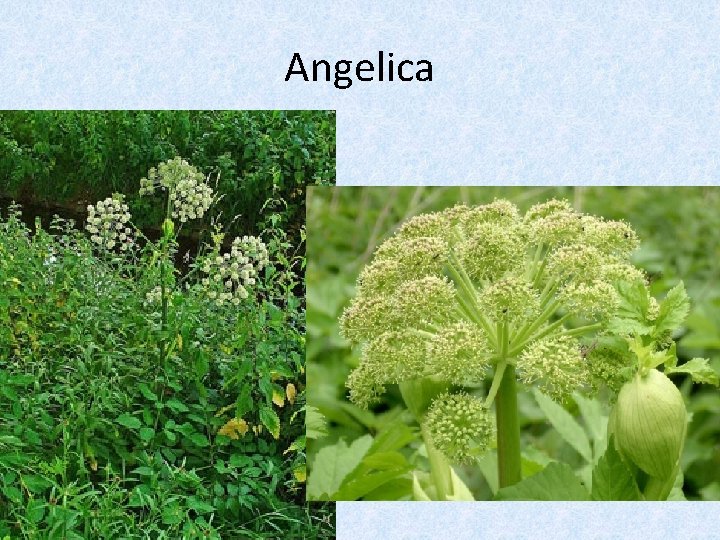
Angelica
The 4 th Trimester Postpartum Post-Birth Issues • Healing tears or episiotomies • Hemorrhoids • Constipation • After pains Lactation and Botanical Galactogogues
Healing the Perineum Stretches, Tears, or Episiotomies Fomentation for the Postpartum Perineum Calendula, yarrow, and lavender flowers Comfrey and rosemary leaves • Combine ½ cup of each herb in a large glass jar, mix well and cover tightly • Use 1/2 cup of herbal mix to one quart of boiling water, cover and steep 30 minutes. Use as a sitz bath or in a peri-bottle as a perineal wash for cleaning after urination or sutures areas. Use daily for the first seven days of postpartum
Healing the Perineum Stretches, Tears, or Episiotomies • Calendula flowers – anti-microbial, vulnerary and antiinflammatory action • Comfrey leaf/root – contains a substance that increases cell proliferation, leading to increased tissue repair and growth, acts as an astringent, emollient, and an anti-inflammatory • Yarrow flowers – effective botanical anti-inflammatory, astringent, anti-microbial, and vulnerary • Rosemary Leaves – anti-septic, astringent, and circulatory stimulant • Lavender flowers- bring relaxing properties to the muscles and nervous tissue, act to diminish pain and discomfort , contain large amount of volatile oils which act as antiseptics, anti-microbials, and analgesics. Clinical trials are shown that lavender added to sitz baths is most effective between the third and five day postpartum
Constipation – Pumpkin, fig, hemp oil puree 2 -3 tbsp/day • Add 1 tbsp hemp oil to ½ cup cooked pureed organic pumpkin with 4 -6 soaked pureed figs – Herbal GI Relaxant Tea • Chamomile flowers, fennel seeds, lemon balm, catnip, cramp bark, and spearmint • Steep 1 tbsp in 1 cup boiling water for several minutes, add 2 ounces blueberry juice, • Drink 1 -3 times daily
Hemorrhoids • Herbal Frozen Pads- witch hazel, rose water, lavender flower tea, calendula flower tea • Ointments of astringent herbs • Grated Potato Poultice • Oral Support for small blood vessels, liver, and rectal tissue – High polyphenol herbs and superfoods – Lactation friendly liver herbs- artichoke, milk thistle, blessed thistle
Hemorrhoids Grated Potato and Slippery Elm Poultice v 1 medium potato grated v 2 -3 tsp slippery elm powder v Mix well, form into small patty and place on area for 10 -15 minutes, 1 -3 times a day. v This may be used on sore or cracked nipples as well
Uterine After Pains • Keep bladder emptied • Heat/Pressure to lower abdomen • Uterine Antispasmodics/Anaelgesics – Nepta cateria/catnip herb – Rosa spp – rose petals – Scutallaria officinalis- skullcap herb – Valeriana officinalis- valerian root – Viburnum opulus or prunifolium- cramp bark or black haw bark
Uterine After Pains II • Uterine Antispasmodics/Analgesics – Senecio aureus/life root or golden root • Tincture 1: 5; 1 -2 mls in few oz warm water TID-QID • In formula with * – Erigeron spp/Cinnamon Compound (Herb Pharm) • 10 -20 drops in few oz warm water • Dose TID - QID
Uterine After Pains II UAP Formula • • • Rose glycerite 30 mls Catnip tincture 20 mls Cramp bark tincture 20 mls Senecio tincture 10 mls Ginger glycerite 10 mls Cinnamon glycerite 10 mls Use ½ to 1 tsp in warm water TID- QID
Herbal Salve used for Tender Cracked Nipples • • Althea root or Slippery elm Chickweed or witch hazel Calendula, Chamomile or Yarrow flowers Make an oil or salve from a combination of the above herbs, use several times a day after nursing baby. Wipe gently with a dry cloth before nursing baby again
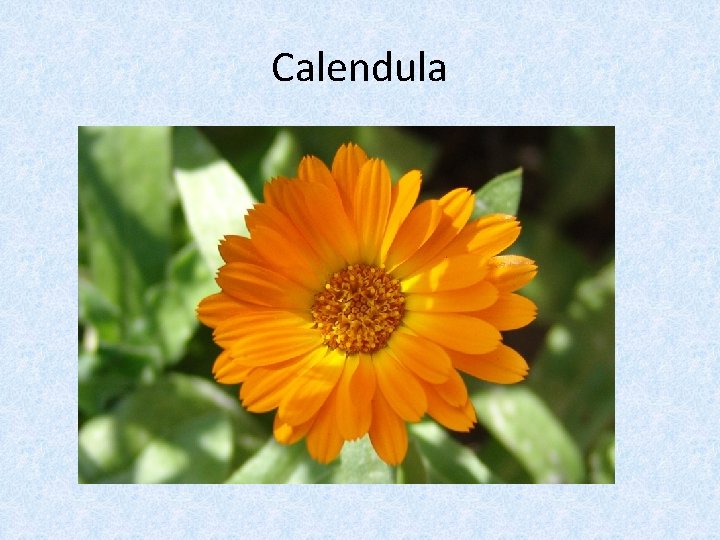
Calendula
The 4 th Trimester Postpartum • • • Postpartum Hemorrhage (PPH) Excessive Bleeding Uterine infection Postpartum depression Anxiety
Prevention of PPH • Hx of previous PPH in previous births, prenatal protocol can include – CBC with platelets, ferritin • Bleeding increases with anemia • Low platelets increase risk of bleeding; tx with high quality protein – Improve connective tissue health and smooth muscle of the blood vessels • Bioflavonoids and vitamin C (500 mg of each) • Berries ( 1 cup frozen blueberries/day)
Case- Postpartum Hemorrhage (PPH) • 34 year old female G 3 P 2; 24 weeks pregnant – CC 1: varicosities of vulva and lower extremeties • Current tx: Pressure stockings – CC 2 Prevention of hemorrhage as 1000 cc loss in previous delivery – Relative hx • • Restless legs <pm Unstable pelvic joints tx: core stabilizing activities Ligament and tendon injuries due to repetitive strain Diet low in veggies & berries
Case- Postpartum Hemorrhage • Lab: – CBC • Hemoglobin 124 • Platelets 156 (optimum 200) • PE – Pale mucus membranes – Dry bumps on back of arms bilateral – Spider veins in lower extremeties including medial left foot; 2 large varicosities behind each knee ; mild right vulvar varicosity with swelling
Case- Postpartum Hemorrhage • Plan – Dark pigmented berries 1 cup/day – Increase veggies 4 c/day (dark leafy greens) – Berry syrup 3 oz: rosehip SE 1 oz; 1 tsp BID – Ligaplex 2 caps ac – Cod liver oil 1 tsp/day
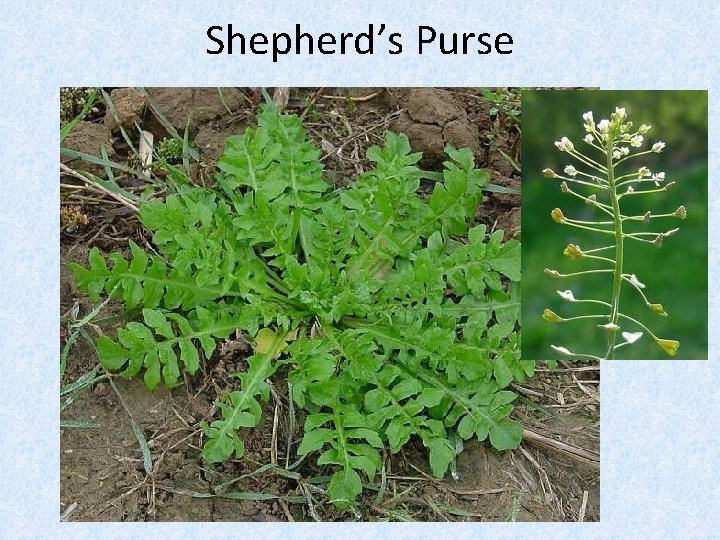
Shepherd’s Purse
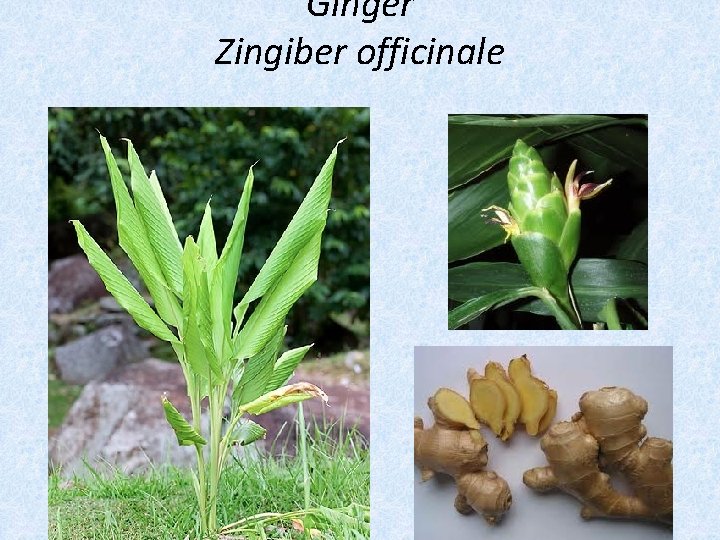
Ginger Zingiber officinale
Case- Postpartum Hemorrhage • Plan 32 weeks – Raspberry leaf: nutrient tea 1 T/cup; steep overnight 3 cups/day – Mother’s cordial 16 drops TID – Continue Berry syrup – Geranium Combo: 15 drops every 2 hours while in labor – No postpartum hemorrhage; minimal blood loss

Excessive or Extended Duration of Postpartum Bleed • • Mitchella repens / Squaw Vine Nettle leaf Raspberry leaf Yarrow Flower Hawthron Berries Rhodiola Root Geranium maculata /Cranesbill Root Use ½ to 1 tsp BID or TID in warm water
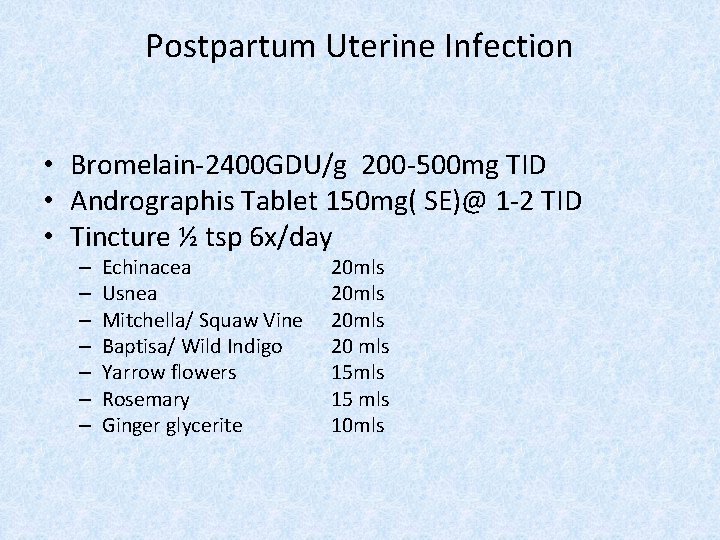
Postpartum Uterine Infection • Bromelain-2400 GDU/g 200 -500 mg TID • Andrographis Tablet 150 mg( SE)@ 1 -2 TID • Tincture ½ tsp 6 x/day – – – – Echinacea Usnea Mitchella/ Squaw Vine Baptisa/ Wild Indigo Yarrow flowers Rosemary Ginger glycerite 20 mls 20 mls 15 mls 10 mls
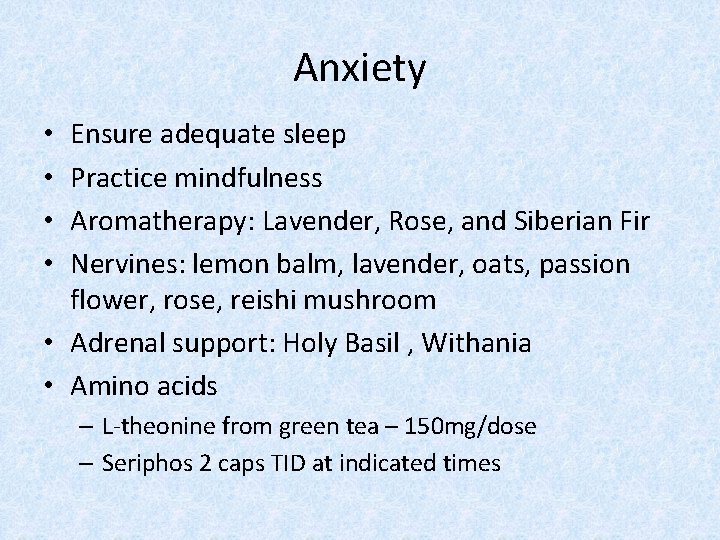
Anxiety Ensure adequate sleep Practice mindfulness Aromatherapy: Lavender, Rose, and Siberian Fir Nervines: lemon balm, lavender, oats, passion flower, rose, reishi mushroom • Adrenal support: Holy Basil , Withania • Amino acids • • – L-theonine from green tea – 150 mg/dose – Seriphos 2 caps TID at indicated times
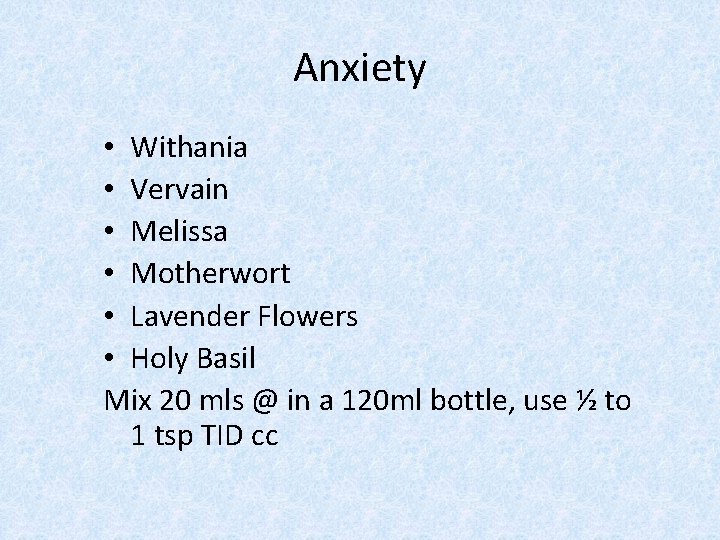
Anxiety • Withania • Vervain • Melissa • Motherwort • Lavender Flowers • Holy Basil Mix 20 mls @ in a 120 ml bottle, use ½ to 1 tsp TID cc

Joy of the Garden

Depression – St. John’s Wort as tea, capsules, or tincture – Aromatic Herbs and EO – Omega-3 supplementation, 500 mg provided a reduction of 50 percent in postpartum depression symptoms – Iron deficiency linked with increased general & postpartum depression – Adrenal support e. g. Rhodiola, Schisandra
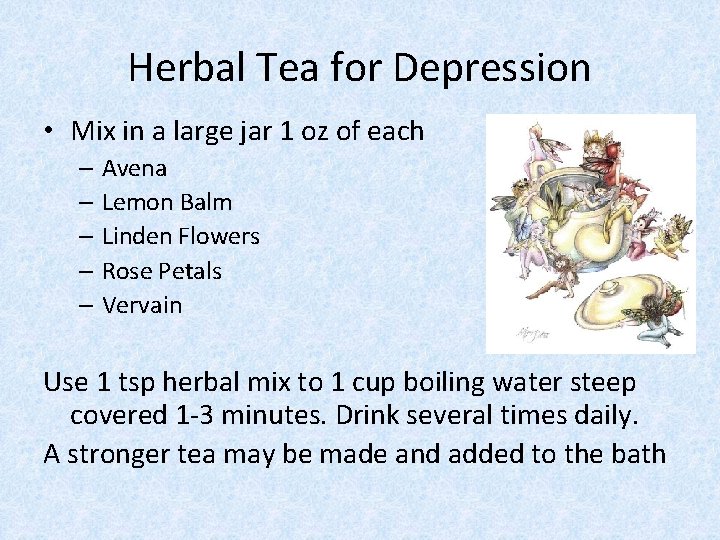
Herbal Tea for Depression • Mix in a large jar 1 oz of each – Avena – Lemon Balm – Linden Flowers – Rose Petals – Vervain Use 1 tsp herbal mix to 1 cup boiling water steep covered 1 -3 minutes. Drink several times daily. A stronger tea may be made and added to the bath
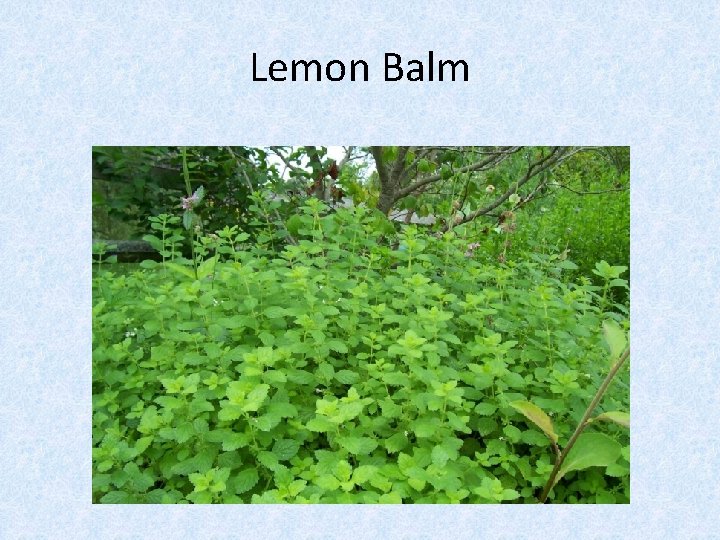
Lemon Balm

Schisandra chinensis • Symptomatic agent against astheno-depressive states independent of the nature of the disease • Act to decrease fatigue, improve the general mood and appetite, and can be recommended as a tonic for healthy people in a state of fatigue • Used in the treatment of psychoses as a stimulant without harmful side effects • The curative effect of S. chinensis preparations is pronounced in cases of asthenic and depressive syndromes • The combination of S. chinensis therapy with tranquilisers or anti-depressants eliminates the side effects of these drugs and allows them to be employed at optimal doses Panossian A and Wikman G, Effects of Adaptogens on the Central Nervous System and Molecular Mechanisms Associated with Their Stress—Protective Activity, Pharmaceuticals 2010, 3, 188 -224; doi: 10. 3390/ph 3010188
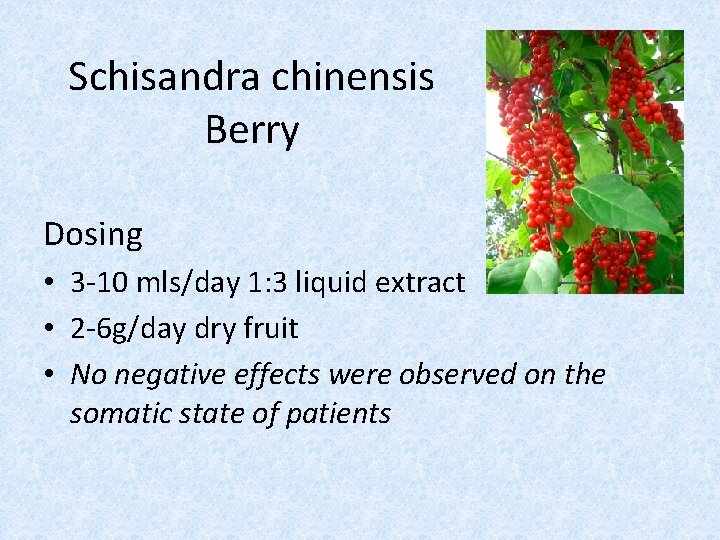
Schisandra chinensis Berry Dosing • 3 -10 mls/day 1: 3 liquid extract • 2 -6 g/day dry fruit • No negative effects were observed on the somatic state of patients

Becoming a woman, you feel the moon Tug at your blood, And you begin to sense The mysteries of the new body. John O’donohue “To Bless the Space Between Us”
- Slides: 130