
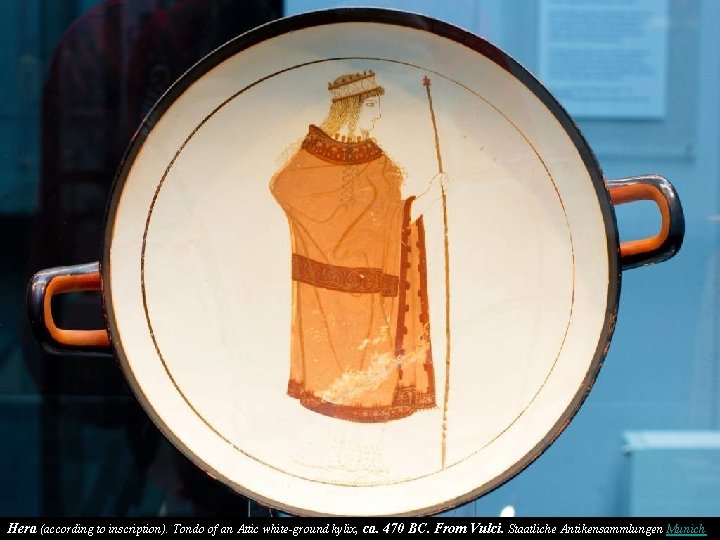
Hera according to inscription Tondo of an Attic




![Ptolemy Hephaestion, New History Book 7 (summary from Photius, Myriobiblon 190) : "She [Aphrodite]](https://slidetodoc.com/presentation_image_h/7595cb2d12ab59ea616eb2ef16f90b73/image-69.jpg "Ptolemy Hephaestion, New History Book 7 (summary from Photius, Myriobiblon 190) : \"She [Aphrodite]")


![Strabo, Geography 5. 1. 9 : "Among the Henetoi [of northern Italia] certain honours](https://slidetodoc.com/presentation_image_h/7595cb2d12ab59ea616eb2ef16f90b73/image-96.jpg "Strabo, Geography 5. 1. 9 : \"Among the Henetoi [of northern Italia] certain honours")


- Slides: 99
Hera (according to inscription). Tondo of an Attic white-ground kylix, ca. 470 BC. From Vulci. Staatliche Antikensammlungen Munich
The Chariot of Juno, the arms of Federico Gonzaga, Marquess of Mantua and his wife, Margherita Paleologo of Montferrat. Urbino, Nicola da Urbino, ca. 1533 , Wallace Collection
Julio Romano, Psyche Appealing in Vain to Juno
HERA was the Queen of the gods, the goddess of the sky, women and marriage. She had numerous shrines and temples in the ancient world, with her primary cult centres being the Heraion near Mykenai in Argos, Olympia where woman-only Games were celebrated in her honour, and the island of Samos, who reputed birth-place. In classical sculpture she was portrayed as a proud, regal figure, crowned and holding a royal sceptre. Her portrait was that of a beautiful, young woman. Hera Ludovisi, c. 5 th century BCE. Museo delle Terme, Rome.
Homeric Hymn 12 to Hera (trans. Evelyn-White) (Greek epic C 7 th to 4 th B. C. ) : "I sing of golden-throned Hera whom Rhea bare. Queen of the Immortals is she, surpassing all in beauty: she is the sister and wife of loud-thundering Zeus, --the glorious one whom all the blessed throughout high Olympos reverence and honour even as Zeus who delights in thunder. " "Hera Borghese" ca 420 B. C, Ny Carlsberg Glyptothek , Copenhagen
Roman copy from the 1 st-2 nd century CE? Roman copy from the Imperial Era after the “Borghese Hera” type after the “Barberini Hera” type, Greek original of the 5 th century. 5 th cent BC. Vatican Museums Louvre Museum, Paris Hera statue in the Mycenaen Museum
Orphic Hymn 16 to Hera (trans. Taylor) (Greek hymns C 3 rd B. C. to 2 nd A. D. ) : "O royal Hera, of majestic mien, aerial-formed, divine, Zeus' blessed queen, throned in the bosom of cerulean air, the race of mortals is thy constant care. The cooling gales they power alone inspires, which nourish life, which every life desires. Mother of showers and winds, from thee alone, producing all things, mortal life is known: all natures share thy temperament divine, and universal sway alone is thine, with sounding blasts of wind, the swelling sea and rolling rivers roar when shook by thee. Come, blessed Goddess, famed almighty queen, with aspect kind, rejoicing and serene. " Bronze statue of Juno ( 2 nd/3 rd century AD ). Roman Museum Weißenburg ( Bavaria )
הרה לידת , האדס , זאוס של ואחותם , וריה כרונוס הטיטאנים של בתם הייתה הרה תוך אל שלמה אותה בלע אביה , היוולדה עם. ודמטר הסטיה , פוסידון כי מהנבואה חששו זאוס( בשל וילדותיו )למעט ילדיו שאר את כמו , בטנו . האלים כבכיר מקומו את ויתפוס אותו ידיח מילדיו אחד , זאוס ידי על דבר של בסופו התגשמה הנבואה , כרונוס של תוכניתו אף על ואחיותיו אחיו עם יחד , זאוס. ואחיותיו אחיו את להקיא אביו את שהכריח , הוכרע וכשהקרב. הטיטאנים ושאר אביו כנגד למלחמה יצא , המשוחררים לידי עבר היקום ובסדרי בעולם והשלטון , ונכלא מכיסאו כרונוס הורד . האולימפיים האלים הם - הצעירים האלים Hesiod, Theogony 453 ff (trans. Evelyn-White) (Greek epic C 8 th or C 7 th B. C. ) "But Rhea was subject in love to Kronos and bare splendid children, Hestia, Demeter, and gold-shod Hera and strong Hades. . . and the loud-crashing Earth-Shaker [Poseidon], and wise Zeus. . . These great Kronos swallowed as each came forth from the womb to his mother's knees with this intent, that no other of the proud sons of Ouranos should hold the kingly office amongst the deathless gods. For he learned from Gaia (Earth) and starry Ouranos (Sky) that he was destined to be overcome by his own son, strong though he was, through the contriving of great Zeus. Therefore he kept no blind outlook, but watched and swallowed down his children: and unceasing grief seized Rhea. . [Rhea hid her youngest child Zeus from Kronos. ] The strength and glorious limbs of the prince increased quickly, and as the years rolled on, great Kronos the wily was beguiled by the deep suggestions of Gaia (Earth), and brought up again his offspring, vanquished by the arts and might of his own son, and he vomited up first the stone which he had swallowed last. " Peter Paul Rubens Saturn, Jupiter's father, devours one of his sons, Neptune Prado Museum, Madrid
Pseudo-Apollodorus, Bibliotheca 1. 4 ff (trans. Aldrich) (Greek mythographer C 2 nd A. D. ) : "Because both Ge (Earth) and Ouranos (Sky) had given him [Kronos] a prophetic warning that his rule would be overthrown by a son of his own stock, he took to swallowing his children at birth. He swallowed his first-born daughter Hestia, then Demeter and Hera, and after Plouton and Poseidon. . . [Later] Metis gave Kronos a drug, by which he was forced to vomit forth first the stone and then the children he had swallowed. “ Vouet, Simon , Father Time Overcome by Love, Hope and Beauty , 1627, Prado Museum, Madrid
FOSTERING OF HERA Homer, Iliad 14. 200 ff (trans. Lattimore) (Greek epic C 8 th B. C. ) : "I [Hera] go now to the ends of the generous earth on a visit to Okeanos, whence the gods have risen, and Tethys our mother who brought me up kindly in their own house, and cared for me and took me from Rheia, at that time when Zeus of the wide brows drove Kronos underneath the earth and the barren water. “ Pausanias, Description of Greece 2. 13. 3 (trans. Jones) (Greek travelogue C 2 nd A. D. ) : "Olen [semi-legendary poet], in his hymn to Hera, says that Hera was reared by the Horai (Seasons). “ Pausanias, Description of Greece 2. 17. 1 : "[Near the Heraion and river Asterios in Argos: ] Euboia is the name they give to the hill here, saying that Asterion the river had three daughters, Euboia, Prosymna, and Akraia, and that they were nurses of Hera. “ Pausanias, Description of Greece 8. 22. 2 : "The story has it that in the old Stymphalos [in Arkadia] dwelt Temenos, the son of Pelasgos, and that Hera was reared by this Temenos. “ Pseudo-Hyginus, Fabulae 177 (trans. Grant) (Roman mythographer C 2 nd A. D. ) : "Tethys, wife of Oceanus and foster mother of Juno. “ Ovid, Metamorphoses 2. 512 ff (trans. Melville) (Roman epic C 1 st B. C. to C 1 st A. D. ) : "Juno [Hera]. . . descended to the sea, to Tethys and old Oceanus, whom the gods greatly revere, and to their questioning replied: ‘. . . You who reared me. . . ’“ Nonnus, Dionysiaca 31. 264 ff (trans. Rouse) (Greek epic C 5 th A. D. ) : “Hera the Titan's daughter took strong part in the war against Kronos her father and helped Zeus in his fight. "
SEDUCTION OF HERA BY ZEUS Pausanias, Description of Greece 2. 17. 4 (trans. Jones) (Greek travelogue C 2 nd A. D. ) : "The presence of a cuckoo seated on the sceptre [of Hera] they explain by the story that when Zeus was in love with Hera in her maidenhood he changed himself into this bird, and she caught it to be her pet [in order to seduce her]. “ Pausanias, Description of Greece 2. 36. 1 : "A mountain [near Halike in Argos], called in old days Thornax; but they say that the name was changed because, according to legend, it was here that the transformation of Zeus into a cuckoo took place. Even to the present day there are sanctuaries on the tops of the mountains : on Mount Kokkux (Cuckoo) one of Zeus, on Pron one of Hera. “ Guillaume Coustou the Elder Maria Leszczyńska as Juno, 1731 Louvre Museum, Paris Statius, Achilleid 1. 588 ff (trans. Mozley) (Roman epic C 1 st A. D. ) : "Beneath his mother Rhea’s rule the young prince of Olympus [Zeus] gave treacherous kisses to his sister [Hera]; he was still her brother and she thought no harm, until the reverence for their common blood gave way, and the sister feared a lover’s passion. " Hera sits on a throne decorated with a cuckoo bird, Attic Red Figure, Lekythos, ca 500 - 475 BC Museum of Art, Rhode Island School of Design, New York City
REMBRANDT Harmenszoon van Rijn Juno, c. 1658 Armand Hammer Collection, Los Angeles
THE MARRIAGE OF ZEUS & HERA Hera grew up to be the most beautiful of the goddesses & Zeus made her his bride. As a wedding present Gaia created for her the famed garden of the golden apples, which the Hesperides & the Drakon Ladon were set to guard. Hesiod, Theogony 921 ff (trans. Evelyn-White) (Greek epic C 8 th or C 7 th B. C. ) : "Lastly, he [Zeus] made Hera his blooming wife : and she was joined in love with the king of gods and men, and brought forth Hebe and Ares and Eileithyia. " [N. B. Hesiod says "lastly" because the marriage of Hera followed after Zeus' seductions of the goddesses Metis, Themis, Eurynome, Demeter, Mnemosyne & Leto. ] , The Marriage Feast of Jupiter and Juno from the Salon of the Muses in the Villa Medici in Florence
Marriage of Zeus and Hera on Mount Ida. (Hieros gamos of Hera), Pompeiian fresco. Museo Archeologico Nazionale, Naples, Italy
Aristophanes, Birds 1720 ff (trans. O'Neill)(Greek comedy C 5 th to 4 th B. C. ) : "Let your nuptial hymns, your nuptial songs, greet him and his [wife]! 'Twas in the midst of such [wedding] festivities that the Moirai (Fates) formerly united Olympian Hera to the King [Zeus] who governs the gods from the summit of his inaccessible throne. Oh! Hymen! oh! Hymenaios! Rosy Eros with the golden wings held the reins and guided the chariot; 'twas he, who presided over the union of Zeus and the fortunate Hera. Oh! Hymen! oh! Hymenaios!" Pseudo-Apollodorus, Bibliotheca 2. 113 (trans. Aldrich) (Greek mythographer C 2 nd A. D. ) : "Gaia (Earth) had given them [the golden apples and tree] to Zeus when he married Hera. An immortal serpent guarded them. . . With it the Hesperides themselves were posted as guards, by name Aigle, Erytheis, Hesperie, Perino del Vaga, and Arethusa. " The Marriage Bed of Jupiter and Juno, 1501 -47, The Metropolitan Museum
Servius, On Virgil's Aeneid 1. 505 (Roman scholia C 4 th A. D. ) : "For his wedding with Juno [Hera], Jupiter [Zeus] ordered Mercurius [Hermes] to invite all the gods, the men and the animals to the wedding. Everyone invited by Mercurius [Hermes] came, except for [the Nymphe] Chelone who did not deign to be there, mocking the wedding. When Mercurius noticed her absence, he went back down to the earth, threw in the river the house of Chelone that was standing over the river and changed Chelone in an animal that would bear her name [the tortoise]. " Henry Bacon, architect , Charles Y. Harvey, sculptor, Burnside Fountain, 1912, Worcester, Massachusetts, USA. (Mercury alighting on the tortoise to which Chelone is changed).
CHILDREN OF ZEUS & HERA Hera became the mother of Ares, Eileithyia and Hebe by Zeus. Ares was born before the Titan-War and he is said to have defended Olympos against the assaults of the Titanes. Hesiod, Theogony 921 ff (trans. Evelyn-White) (Greek epic C 8 th or C 7 th B. C. ) : "Lastly, he [Zeus] made Hera his blooming wife: and she was joined in love with the king of gods and men, and brought forth Hebe and Ares and Eileithyia. “ Aeschylus, Fragment 282 (from Papyri Oxyrhynchus) (trans. Lloyd-Jones) : "Hera has reared a violent son [Ares] whom she has borne to Zeus, a god irascible, hard to govern, an one whose mind knew no respect for others. He shot wayfarers with deadly arrows, and ruthless hacked. . ((lacuna)) with hooked spears. . ((lacuna)) he rejoiced and laughed. " Hera and Zeus, Temple E Selinunte, 450 BC , Museo archeologico regionale di Palermo
HERA & THE BIRTH OF ATHENA There were two versions of Hera's reaction to the birth of Athena. In the first, she was furious that Zeus had produced a child alone, and she produced Hephaistos in response. In the second, Hera was pleased with the child and accepted her like a daughter. Hesiod, Theogony 921 ff (trans. Evelyn-White) (Greek epic C 8 th or C 7 th B. C. ) : "Zeus gave birth from his own head to Tritogeneia [Athena]. . . Hera was very angry and quarrelled with her mate. And because of this strife she bare without union with Zeus who hold the aigis a glorious son, Hephaistos, who excelled all the sons of Heaven in crafts. " Philostratus the Elder, Imagines 2. 27 (trans. Fairbanks) (Greek rhetorician C 3 rd A. D. ) : "[From a description of an ancient Greek painting at Neapolis (Naples): ] Athena, at this moment has just burst forth fully armed from the head of Zeus, through the devices of Hephaistos. . . Zeus breathes deeply with delight. . . and he looks searchingly for his daughter, feeling pride in his offspring; nor yet is there even on Hera's face any trace of indignation; nay, she rejoices, as though Athena were her daughter also. " THE BIRTH OF ATHENE Attic Black Figure Tripod kothon, ca 570 - 565 BC Musée du Louvre, Paris
HERA & HER SON HEPHAESTUS After Athene's birth from the head of Zeus, Hera was furious and gave birth without Zeus to the fatherless Hephaistos. Hesiod, Theogony 921 ff (trans. Evelyn-White) (Greek epic C 8 th or C 7 th B. C. ) : "Zeus gave birth from his own head to Tritogeneia [Athena]. . . Hera was very angry and quarrelled with her mate. And because of this strife she bare without union with Zeus who hold the aigis a glorious son, Hephaistos, who excelled all the sons of Heaven in crafts. " Pseudo-Apollodorus, Bibliotheca 1. 19 (trans. Aldrich) (Greek mythographer C 2 nd A. D. ) : “Hera bore Hephaistos without benefit of sexual intercourse, although Homer says that Zeus was his father. Zeus threw him from the sky for helping Hera when she was in chains. Zeus had hung her from Olympos as punishment for setting a storm on Herakles as he was sailing back from his conquest of Troy. Hephaistos landed on Lemnos, cripped in both legs. " Pausanias, Description of Greece 1. 20. 3 (trans. Jones) (Greek travelogue C 2 nd A. D. ) : "One of the Greek legends is that Hephaistos, when he was born, was thrown down by Hera. In revenge he sent as a gift a golden chair with invisible fetters. When Hera sat down she was held fast, and Hephaistos refused to listen to any other of the gods save Dionysos--in him he reposed the fullest trust--and after making him drunk Dionysos brought him to heaven. "
Hephaestus returns to Mt. Olympus, Caeretan Black Figure, Hydria, ca 530 BC, Kunsthistorisches Museum, Vienna Dionysos leads Hephaistos back to Olympos. The god is depicted riding a donkey and, unusually, with feet severely shrunken and deformed.
SEPERATION & RECONCILIATION OF ZEUS & HERA Pausanias, Description of Greece 8. 22. 2 (trans. Jones) (Greek travelogue C 2 nd A. D. ) : "[Temenos] gave her [Hera] three surnames when she was still a maiden, Pais (Girl); when married to Zeus he called her Teleia (Grown-up); when for some cause or other she quarrelled with Zeus and came back to Stymphalos, Temenos named her Khera (Widow). This is the account which, to my own knowledge, the Stymphalians [of Arkadia] give of the goddess. “ Gavin Hamilton Jupiter and Juno Pausanias, Description of Greece 9. 3. 1 : "Hera, they say, was for some reason or other angry with Zeus, and had retreated to Euboia. Zeus, failing to make her change her mind, visited Kithaeron, at that time despot in Plataia [or the mountain-god], who surpassed all men for his cleverness. So he ordered Zeus to make an image of wood, and to carry it, wrapped up, in a bullock wagon, and to say that he was celebrating his marriage with Plataia, the daughter of Asopos. So Zeus followed the advice of Kithairon. Hera heard the news at once, and at once appeared on the scene. But when she came near the wagon and tore away the dress from the image, she was pleased at the deceit, on finding it a wooden image and not a bride, and was reconciled to Zeus. To commemorate this reconciliation they celebrate a festival called Daidala. "
(Appiani, Andrea (1754 -1817 • Olympus. • Location : Pinacoteca di Brera, Milan, Italy APPIANI, Andrea(1754 - 1817), The Olympus, Pinacoteca di Brera, Milan
Barry, James (Irish, 1741 -1806 ) , Jupiter & Juno on Mount Ida, City Art Galleries, Sheffield, England
בגיגנטים האלים ומלחמת הרה HERA & THE WAR OF THE GIGANTES Hera distinguished herself in the war by slaying the Gigante Phoitos (a scene depicted in ancient vase painting). She was also rescued by Herakles and Zeus when the Gigante Porphyrion became filled with lust and attempted to rape her. Cornelis van Haarlem , Fall of the Titans , 1588, Statens Museum for Kuns Copenhagen, Denmark
• Detail of Hera battling the Gigante Phoitos from a painting of the Detail of Hera, Herakles and the Gigante Porphyrion from a Gigantomakhia (War of the Giants). painting of the Gigantomakhia. Porphyrion, filled with lust, The goddess aims her spear at the sword and shield armed giant. seizes the goddess Hera, ripping her dress. The goddess' spear Attic Red Figure Kylix, 410 - 400 BC is cast awry, and her Amazon-crescent shield seems to slip from Antiken-museen, Berlin, Germany her fingers. Porphyrion, draped in a panther skin, and holding a torch, turns to face Zeus (above, not shown). The god aims his lightning bolt at the giant. To the left Herakles also comes to the . rescue, aiming his bow to fire an arrow at the giant Attic Red Figure, Amphoraca, 400 - 390 BC Musée du Louvre, Paris
Pseudo-Apollodorus, Bibliotheca 1. 36 (trans. Aldrich) (Greek mythographer C 2 nd A. D. ) : “In the course of the battle [of gods and Gigantes] Porphyrion rushed against Herakles and also Hera. Zeus instilled him with a passion for Hera, and when he tore her gown and wanted to rape her, she called for help, whereat Zeus hit him with a thunderbolt and Herakles slew him with an arrow. ” BAYEU Y SUBIAS, Francisco, Olympus: The Fall of the Giants , 1764, Museo del Prado, Madrid
. ניאופיו בשעת זאוס את תתפוס שלא כדי בדיבורים הרה את להעסיק היה שתפקידה , נימפה הייתה אכו כרצונה לדבר תוכל לא ולעולם אחרים דברי על לחזור רק תוכל שהיא אותה קיללה היא זאת גילתה כשהרה . (Echo - להד האנגלית המילה נובעת )מכאן Ovid, Metamorphoses 3. 350 ff )trans. Melville) (Roman epic C 1 st B. C. to C 1 st A. D. ). "A strange-voiced Nymphe observed. . . who must speak if any other speak an cannot speak unless another speak, resounding Echo was still a body, not a voice, but talkative as now, and with the same power of speaking, only to repeat, as best she could, the last of many words, Saturnia [Hera] had made her so; for many a time when the great goddess might have caught the Nymphae lying with Jove [Zeus] upon the mountainside, Echo discreetly kept her talking till the Nymphae had fled away; and when at last the goddess saw the truth, ‘Your tongue’, she said, ‘with which you tricked me, now its power shall lose, your voice avail but fro the briefest use. ’ The event Alexandre Cabanel , Echo confirmed the threat: when speaking ends, all she can do is double each last word, and echo back again the voice she’s heard".
נימפת עם יחד זאוס את תפסה כמעט הרה אחת שפעם מספר ידוע מיתוס . יפהפייה לבנה לעגלה מאהבתו את הפך זאוס מהר חיש אולם , איו בשם מים העגלה את לה שייתן מזאוס ודרשה השתכנעה לא הניסיון למודת הרה נאמנה את הנחתה הרה , למשמורת לה ניתנה שהעגלה ברגע. כמתנה לתת ולא עינו בבת כעל העגלה על לשמור , העיניים מאה בעל הענק , ארגוס את ולשחרר ארגוס את להרוג הרמס את שלח זאוס. אליה להתקרב לזאוס . כן עשה והרמס , איו של בזנבו נצחים לנצח אותן שתלה וזו להרה הביא ארגוס של עיניו את . הטווס מנוחתה את ולטרוד לעקצה זבוב שלחה חופשייה איו כעת כי שידעה הרה . הרף ללא את לו ילדה והיא , המקורית לדמותה איו את זאוס החזיר , דבר של בסופו . (" "אפיס הקדוש השור עם המצרית במיתולוגיה )המזוהה . אפפוס CORREGGIO Jupiter and Io, 1531 -32 Kunsthistorisches Museum, Vienna Pseudo-Apollodorus, Bibliotheca 2. 5 - 9 (trans. Aldrich) (Greek mythographer C 2 nd A. D): "Zeus seduced Io while she was a priestess of Hera. When Hera discovered them, Zeus touched the girl, changed her into a white cow, and swore that he had not had sex with her. For this reason, says Hesiod, oaths made in love do not incite divine anger. Hera demanded the cow from Zeus, and assigned Argos Panoptes as its guard. . . Argos tied the cow to an olive tree in the grove of the Mykenaians. Zeus instructed Hermes to steal her, and Hermes. . . Killed Argos with a stone. Hera then inflicted the cow with a gladfly, and she made her way [in a journey out of Greece]. . . until she finally reached Aigyptos (Egypt), where she regained her shape and gave birth beside the Neilos (Nile) to a son Epaphos. Hera asked the Kouretes to kidnap the child, which they did. When Zeus found this out, he slew the Kouretes, while Io set out to find their babe [and eventually located him in Syria]".
Teniers David the Elder , Io transformed into a cow, is handed to Juno by Jupiter, 1683 , Kunsthistorisches Museum, Vienna, Austria
Argos Panoptes guards the heifer-shaped maiden Io. His body is covered in eyes, he wears an animal skin cape and wields a sword. To his right the god Hermes prepares to draw his sword to attack. Zeus and Hera observe the scene from the left. Attic Red Figure Hydria , 470 - 460 BC , Museum of Fine Arts, Boston, USA
LASTMAN, Pietersz. , Juno Discovering Jupiter with Io, 1618, National Gallery, London
Albani, Francesco (1578 -1660) Mythological Scene )Mercury and Argus, with Jupiter and Juno in the background). Galleria Nazionale d'Arte Antica, Rome, Italy
Hendrick Goltzius , Juno receiving the eyes of Argus from Mercury, 1615, Museum Boijmans Van Beuningen, Rotterdam
AMIGONI, Jacopo Juno Receiving the Head of Argos 1730 -32 Moor Park, Rickmansworth, Hertfordshir
RUBENS, Pieter Pauwel, Juno and Argus, c. 1611, Wallraf-Richartz-Museum, Cologne
FERRARI, Gregorio de Juno and Argus 1685 -95 Musée du Louvre, Paris
Antonio Balestra (1666 -1740), Juno and the Peacock
Callimachus, Hymn 4 to Delos 51 ff (trans. Mair) (Greek poet C 3 rd B. C. ) : "The anger of Hera, who murmured terrible against all child-bearing women that bare children to Zeus, but especially against Leto, for that she only was to bear to Zeus a son dearer even than Ares. Wherefore also she herself kept watch within the sky, angered in her heart greatly and beyond telling, and she prevented Leto who was holden in the pangs of child-birth. And she had two look-outs to keep watch upon the earth. The space of the continents did bold Ares watch, sitting armed on the high top of Thrakian Haimos, and his horses were stalled by the seven-chambered cave of Boreas. And the other kept watch over the far-flung islands, even Thaumantia [Iris] seated on Mimas, whither she had sped. There they sat and threatened all the cities which Leto approached and prevented them from receiving her. Fled Arkadia, fled Auge’s holy hill Parthenion, fled after her aged Pheneios, fled all the land of Pelops that lies beside the Isthmos, save only Aigialos and Argos. For on those ways she set not her feet, since Inakhos belonged unto Hera. Fled, too, Aonia [Boiotia] on the same course, and Dirke and Strophia, holding the hands of their sire, dark-pebbled Ismenos; far behind followed Asopos, heavykneed, for he was marred by a thunderbolt. And the earth-born nymphe Melia wheeled about thereat and ceased from the dance and her cheek paled as she panted for her coeval oak, when she saw the locks of Helikon tremble. . . ]The island] Asteria, lover of song. . . seeing the unhappy lady in the grievous pangs of birth: ‘Hera, do to me what thou wilt. For I heed not they threats. Cross, cross over, Leto, unto me. ’ So didst thou speak, and she gladly ceased from her grievous wandering and sat by the stream of Inopos. . . And she loosed her girdle and leaned back her shoulders against the trunk of a palm-tree, oppressed by the grievous distress, and the sweat poured over her flesh like rain. And she spake in her weakness : ‘Why, child, dost thou weigh down thy mother? There, dear child, is thine island floating on the sea. Be born, be born, my child, and gently issue from the womb. ’ O Spouse of Zeus, Lady of heavy anger, thou wert not to be for long without tidings thereof : so swift a messenger [i. e. the goddess Iris] hastened to thee. And, still breathing heavily, she spake--and her speech was mingled with fear : ‘Honoured Hera, of goddesses most excellent far. . . Leto is undoing her girdle within and island. All the others spurned her and received her not; but Asteria called her by name as she was passing by--Asteria that evil scum of the sea: thou knowest it thyself. . . ’ And Hera was grievously angered and spake to her [Iris] : ‘So now, O shameful creatures of Zeus, may ye all wed in secret and bring forth in darkness, not even where the poor mill-women bring forth in difficult labour, but where the seals of the sea bring forth, amid the desolate rocks. But against Asteria am I no wise angered for this sin, nor can I do to her so unkindly as I should--for very wrongly has she done a favour to Leto. Howbeit I honour her exceedingly for that she did not desecrate my bed, but instead of Zeus preferred the sea. ’" [N. B. Asteria leapt into the sea when Zeus pursued her and was transformed into the island of Delos].
Pseudo-Hyginus, Astronomica 2. 1 (trans. Grant) (Roman mythographer C 2 nd A. D. ) : "Great Bear [the constellation Ursa Major] Some, too, have said that when Callisto was embraced by Jove [Zeus], Juno [Hera] in anger turned her into a bear; then, when she met Diana [Artemis] hunting, she was killed by her, and later, on being recognised, was placed among the stars. " על מפורטת למצגת על לחץ קליסטו הקטנה התמונה Domenico campagnola, Callistows transformation into a bear after giving birth to Arcas
מאהבותיו ואחת לוב מלכת הייתה , פוסידון של בתו , למיה . זאוס של הרבות . ילדיה את ורצחה למפלצת אותה הפכה הכועסת הרה של הכבד ויגונה למיה של ילדיה את רצחה היא , לחילופין . ילדים טורפת למפלצת להפוך לה שגרם הוא למיה לעולם תוכל שלא הרה ידי על קוללה למיה , מזאת יתרה ילדיה ממראה מנוחה לה תתאפשר ולא עיניה את לעצום את לה והעניק הקללה את ריכך זאוס אולם , המתים שתבקש אימת כל מחוריהן עיניה את לשלוף היכולת . מה - זמן כעבור למקומן ולהחזירן Bell, Women of Classical Mythology (sourced from Diodorus Siculus 22. 41; Suidas 'Lamia'; Plutarch 'On Being a Busy. Body 2; Scholiast on Aristophanes' Peace 757; Eustathius on Homer's Odyssey 1714) (Mythology dictionary C 20 th) : "Lamia was a daughter of Belus and a queen in Libya. She was very beautiful and attracted the attention of the everwatchful and far-seeing Zeus. He had children by her, but Hera discovered their involvement and kidnapped the children. Their ultimate fate is unknown. This loss drove Lamia insane; in revenge and despair she snatched up the children of others and murdered them. The cruelty, which became obsessive, caused her appearance to change, and she became ugly with distorted features [a shark]. Perhaps in a well-intended gesture, Zeus inexplicably gave her the power to take out her eyes and then reinsert them". Herbert Draper , Lamia, 1909
בשם תמותה מבת זאוס של בנו היה דיוניסוס את גילתה הרה. תבאי מלך קדמוס של בתו סמלה של בדמותה ההרה סמלה לפני והופיעה הרומן . חכמה זקנה ניאותה אף וסמלה , והתיידדו התחברו השתיים של אביו לזהות בקשר הסוד את הרה בידי להפקיד וזרעה מאמינה - לא פני העמידה הרה אולם. עוברה שהאחרונה עד , סמלה של בליבה ולבטים ספקות עשה זאוס. בפניה עצמו את לחשוף מזאוס דרשה והרגה סמלה את הממה האלוהית תפארתו אך , כן , ירכו בתוך נטעו , העובר את הציל זאוס. אותה . דיוניסוס נולד חודשים מספר ולאחר Pseudo-Apollodorus, Bibliotheca 3. 26 (trans. Aldrich) (Greek mythographer C 2 nd A. D. ) : "Zeus fell in love with Semele and slept with her, promising her anything she wanted, and keeping it all from Hera. But Semele was deceived by Hera into asking Zeus to come to her as he came to Hera during their courtship. So Zeus, unable to refuse her, arrived in her bridal chamber in a chariot with lightning flashes and thunder, and sent a thunderbolt at her. Semele died of fright, and Zeus grabbed from the fire her six-month aborted baby [Dionysos], which he sowed into his thigh. " Gustave Moreau , Jupiter and Semele, 1895
שלחה תינוק היה כשהרקולס להרגו כדי נחשים שני הרה לא היוו הם אך , בעריסתו רב לתינוק משעשוע יותר ראשיהם את שרוצץ העוצמה . בידיו Pseudo-Apollodorus, Bibliotheca 2. 62 (trans. Aldrich) (Greek mythographer C 2 nd A. D. ) : "When Herakles was eight months old, Hera sent two great serpents to his bed, for she wanted the infant destroyed. Alkmene cried out for Amphitryon, but Herakles woke up and squeezed the serpents to death. " Reynolds, Sir Joshua The Infant Hercules Strangling the Serpents sent by Hera, 1786
הרה על הערים שזאוס מספרת נוספת אגדה כדי , הרקולס את להניק אותה ושיכנע כשהרה אך. נצח חיי הנולד לרך להקנות היא , היונק התינוק של זהותו את גילתה ניתז חלב של וזרם מפיו שדה את שלפה שביל נוצר , האגדה מספרת , כך. באוויר . החלב Hera suckling the baby Heracles at her breast, surrounded by Aphrodite and Eros (not visible here), Athena (on the left), Iris (on the right) and a woman, perhaps Alkmene (not visible here). Detail from an Apulian red-figure squat lekythos, ca. 360 -350 BC. From Anzi. British Museum, London
Pausanias, Description of Greece 9. 25. 2 (trans. Jones) (Greek travelogue C 2 nd A. D. ) : "There [in Thebes, Boiotia] is shown a place where according to the Thebans Hera was deceived by Zeus into giving the breast to Herakles when he was a baby". Rubens Peter Paul, The creation of the Milky Way, 1636 -38 , Museo del Prado, Madrid
Jacopo Tintoretto, The Origin of the Milky Way, c. 1575, National Gallery , London
Herakles and Hebe, the newly apotheosed hero leads his bride in a wedding procession through Olympos. They are accompanied by two Erotes Zeus and Hera from a painting depicting the wedding of Herakles and Hebe , To their left stands Athene Attic Red Figure, Pyxis, ca 450 - 400 BC University Museum, University of Pennsylvania, Oxford, Pennsylvania, USA
Altar with the myth of Kleobis and Biton. Roman artwork of the Imperial era. Museo Nazionale Romano, Rome לחגיגות בדרכה הייתה , הרה של כוהנת , קידיפה למשוך אמורים שהיו השוורים אך , האלה של לכבודה . העגלה את שימשוך מי היה ולא הגיעו לא עגלתה את בניה שני עצמם רתמו , לבוא שבוששו השוורים במקום . והסיעוה העגלה אל , וקליאוביס ביטון , קידיפה של שתעניק מהרה וביקשה , זה ממעשה התרשמה קידיפה לבן להעניק יכול שאל ביותר הטובה המתנה את לבניה האחים שני ימותו , זמנם שכשיגיע ציוותה הרה. תמותה . בשנתם Herodotus, Histories 1. 31. 1 (trans. Godley) (Greek historian C 5 th B. C. ) : "Kleobis and Biton were of Argive stock. . . and this story is told about them : there was a festival of Hera in Argos, and their mother absolutely had to be conveyed to the temple by a team of oxen. But their oxen had not come back from the fields in time, so the youths took the yoke upon their own shoulders under constraint of time. They drew the wagon, with their mother riding atop it, traveling five miles until they arrived at the temple. When they had done this and had been seen by the entire gathering, their lives came to an excellent end, and in their case the god made clear that for human beings it is a better thing to die than to live. The Argive men stood around the youths and congratulated them on their strength; the Argive women congratulated their mother for having borne such children. She was overjoyed at the feat and at the praise, so she stood before the image and prayed that the goddess might grant the best thing for man to her children Kleobis and Biton, who had given great honor to the goddess. After this prayer they sacrificed and feasted. The youths then lay down in the temple and went to sleep and never rose again; death held them there. The Argives made and dedicated at Delphoi statues of them as being the best of men. "
Pausanias, Description of Greece 10. 30. 1 (trans. Jones) (Greek travelogue C 2 nd A. D. ): "The parents of the maidens [the daughters of Pandareos] died because of the wrath of the gods, that they were reared as orphans by Aphrodite and received gifts from other goddesses: from Hera wisdom and beauty of form, from Artemis high stature, from Athena schooling in the works that befit women". “. . in Ocean's backward-flowing stream, just as storms snatched up Pandareus' daughters, whose parents the gods killed, thus leaving them orphans in their home. Fair Aphrodite looked after them with cheese, sweet honey, and fine wine, while Hera offered them beauty and wisdom beyond all women. Chaste Artemis made them tall, and Athena gave them their skills in famous handicrafts. But when fair Aphrodite went away to high Olympus, petitioning Zeus, who hurls the thunderbolt, that the girls could find fulfillment in a happy marriage, for Zeus has perfect knowledge of all things, what each man's destiny will be or not, that's when storm spirits snatched away the girls and placed them in the care of hateful Furies” Odyssey Book 20 Johann Heinrich , The daughters of Pandareus, 1795, Kunsthaus Zürich, Switzerland
Pseudo-Apollodorus, Bibliotheca E 1. 20 (trans. Aldrich) (Greek mythographer C 2 nd A. D. ): "Ixion fell in love with Hera and tried to rape her, and when Hera told Zeus about it, Zeus wanted to determine if her report was really true. So he fashioned a cloud to look like Hera, and laid it by Ixion’s side. When Ixion bragged that he had slept with Hera, Zeus punished him by tying him to a wheel, on which he was turned by winds up in the air". Philostratus, Life of Apollonius of Tyana 6. 40 (trans. Conybeare) (Greek biography C 1 st to C 2 nd A. D. ): “If you only would bear in mind the fate of Ixion [who fell in love with Hera], you would never have dreamed of falling in love with beings so much above you. For he, you remember is bent and stretched across the heaven like a wheel”. Punishment of Ixion: in the center Mercury holding the caduceus, on the right the throning Juno, behind her Iris. On the left Vulcanus with Ixion already tied to the wheel. At Mercuries feet sitting Nephele. Roman fresco from the eastern wall of the triclinium in the Casa dei Vettii (VI 15, 1) in Pompeii.
Pseudo-Apollodorus, Bibliotheca E 3. 2 (trans. Aldrich) (Greek mythographer C 2 nd A. D. ) : "[At the wedding of Peleus and Thetis: ] Eris tossed an apple to Hera, Athena, and Aphrodite, in recognition of their beauty, and Zeus bade Hermes escort them to Alexandros [Paris] on Ide, to be judged by him. They offered Alexandros gifts: Hera said if she were chosen fairest of all women, she would make him king of all men; Athena promised him victory in war; and Aphrodite promised him Helene in marriage. So he chose Aphrodite. " Judgement of Paris. Etruscan black-figure amphora, ca. 530 BC. Staatliche Antikensammlungen, Munich
Ptolemy Hephaestion, New History Book 7 (summary from Photius, Myriobiblon 190) : "She [Aphrodite] won and accepted as prize a zither [from Apollon at the first Pythian Games] which she gave as a gift to Alexandros [Paris]. It is of her that Homer says: ‘But what help could your zither bring you. ’" [N. B. Paris is usually shown playing this instrument in Greek vase paintings of the Judgement. ] The Judgment of Paris, Red-figured, hydria, c. 470 B. C. , British Museum, London
The Judgement of Paris, Floor Mosaic, Antioch, Early C 2 nd AD, Musée du Louvre, Paris
על לחץ פאריס של משפטו למצגת הקטנה התמונה BALEN, Hendrick van The Judgement of Paris, 1599 Staatliche Museen, Berlin
. טרויה כלפי איבה במעשי הרה נקמה היופי תפוח את לה מסר שלא על מפאריס עלבונה את HERA SUPPORTS THE GREEKS ON THE BATTLEFIELD Homer, Iliad 5. 711 ff: "Now as the goddess Hera of the white arms perceived how the Argives were perishing in the strong encounter [with the Trojans], immediately she spoke to Pallas Athene her winged words: ‘For shame, now, Atrytone, daughter of Zeus of the aigis: nothing then meant the word we promised to Menelaos, to go home after sacking the strong-walled city of Ilion, if we are to let cursed Ares be so furious. Come then, let us rather think of our own stark courage. ’ So she spoke, nor did the goddess grey-eyed Athene disobey her. . . [The two travelled to Troy in Hera's chariot--. ] Now these two walked forward in little steps like shivering doves, in their eagerness to stand by the men of Argos, after they had come to the place where the most and the bravest stood close huddled about. . . there standing the goddess of the white arms, Hera, shouted, likening herself to high-hearted, bronzevoiced Stentor, who could cry out in as great a voice as fifty other men: ‘Shame, you Argives, poor nonentities splendid to look on. In those days when brilliant Akhilleus came into the fighting, never would the Trojans venture beyond the Dardanian gates, so much did they dread the heavy spear of that man. Now they fight by the hollow ships and far from the city. ’ So she spoke, and stirred the spirit and strength in each man".
Le Sueur, Eustache, Juno throws the lightening bolt against Troy, Pinacoteca Manfrediana, Venice, Italy
Homer, Iliad 14. 153 - 316 : "Now Hera, she of the golden throne, standing on Olympos' horn, looked out with her eyes, and saw at once how her brother and her lord's brother, was bustling about the battle where men win glory, and her heart was happy. Then she saw Zeus, sitting along the loftiest summit on Ida of the springs, and in her eyes she was hateful. And now the lady ox-eyed Hera was divided in purpose as to how she could beguile the brain in Zeus of the aegis. And to her mind this thing appeared to be the best counsel, to array herself in loveliness, and go down to Ida, and perhaps he might be taken with desire to lie in love with her next her skin, and she might be able to drift an innocent warm sleep across his eyelids, and seal his crafty perceptions. . . [She applies her makeup and adorns herself in jewellery--see The Bath of Hera below. ] Now, when she had clothed her body in all this loveliness, she went out from the chamber, and called aside Aphrodite to come away from the rest of the gods, and spoke a word to her: ‘Would you do something for me, dear child, if I were to ask you? Or would you refuse it? Are you forever angered against me because I defend the Danaans, while you help the Trojans? ’ Then the daughter of Zeus, Aphrodite, answered her: ‘Hera, honoured goddess, daughter of mighty Kronos, speak whatever is in your mind. My heart is urgent to do it if I can, and if it is a thing that can be accomplished. ’ Sir Joshua Reynolds (1723– 1792) Juno Receiving the Cestus from Venus
Benjamin West, Juno Borrowing the Girdle of Venus, 1771 Then, with false lying purpose the lady Hera answered her: ‘Give me loveliness and desirability, graces with which you overwhelm mortal men, and all the immortals. Since I go now to the ends of the generous earth, on a visit to Okeanos, whence the gods are risen, and Tethys our mother who brought me up kindly in their own house, and cared for me and took me from Rheia, at that time when Zeus of the wide brows drove Kronos underneath the earth and the barren water. I shall go visit these, and resolve their division of discord, since now for a long time they have stayed apart from each other and from the bed of love, since rancour has entered their feelings. Could I win over with persuasion the dear heart within them and bring them back to their bed to be merged in love with each other I shall be forever called honoured by them, and beloved. ’ Then in turn Aphrodite the laughing answered her: ‘I cannot, and I must not deny this thing that you ask for, you, who lie in the arms of Zeus, since he is our greatest. ’ She spoke, and from her breasts unbound the elaborate pattern-pierced zone, and on it are figured all beguilements. . . Hera smiled on her and smiling hid the zone away in the fold of her bosom.
LÓPEZ Y PIQUER, Luis The Goddess Juno in the House of Dreams Museo del Prado, Madrid
Andrea Appiani, Juno (Hera) , "La toeletta di Giunone” , 1796
Annibale Carracci Jupiter and Juno (detail) 1595 -1600 Fresco Farnese Gallery, Rome So Aphrodite went back into the house, Zeus' daughter, while Hera in a flash of speed left the horn of Olympos and crossed over Pieria and Emathia the lovely and overswept the snowy hills of the Thrakian riders and their uttermost pinnacles, nor touched the ground with her feet. . . Hera light-footed made her way to the peak of Gargaros on towering Ida. And Zeus who gathers the clouds saw her, and when he saw her desire was a mist about his close heart as mush as on that time they first went to bed together and lay in love, and their dear parents knew nothing of it. He stood before her and called her by name and spoke to her: ‘Hera, what is your desire that you come down here from Olympos? And your horses are not here, nor your chariot, which you would ride in. ’ Then with false lying purpose the lady Hera answered him: ‘I am going to the ends of the generous earth, on a visit to Okeanos, whence the gods have risen, and Tethys our mother, who brought me up kindly in their house and cared for me. . . ’ Then in turn Zeus who gathers the clouds answered her: ‘Hera, there will be a time afterwards when you can go there as well. But now let us go to bed and turn to lovemaking. For never before has love for any goddess or woman so melted about the heart inside me, broken it to submission, as now"’.
Annibale Carracci, Jupiter and Juno 1595 -1600, Fresco Farnese Gallery, Rome
Franz Janneck
Balthazar Beschey Hypnos assoupissant Jupiter et Junon Musée des beaux-arts de Rouen
Eugène Ferdinand Victor Delacroix Winter: Juno Beseeches Aeolus to Destroy Ulysses' Fleet, 1862 São Paulo Museum of Art , Brazil
Le Sueur, Eustache, Juno sheds her favours over Carthage, Pinacoteca Manfrediana, Venice
Massari, Lucio (1569 -1633), Aeolus and Juno, Galleria Doria Pamphili, Rome
Domenico Muzzi , Juno Asking Aeolus to Release the Winds, 1790, Fresco Palazzo Sanvitale , Parma
מהאלות אחת הייתה הרה הפנים - ונשואות המכובדות . היווני האלים פנתיאון של לפני עוד נפוץ היה פולחנה וקדום , ההלנית התקופה זאוס של מפולחנם יותר . ופוסידון . Hera and Prometheus Tondo of an Attic red-figured kylix, 490– 480 BC. From Vulci, Etruria Cabinet des Médailles, Paris Statue of enthroned Hera. Museo Archeologico Nazionale, Paestum, Italy
ביותר החשוב חגה נחוג גם זו בעיר. העיר לפטרונית נחשבה והיא , ארגוס בעיר היה הרה של העיקרי מקדשה . וסאמוס דלוס ובאיים מיקנה , ספרטה , קורינת , באולימפיה עמדו להרה נוספים מקדשים. ההראיה , הרה של Pausanias, Description of Greece 2. 22. 1: "The temple of Hera Antheia (Flowery ) is on the right of the sanctuary of Leto [in the city of Argos], and before it is a grave of women. They were killed in a battle against the Argives under Perseus, having come from the Aegean Islands to help Dionysos in war". Pausanias, Description of Greece 2. 24. 1: "As you go up the citadel [of Larissa in the city of Argos] you come to the sanctuary of Hera Akraia (of the Height). . . Adjoining it is the race-course, in which they hold the games in honor of Nemean Zeus and the festival of Hera". Ferdinand Georg Waldmüller Ruins of the Juno Lacinia Temple at Agrigento, 1845
Pausanias, Description of Greece 2. 17. 1 - 7 : "Fifteen stades distant from Mykenai [in Argolis] is on the left the Heraion (temple of Hera). Beside the road flows the brook called Water of Freedom. The priestesses use it in purifications and for such sacrifices as are secret. The sanctuary itself is on a lower part of Euboia is the name they give to the hill here, saying that Asterion the river had three daughters, Euboia, Prosymna, and Akraia, and that they were nurses of Hera. The hill opposite the Heraion they name after Akraia, the environs of the sanctuary they name after Euboia, and the land beneath the Heraion after Prosymna. This Asterion flows above the Heraion, and falling into a cleft disappears. On its banks grows a plant, which also is called Asterion. They offer the plant itself to Hera, and from its leaves weave her garlands. It is said that the architect of the temple was Eupolemos, an Argive. The sculptures carved above the pillars refer either to the birth of Zeus and the battle between the gods and the Gigantes, or to the Trojan war and the capture of Ilium. Before the entrance stand statues of women who have been priestesses to Hera and of various heroes, including Orestes. They say that Orestes is the one with the inscription, that it represents the Emperor Augustus. In the fore-temple are on the one side ancient statues of the Kharites (Graces), and on the right a couch of Hera and a votive offering, the shield which Menelaus once took from Euphorbos at Troy. The statue of Hera is seated on a throne; it is huge, made of gold and ivory, and is a work of Polykleitos. She is wearing a crown with Kharites (Graces) and Horai (Seasons) worked upon it, and in one hand she carries a pomegranate and in the other a sceptre. About the pomegranate I must say nothing, for its story is somewhat of a holy mystery. The presence of a cuckoo seated on the sceptre they explain by the story that when Zeus was in love with Hera in her maidenhood he changed himself into this bird, and she caught it to be her pet. This tale and similar legends about the gods I relate without believing them, but I relate them nevertheless. By the side of Hera stands what is said to be an image of Hebe fashioned by Naukydes; it, too, is of ivory and gold. By its side is an old image of Hera on a pillar. The oldest image is made of wild-pear wood, and was dedicated in Tiryns by Peirasos, son of Argos, and when the Argives destroyed Tiryns they carried it away to the Heraion. I myself saw it, a small, seated image. Of the votive offerings the following are noteworthy. There is an altar upon which is wrought in relief the fabled marriage of Hebe and Herakles. This is of silver, but the peacock dedicated by the Emperor Hadrian is of gold and gleaming stones. He dedicated it because they hold the bird to be sacred to Hera. There lie here a golden crown and a purple robe, offerings of Nero. Above this temple are the foundations of the earlier temple and such parts of it as were spared by the flames. It was burnt down because sleep overpowered Khryseis, the priestess of Hera, when the lamp before the wreaths set fire to them. Khryseis went to Tegea and supplicated Athena Alea. Although so great a disaster had befallen them the Argives did not take down the statue of Khryseis; it is still in position in front of the burnt temple".
Pausanias, Description of Greece 5. 16. 1 - 8 : "It remains after this for me to describe the temple of Hera [at Olympia] and the noteworthy objects contained in it. The Elean account says that it was the people of Skillos, one of the cities in Triphylia, who built the temple about eight years after Oxylos came to the throne of Elis. The style of the temple is Doric, and pillars stand all round it. In the rear chamber one of the two pillars is of oak. The length of the temple is one hundred and sixty-nine feet, the breadth sixtythree feet, the height not short of fifty feet. Who the architect was they do not relate. Every fourth year there is woven for Hera a robe by the Sixteen women, and the same also hold games called Heraia. The games consist of foot-races for maidens. These are not all of the same age. The first to run are the youngest; after them come the next in age, and the last to run are the oldest of the maidens. They run in the following way : their hangs down, a tunic reaches to a little above the knee, and they bare the right shoulder as far as the breast. These too have the Olympic stadium reserved for their games, but the course of the stadium is shortened for them by about one-sixth of its length. To the winning maidens they give crowns of olive and a portion of the cow sacrificed to Hera. They may also dedicate statues with their names inscribed upon them. Those who administer to the Sixteen are, like the presidents of the games, married women. The games of the maidens too are traced back to ancient times; they say that, out of gratitude to Hera for her marriage with Pelops, Hippodameia assembled the Sixteen Women, and with them inaugurated the Heraia. They relate too that a victory was won by Khloris, the only surviving daughter of the house of Amphion, though with her they say survived one of her brothers. . . Besides the account already given they tell another story about the Sixteen Women as follows. Damophon, it is said, when tyrant of Pisa did much grievous harm to the Eleans. But when he died, since the people of Pisa refused to participate as a people in their tyrant's sins, and the Eleans too became quite ready to lay aside their grievances, they chose a woman from each of the sixteen cities of Elis still inhabited at that time to settle their differences, this woman to be the oldest, the most noble, and the most esteemed of all the women. The cities from which they chose the women were Elis ((lacuna)). . The women from these cities made peace between Pisa and Elis. Later on they were entrusted with the management of the Heraian games, and with the weaving of the robe for Hera. The Sixteen Women also arrange two choral dances, one called that of Physkoa and the other that of Hippodameia. This Physkoa they say came from Elis in the Hollow, and the name of the parish where she lived was Orthia. She mated they say with Dionysos, and bore him a son called Narkaios. . . various honors are paid to Physkoa, especially that of the choral dance, named after her and managed by the Sixteen Women. The Eleans still adhere to the other ancient customs, even though some of the cities have been destroyed. For they are now divided into eight tribes, and they choose two women from each. Whatever ritual it is the duty of either the Sixteen Women or the Elean umpires to perform, they do not perform before they have purified themselves with a pig meet for purification and with water. Their purification takes place at the spring Piera. You reach this spring as you go along the flat road from Olympia to Elis".
Strabo, Geography 14. 1. 14 : "As one sails towards the city [of Samos in the island of the same name]. . . on the left is the suburb [of Samos City] near the Heraion (Temple of Hera), and also the Imbrasos River, and the Heraion, which consists of an ancient temple and a great shrine, which latter is now a repository of tablets. Apart from the number of the tablets placed there, there are other repositories of votive tablets and some small chapels full of ancient works of art. And the temple, which is open to the sky, is likewise full of most excellent statues. Of these, three of colossal size, the work of Myron, stood upon one base; Antony took these statues away, but Augustus Caesar restored two of them, those of Athena and Herakles, to the same base, although he transferred the Zeus to the Kapitolion [Capitol of Rome], having erected there a small chapel for that statue". Pausanias, Description of Greece 7. 4. 4 : "Some say that the sanctuary of Hera in Samos was established by those who sailed in the Argo, and that these brought the image from Argos. But the Samians themselves hold that the goddess was born in the island by the side of the river Imbrasos under the willow that even in my time grew in the Heraion. That this sanctuary is very old might be inferred especially by considering the image; for it is the work of an Aeginetan, Smilis, the son of Eukleides. This Smilis was a contemporary of Daidalos, though of less repute. "
Heraion, Delos, view from Mount Cynthus, Greece
Strabo, Geography 5. 1. 9 : "Among the Henetoi [of northern Italia] certain honours have been decreed to [the mythic hero] Diomedes; and, indeed, a white horse is still sacrificed to him, and two precincts are still to be seen one of them sacred to Hera Argeia (of Argos) and the other to Artemis Aitolis (of Aitolia. ). ” VERONESE, Paolo Juno Showering Gifts on Venetia , 1554 -56 Palazzo Ducale, Venice
On the ceiling of the Stanza dell'Amore Coniugale (Room of Conjugal LOve) there is an allegory in which we see Hymen , Juno and Venus facing a happy couple, perhaps Marcantoni o and Giustiniana Barbaro. VERONESE, Paolo, Hyman, Juno, and Venus, 1560 -6, Fresco, Villa Barbaro, Maser
: מקורות http: //www. theoi. com/Olympios/Hera. html http: //www. mlahanas/Hera http: //commons. wikimedia/Hera http: //www. maicar/Hera http: //he. wikipedia. org/Hera http: //www. artcyclopedia/Juno http: //www. wga. hu/Juno פלר אסף : עריכה Statue of Juno Sospita, an Italic divinity of Lavinium. Probably a cult statue of the 2 nd century A. D. Vatican Musuems