
Her 2 Breast Cancer Laura Bidstrup Intro Mrs

Her 2 + Breast Cancer Laura Bidstrup

Intro Mrs B is a 49 yo woman who attended for a regular 3 weekly review and Herceptin dose
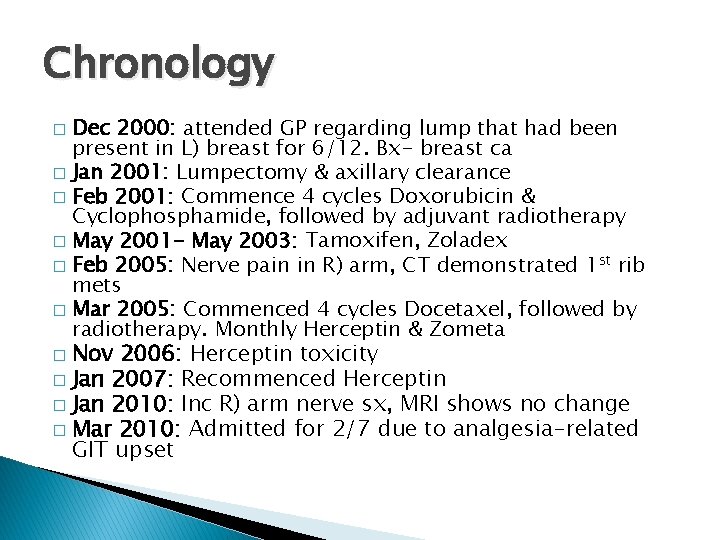
Chronology Dec 2000: attended GP regarding lump that had been present in L) breast for 6/12. Bx- breast ca � Jan 2001: Lumpectomy & axillary clearance � Feb 2001: Commence 4 cycles Doxorubicin & Cyclophosphamide, followed by adjuvant radiotherapy � May 2001 - May 2003: Tamoxifen, Zoladex � Feb 2005: Nerve pain in R) arm, CT demonstrated 1 st rib mets � Mar 2005: Commenced 4 cycles Docetaxel, followed by radiotherapy. Monthly Herceptin & Zometa � Nov 2006: Herceptin toxicity � Jan 2007: Recommenced Herceptin � Jan 2010: Inc R) arm nerve sx, MRI shows no change � Mar 2010: Admitted for 2/7 due to analgesia-related GIT upset �
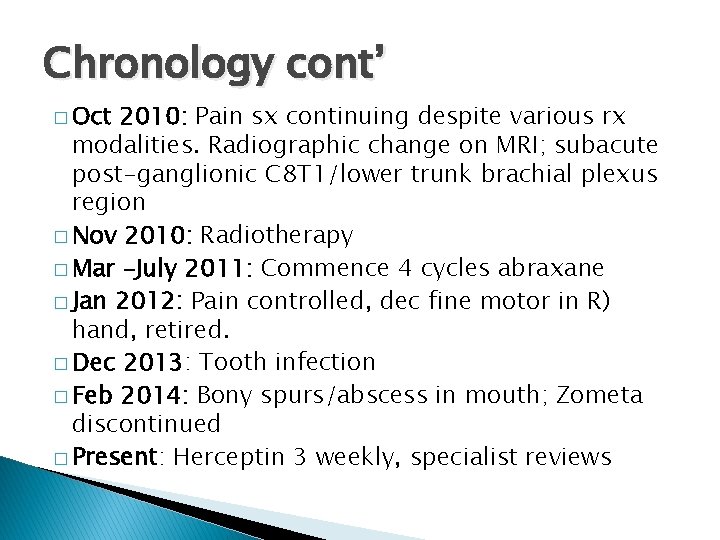
Chronology cont’ � Oct 2010: Pain sx continuing despite various rx modalities. Radiographic change on MRI; subacute post-ganglionic C 8 T 1/lower trunk brachial plexus region � Nov 2010: Radiotherapy � Mar –July 2011: Commence 4 cycles abraxane � Jan 2012: Pain controlled, dec fine motor in R) hand, retired. � Dec 2013: Tooth infection � Feb 2014: Bony spurs/abscess in mouth; Zometa discontinued � Present: Herceptin 3 weekly, specialist reviews
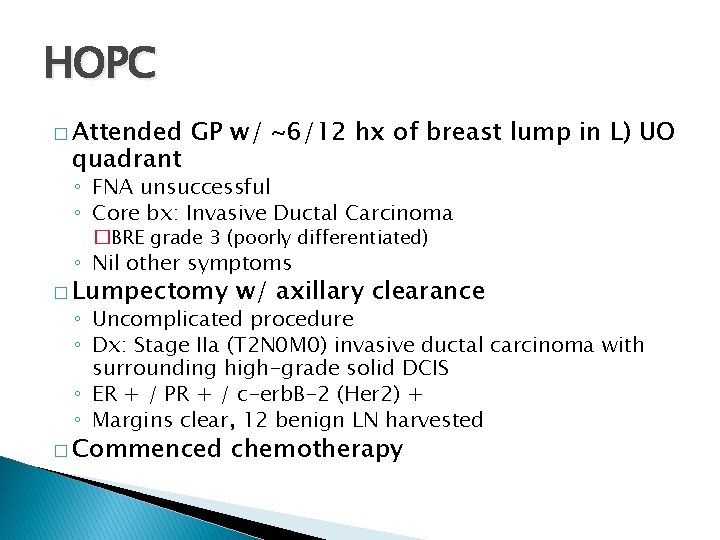
HOPC � Attended quadrant GP w/ ~6/12 hx of breast lump in L) UO ◦ FNA unsuccessful ◦ Core bx: Invasive Ductal Carcinoma �BRE grade 3 (poorly differentiated) ◦ Nil other symptoms � Lumpectomy w/ axillary clearance � Commenced chemotherapy ◦ Uncomplicated procedure ◦ Dx: Stage IIa (T 2 N 0 M 0) invasive ductal carcinoma with surrounding high-grade solid DCIS ◦ ER + / PR + / c-erb. B-2 (Her 2) + ◦ Margins clear, 12 benign LN harvested
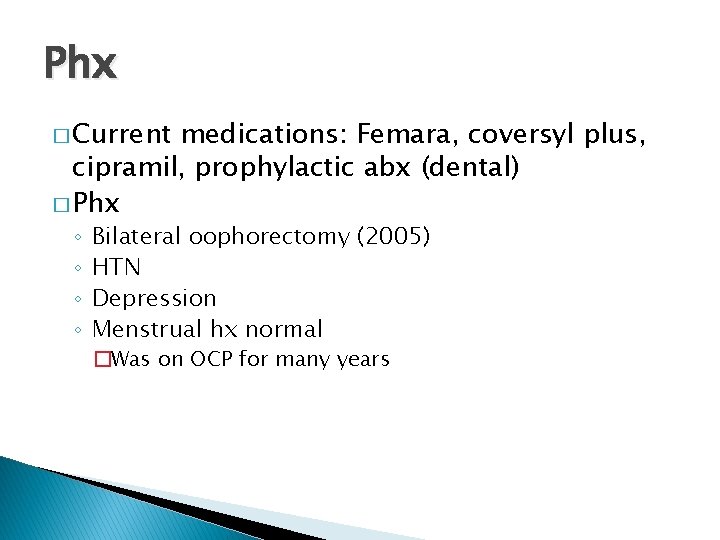
Phx � Current medications: Femara, coversyl plus, cipramil, prophylactic abx (dental) � Phx ◦ ◦ Bilateral oophorectomy (2005) HTN Depression Menstrual hx normal �Was on OCP for many years
Fhx/Social � FHx ◦ Paternal grandmother: sigmoid ca (60) ◦ Father: ? Throat ca (71) ◦ Nil other relevant family hx � Social ◦ Mrs B lives with her husband pets in a Melbourne suburb. She and husband were initially planning to have kids approx at time of initial diagnosis ◦ Worked as community health nurse until deteriorating R) hand function prompted retirement in 2010. Now on disability pension. ◦ Smoking hx: occasional when young adult ◦ Alcohol: average 5 per night ◦ Poor diet/exercise
Mx Initial Dx: Invasive Ductal Carcinoma, Stage IIa (T 2 N 0 M 0) � Rx: 4 cycles Doxorubicin & Taxol (paclitaxel) � Secondary dx: Invasive Ductal Carcinoma with bony metastases, Stage IV (T 2 N 0 M 1) � � Rx: 4 cycles Docetaxel � Recurrence: 4 cycles Nab-paclitaxel � Additional medications �Hydrocortisone �Phenergan �Aprepitant (CINV) �Palonsteron (CINV) �Na. Cl (hydration)
Chemo 1 (Feb - May 2001) � 4 cycles Doxorubicin & Taxol � Effects: ◦ Nil documented information ◦ Mrs B reports nil significant issues �~ ? well tolerated
Interim 2001 -2005 � 2 years Tamoxifen and monthly Zoladex � Nil issues at R/V � Regular CT/mammograms clear � Ca markers stable � 2005: neuropathic R) shoulder & arm pain; metastatic tumour at R) 1 st rib on imaging
Chemo 2 (Mar- Jul 2005) � 4 cycles Docetaxel plus Herceptin � Effects: ◦ Well tolerated ◦ Nil nausea/vomiting, appetite normal, nil weight loss ◦ Some fatigue, ECOG 0 -1 � Commenced 6 weekly Zometa ◦ Bone-protective, for cx from bony mets/Zoladex etc
Interim (2005 – 2010) � Echo demonstrated Herceptin toxicity Nov 2006, rx delayed until cleared in 2007 � Nil concerns on R/V � 2008: Progressing well. On Herceptin, Arimidex (anastrozole), Zometa � Mammograms normal, some inc density in L) UIQ stable since ’ 05 � 2010: Increasing R) arm neuropathic pain �Burning/tingling/numbness �Gastric upset/weight loss due to analgesia; Naprosyn discontinued, Durogesic increased (later ceased) �MRI: rib/T 1 body lesion shows nil change �Neuropathic sx increase, from shoulder to hand, wasting of palmar muscles, R) hand weakness and decreasing fine motor �Attended various specialists including pain clinic; on lyrica, cortisone, panadeine forte, morphine, ? methadone. Stellate ganglion block ineffective, 5/7 ketamine infusion ineffective �November: radiographic change, disease progression
Chemo 3 (Mar-July 2011) � 4 cycles Abraxane (+ Herceptin) � Effects: ◦ ◦ ◦ ◦ Some fatigue, decreased motivation ECOG 2 Nil nausea/vomiting, appetite fine, nil weight loss Nil peripheral neuropathy Mild skin peeling L) hand, ? fungal infection Nil other SE April: febrile, brief admission � On letrozole
Progress � 2012: Development of bilateral knee pain and R) elbow pain. Nil evidence metastatic; degen change and ? synovitis/soft tissue injury respectively � Increasing loss of fine motor skill in R) hand � 2013 -14: Tooth infection; attended specialist. Bony spurs in mouth due to Zometa, abscess formation in floor of mouth near exposed bone. 2 nd to Bisphos related osteonecrosis of jaw. � Otherwise well, continuing on 3 weekly Herceptin.

Breast Cancer
Incidence & Aetiology �Incidence: ◦ Leading cause of cancer death in women > 65 ◦ Invasive breast ca �<50 yo: 44/100, 000 �>50 yo: 345/100, 000 ◦ Bimodal incidence: poorly differentiated, high-grade disease usually occur earlier (~50 s), whereas hormone-sensitive, slower-growing tumors are later (~70 s) ◦ Mortality: The 2013 estimates are 39, 920 expected breast cancer deaths (39, 510 women, 410 men) �Aetiology: ◦ Multifactorial; sporadic vs genetic predisposition
Risk Factors � � Phx of breast ca (esp invasive): 3 -4 x risk of a second primary cancer in the contralateral breast Family hx ◦ ◦ ◦ ◦ � � � � � >2 relatives with breast/ovarian cancer Breast cancer in relative <50 yo Relatives with both breast cancer and ovarian cancer One or more relatives with 2 cancers (breast and ovarian cancer or 2 independent breast cancers) Male relatives with breast cancer BRCA 1 and BRCA 2 mutations Ataxia telangiectasia heterozygotes (4 x risk) Ashkenazi Jewish descent (2 x risk) High SES Advanced age Caucasian Late age at first pregnancy/nulliparity Early onset of menses/late age of menopause/HRT Long term OCP use Western diet Obesity/sedentary lifestyle Smoking/alcohol/carcinogens
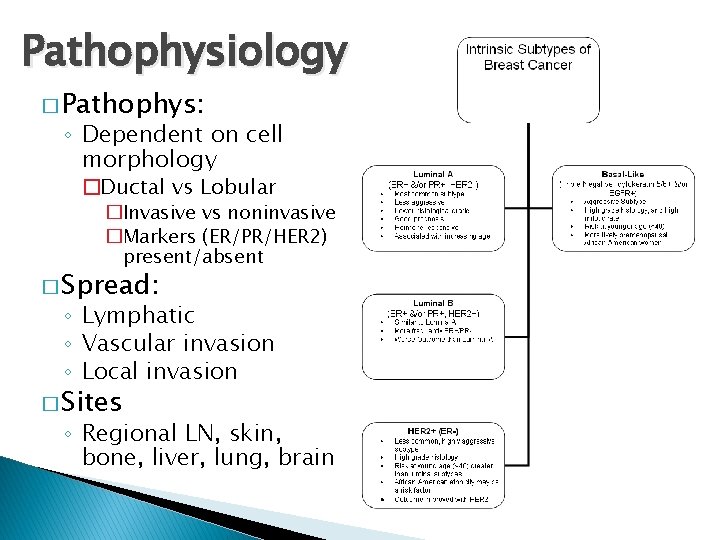
Pathophysiology � Pathophys: ◦ Dependent on cell morphology �Ductal vs Lobular �Invasive vs noninvasive �Markers (ER/PR/HER 2) present/absent � Spread: ◦ Lymphatic ◦ Vascular invasion ◦ Local invasion � Sites ◦ Regional LN, skin, bone, liver, lung, brain
Sg & Sx � Sx ◦ Primary: Asymptomatic, painless mass, breast pain (rare) ◦ Mets: � Dyspnoea � Bone pain � Symptoms of hypercalcemia � Abdominal distension � Jaundice � Localizing neurologic signs � Altered cognitive function � Headache � Clinical signs ◦ Change in breast size or shape/contour ◦ Skin dimpling or skin changes (eg, thickening, swelling, tethering, Pagets, redness, ulceration, dilated veins, oedema) ◦ Recent nipple abnormalities (eg, ulceration, retraction, or spontaneous bloody discharge) ◦ Lump (Hard/irreg/nodular/asymmetry/fixation)
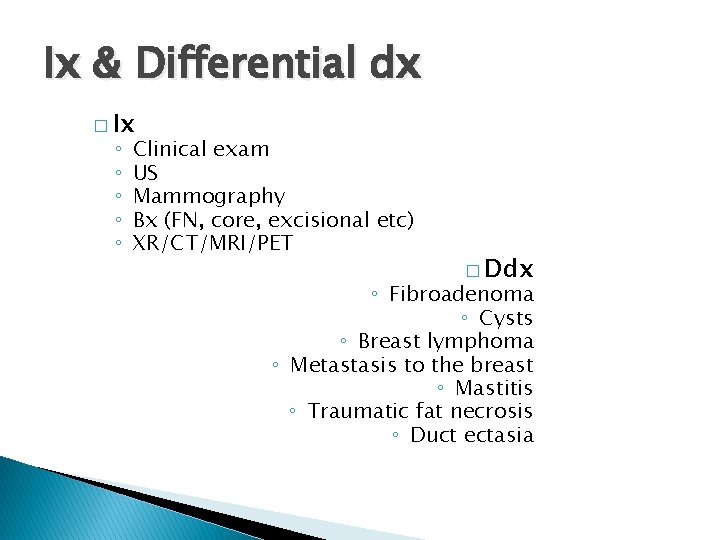
Ix & Differential dx � Ix ◦ ◦ ◦ Clinical exam US Mammography Bx (FN, core, excisional etc) XR/CT/MRI/PET � Ddx ◦ Fibroadenoma ◦ Cysts ◦ Breast lymphoma ◦ Metastasis to the breast ◦ Mastitis ◦ Traumatic fat necrosis ◦ Duct ectasia
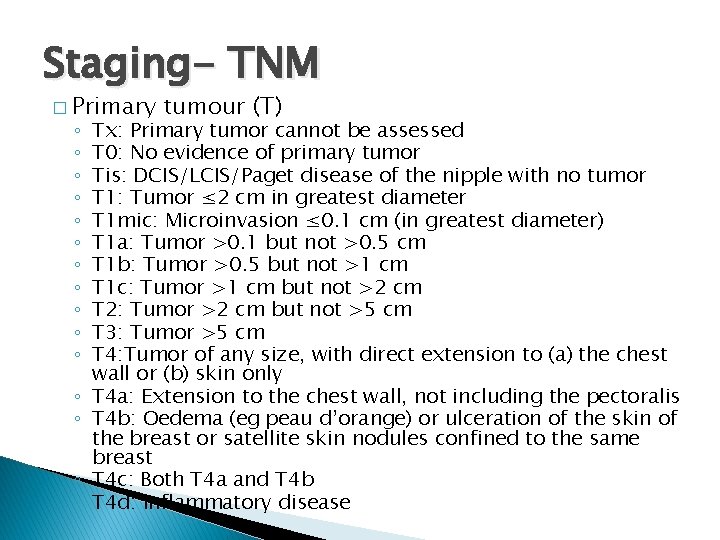
Staging- TNM � Primary ◦ ◦ ◦ ◦ tumour (T) Tx: Primary tumor cannot be assessed T 0: No evidence of primary tumor Tis: DCIS/LCIS/Paget disease of the nipple with no tumor T 1: Tumor ≤ 2 cm in greatest diameter T 1 mic: Microinvasion ≤ 0. 1 cm (in greatest diameter) T 1 a: Tumor >0. 1 but not >0. 5 cm T 1 b: Tumor >0. 5 but not >1 cm T 1 c: Tumor >1 cm but not >2 cm T 2: Tumor >2 cm but not >5 cm T 3: Tumor >5 cm T 4: Tumor of any size, with direct extension to (a) the chest wall or (b) skin only T 4 a: Extension to the chest wall, not including the pectoralis T 4 b: Oedema (eg peau d’orange) or ulceration of the skin of the breast or satellite skin nodules confined to the same breast T 4 c: Both T 4 a and T 4 b T 4 d: Inflammatory disease
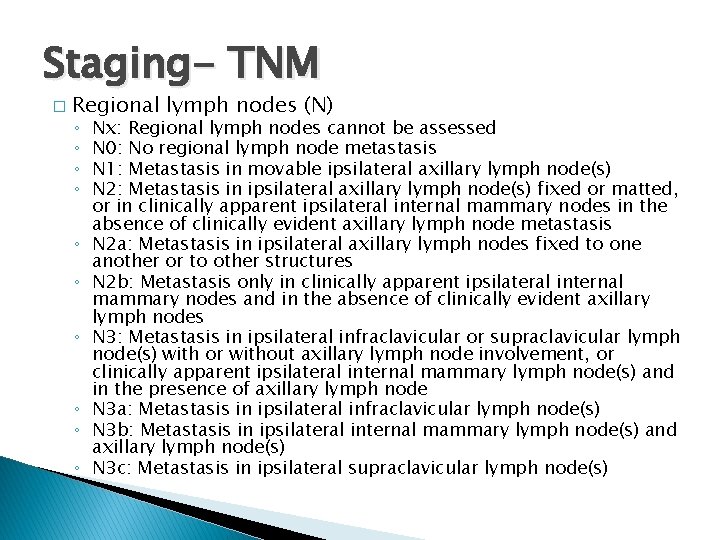
Staging- TNM � Regional lymph nodes (N) ◦ ◦ ◦ ◦ ◦ Nx: Regional lymph nodes cannot be assessed N 0: No regional lymph node metastasis N 1: Metastasis in movable ipsilateral axillary lymph node(s) N 2: Metastasis in ipsilateral axillary lymph node(s) fixed or matted, or in clinically apparent ipsilateral internal mammary nodes in the absence of clinically evident axillary lymph node metastasis N 2 a: Metastasis in ipsilateral axillary lymph nodes fixed to one another or to other structures N 2 b: Metastasis only in clinically apparent ipsilateral internal mammary nodes and in the absence of clinically evident axillary lymph nodes N 3: Metastasis in ipsilateral infraclavicular or supraclavicular lymph node(s) with or without axillary lymph node involvement, or clinically apparent ipsilateral internal mammary lymph node(s) and in the presence of axillary lymph node N 3 a: Metastasis in ipsilateral infraclavicular lymph node(s) N 3 b: Metastasis in ipsilateral internal mammary lymph node(s) and axillary lymph node(s) N 3 c: Metastasis in ipsilateral supraclavicular lymph node(s)
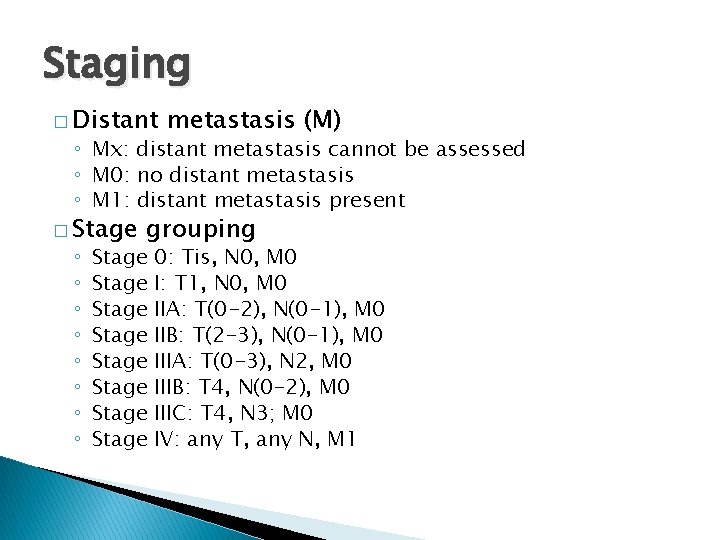
Staging � Distant metastasis (M) ◦ Mx: distant metastasis cannot be assessed ◦ M 0: no distant metastasis ◦ M 1: distant metastasis present � Stage ◦ ◦ ◦ ◦ grouping Stage Stage 0: Tis, N 0, M 0 I: T 1, N 0, M 0 IIA: T(0 -2), N(0 -1), M 0 IIB: T(2 -3), N(0 -1), M 0 IIIA: T(0 -3), N 2, M 0 IIIB: T 4, N(0 -2), M 0 IIIC: T 4, N 3; M 0 IV: any T, any N, M 1
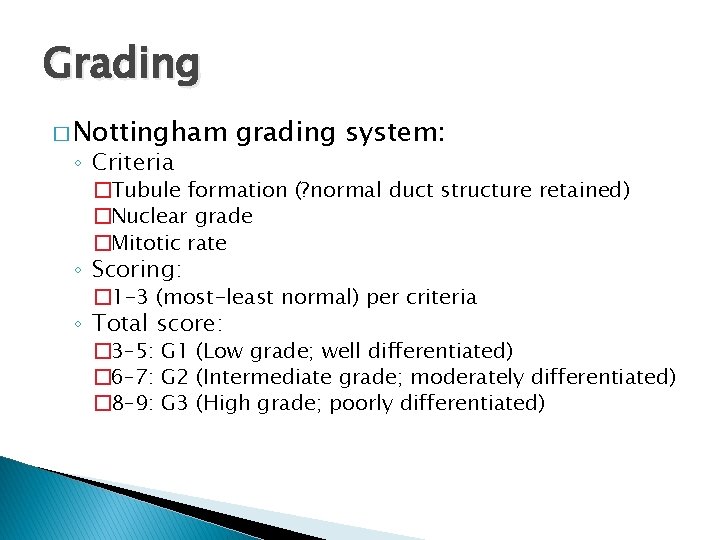
Grading � Nottingham ◦ Criteria grading system: �Tubule formation (? normal duct structure retained) �Nuclear grade �Mitotic rate ◦ Scoring: � 1 -3 (most-least normal) per criteria ◦ Total score: � 3– 5: G 1 (Low grade; well differentiated) � 6– 7: G 2 (Intermediate grade; moderately differentiated) � 8– 9: G 3 (High grade; poorly differentiated)
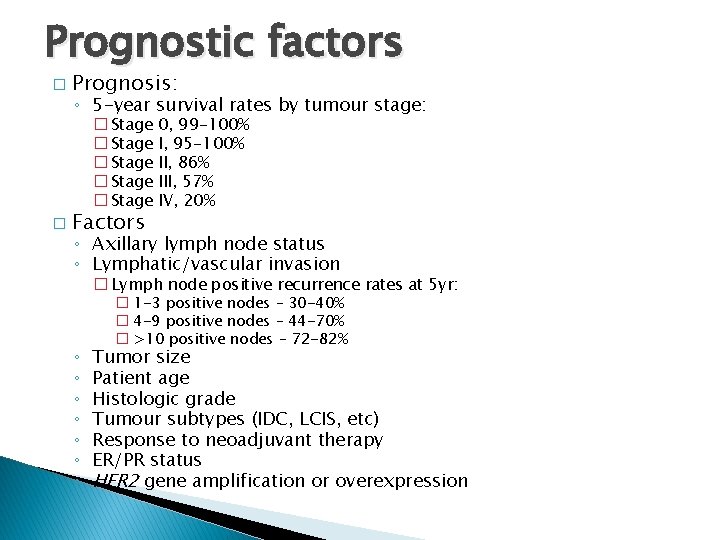
Prognostic factors � Prognosis: ◦ 5 -year survival rates by tumour stage: � Stage � Stage � Factors 0, 99 -100% I, 95 -100% II, 86% III, 57% IV, 20% ◦ Axillary lymph node status ◦ Lymphatic/vascular invasion � Lymph node positive recurrence rates at 5 yr: ◦ ◦ ◦ ◦ � 1 -3 positive nodes – 30 -40% � 4 -9 positive nodes – 44 -70% � >10 positive nodes – 72 -82% Tumor size Patient age Histologic grade Tumour subtypes (IDC, LCIS, etc) Response to neoadjuvant therapy ER/PR status HER 2 gene amplification or overexpression
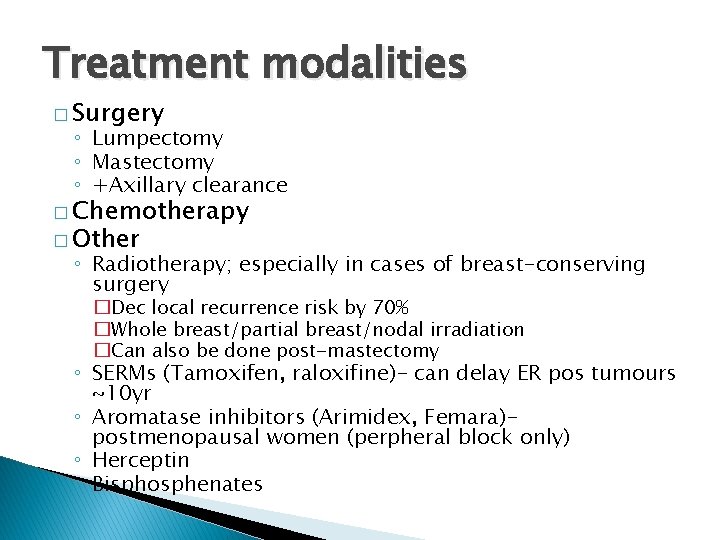
Treatment modalities � Surgery ◦ Lumpectomy ◦ Mastectomy ◦ +Axillary clearance � Chemotherapy � Other ◦ Radiotherapy; especially in cases of breast-conserving surgery �Dec local recurrence risk by 70% �Whole breast/partial breast/nodal irradiation �Can also be done post-mastectomy ◦ SERMs (Tamoxifen, raloxifine)- can delay ER pos tumours ~10 yr ◦ Aromatase inhibitors (Arimidex, Femara)postmenopausal women (perpheral block only) ◦ Herceptin ◦ Bisphosphenates
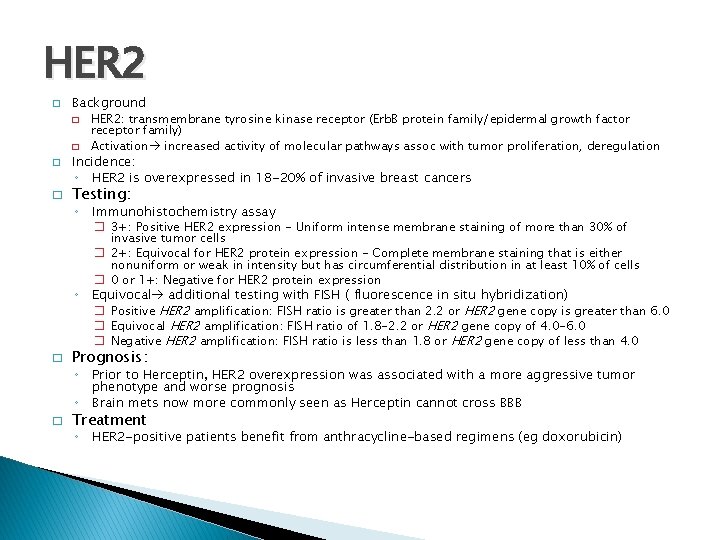
HER 2 � Background � � HER 2: transmembrane tyrosine kinase receptor (Erb. B protein family/epidermal growth factor receptor family) Activation increased activity of molecular pathways assoc with tumor proliferation, deregulation Incidence: ◦ HER 2 is overexpressed in 18 -20% of invasive breast cancers Testing: ◦ Immunohistochemistry assay ◦ � � 3+: Positive HER 2 expression - Uniform intense membrane staining of more than 30% of invasive tumor cells � 2+: Equivocal for HER 2 protein expression - Complete membrane staining that is either nonuniform or weak in intensity but has circumferential distribution in at least 10% of cells � 0 or 1+: Negative for HER 2 protein expression Equivocal additional testing with FISH ( fluorescence in situ hybridization) � Positive HER 2 amplification: FISH ratio is greater than 2. 2 or HER 2 gene copy is greater than 6. 0 � Equivocal HER 2 amplification: FISH ratio of 1. 8 -2. 2 or HER 2 gene copy of 4. 0 -6. 0 � Negative HER 2 amplification: FISH ratio is less than 1. 8 or HER 2 gene copy of less than 4. 0 Prognosis: ◦ Prior to Herceptin, HER 2 overexpression was associated with a more aggressive tumor phenotype and worse prognosis ◦ Brain mets now more commonly seen as Herceptin cannot cross BBB � Treatment ◦ HER 2 -positive patients benefit from anthracycline-based regimens (eg doxorubicin)
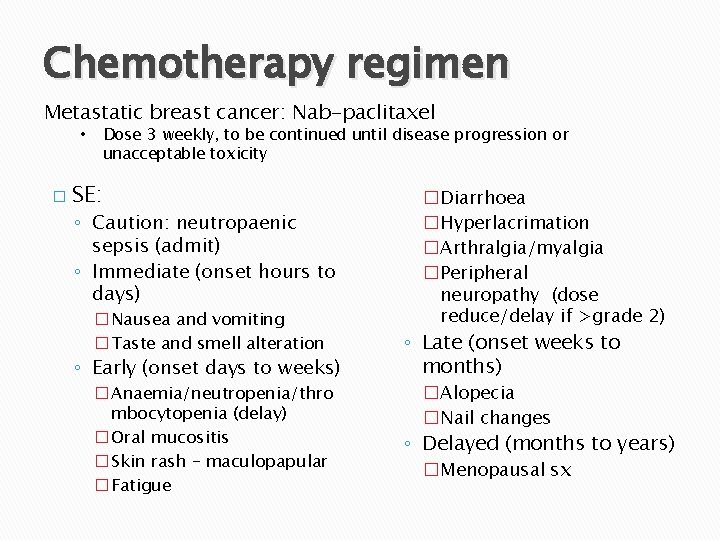
Chemotherapy regimen Metastatic breast cancer: Nab-paclitaxel • � Dose 3 weekly, to be continued until disease progression or unacceptable toxicity SE: ◦ Caution: neutropaenic sepsis (admit) ◦ Immediate (onset hours to days) �Nausea and vomiting �Taste and smell alteration ◦ Early (onset days to weeks) �Anaemia/neutropenia/thro mbocytopenia (delay) �Oral mucositis �Skin rash – maculopapular �Fatigue �Diarrhoea �Hyperlacrimation �Arthralgia/myalgia �Peripheral neuropathy (dose reduce/delay if >grade 2) ◦ Late (onset weeks to months) �Alopecia �Nail changes ◦ Delayed (months to years) �Menopausal sx
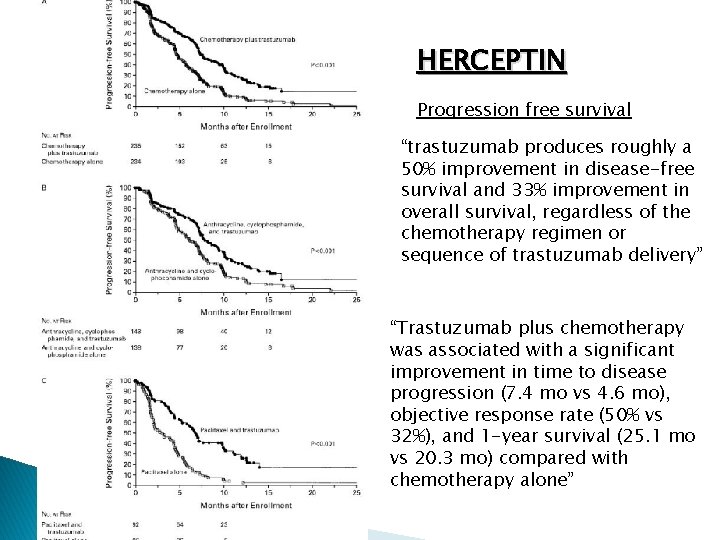
HERCEPTIN Progression free survival “trastuzumab produces roughly a 50% improvement in disease-free survival and 33% improvement in overall survival, regardless of the chemotherapy regimen or sequence of trastuzumab delivery” “Trastuzumab plus chemotherapy was associated with a significant improvement in time to disease progression (7. 4 mo vs 4. 6 mo), objective response rate (50% vs 32%), and 1 -year survival (25. 1 mo vs 20. 3 mo) compared with chemotherapy alone”
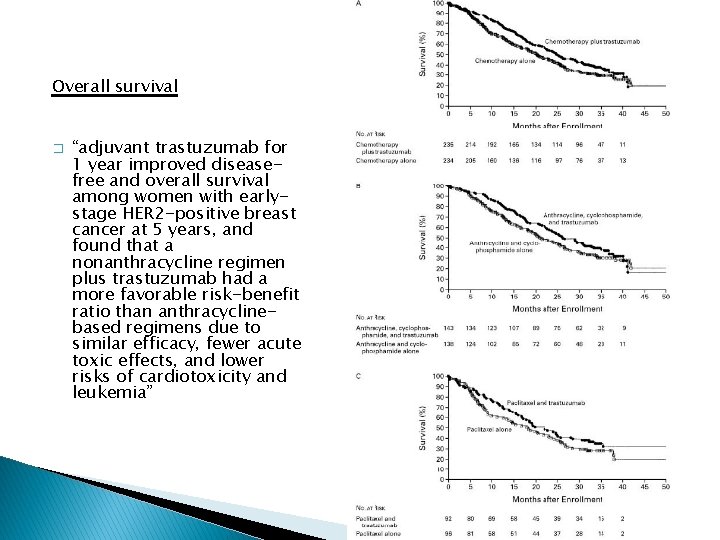
Overall survival � “adjuvant trastuzumab for 1 year improved diseasefree and overall survival among women with earlystage HER 2 -positive breast cancer at 5 years, and found that a nonanthracycline regimen plus trastuzumab had a more favorable risk-benefit ratio than anthracyclinebased regimens due to similar efficacy, fewer acute toxic effects, and lower risks of cardiotoxicity and leukemia”
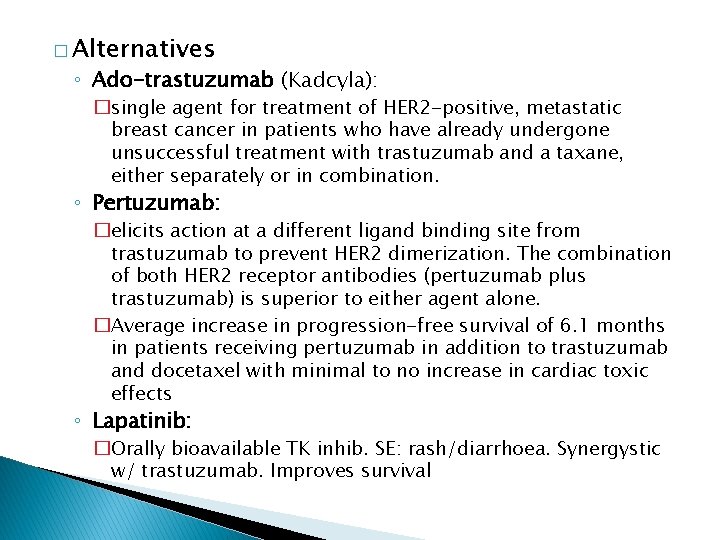
� Alternatives ◦ Ado-trastuzumab (Kadcyla): �single agent for treatment of HER 2 -positive, metastatic breast cancer in patients who have already undergone unsuccessful treatment with trastuzumab and a taxane, either separately or in combination. ◦ Pertuzumab: �elicits action at a different ligand binding site from trastuzumab to prevent HER 2 dimerization. The combination of both HER 2 receptor antibodies (pertuzumab plus trastuzumab) is superior to either agent alone. �Average increase in progression-free survival of 6. 1 months in patients receiving pertuzumab in addition to trastuzumab and docetaxel with minimal to no increase in cardiac toxic effects ◦ Lapatinib: �Orally bioavailable TK inhib. SE: rash/diarrhoea. Synergystic w/ trastuzumab. Improves survival
References � � � � Evi. Q Best Practice Medscape Manual of Clinical Oncology, seventh ed. Slamon D, Eiermann W, Robert N, Pienkowski T, Martin M, Press M, et al. Adjuvant trastuzumab in HER 2 -positive breast cancer. N Engl J Med. Oct 6 2011; 365(14): 1273 -83. Baselga J, Cortés J, Kim SB, Im SA, Hegg R, Im YH, et al. Pertuzumab plus trastuzumab plus docetaxel for metastatic breast cancer. N Engl J Med. Jan 12 2012; 366(2): 109 -19. Slamon DJ, Leyland-Jones B, Shak S, Fuchs H, Paton V, Bajamonde A, et al. Use of chemotherapy plus a monoclonal antibody against HER 2 for metastatic breast cancer that overexpresses HER 2. N Engl J Med. Mar 15 2001; 344(11): 783 -92. Welslau M. Dieras V. Sohn JH. Hurvitz SA. Lalla D. Fang L. Althaus B. Guardino E. Miles D. Patient-reported outcomes from EMILIA, a randomized phase 3 study of trastuzumab emtansine (T-DM 1) versus capecitabine and lapatinib in human epidermal growth factor receptor 2 positive locally advanced or metastatic breast cancer. Clinical Trial, Phase III. Journal Article. 120(5): 642 -51, 2014 Mar 1.
- Slides: 32