
HEPCCE The High Energy Physics Center for Computational
- Slides: 22
HEP-CCE The High Energy Physics Center for Computational Excellence (HEP-CCE) I/O and Storage Project: Plans and Progress P. Van Gemmeren for the HEP-CCE (IOS) project Software & Computing Round Table Feb 9, 2021
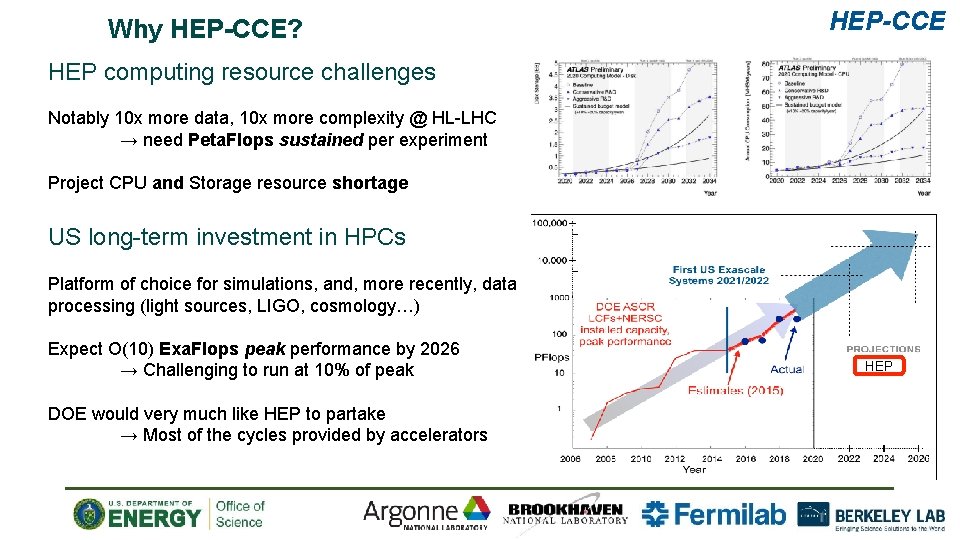
Why HEP-CCE? HEP-CCE HEP computing resource challenges Notably 10 x more data, 10 x more complexity @ HL-LHC → need Peta. Flops sustained per experiment Project CPU and Storage resource shortage US long-term investment in HPCs Platform of choice for simulations, and, more recently, data processing (light sources, LIGO, cosmology…) Expect O(10) Exa. Flops peak performance by 2026 → Challenging to run at 10% of peak DOE would very much like HEP to partake → Most of the cycles provided by accelerators HEP
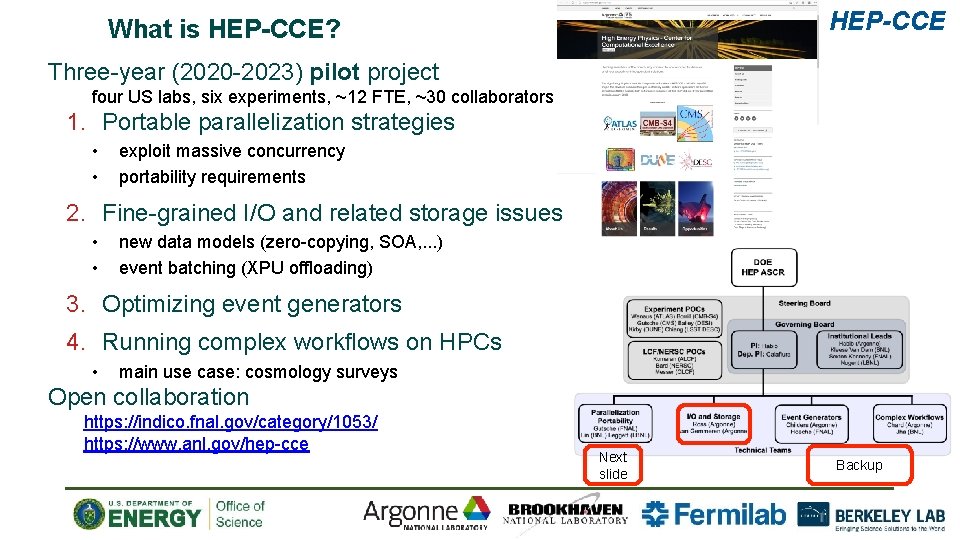
HEP-CCE What is HEP-CCE? Three-year (2020 -2023) pilot project four US labs, six experiments, ~12 FTE, ~30 collaborators 1. Portable parallelization strategies • • exploit massive concurrency portability requirements 2. Fine-grained I/O and related storage issues • • new data models (zero-copying, SOA, . . . ) event batching (XPU offloading) 3. Optimizing event generators 4. Running complex workflows on HPCs • main use case: cosmology surveys Open collaboration https: //indico. fnal. gov/category/1053/ https: //www. anl. gov/hep-cce Next slide Backup
CCE/PPS: Goals and Year 1 priorities HEP-CCE Investigate a range of software portability solutions: • • Kokkos / Raja SYCL / dpc++ Alpaka Open. MP / Open. ACC ● ● products are rapidly evolving we have some hope of seeing the emergence of industry standards at the C++ language level Port a small number of HEP testbeds to each language • Patatrack Pixel Tracking (CMS) • Wire. Cell Toolkit (DUNE) • Fast. Calo. Sim (ATLAS) Define a set of metrics to evaluate the ports, and apply them • Ease of porting, performance, code impact, relevance, etc Make recommendations to the experiments • Must address needs of both LHC style workflows with many modules and many developers, and smaller/simpler workflows
CCE/IOS: Goals HEP-CCE Parallel serialization/de-serialization of HEP data models • Both single node and multi-node access patterns Persistable data representations tuned for HPC storage systems • Connection to PPS exploration of portable parallelization libraries • Can benefit from Write-Once/Read-Many HEP access models Accessing partial, partitioned or sub-event data blocks • Matched to specific algorithm consumption requirement Runtime memory mapping of data • Exploit batched, vectorized, and data parallel operations and transforms on columnar data. • Taking into account CPU-XPU communication Open collaboration, meets bi-weekly Wednesday 2 -3 pm CST https: //indico. fnal. gov/category/1080/
CCE/IOS: Year 1 Activities HEP-CCE Darshan for ROOT I/O in HEP workflows on HPC. • ROOT I/O is central to all HEP experiments. Measurements of its performance on HPC using tools like Darshan, could give valuable insights for possible improvements. Investigate HDF 5 as intermediate event storage for HPC processing • In some workflows, such as the ATLAS Event. Service, temporary data is written to ROOT files. Moving this data to a parallel file format such as HDF 5 could be beneficial. Testing framework for understanding scalability and performance of HEP output methods • An ability to simulate HEP output of specific data products (e. g. , RECO, AOD, mini. AOD) in different scenarios prepares us for deeper analysis of intermediate data storage options.
CCE/IOS: Year 1 Achievements HEP-CCE Darshan for ROOT I/O in HEP workflows on HPC. • Darshan is a lightweight I/O characterization tool that can capture either condensed views or entire traces (DXT) of application I/O behavior • Darshan is deployed at a number of DOE computing facilities (including ALCF, ANL LCRC, and NERSC) and has become a popular tool for HPC users to better understand their I/O workloads • While originally designed specifically for MPI applications, in the past year we have modified Darshan to also work in non-MPI contexts • Extends I/O instrumentation into exciting new HPC contexts, like HEP workflows that have traditionally not been based on MPI
CCE/IOS: Year 1 Achievements HEP-CCE Darshan for ROOT I/O activity status. • Integration of Darshan into HEP workflows like ATLAS, CMS, and DUNE can provide deeper understanding of their use of HPC storage resources. This understanding can be used to optimize workflow usage of ROOT as well as to make general improvements to the ROOT I/O library. • Phase 1: Preparation • Introduction to Darshan, ROOT, and HEP workflow (ATLAS, CMS, DUNE) technologies and discussion of potential deployment strategies • Phase 2: Prototyping • • • Deployment of Darshan for use in different HEP workflows (e. g. , in containers) Development of fork-safe Darshan instrumentation strategies (needed for ATLAS) Development of Darshan analysis tools for understanding workflow I/O behavior
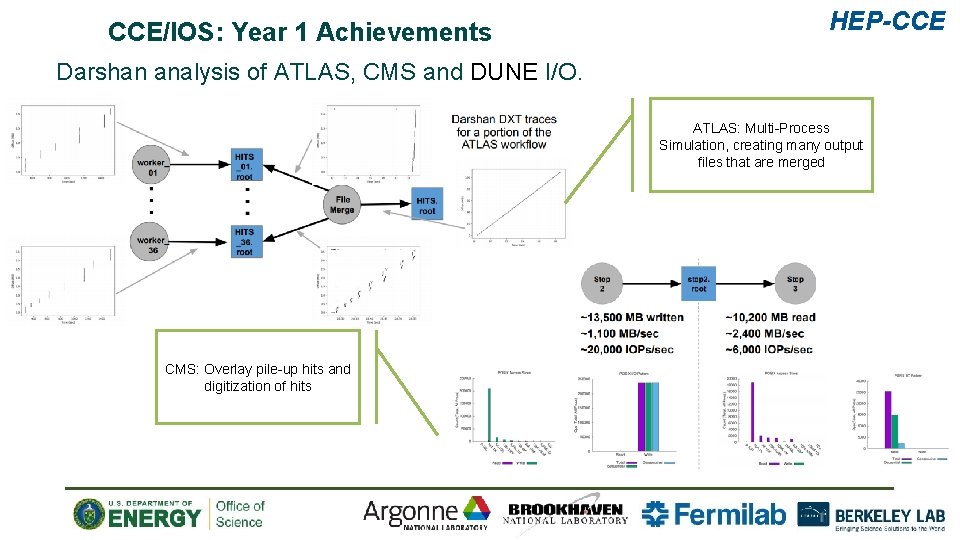
CCE/IOS: Year 1 Achievements HEP-CCE Darshan analysis of ATLAS, CMS and DUNE I/O. ATLAS: Multi-Process Simulation, creating many output files that are merged CMS: Overlay pile-up hits and digitization of hits
CCE/IOS: Year 1 Achievements HEP-CCE Darshan for ROOT I/O next steps. • Investigate and develop workarounds for numerous obstacles to instrumenting ROOT I/O workloads • Unreliable I/O instrumentation forked processes • Difficulty deploying Darshan in complex production environments (i. e. , workflows employing containers) • Missing Darshan log data (e. g. , due to instrumenting too many workflow files) • With broader instrumentation coverage of ATLAS, CMS, DUNE workflows, we can turn focus to Darshan analysis tools to better understand flow of data, I/O access patterns, and achieved performance of different HEP data processing stages • Drive tuning decisions for ROOT usage and for ROOT implementation • New Python bindings for Darshan log utility library should ease development of new analysis tools
CCE/IOS: Year 1 Achievements HEP-CCE Investigate HDF 5 as intermediate event storage for HPC processing. • HDF 5 (Hierarchical Data Format) is a portable, self-describing file format designed to store large amounts of data • It is maintained by the HDF Group [https: //www. hdfgroup. org] • It is widely available at HPC centers, and easily installable on laptops • It supports parallel IO using MPI, and has special drivers tuned for parallel file systems at HPC centers • A few key abstractions are: • datasets, which are multidimensional arrays of homogeneous types, • groups, which are containers of datasets and other groups, and • attributes, which are small metadata objects to describe groups and datasets • Allows efficient columnar data access for the “required” data products
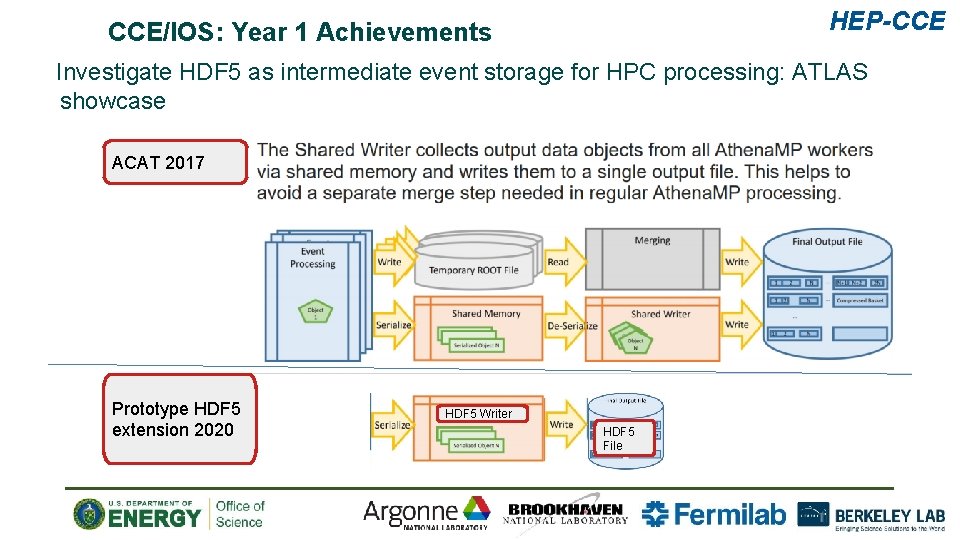
CCE/IOS: Year 1 Achievements HEP-CCE Investigate HDF 5 as intermediate event storage for HPC processing activity status. • The focus of this activity is to explore the use of HDF 5 files for writing HEP data products that have already been serialized using ROOT serialization. • We are interested in developing an experiment-independent approach. • We are currently using a multi-threaded testing framework developed as part of the CCE project to work on the use of HDF 5. • This work is the first attempt to write intermediate output in HDF 5 style. • We have demonstrated the efficient and high performing data access and hence subsequent analysis by using HDF 5 representation of the analysisready data in Sci. DAC (HEP on HPC) project.
HEP-CCE CCE/IOS: Year 1 Achievements Investigate HDF 5 as intermediate event storage for HPC processing: ATLAS showcase ACAT 2017 Prototype HDF 5 extension 2020 HDF 5 Writer HDF 5 File
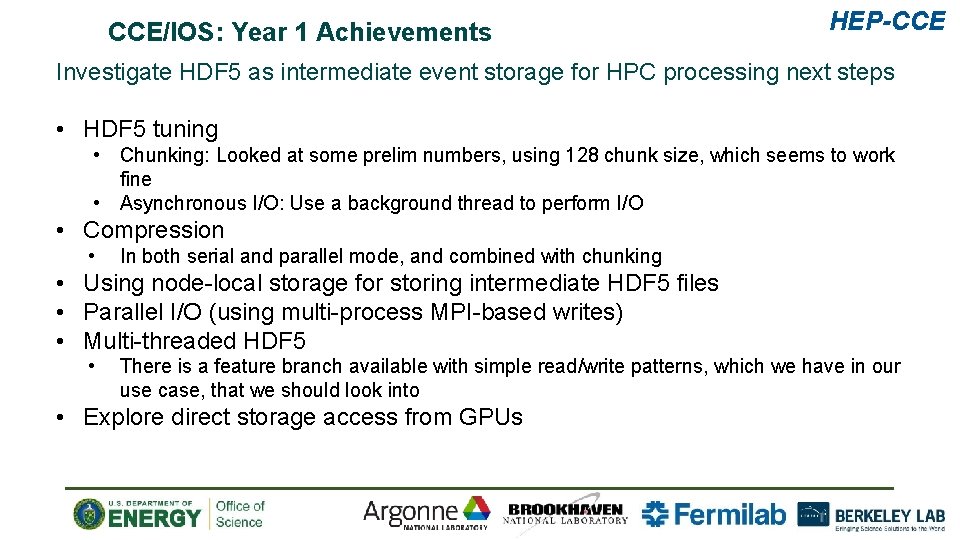
CCE/IOS: Year 1 Achievements HEP-CCE Investigate HDF 5 as intermediate event storage for HPC processing next steps • HDF 5 tuning • Chunking: Looked at some prelim numbers, using 128 chunk size, which seems to work fine • Asynchronous I/O: Use a background thread to perform I/O • Compression • In both serial and parallel mode, and combined with chunking • Using node-local storage for storing intermediate HDF 5 files • Parallel I/O (using multi-process MPI-based writes) • Multi-threaded HDF 5 • There is a feature branch available with simple read/write patterns, which we have in our use case, that we should look into • Explore direct storage access from GPUs
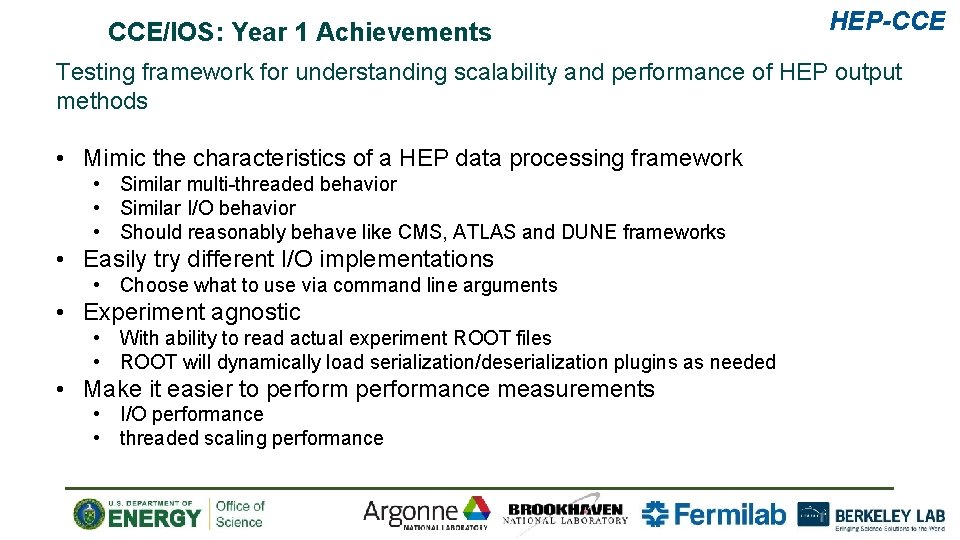
CCE/IOS: Year 1 Achievements HEP-CCE Testing framework for understanding scalability and performance of HEP output methods • Mimic the characteristics of a HEP data processing framework • Similar multi-threaded behavior • Similar I/O behavior • Should reasonably behave like CMS, ATLAS and DUNE frameworks • Easily try different I/O implementations • Choose what to use via command line arguments • Experiment agnostic • With ability to read actual experiment ROOT files • ROOT will dynamically load serialization/deserialization plugins as needed • Make it easier to performance measurements • I/O performance • threaded scaling performance
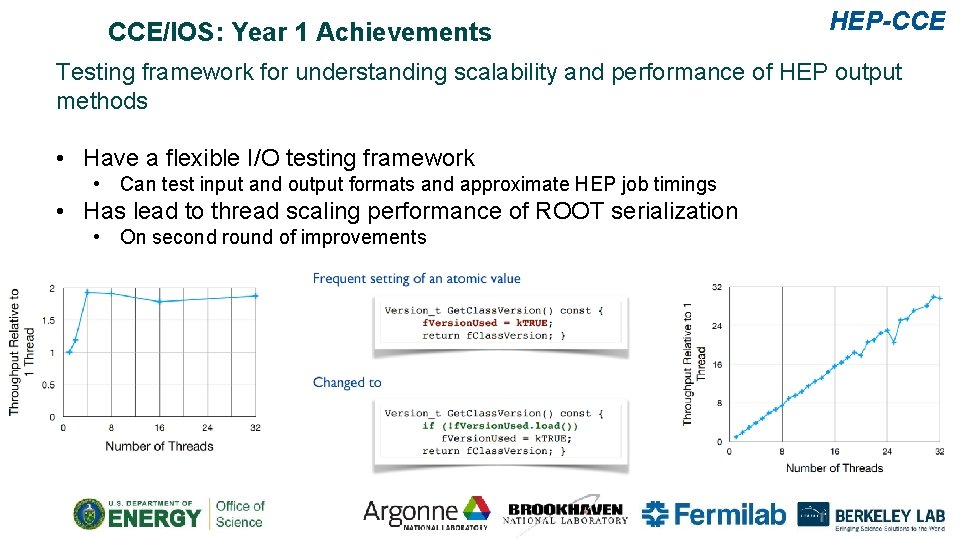
CCE/IOS: Year 1 Achievements HEP-CCE Testing framework for understanding scalability and performance of HEP output methods • Have a flexible I/O testing framework • Can test input and output formats and approximate HEP job timings • Has lead to thread scaling performance of ROOT serialization • On second round of improvements
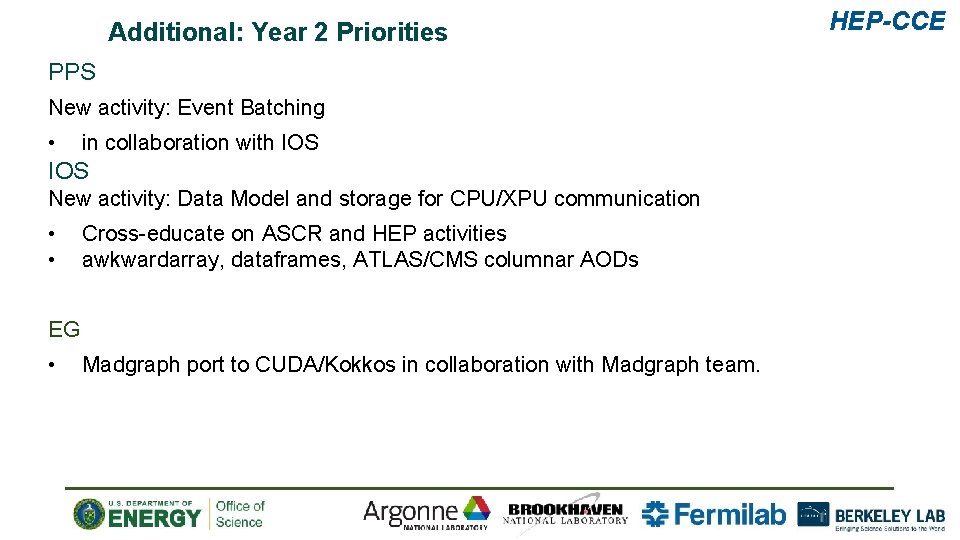
Additional: Year 2 Priorities PPS New activity: Event Batching • in collaboration with IOS New activity: Data Model and storage for CPU/XPU communication • • Cross-educate on ASCR and HEP activities awkwardarray, dataframes, ATLAS/CMS columnar AODs EG • Madgraph port to CUDA/Kokkos in collaboration with Madgraph team. HEP-CCE
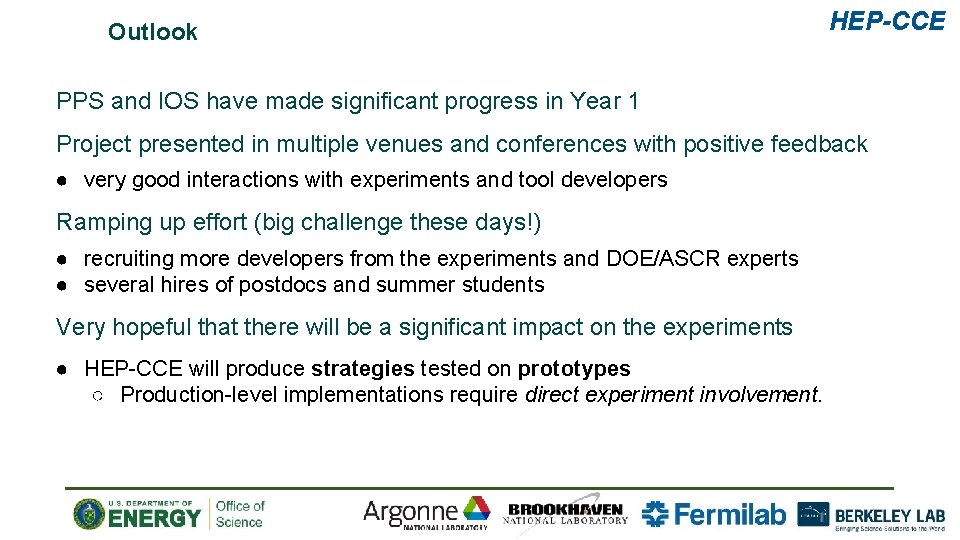
Outlook HEP-CCE PPS and IOS have made significant progress in Year 1 Project presented in multiple venues and conferences with positive feedback ● very good interactions with experiments and tool developers Ramping up effort (big challenge these days!) ● recruiting more developers from the experiments and DOE/ASCR experts ● several hires of postdocs and summer students Very hopeful that there will be a significant impact on the experiments ● HEP-CCE will produce strategies tested on prototypes ○ Production-level implementations require direct experiment involvement.
HEP-CCE Thanks! https: //www. anl. gov/hep-cce gemmeren@anl. gov
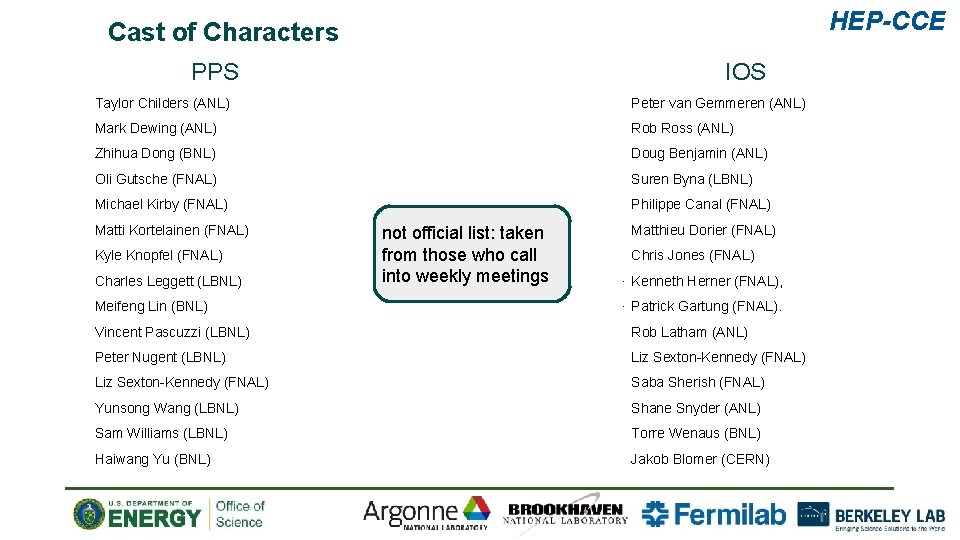
HEP-CCE Cast of Characters IOS PPS ∙ Taylor Childers (ANL) ∙ Peter van Gemmeren (ANL) ∙ Mark Dewing (ANL) ∙ Rob Ross (ANL) ∙ Zhihua Dong (BNL) ∙ Doug Benjamin (ANL) ∙ Oli Gutsche (FNAL) ∙ Suren Byna (LBNL) ∙ Michael Kirby (FNAL) ∙ Philippe Canal (FNAL) ∙ Matti Kortelainen (FNAL) ∙ Matthieu Dorier (FNAL) ∙ Kyle Knopfel (FNAL) ∙ Chris Jones (FNAL) ∙ Charles Leggett (LBNL) ∙ Meifeng Lin (BNL) ∙ Vincent Pascuzzi (LBNL) ∙ Rob Latham (ANL) ∙ Peter Nugent (LBNL) ∙ Liz Sexton-Kennedy (FNAL) ∙ Saba Sherish (FNAL) ∙ Yunsong Wang (LBNL) ∙ Shane Snyder (ANL) ∙ Sam Williams (LBNL) ∙ Torre Wenaus (BNL) ∙ Haiwang Yu (BNL) ∙ Jakob Blomer (CERN) not official list: taken from those who call into weekly meetings ∙ Kenneth Herner (FNAL), ∙ Patrick Gartung (FNAL).
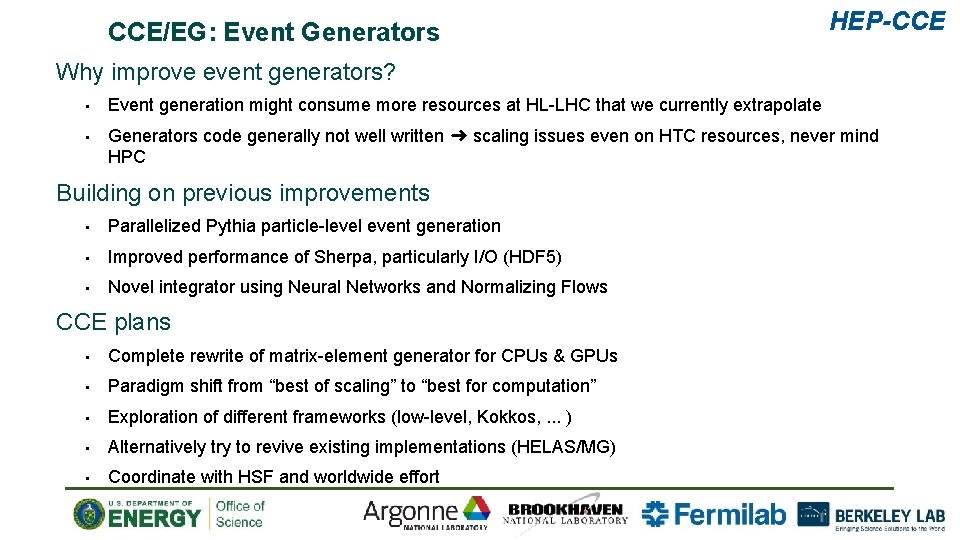
CCE/EG: Event Generators HEP-CCE Why improve event generators? • Event generation might consume more resources at HL-LHC that we currently extrapolate • Generators code generally not well written ➜ scaling issues even on HTC resources, never mind HPC Building on previous improvements • Parallelized Pythia particle-level event generation • Improved performance of Sherpa, particularly I/O (HDF 5) • Novel integrator using Neural Networks and Normalizing Flows CCE plans • Complete rewrite of matrix-element generator for CPUs & GPUs • Paradigm shift from “best of scaling” to “best for computation” • Exploration of different frameworks (low-level, Kokkos, . . . ) • Alternatively try to revive existing implementations (HELAS/MG) • Coordinate with HSF and worldwide effort
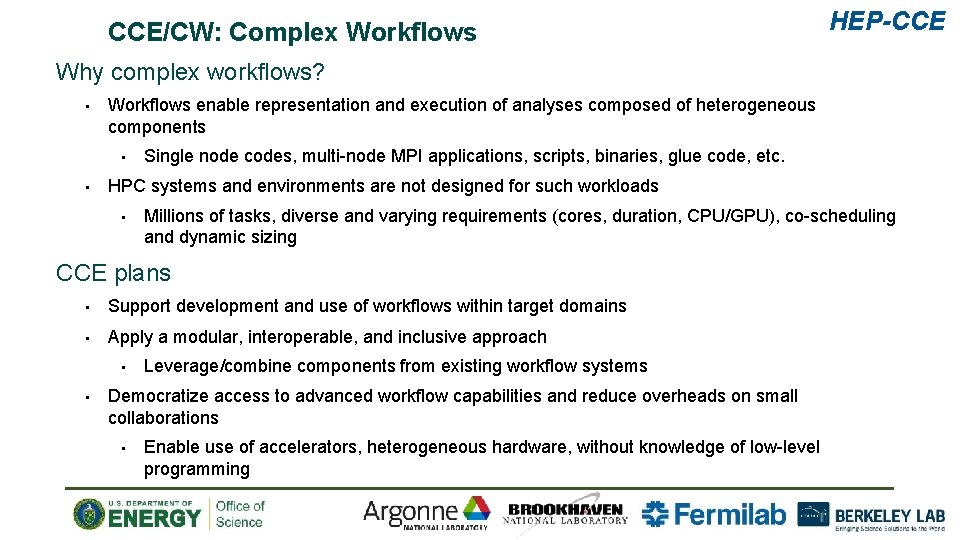
CCE/CW: Complex Workflows HEP-CCE Why complex workflows? • Workflows enable representation and execution of analyses composed of heterogeneous components • • Single node codes, multi-node MPI applications, scripts, binaries, glue code, etc. HPC systems and environments are not designed for such workloads • Millions of tasks, diverse and varying requirements (cores, duration, CPU/GPU), co-scheduling and dynamic sizing CCE plans • Support development and use of workflows within target domains • Apply a modular, interoperable, and inclusive approach • • Leverage/combine components from existing workflow systems Democratize access to advanced workflow capabilities and reduce overheads on small collaborations • Enable use of accelerators, heterogeneous hardware, without knowledge of low-level programming