
HEP Program and Strategic Planning and Community Process
![HEP Program and Strategic Planning and Community Process [Snowmass/P 5] Snowmass Energy Frontier Workshop](https://slidetodoc.com/presentation_image_h2/a51b4b9d185b409b3d171fc7e28ad901/image-1.jpg "HEP Program and Strategic Planning and Community Process [Snowmass/P 5] Snowmass Energy Frontier Workshop")

![Current LBNE Strategy § We are trying to follow the reconfiguration [phased] plan for](https://slidetodoc.com/presentation_image_h2/a51b4b9d185b409b3d171fc7e28ad901/image-14.jpg "Current LBNE Strategy § We are trying to follow the reconfiguration [phased] plan for")
![Major Item of Equipment (MIE) Issues § We were not able to implement [most]](https://slidetodoc.com/presentation_image_h2/a51b4b9d185b409b3d171fc7e28ad901/image-15.jpg "Major Item of Equipment (MIE) Issues § We were not able to implement [most]")
![Joint Agency Letter to the Community • Fundamentally…[planning] is a multi-step process with several](https://slidetodoc.com/presentation_image_h2/a51b4b9d185b409b3d171fc7e28ad901/image-22.jpg "Joint Agency Letter to the Community • Fundamentally…[planning] is a multi-step process with several")





- Slides: 64
HEP Program and Strategic Planning and Community Process [Snowmass/P 5] Snowmass Energy Frontier Workshop Seattle, Washington June 30 – July 3, 2013 Abid Patwa Program Manager Office of High Energy Physics Office of Science, U. S. Department of Energy
Outline § § Energy Frontier Program Status & Issues Budget and Issues Strategic Planning and Community Process Summary 2
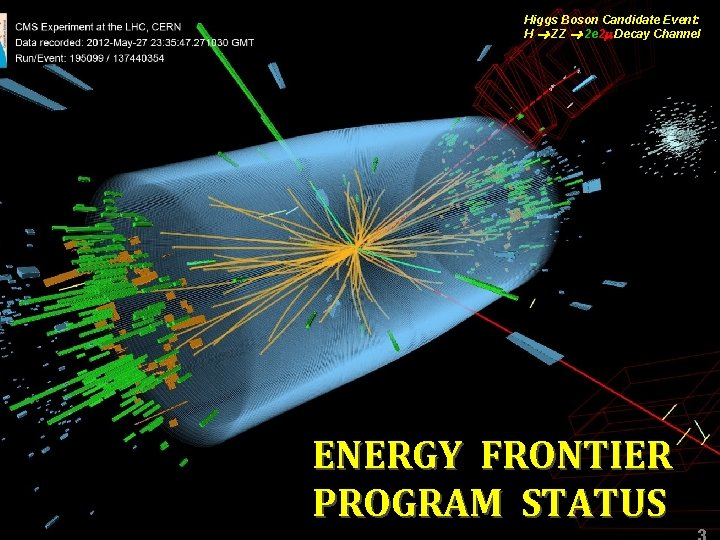
Higgs Boson Candidate Event: H ® ZZ ® 2 e 2 m Decay Channel ENERGY FRONTIER PROGRAM STATUS
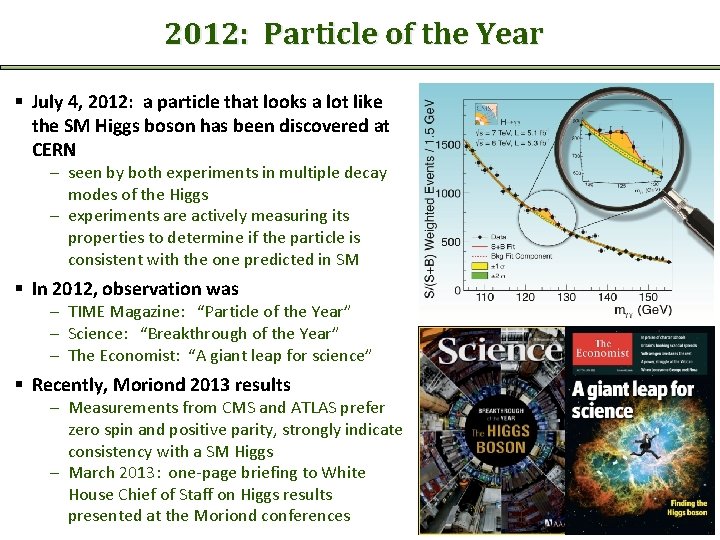
2012: Particle of the Year § July 4, 2012: a particle that looks a lot like the SM Higgs boson has been discovered at CERN – seen by both experiments in multiple decay modes of the Higgs – experiments are actively measuring its properties to determine if the particle is consistent with the one predicted in SM § In 2012, observation was – TIME Magazine: “Particle of the Year” – Science: “Breakthrough of the Year” – The Economist: “A giant leap for science” § Recently, Moriond 2013 results – Measurements from CMS and ATLAS prefer zero spin and positive parity, strongly indicate consistency with a SM Higgs – March 2013: one-page briefing to White House Chief of Staff on Higgs results presented at the Moriond conferences
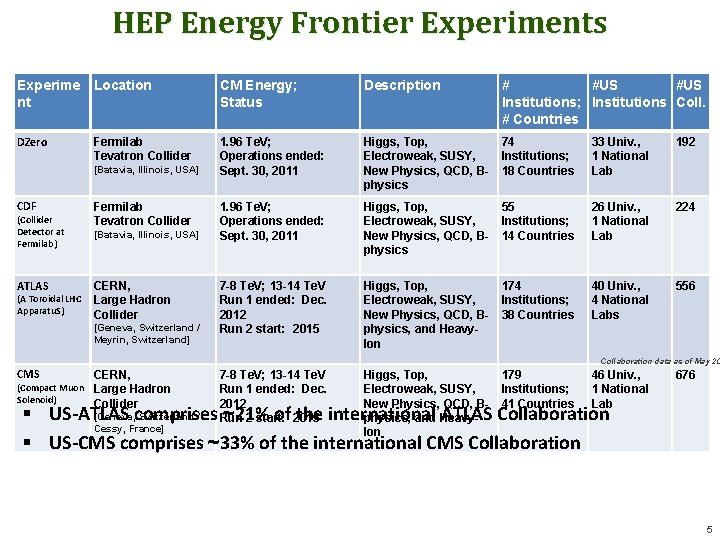
HEP Energy Frontier Experiments Experime Location nt CM Energy; Status Description # #US Institutions; Institutions Coll. # Countries DZero 1. 96 Te. V; Operations ended: Sept. 30, 2011 Higgs, Top, Electroweak, SUSY, New Physics, QCD, Bphysics 74 Institutions; 18 Countries 33 Univ. , 1 National Lab 192 1. 96 Te. V; Operations ended: Sept. 30, 2011 Higgs, Top, Electroweak, SUSY, New Physics, QCD, Bphysics 55 Institutions; 14 Countries 26 Univ. , 1 National Lab 224 7 -8 Te. V; 13 -14 Te. V Run 1 ended: Dec. 2012 Run 2 start: 2015 Higgs, Top, Electroweak, SUSY, New Physics, QCD, Bphysics, and Heavy. Ion 174 Institutions; 38 Countries 40 Univ. , 4 National Labs 556 Fermilab Tevatron Collider [Batavia, Illinois, USA] CDF (Collider Detector at Fermilab) ATLAS (A Toroidal LHC Apparatu. S) Fermilab Tevatron Collider [Batavia, Illinois, USA] CERN, Large Hadron Collider [Geneva, Switzerland / Meyrin, Switzerland] Collaboration data as of May 20 CMS (Compact Muon Solenoid) CERN, Large Hadron Collider 7 -8 Te. V; 13 -14 Te. V Run 1 ended: Dec. 2012 Run 2 start: 2015 Higgs, Top, Electroweak, SUSY, New Physics, QCD, Bphysics, and Heavy. Ion 179 Institutions; 41 Countries 46 Univ. , 1 National Lab 676 [Geneva, comprises Switzerland / § US-ATLAS ~21% of the international ATLAS Collaboration Cessy, France] § US-CMS comprises ~33% of the international CMS Collaboration 5
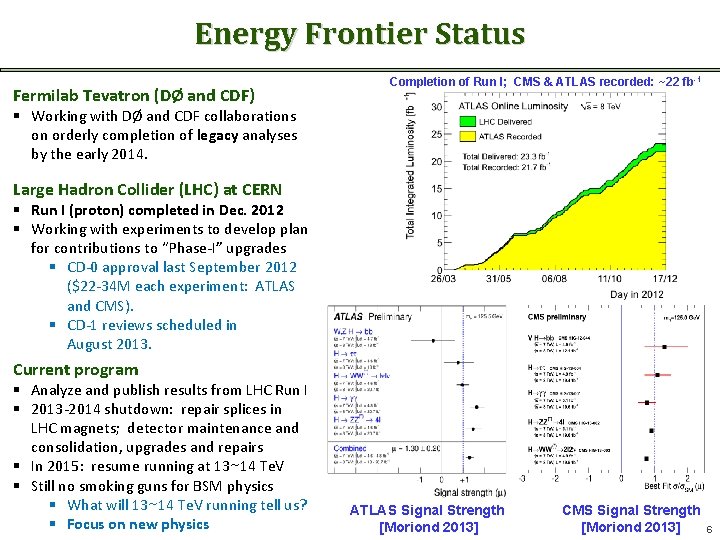
Energy Frontier Status Fermilab Tevatron (DØ and CDF) Completion of Run I; CMS & ATLAS recorded: ~22 fb-1 § Working with DØ and CDF collaborations on orderly completion of legacy analyses by the early 2014. Large Hadron Collider (LHC) at CERN § Run I (proton) completed in Dec. 2012 § Working with experiments to develop plan for contributions to “Phase-I” upgrades § CD-0 approval last September 2012 ($22 -34 M each experiment: ATLAS and CMS). § CD-1 reviews scheduled in August 2013. Current program § Analyze and publish results from LHC Run I § 2013 -2014 shutdown: repair splices in LHC magnets; detector maintenance and consolidation, upgrades and repairs § In 2015: resume running at 13~14 Te. V § Still no smoking guns for BSM physics § What will 13~14 Te. V running tell us? § Focus on new physics ATLAS Signal Strength [Moriond 2013] CMS Signal Strength [Moriond 2013] 6
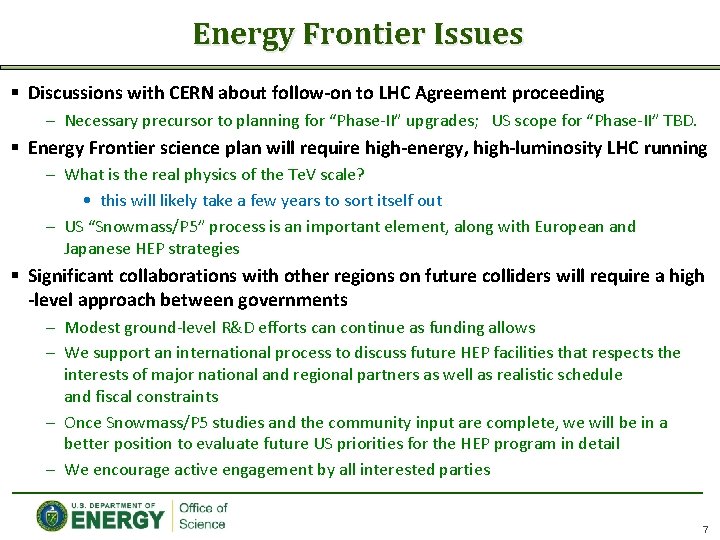
Energy Frontier Issues § Discussions with CERN about follow-on to LHC Agreement proceeding – Necessary precursor to planning for “Phase-II” upgrades; US scope for “Phase-II” TBD. § Energy Frontier science plan will require high-energy, high-luminosity LHC running – What is the real physics of the Te. V scale? • this will likely take a few years to sort itself out – US “Snowmass/P 5” process is an important element, along with European and Japanese HEP strategies § Significant collaborations with other regions on future colliders will require a high -level approach between governments – Modest ground-level R&D efforts can continue as funding allows – We support an international process to discuss future HEP facilities that respects the interests of major national and regional partners as well as realistic schedule and fiscal constraints – Once Snowmass/P 5 studies and the community input are complete, we will be in a better position to evaluate future US priorities for the HEP program in detail – We encourage active engagement by all interested parties 7
HEP BUDGET
HEP Budget Overview § FY 2014 budget philosophy was to enable new world-leading HEP capabilities in the U. S. through investments on all three frontiers – Accomplished through ramp-down of existing Projects and Research – When we were not able to fully implement this approach, converted planned project funds to R&D: Research Projects Research – Therefore the FY 14 Request shows increases for Research that are driven by this R&D “bump”, while Construction/MIE funding is only slightly increased – Details in following slides § Impact of these actions: – Several new efforts are delayed: • LHC detector upgrades, LBNE, 2 nd Generation Dark Matter detectors – US leadership/partnership capabilities will be challenged by others – Workforce reductions at universities and labs § Key areas in FY 2014 Request – Maintaining forward progress on new projects via Construction and Research funding lines 9
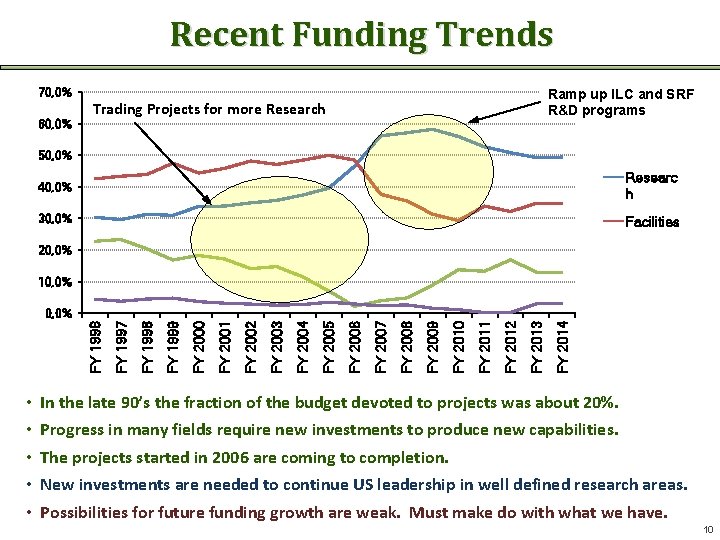
Recent Funding Trends 70, 0% 60, 0% Ramp up ILC and SRF R&D programs Trading Projects for more Research 50, 0% 40, 0% Researc h 30, 0% Facilities 20, 0% 10, 0% • • • FY 2014 FY 2013 FY 2012 FY 2011 FY 2010 FY 2009 FY 2008 FY 2007 FY 2006 FY 2005 FY 2004 FY 2003 FY 2002 FY 2001 FY 2000 FY 1999 FY 1998 FY 1997 FY 1996 0, 0% In the late 90’s the fraction of the budget devoted to projects was about 20%. Progress in many fields require new investments to produce new capabilities. The projects started in 2006 are coming to completion. New investments are needed to continue US leadership in well defined research areas. Possibilities for future funding growth are weak. Must make do with what we have. 10
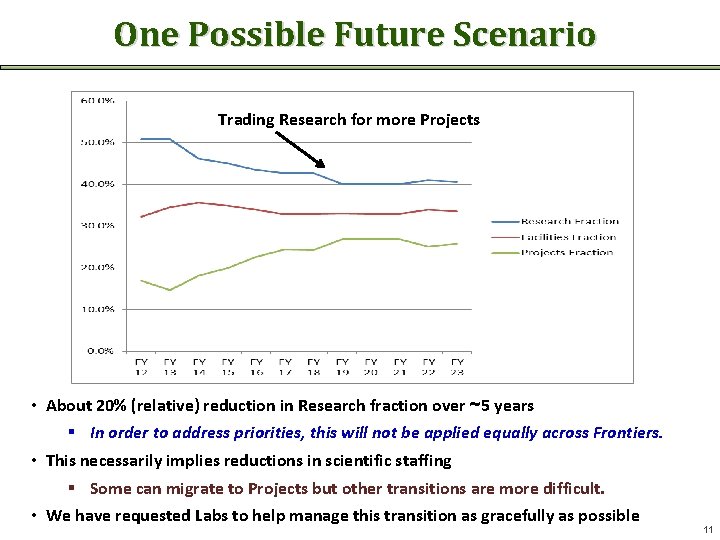
One Possible Future Scenario Trading Research for more Projects • About 20% (relative) reduction in Research fraction over ~5 years § In order to address priorities, this will not be applied equally across Frontiers. • This necessarily implies reductions in scientific staffing § Some can migrate to Projects but other transitions are more difficult. • We have requested Labs to help manage this transition as gracefully as possible 11
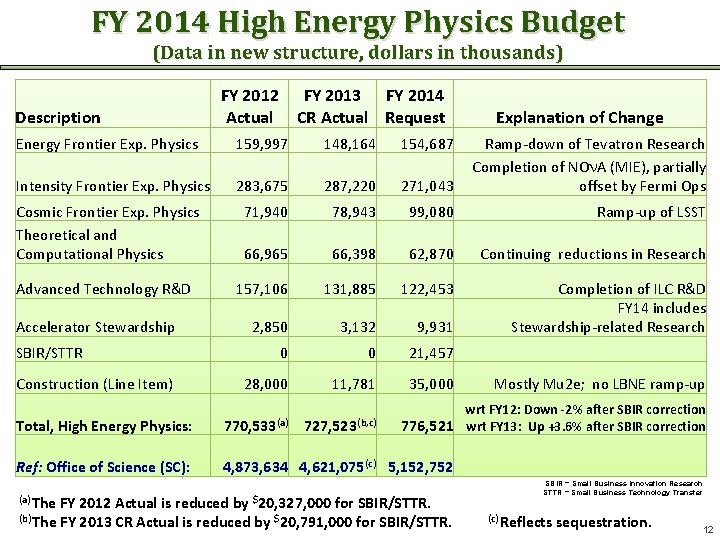
FY 2014 High Energy Physics Budget (Data in new structure, dollars in thousands) Description FY 2012 Actual FY 2013 FY 2014 CR Actual Request Explanation of Change Energy Frontier Exp. Physics 159, 997 148, 164 154, 687 Intensity Frontier Exp. Physics 283, 675 287, 220 271, 043 Ramp-down of Tevatron Research Completion of NOn. A (MIE), partially offset by Fermi Ops Cosmic Frontier Exp. Physics Theoretical and Computational Physics 71, 940 78, 943 99, 080 Ramp-up of LSST 66, 965 66, 398 62, 870 Continuing reductions in Research Advanced Technology R&D 157, 106 131, 885 122, 453 2, 850 3, 132 9, 931 Completion of ILC R&D FY 14 includes Stewardship-related Research 0 0 21, 457 28, 000 11, 781 35, 000 Total, High Energy Physics: 770, 533 (a) 727, 523 (b, c) Ref: Office of Science (SC): 4, 873, 634 4, 621, 075 (c) 5, 152, 752 Accelerator Stewardship SBIR/STTR Construction (Line Item) (a) The Mostly Mu 2 e; no LBNE ramp-up wrt FY 12: Down -2% after SBIR correction 776, 521 wrt FY 13: Up +3. 6% after SBIR correction FY 2012 Actual is reduced by $20, 327, 000 for SBIR/STTR. (b) The FY 2013 CR Actual is reduced by $20, 791, 000 for SBIR/STTR. SBIR = Small Business Innovation Research STTR = Small Business Technology Transfer (c) Reflects sequestration. 12
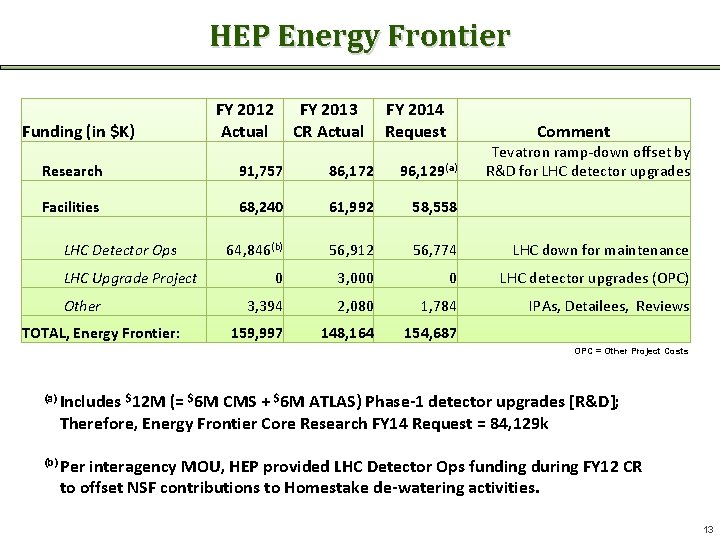
HEP Energy Frontier Funding (in $K) FY 2012 Actual FY 2013 CR Actual FY 2014 Request Comment Tevatron ramp-down offset by R&D for LHC detector upgrades Research 91, 757 86, 172 96, 129 (a) Facilities 68, 240 61, 992 58, 558 64, 846 (b) 56, 912 56, 774 LHC down for maintenance 0 3, 000 0 LHC detector upgrades (OPC) 3, 394 2, 080 1, 784 IPAs, Detailees, Reviews 159, 997 148, 164 154, 687 LHC Detector Ops LHC Upgrade Project Other TOTAL, Energy Frontier: OPC = Other Project Costs (a) Includes $12 M (= $6 M CMS + $6 M ATLAS) Phase-1 detector upgrades [R&D]; Therefore, Energy Frontier Core Research FY 14 Request = 84, 129 k (b) Per interagency MOU, HEP provided LHC Detector Ops funding during FY 12 CR to offset NSF contributions to Homestake de-watering activities. 13
Current LBNE Strategy § We are trying to follow the reconfiguration [phased] plan for LBNE, though it has hit some snags – Out-year budgets are challenging – Some members of the community objected that the phased LBNE was not what P 5 (or they) had in mind § The plan, as it currently stands: – Use time before baselining to recruit partners (international and domestic) that expand scope and science reach – Working to get more of the community on board § It seems clear this is necessary. Will it also be sufficient? – Need to get agreement on what is required for success 14
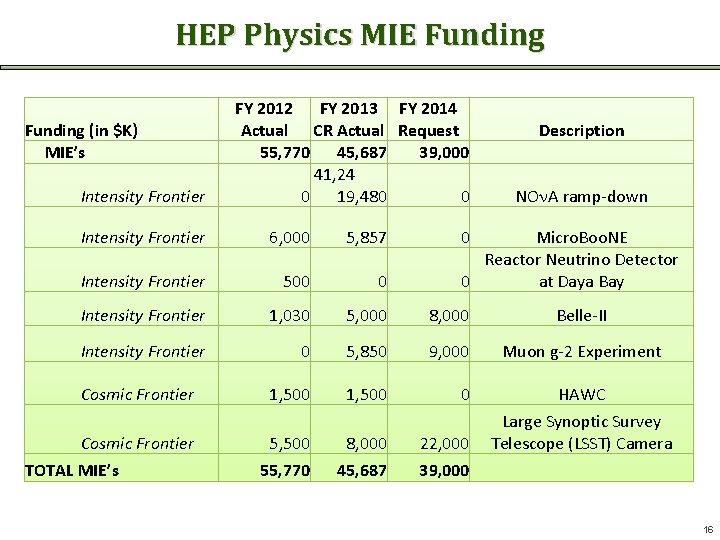
Major Item of Equipment (MIE) Issues § We were not able to implement [most] new MIE starts in the FY 14 request – Muon g-2 experiment is the only new start in HEP Brookhaven National Laboratory Muon g-2 Ring: On Barge, Departing Southern Long Island June 25, 2013 § This upsets at least 2 major features of our budget strategy: – Strategic plan: “Trading Research for Projects” – Implementation of facilities balanced across Frontiers 15
HEP Physics MIE Funding (in $K) MIE’s Intensity Frontier FY 2012 FY 2013 FY 2014 Actual CR Actual Request 55, 770 45, 687 39, 000 41, 24 0 19, 480 0 Description NOn. A ramp-down Intensity Frontier 6, 000 5, 857 Intensity Frontier 500 0 Intensity Frontier 1, 030 5, 000 8, 000 Belle-II Intensity Frontier 0 5, 850 9, 000 Muon g-2 Experiment 1, 500 0 Cosmic Frontier TOTAL MIE’s 0 Micro. Boo. NE Reactor Neutrino Detector 0 at Daya Bay 5, 500 8, 000 22, 000 55, 770 45, 687 39, 000 HAWC Large Synoptic Survey Telescope (LSST) Camera 16
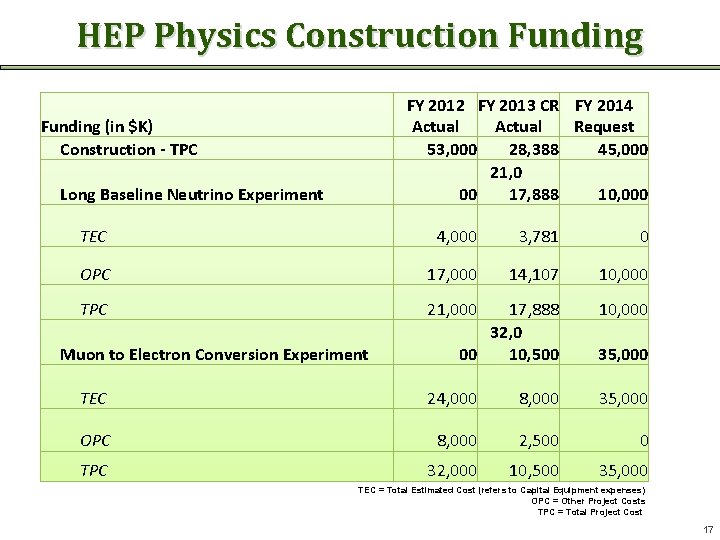
HEP Physics Construction Funding FY 2012 FY 2013 CR FY 2014 Actual Request 53, 000 28, 388 45, 000 21, 0 00 17, 888 10, 000 Funding (in $K) Construction - TPC Long Baseline Neutrino Experiment TEC 4, 000 3, 781 0 OPC 17, 000 14, 107 10, 000 TPC 21, 000 17, 888 32, 0 00 10, 500 10, 000 Muon to Electron Conversion Experiment 35, 000 TEC 24, 000 8, 000 35, 000 OPC 8, 000 2, 500 0 TPC 32, 000 10, 500 35, 000 TEC = Total Estimated Cost (refers to Capital Equipment expenses) OPC = Other Project Costs TPC = Total Project Cost 17
http: //xkcd. com/1116/ STRATEGIC PLANNING AND COMMUNITY PROCESS
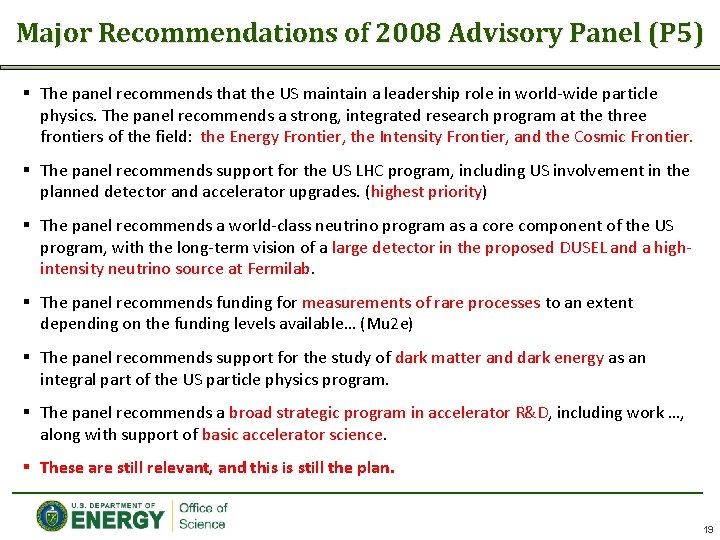
Major Recommendations of 2008 Advisory Panel (P 5) § The panel recommends that the US maintain a leadership role in world-wide particle physics. The panel recommends a strong, integrated research program at the three frontiers of the field: the Energy Frontier, the Intensity Frontier, and the Cosmic Frontier. § The panel recommends support for the US LHC program, including US involvement in the planned detector and accelerator upgrades. (highest priority) § The panel recommends a world-class neutrino program as a core component of the US program, with the long-term vision of a large detector in the proposed DUSEL and a highintensity neutrino source at Fermilab. § The panel recommends funding for measurements of rare processes to an extent depending on the funding levels available… (Mu 2 e) § The panel recommends support for the study of dark matter and dark energy as an integral part of the US particle physics program. § The panel recommends a broad strategic program in accelerator R&D, including work …, along with support of basic accelerator science. § These are still relevant, and this is still the plan. 19
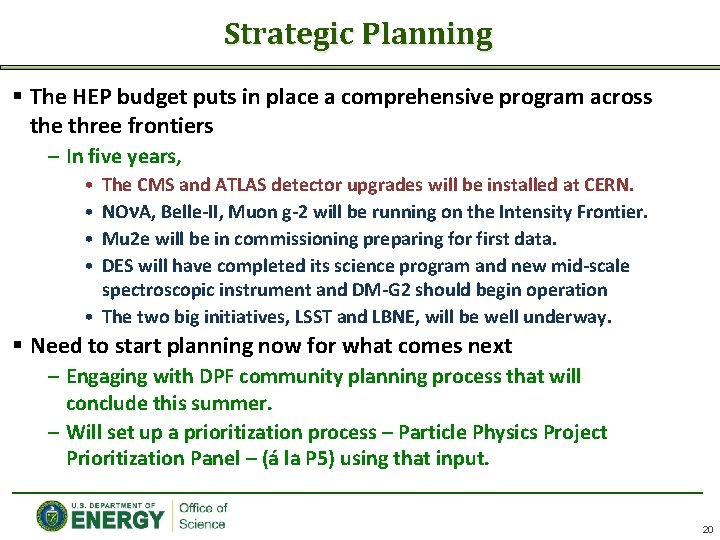
Strategic Planning § The HEP budget puts in place a comprehensive program across the three frontiers – In five years, • • The CMS and ATLAS detector upgrades will be installed at CERN. NOn. A, Belle-II, Muon g-2 will be running on the Intensity Frontier. Mu 2 e will be in commissioning preparing for first data. DES will have completed its science program and new mid-scale spectroscopic instrument and DM-G 2 should begin operation • The two big initiatives, LSST and LBNE, will be well underway. § Need to start planning now for what comes next – Engaging with DPF community planning process that will conclude this summer. – Will set up a prioritization process – Particle Physics Project Prioritization Panel – (á la P 5) using that input. 20
Customized Implementation Strategies § Energy Frontier – US has a leading role in LHC physics collaborations but is not the driver • The issue is the scope and scale of US involvement. Requires US-CERN negotiation • Could also be true for Japanese-hosted ILC § Intensity Frontier – US is the world leader and needs new facilities and/or upgrades of existing facilities to maintain its position • Has the potential to attract new partners to US-led projects • Portfolio of experiments and science case is diverse. This complicates the case. The scale of the projected investments is a big challenge § Cosmic Frontier – US HEP has a leading role in a competitive, multidisciplinary environment • HEP component of the physics case is simple and compelling. Only question is how far one needs to go in precision/setting limits on, e. g. , dark matter. • DOE is a technology enabler, not a facilities provider (see NSF, NASA) – Analogous to LHC but the HEP physics goals are not those of the facility owners • DOE supports particle physics goals and HEP-style collaborations – Astronomy and astrophysics is not in our mission nor our modus operandi 21
Joint Agency Letter to the Community • Fundamentally…[planning] is a multi-step process with several important milestones over the coming year, and each step will inform and prepare for the next. 1. HEP Facilities Subpanel: Advise DOE/SC mgmt. on the scientific impact and technical maturity of planned and proposed SC Facilities, in order to develop a coherent 10 -yr SC facilities plan • Subpanel can add or subtract from initial facilities list • Does not exclude/pre-empt later additions 2. DPF/CSS 2013 “Snowmass”: community identifies compelling HEP science opportunities over an approximately 20 -year time frame. • Not a prioritization but can make scientific judgments 3. HEPAP/P 5: Advises agencies on new strategic plan and priorities for US HEP in various funding scenarios, using input from #1 and #2 above (among others) 22
Snowmass / P 5 Interface What we hope to see from Snowmass: – What are the most compelling science questions in HEP that can be addressed in the next 10 to 20 years and why? – What are the primary experimental approaches that can be used to address them? Are they likely to answer the question(s) in a “definitive” manner or will follow-on experiments be needed? – What are the “hard questions” (science, technical, cost…) that a given experiment or facility needs to answer to respond to perceived limitations in its proposal? These topics should be covered in the Snowmass Reports and White Papers. P 5 will use these reports and white papers as its starting point. – We expect to have the P 5 panel selected and a formal charge issued by the time of the September HEPAP meeting 23
Goals for the P 5 Process DOE/NSF met in early May to kickoff P 5 process and agree on goals: § The P 5 process takes the science vision of the community and turns it into plan that is feasible and executable over a 10 -20 year timescale § HEP MUST have a planning and prioritization process that the community can stand behind and support once the P 5 report is complete. § We also need a process that repeats at more less regular intervals (5 years? ) – We also want to allow for less comprehensive updates and modest course corrections to the plan along the way (á la P 5 updates in 2009, 2010) § Key elements envisioned for the P 5 process: – Revisit the questions we use to describe the field • e. g. , Quantum Universe, updated and corrected – Decide on the project priorities within budget guidance • in detail for the next 10 years, in broad outline beyond that – Propose the best way to describe the value of HEP research to society – Build on the investment in Snowmass process and outcomes 24
What P 5 Is (and is Not) P 5 will prioritize HEP projects over a 10 -20 year timeframe within reasonable budget assumptions and position the U. S. to a be a leader in some (but not all) areas of HEP. § § § This will include an explicit discussion of the necessity (or not) of domestic HEP facilities in order to maintain such a world leadership position. Necessarily this will involve consideration of technical feasibility as well as plausible timescales and resources for future projects. There will be budget “fixed points” for projects already under construction and other prior commitments The charge to P 5 will NOT include explicit examination of § § § Agency review processes Roles, responsibilities and funding of Labs vs. Universities Relative funding of experimental HEP vs. theory vs. technology R&D 25
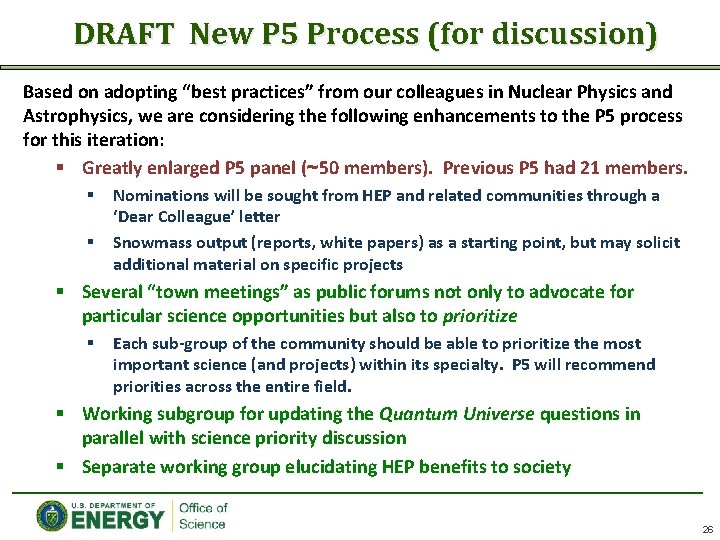
DRAFT New P 5 Process (for discussion) Based on adopting “best practices” from our colleagues in Nuclear Physics and Astrophysics, we are considering the following enhancements to the P 5 process for this iteration: § Greatly enlarged P 5 panel (~50 members). Previous P 5 had 21 members. § § Nominations will be sought from HEP and related communities through a ‘Dear Colleague’ letter Snowmass output (reports, white papers) as a starting point, but may solicit additional material on specific projects § Several “town meetings” as public forums not only to advocate for particular science opportunities but also to prioritize § Each sub-group of the community should be able to prioritize the most important science (and projects) within its specialty. P 5 will recommend priorities across the entire field. § Working subgroup for updating the Quantum Universe questions in parallel with science priority discussion § Separate working group elucidating HEP benefits to society 26
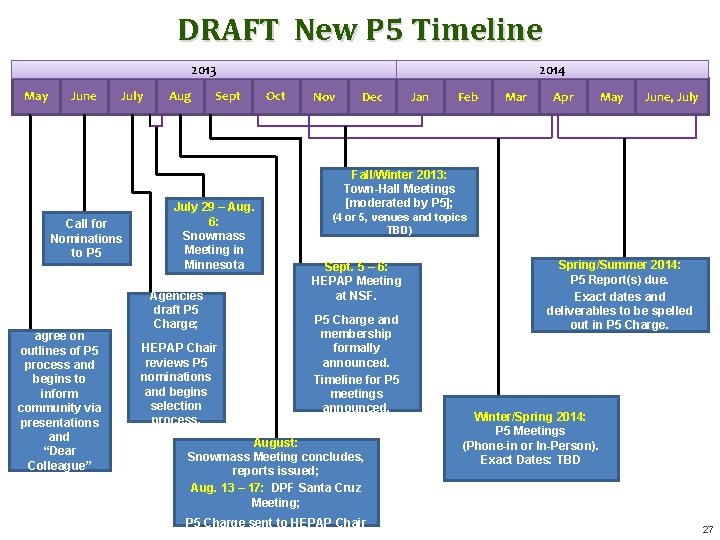
DRAFT New P 5 Timeline 2013 May June July Call for Nominations to P 5 DOE/NSF agree on outlines of P 5 process and begins to inform community via presentations and “Dear Colleague” Letter. Aug Sept July 29 – Aug. 6: Snowmass Meeting in Minnesota Agencies draft P 5 Charge; HEPAP Chair reviews P 5 nominations and begins selection process. 2014 Oct Nov Dec Jan Feb Mar Apr May June, July Fall/Winter 2013: Town-Hall Meetings [moderated by P 5]; (4 or 5, venues and topics TBD) Sept. 5 – 6: HEPAP Meeting at NSF. P 5 Charge and membership formally announced. Timeline for P 5 meetings announced. August: Snowmass Meeting concludes, reports issued; Aug. 13 – 17: DPF Santa Cruz Meeting; P 5 Charge sent to HEPAP Chair Spring/Summer 2014: P 5 Report(s) due. Exact dates and deliverables to be spelled out in P 5 Charge. Winter/Spring 2014: P 5 Meetings (Phone-in or In-Person). Exact Dates: TBD 27
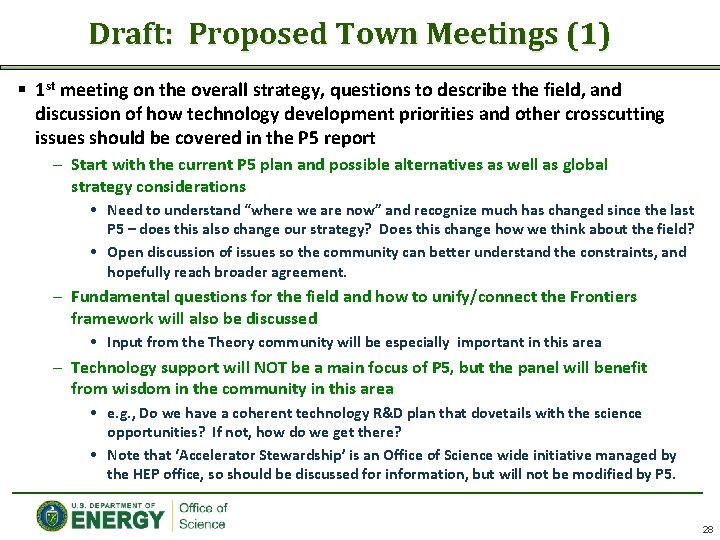
Draft: Proposed Town Meetings (1) § 1 st meeting on the overall strategy, questions to describe the field, and discussion of how technology development priorities and other crosscutting issues should be covered in the P 5 report – Start with the current P 5 plan and possible alternatives as well as global strategy considerations • Need to understand “where we are now” and recognize much has changed since the last P 5 – does this also change our strategy? Does this change how we think about the field? • Open discussion of issues so the community can better understand the constraints, and hopefully reach broader agreement. – Fundamental questions for the field and how to unify/connect the Frontiers framework will also be discussed • Input from the Theory community will be especially important in this area – Technology support will NOT be a main focus of P 5, but the panel will benefit from wisdom in the community in this area • e. g. , Do we have a coherent technology R&D plan that dovetails with the science opportunities? If not, how do we get there? • Note that ‘Accelerator Stewardship’ is an Office of Science wide initiative managed by the HEP office, so should be discussed for information, but will not be modified by P 5. 28
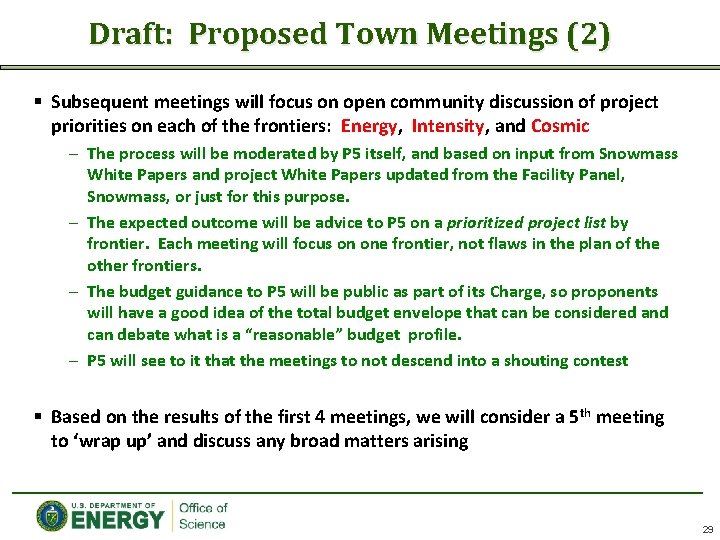
Draft: Proposed Town Meetings (2) § Subsequent meetings will focus on open community discussion of project priorities on each of the frontiers: Energy, Intensity, and Cosmic – The process will be moderated by P 5 itself, and based on input from Snowmass White Papers and project White Papers updated from the Facility Panel, Snowmass, or just for this purpose. – The expected outcome will be advice to P 5 on a prioritized project list by frontier. Each meeting will focus on one frontier, not flaws in the plan of the other frontiers. – The budget guidance to P 5 will be public as part of its Charge, so proponents will have a good idea of the total budget envelope that can be considered and can debate what is a “reasonable” budget profile. – P 5 will see to it that the meetings to not descend into a shouting contest § Based on the results of the first 4 meetings, we will consider a 5 th meeting to ‘wrap up’ and discuss any broad matters arising 29
Next Steps on Snowmass / P 5 § Agencies welcome input from the community on the shape of the P 5 process § We have until the end of Snowmass to modify our P 5 plans – the agencies continue to give a series of talks at the Snowmass meetings to solicit further input – information on Snowmass/P 5 process is also available from DOE OHEP webpage § Agencies will begin to draft P 5 charge § The agencies expect that our community is capable of professional behavior, and look forward to vigorous and open discussions of our challenges and opportunities – encourage active engagement from the entire HEP community in the full process including those from the US that are resident at experiments offshore (e. g. , at CERN) 30
SUMMARY
HEP Program Planning – Energy Frontier Issues and questions we will need to deal with when laying out longer term plans – and to be able to execute & defend the program § Continue to sharpen the science case: What is the physics motivation for the Phase-2 LHC detector upgrades? How best do we exploit the physics opportunities for high luminosity LHC running? What is the physics motivation for future lepton colliders? Do we need more results from the LHC experiments in order to make the case for future machines? § How far do we need to go in precision measurements and/or setting limits in each respective area of physics research with the current machines? § What computational resources are needed for future participation in large-scale projects and operations such as the LHC and ILC? § How do we maintain or enhance the performance of LHC detectors in the challenging accelerator environment of high instantaneous luminosities and high pile-up? § What is the impact of participation in global projects at a time when the US is trying to advance leadership in a domestic program? Can the impact be quantified? § Need to promote case for the importance of Energy Frontier with other frontiers and overall HEP community 31
Take-Away Messages § The U. S. HEP program is following the strategic plan laid out by the previous HEPAP/P 5 studies § Though some of the boundary conditions have changed, we are still trying to implement that plan within the current constraints – FY 2014 request generally supports this, though funding constraints have led to delays in some key projects – Need to maintain progress with projects currently “on the books” – Working to attract partnerships that will extend the science impact § Actively engaged with community in developing new strategic plan § Our only hope to maintain leadership in the long-term is to out-innovate the competition, and exploit unique capabilities – Focus on areas where US can have leadership – “High-risk, high-impact” as opposed to incremental advances – Note this is not an either/or proposition, we need both with appropriate balance 32
REFERENCE SLIDES
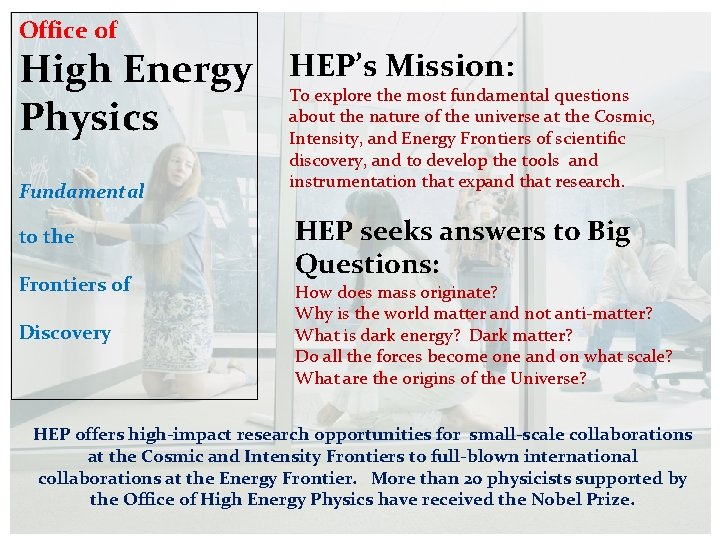
Office of High Energy Physics Fundamental to the Frontiers of Discovery HEP’s Mission: To explore the most fundamental questions about the nature of the universe at the Cosmic, Intensity, and Energy Frontiers of scientific discovery, and to develop the tools and instrumentation that expand that research. HEP seeks answers to Big Questions: How does mass originate? Why is the world matter and not anti-matter? What is dark energy? Dark matter? Do all the forces become one and on what scale? What are the origins of the Universe? HEP offers high-impact research opportunities for small-scale collaborations at the Cosmic and Intensity Frontiers to full-blown international collaborations at the Energy Frontier. More than 20 physicists supported by the Office of High Energy Physics have received the Nobel Prize.
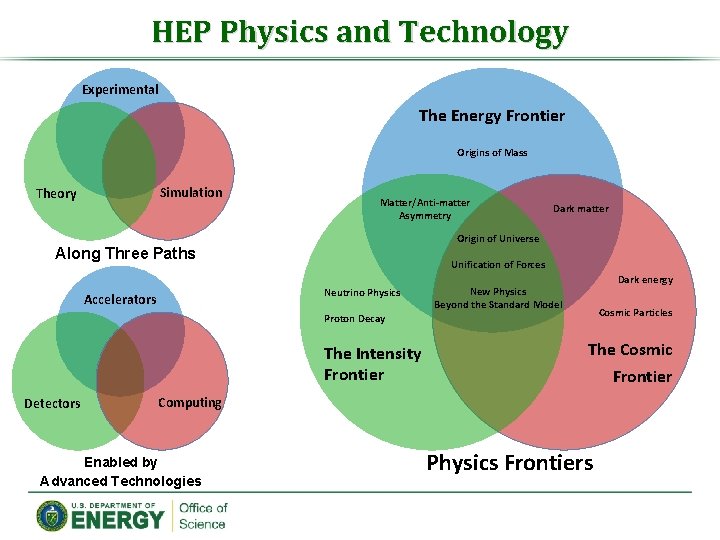
HEP Physics and Technology Experimental The Energy Frontier Origins of Mass Simulation Theory Matter/Anti-matter Asymmetry Origin of Universe Along Three Paths Unification of Forces Neutrino Physics Accelerators Dark matter Dark energy New Physics Beyond the Standard Model Cosmic Particles Proton Decay The Intensity Frontier Detectors The Cosmic Frontier Computing Enabled by Advanced Technologies Physics Frontiers
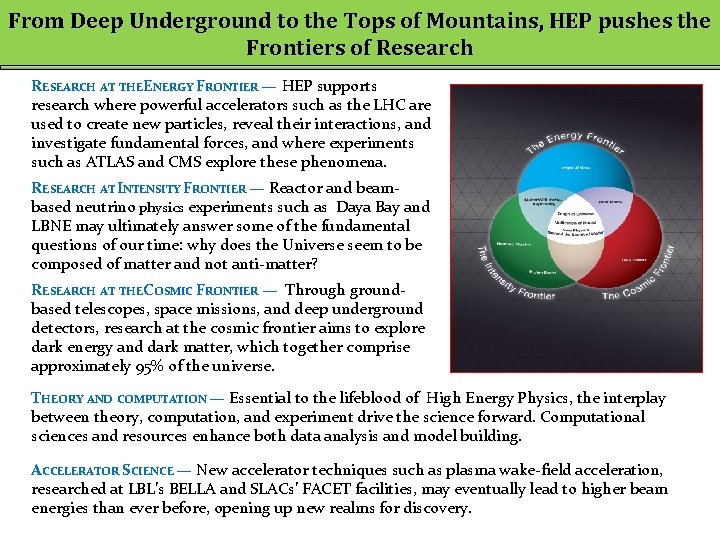
From Deep Underground to the Tops of Mountains, HEP pushes the Frontiers of Research RESEARCH AT THEENERGY FRONTIER — HEP supports research where powerful accelerators such as the LHC are used to create new particles, reveal their interactions, and investigate fundamental forces, and where experiments such as ATLAS and CMS explore these phenomena. RESEARCH AT INTENSITY FRONTIER — Reactor and beambased neutrino physics experiments such as Daya Bay and LBNE may ultimately answer some of the fundamental questions of our time: why does the Universe seem to be composed of matter and not anti-matter? RESEARCH AT THECOSMIC FRONTIER — Through groundbased telescopes, space missions, and deep underground detectors, research at the cosmic frontier aims to explore dark energy and dark matter, which together comprise approximately 95% of the universe. THEORY AND COMPUTATION — Essential to the lifeblood of High Energy Physics, the interplay between theory, computation, and experiment drive the science forward. Computational sciences and resources enhance both data analysis and model building. ACCELERATOR SCIENCE — New accelerator techniques such as plasma wake-field acceleration, researched at LBL’s BELLA and SLACs’ FACET facilities, may eventually lead to higher beam energies than ever before, opening up new realms for discovery.
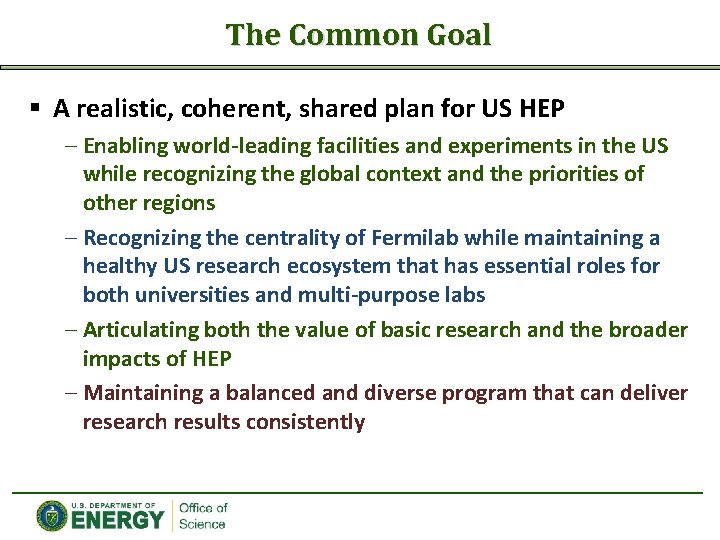
The Common Goal § A realistic, coherent, shared plan for US HEP – Enabling world-leading facilities and experiments in the US while recognizing the global context and the priorities of other regions – Recognizing the centrality of Fermilab while maintaining a healthy US research ecosystem that has essential roles for both universities and multi-purpose labs – Articulating both the value of basic research and the broader impacts of HEP – Maintaining a balanced and diverse program that can deliver research results consistently
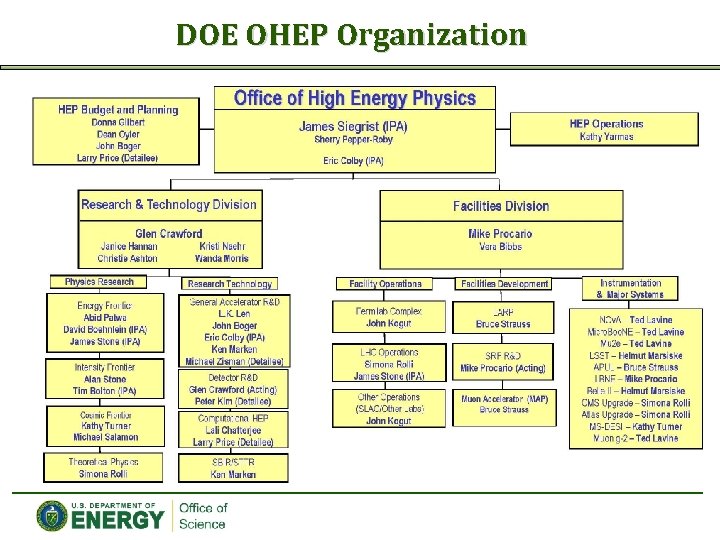
DOE OHEP Organization
ENERGY FRONTIER
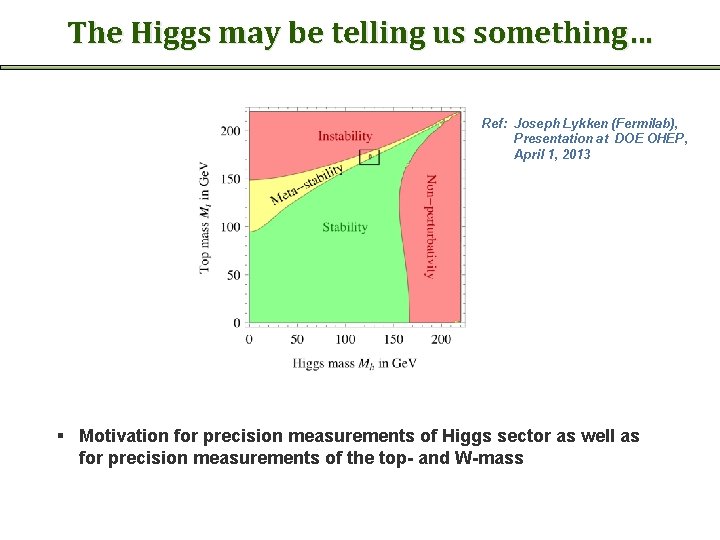
The Higgs may be telling us something… Ref: Joseph Lykken (Fermilab), Presentation at DOE OHEP, April 1, 2013 § Motivation for precision measurements of Higgs sector as well as for precision measurements of the top- and W-mass
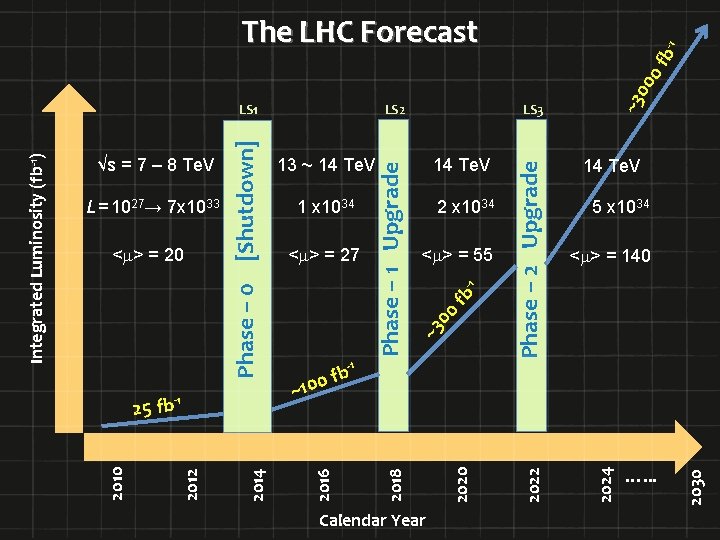
-1 1 fb 00 14 Te. V 5 x 1034 <m> = 140 Calendar Year …. . . 2030 b 00 f 2024 ~1 <m> = 55 ~3 <m> = 27 ~3 2 x 1034 Phase – 1 Upgrade 1 x 1034 LS 3 2022 2014 2012 25 fb 14 Te. V 2020 -1 13 ~ 14 Te. V 2018 <m> = 20 LS 2 2016 L = 1027→ 7 x 1033 Phase – 0 [Shutdown] √s = 7 – 8 Te. V 2010 Integrated Luminosity (fb-1) LS 1 Phase – 2 Upgrade 00 0 f b -1 The LHC Forecast
BROADER IMPACTS OF HEP
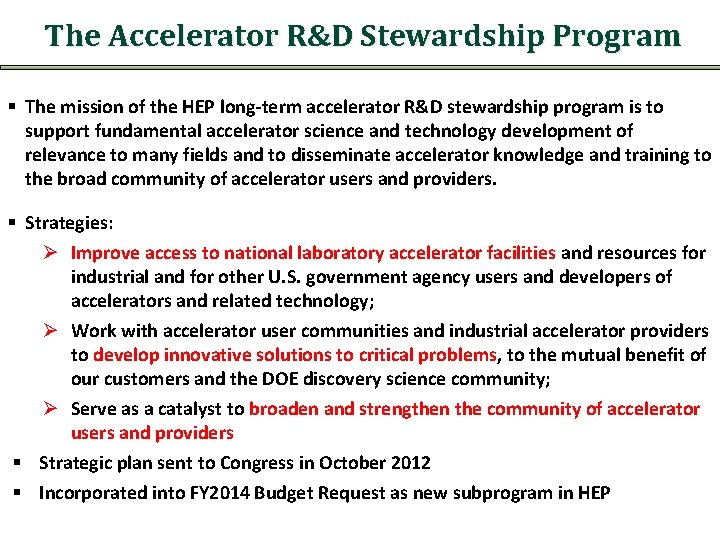
The Accelerator R&D Stewardship Program § The mission of the HEP long-term accelerator R&D stewardship program is to support fundamental accelerator science and technology development of relevance to many fields and to disseminate accelerator knowledge and training to the broad community of accelerator users and providers. § Strategies: Ø Improve access to national laboratory accelerator facilities and resources for industrial and for other U. S. government agency users and developers of accelerators and related technology; Ø Work with accelerator user communities and industrial accelerator providers to develop innovative solutions to critical problems, to the mutual benefit of our customers and the DOE discovery science community; Ø Serve as a catalyst to broaden and strengthen the community of accelerator users and providers § Strategic plan sent to Congress in October 2012 § Incorporated into FY 2014 Budget Request as new subprogram in HEP
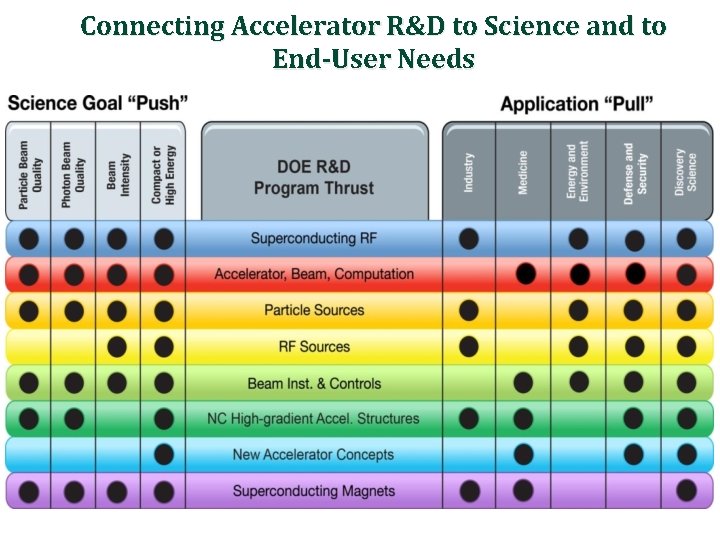
Connecting Accelerator R&D to Science and to End-User Needs
BUDGET BACKUP
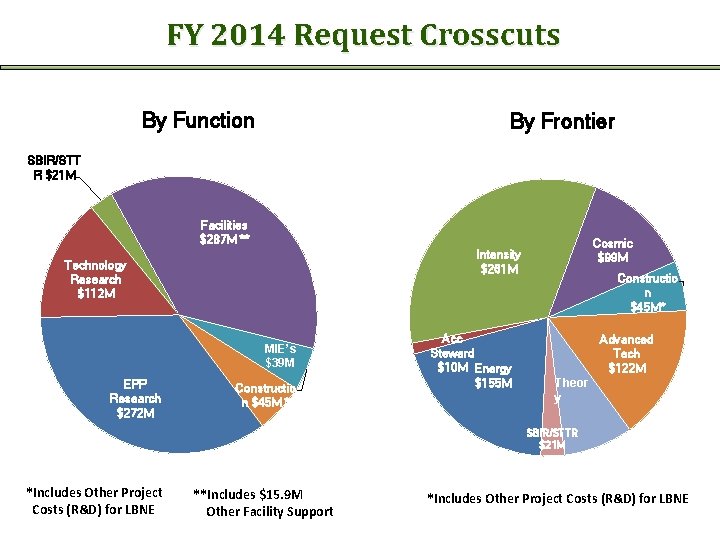
FY 2014 Request Crosscuts By Function By Frontier SBIR/STT R $21 M Facilities $287 M ** Technology Research $112 M MIE’s $39 M EPP Research $272 M Cosmic $99 M Intensity $261 M Constructio n $45 M * Acc Steward $10 M Energy $155 M Constructio n $45 M* Advanced Tech $122 M Theor y SBIR/STTR $21 M *Includes Other Project Costs (R&D) for LBNE **Includes $15. 9 M Other Facility Support *Includes Other Project Costs (R&D) for LBNE
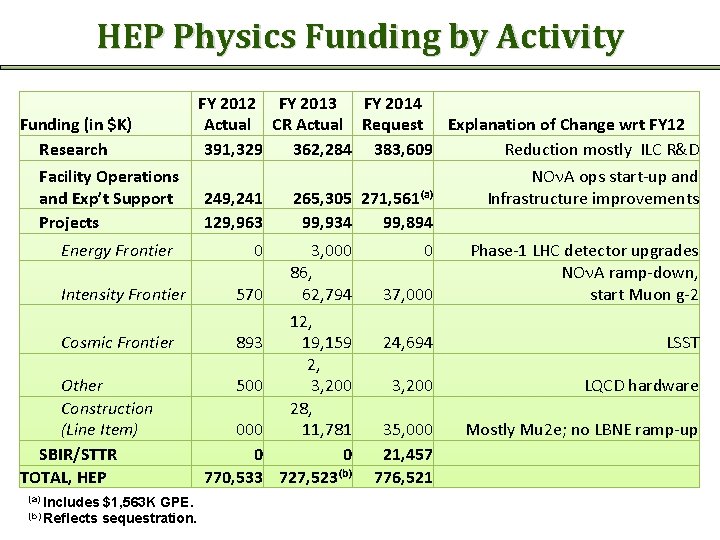
HEP Physics Funding by Activity Funding (in $K) Research Facility Operations and Exp’t Support Projects Energy Frontier FY 2012 FY 2013 FY 2014 Actual CR Actual Request Explanation of Change wrt FY 12 391, 329 362, 284 383, 609 Reduction mostly ILC R&D NOn. A ops start-up and 249, 241 265, 305 271, 561(a) Infrastructure improvements 129, 963 99, 934 99, 894 0 Intensity Frontier 570 Cosmic Frontier 893 Other Construction (Line Item) SBIR/STTR TOTAL, HEP (a) Includes (b) Reflects $1, 563 K GPE. sequestration. 500 0 770, 533 3, 000 86, 62, 794 12, 19, 159 2, 3, 200 28, 11, 781 0 727, 523(b) 0 37, 000 Phase-1 LHC detector upgrades NOn. A ramp-down, start Muon g-2 24, 694 LSST 3, 200 LQCD hardware 35, 000 21, 457 776, 521 Mostly Mu 2 e; no LBNE ramp-up
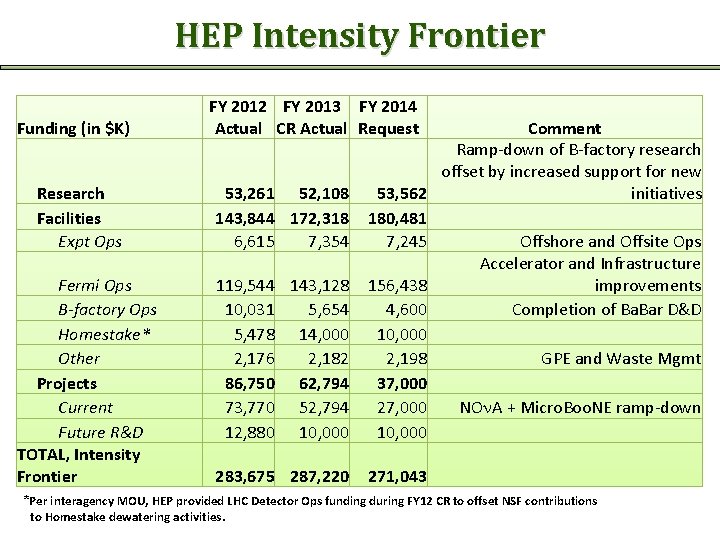
HEP Intensity Frontier Funding (in $K) Research Facilities Expt Ops Fermi Ops B-factory Ops Homestake* Other Projects Current Future R&D TOTAL, Intensity Frontier FY 2012 FY 2013 FY 2014 Actual CR Actual Request 119, 544 143, 128 10, 031 5, 654 5, 478 14, 000 2, 176 2, 182 86, 750 62, 794 73, 770 52, 794 12, 880 10, 000 Comment Ramp-down of B-factory research offset by increased support for new 53, 562 initiatives 180, 481 7, 245 Offshore and Offsite Ops Accelerator and Infrastructure 156, 438 improvements 4, 600 Completion of Ba. Bar D&D 10, 000 2, 198 GPE and Waste Mgmt 37, 000 27, 000 NOn. A + Micro. Boo. NE ramp-down 10, 000 283, 675 287, 220 271, 043 53, 261 52, 108 143, 844 172, 318 6, 615 7, 354 *Per interagency MOU, HEP provided LHC Detector Ops funding during FY 12 CR to offset NSF contributions to Homestake dewatering activities.
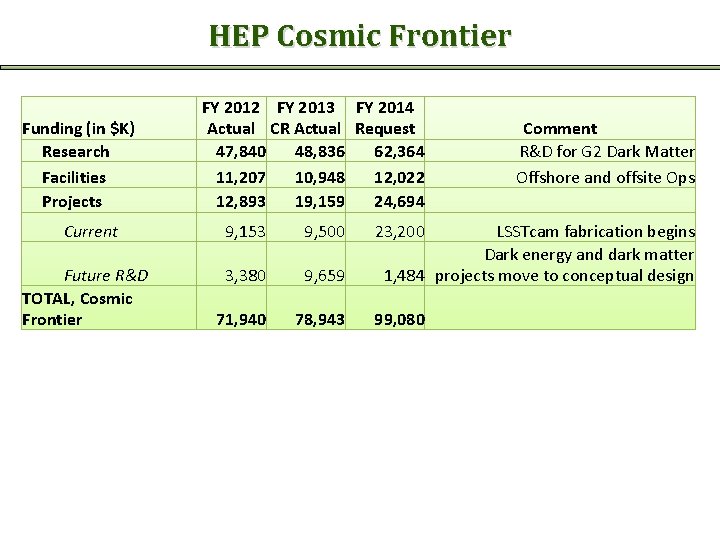
HEP Cosmic Frontier Funding (in $K) Research Facilities Projects Current Future R&D TOTAL, Cosmic Frontier FY 2012 FY 2013 FY 2014 Actual CR Actual Request 47, 840 48, 836 62, 364 11, 207 10, 948 12, 022 12, 893 19, 159 24, 694 9, 153 9, 500 3, 380 9, 659 71, 940 78, 943 23, 200 Comment R&D for G 2 Dark Matter Offshore and offsite Ops LSSTcam fabrication begins Dark energy and dark matter 1, 484 projects move to conceptual design 99, 080
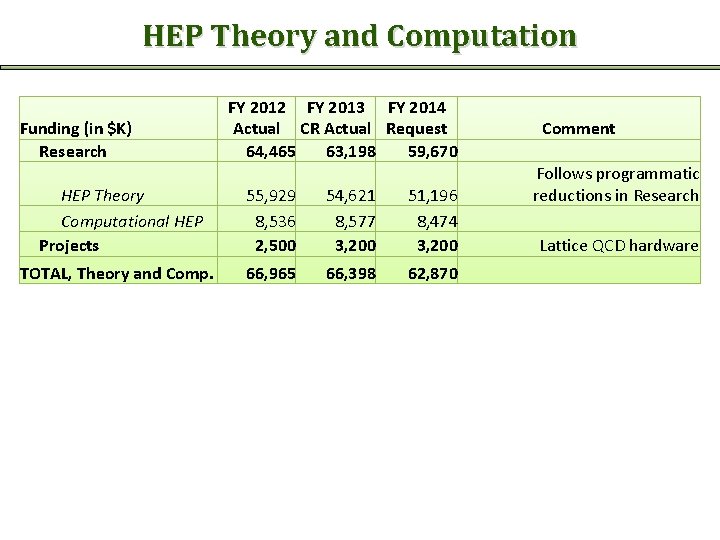
HEP Theory and Computation Funding (in $K) Research FY 2012 FY 2013 FY 2014 Actual CR Actual Request 64, 465 63, 198 59, 670 HEP Theory Computational HEP Projects 55, 929 8, 536 2, 500 54, 621 8, 577 3, 200 51, 196 8, 474 3, 200 TOTAL, Theory and Comp. 66, 965 66, 398 62, 870 Comment Follows programmatic reductions in Research Lattice QCD hardware
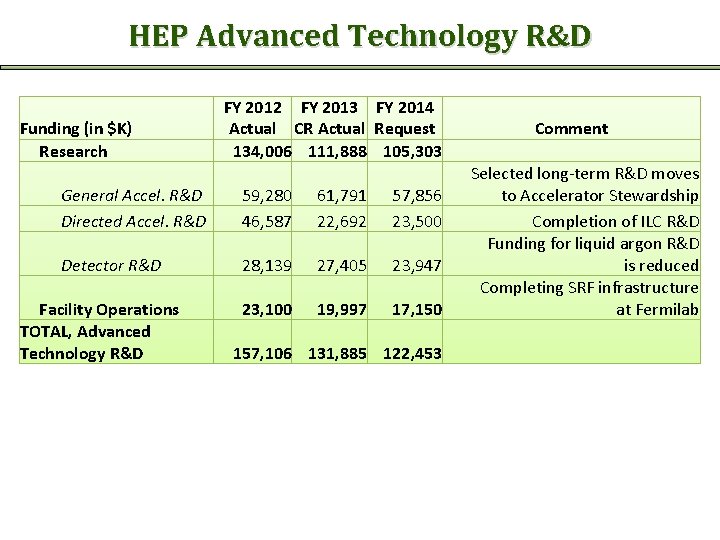
HEP Advanced Technology R&D Funding (in $K) Research FY 2012 FY 2013 FY 2014 Actual CR Actual Request 134, 006 111, 888 105, 303 General Accel. R&D Directed Accel. R&D 59, 280 46, 587 61, 791 22, 692 57, 856 23, 500 Detector R&D 28, 139 27, 405 23, 947 23, 100 19, 997 17, 150 Facility Operations TOTAL, Advanced Technology R&D 157, 106 131, 885 122, 453 Comment Selected long-term R&D moves to Accelerator Stewardship Completion of ILC R&D Funding for liquid argon R&D is reduced Completing SRF infrastructure at Fermilab
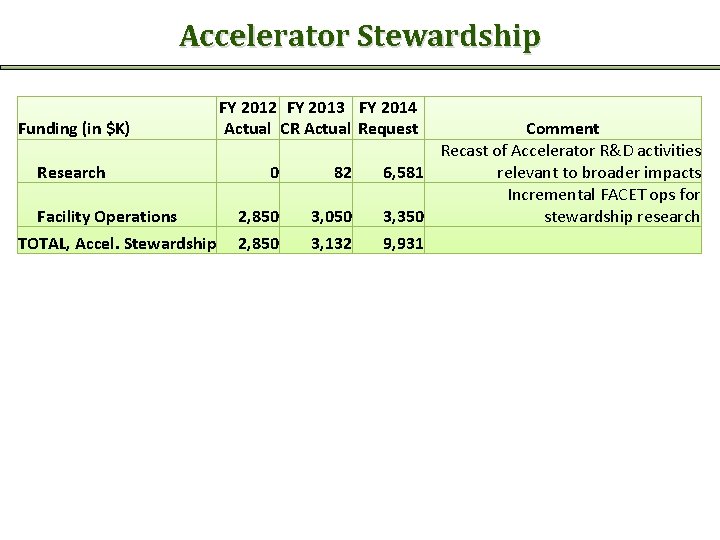
Accelerator Stewardship Funding (in $K) Research Facility Operations TOTAL, Accel. Stewardship FY 2012 FY 2013 FY 2014 Actual CR Actual Request 0 82 2, 850 3, 050 Comment Recast of Accelerator R&D activities 6, 581 relevant to broader impacts Incremental FACET ops for stewardship research 3, 350 2, 850 3, 132 9, 931
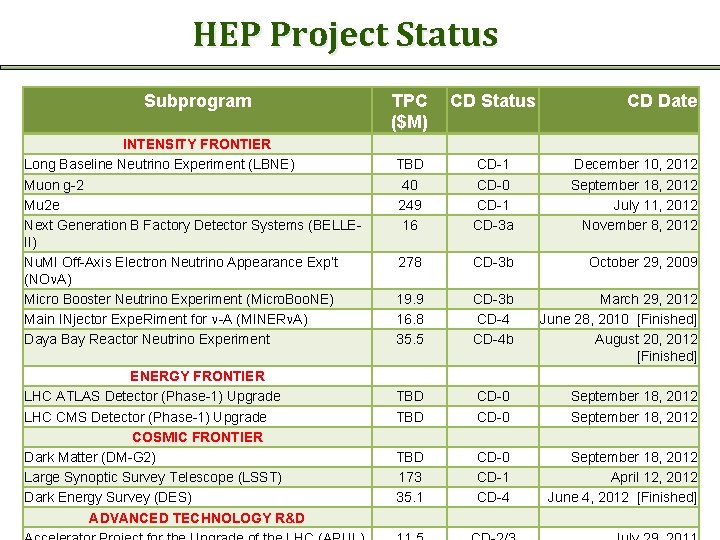
HEP Project Status Subprogram INTENSITY FRONTIER Long Baseline Neutrino Experiment (LBNE) Muon g-2 Mu 2 e Next Generation B Factory Detector Systems (BELLEII) Nu. MI Off-Axis Electron Neutrino Appearance Exp’t (NOn. A) Micro Booster Neutrino Experiment (Micro. Boo. NE) Main INjector Expe. Riment for n-A (MINERn. A) Daya Bay Reactor Neutrino Experiment ENERGY FRONTIER LHC ATLAS Detector (Phase-1) Upgrade LHC CMS Detector (Phase-1) Upgrade COSMIC FRONTIER Dark Matter (DM-G 2) Large Synoptic Survey Telescope (LSST) Dark Energy Survey (DES) ADVANCED TECHNOLOGY R&D TPC ($M) CD Status CD Date TBD 40 249 16 CD-1 CD-0 CD-1 CD-3 a December 10, 2012 September 18, 2012 July 11, 2012 November 8, 2012 278 CD-3 b October 29, 2009 19. 9 16. 8 35. 5 CD-3 b CD-4 b March 29, 2012 June 28, 2010 [Finished] August 20, 2012 [Finished] TBD CD-0 September 18, 2012 TBD 173 35. 1 CD-0 CD-1 CD-4 September 18, 2012 April 12, 2012 June 4, 2012 [Finished]
NEUTRINO BACKUP
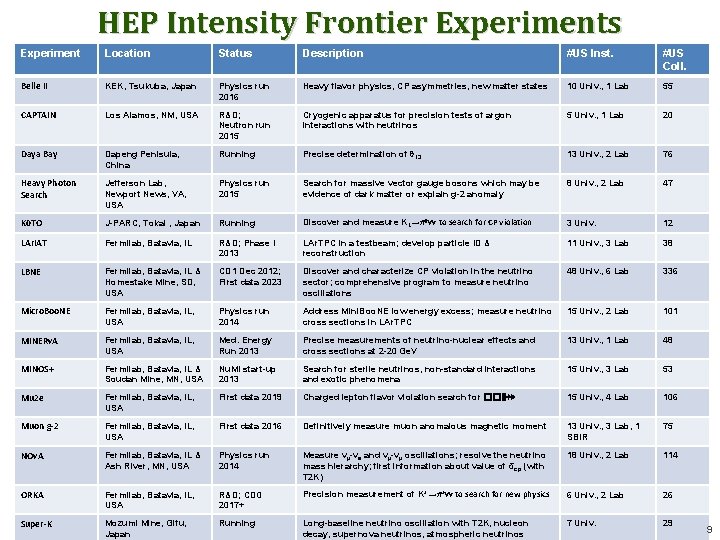
HEP Intensity Frontier Experiments Experiment Location Status Description #US Inst. #US Coll. Belle II KEK, Tsukuba, Japan Physics run 2016 Heavy flavor physics, CP asymmetries, new matter states 10 Univ. , 1 Lab 55 CAPTAIN Los Alamos, NM, USA R&D; Neutron run 2015 Cryogenic apparatus for precision tests of argon interactions with neutrinos 5 Univ. , 1 Lab 20 Daya Bay Dapeng Penisula, China Running Precise determination of θ 13 13 Univ. , 2 Lab 76 Heavy Photon Search Jefferson Lab, Newport News, VA, USA Physics run 2015 Search for massive vector gauge bosons which may be evidence of dark matter or explain g-2 anomaly 8 Univ. , 2 Lab 47 K 0 TO J-PARC, Tokai , Japan Running Discover and measure KL→π0νν to search for CP violation 3 Univ. 12 LAr. IAT Fermilab, Batavia, IL R&D; Phase I 2013 LAr. TPC in a testbeam; develop particle ID & reconstruction 11 Univ. , 3 Lab 38 LBNE Fermilab, Batavia, IL & Homestake Mine, SD, USA CD 1 Dec 2012; First data 2023 Discover and characterize CP violation in the neutrino sector; comprehensive program to measure neutrino oscillations 48 Univ. , 6 Lab 336 Micro. Boo. NE Fermilab, Batavia, IL, USA Physics run 2014 Address Mini. Boo. NE low energy excess; measure neutrino cross sections in LAr. TPC 15 Univ. , 2 Lab 101 MINERνA Fermilab, Batavia, IL, USA Med. Energy Run 2013 Precise measurements of neutrino-nuclear effects and cross sections at 2 -20 Ge. V 13 Univ. , 1 Lab 48 MINOS+ Fermilab, Batavia, IL & Soudan Mine, MN, USA Nu. MI start-up 2013 Search for sterile neutrinos, non-standard interactions and exotic phenomena 15 Univ. , 3 Lab 53 Mu 2 e Fermilab, Batavia, IL, USA First data 2019 Charged lepton flavor violation search for ��N→ e. N 15 Univ. , 4 Lab 106 Muon g-2 Fermilab, Batavia, IL, USA First data 2016 Definitively measure muon anomalous magnetic moment 13 Univ. , 3 Lab, 1 SBIR 75 NOνA Fermilab, Batavia, IL & Ash River, MN, USA Physics run 2014 Measure νμ-νe and νμ-νμ oscillations; resolve the neutrino mass hierarchy; first information about value of δcp (with T 2 K) 18 Univ. , 2 Lab 114 ORKA Fermilab, Batavia, IL, USA R&D; CD 0 2017+ Precision measurement of K+→π+νν to search for new physics 6 Univ. , 2 Lab 26 Super-K Mozumi Mine, Gifu, Japan Running Long-baseline neutrino oscillation with T 2 K, nucleon decay, supernova neutrinos, atmospheric neutrinos 7 Univ. 29 9
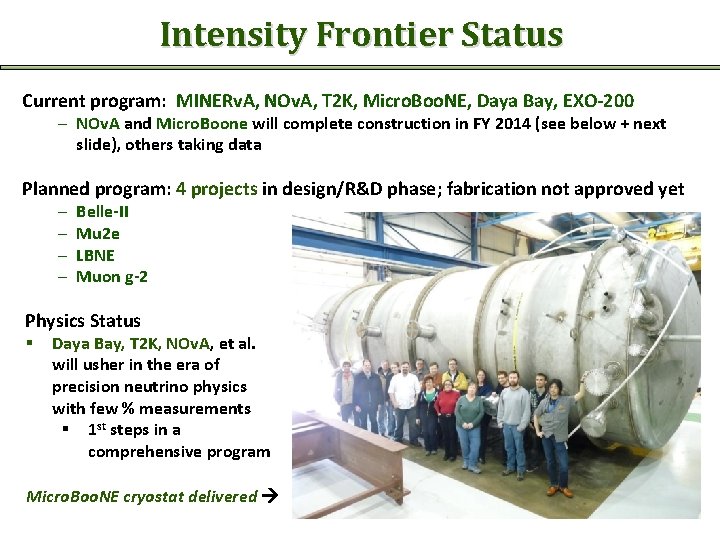
Intensity Frontier Status Current program: MINERv. A, NOv. A, T 2 K, Micro. Boo. NE, Daya Bay, EXO-200 – NOv. A and Micro. Boone will complete construction in FY 2014 (see below + next slide), others taking data Planned program: 4 projects in design/R&D phase; fabrication not approved yet – – Belle-II Mu 2 e LBNE Muon g-2 Physics Status § Daya Bay, T 2 K, NOv. A, et al. will usher in the era of precision neutrino physics with few % measurements § 1 st steps in a comprehensive program Micro. Boo. NE cryostat delivered
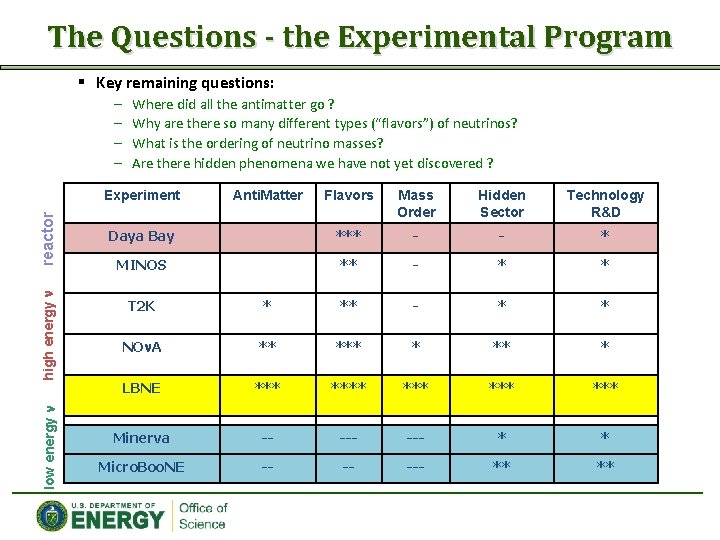
The Questions - the Experimental Program § Key remaining questions: – – Where did all the antimatter go ? Why are there so many different types (“flavors”) of neutrinos? What is the ordering of neutrino masses? Are there hidden phenomena we have not yet discovered ? low energy n high energy n reactor Experiment Anti. Matter Flavors Mass Order Hidden Sector Technology R&D Daya Bay *** - - * MINOS ** - * * T 2 K * ** - * * NOn. A ** * LBNE **** *** *** Minerva -- --- * * Micro. Boo. NE -- -- --- ** **
Why Study Neutrinos? • Neutrinos are the least understood and most abundant constituents of matter. – They are everywhere, but they hardly interact at all. More than 10 million are inside every person on earth. You don’t notice. – Neutrinos are very, very light. • Less than one-millionth the mass of an electron, so light no one has actually been able to measure the mass yet (but we know its not = 0). – Neutrinos come in three “flavors” (types) that can change from one kind to another. • Neutrinos are also very important to our existence. – They are vital to how stars shine and how they produce all the elements beyond hydrogen, including the carbon and oxygen that makes up people. – They may play a key role in why there is any matter at all in the universe. • The Big Bang should have produced equal amounts of matter and antimatter, which should have annihilated into pure energy. Yet almost all the antimatter seems to have vanished and matter is still here.
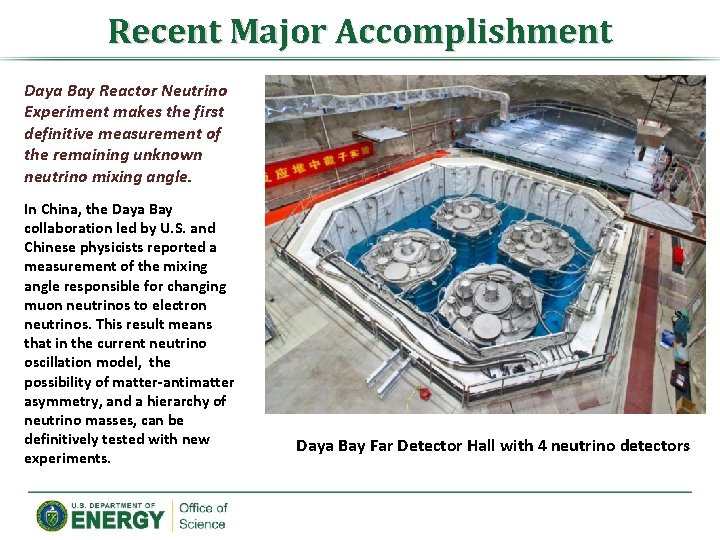
Recent Major Accomplishment Daya Bay Reactor Neutrino Experiment makes the first definitive measurement of the remaining unknown neutrino mixing angle. In China, the Daya Bay collaboration led by U. S. and Chinese physicists reported a measurement of the mixing angle responsible for changing muon neutrinos to electron neutrinos. This result means that in the current neutrino oscillation model, the possibility of matter-antimatter asymmetry, and a hierarchy of neutrino masses, can be definitively tested with new experiments. Daya Bay Far Detector Hall with 4 neutrino detectors
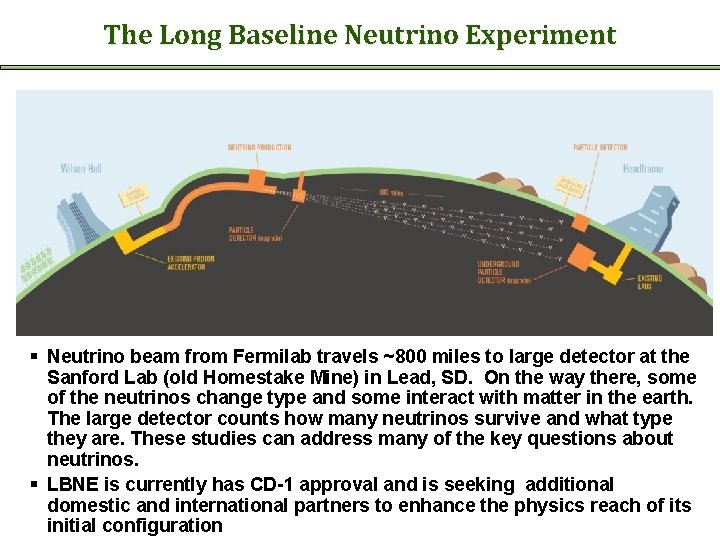
The Long Baseline Neutrino Experiment § Neutrino beam from Fermilab travels ~800 miles to large detector at the Sanford Lab (old Homestake Mine) in Lead, SD. On the way there, some of the neutrinos change type and some interact with matter in the earth. The large detector counts how many neutrinos survive and what type they are. These studies can address many of the key questions about neutrinos. § LBNE is currently has CD-1 approval and is seeking additional domestic and international partners to enhance the physics reach of its initial configuration
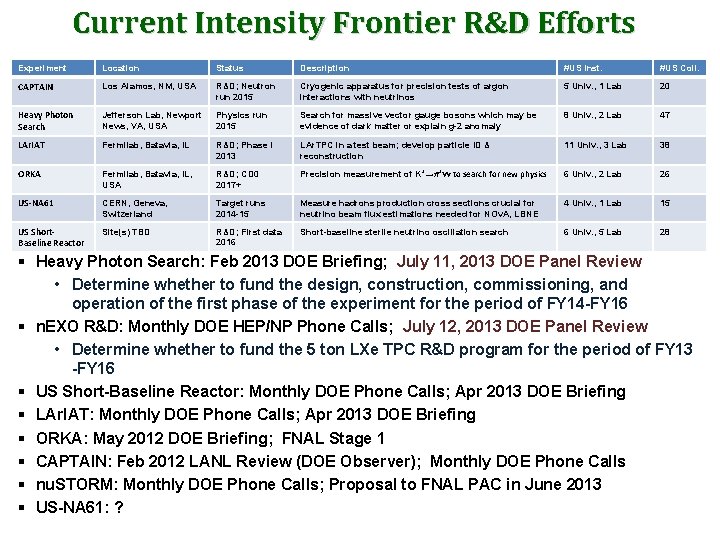
Current Intensity Frontier R&D Efforts Experiment Location Status Description #US Inst. #US Coll. CAPTAIN Los Alamos, NM, USA R&D; Neutron run 2015 Cryogenic apparatus for precision tests of argon interactions with neutrinos 5 Univ. , 1 Lab 20 Heavy Photon Search Jefferson Lab, Newport News, VA, USA Physics run 2015 Search for massive vector gauge bosons which may be evidence of dark matter or explain g-2 anomaly 8 Univ. , 2 Lab 47 LAr. IAT Fermilab, Batavia, IL R&D; Phase I 2013 LAr. TPC in a test beam; develop particle ID & reconstruction 11 Univ. , 3 Lab 38 ORKA Fermilab, Batavia, IL, USA R&D; CD 0 2017+ Precision measurement of K+→π+νν to search for new physics 6 Univ. , 2 Lab 26 US-NA 61 CERN, Geneva, Switzerland Target runs 2014 -15 Measure hadrons production cross sections crucial for neutrino beam flux estimations needed for NOv. A, LBNE 4 Univ. , 1 Lab 15 US Short. Baseline Reactor Site(s) TBD R&D; First data 2016 Short-baseline sterile neutrino oscillation search 6 Univ. , 5 Lab 28 § Heavy Photon Search: Feb 2013 DOE Briefing; July 11, 2013 DOE Panel Review • Determine whether to fund the design, construction, commissioning, and operation of the first phase of the experiment for the period of FY 14 -FY 16 § n. EXO R&D: Monthly DOE HEP/NP Phone Calls; July 12, 2013 DOE Panel Review • Determine whether to fund the 5 ton LXe TPC R&D program for the period of FY 13 -FY 16 § US Short-Baseline Reactor: Monthly DOE Phone Calls; Apr 2013 DOE Briefing § LAr. IAT: Monthly DOE Phone Calls; Apr 2013 DOE Briefing § ORKA: May 2012 DOE Briefing; FNAL Stage 1 § CAPTAIN: Feb 2012 LANL Review (DOE Observer); Monthly DOE Phone Calls § nu. STORM: Monthly DOE Phone Calls; Proposal to FNAL PAC in June 2013 § US-NA 61: ?
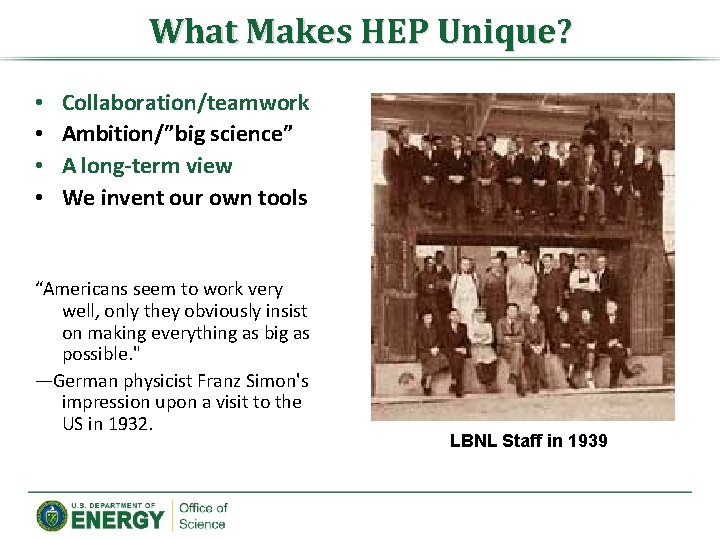
What Makes HEP Unique? • • Collaboration/teamwork Ambition/”big science” A long-term view We invent our own tools “Americans seem to work very well, only they obviously insist on making everything as big as possible. " —German physicist Franz Simon's impression upon a visit to the US in 1932. LBNL Staff in 1939
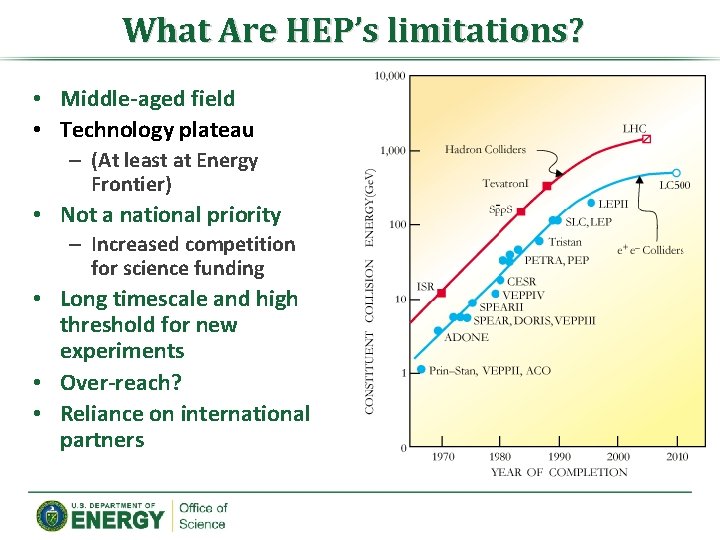
What Are HEP’s limitations? • Middle-aged field • Technology plateau – (At least at Energy Frontier) • Not a national priority – Increased competition for science funding • Long timescale and high threshold for new experiments • Over-reach? • Reliance on international partners