
HEMPELS RAVEN PARADOX A lacuna in the standard
- Slides: 15
HEMPEL’S RAVEN PARADOX A lacuna in the standard Bayesian solution Peter B. M. Vranas Iowa State University PSA’ 02, 8 November 2002
OVERVIEW PART 1 Hempel’s paradox, the Bayesian solution, and the disputed assumption PART 2 Two attempts to defend the assumption PART 3 Three attempts to refute the assumption CONCLUSION A possible way out for Bayesians
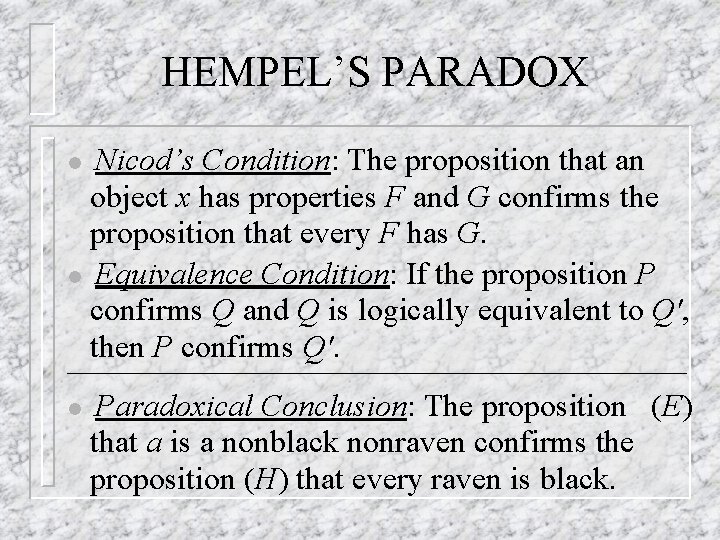
HEMPEL’S PARADOX Nicod’s Condition: The proposition that an object x has properties F and G confirms the proposition that every F has G. l Equivalence Condition: If the proposition P confirms Q and Q is logically equivalent to Q', then P confirms Q'. l ______________________________________________________________________________ l Paradoxical Conclusion: The proposition (E) that a is a nonblack nonraven confirms the proposition (H) that every raven is black.
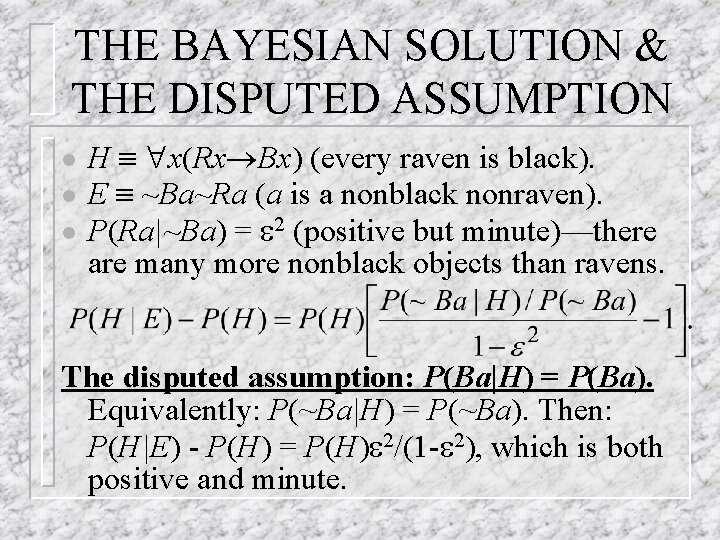
THE BAYESIAN SOLUTION & THE DISPUTED ASSUMPTION l l l H x(Rx Bx) (every raven is black). E ~Ba~Ra (a is a nonblack nonraven). P(Ra|~Ba) = 2 (positive but minute)—there are many more nonblack objects than ravens. The disputed assumption: P(Ba|H) = P(Ba). Equivalently: P(~Ba|H) = P(~Ba). Then: P(H|E) - P(H) = P(H) 2/(1 - 2), which is both positive and minute.
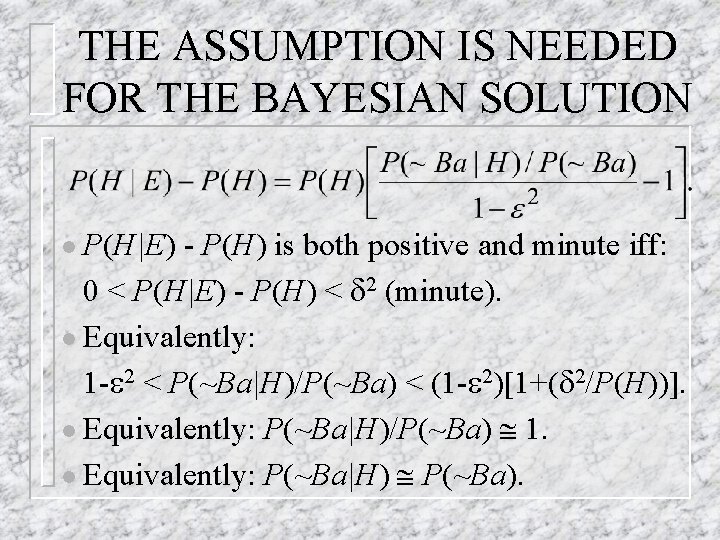
THE ASSUMPTION IS NEEDED FOR THE BAYESIAN SOLUTION l P(H|E) - P(H) is both positive and minute iff: 0 < P(H|E) - P(H) < 2 (minute). l Equivalently: 1 - 2 < P(~Ba|H)/P(~Ba) < (1 - 2)[1+( 2/P(H))]. l Equivalently: P(~Ba|H)/P(~Ba) 1. l Equivalently: P(~Ba|H) P(~Ba).
OVERVIEW PART 1 Hempel’s paradox, the Bayesian solution, and the disputed assumption PART 2 Two attempts to defend the assumption PART 3 Three attempts to refute the assumption CONCLUSION A possible way out for Bayesians
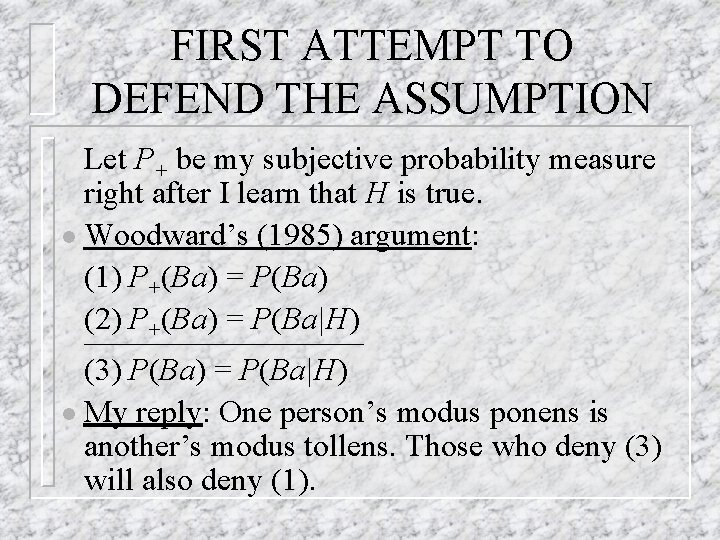
FIRST ATTEMPT TO DEFEND THE ASSUMPTION Let P+ be my subjective probability measure right after I learn that H is true. l Woodward’s (1985) argument: (1) P+(Ba) = P(Ba) (2) P+(Ba) = P(Ba|H) ___________________________________ (3) P(Ba) = P(Ba|H) l My reply: One person’s modus ponens is another’s modus tollens. Those who deny (3) will also deny (1).
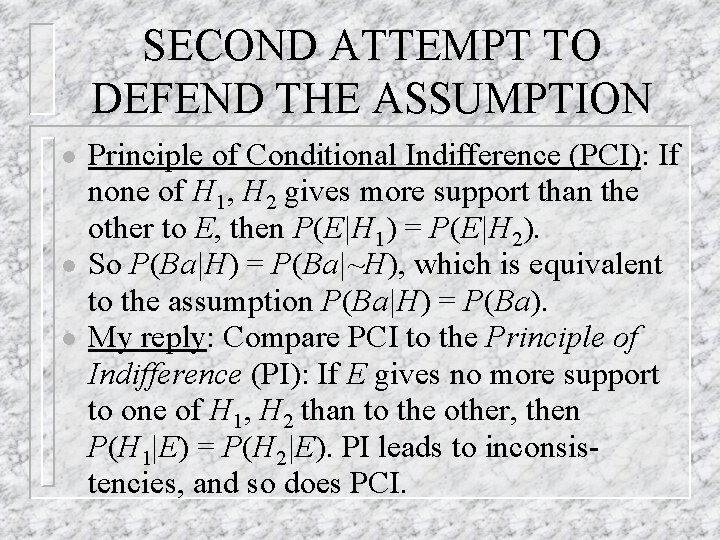
SECOND ATTEMPT TO DEFEND THE ASSUMPTION l l l Principle of Conditional Indifference (PCI): If none of H 1, H 2 gives more support than the other to E, then P(E|H 1) = P(E|H 2). So P(Ba|H) = P(Ba|~H), which is equivalent to the assumption P(Ba|H) = P(Ba). My reply: Compare PCI to the Principle of Indifference (PI): If E gives no more support to one of H 1, H 2 than to the other, then P(H 1|E) = P(H 2|E). PI leads to inconsistencies, and so does PCI.
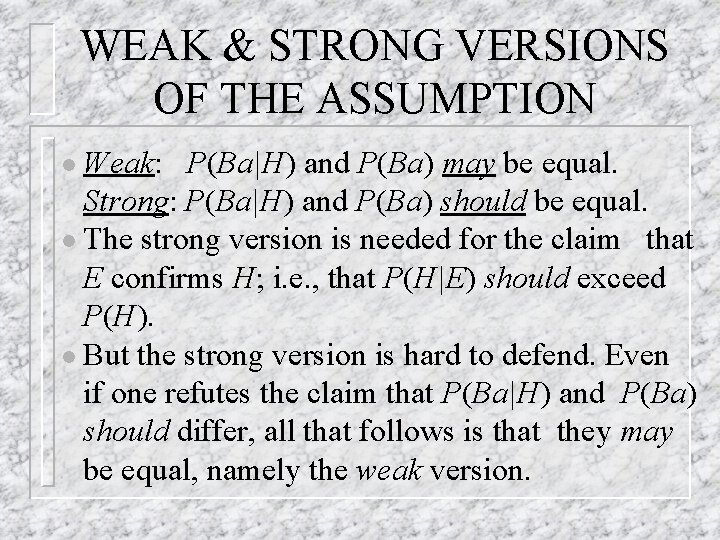
WEAK & STRONG VERSIONS OF THE ASSUMPTION l Weak: P(Ba|H) and P(Ba) may be equal. Strong: P(Ba|H) and P(Ba) should be equal. l The strong version is needed for the claim that E confirms H; i. e. , that P(H|E) should exceed P(H). l But the strong version is hard to defend. Even if one refutes the claim that P(Ba|H) and P(Ba) should differ, all that follows is that they may be equal, namely the weak version.
OVERVIEW PART 1 Hempel’s paradox, the Bayesian solution, and the disputed assumption PART 2 Two attempts to defend the assumption PART 3 Three attempts to refute the assumption CONCLUSION A possible way out for Bayesians
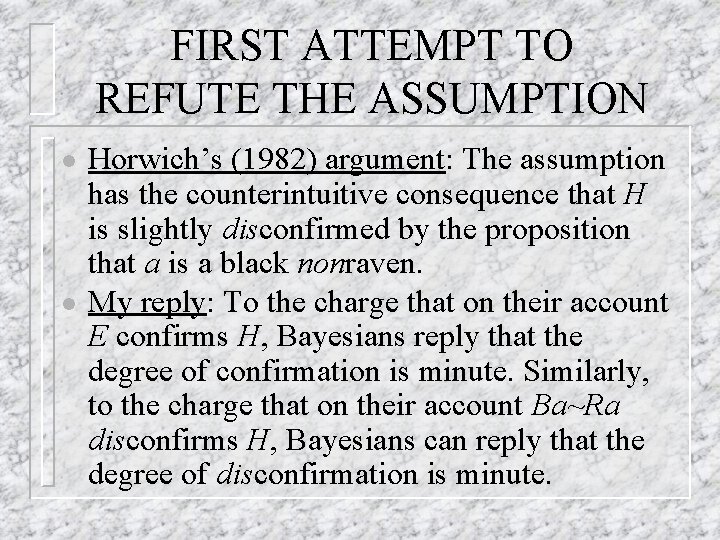
FIRST ATTEMPT TO REFUTE THE ASSUMPTION l l Horwich’s (1982) argument: The assumption has the counterintuitive consequence that H is slightly disconfirmed by the proposition that a is a black nonraven. My reply: To the charge that on their account E confirms H, Bayesians reply that the degree of confirmation is minute. Similarly, to the charge that on their account Ba~Ra disconfirms H, Bayesians can reply that the degree of disconfirmation is minute.
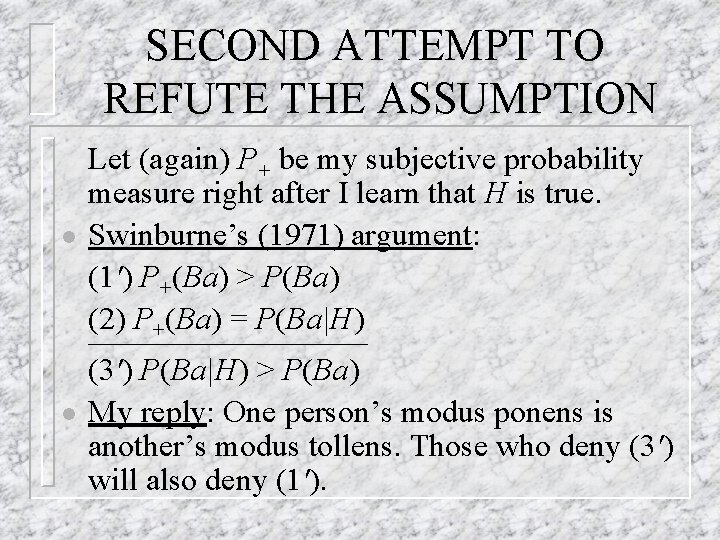
SECOND ATTEMPT TO REFUTE THE ASSUMPTION l Let (again) P+ be my subjective probability measure right after I learn that H is true. Swinburne’s (1971) argument: (1') P+(Ba) > P(Ba) (2) P+(Ba) = P(Ba|H) ___________________________________ l (3') P(Ba|H) > P(Ba) My reply: One person’s modus ponens is another’s modus tollens. Those who deny (3') will also deny (1').
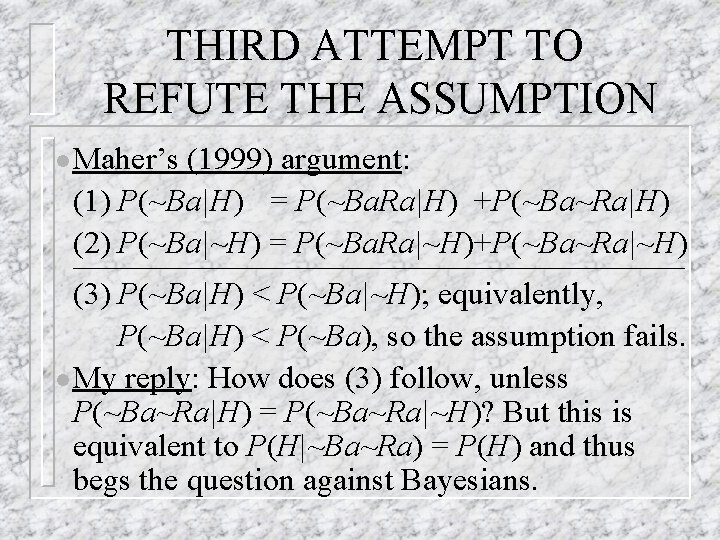
THIRD ATTEMPT TO REFUTE THE ASSUMPTION l Maher’s (1999) argument: (1) P(~Ba|H) = P(~Ba. Ra|H) +P(~Ba~Ra|H) (2) P(~Ba|~H) = P(~Ba. Ra|~H)+P(~Ba~Ra|~H) _____________________________________________________________________________ (3) P(~Ba|H) < P(~Ba|~H); equivalently, P(~Ba|H) < P(~Ba), so the assumption fails. l My reply: How does (3) follow, unless P(~Ba~Ra|H) = P(~Ba~Ra|~H)? But this is equivalent to P(H|~Ba~Ra) = P(H) and thus begs the question against Bayesians.
OVERVIEW PART 1 Hempel’s paradox, the Bayesian solution, and the disputed assumption PART 2 Two attempts to defend the assumption PART 3 Three attempts to refute the assumption CONCLUSION A possible way out for Bayesians
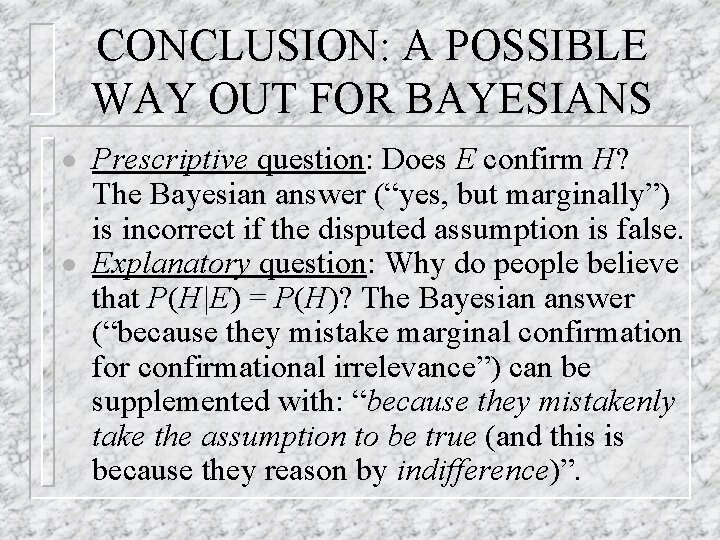
CONCLUSION: A POSSIBLE WAY OUT FOR BAYESIANS l l Prescriptive question: Does E confirm H? The Bayesian answer (“yes, but marginally”) is incorrect if the disputed assumption is false. Explanatory question: Why do people believe that P(H|E) = P(H)? The Bayesian answer (“because they mistake marginal confirmation for confirmational irrelevance”) can be supplemented with: “because they mistakenly take the assumption to be true (and this is because they reason by indifference)”.