
Hempel on Confirmation and Explanation Philosophy of Science
- Slides: 33
Hempel on Confirmation and Explanation Philosophy of Science, Supplementary Subject Sophie Allen Lecture 3 Part 1
Last week we looked at two problems of induction: Reasoning from observed cases to a general hypothesis, or a prediction about unobserved cases is ultimately unjustified. If one tries to describe this process of reasoning, it cannot be done formally. (The grue problem)
Carl Hempel’s Project Working out the Methodology of Science: How should science be done? Clarifying the meaning of concepts like ‘explanation’, ‘evidence’, ‘confirmation’, ‘law of nature’ etc. He worked mainly within the logical empiricist tradition.
Two Important Questions to do with Confirmation and Explanation How does evidence confirm theory? How does theory explain the evidence?
Carl Hempel’s Project: 1) What is the relationship between Evidence and Hypothesis? What counts as confirmation? Or disconfirmation?
Carl Hempel’s Project: 1) What is the relationship between Evidence and Hypothesis? What counts as confirmation? Or disconfirmation? We are not interested (in this context) in how the hypothesis is arrived at. . .
The physicist George Darwin once remarked that sometimes one should do a completely wild experiment, like blowing the trumpet to the tulips every morning for a month. Probably nothing would happen, but what if it did? Ian Hacking
Hempel’s Project: 1) What is the relationship between Evidence and Hypothesis? What counts as confirmation? Or disconfirmation? 2) Can we understand Degree of Confirmation? How well confirmed is a Hypothesis with respect to the Evidence? Can we say when H 1 is as well confirmed as H 2 (say)? Or, when H 1 is better confirmed than H 2?
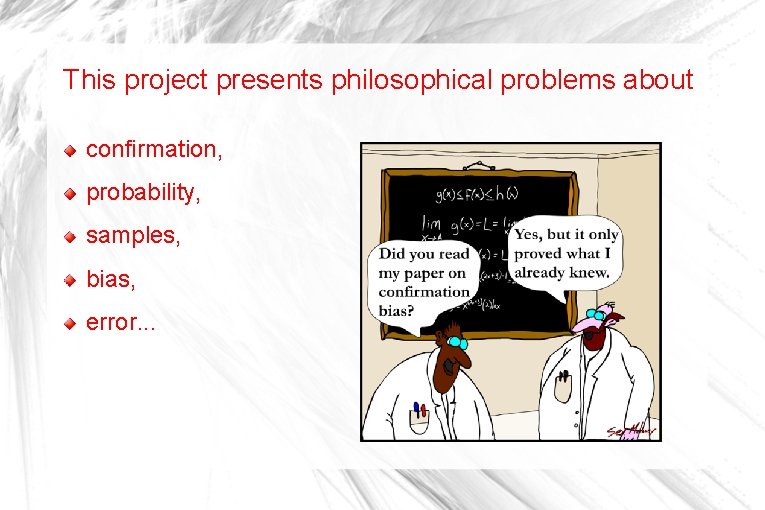
This project presents philosophical problems about confirmation, probability, samples, bias, error. . .
What counts as confirmation? Or disconfirmation? When does Evidence E confirm Hypothesis H? This is a relationship between sentences or sets of sentences, not between ‘things in the world’ and a hypothesis. Both E and H are taken as given, in some sense, before the current problem arises.
What counts as confirmation? Or disconfirmation? When does Evidence E confirm Hypothesis H? This is a relationship between sentences or sets of sentences, not between ‘things in the world’ and a hypothesis. Both E and H are taken as given, in some sense, before this question arises. Nicod’s Criterion: A hypothesis is confirmed by its instances.
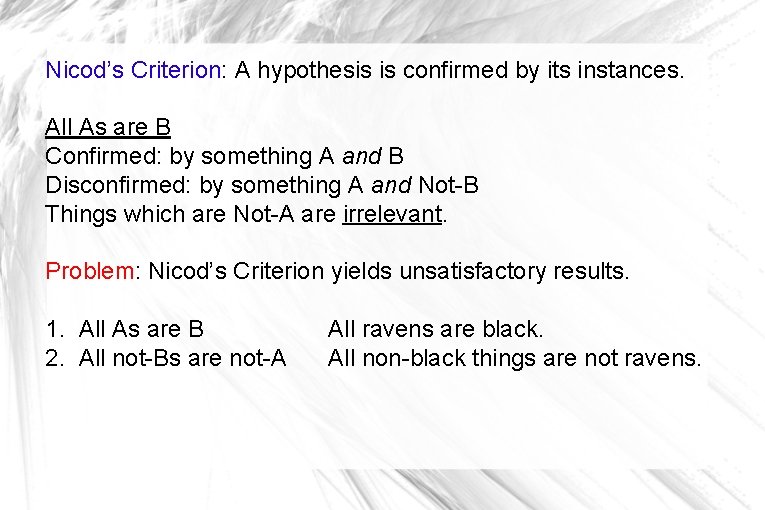
What counts as confirmation? Or disconfirmation? When does Evidence E confirm Hypothesis H? Nicod’s Criterion: A hypothesis is confirmed by its instances. (Slightly) more formally: All As are B Confirmed: by something A and B Disconfirmed: by something A and Not-B Things which are Not-A are irrelevant.
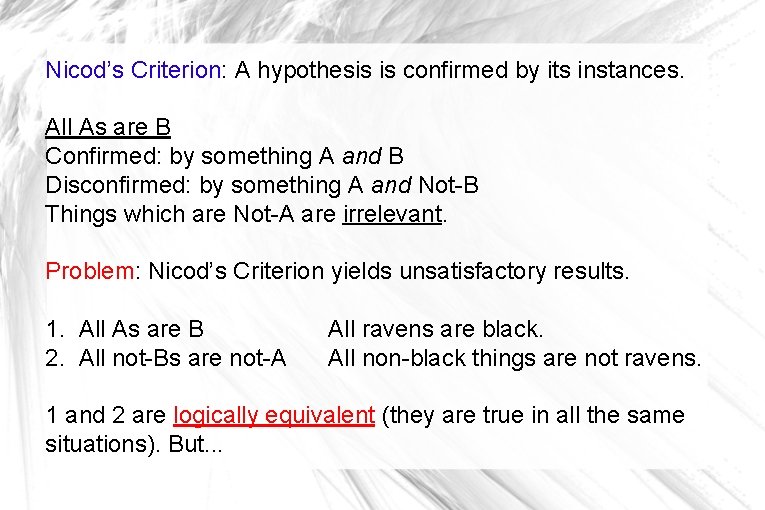
Nicod’s Criterion: A hypothesis is confirmed by its instances. All As are B Confirmed: by something A and B Disconfirmed: by something A and Not-B Things which are Not-A are irrelevant. Problem: Nicod’s Criterion yields unsatisfactory results. 1. All As are B 2. All not-Bs are not-A All ravens are black. All non-black things are not ravens.
Nicod’s Criterion: A hypothesis is confirmed by its instances. All As are B Confirmed: by something A and B Disconfirmed: by something A and Not-B Things which are Not-A are irrelevant. Problem: Nicod’s Criterion yields unsatisfactory results. 1. All As are B 2. All not-Bs are not-A All ravens are black. All non-black things are not ravens. 1 and 2 are logically equivalent (they are true in all the same situations). But. . .
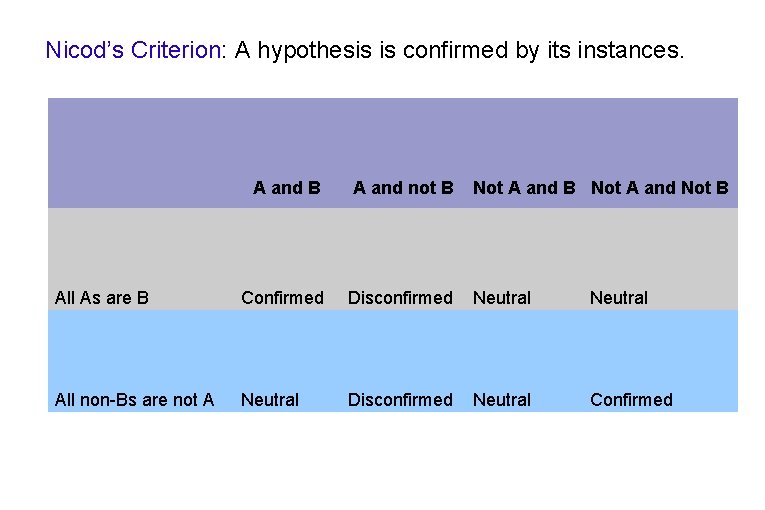
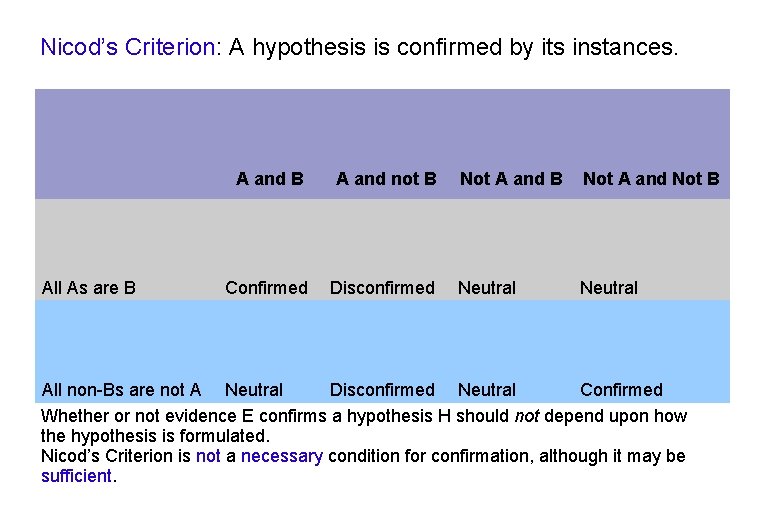
Nicod’s Criterion: A hypothesis is confirmed by its instances. A and B A and not B Not A and Not B All As are B Confirmed Disconfirmed Neutral All non-Bs are not A Neutral Disconfirmed Neutral Confirmed
Nicod’s Criterion: A hypothesis is confirmed by its instances. All As are B A and not B Confirmed Disconfirmed Not A and B Not A and Not B Neutral All non-Bs are not A Neutral Disconfirmed Neutral Confirmed Whether or not evidence E confirms a hypothesis H should not depend upon how the hypothesis is formulated. Nicod’s Criterion is not a necessary condition for confirmation, although it may be sufficient.
Nicod’s Criterion: A hypothesis is confirmed by its instances. Sufficient, but not Necessary Condition of confirmation. Equivalence Condition: Confirmation is independent of formulation. (Logically equivalent sentences are confirmed by the same evidence. )
What does Logical Equivalence mean? Two sentences are logically equivalent if and only if they are both true or both false in every situation (they always share the same truth value). All As are B All not-Bs are not-A
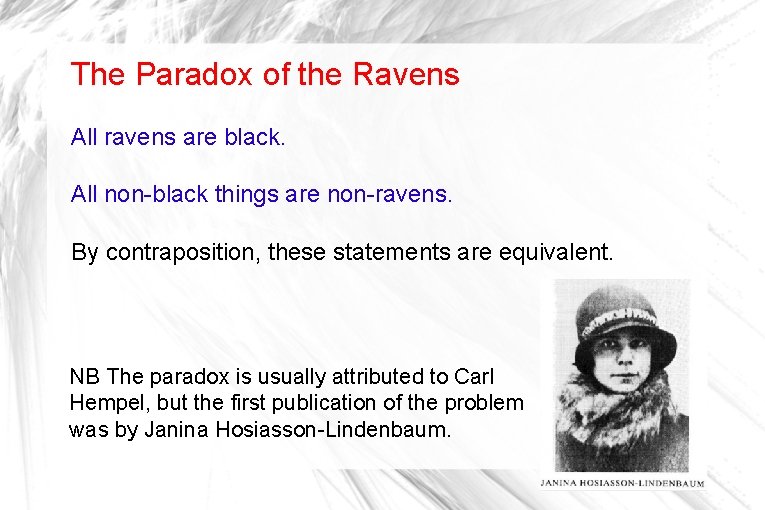
The Paradox of the Ravens All ravens are black. All non-black things are non-ravens. By contraposition, these statements are equivalent. NB The paradox is usually attributed to Carl Hempel, but the first publication of the problem was by Janina Hosiasson-Lindenbaum.
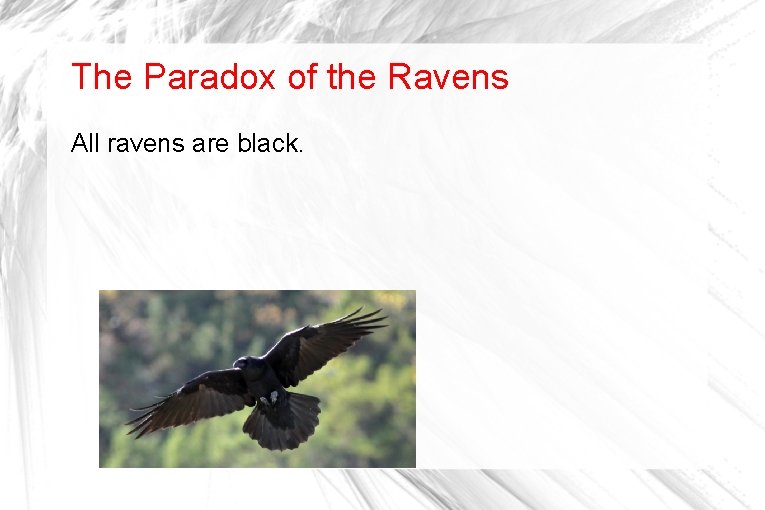
The Paradox of the Ravens All ravens are black.
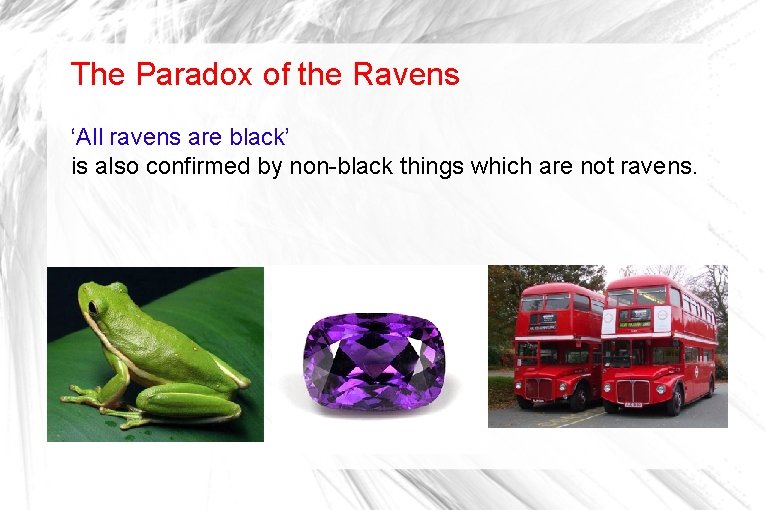
The Paradox of the Ravens ‘All ravens are black’ is also confirmed by non-black things which are not ravens.
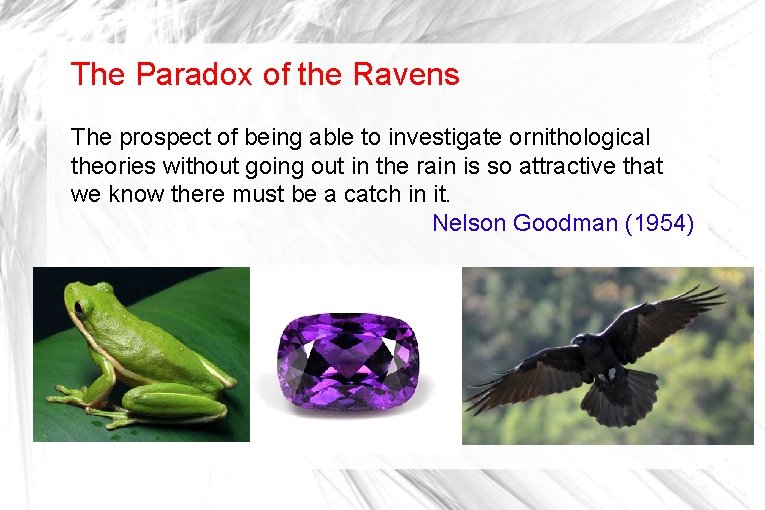
The Paradox of the Ravens The prospect of being able to investigate ornithological theories without going out in the rain is so attractive that we know there must be a catch in it. Nelson Goodman (1954)
The Paradox of the Ravens: Responses 1) Hempel: Accept the conclusion. The appearance of paradox is a psychological illusion.
The Paradox of the Ravens: Responses 1) Hempel: Accept the conclusion. The appearance of paradox is a psychological illusion. All sodium salts burn yellow. a) Our area of interest is usually limited (to sodium salts, or ravens) but the generalisation does actually say something about everything. b) The problem evidence only seems pointless because we happen already to have other information. Feeling of confirmation is relevant to background knowledge.
The Paradox of the Ravens: Responses 1) Hempel: Accept the conclusion. The appearance of paradox is a psychological illusion. 2) Can we use Bayesian probability to distinguish between the different cases?
2) Can we use Bayesian probability to distinguish between the different cases? Bayes Theorem: P(H/E) = P(E/H) x P(H)/P(E) Evidence offers a greater degree of confirmation of H the more unlikely E is relative to our background knowledge. In general: E confirms H iff P(H/E) > P(H)
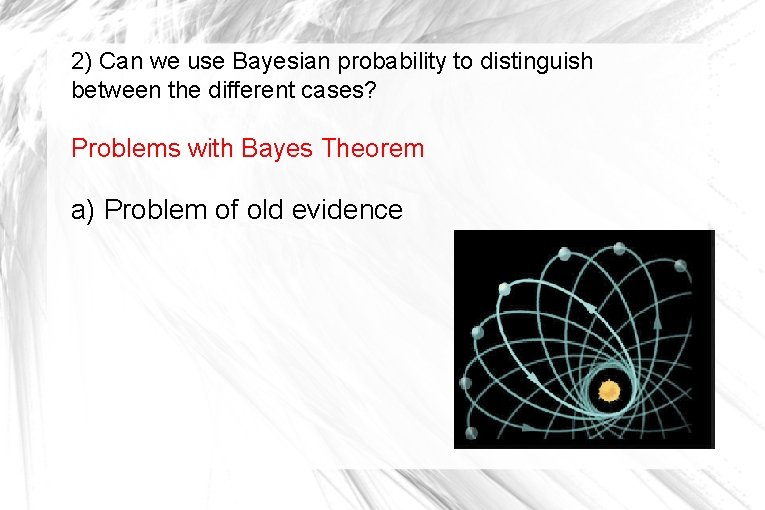
2) Can we use Bayesian probability to distinguish between the different cases? Problems with Bayes Theorem a) Problem of old evidence
2) Can we use Bayesian probability to distinguish between the different cases? Problems with Bayes Theorem a) Problem of old evidence b) Problem of subjective degrees of belief.
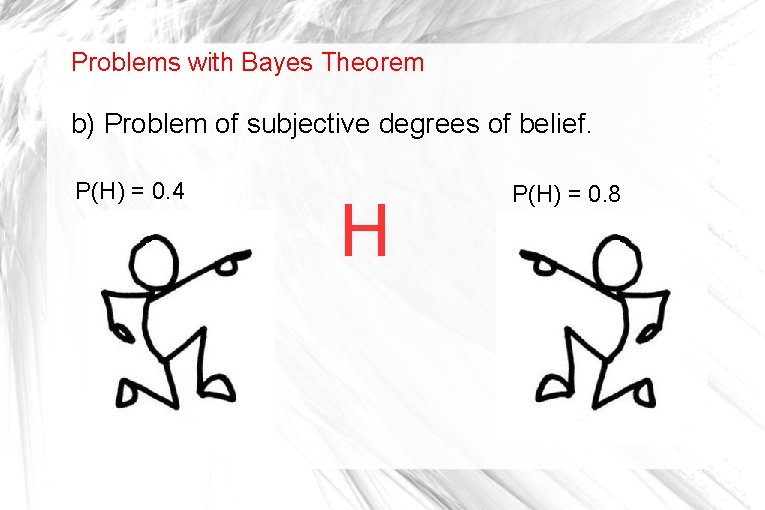
Problems with Bayes Theorem b) Problem of subjective degrees of belief. P(H) = 0. 4 H P(H) = 0. 8
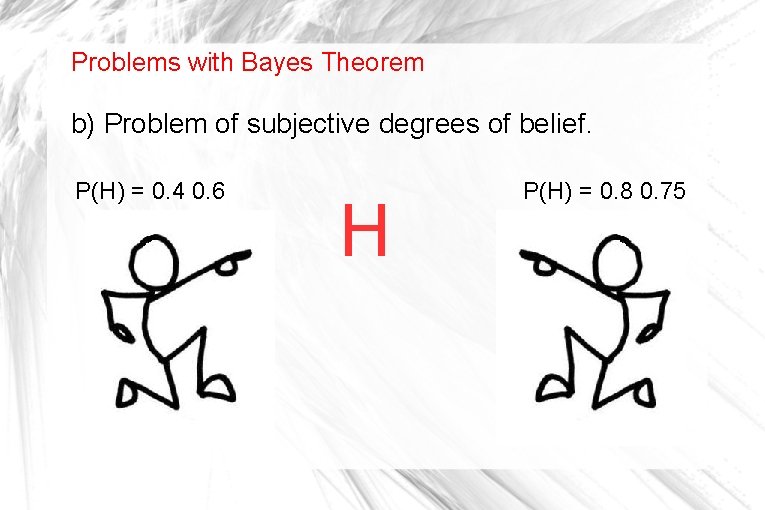
Problems with Bayes Theorem b) Problem of subjective degrees of belief. P(H) = 0. 4 0. 6 H P(H) = 0. 8 0. 75
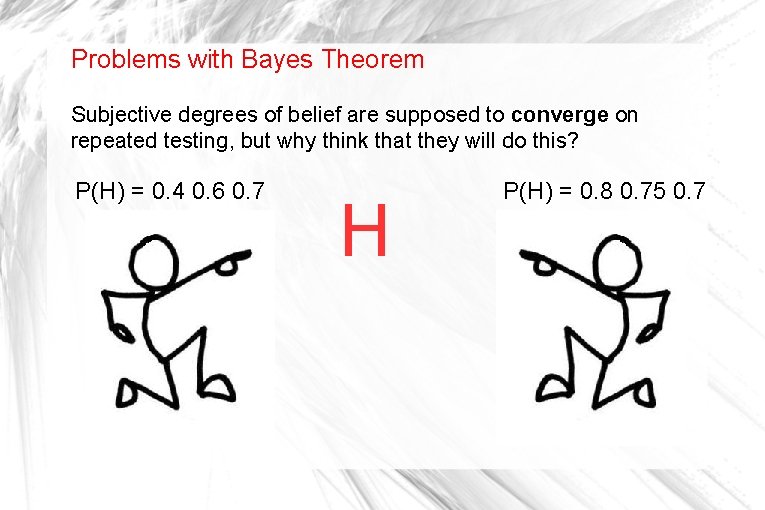
Problems with Bayes Theorem Subjective degrees of belief are supposed to converge on repeated testing, but why think that they will do this? P(H) = 0. 4 0. 6 0. 7 H P(H) = 0. 8 0. 75 0. 7
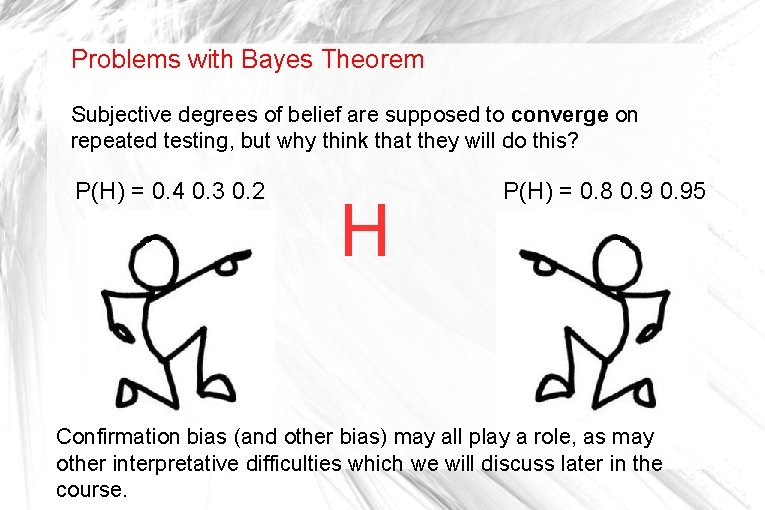
Problems with Bayes Theorem Subjective degrees of belief are supposed to converge on repeated testing, but why think that they will do this? P(H) = 0. 4 0. 3 0. 2 H P(H) = 0. 8 0. 95 Confirmation bias (and other bias) may all play a role, as may other interpretative difficulties which we will discuss later in the course.
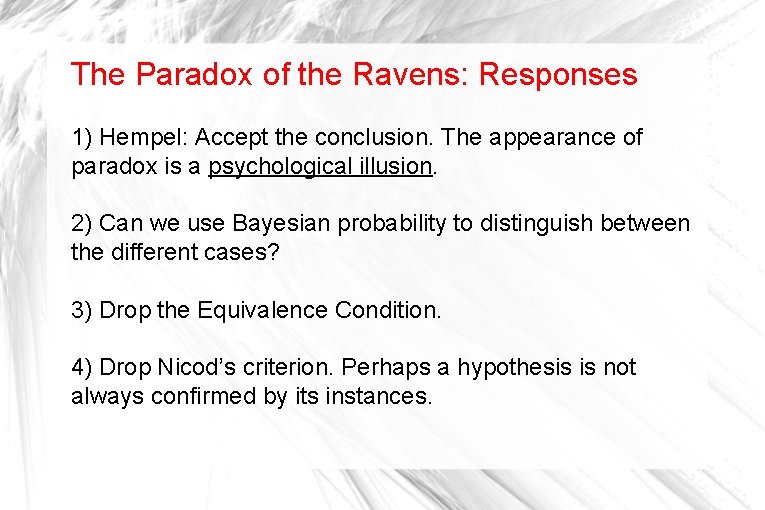
The Paradox of the Ravens: Responses 1) Hempel: Accept the conclusion. The appearance of paradox is a psychological illusion. 2) Can we use Bayesian probability to distinguish between the different cases? 3) Drop the Equivalence Condition. 4) Drop Nicod’s criterion. Perhaps a hypothesis is not always confirmed by its instances.