
Hemophilia Galila Zaher Consultant Hematologist MRCPath KAUH Prevalence

- Slides: 44
Hemophilia Galila Zaher Consultant Hematologist MRCPath KAUH
Prevalence World-wide occurs in all racial groups. Few decades ago, children with hemophilia had a significantly reduced life expectancy. Crippled with arthritis &joint deformity Recent studies : increased life-expectancy Now : face few limitations. Normal schools, most jobs are open with full participation in society.
Hemophilia Statistics By Country-specific prevalence statistics Extrapolations of various prevalence rates against the populations Calculation is automated and does not take into account differences across various countries May be highly inaccurate and only give a general indication to actual prevalence Cure. Research. com
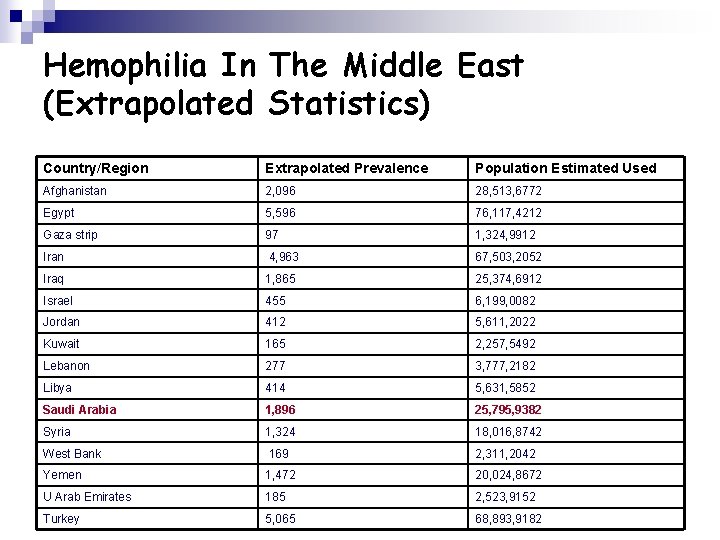
Hemophilia In The Middle East (Extrapolated Statistics) Country/Region Extrapolated Prevalence Population Estimated Used Afghanistan 2, 096 28, 513, 6772 Egypt 5, 596 76, 117, 4212 Gaza strip 97 1, 324, 9912 Iran 4, 963 67, 503, 2052 Iraq 1, 865 25, 374, 6912 Israel 455 6, 199, 0082 Jordan 412 5, 611, 2022 Kuwait 165 2, 257, 5492 Lebanon 277 3, 777, 2182 Libya 414 5, 631, 5852 Saudi Arabia 1, 896 25, 795, 9382 Syria 1, 324 18, 016, 8742 West Bank 169 2, 311, 2042 Yemen 1, 472 20, 024, 8672 U Arab Emirates 185 2, 523, 9152 Turkey 5, 065 68, 893, 9182
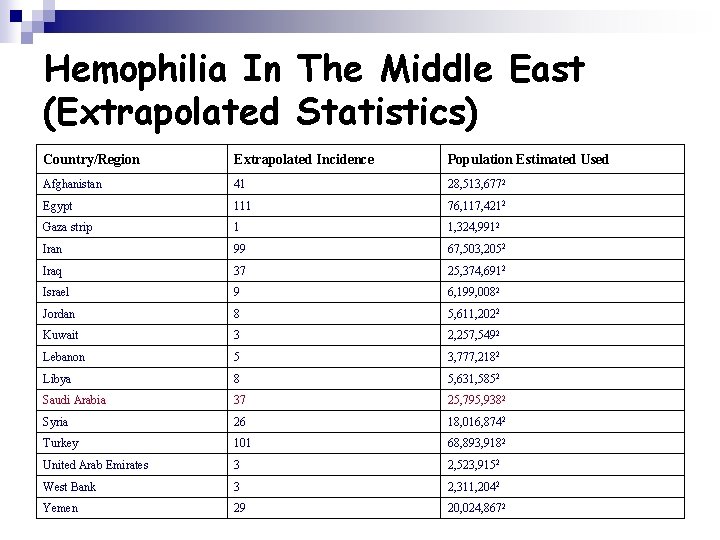
Hemophilia In The Middle East (Extrapolated Statistics) Country/Region Extrapolated Incidence Population Estimated Used Afghanistan 41 28, 513, 6772 Egypt 111 76, 117, 4212 Gaza strip 1 1, 324, 9912 Iran 99 67, 503, 2052 Iraq 37 25, 374, 6912 Israel 9 6, 199, 0082 Jordan 8 5, 611, 2022 Kuwait 3 2, 257, 5492 Lebanon 5 3, 777, 2182 Libya 8 5, 631, 5852 Saudi Arabia 37 25, 795, 9382 Syria 26 18, 016, 8742 Turkey 101 68, 893, 9182 United Arab Emirates 3 2, 523, 9152 West Bank 3 2, 311, 2042 Yemen 29 20, 024, 8672
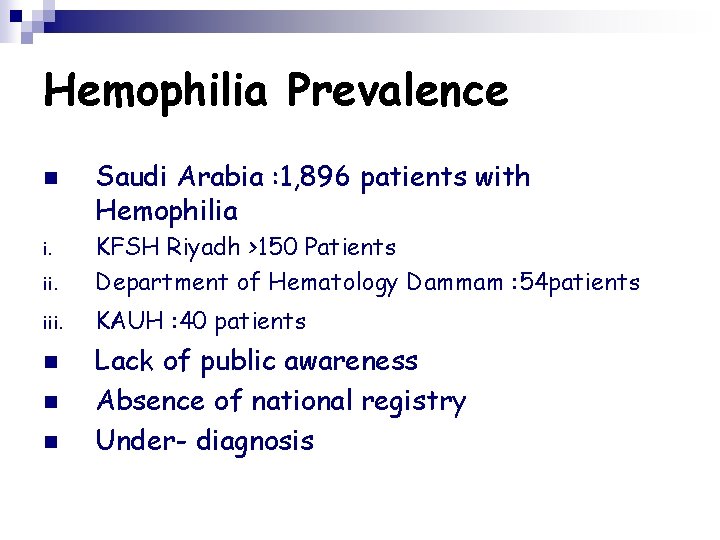
Hemophilia Prevalence n Saudi Arabia : 1, 896 patients with Hemophilia ii. KFSH Riyadh >150 Patients Department of Hematology Dammam : 54 patients iii. KAUH : 40 patients i. n n n Lack of public awareness Absence of national registry Under- diagnosis
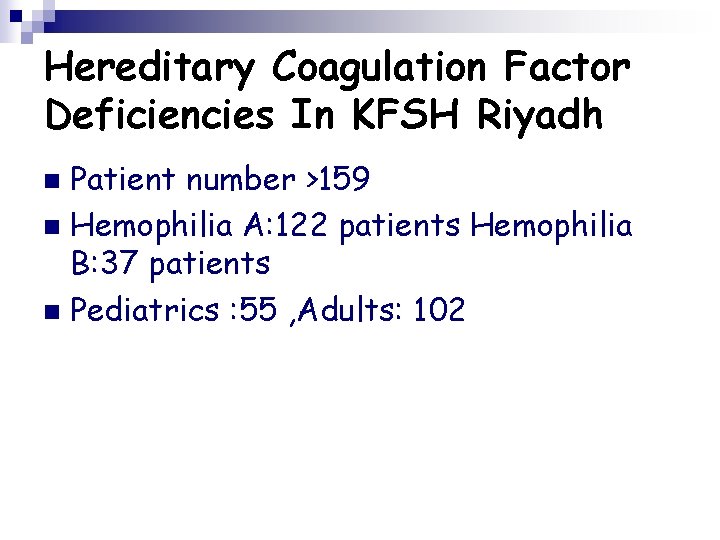
Hereditary Coagulation Factor Deficiencies In KFSH Riyadh Patient number >159 n Hemophilia A: 122 patients Hemophilia B: 37 patients n Pediatrics : 55 , Adults: 102 n
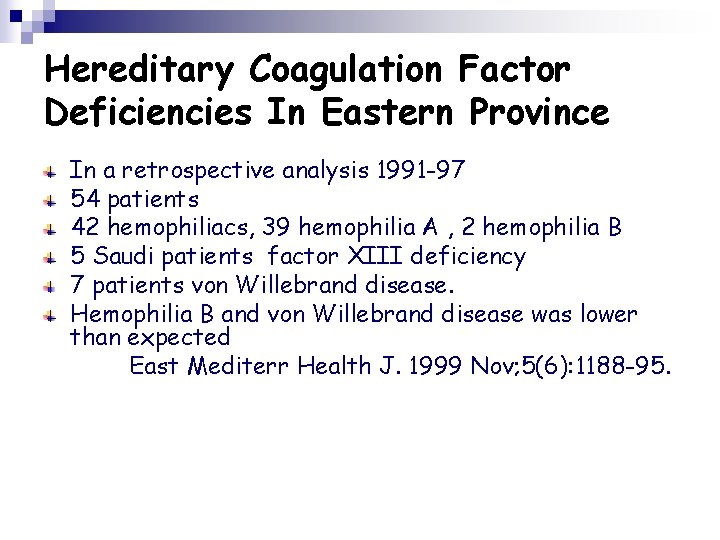
Hereditary Coagulation Factor Deficiencies In Eastern Province In a retrospective analysis 1991 -97 54 patients 42 hemophiliacs, 39 hemophilia A , 2 hemophilia B 5 Saudi patients factor XIII deficiency 7 patients von Willebrand disease. Hemophilia B and von Willebrand disease was lower than expected East Mediterr Health J. 1999 Nov; 5(6): 1188 -95.
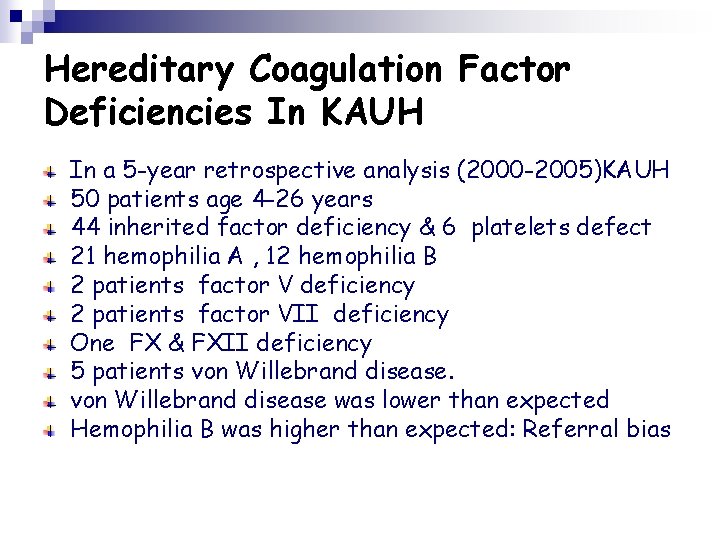
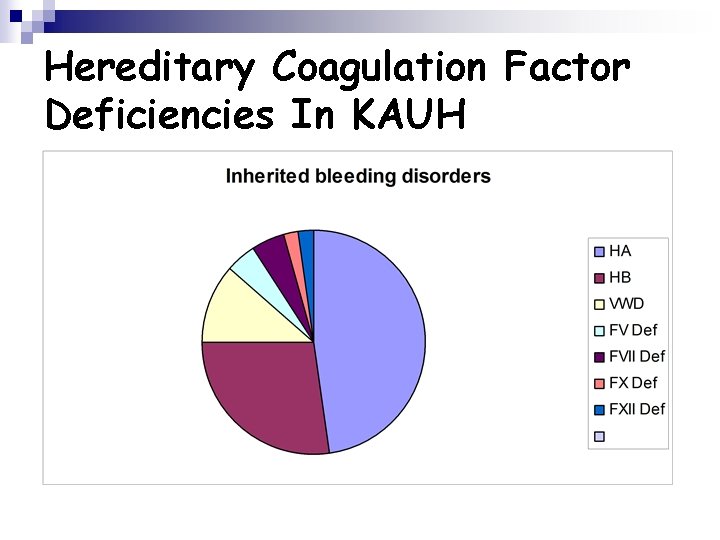
Hereditary Coagulation Factor Deficiencies In KAUH In a 5 -year retrospective analysis (2000 -2005)KAUH 50 patients age 4 -26 years 44 inherited factor deficiency & 6 platelets defect 21 hemophilia A , 12 hemophilia B 2 patients factor V deficiency 2 patients factor VII deficiency One FX & FXII deficiency 5 patients von Willebrand disease was lower than expected Hemophilia B was higher than expected: Referral bias
Hereditary Coagulation Factor Deficiencies In KAUH
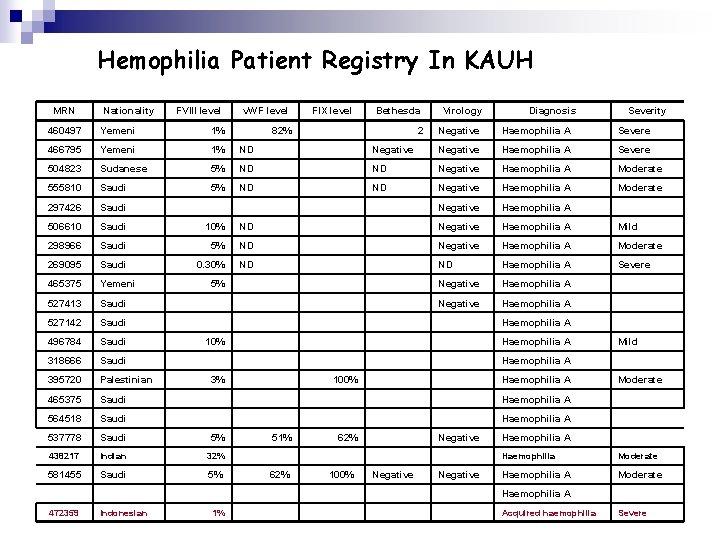
Hemophilia Patient Registry In KAUH MRN Nationality FVIII level v. WF level FIX level Bethesda Severity Negative Haemophilia A Severe Yemeni 1% 466795 Yemeni 1% ND Negative Haemophilia A Severe 504823 Sudanese 5% ND ND Negative Haemophilia A Moderate 555810 Saudi 5% ND ND Negative Haemophilia A Moderate 297426 Saudi Negative Haemophilia A 506610 Saudi 10% ND Negative Haemophilia A Mild 298966 Saudi 5% ND Negative Haemophilia A Moderate 269095 Saudi 0. 30% ND Haemophilia A Severe 465375 Yemeni Negative Haemophilia A 527413 Saudi Negative Haemophilia A 527142 Saudi Haemophilia A 496784 Saudi Haemophilia A Mild 318666 Saudi Haemophilia A 395720 Palestinian Haemophilia A Moderate 465375 Saudi Haemophilia A 564518 Saudi Haemophilia A 537778 Saudi 5% Negative Haemophilia A 438217 Indian 32% 581455 Saudi 472359 Indonesian 5% 10% 3% 2 Diagnosis 460497 82% Virology 100% 51% 62% Haemophilia Moderate 5% 62% 100% Negative Haemophilia A Moderate Haemophilia A Acquired haemophilia Severe 1%
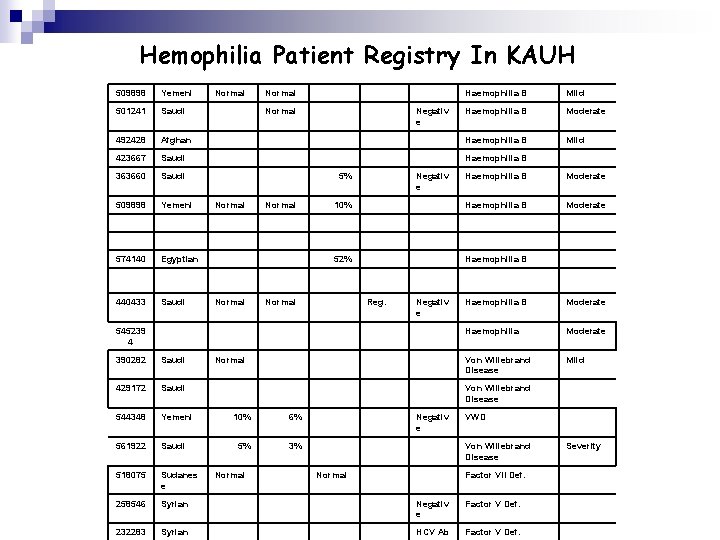
Hemophilia Patient Registry In KAUH 509898 Yemeni Normal Haemophilia B Mild 501241 Saudi Normal Negativ e Haemophilia B Moderate 492428 Afghan Haemophilia B Mild 423667 Saudi Haemophilia B 363660 Saudi 5% Negativ e Haemophilia B Moderate 509898 Yemeni Normal 10% Haemophilia B Moderate 574140 Egyptian 52% Haemophilia B 440433 Saudi Normal Reg. Negativ e Haemophilia B Moderate 545239 4 Haemophilia Moderate 390282 Saudi Normal Von Willebrand Disease Mild 429172 Saudi Von Willebrand Disease 544348 Yemeni 561922 Saudi 518075 Sudanes e Normal 258546 Syrian 232283 Syrian 10% 6% Negativ e VWD 5% 3% Von Willebrand Disease Severity Normal Factor VII Def. Negativ e Factor V Def. HCV Ab Factor V Def.
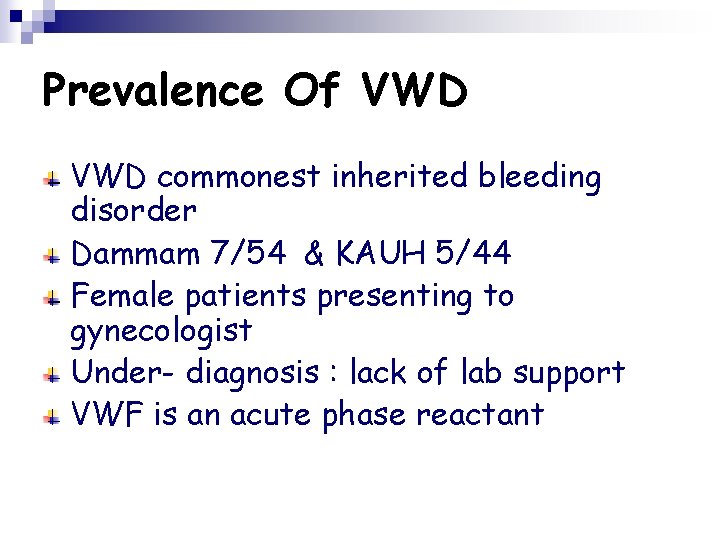
Prevalence Of VWD commonest inherited bleeding disorder Dammam 7/54 & KAUH 5/44 Female patients presenting to gynecologist Under- diagnosis : lack of lab support VWF is an acute phase reactant
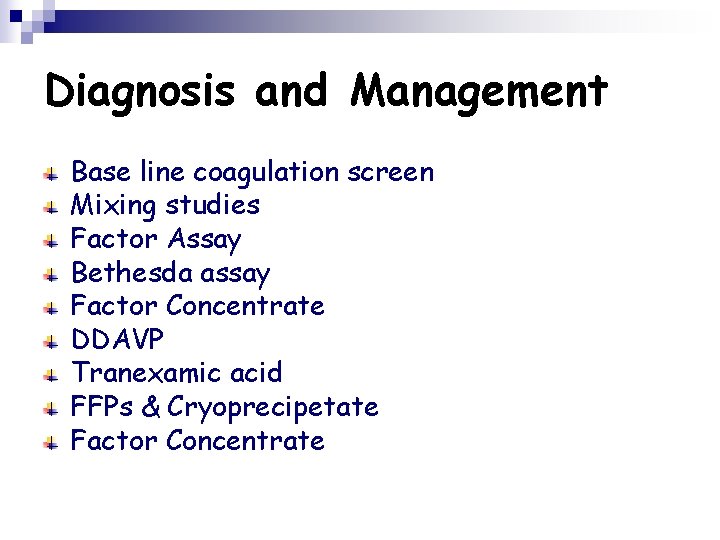
Diagnosis and Management Base line coagulation screen Mixing studies Factor Assay Bethesda assay Factor Concentrate DDAVP Tranexamic acid FFPs & Cryoprecipetate Factor Concentrate
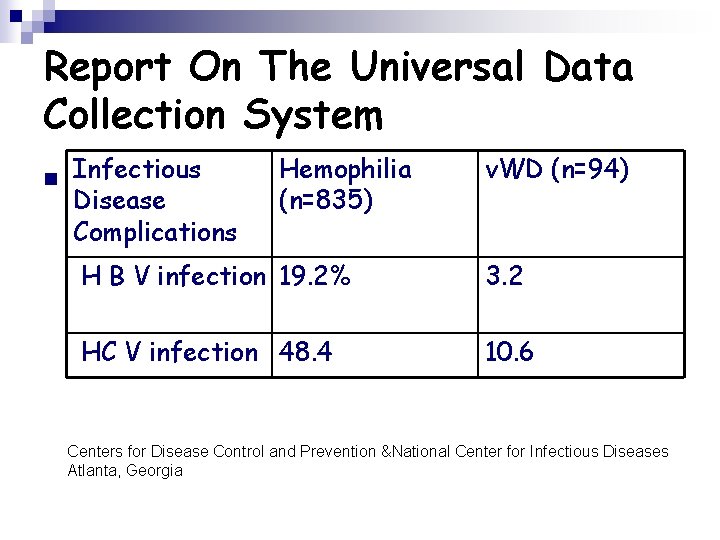
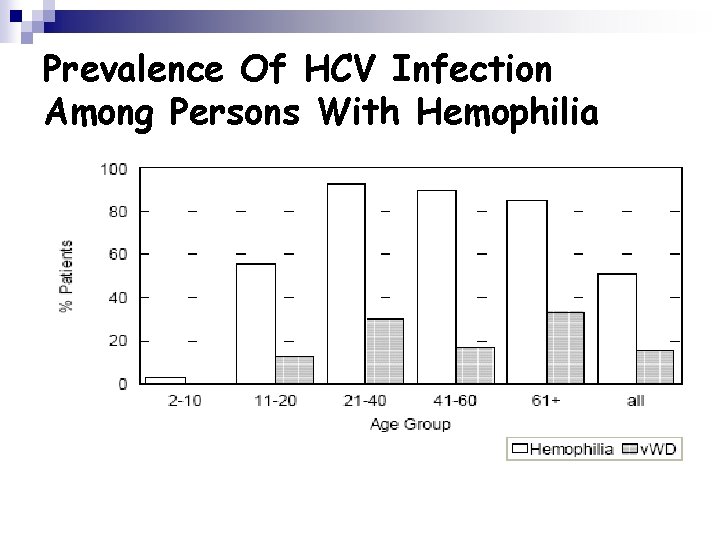
Report On The Universal Data Collection System n Infectious Disease Complications Hemophilia (n=835) v. WD (n=94) H B V infection 19. 2% 3. 2 HC V infection 48. 4 10. 6 Centers for Disease Control and Prevention &National Center for Infectious Diseases Atlanta, Georgia
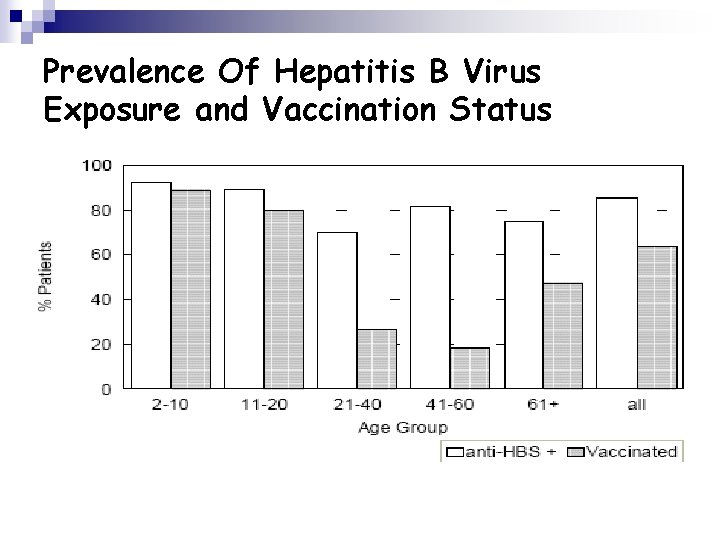
Prevalence Of Hepatitis B Virus Exposure and Vaccination Status
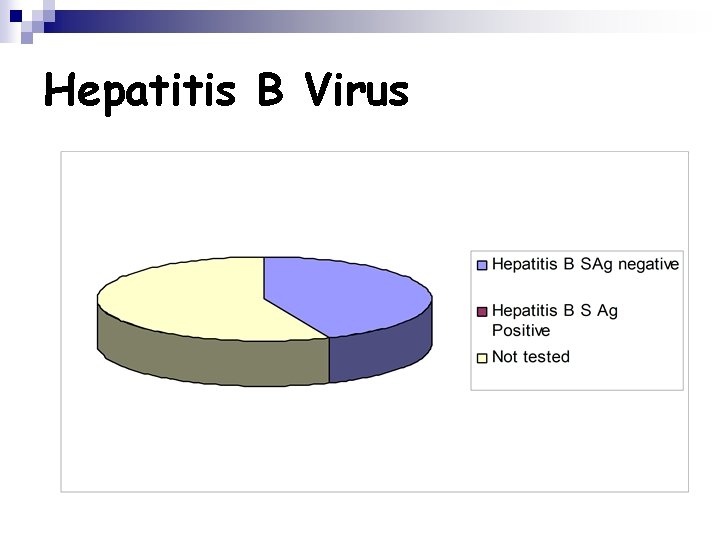
Hepatitis B Virus Infection The rate of exposure to HBV in congenital bleeding disorders 11. 1% Trans R Soc Trop Med Hyg. 1989 Mar-Apr; 83(2): 256 -7 26/44 not tested reflecting lack of written protocols 18/44 tested and were negative reflecting the routine neonatal immunization program started 1990 in SA including HB vaccine
Hepatitis B Virus
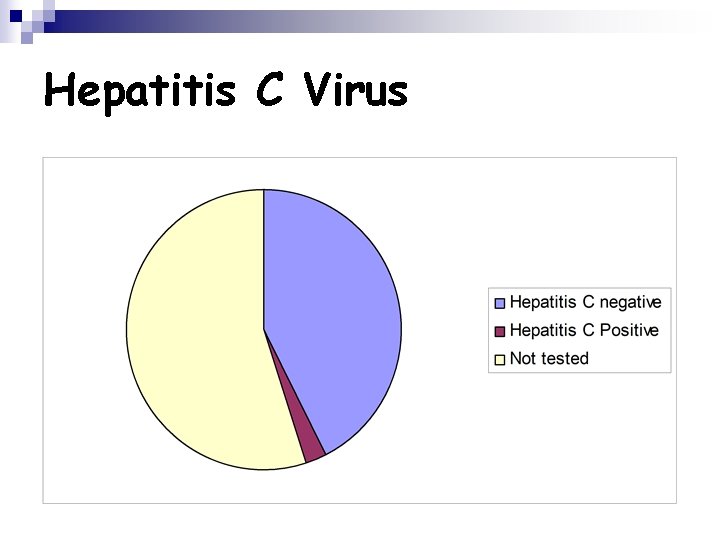
HCV Transmission HCV major cause of virus-induced liver diseases 1990, anti-HCV of blood donors became mandatory Incidence of post-transfusion HCV < 1% Improvements in HCV antibody assays: 1/106 Hemophilia generated new susceptible populations
Prevalence Of HCV Infection Among Persons With Hemophilia
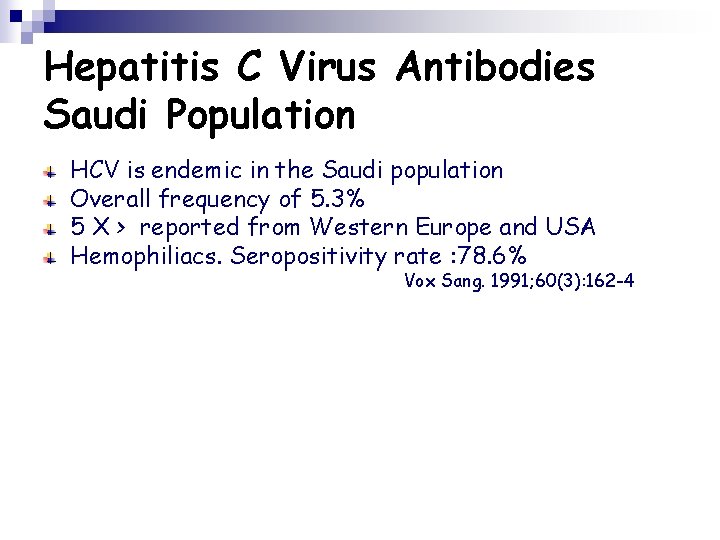
Hepatitis C Virus Antibodies Saudi Population HCV is endemic in the Saudi population Overall frequency of 5. 3% 5 X > reported from Western Europe and USA Hemophiliacs. Seropositivity rate : 78. 6% Vox Sang. 1991; 60(3): 162 -4
Hepatitis C Virus
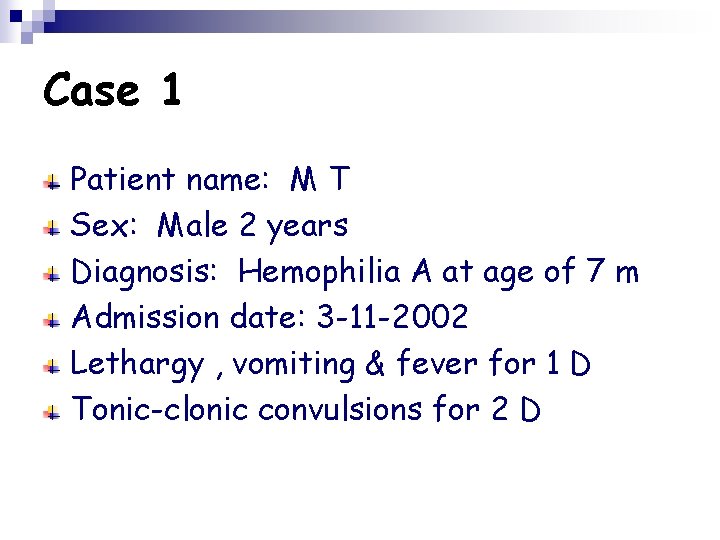
Case 1 Patient name: M T Sex: Male 2 years Diagnosis: Hemophilia A at age of 7 m Admission date: 3 -11 -2002 Lethargy , vomiting & fever for 1 D Tonic-clonic convulsions for 2 D
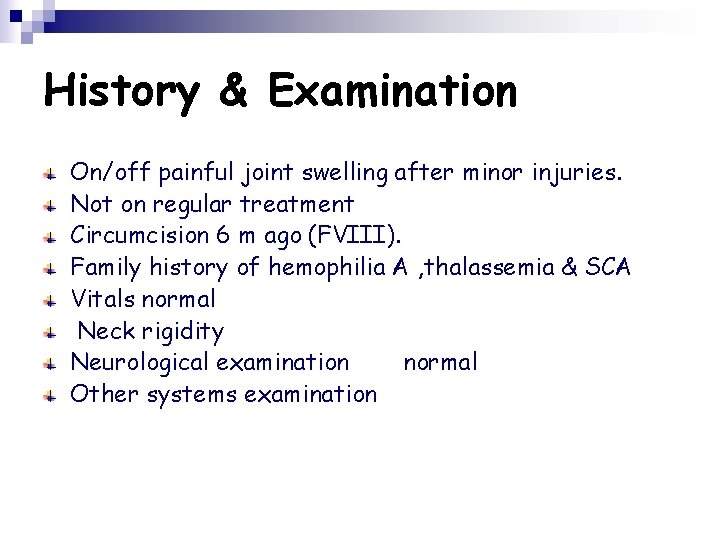
History & Examination On/off painful joint swelling after minor injuries. Not on regular treatment Circumcision 6 m ago (FVIII). Family history of hemophilia A , thalassemia & SCA Vitals normal Neck rigidity Neurological examination normal Other systems examination
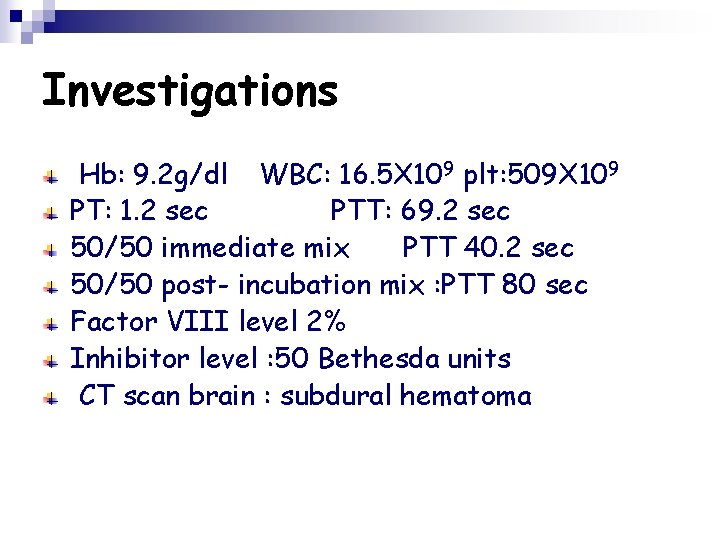
Investigations Hb: 9. 2 g/dl WBC: 16. 5 X 10⁹ plt: 509 X 109 PT: 1. 2 sec PTT: 69. 2 sec 50/50 immediate mix PTT 40. 2 sec 50/50 post- incubation mix : PTT 80 sec Factor VIII level 2% Inhibitor level : 50 Bethesda units CT scan brain : subdural hematoma
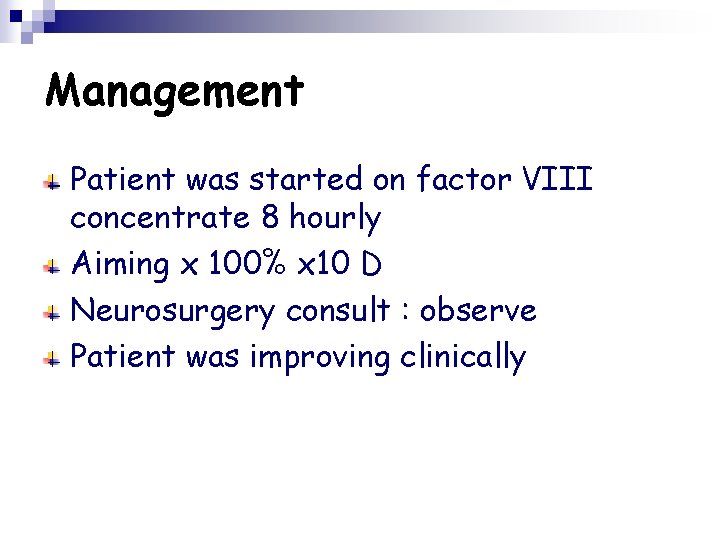
Management Patient was started on factor VIII concentrate 8 hourly Aiming x 100% x 10 D Neurosurgery consult : observe Patient was improving clinically
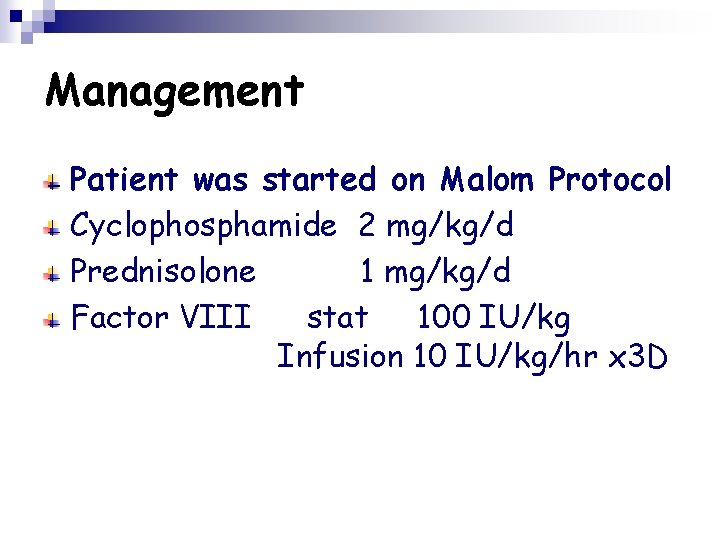
Management Patient was started on Malom Protocol Cyclophosphamide 2 mg/kg/d Prednisolone 1 mg/kg/d Factor VIII stat 100 IU/kg Infusion 10 IU/kg/hr x 3 D
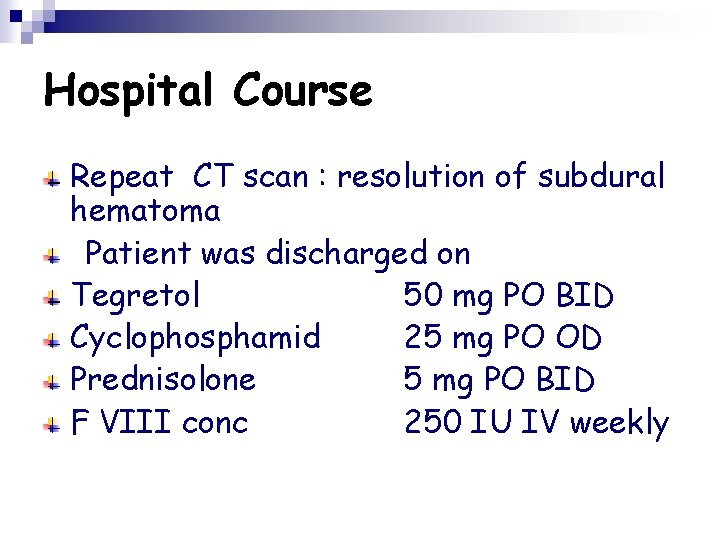
Hospital Course Repeat CT scan : resolution of subdural hematoma Patient was discharged on Tegretol 50 mg PO BID Cyclophosphamid 25 mg PO OD Prednisolone 5 mg PO BID F VIII conc 250 IU IV weekly
Follow-Up Follow-up in OPD Inhibitor screen at Nov 2003: Negative
Case 2 15 y old girl Referred with history of PR bleeding. History of salmonella infection. PMH of ? 2 attacks of DVT (clinical suspicion).
Case History cont CBC : Hb 3. 5 g/dl PLT 159 X 109/L. Isolated prolonged APTT. Mixing studies : NC. LA screen : negative Factor VIII level 2%. PRBCs TX , FFP & FVIII concentrate.
Transfer To KAUH Fresh PR bleeding & heavy menstrual period. Febrile. Bruises on anti-cubital fossa.
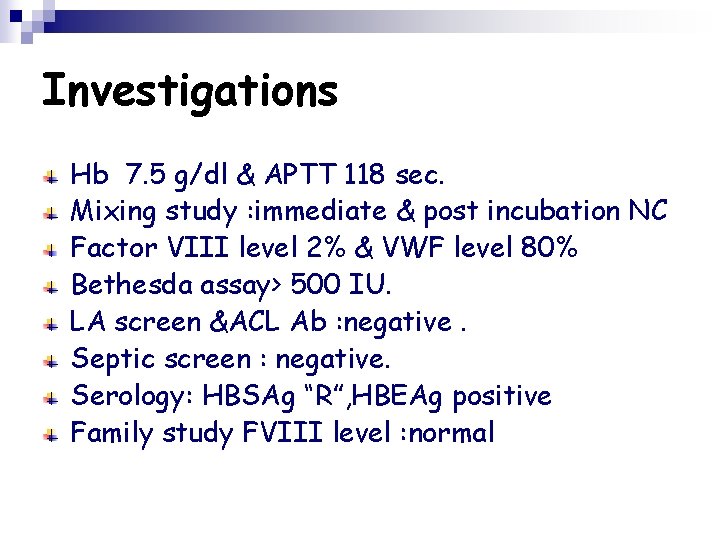
Investigations Hb 7. 5 g/dl & APTT 118 sec. Mixing study : immediate & post incubation NC Factor VIII level 2% & VWF level 80% Bethesda assay> 500 IU. LA screen &ACL Ab : negative. Septic screen : negative. Serology: HBSAg “R”, HBEAg positive Family study FVIII level : normal
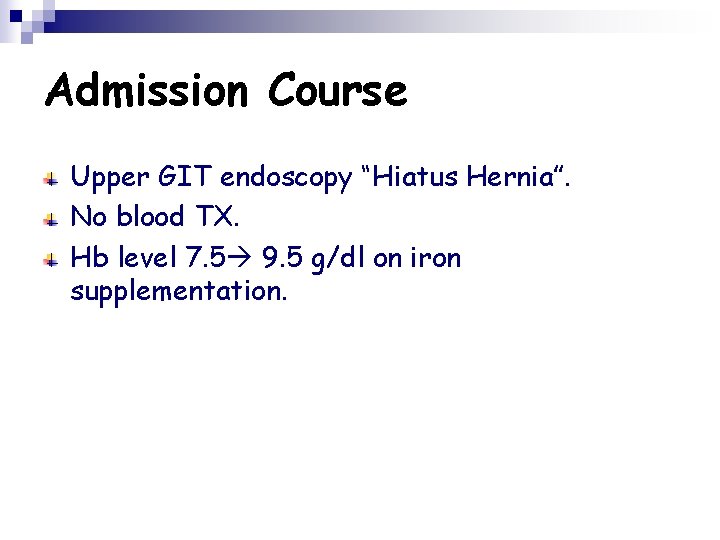
Admission Course Upper GIT endoscopy “Hiatus Hernia”. No blood TX. Hb level 7. 5 9. 5 g/dl on iron supplementation.
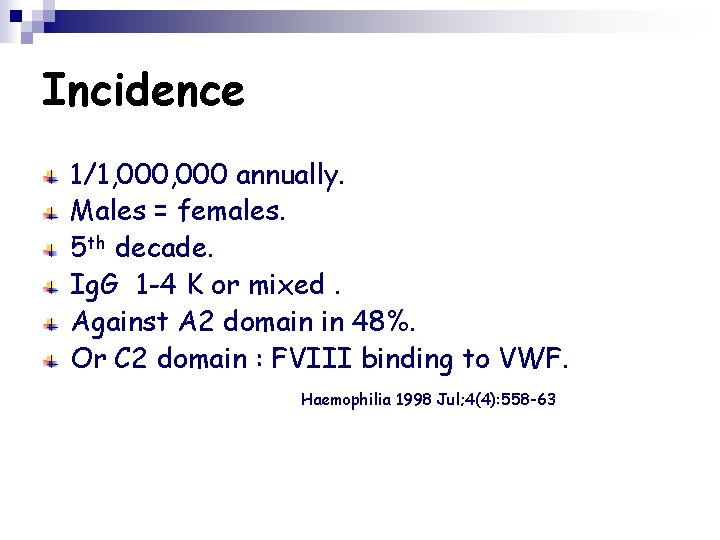
Incidence 1/1, 000 annually. Males = females. 5 th decade. Ig. G 1 -4 K or mixed. Against A 2 domain in 48%. Or C 2 domain : FVIII binding to VWF. Haemophilia 1998 Jul; 4(4): 558 -63
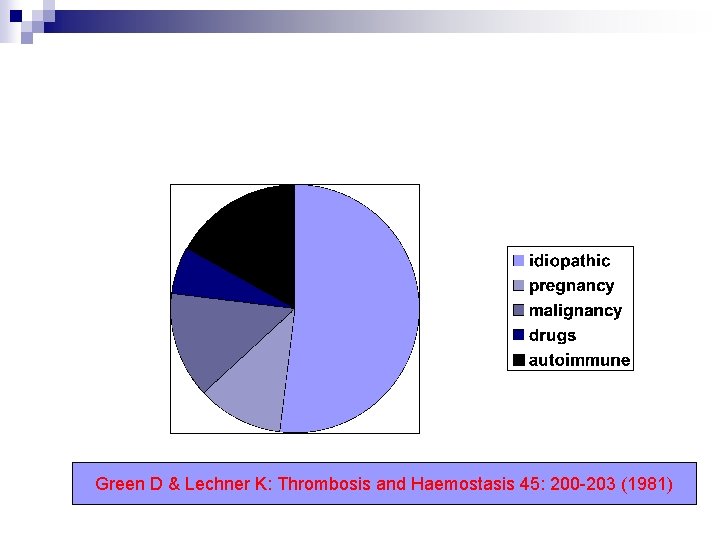
Green D & Lechner K: Thrombosis and Haemostasis 45: 200 -203 (1981)
Management Clinical presentation. Titer of the inhibitor. Associated medical condition. Likelihood of spontaneous remission. Risk of toxicities of therapy. Cost.
Management Prednisolone 6 weeks Regular F/U in OPD Continuous search for underlying cause CT chest , abdomen & pelvis every year Autoimmune profile every 6 m 3 years since diagnosis: Idiopathic Acquired Hemophilia
Dental Extraction During F/U fracture wisdom tooth for extraction Patient was admitted prior to extraction FVII level >1% Bethesda assay >500 IU Trial of FVIII conc under IVIG, no improvement Recombinant FVII 90 micg ; No intra-operative nor post-operative bleed Local fibrin glue to maintain local hemostasis
Case 3 Patient name : H K Known sever HA : bloody diarrhea Oct 2001 Post circumcision bleed Lf knee swelling post trauma Family history : HA brother
Follow Up Intra-muscular hematoma Wasting of the Rt hand muscles post wrist bleed Age : 3 years : Inhibitor : 50 B IU Rt knee hemarthrosis limited extension & flexion Sever tongue bleed which required ICU admission Inhibitor assay 2 BU Low responder
Genetic Disorders &Impact On Health Care Delivery No agreed-upon definitive cure with acceptable risk Chronic nature requires lifelong medical attention Expensive supportive and symptomatic therapy Significant burden on the health care delivery system. el-Hazmi MA East Mediterr Health J. 1999 Nov; 5(6): 1104 -13.
Hemophilia working Group in KAUH Blood bank specialist Pediatrician Infectious disease specialist Orthopedic surgeon Dentist Pharmacist Hemophilia nurse Social worker Hematologist
Thank you