
Hemophilia and other bleeding disorders Brought To You
Hemophilia and other bleeding disorders Brought To You By the West Virginia Chapter of the National Hemophilia Foundation WVNHF Amber Tichnell, Executive Director
THE BASICS � The human body is made up of several clotting factors – Factors 1 through 13 plus Von Willebrand Factor � A person can have deficiencies in any of these factors � These clotting factors are involved in the process called the “clotting cascade” and help form a Platelet Plug at the site of bleeding. � The most common deficiencies experienced (by far) are Factor VIII, Factor IX, and Von Willebrand. � We will be discussing these most common deficiencies today. � The other factor deficiencies are much more rare. If you encounter them, please contact us and we can help you deal with them as they arise.

HEMOPHILIA �Factor VIII deficiency is more commonly known as Hemophilia A or Classic Hemophilia �It is the most common form of Hemophilia. �Hemophilia A is four times as common as Hemophilia B �Factor IX deficiency is more commonly know as Hemophilia B or Christmas disease. �Hemophilia occurs in 1 out of every 5000 live male births.

HEMOPHILIA
HEMOPHILIA: WHAT YOU SHOULD KNOW �People with hemophilia don’t bleed more, they bleed longer �The idea that people with hemophilia can “bleed out” from a simple cut is a myth �The biggest concerns with hemophilia are joint bleeds (which can damage cartilage and bone), and neck and brain bleeds which can be life threatening �People with hemophilia develop “target joints. ” A joint they will bleed into over and over.
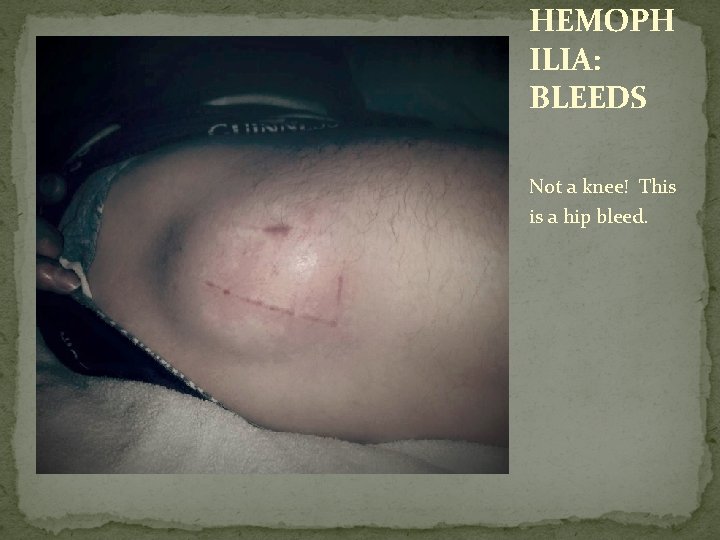
HEMOPH ILIA: BLEEDS Not a knee! This is a hip bleed.
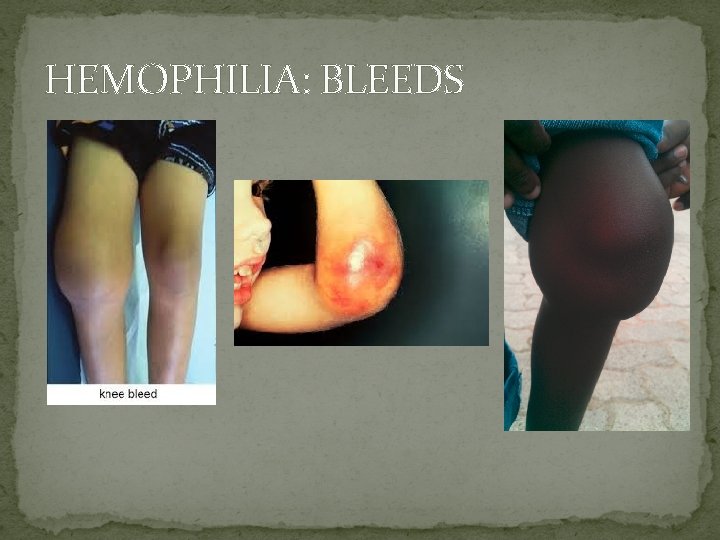
HEMOPHILIA: BLEEDS
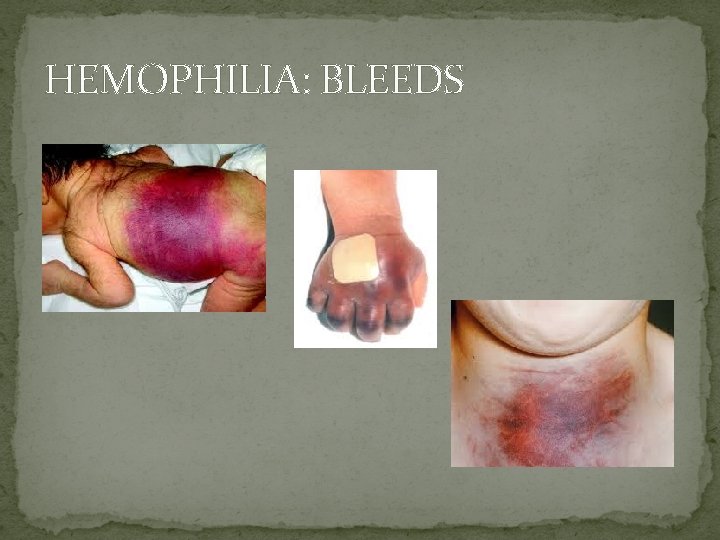
HEMOPHILIA: BLEEDS
HEMOPHILIA: GENETICS �The gene for hemophilia is inherited in the x-linked recessive manner. In other words, Mothers are carriers and sons have a 50/50 chance of inheriting. Daughters have a 50/50 chance of being carriers. �Daughters can have hemophilia, but it is rare and tends to be mild when they do. �About 60% of boys with hemophilia are severe �Approximately 30% of hemophilia cases are spontaneous mutations
HEMOPHILIA: TREATMENT � The treatment for hemophilia is clotting factor, commonly called factor � This is an medication administered intravenously � Severe and sometimes moderate hemophiliacs take factor prophylactically 3 times a week to prevent bleeds and when they have an active bleed. � The medicine is infused - typically over 15 to 20 minutes. � Others take factor only when they have bleeds. � The medication is extremely expensive. The average cost is $3000 a vial and adults can take multiple vials per infusion. This can cost between $500, 000 to $1, 000 a year. � The ACA has helped the bleeding disorder population immensely by getting rid of lifetime maximums and pre-existing condition clauses
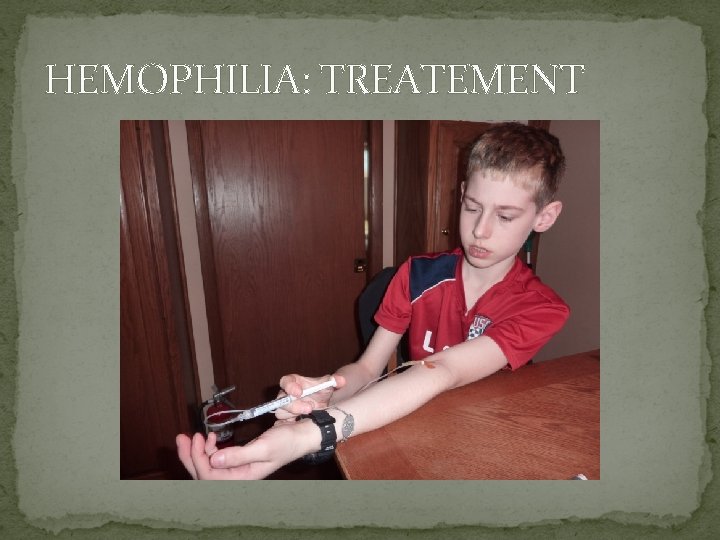
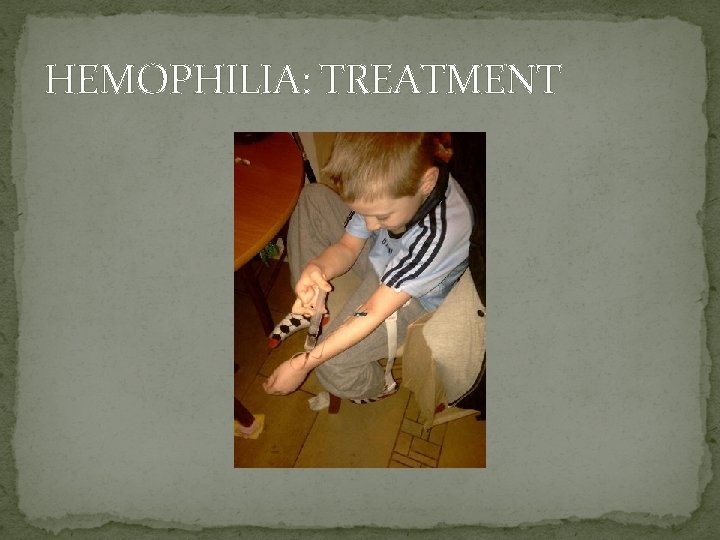
HEMOPHILIA: TREATMENT �Ports are typically inserted in babies diagnosed as severe or moderate to severe. �Families infuse through the port until the child is old enough to move to peripheral infusion. �Children are taught to self-infuse as soon as the child is considered mature enough to handle self-infusion. �This can be as early as 6 years old. �Children are often taught to self-infuse at Hemophilia Camp.
HEMOPHILIA: TREATEMENT
HEMOPHILIA: TREATMENT
HEMOPHILIA: TREATMENT A word about inhibitors: � Inhibitors are when the body’s immune system develop an immune response to clotting factor. � For certain patients, the immune system produces antibodies that “inhibit” clot formation by destroying the clotting factor before it has a chance to stop the bleeding. � Typical treatment for inhibitors is to overwhelm the body with clotting factor. � Inhibitor treatment is extremely expensive and estimates vary widely on how many hemophiliacs are currently affected by inhibitors.
VON WILLEBRAND DISEASE �By far, the most common bleeding disorder is Von Willebrand Disease, known more commonly as VWD or VW �It affects up to 1 in 100 people. �However, estimates vary, because it is also the most underdiagnosed bleeding disorder. �VWD is the #1 cause of unnecessary hysterectomies in the US
VON WILLEBRAND DISEASE �A key difference between hemophilia and VWD is that hemophilia is almost always diagnosed at birth or in the first year. �VWD affects men and women equally. �VWD can go well into adulthood before being recognized. �There are 3 types of VWD, with type 2 having 4 subtypes.
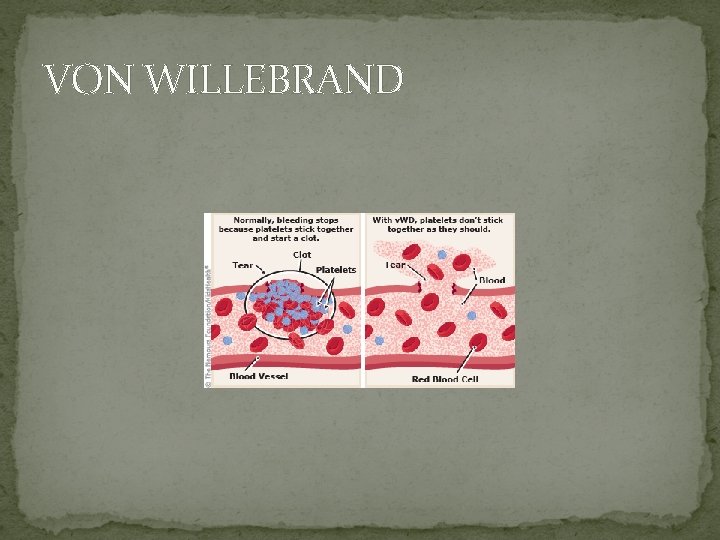
VON WILLEBRAND
VON WILLEBRAND: TYPE 1 QUANTITY �VWD Type one is typically seen as the most mild. �They are lacking in VWD Factor. �This group accounts for 60 -80% of the total VWD population. �They have about 20 -50% of normal VWD factor.
VON WILLEBRAND: TYPE 2 A, 2 B, 2 M, 2 N – QUALITY � Accounts for 15 -30% of the population. � It’s the quality of the VWD. Not the quantity � Type 2 A – The VWF multimers are not the right size. This stops the platelet from making a good plug � Type 2 B - the VWF multimers are not the right size and the VWF becomes too active. It attaches to the platelets in the blood when it is not supposed to. The body quickly gets rid of the platelets with the attached VWF. This causes a shortage of both platelets and VWF in the blood.
VON WILLEBRAND: TYPE 2 A, 2 B, 2 M, 2 N – QUALITY � Type 2 M - the VWF is not able to stick to the platelets and a good platelet plug does not form. � Type 2 N - the VWF is not able to do its job as the carrier of factor VIII. The level of factor VIII in the body is low because it doesn’t have the VWF to keep it from being broken down. With low levels of factor VIII, the body has trouble making a fibrin clot. A person with Type 2 N VWD can appear to have mild hemophilia with some of the same symptoms. It is not hemophilia, though, because the problem is with the VWF and not the factor VIII. Another name for Type 2 N is Type 2 Normandy.
VON WILLEBRAND: TYPE 3 QUANTITY �Typically the most severe �It’s the quantity of VWD that’s the issue �People with Type 3 make little to no VWF �Have low factor 8 levels �Type 3’s can have spontaneous bleeds
VON WILLEBRAND DISEASE: SIGNS AND SYPMTOMS �Frequent and/or prolonged nosebleeds �Easy bruising �Heavy and/or prolonged menstrual bleeding �Anemia �Excessive bleeding after dental work or surgery �In severe cases, spontaneous bleeding in soft tissue and joints �Hemorrhaging after child birth
VON WILLEBRAN DISEASE: GENETICS �Carried on chromosome 12 �Equally affects men and women �If a parent has VWD, then their child has a 50/50 chance of being affected.
VON WILLEBRAND TREATMENT
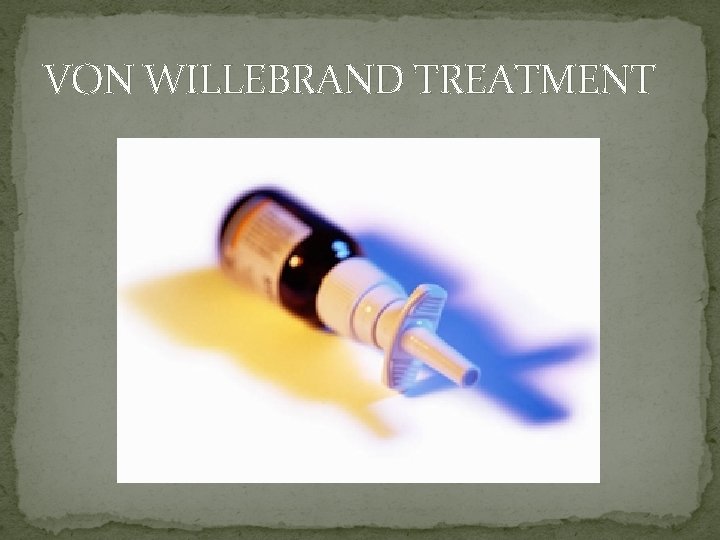
VON WILLEBRAND TREATMENT �DDAVP – Most common treatment. Releases stored VWD from the body. Comes in a nose spray or injection. (anti-diuretic – watch fluid intake. ) �Antifibrinalytic Agents –Prevent the breakdown of clots. �For Females, Oral Contraceptive Agents for heavy menstrual bleeding. �In severe cases, like type 3, infusion of factor 8 is necessary.
VON WILLEBRAND DISEASE: DIAGNOSIS
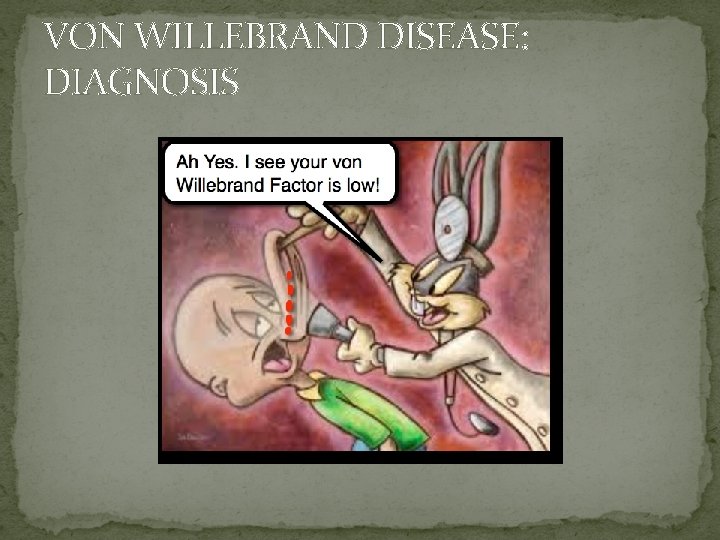
VON WILLEBRAND: DIANOSIS �As mentioned earlier, can be caught much later in life. �Many variables affect testing: stress, hormone levels, fear of needles, etc. �May need multiple tests to make diagnosis
BLEEDING DISORDERS: WHERE TO REFER? �HEMOPHILIA TREATMENT CENTERS (HTC’S) ARE THE STANDARD OF CARE �Patients are seen by Benign Hematologists who specialize in bleeding disorders (Pediatric and Adult) �West Virginia ha. S two HTC’s �West Virgnia University Hospital (Ruby) in Morgantown. The contact is: Sylvia Webber 304293 -4500 �Charleston Area Medical Center in Charleston. The contact is Donna Arden 304 -388 -8896
BLEEDING DISORDERS: RESOURCES � The West Virginia Chapter of the National Hemophilia Foundation works with people with bleeding disorders throughout the state � Funding to get to and from doctors’ appointments. Emergency assistance funding for patients � Educational programming for patients and families throughout the year � Advocacy programs at the local, state and national level. � WVNHF helps to create a sense of community for those with bleeding disorders. � Will travel anywhere in WV.
BLEEDING DISORDERS: RESOURCES �www. wvnhf. org �https: //www. facebook. com/wvnhf/ �National Hemophilia Foundation Website www. hemophilia. org �An assessment tool for bleeding disorders can be found at: http: //www. wfh. org/en/resources/bleedingassessment-tools �A short video on VWD: https: //stepsforliving. hemophilia. org/resources/ videos/VWD
BLEEDING DISORDERS: RESOURCES �Video for schools that have a student with a bleeding disorder: https: //stepsforliving. hemophilia. org/resources/ videos/for-schools
- Slides: 31