
HEMODYNAMICS Dr R Tandon Sitaram Bhartia Institute New
HEMODYNAMICS Dr. R. Tandon Sitaram Bhartia Institute, New Delhi
Pressures RA RV PA PAW LA (PV) LV SA : a = 2 -6; V = 2 -4 m = 3 (0 -6) : 15 -25 edp 0 -5. : 15 -25; diast. 6 -10, m = 10 -15. : a = 6 -12, V = 8 -14, m 6 -10 (12) : a=6 -12, V=8 -14, m = 6 -10 (12) : 90 -120 / 0 -10 (12) : 90 -120 / 60 -75 (70 -85).
Pressures i) RA a = RV edp ‘a’ edp = TS ii) PA diast. = LA m. PA diast. LA (m) = PVR iii) PAW ‘a’ = LA ‘a’ = LV edp. iv) PAW ‘a’ (LA a) edp = obstr. (PV obstr, cortriat, MS, supra valv ring).
Oxymetry Oxygen Capacity (vol. %) Oxygen content (vol. %) Oxygen saturation (%) Vol % = ml O 2 / 100 ml. Bl.
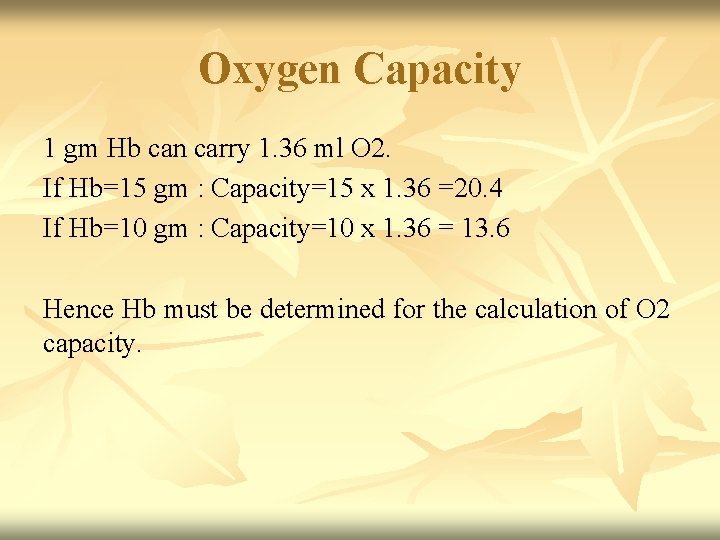
Oxygen Capacity 1 gm Hb can carry 1. 36 ml O 2. If Hb=15 gm : Capacity=15 x 1. 36 =20. 4 If Hb=10 gm : Capacity=10 x 1. 36 = 13. 6 Hence Hb must be determined for the calculation of O 2 capacity.

Oxygen Saturation (%) % of oxygenated Hb. Obtained directly using oxymeters. Pulm. Ven. Sat. = 98% (100%). Arterial O 2 Sat. = PV sat = 98 -100%. Mixed ven. O 2 Sat = 75 -80% (PA). A drop of 2% or in arterial O 2 sat. compared to PV Sat. = R L shunt
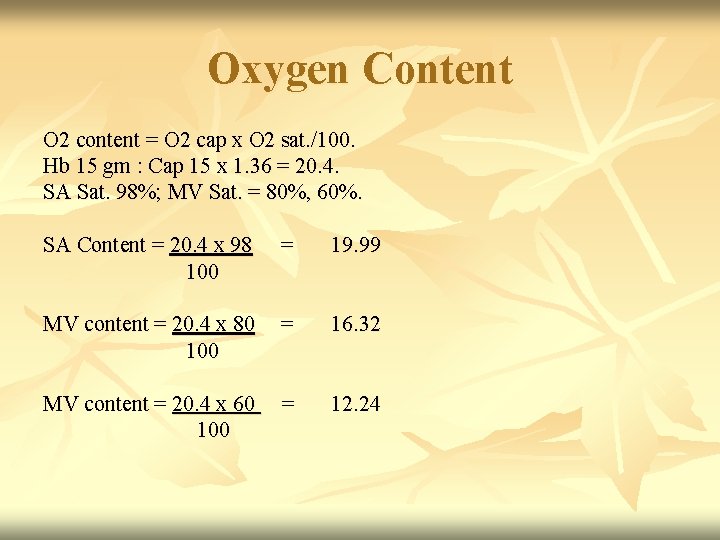
Oxygen Content O 2 content = O 2 cap x O 2 sat. /100. Hb 15 gm : Cap 15 x 1. 36 = 20. 4. SA Sat. 98%; MV Sat. = 80%, 60%. SA Content = 20. 4 x 98 100 = 19. 99 MV content = 20. 4 x 80 100 = 16. 32 MV content = 20. 4 x 60 100 = 12. 24
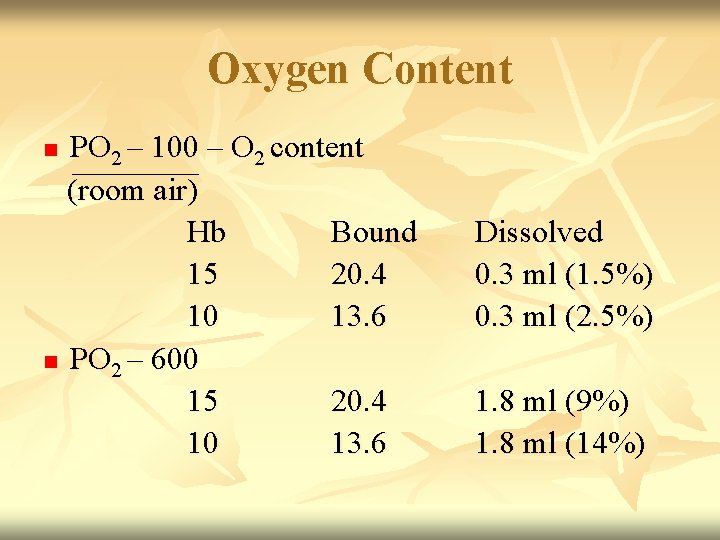
Oxygen Content PO 2 – 100 – O 2 content (room air) Hb Bound 15 20. 4 10 13. 6 n PO 2 – 600 15 20. 4 10 13. 6 n Dissolved 0. 3 ml (1. 5%) 0. 3 ml (2. 5%) 1. 8 ml (9%) 1. 8 ml (14%)
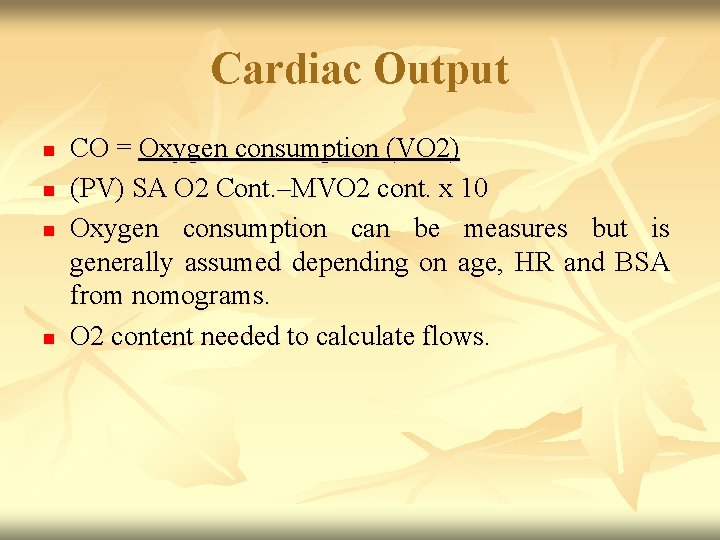
Cardiac Output n n CO = Oxygen consumption (VO 2) (PV) SA O 2 Cont. –MVO 2 cont. x 10 Oxygen consumption can be measures but is generally assumed depending on age, HR and BSA from nomograms. O 2 content needed to calculate flows.
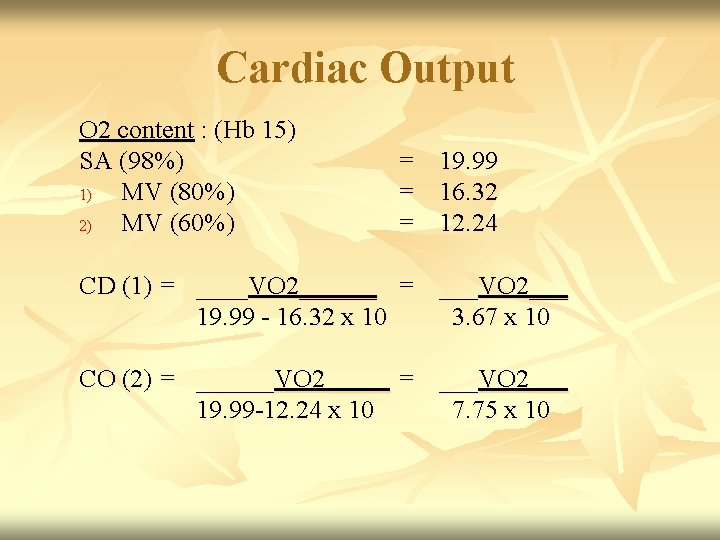
Cardiac Output O 2 content : (Hb 15) SA (98%) 1) MV (80%) 2) MV (60%) = = = 19. 99 16. 32 12. 24 CD (1) = ____VO 2______ = ___VO 2___ 19. 99 - 16. 32 x 10 3. 67 x 10 CO (2) = ______VO 2_____ = ___VO 2___ 19. 99 -12. 24 x 10 7. 75 x 10
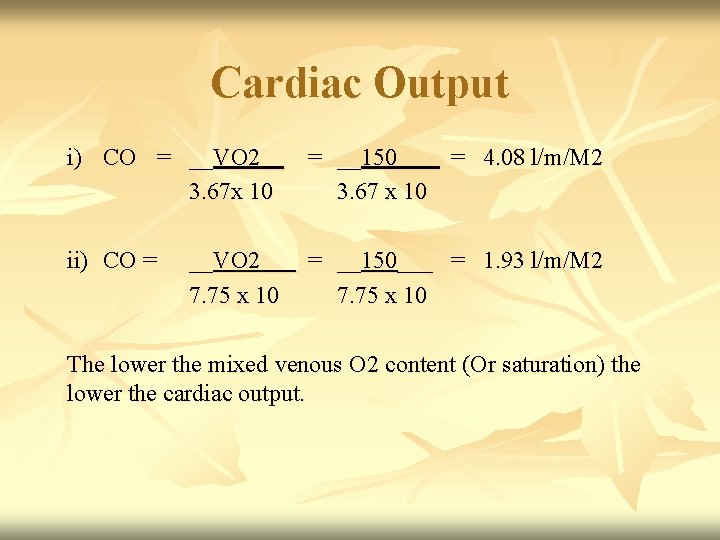
Cardiac Output i) CO = __VO 2__ = __150___ = 4. 08 l/m/M 2 3. 67 x 10 3. 67 x 10 ii) CO = __VO 2___ = __150___ = 1. 93 l/m/M 2 7. 75 x 10 The lower the mixed venous O 2 content (Or saturation) the lower the cardiac output.
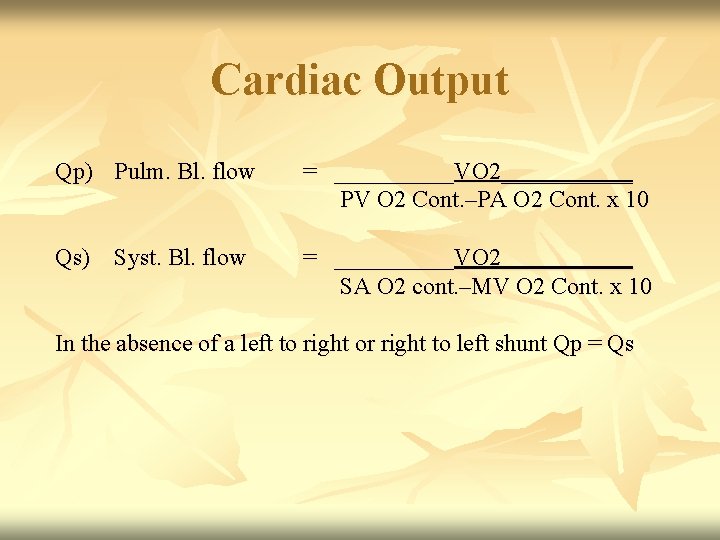
Cardiac Output Qp) Pulm. Bl. flow = _____VO 2______ PV O 2 Cont. –PA O 2 Cont. x 10 Qs) Syst. Bl. flow = _____VO 2______ SA O 2 cont. –MV O 2 Cont. x 10 In the absence of a left to right or right to left shunt Qp = Qs
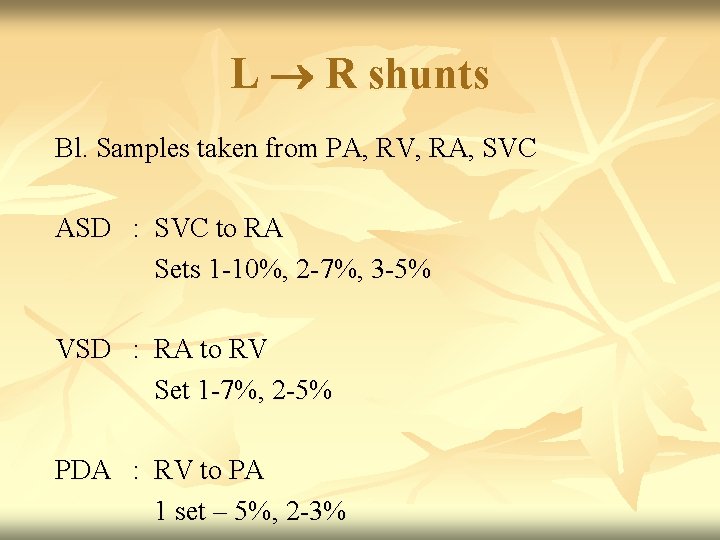
L R shunts Bl. Samples taken from PA, RV, RA, SVC ASD : SVC to RA Sets 1 -10%, 2 -7%, 3 -5% VSD : RA to RV Set 1 -7%, 2 -5% PDA : RV to PA 1 set – 5%, 2 -3%
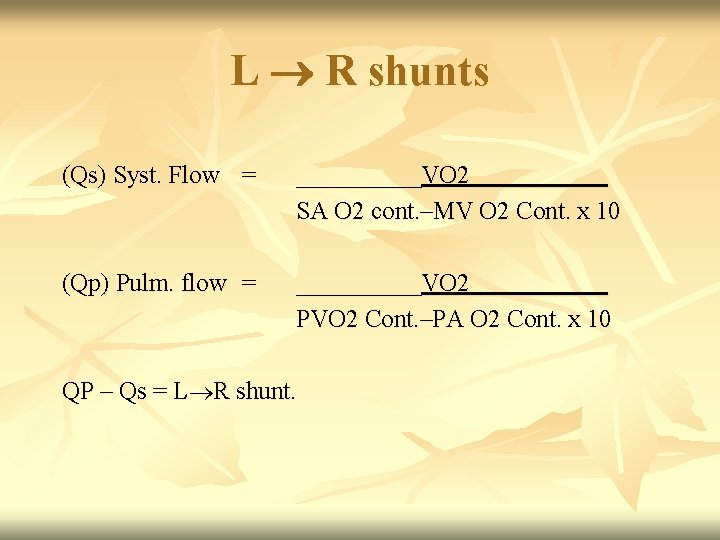
L R shunts (Qs) Syst. Flow = _____VO 2______ SA O 2 cont. –MV O 2 Cont. x 10 (Qp) Pulm. flow = _____VO 2______ PVO 2 Cont. –PA O 2 Cont. x 10 QP – Qs = L R shunt.
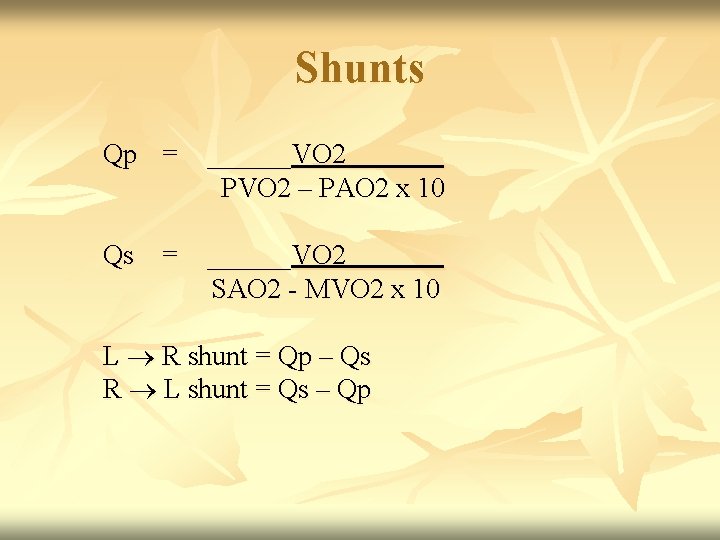
Shunts Qp = ______VO 2_______ PVO 2 – PAO 2 x 10 Qs = ______VO 2_______ SAO 2 - MVO 2 x 10 L R shunt = Qp – Qs R L shunt = Qs – Qp
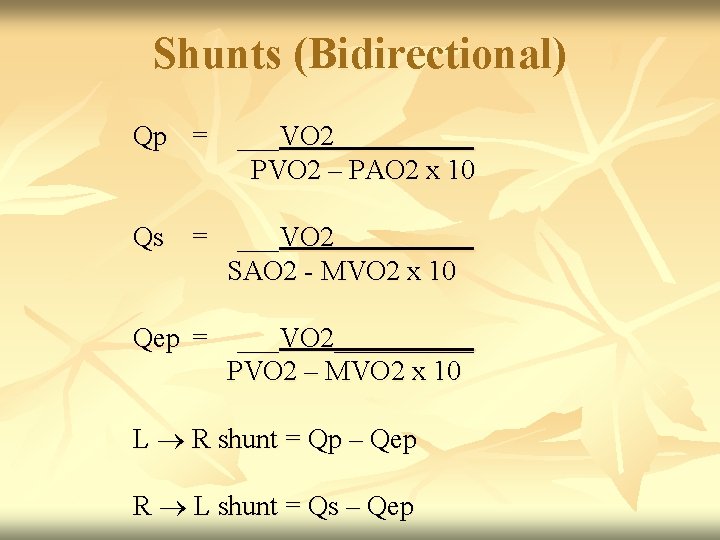
Shunts (Bidirectional) Qp = ___VO 2_____ PVO 2 – PAO 2 x 10 Qs = ___VO 2_____ SAO 2 - MVO 2 x 10 Qep = ___VO 2_____ PVO 2 – MVO 2 x 10 L R shunt = Qp – Qep R L shunt = Qs – Qep
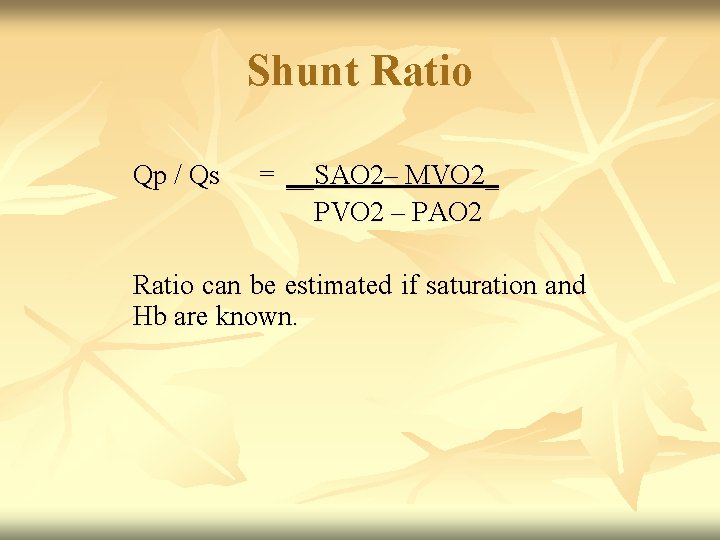
Shunt Ratio Qp / Qs = __SAO 2– MVO 2_ PVO 2 – PAO 2 Ratio can be estimated if saturation and Hb are known.
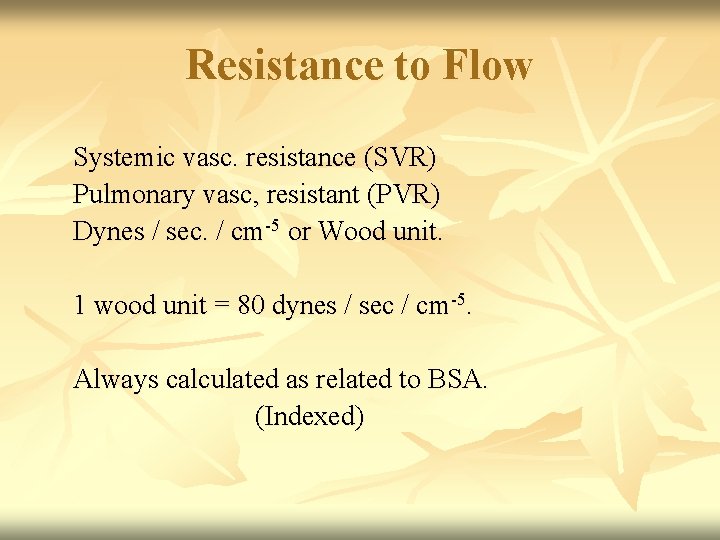
Resistance to Flow Systemic vasc. resistance (SVR) Pulmonary vasc, resistant (PVR) Dynes / sec. / cm-5 or Wood unit. 1 wood unit = 80 dynes / sec / cm-5. Always calculated as related to BSA. (Indexed)
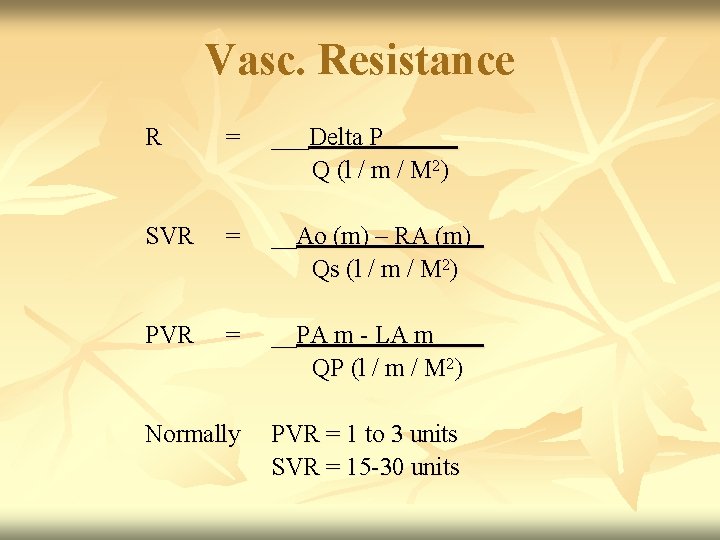
Vasc. Resistance R = ___Delta P______ Q (l / m / M 2) SVR = __Ao (m) – RA (m)_ Qs (l / m / M 2) PVR = __PA m - LA m____ QP (l / m / M 2) Normally PVR = 1 to 3 units SVR = 15 -30 units

- Slides: 20