
HEMODIALYSIS www akronchildrens orggiving Rupesh Raina MD FAAP

![Counter - current Flow Concurrent Flow Blood [Urea] [Solute] Blood [Urea] Dialysate [Urea] www.](https://slidetodoc.com/presentation_image_h2/5a700538a2429c518bc6f1d963be04d3/image-10.jpg "Counter - current Flow Concurrent Flow Blood [Urea] [Solute] Blood [Urea] Dialysate [Urea] www.")
- Slides: 43
HEMODIALYSIS www. akronchildrens. org/giving
Rupesh Raina MD, FAAP and FACP Consultant Nephrologist Adult-Pediatric Kidney Disease/Hypertension Department of Nephrology Director of Medical Research in Internal Medicine Akron General Medical Center Associate of Cleveland Clinic Foundation & Akron Children's Hospital, Cleveland Ohio. Council Member for University Council of Deans Northeast Ohio Medical University Faculty Staff at Case Western Reserve University School of Medicine Cleveland Ohio. www. akronchildrens. org/giving
About Akron Children’s • Ranked a Best Children’s Hospital by U. S. News & World Report • 10 th largest children’s hospital in country* • Magnet® Recognition for Nursing Excellence • Largest pediatric provider in NE Ohio • 2 hospital campuses • 23+ primary care locations • 60+ specialty location • 4, 700+ employees • 700+ medical staff *Source: 2013 Becker's Hospital Review www. akronchildrens. org/giving
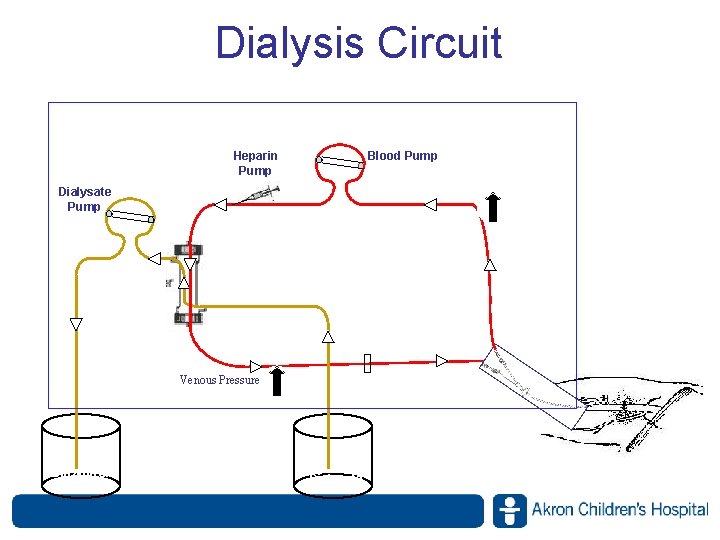
Dialysis Circuit Heparin Pump Blood Pump Arterial Pressure Monitor Dialysate Pump Dialysis Access Venous Pressure Monitor Air Trap Femoral Vein Ultrafiltrate Dialysate www. akronchildrens. org/giving
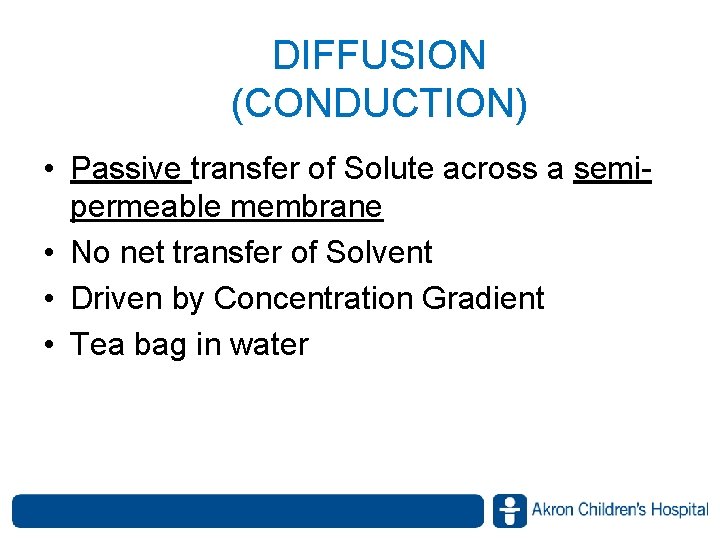
DIFFUSION (CONDUCTION) • Passive transfer of Solute across a semipermeable membrane • No net transfer of Solvent • Driven by Concentration Gradient • Tea bag in water www. akronchildrens. org/giving
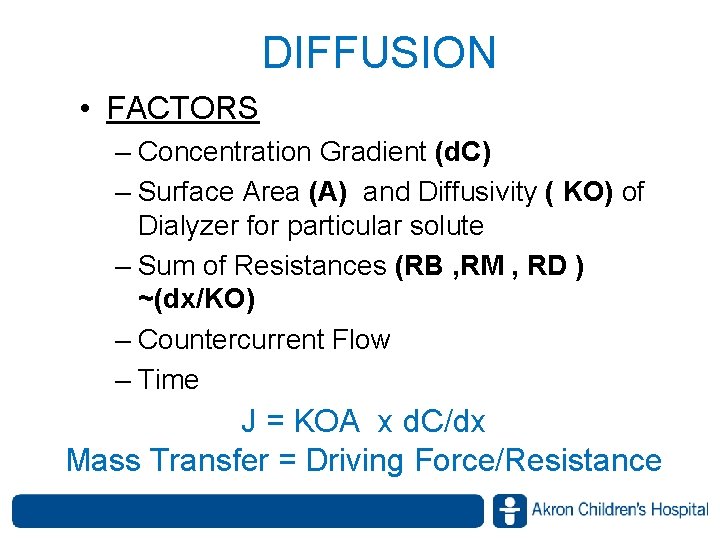
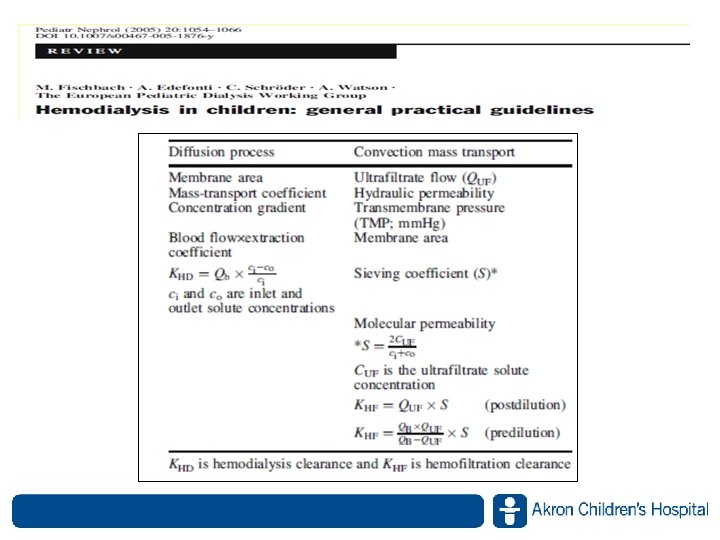
DIFFUSION • FACTORS – Concentration Gradient (d. C) – Surface Area (A) and Diffusivity ( KO) of Dialyzer for particular solute – Sum of Resistances (RB , RM , RD ) ~(dx/KO) – Countercurrent Flow – Time J = KOA x d. C/dx Mass Transfer = Driving Force/Resistance www. akronchildrens. org/giving
www. akronchildrens. org/giving
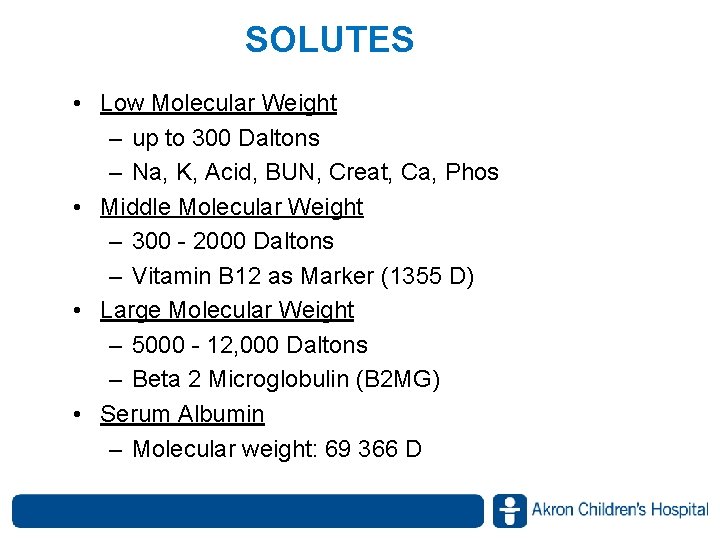
SOLUTES • Low Molecular Weight – up to 300 Daltons – Na, K, Acid, BUN, Creat, Ca, Phos • Middle Molecular Weight – 300 - 2000 Daltons – Vitamin B 12 as Marker (1355 D) • Large Molecular Weight – 5000 - 12, 000 Daltons – Beta 2 Microglobulin (B 2 MG) • Serum Albumin – Molecular weight: 69 366 D www. akronchildrens. org/giving
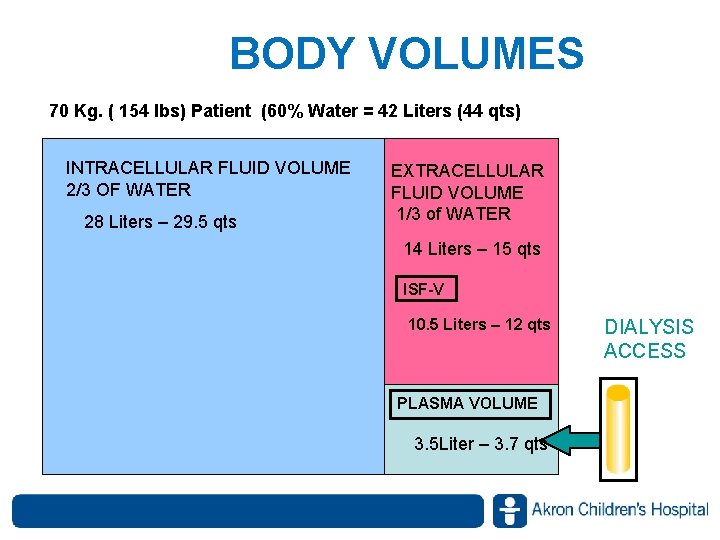
BODY VOLUMES 70 Kg. ( 154 lbs) Patient (60% Water = 42 Liters (44 qts) INTRACELLULAR FLUID VOLUME 2/3 OF WATER 28 Liters – 29. 5 qts EXTRACELLULAR FLUID VOLUME 1/3 of WATER 14 Liters – 15 qts ISF-V 10. 5 Liters – 12 qts PLASMA VOLUME 3. 5 Liter – 3. 7 qts www. akronchildrens. org/giving DIALYSIS ACCESS
Counter - current Flow Concurrent Flow Blood [Urea] [Solute] Blood [Urea] Dialysate [Urea] www. akronchildrens. org/giving Dialysate [Urea]
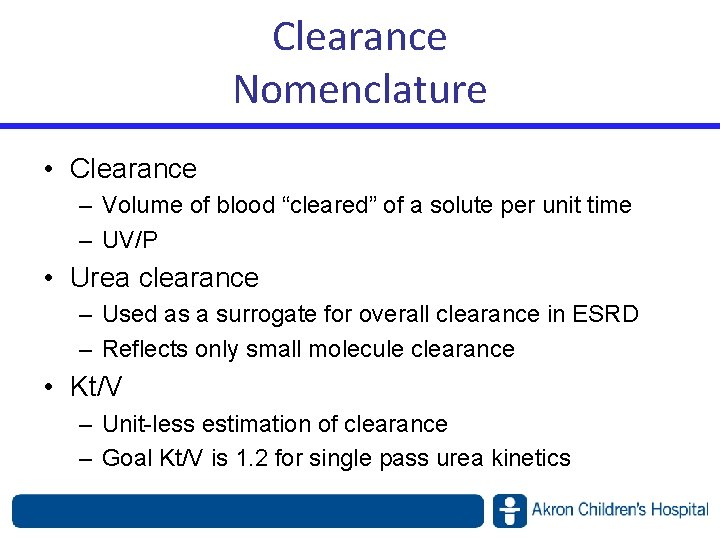
Clearance Nomenclature • Clearance – Volume of blood “cleared” of a solute per unit time – UV/P • Urea clearance – Used as a surrogate for overall clearance in ESRD – Reflects only small molecule clearance • Kt/V – Unit-less estimation of clearance – Goal Kt/V is 1. 2 for single pass urea kinetics www. akronchildrens. org/giving
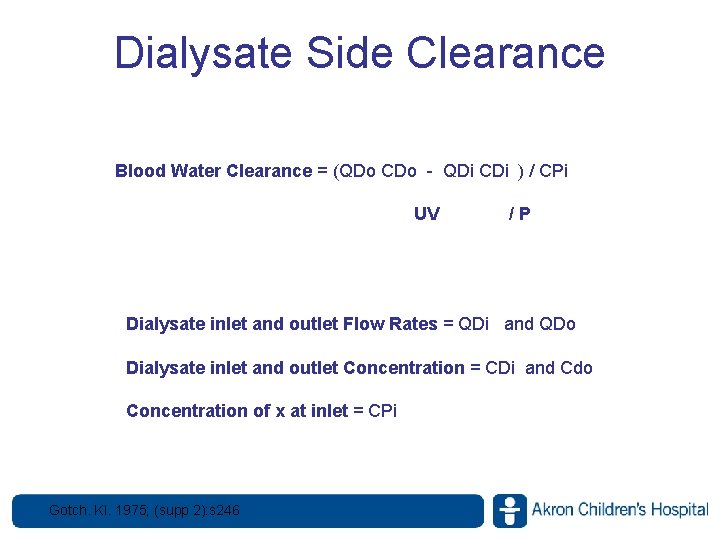
Dialysate Side Clearance Blood Water Clearance = (QDo CDo - QDi CDi ) / CPi UV /P Dialysate inlet and outlet Flow Rates = QDi and QDo Dialysate inlet and outlet Concentration = CDi and Cdo Concentration of x at inlet = CPi Gotch. KI. 1975; (supp 2): s 246 www. akronchildrens. org/giving
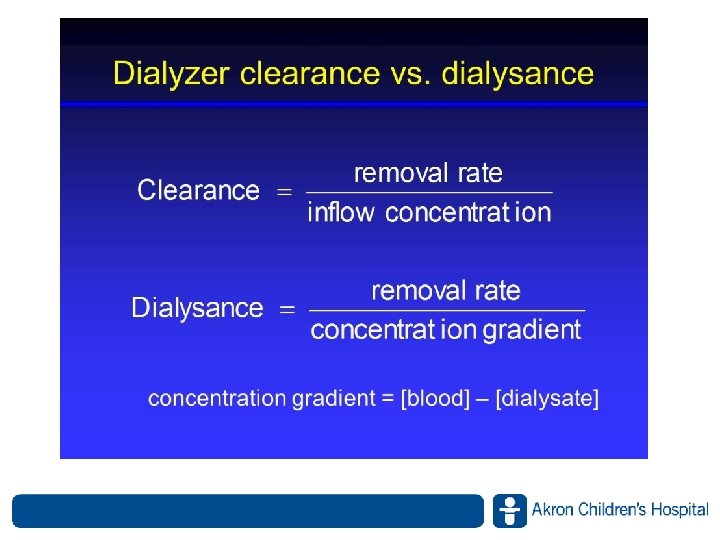
www. akronchildrens. org/giving
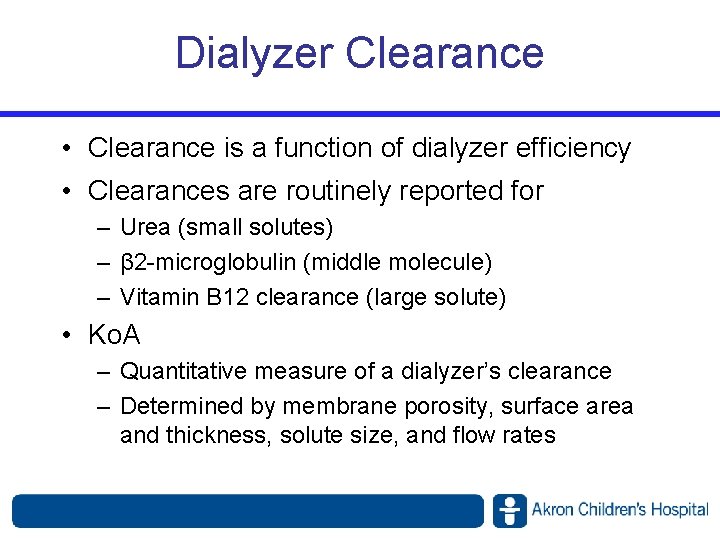
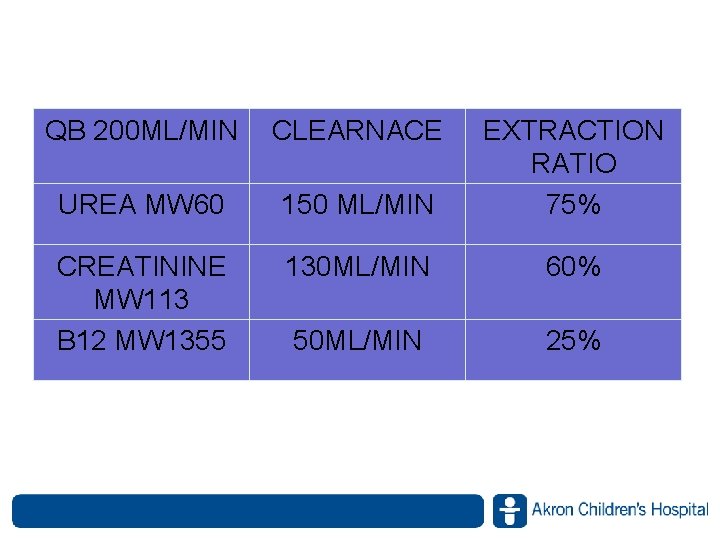
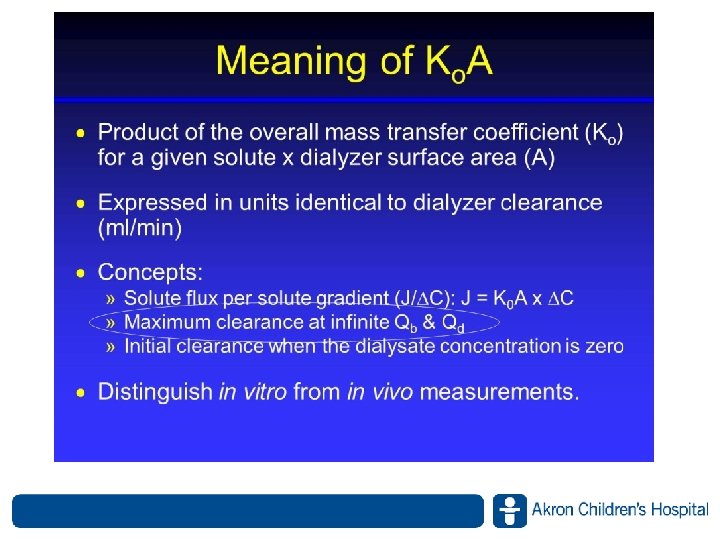
Dialyzer Clearance • Clearance is a function of dialyzer efficiency • Clearances are routinely reported for – Urea (small solutes) – β 2 -microglobulin (middle molecule) – Vitamin B 12 clearance (large solute) • Ko. A – Quantitative measure of a dialyzer’s clearance – Determined by membrane porosity, surface area and thickness, solute size, and flow rates www. akronchildrens. org/giving
QB 200 ML/MIN CLEARNACE UREA MW 60 150 ML/MIN EXTRACTION RATIO 75% CREATININE MW 113 B 12 MW 1355 130 ML/MIN 60% 50 ML/MIN 25% www. akronchildrens. org/giving
www. akronchildrens. org/giving
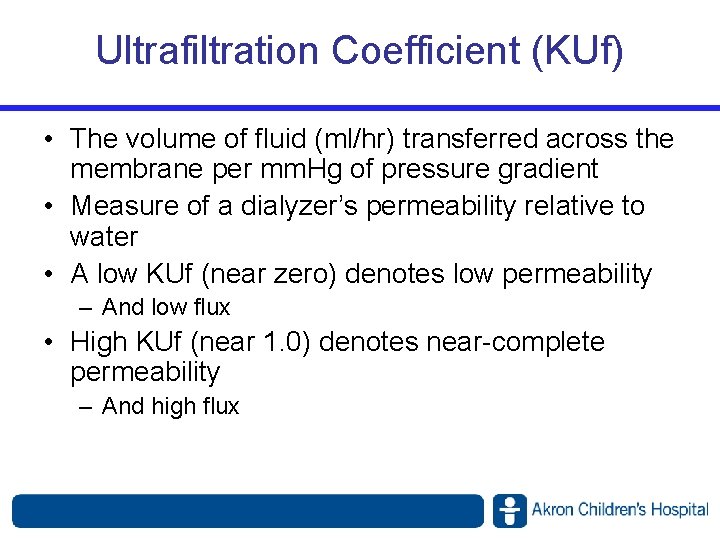
Ultrafiltration Coefficient (KUf) • The volume of fluid (ml/hr) transferred across the membrane per mm. Hg of pressure gradient • Measure of a dialyzer’s permeability relative to water • A low KUf (near zero) denotes low permeability – And low flux • High KUf (near 1. 0) denotes near-complete permeability – And high flux www. akronchildrens. org/giving
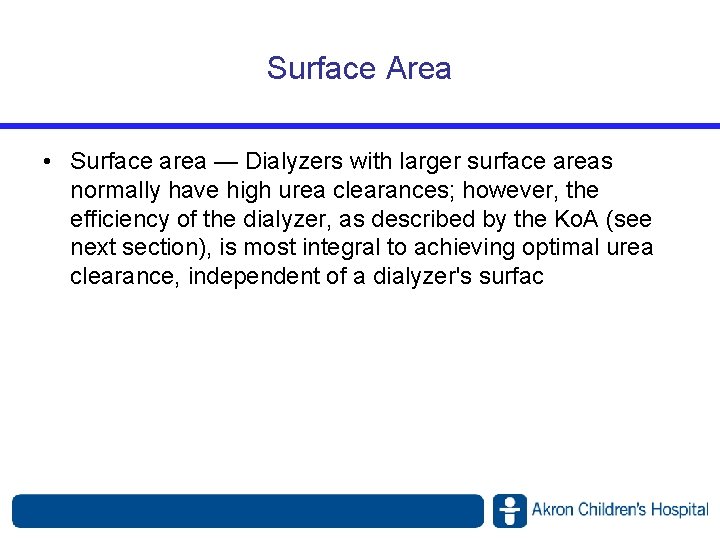
Surface Area • Surface area — Dialyzers with larger surface areas normally have high urea clearances; however, the efficiency of the dialyzer, as described by the Ko. A (see next section), is most integral to achieving optimal urea clearance, independent of a dialyzer's surface area. www. akronchildrens. org/giving
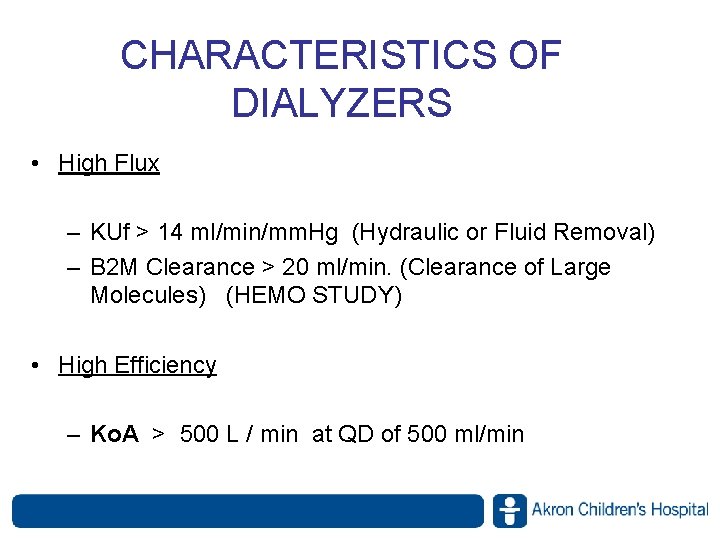
CHARACTERISTICS OF DIALYZERS • High Flux – KUf > 14 ml/min/mm. Hg (Hydraulic or Fluid Removal) – B 2 M Clearance > 20 ml/min. (Clearance of Large Molecules) (HEMO STUDY) • High Efficiency – Ko. A > 500 L / min at QD of 500 ml/min www. akronchildrens. org/giving
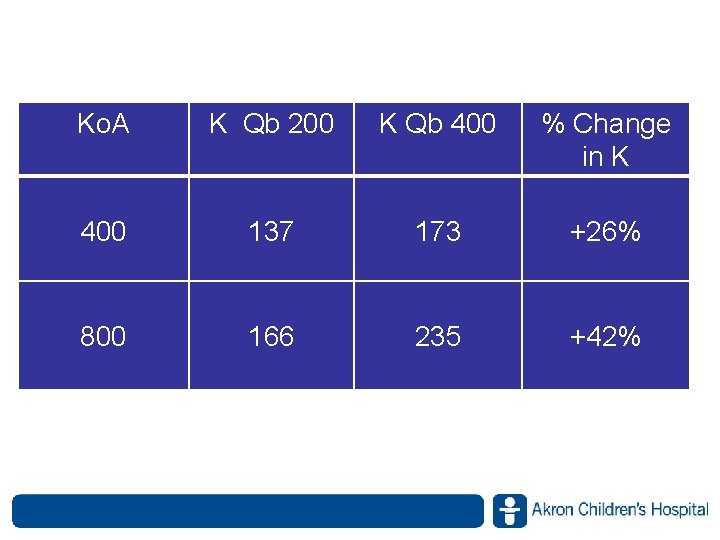
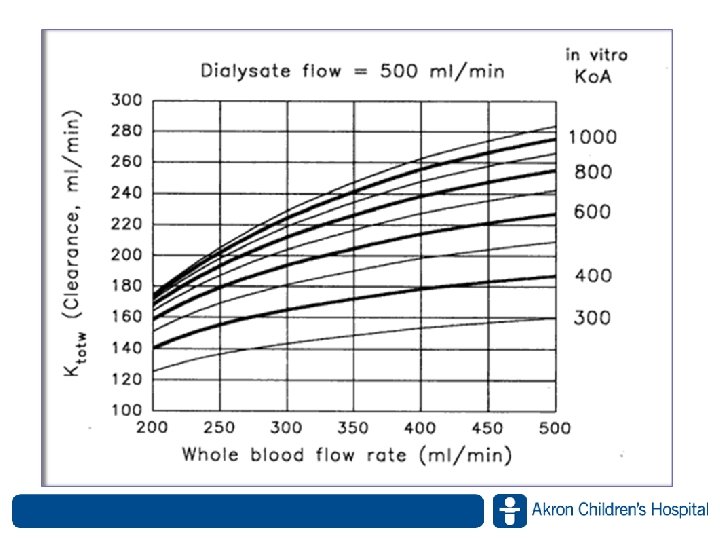
Ko. A K Qb 200 K Qb 400 % Change in K 400 137 173 +26% 800 166 235 +42% www. akronchildrens. org/giving
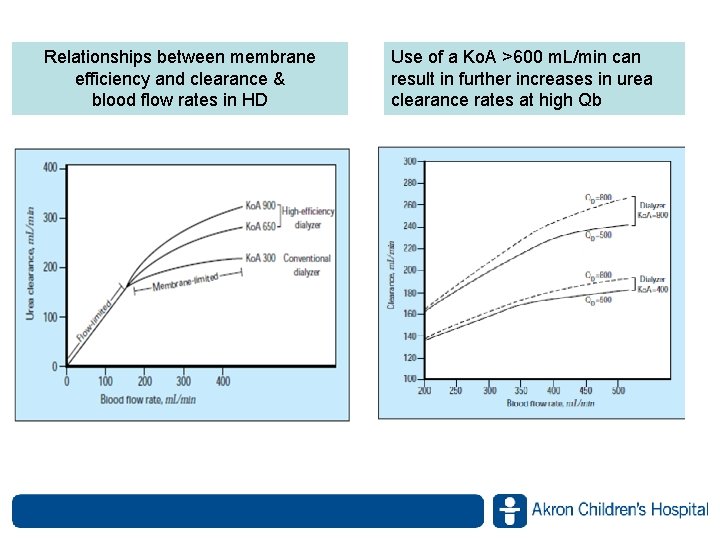
Relationships between membrane efficiency and clearance & blood flow rates in HD Use of a Ko. A >600 m. L/min can result in further increases in urea clearance rates at high Qb www. akronchildrens. org/giving
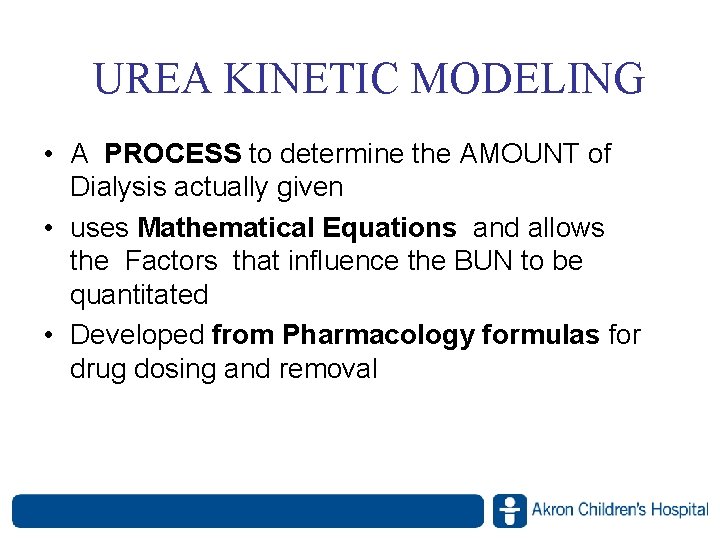
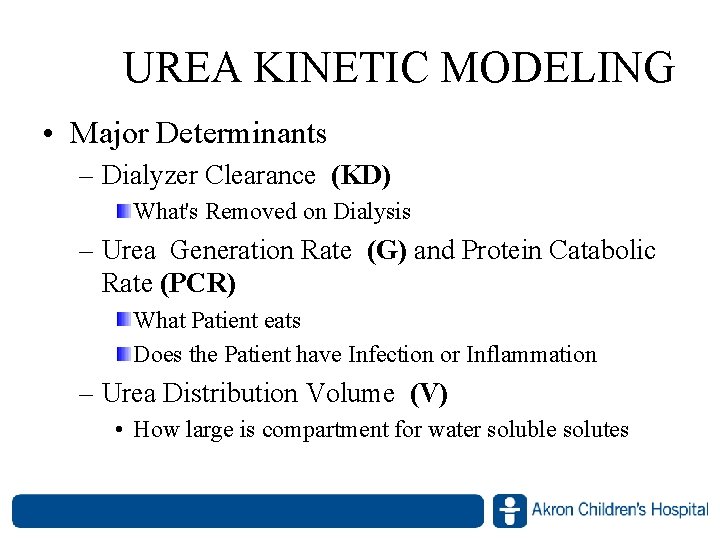
UREA KINETIC MODELING • A PROCESS to determine the AMOUNT of Dialysis actually given • uses Mathematical Equations and allows the Factors that influence the BUN to be quantitated • Developed from Pharmacology formulas for drug dosing and removal www. akronchildrens. org/giving
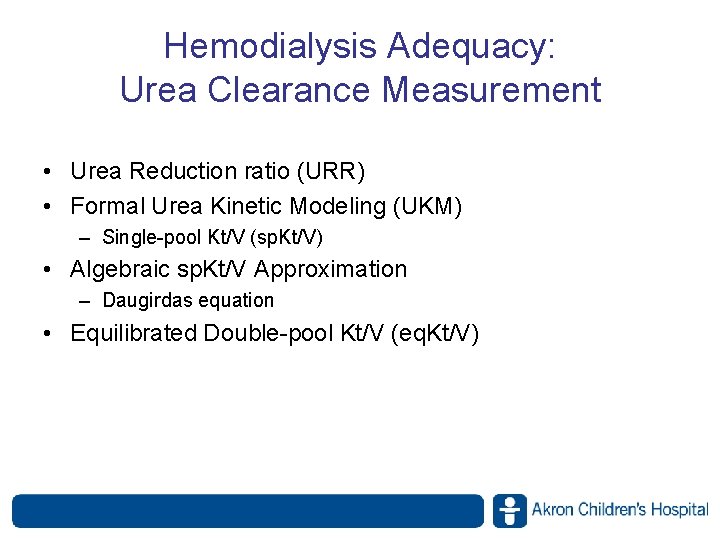
Hemodialysis Adequacy: Urea Clearance Measurement • Urea Reduction ratio (URR) • Formal Urea Kinetic Modeling (UKM) – Single-pool Kt/V (sp. Kt/V) • Algebraic sp. Kt/V Approximation – Daugirdas equation • Equilibrated Double-pool Kt/V (eq. Kt/V) www. akronchildrens. org/giving
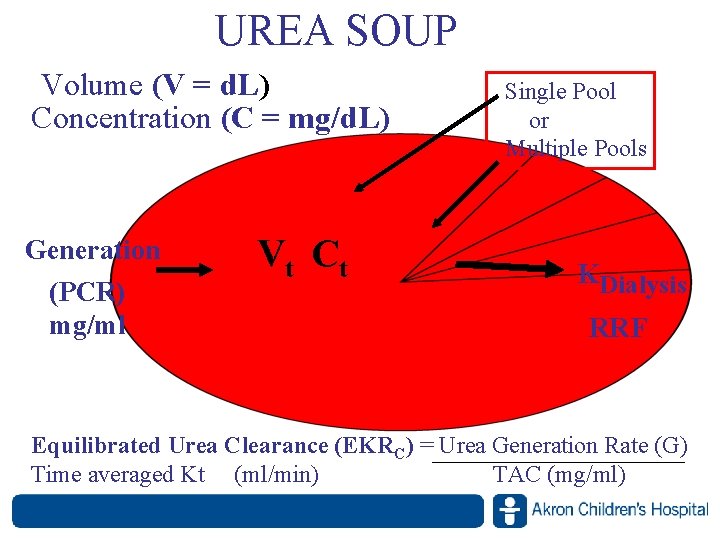
UREA SOUP Volume (V = d. L) Concentration (C = mg/d. L) Generation (PCR) mg/ml Vt Ct Single Pool or Multiple Pools KDialysis RRF Equilibrated Urea Clearance (EKRC) = Urea Generation Rate (G) Time averaged Kt (ml/min) TAC (mg/ml) www. akronchildrens. org/giving
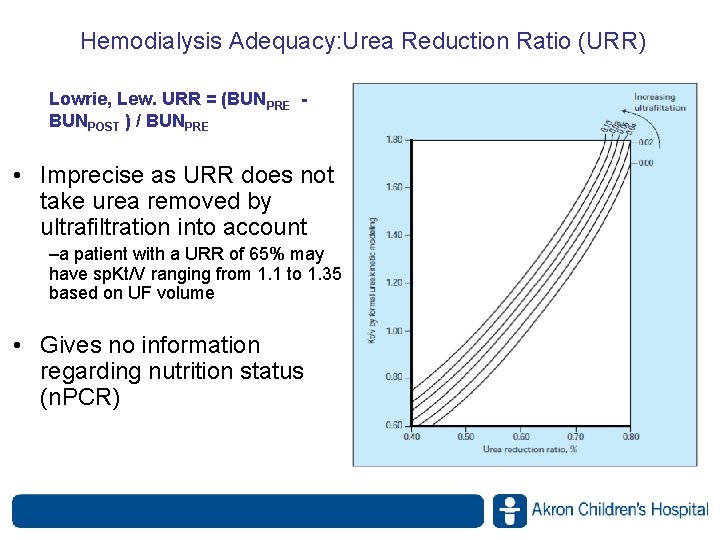
Hemodialysis Adequacy: Urea Reduction Ratio (URR) Lowrie, Lew. URR = (BUNPRE BUNPOST ) / BUNPRE • Imprecise as URR does not take urea removed by ultrafiltration into account –a patient with a URR of 65% may have sp. Kt/V ranging from 1. 1 to 1. 35 based on UF volume • Gives no information regarding nutrition status (n. PCR) www. akronchildrens. org/giving
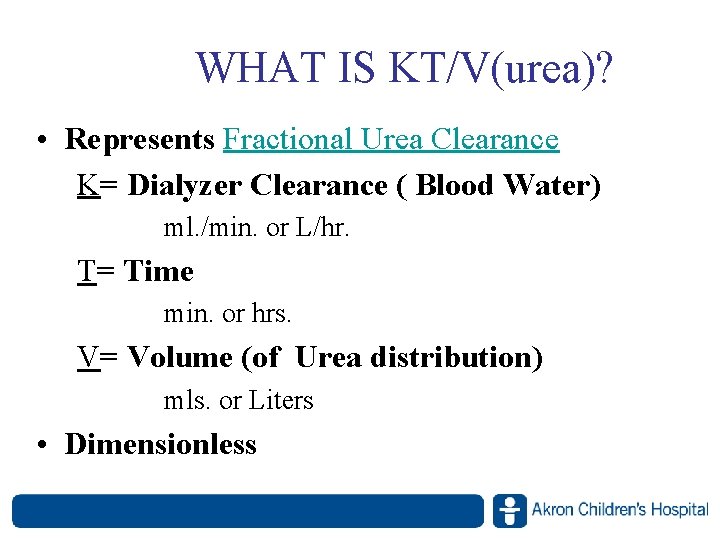
WHAT IS KT/V(urea)? • Represents Fractional Urea Clearance K= Dialyzer Clearance ( Blood Water) ml. /min. or L/hr. T= Time min. or hrs. V= Volume (of Urea distribution) mls. or Liters • Dimensionless www. akronchildrens. org/giving
UREA KINETIC MODELING • Major Determinants – Dialyzer Clearance (KD) What's Removed on Dialysis – Urea Generation Rate (G) and Protein Catabolic Rate (PCR) What Patient eats Does the Patient have Infection or Inflammation – Urea Distribution Volume (V) • How large is compartment for water soluble solutes www. akronchildrens. org/giving
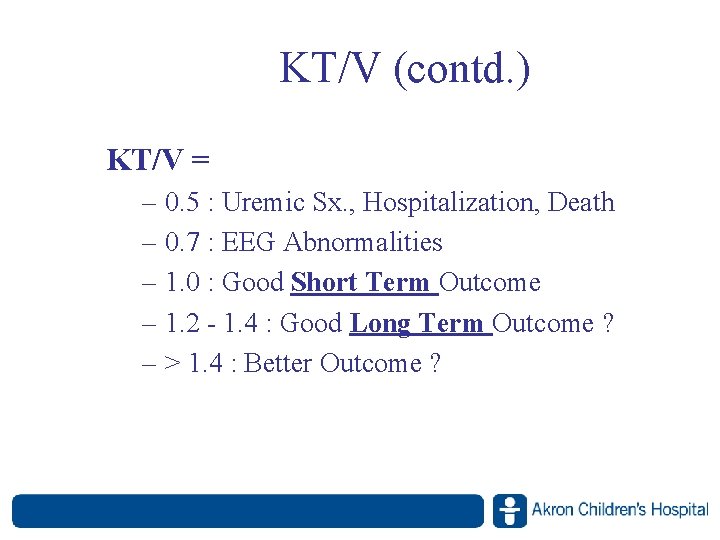
KT/V (contd. ) KT/V = – 0. 5 : Uremic Sx. , Hospitalization, Death – 0. 7 : EEG Abnormalities – 1. 0 : Good Short Term Outcome – 1. 2 - 1. 4 : Good Long Term Outcome ? – > 1. 4 : Better Outcome ? www. akronchildrens. org/giving
www. akronchildrens. org/giving
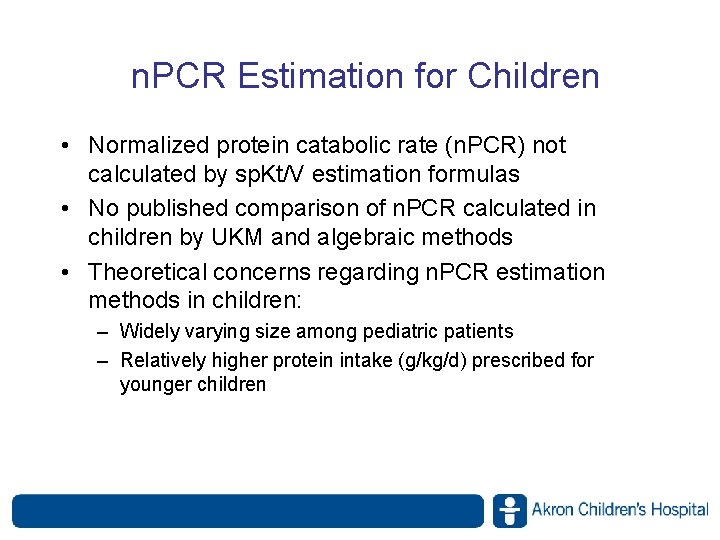
n. PCR Estimation for Children • Normalized protein catabolic rate (n. PCR) not calculated by sp. Kt/V estimation formulas • No published comparison of n. PCR calculated in children by UKM and algebraic methods • Theoretical concerns regarding n. PCR estimation methods in children: – Widely varying size among pediatric patients – Relatively higher protein intake (g/kg/d) prescribed for younger children www. akronchildrens. org/giving
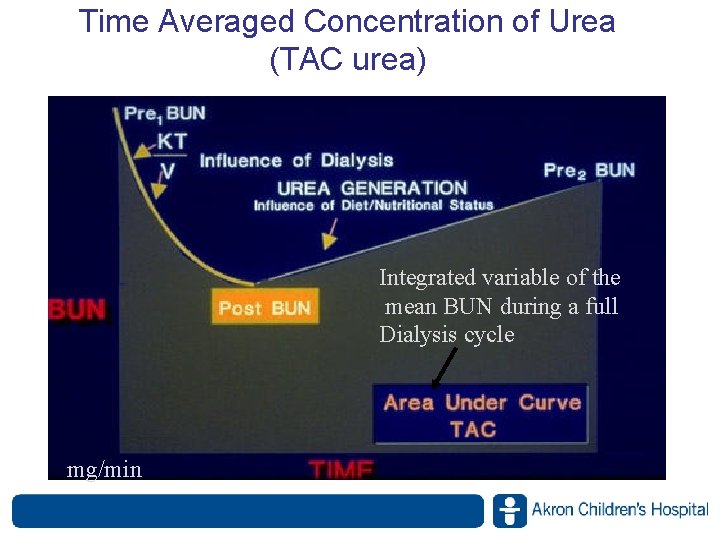
Time Averaged Concentration of Urea (TAC urea) Integrated variable of the mean BUN during a full Dialysis cycle mg/min www. akronchildrens. org/giving
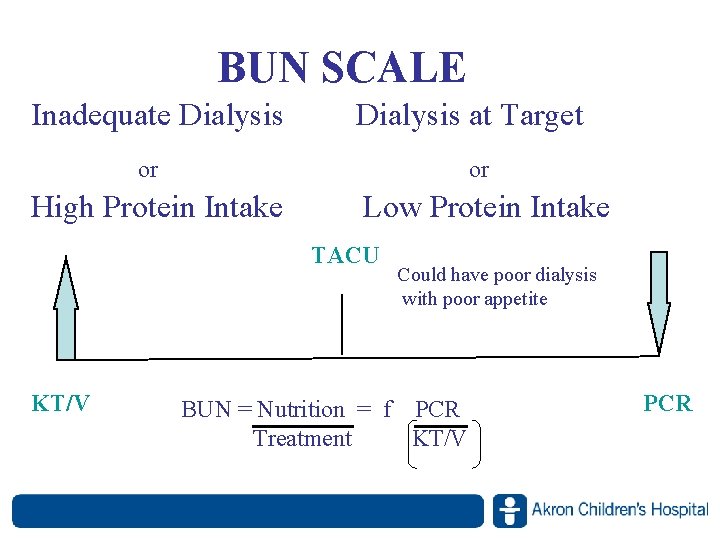
BUN SCALE Inadequate Dialysis at Target or or High Protein Intake Low Protein Intake TACU KT/V Could have poor dialysis with poor appetite BUN = Nutrition = f PCR Treatment KT/V www. akronchildrens. org/giving PCR
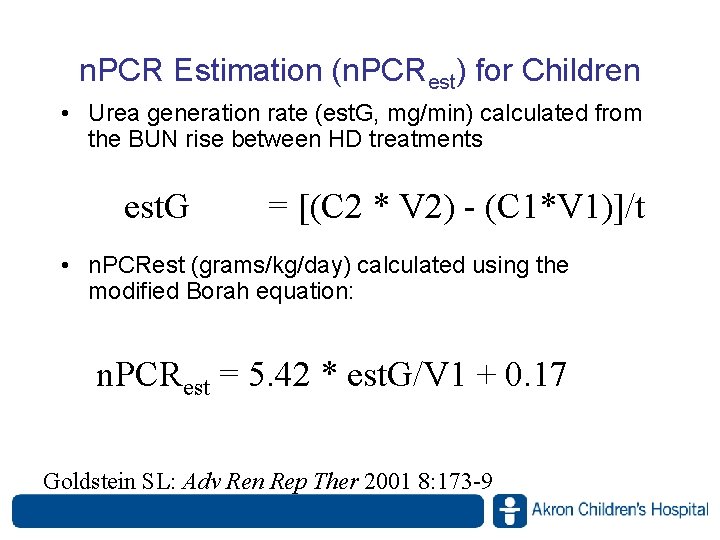
n. PCR Estimation (n. PCRest) for Children • Urea generation rate (est. G, mg/min) calculated from the BUN rise between HD treatments est. G = [(C 2 * V 2) - (C 1*V 1)]/t • n. PCRest (grams/kg/day) calculated using the modified Borah equation: n. PCRest = 5. 42 * est. G/V 1 + 0. 17 Goldstein SL: Adv Ren Rep Ther 2001 8: 173 -9. www. akronchildrens. org/giving
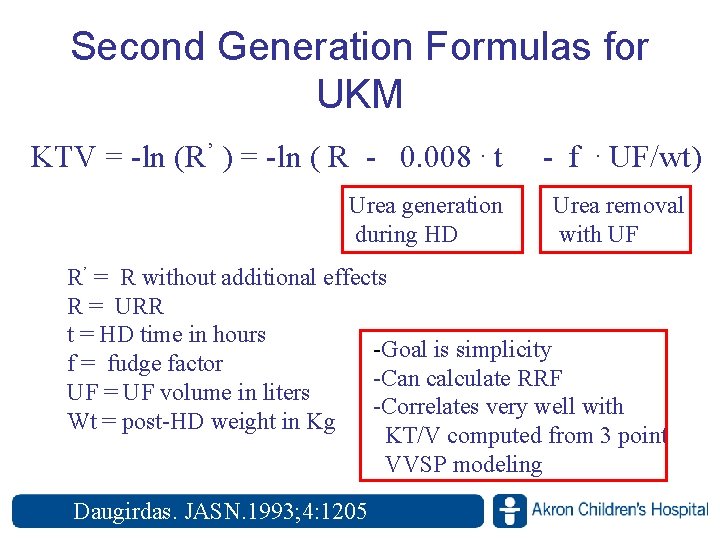
Second Generation Formulas for UKM KTV = -ln (R’ ) = -ln ( R - 0. 008. t Urea generation during HD - f. UF/wt) Urea removal with UF R’ = R without additional effects R = URR t = HD time in hours -Goal is simplicity f = fudge factor -Can calculate RRF UF = UF volume in liters -Correlates very well with Wt = post-HD weight in Kg KT/V computed from 3 point VVSP modeling Daugirdas. JASN. 1993; 4: 1205 www. akronchildrens. org/giving
www. akronchildrens. org/giving
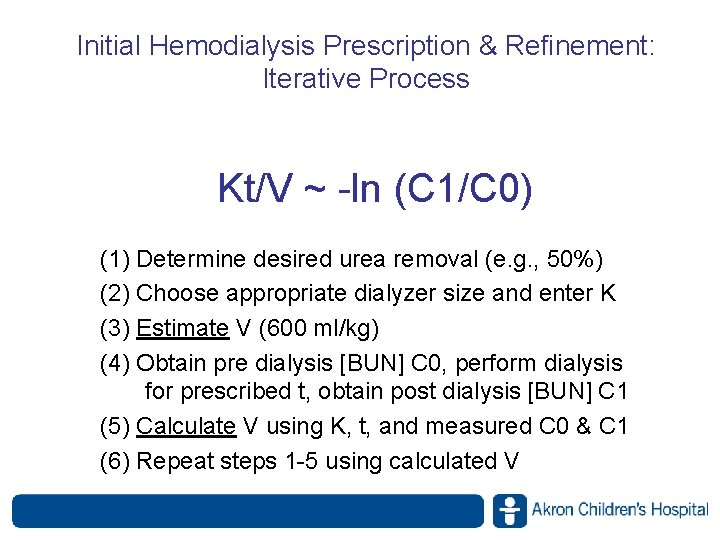
Initial Hemodialysis Prescription & Refinement: Iterative Process Kt/V ~ -ln (C 1/C 0) (1) Determine desired urea removal (e. g. , 50%) (2) Choose appropriate dialyzer size and enter K (3) Estimate V (600 ml/kg) (4) Obtain pre dialysis [BUN] C 0, perform dialysis for prescribed t, obtain post dialysis [BUN] C 1 (5) Calculate V using K, t, and measured C 0 & C 1 (6) Repeat steps 1 -5 using calculated V www. akronchildrens. org/giving
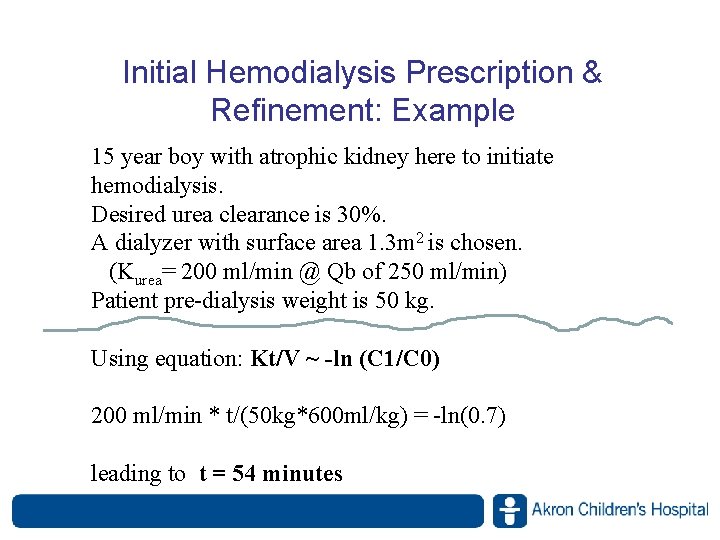
Initial Hemodialysis Prescription & Refinement: Example 15 year boy with atrophic kidney here to initiate hemodialysis. Desired urea clearance is 30%. A dialyzer with surface area 1. 3 m 2 is chosen. (Kurea= 200 ml/min @ Qb of 250 ml/min) Patient pre-dialysis weight is 50 kg. Using equation: Kt/V ~ -ln (C 1/C 0) 200 ml/min * t/(50 kg*600 ml/kg) = -ln(0. 7) leading to t = 54 minutes www. akronchildrens. org/giving
www. akronchildrens. org/giving
Dialysate Flow • Standard of 500 ml/min is appropriate for most patients • Ultrafiltration goal- in general, no more than 5% of a patient’s body weight should be removed during a 3 -4 hour dialysis session • To prevent disequilibrium, aim for urea clearance of: – 40% for 1 st treatment (Kt/V = 0. 8) – 50% for 2 nd treatment (Kt/V = 1. 0) – 70% for 3 rd and subsequent treatments (Kt/V = 1. 2) www. akronchildrens. org/giving
Dialysis • Initial dialysis treatment in uremic patient not previously dialyzed should be limited to 2 hours • Subsequent dialysis treatments may be increased gradually to 3 to 4 hours by 30 -60 minutes/treatment. • Consider use of IV mannitol (0. 25 gm/kg/dose) at initiation of dialysis if serum osmolality > 300 m. Osm, BUN > 100 mg/dl, or first dialysis treatment in chronic patient www. akronchildrens. org/giving
Blood Priming • If the extracorporeal volume (tubing volume + dialyzer volume) exceeds 10% of the patient’s estimated blood volume (> 80 ml/kg), consider priming the circuit with blood to prevent instability when initiating hemodialysis) • This usually applies to children weighing less than 10 kg www. akronchildrens. org/giving
Blood Priming • Diluted PRBC (hematocrit 35%) that has been typed and cross-matched with the patient. • Prime the circuit per routine, using normal saline • Inject 2 units of heparin per ml into the diluted PRBCs. • Prime the dialysis circuit with the diluted PRBCs. • Allow the system to recirculate for 5 minutes to heparinization it and to warm the blood to an appropriate level for the patient. • In any child in whom a blood prime is used, give the entire blood prime by connecting the arterial and venous lines simultaneously • In patients 10 -15 kg or hemodynamically unstable patients, give half or all of the prime • In patients > 15 kg who are hemodynamically stable, do not give the prime. www. akronchildrens. org/giving
www. akronchildrens. org/giving