
Helping Your Students Improve Math Success Learning Strategies
- Slides: 38
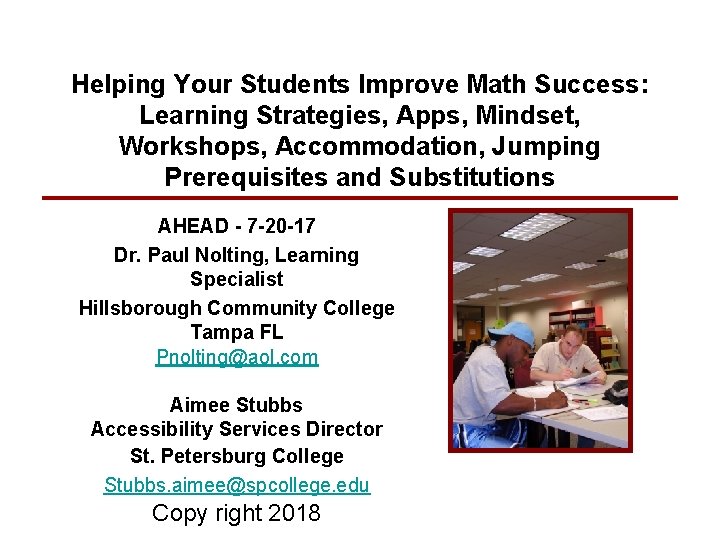
Helping Your Students Improve Math Success: Learning Strategies, Apps, Mindset, Workshops, Accommodation, Jumping Prerequisites and Substitutions AHEAD - 7 -20 -17 Dr. Paul Nolting, Learning Specialist Hillsborough Community College Tampa FL Pnolting@aol. com Aimee Stubbs Accessibility Services Director St. Petersburg College Stubbs. aimee@spcollege. edu Copy right 2018
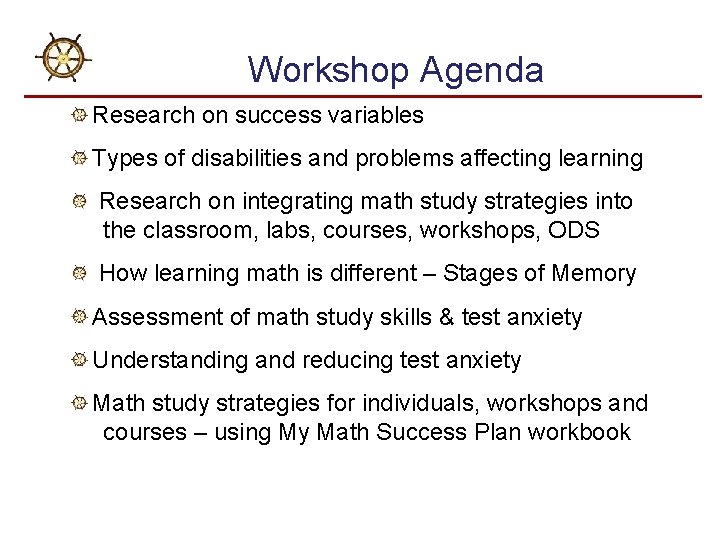
Workshop Agenda Research on success variables Types of disabilities and problems affecting learning Research on integrating math study strategies into the classroom, labs, courses, workshops, ODS How learning math is different – Stages of Memory Assessment of math study skills & test anxiety Understanding and reducing test anxiety Math study strategies for individuals, workshops and courses – using My Math Success Plan workbook
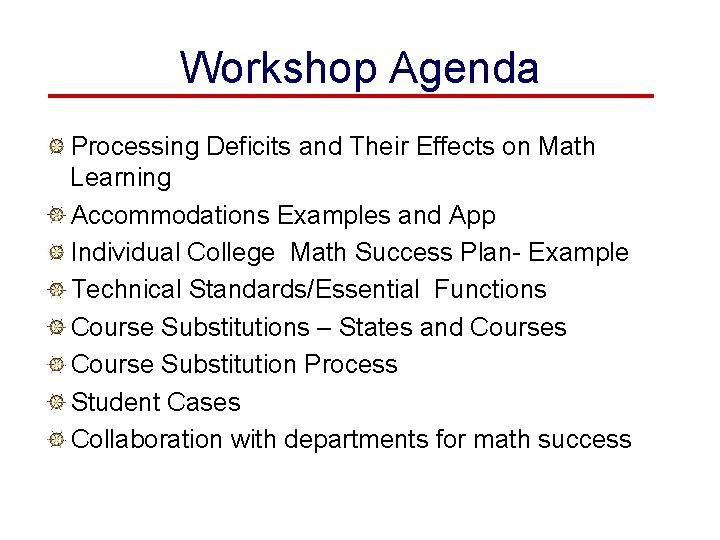
Workshop Agenda Processing Deficits and Their Effects on Math Learning Accommodations Examples and App Individual College Math Success Plan- Example Technical Standards/Essential Functions Course Substitutions – States and Courses Course Substitution Process Student Cases Collaboration with departments for math success
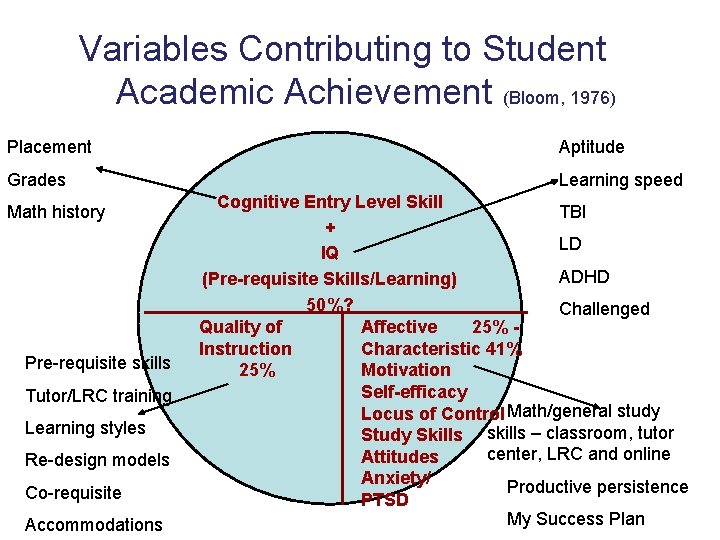
Variables Contributing to Student Academic Achievement (Bloom, 1976) Placement Aptitude Grades Learning speed Math history Pre-requisite skills Tutor/LRC training Learning styles Re-design models Co-requisite Accommodations Cognitive Entry Level Skill TBI + LD IQ ADHD (Pre-requisite Skills/Learning) 50%? Challenged Quality of Affective 25% Instruction Characteristic 41% 25% Motivation Self-efficacy Math/general study Locus of Control Study Skills skills – classroom, tutor center, LRC and online Attitudes Anxiety/ Productive persistence PTSD My Success Plan
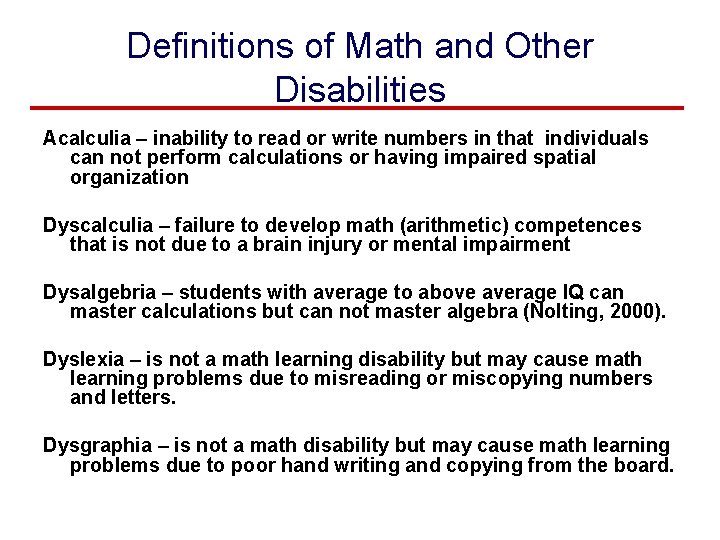
Definitions of Math and Other Disabilities Acalculia – inability to read or write numbers in that individuals can not perform calculations or having impaired spatial organization Dyscalculia – failure to develop math (arithmetic) competences that is not due to a brain injury or mental impairment Dysalgebria – students with average to above average IQ can master calculations but can not master algebra (Nolting, 2000). Dyslexia – is not a math learning disability but may cause math learning problems due to misreading or miscopying numbers and letters. Dysgraphia – is not a math disability but may cause math learning problems due to poor hand writing and copying from the board.
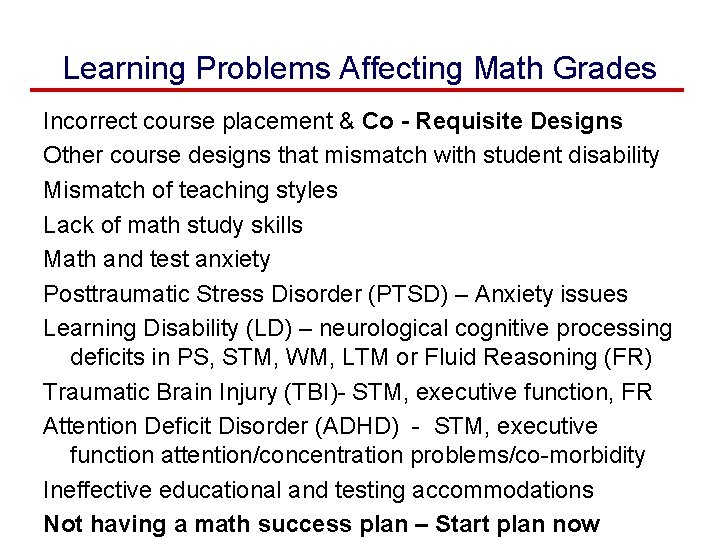
Learning Problems Affecting Math Grades Incorrect course placement & Co - Requisite Designs Other course designs that mismatch with student disability Mismatch of teaching styles Lack of math study skills Math and test anxiety Posttraumatic Stress Disorder (PTSD) – Anxiety issues Learning Disability (LD) – neurological cognitive processing deficits in PS, STM, WM, LTM or Fluid Reasoning (FR) Traumatic Brain Injury (TBI)- STM, executive function, FR Attention Deficit Disorder (ADHD) - STM, executive function attention/concentration problems/co-morbidity Ineffective educational and testing accommodations Not having a math success plan – Start plan now
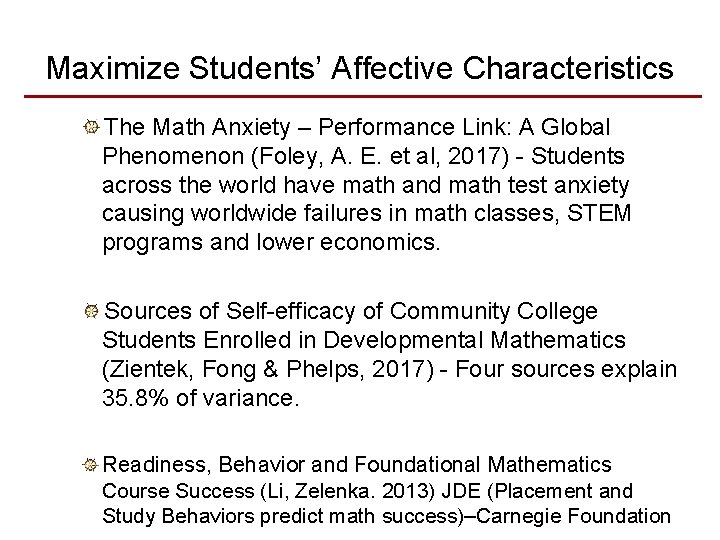
Maximize Students’ Affective Characteristics The Math Anxiety – Performance Link: A Global Phenomenon (Foley, A. E. et al, 2017) - Students across the world have math and math test anxiety causing worldwide failures in math classes, STEM programs and lower economics. Sources of Self-efficacy of Community College Students Enrolled in Developmental Mathematics (Zientek, Fong & Phelps, 2017) - Four sources explain 35. 8% of variance. Readiness, Behavior and Foundational Mathematics Course Success (Li, Zelenka. 2013) JDE (Placement and Study Behaviors predict math success)–Carnegie Foundation
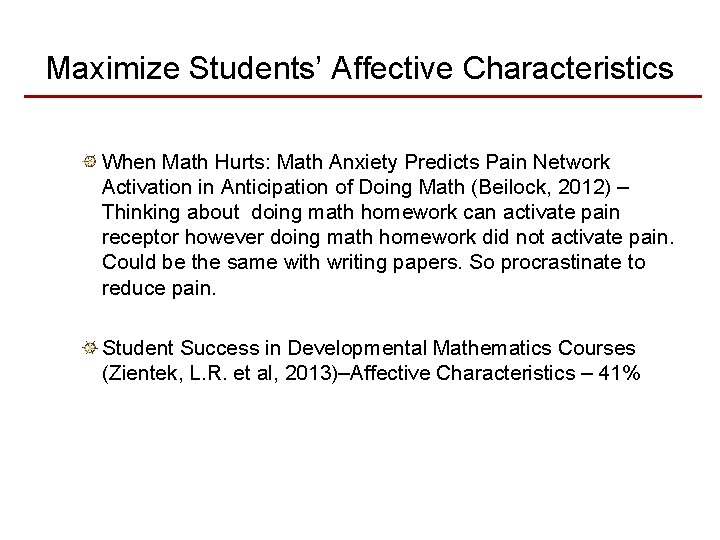
Maximize Students’ Affective Characteristics When Math Hurts: Math Anxiety Predicts Pain Network Activation in Anticipation of Doing Math (Beilock, 2012) – Thinking about doing math homework can activate pain receptor however doing math homework did not activate pain. Could be the same with writing papers. So procrastinate to reduce pain. Student Success in Developmental Mathematics Courses (Zientek, L. R. et al, 2013)–Affective Characteristics – 41%
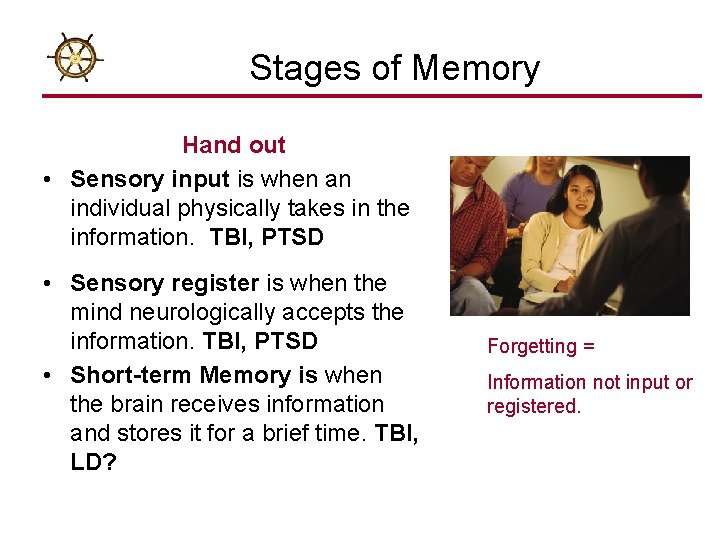
Stages of Memory Hand out • Sensory input is when an individual physically takes in the information. TBI, PTSD • Sensory register is when the mind neurologically accepts the information. TBI, PTSD • Short-term Memory is when the brain receives information and stores it for a brief time. TBI, LD? Forgetting = Information not input or registered.
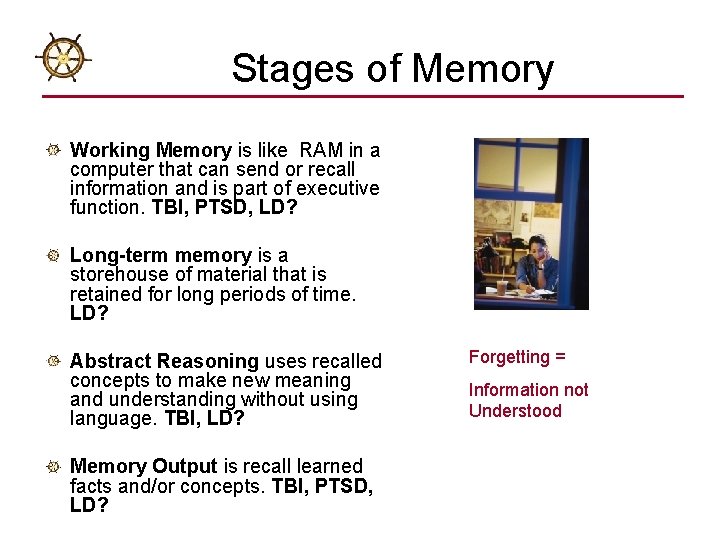
Stages of Memory Working Memory is like RAM in a computer that can send or recall information and is part of executive function. TBI, PTSD, LD? Long-term memory is a storehouse of material that is retained for long periods of time. LD? Abstract Reasoning uses recalled concepts to make new meaning and understanding without using language. TBI, LD? Memory Output is recall learned facts and/or concepts. TBI, PTSD, LD? Forgetting = Information not Understood
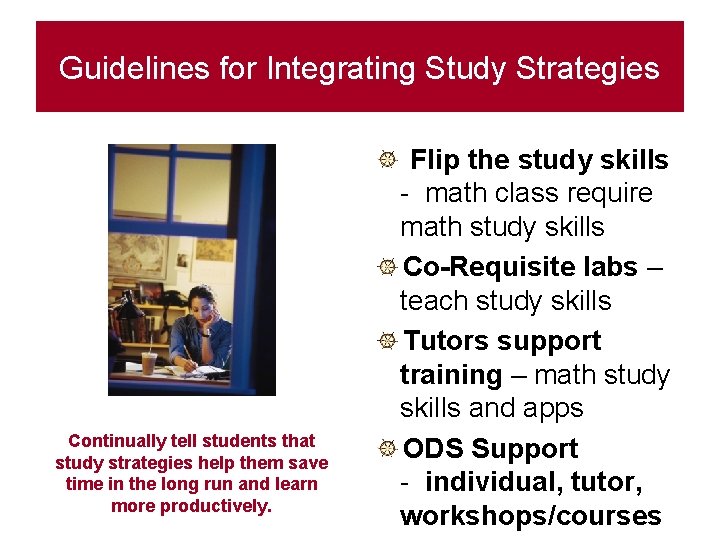
Guidelines for Integrating Study Strategies Continually tell students that study strategies help them save time in the long run and learn more productively. Flip the study skills - math class require math study skills Co-Requisite labs – teach study skills Tutors support training – math study skills and apps ODS Support - individual, tutor, workshops/courses
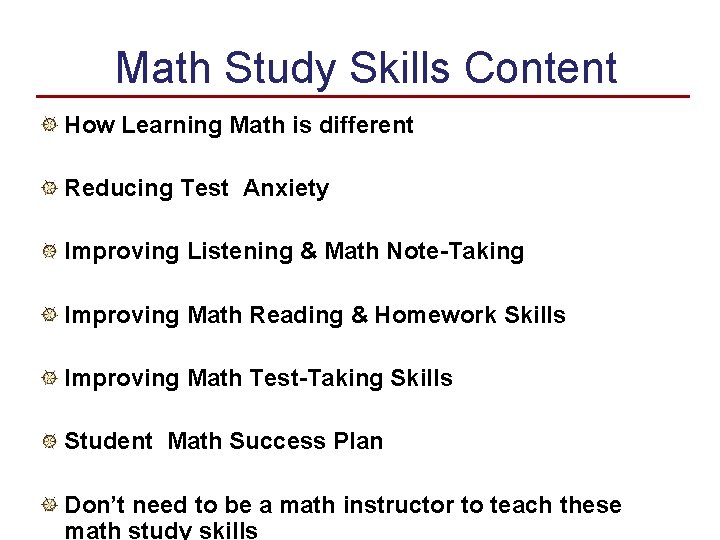
Math Study Skills Content How Learning Math is different Reducing Test Anxiety Improving Listening & Math Note-Taking Improving Math Reading & Homework Skills Improving Math Test-Taking Skills Student Math Success Plan Don’t need to be a math instructor to teach these math study skills
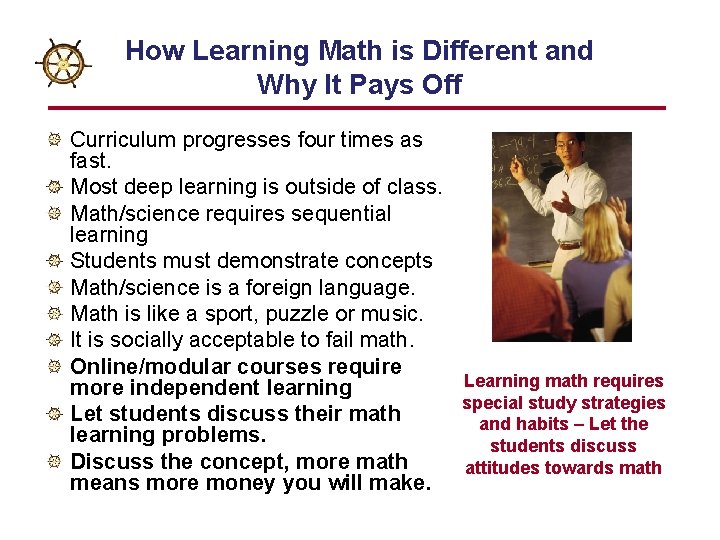
How Learning Math is Different and Why It Pays Off Curriculum progresses four times as fast. Most deep learning is outside of class. Math/science requires sequential learning Students must demonstrate concepts Math/science is a foreign language. Math is like a sport, puzzle or music. It is socially acceptable to fail math. Online/modular courses require Learning math requires more independent learning special study strategies Let students discuss their math and habits – Let the learning problems. students discuss Discuss the concept, more math attitudes towards math means more money you will make.
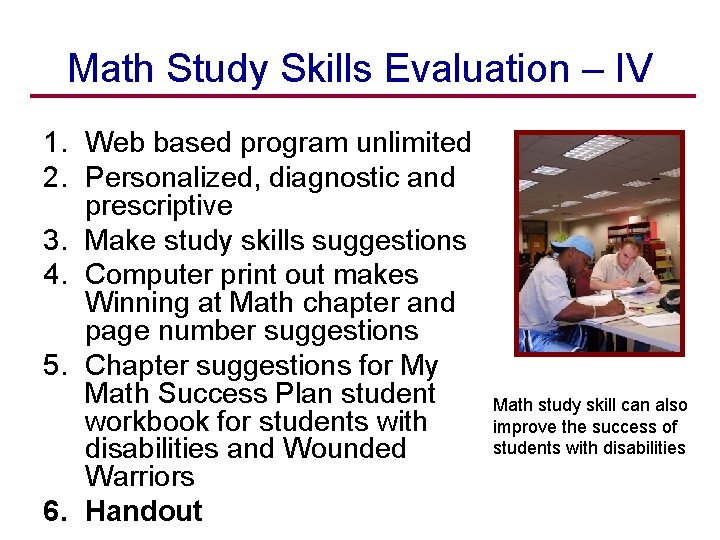
Math Study Skills Evaluation – IV 1. Web based program unlimited 2. Personalized, diagnostic and prescriptive 3. Make study skills suggestions 4. Computer print out makes Winning at Math chapter and page number suggestions 5. Chapter suggestions for My Math Success Plan student workbook for students with disabilities and Wounded Warriors 6. Handout Math study skill can also improve the success of students with disabilities
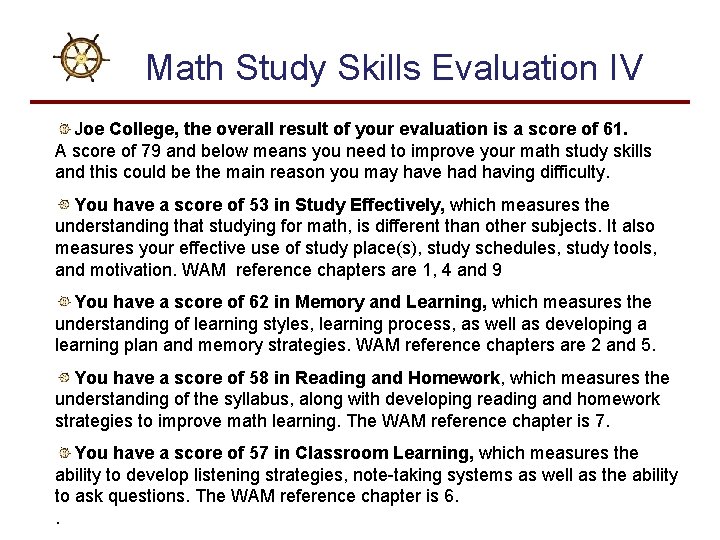
Math Study Skills Evaluation IV Joe College, the overall result of your evaluation is a score of 61. A score of 79 and below means you need to improve your math study skills and this could be the main reason you may have had having difficulty. You have a score of 53 in Study Effectively, which measures the understanding that studying for math, is different than other subjects. It also measures your effective use of study place(s), study schedules, study tools, and motivation. WAM reference chapters are 1, 4 and 9 You have a score of 62 in Memory and Learning, which measures the understanding of learning styles, learning process, as well as developing a learning plan and memory strategies. WAM reference chapters are 2 and 5. You have a score of 58 in Reading and Homework, which measures the understanding of the syllabus, along with developing reading and homework strategies to improve math learning. The WAM reference chapter is 7. You have a score of 57 in Classroom Learning, which measures the ability to develop listening strategies, note-taking systems as well as the ability to ask questions. The WAM reference chapter is 6. .
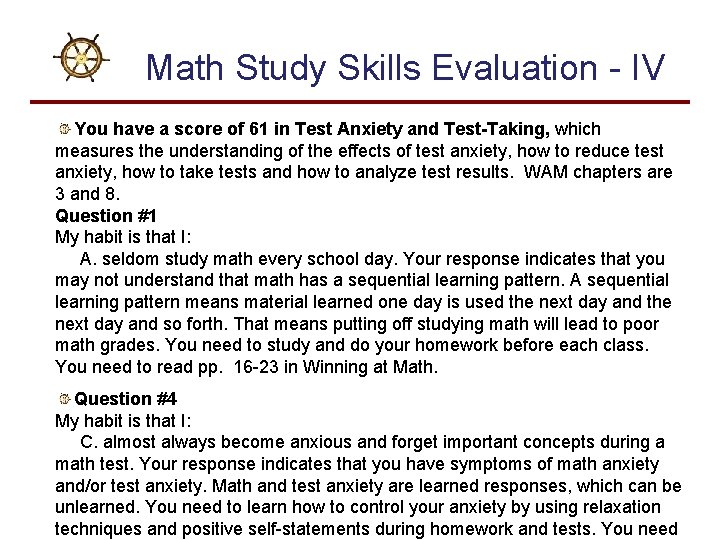
Math Study Skills Evaluation - IV You have a score of 61 in Test Anxiety and Test-Taking, which measures the understanding of the effects of test anxiety, how to reduce test anxiety, how to take tests and how to analyze test results. WAM chapters are 3 and 8. Question #1 My habit is that I: A. seldom study math every school day. Your response indicates that you may not understand that math has a sequential learning pattern. A sequential learning pattern means material learned one day is used the next day and so forth. That means putting off studying math will lead to poor math grades. You need to study and do your homework before each class. You need to read pp. 16 -23 in Winning at Math. Question #4 My habit is that I: C. almost always become anxious and forget important concepts during a math test. Your response indicates that you have symptoms of math anxiety and/or test anxiety. Math and test anxiety are learned responses, which can be unlearned. You need to learn how to control your anxiety by using relaxation techniques and positive self-statements during homework and tests. You need
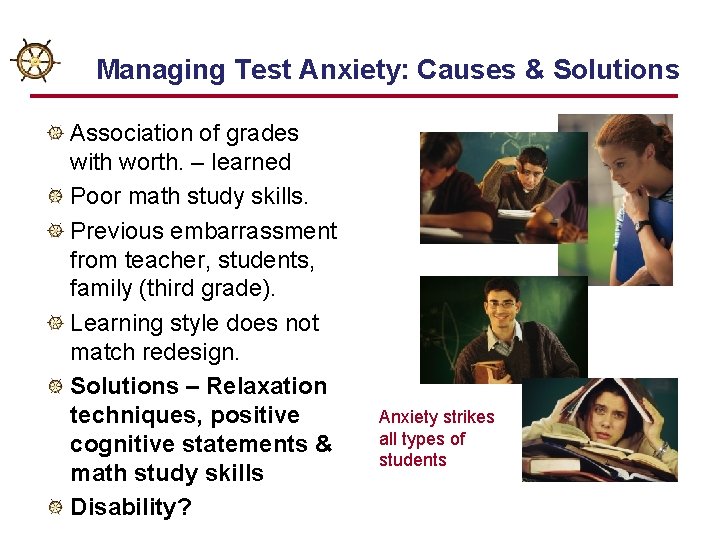
M Managing Test Anxiety: Causes & Solutions Association of grades with worth. – learned Poor math study skills. Previous embarrassment from teacher, students, family (third grade). Learning style does not match redesign. Solutions – Relaxation techniques, positive cognitive statements & math study skills Disability? Anxiety strikes all types of students
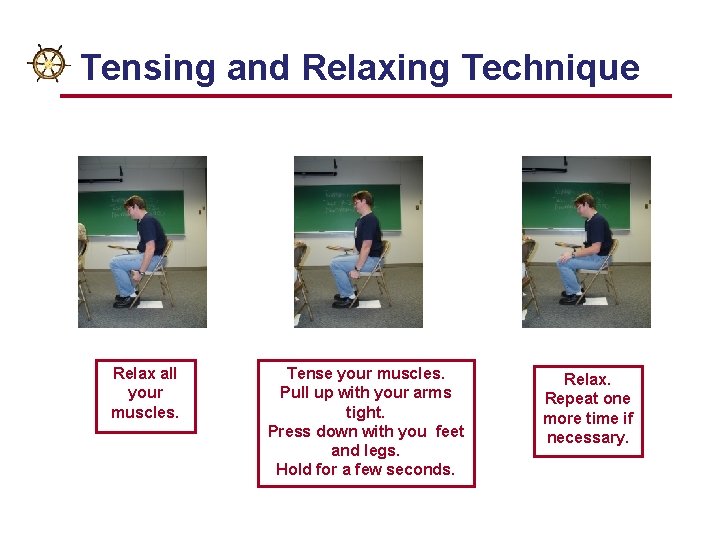
Tensing and Relaxing Technique Relax all your muscles. Tense your muscles. Pull up with your arms tight. Press down with you feet and legs. Hold for a few seconds. Relax. Repeat one more time if necessary.
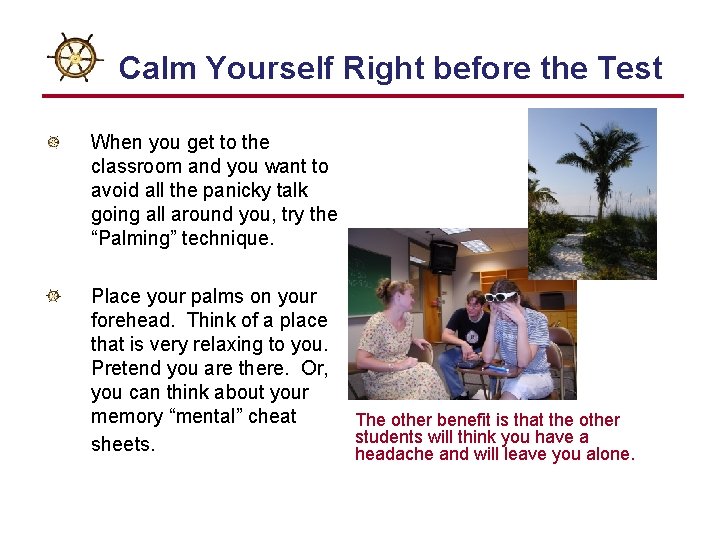
Calm Yourself Right before the Test When you get to the classroom and you want to avoid all the panicky talk going all around you, try the “Palming” technique. Place your palms on your forehead. Think of a place that is very relaxing to you. Pretend you are there. Or, you can think about your memory “mental” cheat The other benefit is that the other students will think you have a sheets. headache and will leave you alone.
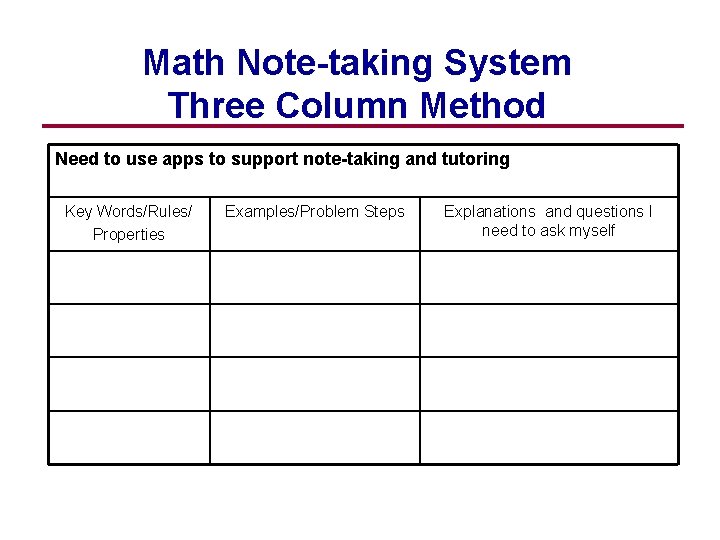
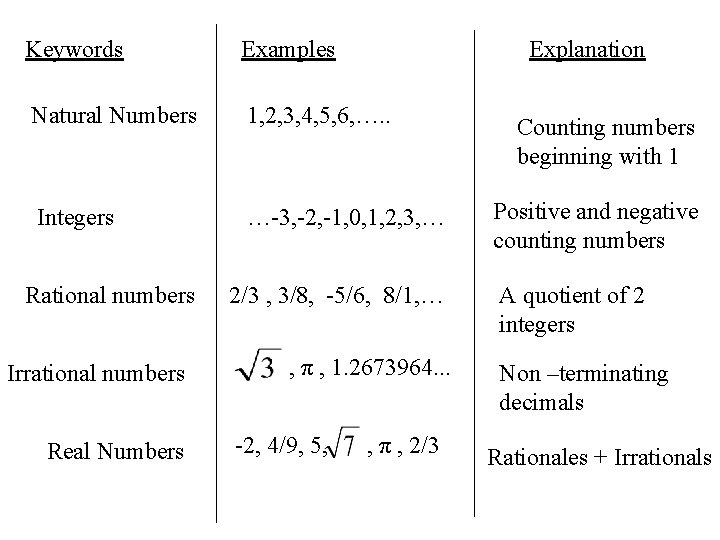
Math Note-taking System Three Column Method Need to use apps to support note-taking and tutoring Key Words/Rules/ Properties Examples/Problem Steps Explanations and questions I need to ask myself
Keywords Examples Natural Numbers 1, 2, 3, 4, 5, 6, …. . Integers …-3, -2, -1, 0, 1, 2, 3, … Rational numbers Irrational numbers Real Numbers Explanation 2/3 , 3/8, -5/6, 8/1, … , π , 1. 2673964. . . -2, 4/9, 5, , π , 2/3 Counting numbers beginning with 1 Positive and negative counting numbers A quotient of 2 integers Non –terminating decimals Rationales + Irrationals
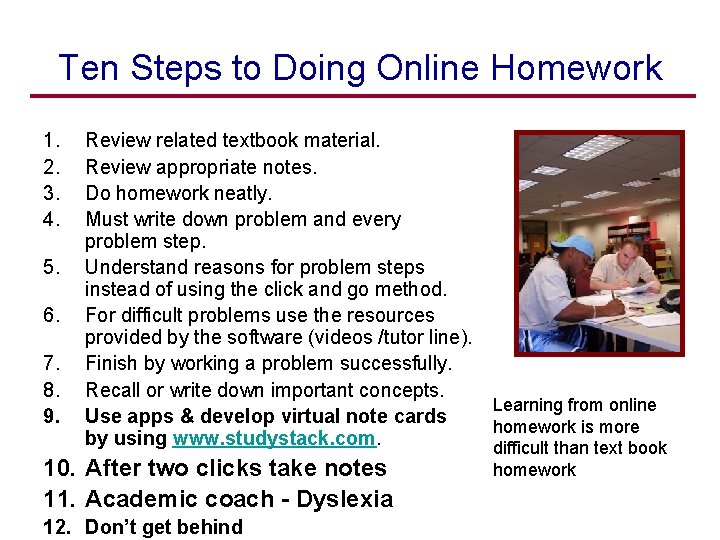
Ten Steps to Doing Online Homework 1. 2. 3. 4. 5. 6. 7. 8. 9. Review related textbook material. Review appropriate notes. Do homework neatly. Must write down problem and every problem step. Understand reasons for problem steps instead of using the click and go method. For difficult problems use the resources provided by the software (videos /tutor line). Finish by working a problem successfully. Recall or write down important concepts. Use apps & develop virtual note cards by using www. studystack. com. 10. After two clicks take notes 11. Academic coach - Dyslexia 12. Don’t get behind Learning from online homework is more difficult than text book homework
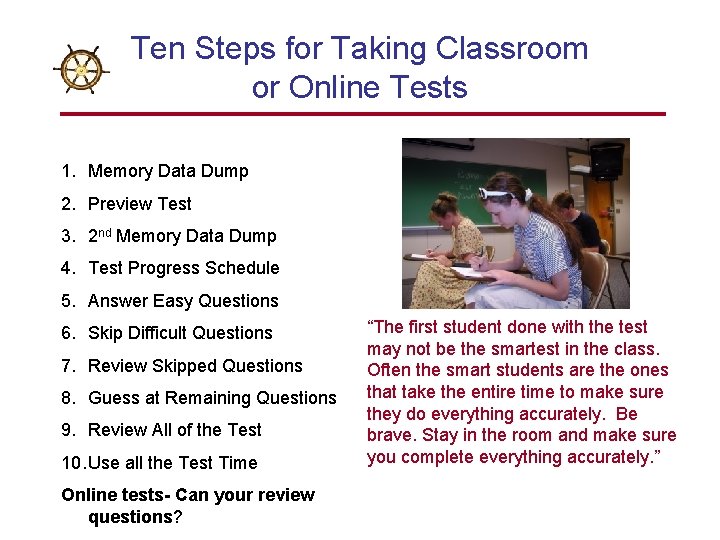
Ten Steps for Taking Classroom or Online Tests 1. Memory Data Dump 2. Preview Test 3. 2 nd Memory Data Dump 4. Test Progress Schedule 5. Answer Easy Questions 6. Skip Difficult Questions 7. Review Skipped Questions 8. Guess at Remaining Questions 9. Review All of the Test 10. Use all the Test Time Online tests- Can your review questions? “The first student done with the test may not be the smartest in the class. Often the smart students are the ones that take the entire time to make sure they do everything accurately. Be brave. Stay in the room and make sure you complete everything accurately. ”
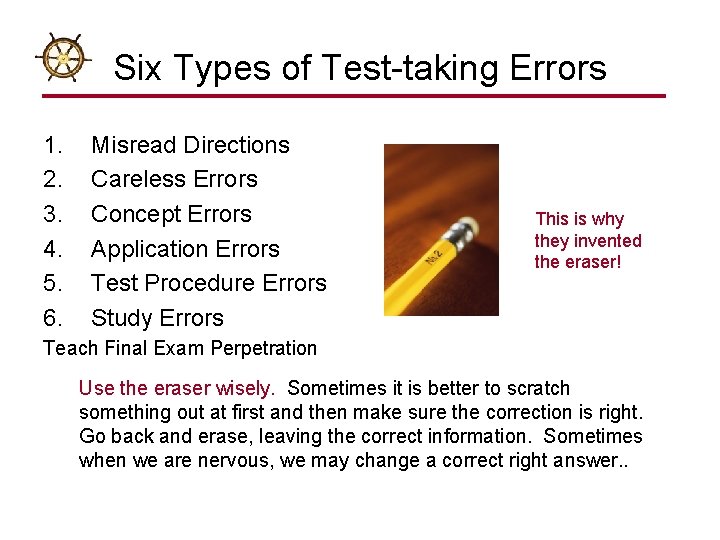
Six Types of Test-taking Errors 1. 2. 3. 4. 5. 6. Misread Directions Careless Errors Concept Errors Application Errors Test Procedure Errors Study Errors This is why they invented the eraser! Teach Final Exam Perpetration Use the eraser wisely. Sometimes it is better to scratch something out at first and then make sure the correction is right. Go back and erase, leaving the correct information. Sometimes when we are nervous, we may change a correct right answer. .
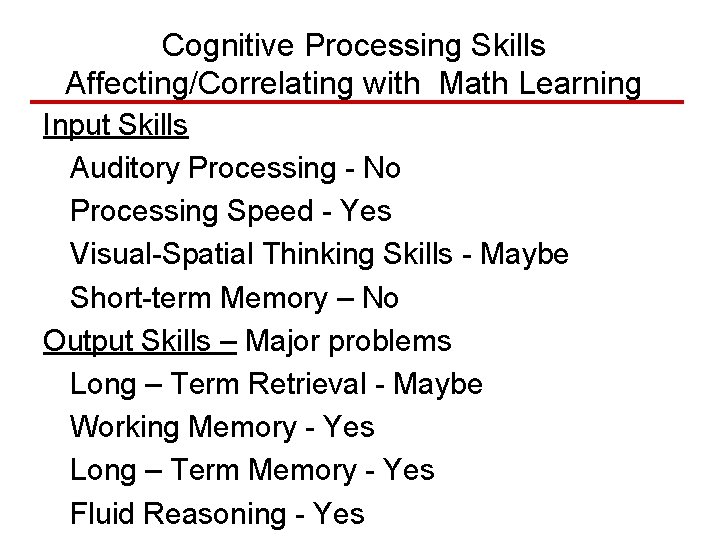
Cognitive Processing Skills Affecting/Correlating with Math Learning Input Skills Auditory Processing - No Processing Speed - Yes Visual-Spatial Thinking Skills - Maybe Short-term Memory – No Output Skills – Major problems Long – Term Retrieval - Maybe Working Memory - Yes Long – Term Memory - Yes Fluid Reasoning - Yes
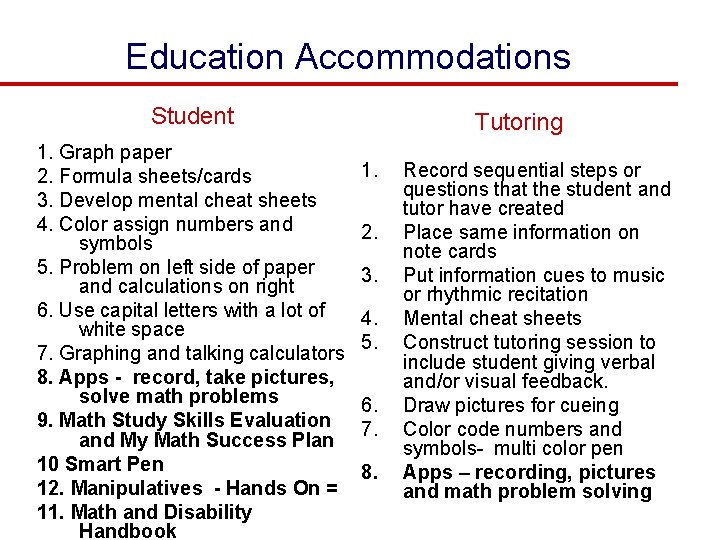
Education Accommodations Student 1. Graph paper 2. Formula sheets/cards 3. Develop mental cheat sheets 4. Color assign numbers and symbols 5. Problem on left side of paper and calculations on right 6. Use capital letters with a lot of white space 7. Graphing and talking calculators 8. Apps - record, take pictures, solve math problems 9. Math Study Skills Evaluation and My Math Success Plan 10 Smart Pen 12. Manipulatives - Hands On = 11. Math and Disability Handbook Tutoring 1. 2. 3. 4. 5. 6. 7. 8. Record sequential steps or questions that the student and tutor have created Place same information on note cards Put information cues to music or rhythmic recitation Mental cheat sheets Construct tutoring session to include student giving verbal and/or visual feedback. Draw pictures for cueing Color code numbers and symbols- multi color pen Apps – recording, pictures and math problem solving
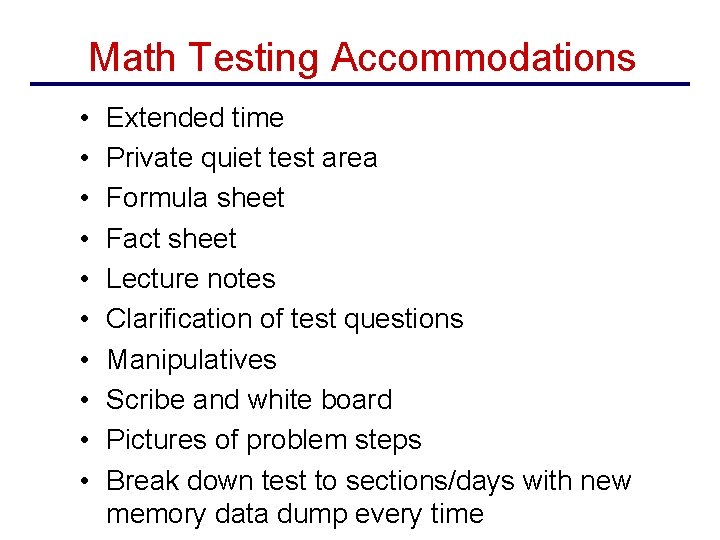
Math Testing Accommodations • • • Extended time Private quiet test area Formula sheet Fact sheet Lecture notes Clarification of test questions Manipulatives Scribe and white board Pictures of problem steps Break down test to sections/days with new memory data dump every time
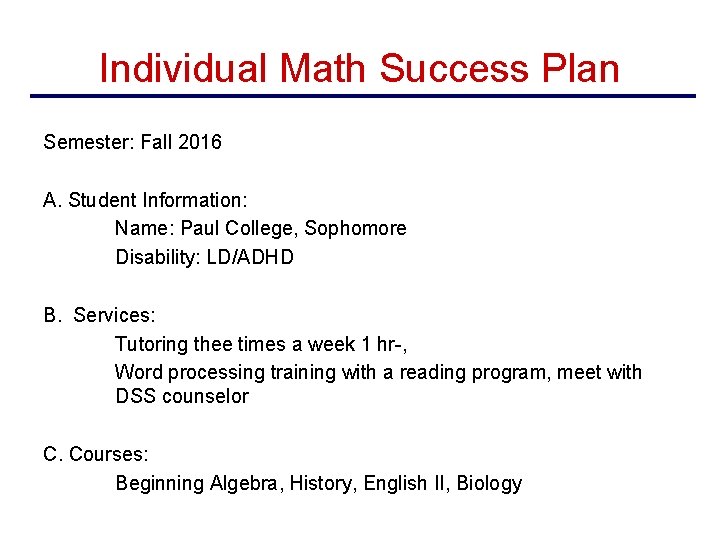
Individual Math Success Plan Semester: Fall 2016 A. Student Information: Name: Paul College, Sophomore Disability: LD/ADHD B. Services: Tutoring thee times a week 1 hr-, Word processing training with a reading program, meet with DSS counselor C. Courses: Beginning Algebra, History, English II, Biology
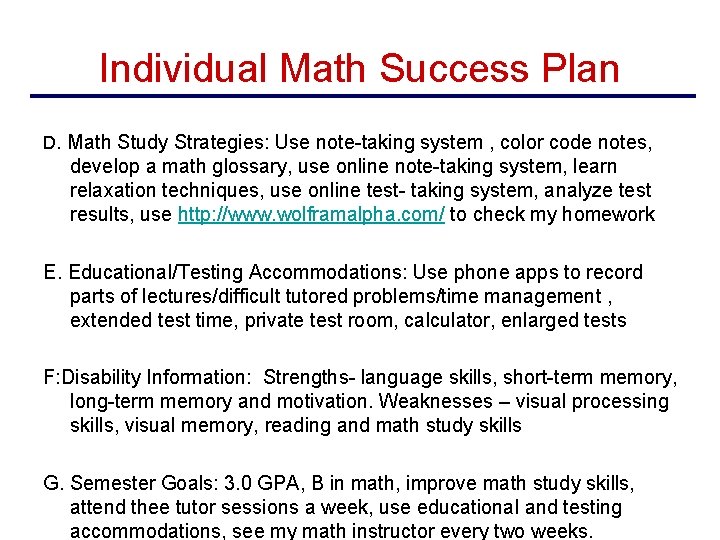
Individual Math Success Plan D. Math Study Strategies: Use note-taking system , color code notes, develop a math glossary, use online note-taking system, learn relaxation techniques, use online test- taking system, analyze test results, use http: //www. wolframalpha. com/ to check my homework E. Educational/Testing Accommodations: Use phone apps to record parts of lectures/difficult tutored problems/time management , extended test time, private test room, calculator, enlarged tests F: Disability Information: Strengths- language skills, short-term memory, long-term memory and motivation. Weaknesses – visual processing skills, visual memory, reading and math study skills G. Semester Goals: 3. 0 GPA, B in math, improve math study skills, attend thee tutor sessions a week, use educational and testing accommodations, see my math instructor every two weeks.
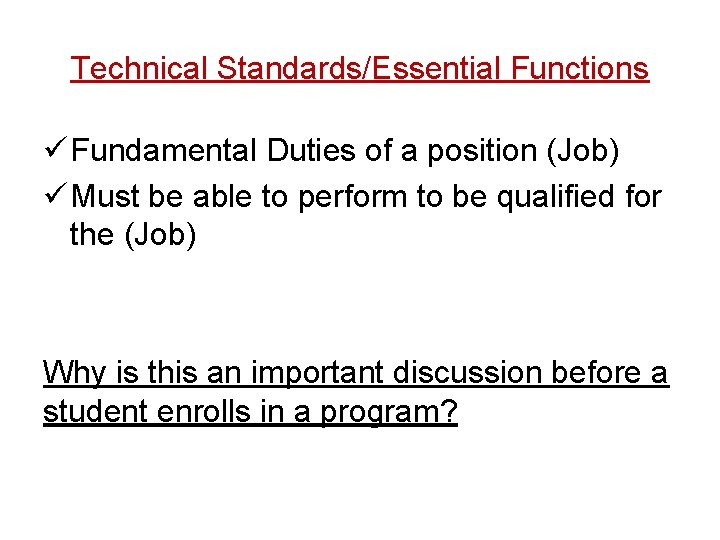
Technical Standards/Essential Functions ü Fundamental Duties of a position (Job) ü Must be able to perform to be qualified for the (Job) Why is this an important discussion before a student enrolls in a program?
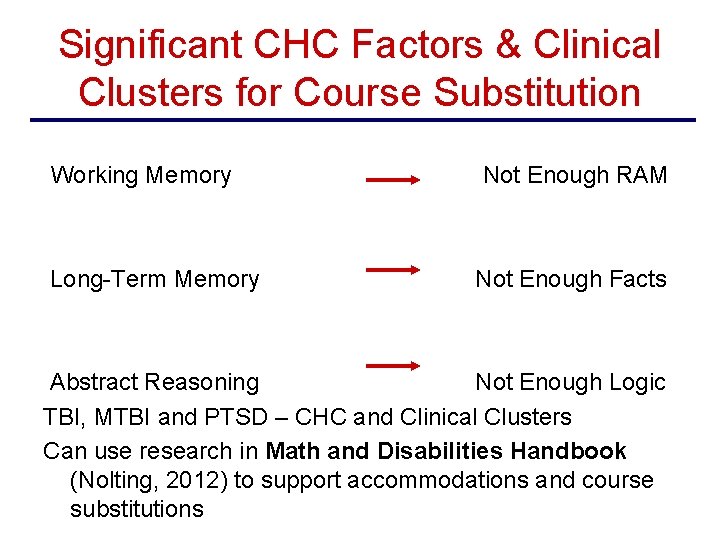
Significant CHC Factors & Clinical Clusters for Course Substitution Working Memory Long-Term Memory Not Enough RAM Not Enough Facts Abstract Reasoning Not Enough Logic TBI, MTBI and PTSD – CHC and Clinical Clusters Can use research in Math and Disabilities Handbook (Nolting, 2012) to support accommodations and course substitutions
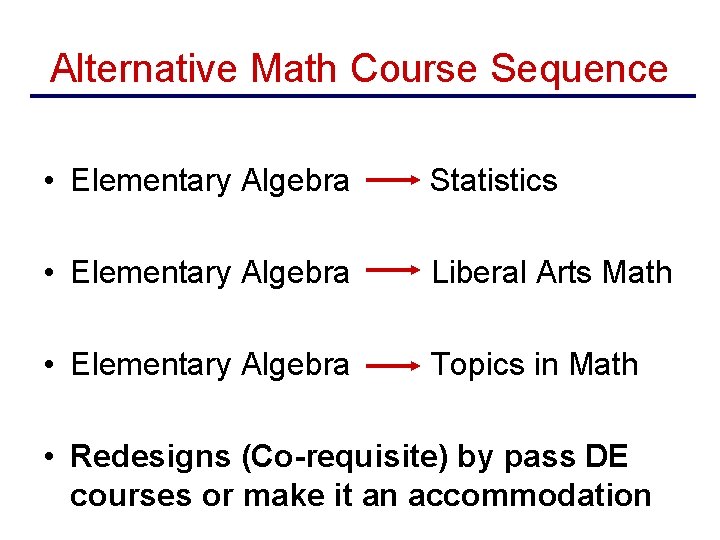
Alternative Math Course Sequence • Elementary Algebra Statistics • Elementary Algebra Liberal Arts Math • Elementary Algebra Topics in Math • Redesigns (Co-requisite) by pass DE courses or make it an accommodation
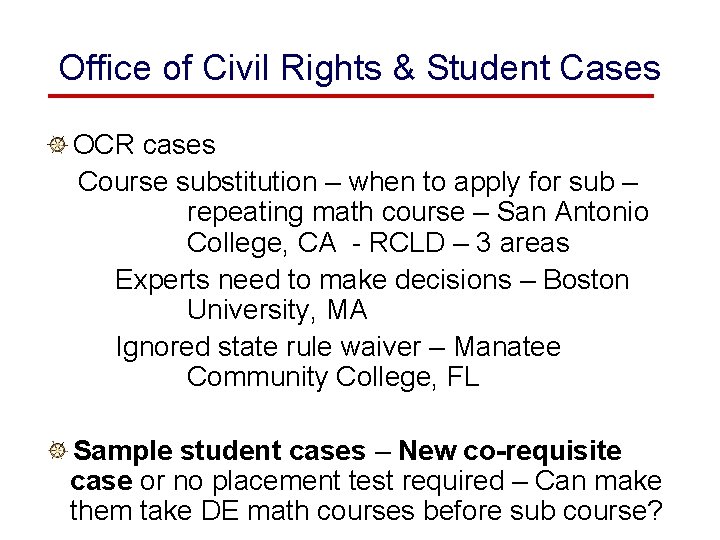
Office of Civil Rights & Student Cases OCR cases Course substitution – when to apply for sub – repeating math course – San Antonio College, CA - RCLD – 3 areas Experts need to make decisions – Boston University, MA Ignored state rule waiver – Manatee Community College, FL Sample student cases – New co-requisite case or no placement test required – Can make them take DE math courses before sub course?
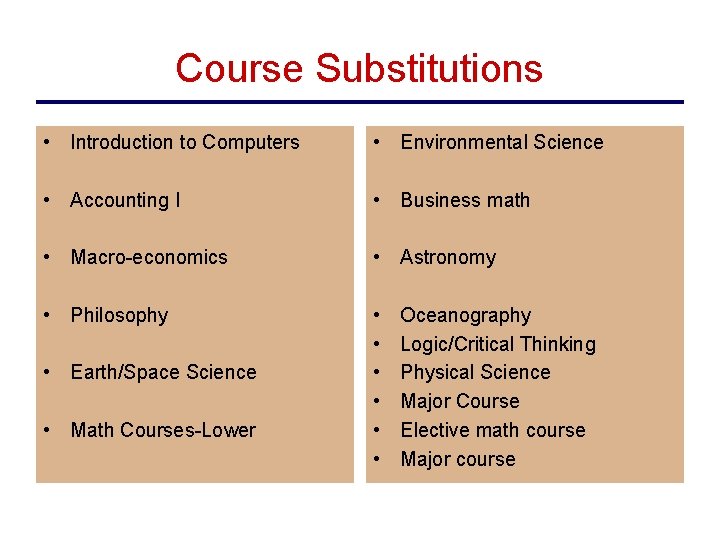
Course Substitutions • Introduction to Computers • Environmental Science • Accounting I • Business math • Macro-economics • Astronomy • Philosophy • • Earth/Space Science • Math Courses-Lower Oceanography Logic/Critical Thinking Physical Science Major Course Elective math course Major course
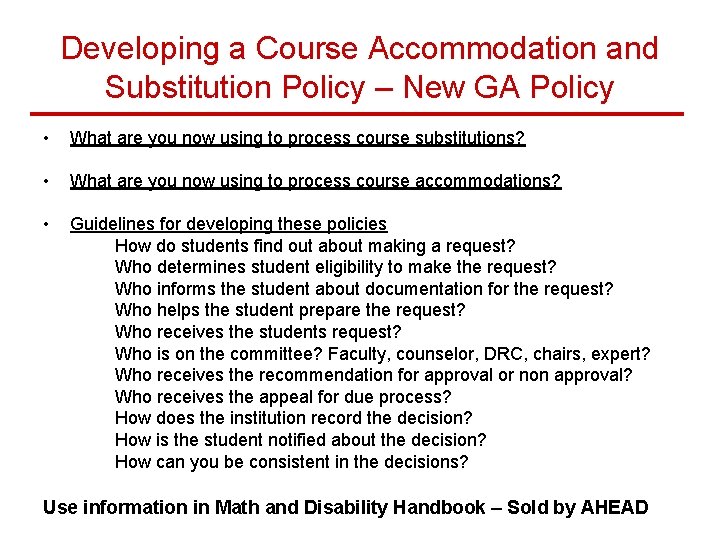
Developing a Course Accommodation and Substitution Policy – New GA Policy • What are you now using to process course substitutions? • What are you now using to process course accommodations? • Guidelines for developing these policies How do students find out about making a request? Who determines student eligibility to make the request? Who informs the student about documentation for the request? Who helps the student prepare the request? Who receives the students request? Who is on the committee? Faculty, counselor, DRC, chairs, expert? Who receives the recommendation for approval or non approval? Who receives the appeal for due process? How does the institution record the decision? How is the student notified about the decision? How can you be consistent in the decisions? Use information in Math and Disability Handbook – Sold by AHEAD
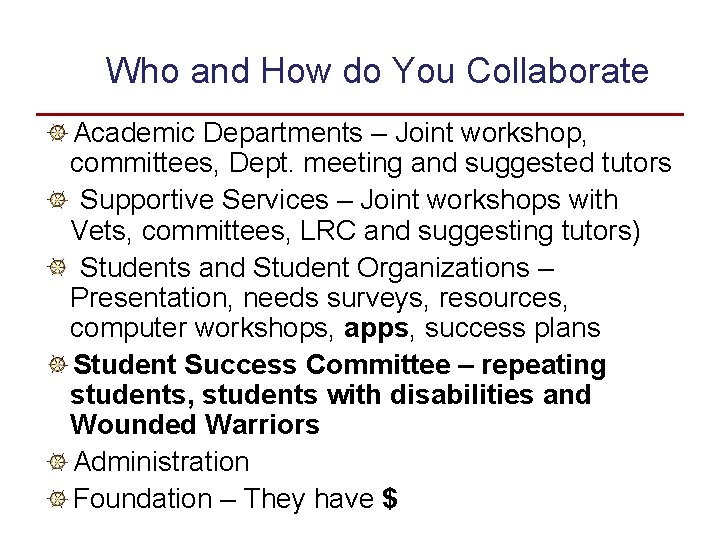
Who and How do You Collaborate Academic Departments – Joint workshop, committees, Dept. meeting and suggested tutors Supportive Services – Joint workshops with Vets, committees, LRC and suggesting tutors) Students and Student Organizations – Presentation, needs surveys, resources, computer workshops, apps, success plans Student Success Committee – repeating students, students with disabilities and Wounded Warriors Administration Foundation – They have $
Web Resources • Math Success Blog http: //www. academicsuccessblog. com • Math study Skills Evaluation: • http: //www. academicsuccess. com/ • • Online Math Study Skills and Support Web site for classroom use http: //www. e. Math. Ready. com • Additional research on math study skills by Dr. Paul Nolting and others http: //www. academicsuccess. com Student Guide: http: //www. studentguide. org/effective-learning-strategies
Additional Resources • Look here for time management and organization tips from experts: ADD: http: //www. additudemag. com/adhd/article/11283. html My Math Success Plan (Nolting, 2013) which is a student workbook demonstrating how disabilities affect math learning and teaches math study skills (e. Book or print). Contact us: Pnolting@aol. com Stubbs. aimee@spcollege. edu