
Helping the Helpers Addressing Knowledge Service Gaps in
- Slides: 36
Helping the Helpers: Addressing Knowledge & Service Gaps in IPV related TBI Nneka Mac. Gregor, LL. B. Executive Director nneka@womenatthecentre. com Women’s Centre For Social Justice, o/a Womenatthecentr. E
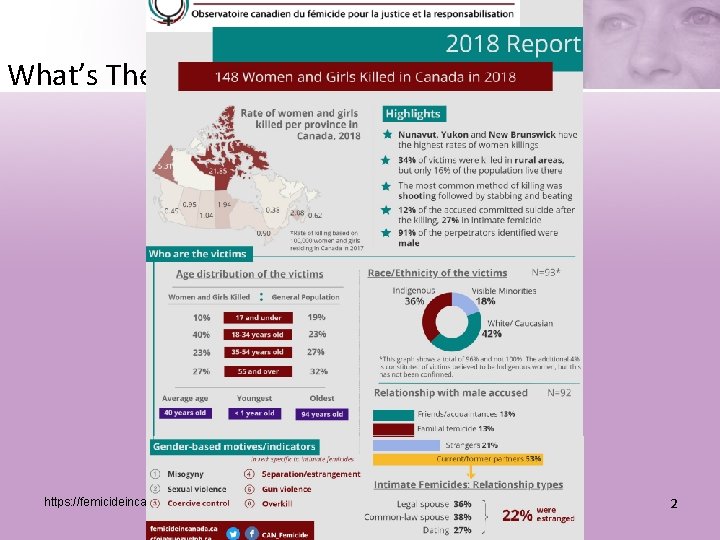
What’s The Issue? • This IS a gendered issue – about male violence against women • Socially constructed, but individually willed • Canadian Femicide Observatory for Justice & Accountability 2018 Report https: //femicideincanada. ca/callitfemicide. pdf 2
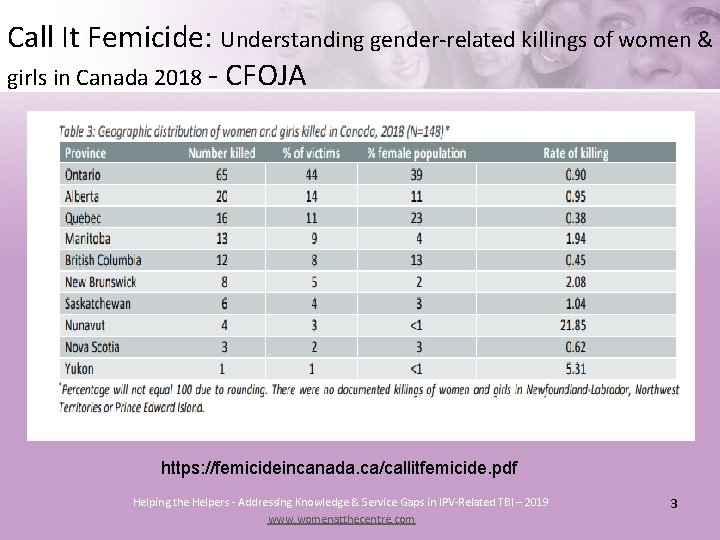
Call It Femicide: Understanding gender-related killings of women & girls in Canada 2018 - CFOJA https: //femicideincanada. ca/callitfemicide. pdf Helping the Helpers - Addressing Knowledge & Service Gaps in IPV-Related TBI – 2019 www. womenatthecentre. com 3
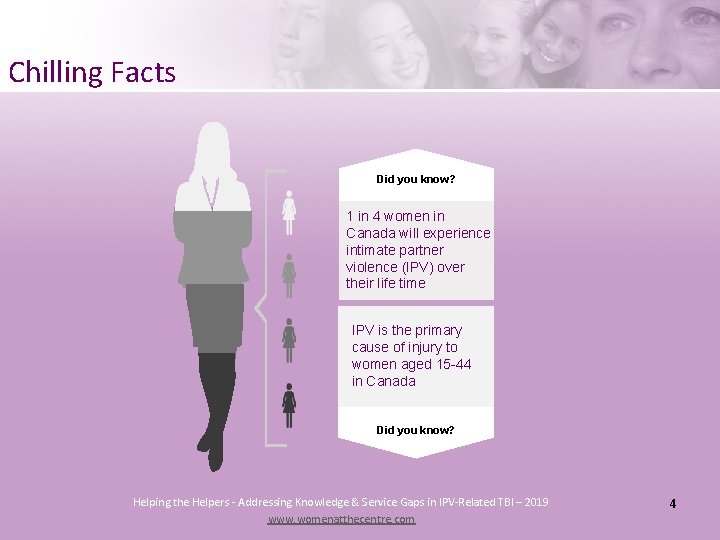
Chilling Facts Did you know? 1 in 4 women in Canada will experience intimate partner violence (IPV) over their life time IPV is the primary cause of injury to women aged 15 -44 in Canada Did you know? Helping the Helpers - Addressing Knowledge & Service Gaps in IPV-Related TBI – 2019 www. womenatthecentre. com 4
Chilling Facts 35 -80% of women survivors of IPV have possible TBI • Helping the Helpers - Addressing Knowledge & Service Gaps in IPV-Related TBI – 2019 www. womenatthecentre. com (Kwako et al. , 2011) 5
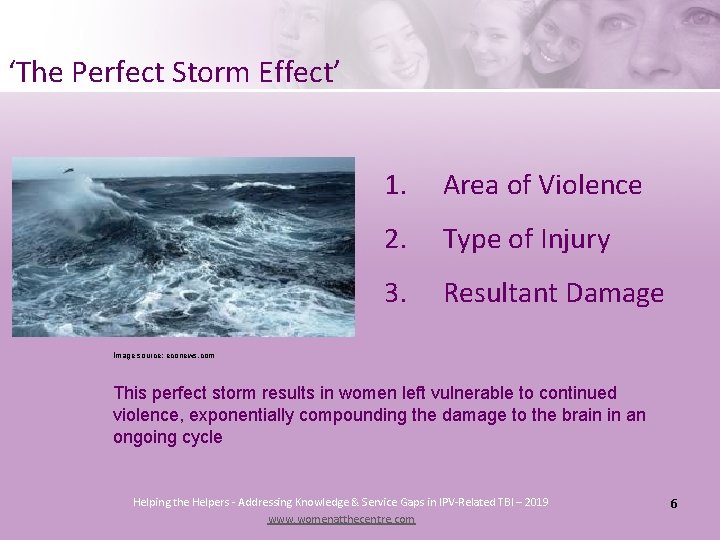
‘The Perfect Storm Effect’ 1. Area of Violence 2. Type of Injury 3. Resultant Damage Image source: econews. com This perfect storm results in women left vulnerable to continued violence, exponentially compounding the damage to the brain in an ongoing cycle Helping the Helpers - Addressing Knowledge & Service Gaps in IPV-Related TBI – 2019 www. womenatthecentre. com 6
So How Can We Help You Help Survivors? Key Takeaways: TBI 101: What is it & what does it look like? TBI & IPV: How is it relevant to you in your work? What are we doing about it? Helping the Helpers - Addressing Knowledge & Service Gaps in IPV-Related TBI – 2019 www. womenatthecentre. com 7
Common Signs & Symptoms of TBI 1. Cognitive: § § § § § Decision making / Judgement Reasoning / Impulsivity Multi-tasking Concentration Memory Organization Reduced processing speed Inability to read facial expressions Communication challenges Helping the Helpers - Addressing Knowledge & Service Gaps in IPV-Related TBI – 2019 www. womenatthecentre. com 8
Common Signs & Symptoms of TBI 2. Psychological: § § § Depression Anxiety Suicidality Anger Emotional lability Changes to personality Helping the Helpers - Addressing Knowledge & Service Gaps in IPV-Related TBI – 2019 www. womenatthecentre. com 9
Common Signs & Symptoms of TBI 3. Physical: § § § Headaches Ringing in the ears (Tinnitus) Chronic fatigue (physical & mental) Dizziness Blurred vision Hormone & endocrine system involvement Helping the Helpers - Addressing Knowledge & Service Gaps in IPV-Related TBI – 2019 www. womenatthecentre. com 10
Consequences of TBI § § § § Increased rates of mental illness Higher amounts of unemployment and homelessness Higher rates of divorce Higher rates of substance use challenges More likely to experience poverty Higher rates of social isolation Potential for challenges to credibility and capability based on being ‘disabled’ or ‘brain damaged’ Helping the Helpers - Addressing Knowledge & Service Gaps in IPV-Related TBI – 2019 www. womenatthecentre. com 11
Communication After Brain Injury § Individuals with TBI often report communication challenges § Not always obvious § More subtle (but debilitating) communication issues can be misconstrued as poor attitude, disinterest, disrespect, low intelligence or even substance use § (Wiseman-Hakes, C. , 2017) Helping the Helpers - Addressing Knowledge & Service Gaps in IPV-Related TBI – 2019 www. womenatthecentre. com 12
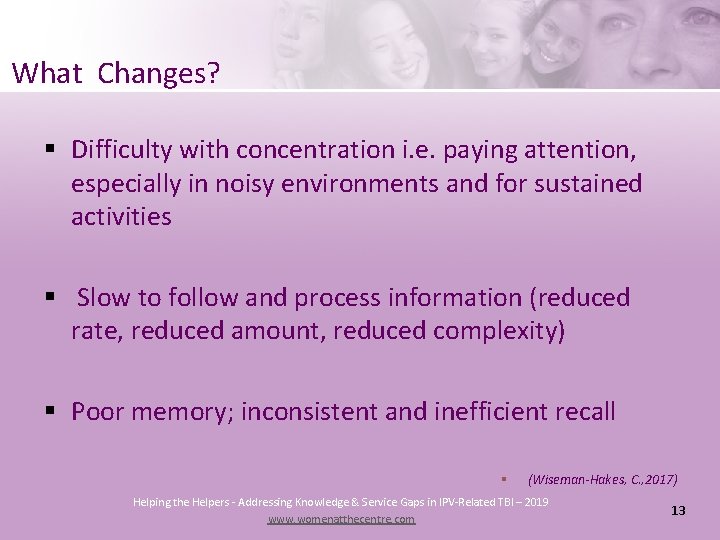
What Changes? § Difficulty with concentration i. e. paying attention, especially in noisy environments and for sustained activities § Slow to follow and process information (reduced rate, reduced amount, reduced complexity) § Poor memory; inconsistent and inefficient recall § (Wiseman-Hakes, C. , 2017) Helping the Helpers - Addressing Knowledge & Service Gaps in IPV-Related TBI – 2019 www. womenatthecentre. com 13
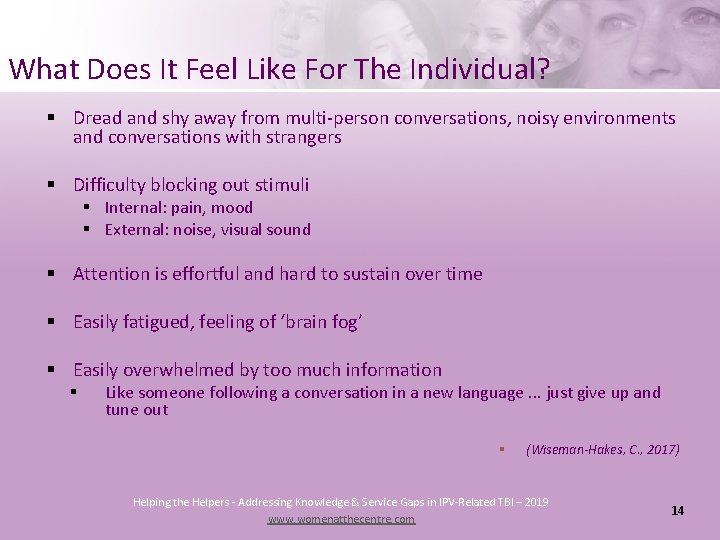
What Does It Feel Like For The Individual? § Dread and shy away from multi-person conversations, noisy environments and conversations with strangers § Difficulty blocking out stimuli § Internal: pain, mood § External: noise, visual sound § Attention is effortful and hard to sustain over time § Easily fatigued, feeling of ‘brain fog’ § Easily overwhelmed by too much information § Like someone following a conversation in a new language. . . just give up and tune out § (Wiseman-Hakes, C. , 2017) Helping the Helpers - Addressing Knowledge & Service Gaps in IPV-Related TBI – 2019 www. womenatthecentre. com 14
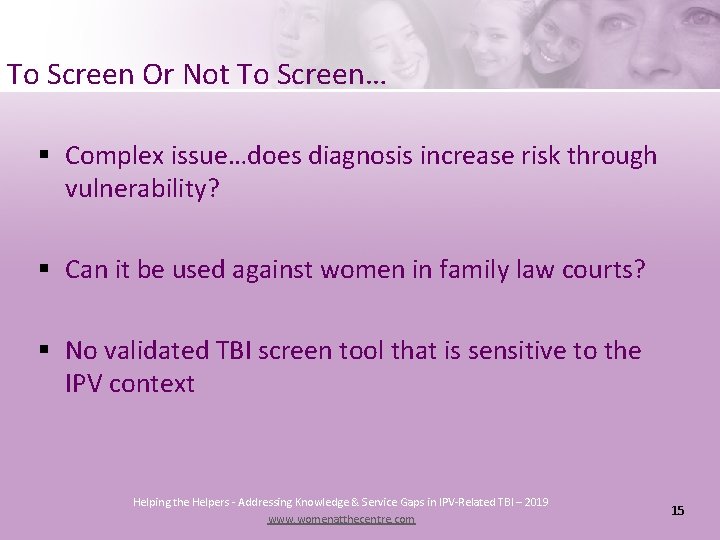
To Screen Or Not To Screen… § Complex issue…does diagnosis increase risk through vulnerability? § Can it be used against women in family law courts? § No validated TBI screen tool that is sensitive to the IPV context Helping the Helpers - Addressing Knowledge & Service Gaps in IPV-Related TBI – 2019 www. womenatthecentre. com 15
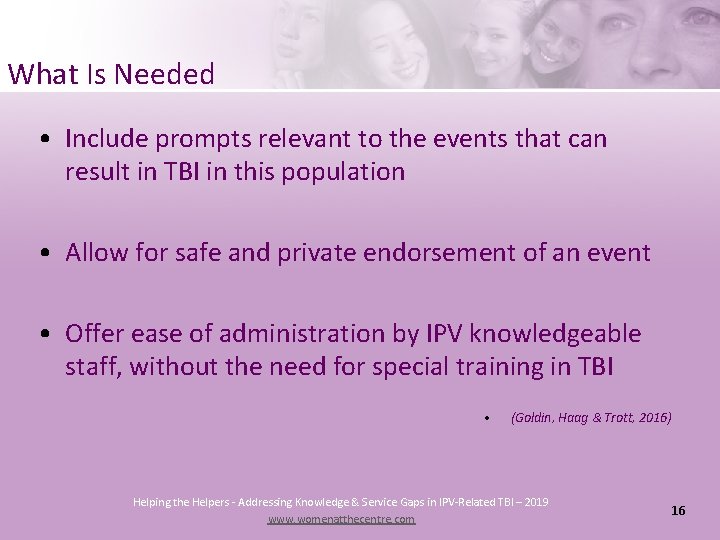
What Is Needed • Include prompts relevant to the events that can result in TBI in this population • Allow for safe and private endorsement of an event • Offer ease of administration by IPV knowledgeable staff, without the need for special training in TBI • (Goldin, Haag & Trott, 2016) Helping the Helpers - Addressing Knowledge & Service Gaps in IPV-Related TBI – 2019 www. womenatthecentre. com 16
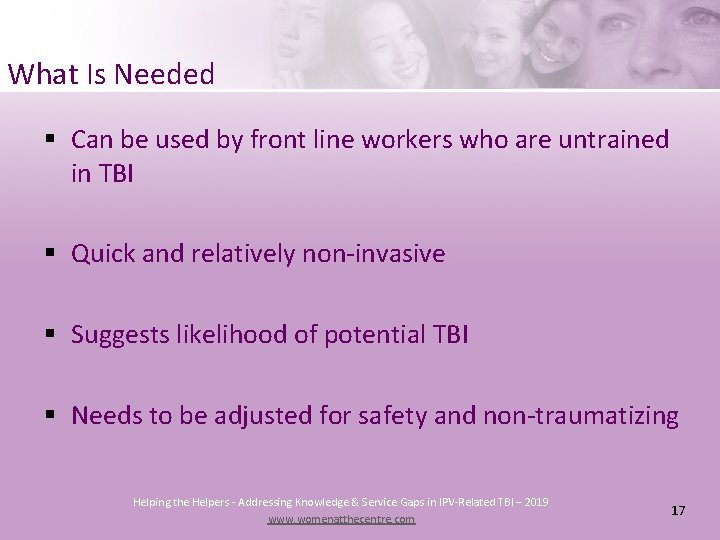
What Is Needed § Can be used by front line workers who are untrained in TBI § Quick and relatively non-invasive § Suggests likelihood of potential TBI § Needs to be adjusted for safety and non-traumatizing Helping the Helpers - Addressing Knowledge & Service Gaps in IPV-Related TBI – 2019 www. womenatthecentre. com 17
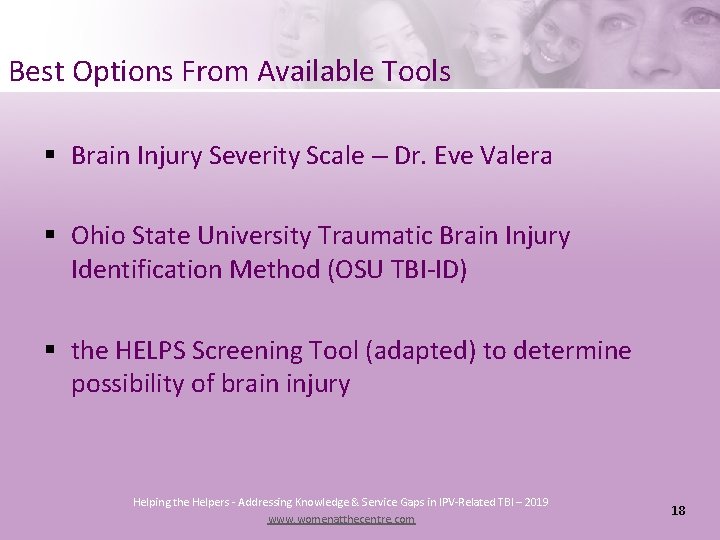
Best Options From Available Tools § Brain Injury Severity Scale – Dr. Eve Valera § Ohio State University Traumatic Brain Injury Identification Method (OSU TBI-ID) § the HELPS Screening Tool (adapted) to determine possibility of brain injury Helping the Helpers - Addressing Knowledge & Service Gaps in IPV-Related TBI – 2019 www. womenatthecentre. com 18
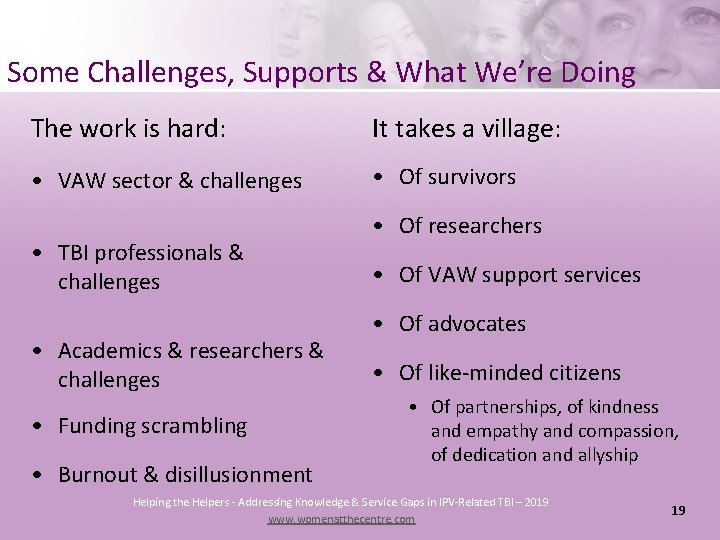
Some Challenges, Supports & What We’re Doing The work is hard: It takes a village: • VAW sector & challenges • Of survivors • TBI professionals & challenges • Academics & researchers & challenges • Funding scrambling • Burnout & disillusionment • Of researchers • Of VAW support services • Of advocates • Of like-minded citizens • Of partnerships, of kindness and empathy and compassion, of dedication and allyship Helping the Helpers - Addressing Knowledge & Service Gaps in IPV-Related TBI – 2019 www. womenatthecentre. com 19
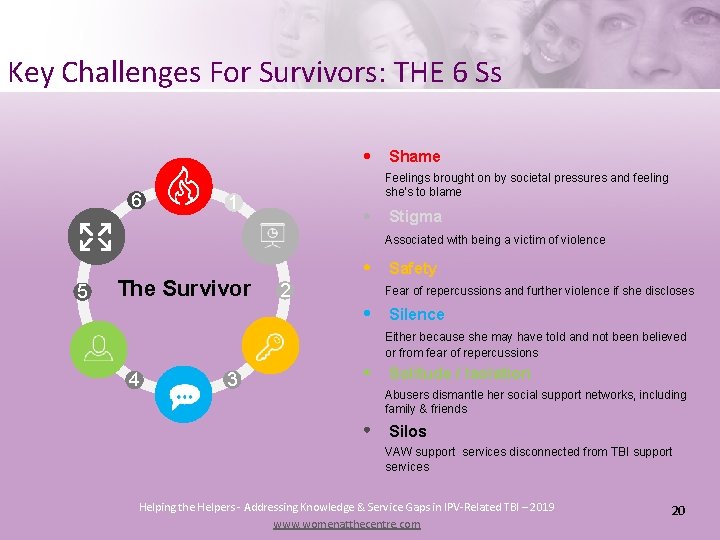
Key Challenges For Survivors: THE 6 Ss Shame 6 Feelings brought on by societal pressures and feeling she’s to blame 1 Stigma Associated with being a victim of violence 5 The Survivor Safety 2 Fear of repercussions and further violence if she discloses Silence Either because she may have told and not been believed or from fear of repercussions 4 3 Solitude / Isolation Abusers dismantle her social support networks, including family & friends Silos VAW support services disconnected from TBI support services Helping the Helpers - Addressing Knowledge & Service Gaps in IPV-Related TBI – 2019 www. womenatthecentre. com 20
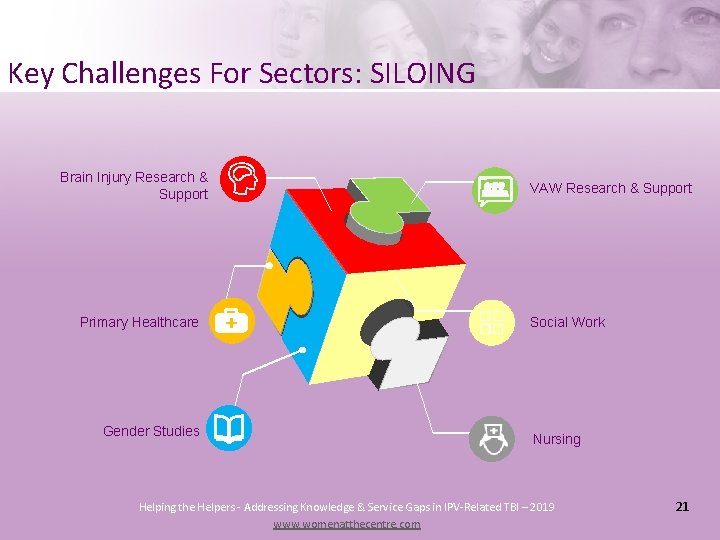
Key Challenges For Sectors: SILOING Brain Injury Research & Support Primary Healthcare Gender Studies VAW Research & Support Social Work Nursing Helping the Helpers - Addressing Knowledge & Service Gaps in IPV-Related TBI – 2019 www. womenatthecentre. com 21
Battered & Brain Injured Programme of Research Helping the Helpers - Addressing Knowledge & Service Gaps in IPV-Related TBI – 2019 www. womenatthecentre. com 22
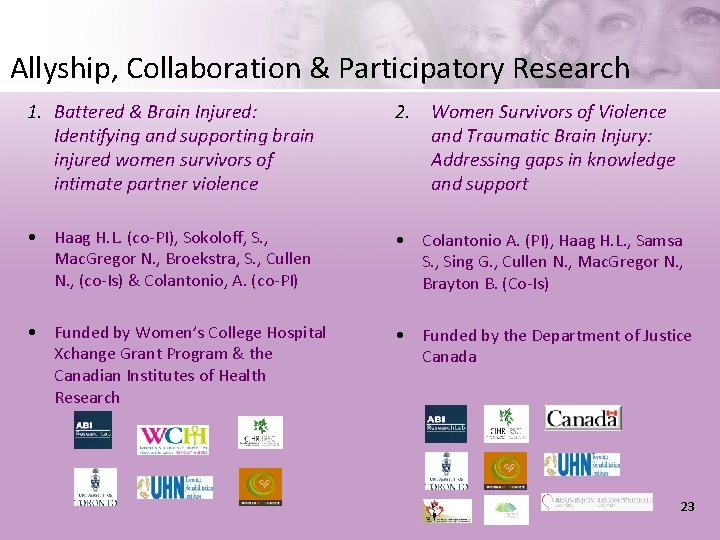
Allyship, Collaboration & Participatory Research 1. Battered & Brain Injured: Identifying and supporting brain injured women survivors of intimate partner violence 2. Women Survivors of Violence and Traumatic Brain Injury: Addressing gaps in knowledge and support • Haag H. L. (co-PI), Sokoloff, S. , Mac. Gregor N. , Broekstra, S. , Cullen N. , (co-Is) & Colantonio, A. (co-PI) • Colantonio A. (PI), Haag H. L. , Samsa S. , Sing G. , Cullen N. , Mac. Gregor N. , Brayton B. (Co-Is) • Funded by Women’s College Hospital Xchange Grant Program & the Canadian Institutes of Health Research • Funded by the Department of Justice Canada 23
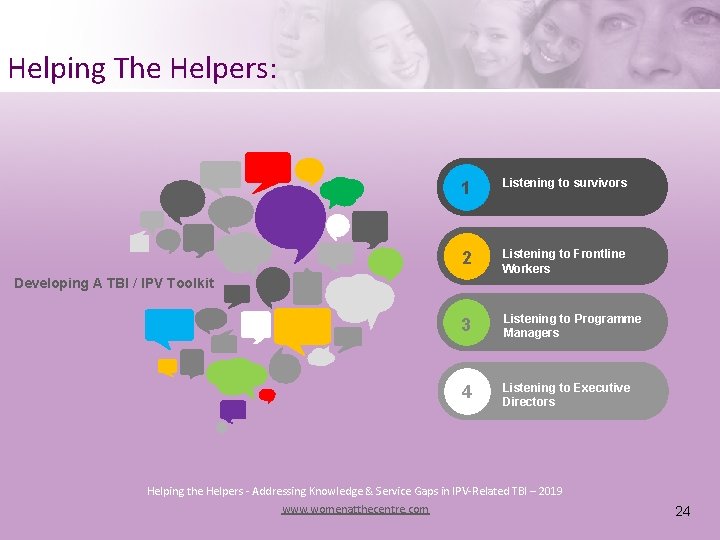
Helping The Helpers: 1 Listening to survivors 2 Listening to Frontline Workers 3 Listening to Programme Managers 4 Listening to Executive Directors Developing A TBI / IPV Toolkit Helping the Helpers - Addressing Knowledge & Service Gaps in IPV-Related TBI – 2019 www. womenatthecentre. com 24
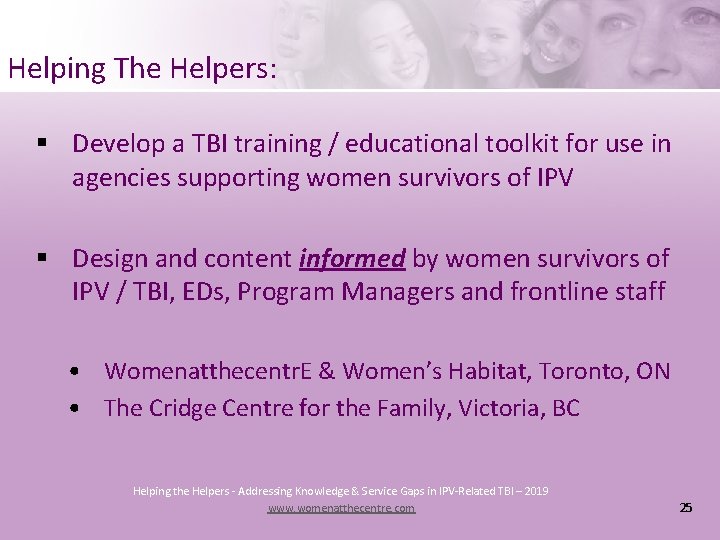
Helping The Helpers: § Develop a TBI training / educational toolkit for use in agencies supporting women survivors of IPV § Design and content informed by women survivors of IPV / TBI, EDs, Program Managers and frontline staff • Womenatthecentr. E & Women’s Habitat, Toronto, ON • The Cridge Centre for the Family, Victoria, BC Helping the Helpers - Addressing Knowledge & Service Gaps in IPV-Related TBI – 2019 www. womenatthecentre. com 25
What Did We Do? • Stakeholder consultation in Phase I • Focus groups with direct service providers and survivors in Victoria & Toronto • Individual interviews with EDs & Program Managers • We asked: 1. What content do you want in the toolkit? 2. What format do you want it in? Helping the Helpers - Addressing Knowledge & Service Gaps in IPV-Related TBI – 2019 www. womenatthecentre. com 26
Battered & Brain Injured Video
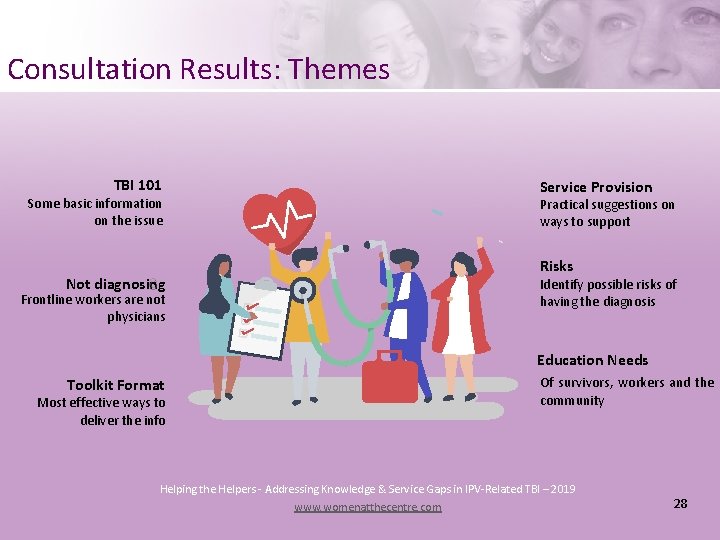
Consultation Results: Themes TBI 101 Some basic information on the issue Not diagnosing Frontline workers are not physicians Service Provision Practical suggestions on ways to support Risks Identify possible risks of having the diagnosis Education Needs Toolkit Format Most effective ways to deliver the info Of survivors, workers and the community Helping the Helpers - Addressing Knowledge & Service Gaps in IPV-Related TBI – 2019 www. womenatthecentre. com 28
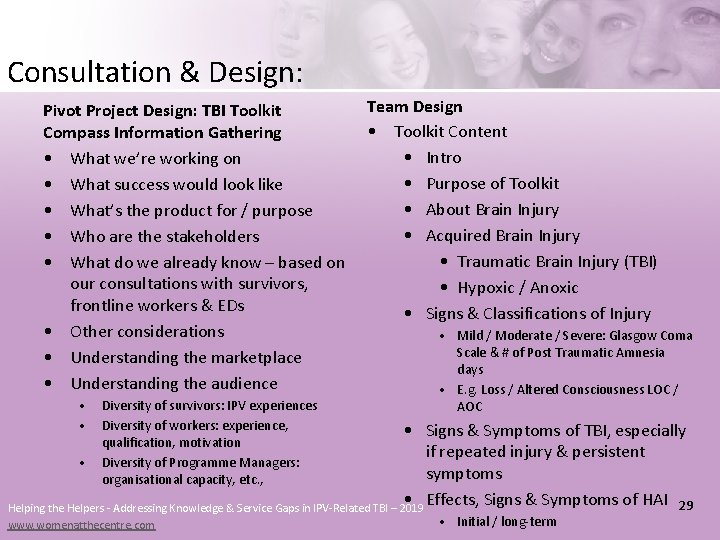
Consultation & Design: Pivot Project Design: TBI Toolkit Compass Information Gathering • What we’re working on • What success would look like • What’s the product for / purpose • Who are the stakeholders • What do we already know – based on our consultations with survivors, frontline workers & EDs • Other considerations • Understanding the marketplace • Understanding the audience • • Diversity of survivors: IPV experiences Diversity of workers: experience, qualification, motivation Diversity of Programme Managers: organisational capacity, etc. , Team Design • Toolkit Content • Intro • Purpose of Toolkit • About Brain Injury • Acquired Brain Injury • Traumatic Brain Injury (TBI) • Hypoxic / Anoxic • Signs & Classifications of Injury • Mild / Moderate / Severe: Glasgow Coma Scale & # of Post Traumatic Amnesia days • E. g. Loss / Altered Consciousness LOC / AOC • Signs & Symptoms of TBI, especially if repeated injury & persistent • symptoms • Effects, Signs & Symptoms of HAI 29 Helping the Helpers - Addressing Knowledge & Service Gaps in IPV-Related TBI – 2019 www. womenatthecentre. com • Initial / long-term
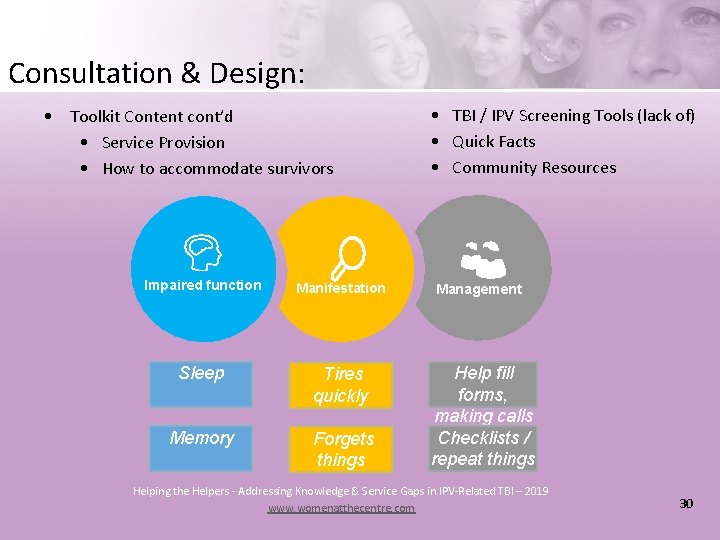
Consultation & Design: • Toolkit Content cont’d • Service Provision • How to accommodate survivors Impaired function Manifestation Sleep Tires quickly Memory Forgets things • TBI / IPV Screening Tools (lack of) • Quick Facts • Community Resources Management Help fill forms, making calls Checklists / repeat things Helping the Helpers - Addressing Knowledge & Service Gaps in IPV-Related TBI – 2019 www. womenatthecentre. com 30
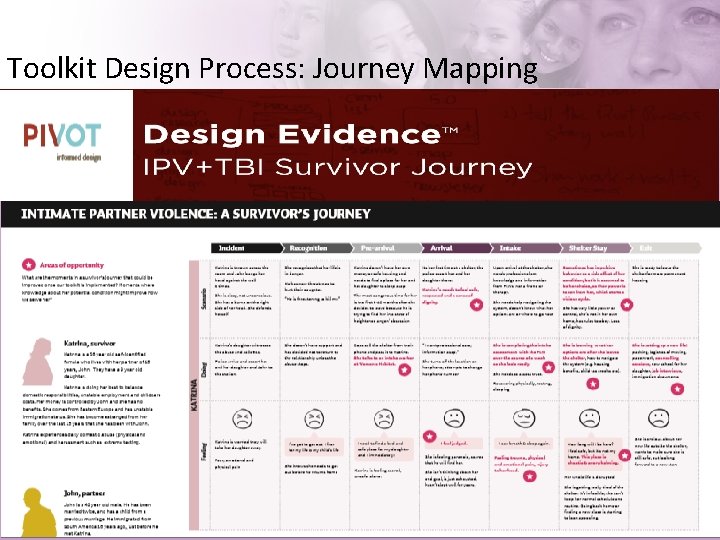
Toolkit Design Process: Journey Mapping
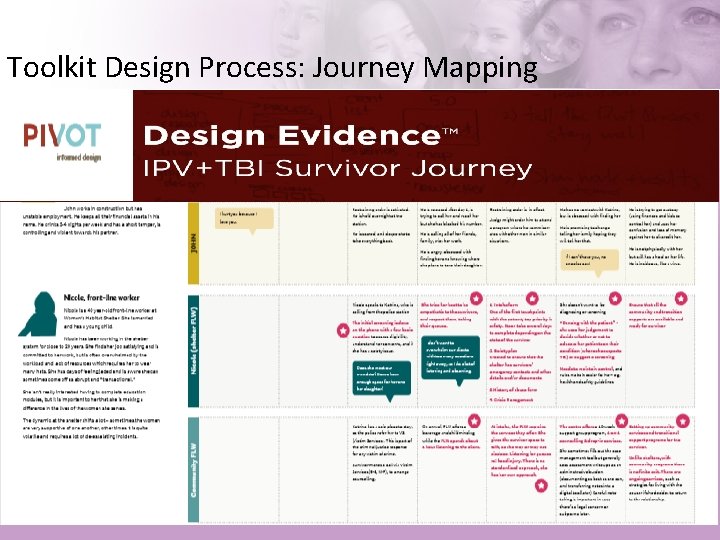
Toolkit Design Process: Journey Mapping 32
TA-DAH! Abused & Brain Injured https: //tbi. pivot. design/ Helping the Helpers - Addressing Knowledge & Service Gaps in IPV-Related TBI – 2019 www. womenatthecentre. com 33
Thanks for Listening Helping the Helpers - Addressing Knowledge & Service Gaps in IPV-Related TBI – 2019 www. womenatthecentre. com 34
Q&A 35
Get In Touch +416 -964 -0892 nneka@womenatthecentre. com CONTACT US Womenatthecentr. E 18 Wynford Drive, Suite 502, Toronto, ON www. womenatthecentre. com 36