
HELPING NEW EMPLOYEES SUCCEED SDLA 2018 Conference David
![References Johnson, P. (2013 a). Generations in the workplace [Power. Point slides]. Retrieved from](https://slidetodoc.com/presentation_image_h2/380cbca68081c34f87f5baee60fb4286/image-58.jpg "References Johnson, P. (2013 a). Generations in the workplace [Power. Point slides]. Retrieved from")
- Slides: 59
HELPING NEW EMPLOYEES SUCCEED SDLA 2018 Conference David Bradford, MLIS, MBA Daniel Burniston, BA History, MLIS September 27, 2018
Agenda Overview � Onboarding Process � Other Considerations �
PART 1 Overview
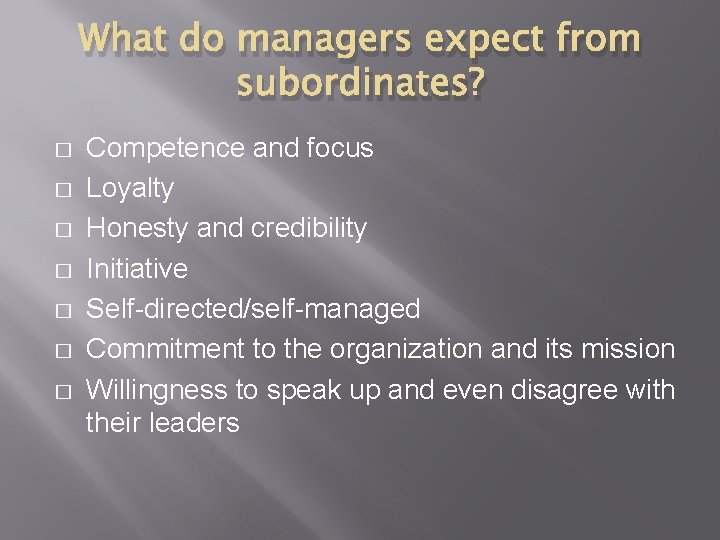
What do managers expect from subordinates? � � � � Competence and focus Loyalty Honesty and credibility Initiative Self-directed/self-managed Commitment to the organization and its mission Willingness to speak up and even disagree with their leaders
What do subordinates expect from managers? � � � � Good communication and feedback Leadership Encouragement and support Appreciation for work done well Delegation and autonomy Professional competence Information
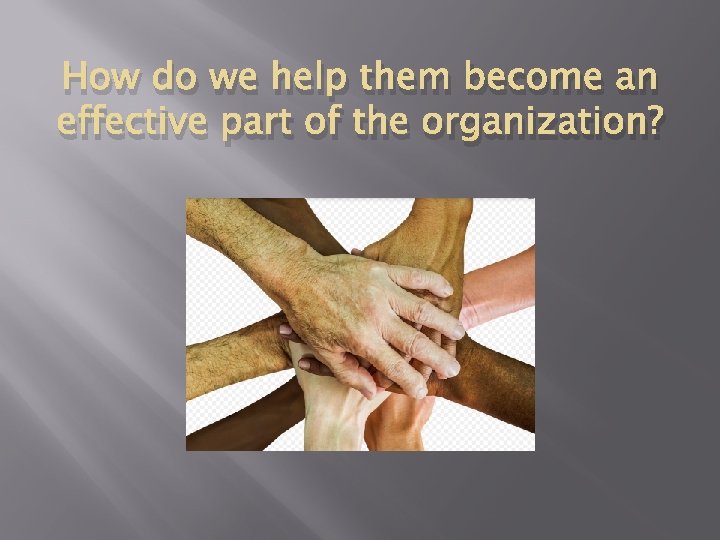
How do we help them become an effective part of the organization?
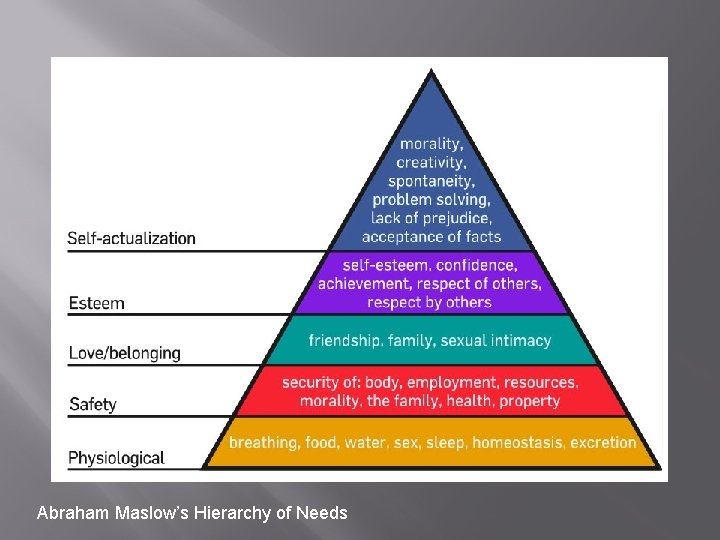
Abraham Maslow’s Hierarchy of Needs
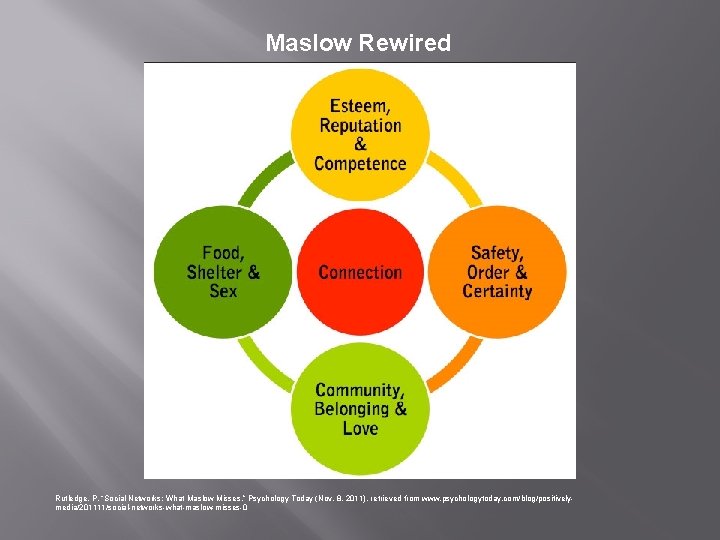
Maslow Rewired Rutledge, P. “Social Networks: What Maslow Misses, ” Psychology Today (Nov. 8, 2011), retrieved from www. psychologytoday. com/blog/positivelymedia/201111/social-networks-what-maslow-misses-0
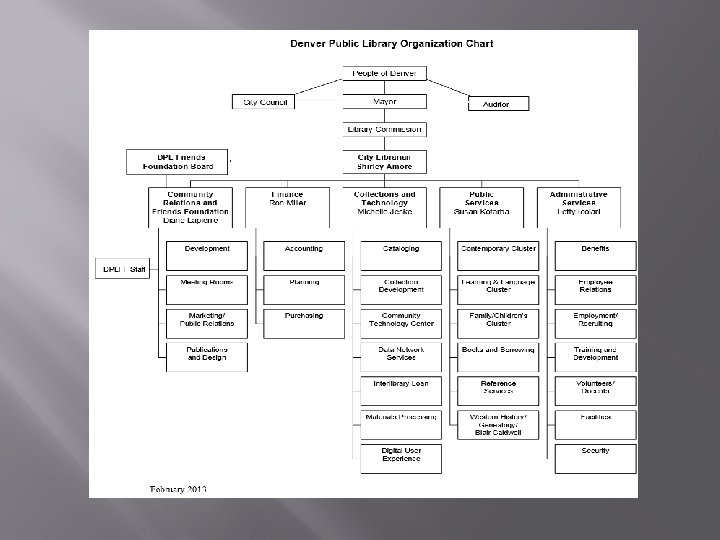
Organizational structure and culture � Organizational �System structure of relations, formal and informal, that governs the activities of coworkers seeking to accomplish common objectives
Organizational culture � Collective assumptions, value systems, and norms that groups develop to cope with problems of external adaption and internal integration
Common elements in organizational culture � � � � Symbols Manner of dress Group norms/values (articulated and unspoken) Slogans Heroes and villains Myths and stories Ceremonies, rituals
Keep structure and culture in mind Keep your onboarding process consistent with your organizational structure � Help the new person learn about the organizational culture � �Much of this is informal
PART 2 Onboarding Process
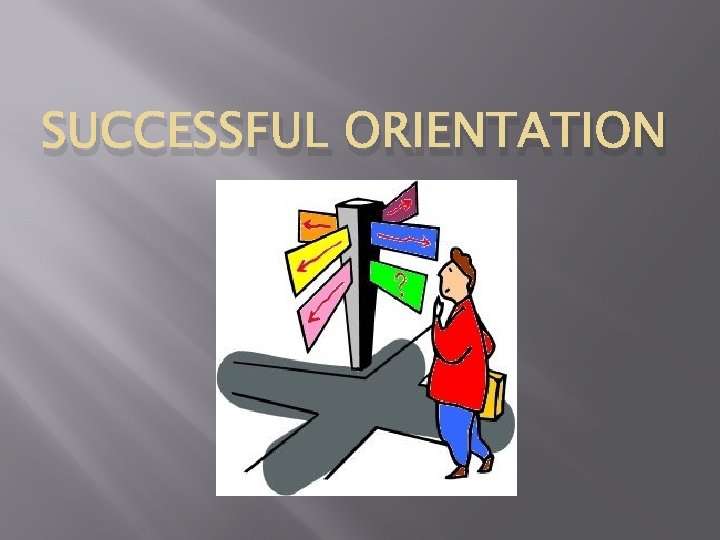
SUCCESSFUL ORIENTATION
Primary goals Make the employee feel welcome � Reduce anxiety of a new job and place � � Start with the assumption that a smart, hard-working, and competent employee has been hired
What does an effective orientation do? � � � Provides familiarity, sense of security, and reduces anxiety Develops understanding of expectations Provides information on work environment, policies, and practices Makes employee feel valued Increases morale and productivity Ultimately reduces turnover
What would you expect to learn the first day on a new job? � � Paperwork such as forms, keys, desk, computer, logins, email, ID, phone number Location of restrooms, supplies, equipment, staff room, exits Emergency/safety information Dress norms
More on the first day: � � � Work hours, break and lunch policy Procedures for absences and being late Holidays, sick and vacation policies Pay periods and how paid Chain of command where to direct questions Introduction to basic, core job duties
For the first day: � � � Give them a small task that the person can succeed at, that will be part of the regular job Shelving books Checking out an item Finding a resource Etc.
What not to do � � � Do not overwhelm them with too much information Stick to core duties Do not discuss minor aspects of the job or any future projects Meet the people they will work with regularly, but not necessarily everyone in library Do not assume filling a position is the last step in the process (Mc. Neil, 2017, p. 31 -33)
Retention of information over three days: � � � 10% of what is read 20% of what is heard 30% of what is seen 50% of what is seen and heard 80% of what is seen, heard, and done
Importance of first impressions: � � � � Is the work environment neat and organized? Are the whereabouts of staff members known? Does normal work continue when supervisors are out of the office? Does staff appear to be doing productive work? Is there a friendly and outgoing atmosphere? Are interruptions dealt with positively? Are positive things said about the work and the library?
First Week � � Stick to core duties, build some proficiency Learning about their duties, area, department Cover job-related plans, policies and procedures Align training to the job description and responsibilities
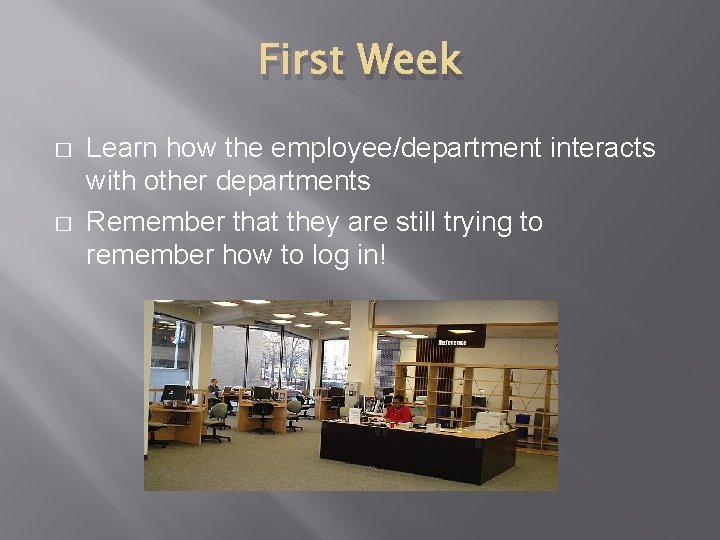
First Week � � Learn how the employee/department interacts with other departments Remember that they are still trying to remember how to log in!
Weeks 2 -4 � � � Practice and build upon learned duties Continue adding additional duties Don’t dump duties on people, add them gradually Let them become familiar/proficient before adding many additional duties Check that core information hasn’t been missed � Listservs � Files (paper or electronic) � Other eresources
Weeks 2 -4 � � Become knowledgeable about the functions of other departments and staff Develop an understanding of the organizational chart and how the library fits into parent institution’s goals and plans Understand how performance will be evaluated Get feedback from the employee at the end of the first month about their orientation
After the First Month � � � Fill in any gaps that were not completed the first month Check everything makes sense Ask for employee input Encourage teamwork Cultivate creativity and initiative Consider cross-training opportunities (Graves, 2014, p. 22)
After the First Month � � Professional development - consider other beneficial training and development opportunities Introduce the employee to long-range strategic plans Play and adapt to new employees strengths Delegate specific responsibilities / more freedom
Onboarding summary � � Effective orientation improves employee performance and increases retention Length of an effective orientation process can depend on the position Remember each employee will learn different aspects of their job at varying rates It will most likely take months for the employee to become as proficient as their predecessor
Onboarding summary � Keep your orientation process and check list up to date and get feed back Check in regularly and encourage questions – formally and casually Provide every opportunity for your new employee to succeed and continue to be successful! (Mc. Neil, 2017, p. 34 -35) � (Wallace, 2009, p. 174 -175) �
PART 3 Other Considerations
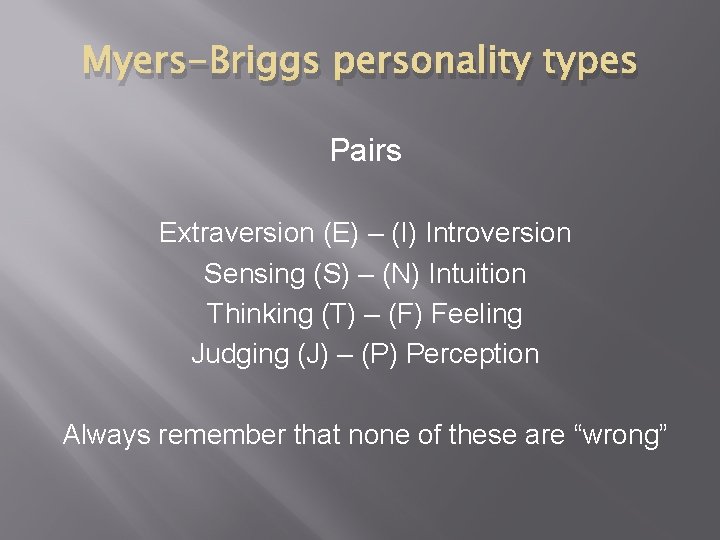
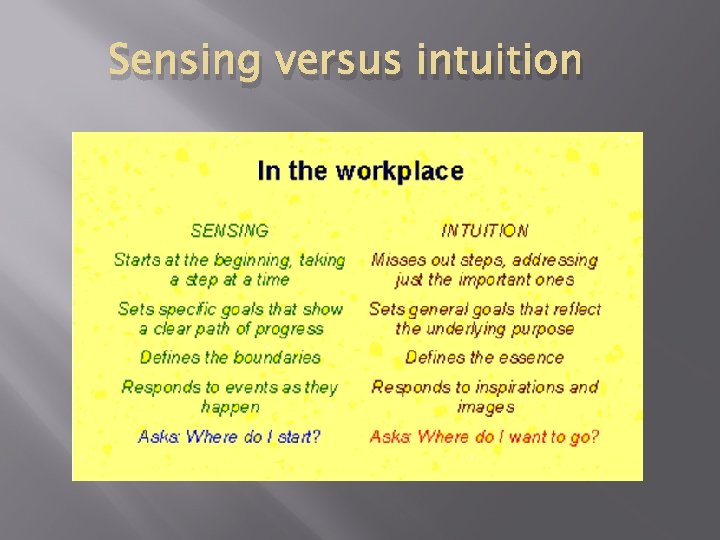
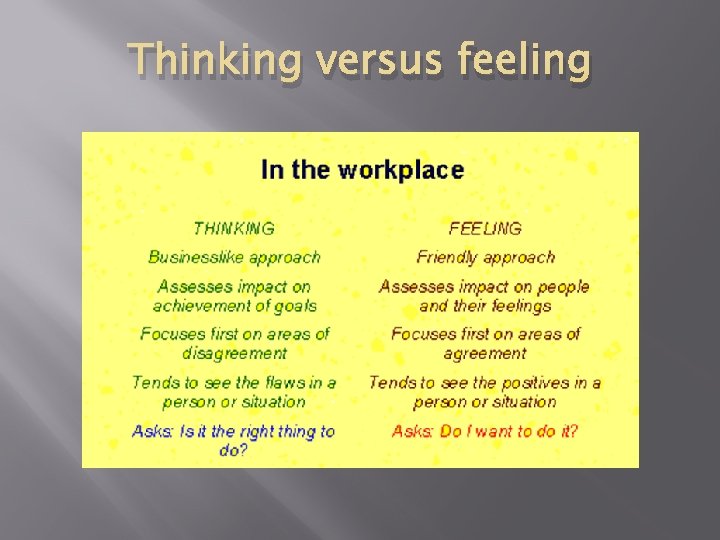
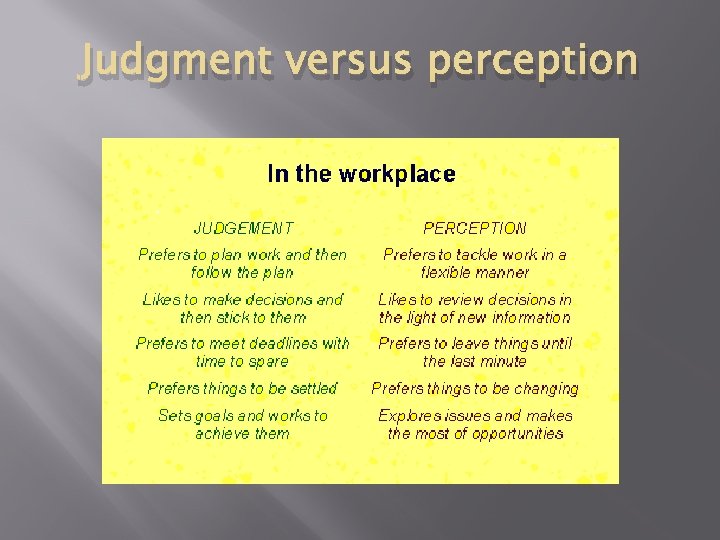
Myers-Briggs personality types Pairs Extraversion (E) – (I) Introversion Sensing (S) – (N) Intuition Thinking (T) – (F) Feeling Judging (J) – (P) Perception Always remember that none of these are “wrong”
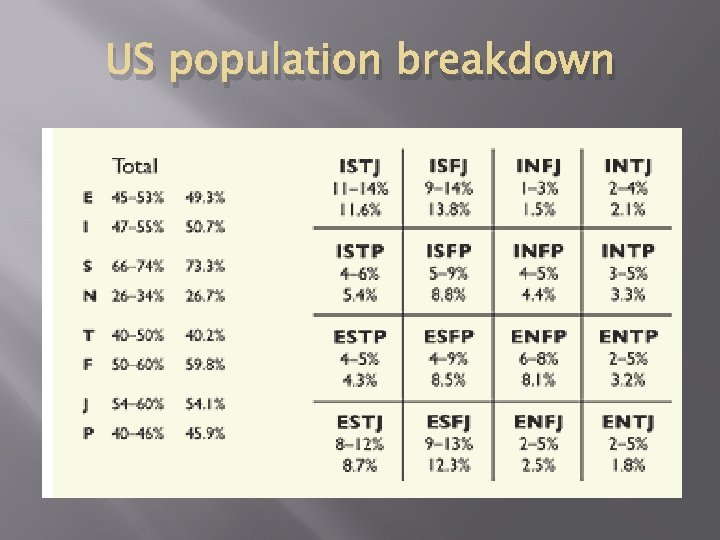
US population breakdown
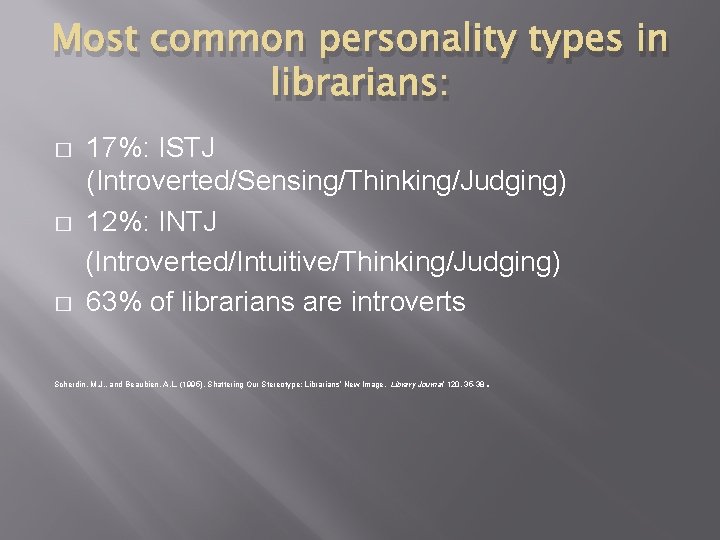
Most common personality types in librarians: � � � 17%: ISTJ (Introverted/Sensing/Thinking/Judging) 12%: INTJ (Introverted/Intuitive/Thinking/Judging) 63% of librarians are introverts Scherdin, M. J. , and Beaubien, A. L. (1995). Shattering Our Stereotype: Librarians’ New Image. Library Journal 120, 35 -38 .
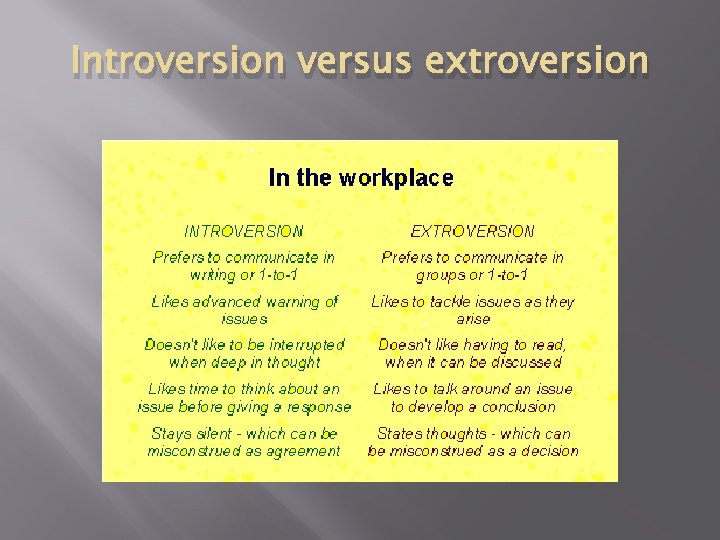
Introversion versus extroversion
Sensing versus intuition
Thinking versus feeling
Judgment versus perception
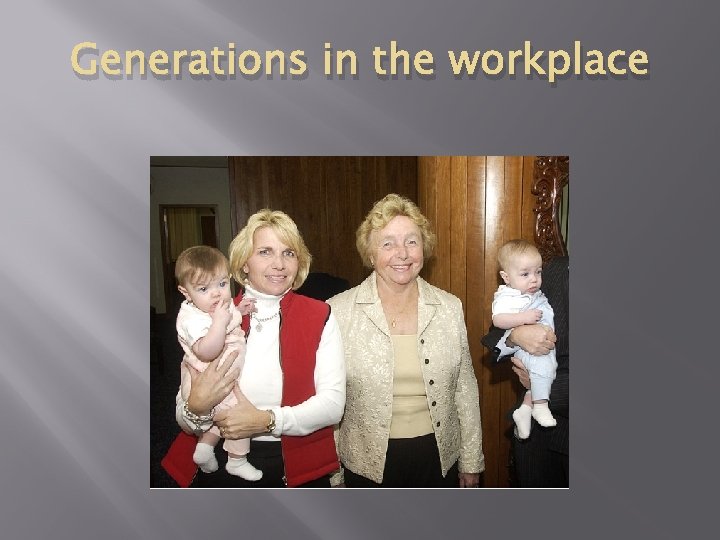
Generations in the workplace
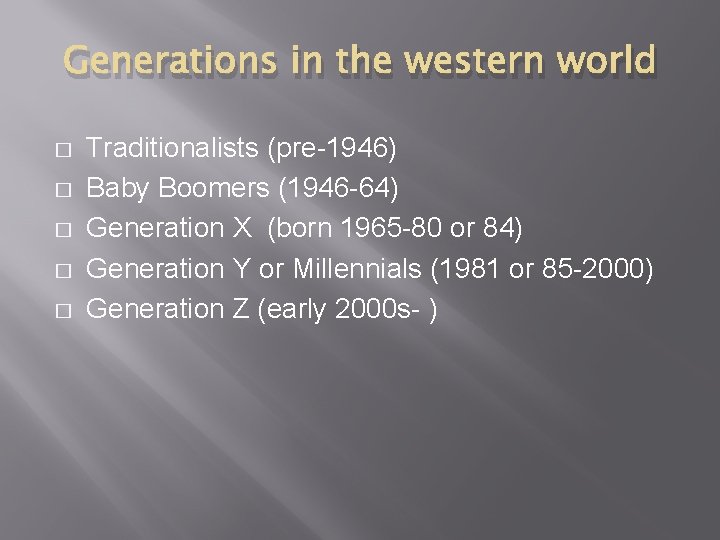
Generations in the western world � � � Traditionalists (pre-1946) Baby Boomers (1946 -64) Generation X (born 1965 -80 or 84) Generation Y or Millennials (1981 or 85 -2000) Generation Z (early 2000 s- )
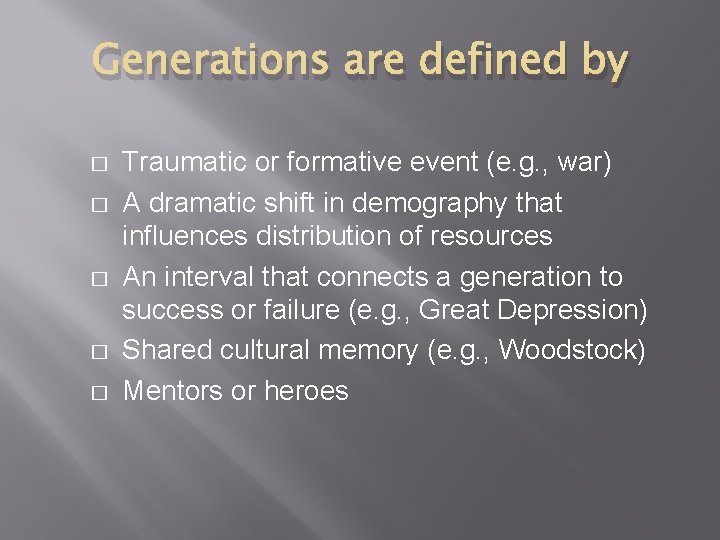
Generations are defined by � � � Traumatic or formative event (e. g. , war) A dramatic shift in demography that influences distribution of resources An interval that connects a generation to success or failure (e. g. , Great Depression) Shared cultural memory (e. g. , Woodstock) Mentors or heroes
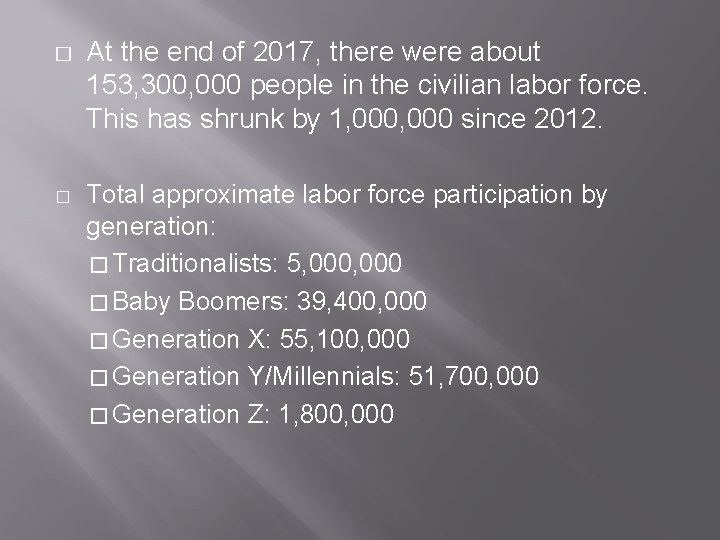
� � At the end of 2017, there were about 153, 300, 000 people in the civilian labor force. This has shrunk by 1, 000 since 2012. Total approximate labor force participation by generation: � Traditionalists: 5, 000 � Baby Boomers: 39, 400, 000 � Generation X: 55, 100, 000 � Generation Y/Millennials: 51, 700, 000 � Generation Z: 1, 800, 000
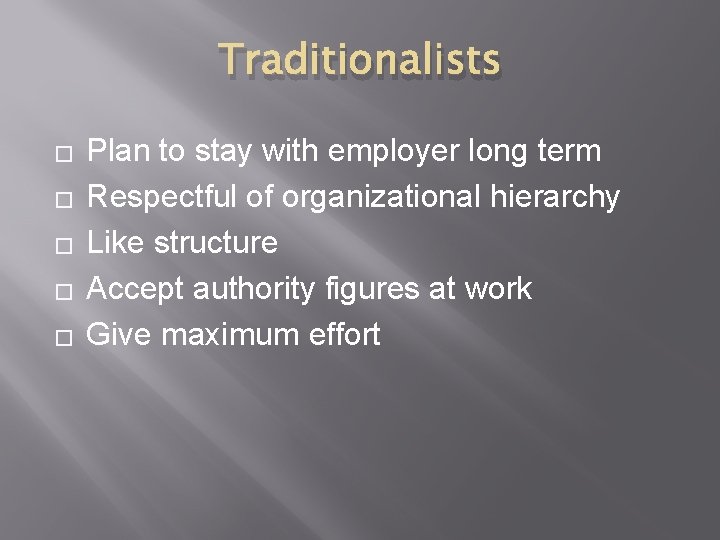
Traditionalists � � � Plan to stay with employer long term Respectful of organizational hierarchy Like structure Accept authority figures at work Give maximum effort
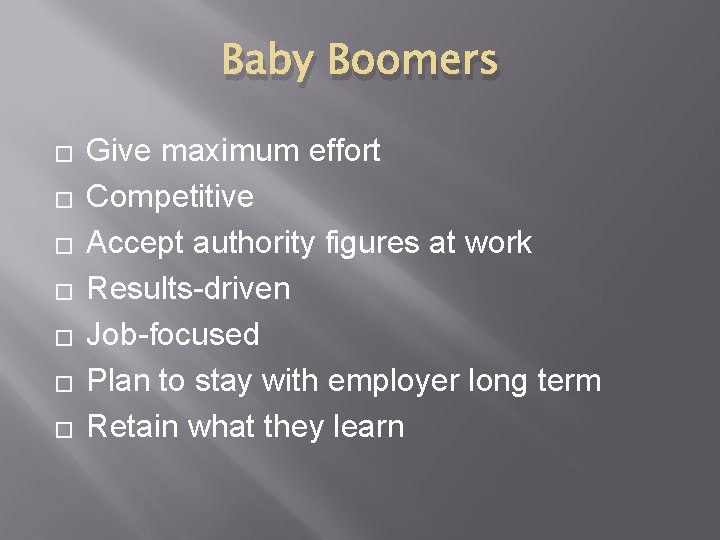
Baby Boomers � � � � Give maximum effort Competitive Accept authority figures at work Results-driven Job-focused Plan to stay with employer long term Retain what they learn
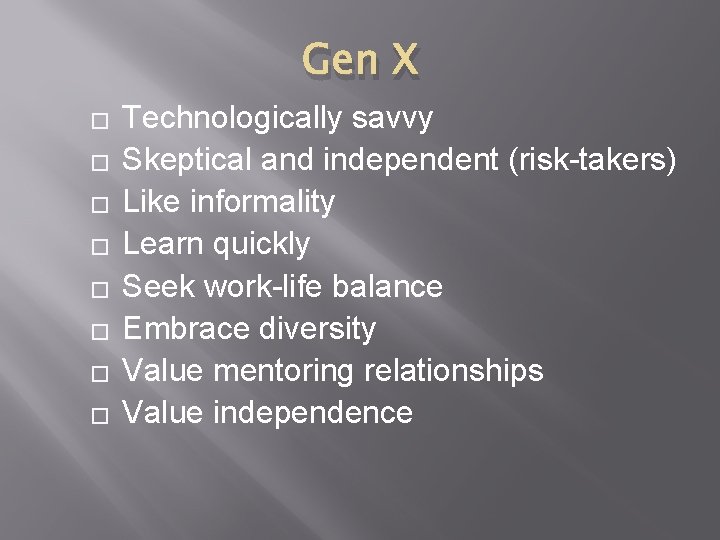
Gen X � � � � Technologically savvy Skeptical and independent (risk-takers) Like informality Learn quickly Seek work-life balance Embrace diversity Value mentoring relationships Value independence
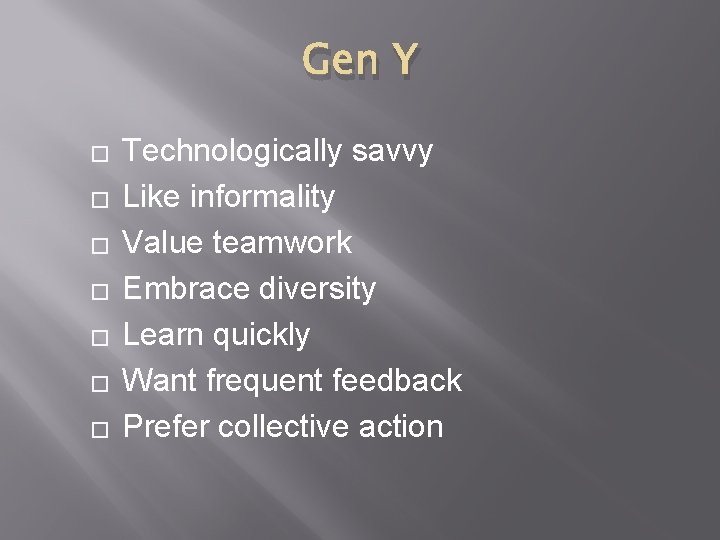
Gen Y � � � � Technologically savvy Like informality Value teamwork Embrace diversity Learn quickly Want frequent feedback Prefer collective action
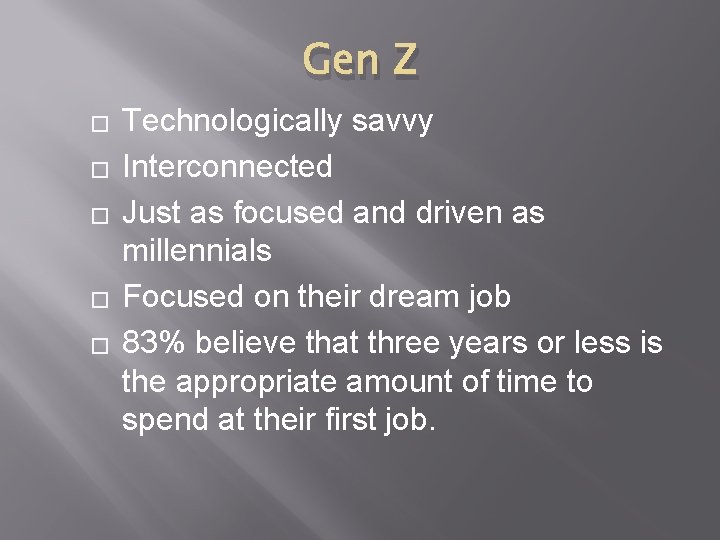
Gen Z � � � Technologically savvy Interconnected Just as focused and driven as millennials Focused on their dream job 83% believe that three years or less is the appropriate amount of time to spend at their first job.
Each generation has unique strengths, but those strengths may be perceived as weaknesses by other age groups.
Clash points � � � Traditionalists: Institutions deserve loyalty Baby Boomers: Institutions deserve to change. Gen X: Institutions are suspect. Gen Y: Institutions should be judged on their own merit. Gen Z: Will remain at this institution just a short time.
Strategies for employers � � � Facilitate mentoring Keep employees engaged (regular CE, involvement with task forces, etc. ) Open up the work environment (less rigidity) Toss routines Create recognition programs (validation and approval) Give all employees a voice
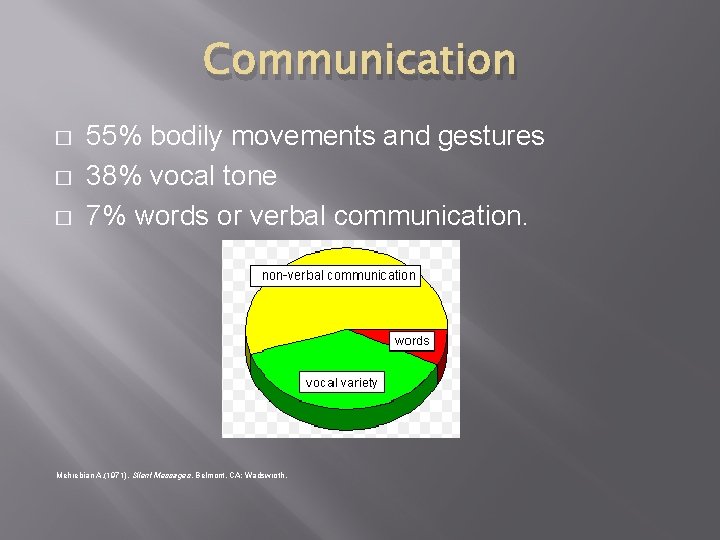
Communication � � � 55% bodily movements and gestures 38% vocal tone 7% words or verbal communication. Mehrebian A. (1971). Silent Messages. Belmont, CA: Wadswroth.
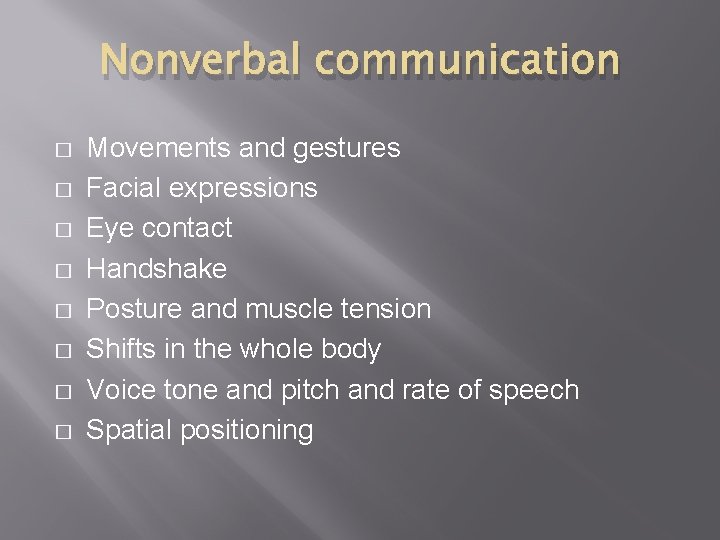
Nonverbal communication � � � � Movements and gestures Facial expressions Eye contact Handshake Posture and muscle tension Shifts in the whole body Voice tone and pitch and rate of speech Spatial positioning
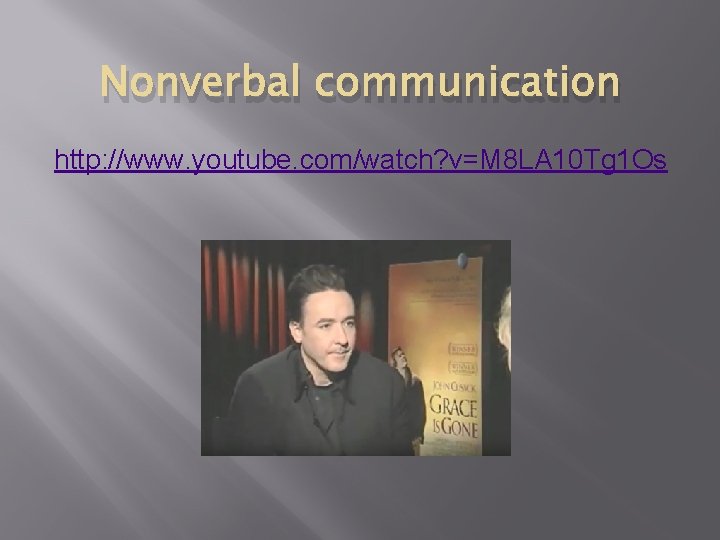
Nonverbal communication http: //www. youtube. com/watch? v=M 8 LA 10 Tg 1 Os
Why pay attention to nonverbal communication? � � � You can see how the new employee is responding/ learning adapting The way we talk, walk, gesture, and stand say something about us You can communicate more effectively
Thank You! DAVID BRADFORD � � Digital Resources Coordinator South Dakota State Library 605 -295 -3174 David. bradford@state. s d. us DANIEL BURNISTON � � Library Director Edith B. Siegrist Vermillion Public Library 605 -677 -7060 daniel. burniston@vermil lionpubliclibrary. org
References American Library Association. (2009). New Employee Orientation. Retrieved from https: //wikis. ala. org/professionaltips/index. php? title=New_Employee_Orientation Burke, M. (2004). Generational Differences. Alexandria, VA: Society for Human Resource Management. Clausen, T. V. (2011, July 19). Quick test body language [Video file]. Retrieved from https: //www. youtube. com/watch? v=M 8 LA 10 Tg 1 Os Crouch, B. (2015). How will generation Z disrupt the workplace? . Fortune. com, N. PAG. Retrieved form EBSCO Mega. File. Dunn, Kathel (2016). Hiring Librarians and Ensuring Their Early Success: Hiring a New Librarian Is Both a Challenge and an Opportunity, and It Tests the Planning and Management Skills of the Supervisor. Information Outlook 20(1). Giesecke, J. (Ed. ). (1997). Practical help for new supervisors, Third Edition. Chicago: American Library Association. Graves, A. (2014). The Small Library Manager’s Handbook. Lanham Boulder New York: Rowman & Littlefield. Hands teamwork [image]. (2016). Retrieved from https: //pixabay. com/en/hands-teamwork-team-spiritcheer-up-1939895/
References Johnson, P. (2013 a). Generations in the workplace [Power. Point slides]. Retrieved from St. Catherine University intranet (not publicly available) Johnson, P. (2013 b, September 11). Management & Changing Landscape [Power. Point slides]. Retrieved from St. Catherine University intranet (not publicly available) Johnson, P. (2013 c). Managing your boss [Power. Point slides]. Retrieved from St. Catherine University intranet (not publicly available) Johnson, P. (2013 d). Nonverbal communication [Power. Point slides]. Retrieved from St. Catherine University intranet (not publicly available) Johnson, P. (2013 e). Organization and Organizational Culture [Power. Point slides]. Retrieved from St. Catherine University intranet (not publicly available). Johnson, P. (2013 f). Successful Orientation [Power. Point slides]. Retrieved from St. Catherine University intranet (not publicly available) Langsdale library. (2007, January 31). New Reference Desk with Computer Tables. Retrieved from https: //commons. wikimedia. org/wiki/File: New_Reference_Desk_with_Computer_Tables_(37586 5443). jpg
References Mc. Neil, B. & Giesecke, J. (2017). Fundamentals of library supervision. Third Edition. Chicago: Neal. Schuman, an imprint of the American Library Association. The Meyers & Briggs Foundation. (2002). How frequent is my type. Retrieved from https: //www. myersbriggs. org/my-mbti-personality-type/my-mbti-results/how-frequent-is-mytype. htm? bhcp=1 Mossman, K. (2005, June 15). Next. Gen: Good Orientation Counts. Library Journal. Secretary Alphonso Jackson with Assistant Secretary Pam Patenaude and Family Members. (2005, November 5). Retrieved from https: //catalog. archives. gov/id/7299503 Sessa V. , et al. (2007). Generational difference in leader values and leadership behaviours. Psychologist-Manager Journal, 10(1), 47 -74. U. S. Department of Labor. (2017). Labor Force Statistics from the Current Population Survey. Retrieved from https: //www. bls. gov/cps/demographics. htm Wallace, K. (2009). Creating an Effective New Employee Orientation Program. Library Leadership & Management, 23(4).