
Helping ESE and ESOL students experience success Buffalo
Helping ESE and ESOL students experience success. Buffalo Creek Middle School 12/05/12
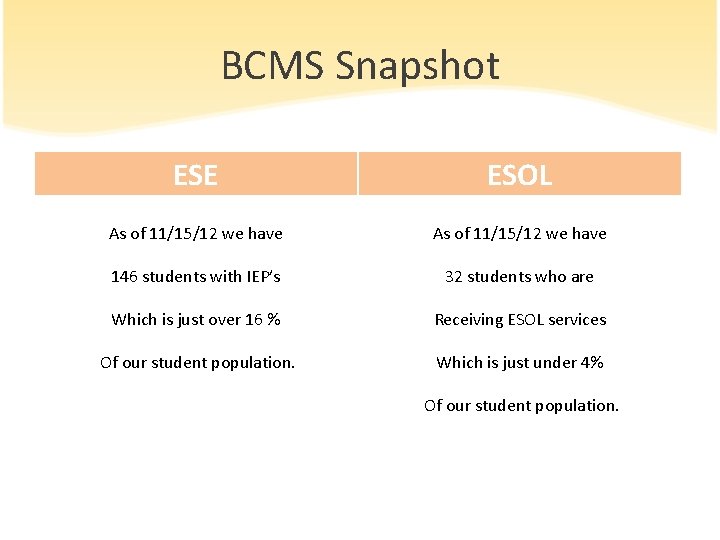
BCMS Snapshot ESE ESOL As of 11/15/12 we have 146 students with IEP’s 32 students who are Which is just over 16 % Receiving ESOL services Of our student population. Which is just under 4% Of our student population.
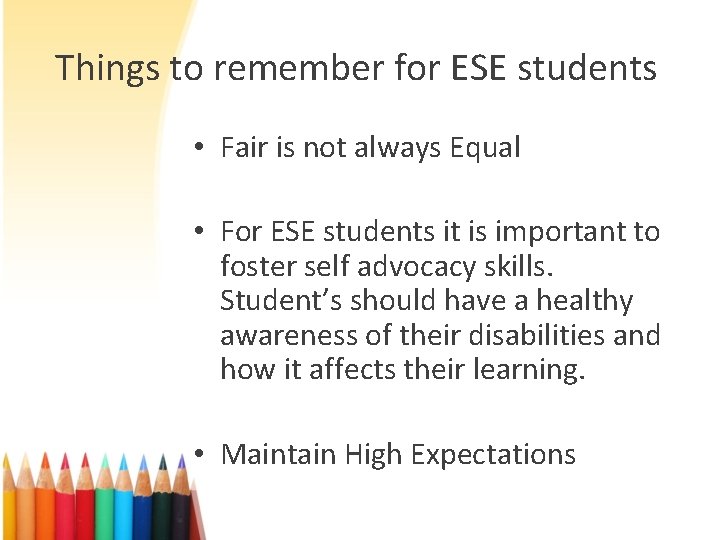
Things to remember for ESE students • Fair is not always Equal • For ESE students it is important to foster self advocacy skills. Student’s should have a healthy awareness of their disabilities and how it affects their learning. • Maintain High Expectations

ESE Grading From Manatee County School Board Pupil Progression Plan (4 -22) A student with a disability who is taking standardized state assessments such as FCAT or SAT is graded on his/her achievement of the standards, benchmarks and grade level expectations appropriate for his/her grade using the standard report card. The student is to be given appropriate accommodations for all classroom instruction and testing. These accommodations are to be documented on the student’s Individual Education Plan (IEP).
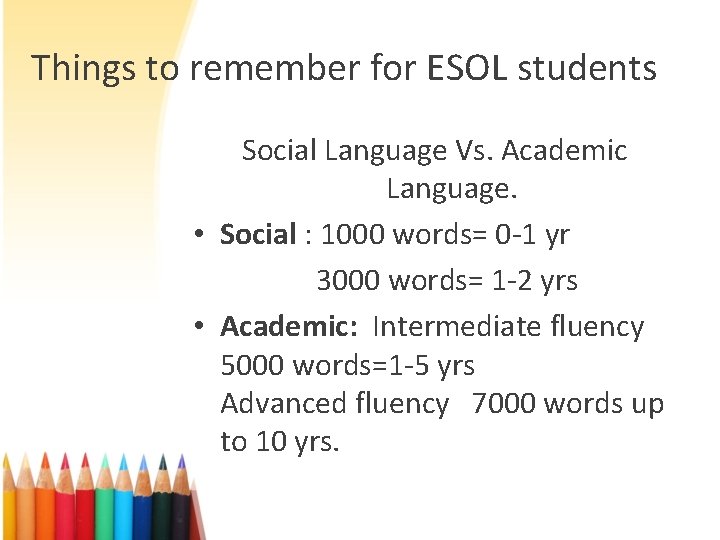
Things to remember for ESOL students Social Language Vs. Academic Language. • Social : 1000 words= 0 -1 yr 3000 words= 1 -2 yrs • Academic: Intermediate fluency 5000 words=1 -5 yrs Advanced fluency 7000 words up to 10 yrs.

ESOL Grading From Manatee County School Board Pupil Progression Plan (4 -22) A grade of “unsatisfactory, ” “D, ” or “F” may only be assigned to a English Language Learner receiving ESOL services if he/she received appropriate accommodations and strategies in instruction and assessment and the student demonstrated no progress toward achieving the benchmarks and grade level expectations at his/her level of English proficiency.
Teacher’s responsibilities • Document strategies and interventions used if a student will fail your class. • Student’s right to fail: All students (ESE and ESOL inclusive) have a right to fail. If no effort is shown on the part of the student and teacher has provided all accommodations and used appropriate strategies interventions, the student may fail.
Accommodation vs. Modification • Accommodations are intended to lessen the affects of a student’s disability or learning difference. They are not intended to reduce learning expectations. (extended time, copy of notes, reduced assignments) • Changing, lowering, or reducing learning expectations is referred to as a modification. (VE or ESE classes)
Useful strategies • Simplify language • Repitition and re-phrasing • Wait time – extended for ESE and ESOL students (double). • Reduce length of assignments* • Use visuals ; non-linguistic represenations • Hands on learning (manipulatives)

Useful strategies con’t • AVID strategies • Cooperative learning (Kagan) • Reinforcing effort and provide recognition for effort. • Setting objectives and providing feedback • Goal setting and monitoring • Teach/Model appropriate social skills often • Set routines
Useful strategies con’t • Take breaks in lessons to summarize learning • Opportunities to discuss content / learning with a partner. • Modeling thinking process, behaviors, social interactions during teaching • Use cues, questions, and advanced organizers to assist with and check understanding.
Useful strategies con’t • Take frequent brain breaks. • High energy students: allow them to move appropriately (run errands, stand stretch) use fidget tools (play-doh, stress balls)
Handwriting and Organization • Prompt student to take time and write neatly (remember to give extra time). • Allow students to type when possible. • Use of graph paper is a good tool (especially for math teachers) • Take time teach/model organizational skills (cornell notes, interactive notebooks, agendas, organizing folders/binders, etc. )
Thank you for helping ALL students achieve success!!!
- Slides: 14