
Helping Couples Improve Their Relationships MARRCH Annual Workshop
- Slides: 33
Helping Couples Improve Their Relationships MARRCH Annual Workshop 1 -2: 40 & 3 -4: 40 pm 10/30/07 Doug Greenlee MA/MS LMFT, LADC, CGC Staff Psychotherapist, Recovery Plus Addiction & Mental Health Center Greenleed@centracare. com
Goals & Objectives n To highlight biopsychosocial evidence- informed relational enhancement models that may be useful for reducing conflict and enhancing intimacy skills in couple and/or family relationships n To provide opportunity for attendees to review and to discuss sample case scenarios via practice identifying basic issues, implementing problem solving and enhancing intimacy skills development
Logistics n Learning level: Beginner n Core Functions: Counseling & implications n Presenter Information: Experience & Education n Presentation summary: Evidence-informed relational enhancement models n Client? n Cultural Diversity: Client as Cultural Unit n Ethics: Informed consent, confidentiality limits, dual licensure & gray areas
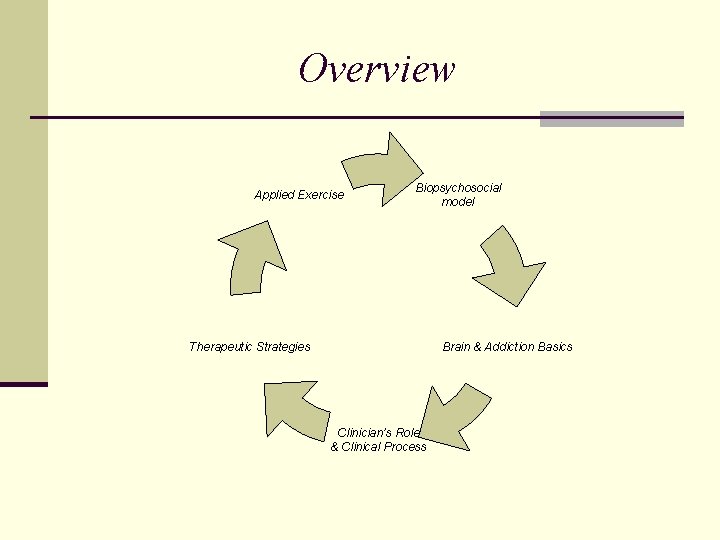
Overview Applied Exercise Biopsychosocial model Therapeutic Strategies Brain & Addiction Basics Clinician’s Role & Clinical Process
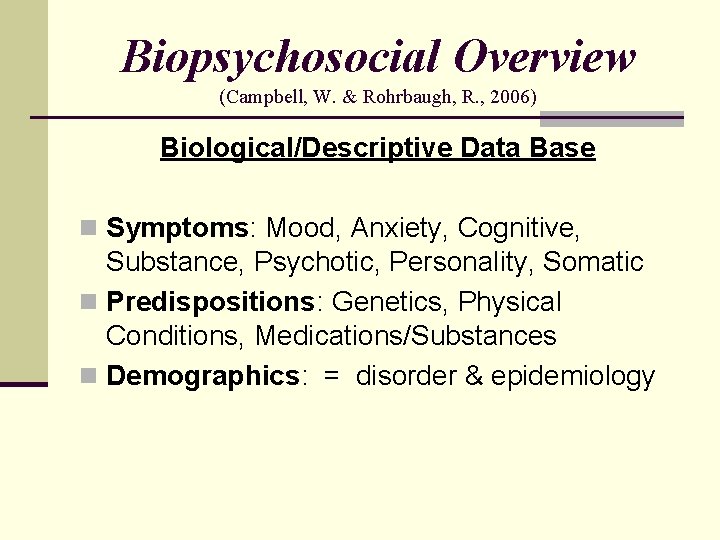
Biopsychosocial Overview (Campbell, W. & Rohrbaugh, R. , 2006) Biological/Descriptive Data Base n Symptoms: Mood, Anxiety, Cognitive, Substance, Psychotic, Personality, Somatic n Predispositions: Genetics, Physical Conditions, Medications/Substances n Demographics: = disorder & epidemiology
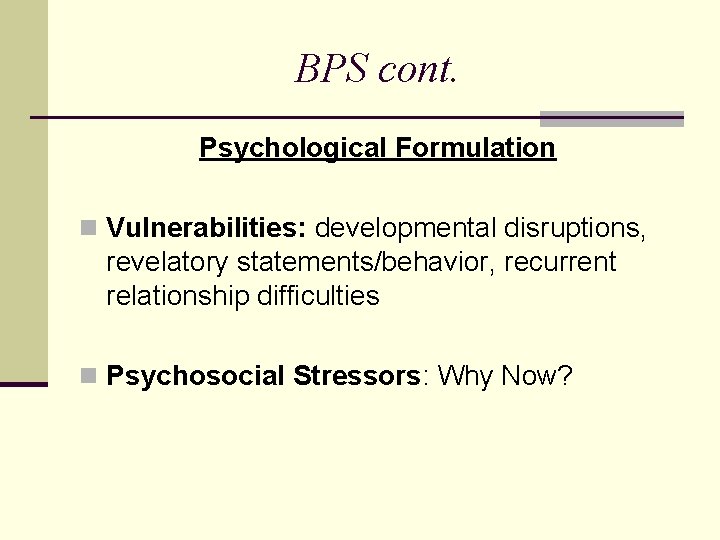
BPS cont. Psychological Formulation n Vulnerabilities: developmental disruptions, revelatory statements/behavior, recurrent relationship difficulties n Psychosocial Stressors: Why Now?
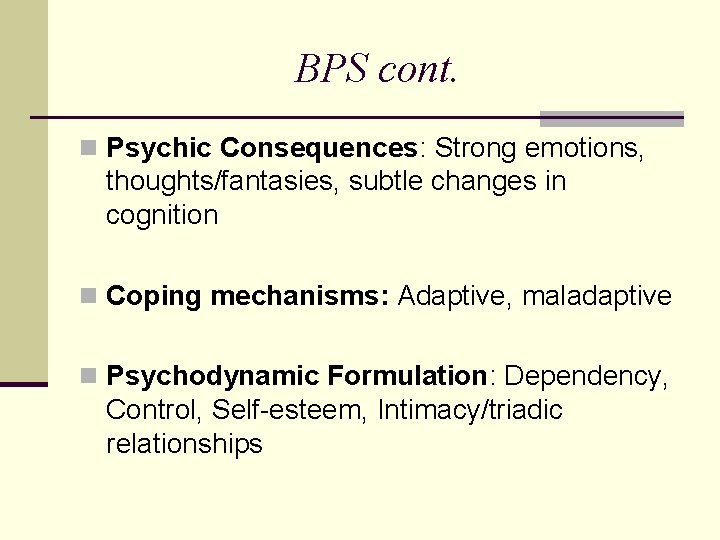
BPS cont. n Psychic Consequences: Strong emotions, thoughts/fantasies, subtle changes in cognition n Coping mechanisms: Adaptive, maladaptive n Psychodynamic Formulation: Dependency, Control, Self-esteem, Intimacy/triadic relationships
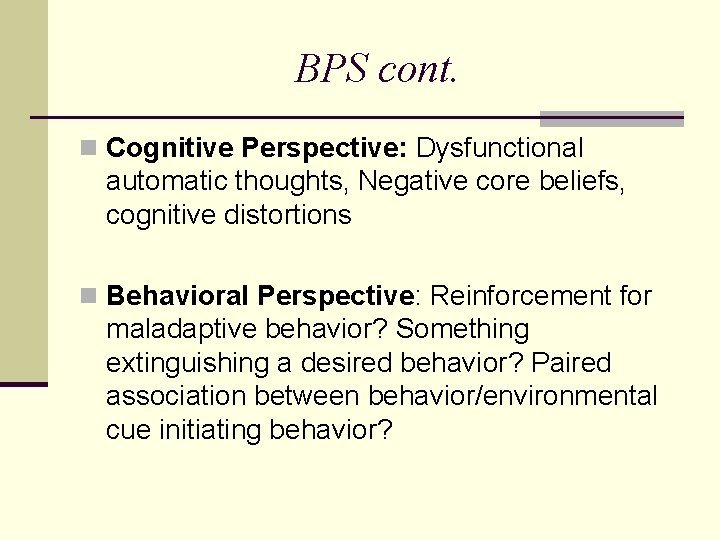
BPS cont. n Cognitive Perspective: Dysfunctional automatic thoughts, Negative core beliefs, cognitive distortions n Behavioral Perspective: Reinforcement for maladaptive behavior? Something extinguishing a desired behavior? Paired association between behavior/environmental cue initiating behavior?
BPS cont. Social Formulation/Database n Social Stressors & Strengths: Family, SO/friendships, social issues, education, work, housing, income, health care access, legal/crime n Cultural/Spiritual: C/S-- identity, explanations of illness, psychosocial environment/functioning level, therapeutic alliance dynamics
BPS cont. Prognosis n Compliance with treatment n Response to prior treatment n Availability of treatment n Personality/defense mechanisms n Social supports
Addiction Science Overview (Erickson, C. , 2007) n n n Brain Disease Nervous system functions: Sensing, integrative, & motor Nervous system: CNS, PNS Neurochemicals: Dopamine, Serotonin, Norepinephrine, Acetycholine, Endorphins, Endocannibinoids, Glutamate & Gaba Reward pathway: Mesolimbic Dopamine System Disease: Genetic vulnerability, neuroadaptation synaptic plasticity & sensitization/desensitization, dysregulations
Addiction Science cont. Neurobiological Theories of Dependence n Allostasis n Pathology of motivation and choice n Incentive socialization n Learning and memory mechanisms
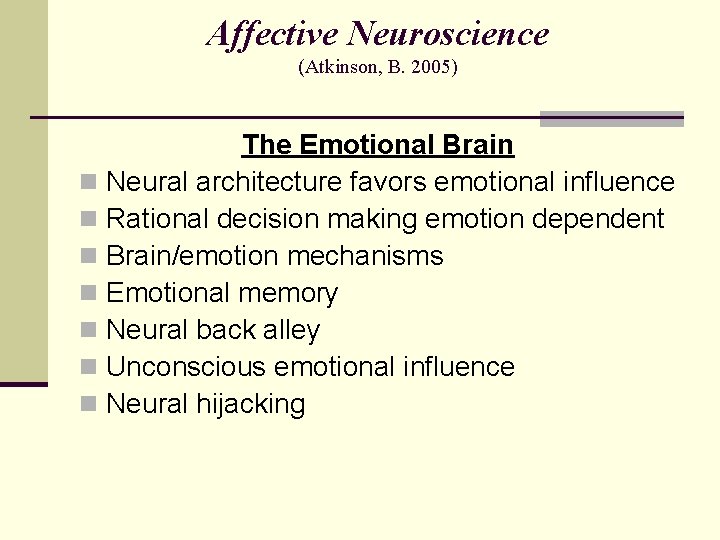
Affective Neuroscience (Atkinson, B. 2005) The Emotional Brain n Neural architecture favors emotional influence n Rational decision making emotion dependent n Brain/emotion mechanisms n Emotional memory n Neural back alley n Unconscious emotional influence n Neural hijacking
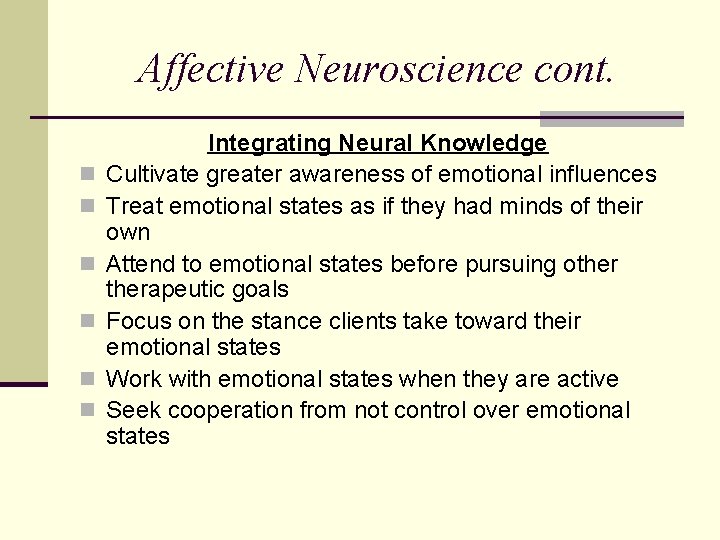
Affective Neuroscience cont. n n n Integrating Neural Knowledge Cultivate greater awareness of emotional influences Treat emotional states as if they had minds of their own Attend to emotional states before pursuing otherapeutic goals Focus on the stance clients take toward their emotional states Work with emotional states when they are active Seek cooperation from not control over emotional states
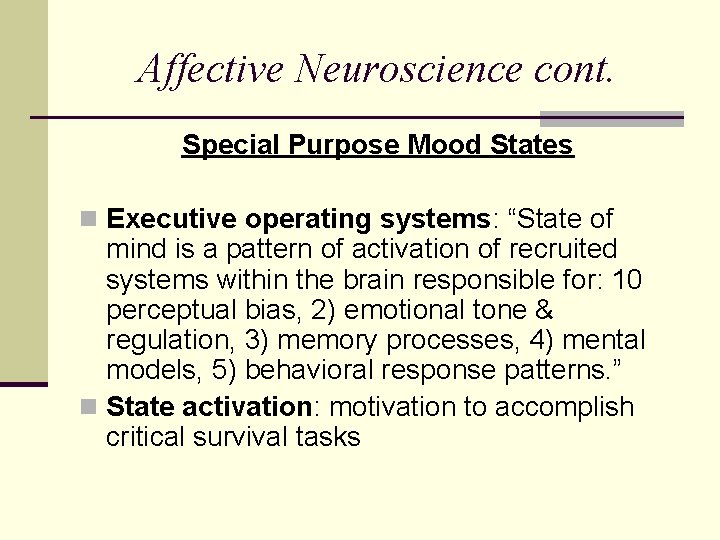
Affective Neuroscience cont. Special Purpose Mood States n Executive operating systems: “State of mind is a pattern of activation of recruited systems within the brain responsible for: 10 perceptual bias, 2) emotional tone & regulation, 3) memory processes, 4) mental models, 5) behavioral response patterns. ” n State activation: motivation to accomplish critical survival tasks
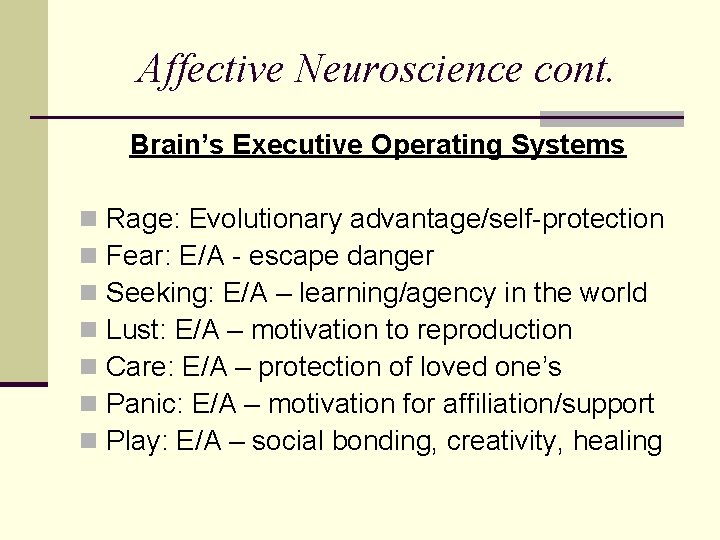
Affective Neuroscience cont. Brain’s Executive Operating Systems n n n n Rage: Evolutionary advantage/self-protection Fear: E/A - escape danger Seeking: E/A – learning/agency in the world Lust: E/A – motivation to reproduction Care: E/A – protection of loved one’s Panic: E/A – motivation for affiliation/support Play: E/A – social bonding, creativity, healing
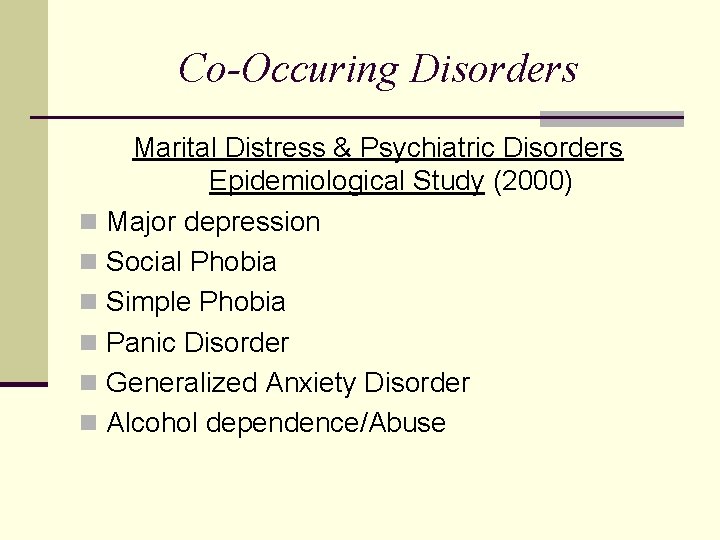
Co-Occuring Disorders Marital Distress & Psychiatric Disorders Epidemiological Study (2000) n Major depression n Social Phobia n Simple Phobia n Panic Disorder n Generalized Anxiety Disorder n Alcohol dependence/Abuse
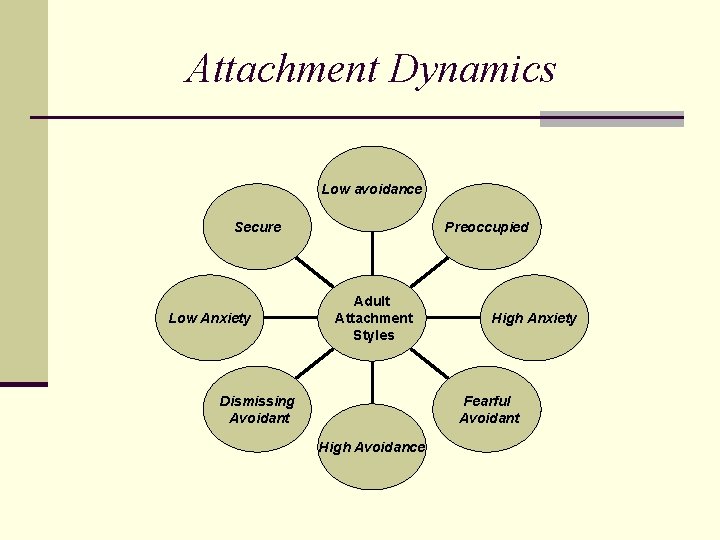
Attachment Dynamics Low avoidance Preoccupied Secure Low Anxiety Adult Attachment Styles Dismissing Avoidant High Anxiety Fearful Avoidant High Avoidance
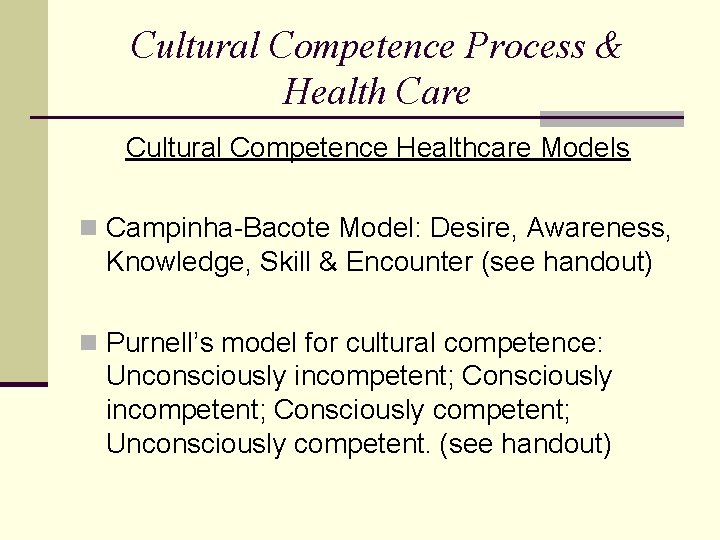
Cultural Competence Process & Health Care Cultural Competence Healthcare Models n Campinha-Bacote Model: Desire, Awareness, Knowledge, Skill & Encounter (see handout) n Purnell’s model for cultural competence: Unconsciously incompetent; Consciously competent; Unconsciously competent. (see handout)
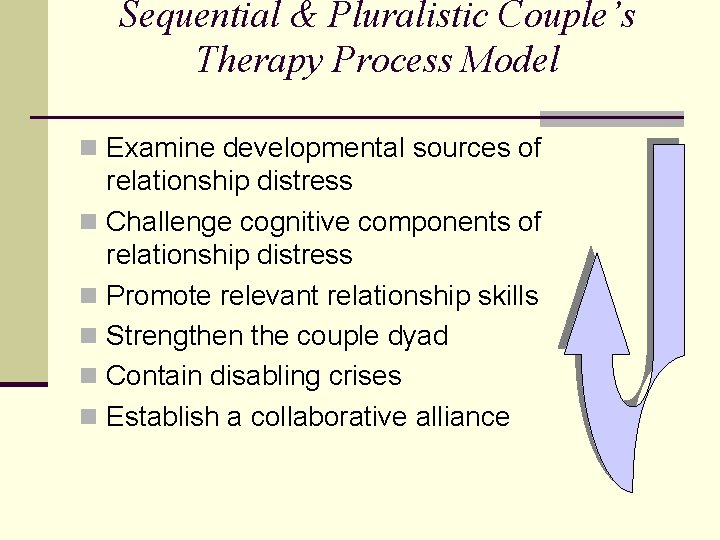
Sequential & Pluralistic Couple’s Therapy Process Model n Examine developmental sources of relationship distress n Challenge cognitive components of relationship distress n Promote relevant relationship skills n Strengthen the couple dyad n Contain disabling crises n Establish a collaborative alliance
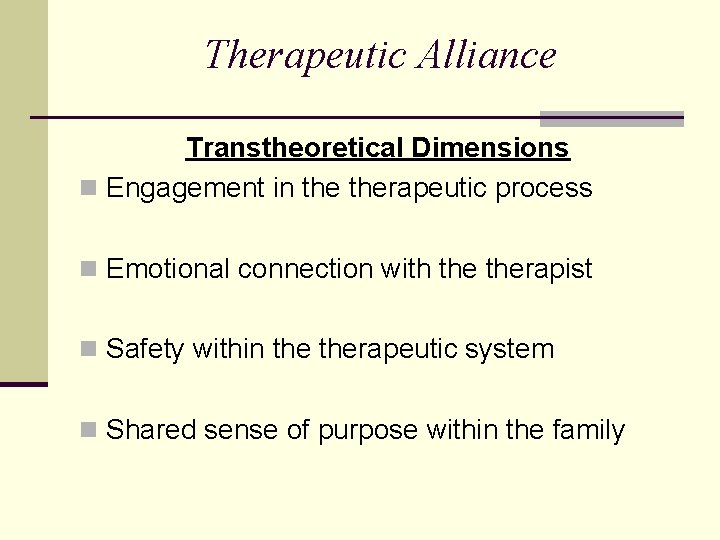
Therapeutic Alliance Transtheoretical Dimensions n Engagement in therapeutic process n Emotional connection with therapist n Safety within therapeutic system n Shared sense of purpose within the family
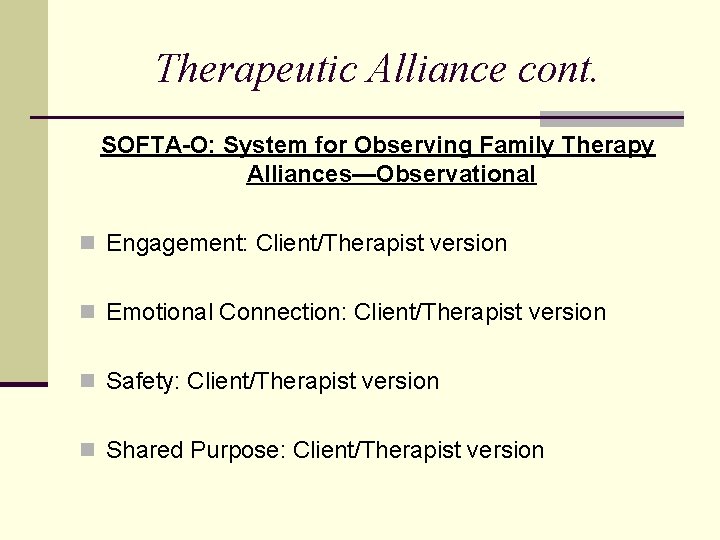
Therapeutic Alliance cont. SOFTA-O: System for Observing Family Therapy Alliances—Observational n Engagement: Client/Therapist version n Emotional Connection: Client/Therapist version n Safety: Client/Therapist version n Shared Purpose: Client/Therapist version
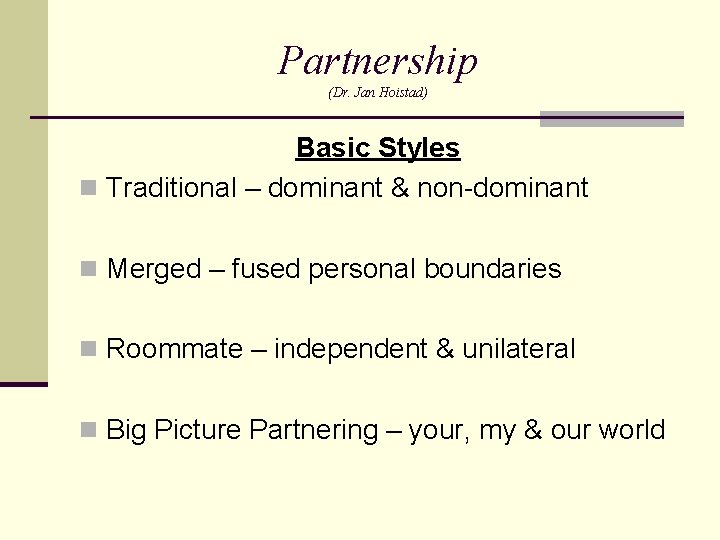
Partnership (Dr. Jan Hoistad) Basic Styles n Traditional – dominant & non-dominant n Merged – fused personal boundaries n Roommate – independent & unilateral n Big Picture Partnering – your, my & our world
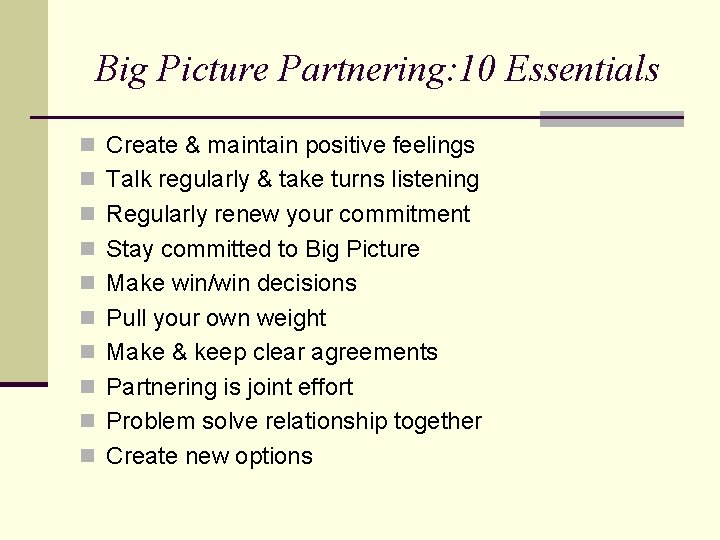
Big Picture Partnering: 10 Essentials n Create & maintain positive feelings n Talk regularly & take turns listening n Regularly renew your commitment n Stay committed to Big Picture n Make win/win decisions n Pull your own weight n Make & keep clear agreements n Partnering is joint effort n Problem solve relationship together n Create new options
The Four Horseman of the Apocalypse n Criticism n Defensiveness n Contempt n Stonewalling
Relational Success Managing Conflict n Prerequisite: 1 Soft Start-up n Prerequisite: 2 Accepting Influence n Prerequisite: 3 Effective Repair n Prerequisite: 4 Respecting Partner’s Dreams Connecting During Non-Conflict Times n Prerequisite: 5 Five Positives – 1 Negative
Relational Success: Predictive Habits Soft Start-Up n Avoiding a Judgmental Attitude n Standing Up for Yourself Without Putting Your Partner Down Accepting Influence n Finding the Understandable Part n Giving Equal Regard
Relational Success: Predictive Habits Effective Repair n Offering Assurances Respecting Your Partner’s Dreams & Holding on to Your Own n Understanding & Explaining What is at Stake
Relational Success: Predictive Habits 5 Positives for Every Negative n Curiosity about Your Partner’s World n Keeping Sight of the Positive n Pursuing Shared Meaning n Making and Responding to Bids for Connnection
Common Issues n Workaholic – Where do we fit? n The Affair – Can I/we get over it? n Crises – Yes! Problem solving but intimacy? n Stonewalling – Why don’t we talk anymore? n Dream loss – What about my/our dreams? n Depressed – Why so distant & irritable? n Frustrated – So, I’m a nag? n Dead-in-the water – Where’s the fun? n Children-focused – What about Us? n Dramatic – Is it really that complicated?
Conversation Practice n Living Your Dreams Together: Conversation Cards for Couples by Dr. Jan Hoistad n The Art of Conversation & The Ouchkit: Couples Therapy in a Box by Betsy Sansby MS LMFT n Interpersonal Effectiveness Skills: DEARMAN GIVE & FAST by Dr. Marsha Linehan n The Peaceful Heart: A practical guide to unconditional love and forgiveness by Mary Hayes-Grieco
Ethics & Law Universal Ethics Beneficence Non-malefalence Preserving Independence Fidelity or True to Purpose Justice Legal n Informed consent n Confidentiality n n n
Summary & Application n Biopsychosocial model & Addiction dynamics in early recovery n Strategic role of the clinician as guiding interpersonal problem solving n Basic paper & pencil or related activities for identifying, stimulating & potentially resolving interpersonal issues n Review of handouts & bibliography n Applied exercise(s)